Archive | Rocks and (no) Roads RSS for this section

Eidersperrwerk: Keeping Out the North Sea

My last post explored the mud flats bordering the North Sea in northern Germany, where we found conflicting methods applied to control and protect the levee system. This post investigates more aggressive measures implemented at the mouth of the Eider River. We will briefly look at the Eidersperrwerk, a gate system designed to control both storm surge incursion up the Eider, and river outflow
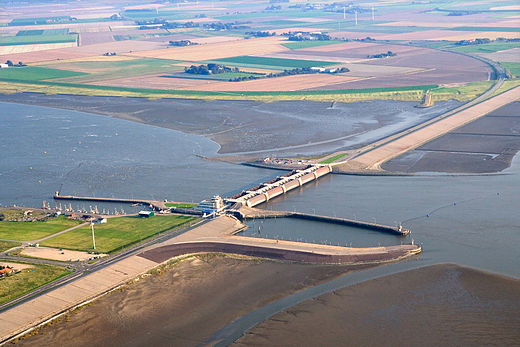
Figure 1. Aerial view of the Eidersperrwerk gate system, looking southward. The North Sea is to the right. We will examine the mud flats to the right of the roadway in this post. Note that more than half of the original mouth of the Eider River has been blocked by the levee.(Image from Wikipedia.)

We will focus on the seaward mud flats in this post. Let’s take a look at the south side of the river first (upper-right of Fig. 1).
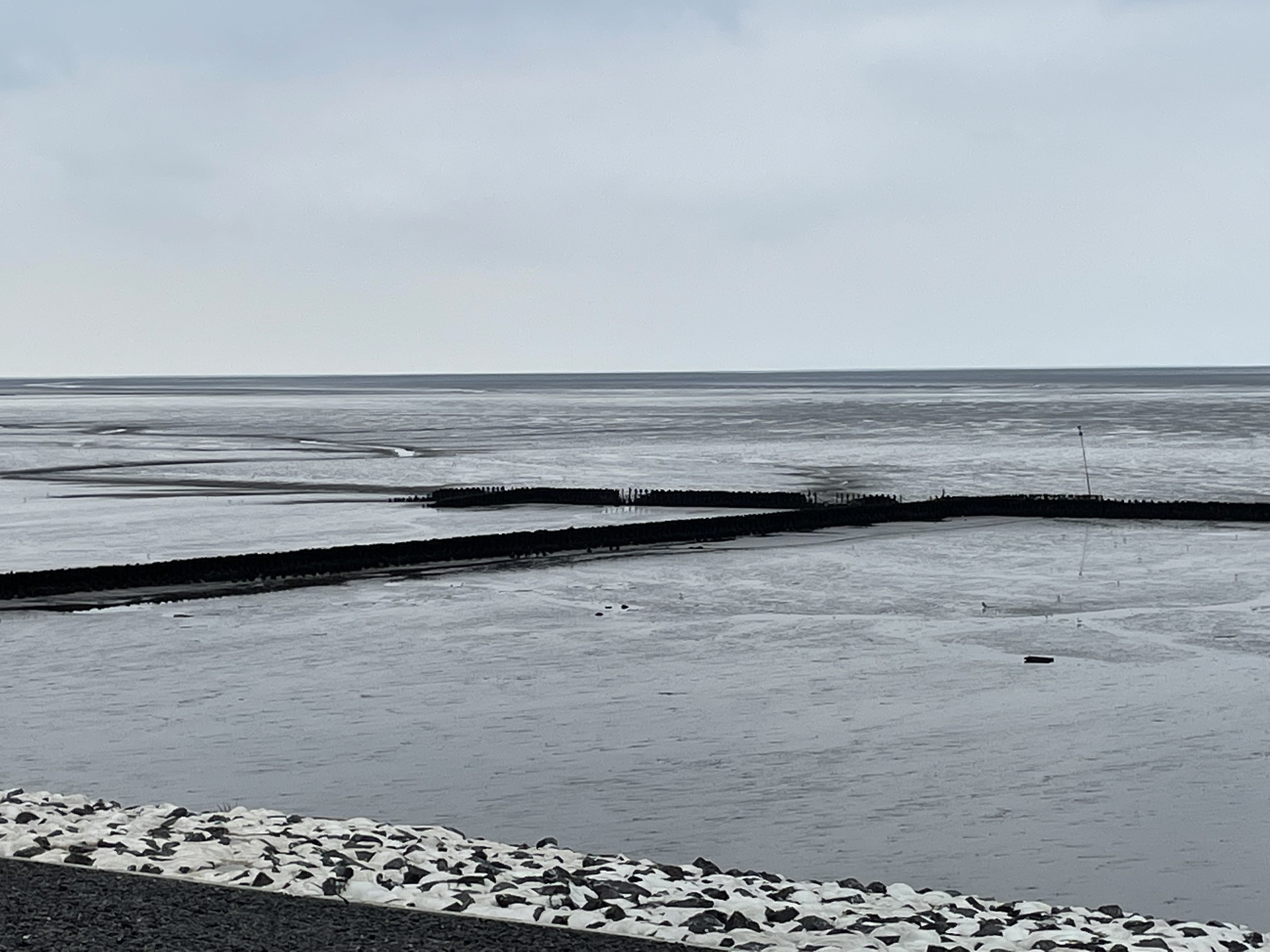
Figure 2. Sediment retention fences on south side of Eider River. Note the erosion at the base of the fence running across the image from left to right (perpendicular to shore). They are intended to trap sediment, but that doesn’t appear to be happening.
Figure 3. Detail of gate on river side. The gates were closed when we visited at low tide, possibly to keep water depths navigable in the estuary.
Figure 4. Lock approach from seaward. This small enclosure was constructed with steel plates, but the lock gates were closed except to allow the passage of a tour boat, during our study.
Figure 5. Looking north along the seaward side of levee (lower part of Fig. 1). Note the grass that has filled in where only mud was present before (presumably, Fig. 1 is an older image).
Figure 6. Close-up near the junction of levee and lock enclosure (see Fig. 1 for location), showing clumps of grass (center of image) surrounded by pieces of stone used to armor the levee. This looks like recent erosion to me, because the grass grass was probably contiguous with the thick growth near the levee toe.
Figure 7. View looking north in the natural embayment (see Fig. 1 for location). Note the drier sediment near the top of the image. This is a berm that is semipermanent, formed of silt and minor sand by tidal and wave action. It is cut by multiple rivulets, formed as the tidewater drains from the nearshore area (to the right). The scattered boulders are evidence of intense erosion during storms.
Figure 8. View seaward from tip of lock embayment, showing eroded riprap, vegetation clinging to the toe of levee, runnel at low tide (strip of water running north-south in Fig. 1), and berm from Fig. 7 turning seaward.

Comparing Fig. 1 to Figs. 2 and 5-8, we can see the effects of years (probably decades), during which interval the northern margin of the river mouth filled with sediment and grass was established (Fig. 5). Subsequently, it seems that erosion removed some of this soil and grass (Fig. 6). Meanwhile, storms have been slowly wearing away the boulders armoring the base of the levee (Fig. 8) and a semipermanent fair-weather berm was constructed (compare Figs. 1 and 7).

In summary, something appears to have changed in the dynamic environment around the mouth of the Eider. It should come as no surprise that constructing a gate system and cutting off a major sediment supply for at least half the time had dramatic effects on the nearshore. Mud flats are very sensitive to sediment supply, and it could have been either reduced alongshore transport from the north, or the almost-complete denial of rive-borne mud that led to the current situation.

Some scientists propose that storminess varies on many scales, from decadal to millennial as climate fluctuates…

Coastal Restoration on the North Sea

Figure 1. Sign introducing the coastal area and the restoration project. The mud flat here is a mile wide (estimated) because of about 20 feet of tidal range, twice a day.

Today’s post takes me to the North Sea coast of Germany, the city of Husum, and to one of the famous mud flats from the region. Rivers running from the Alps drain Germany, transporting mud (silt and clay) to the north coast, where it is transported along the coast and stirred around by strong tidal flows. We are going to look at efforts to stop dramatic erosion caused by a reduction of sediment input, because of dams and coastal construction, leading to a serious threat to the levee protecting Husum from the North Sea (Fig. 2).

Figure 2. Photo of levee that protects the city of Husum from the North Sea. (Right side of inset map of Fig. 1) The building to the right is an abandoned hotel inside the levee. The building to the left is a restaurant on pilings where people swim during high tide. The asphalt road is the path to the seashore.

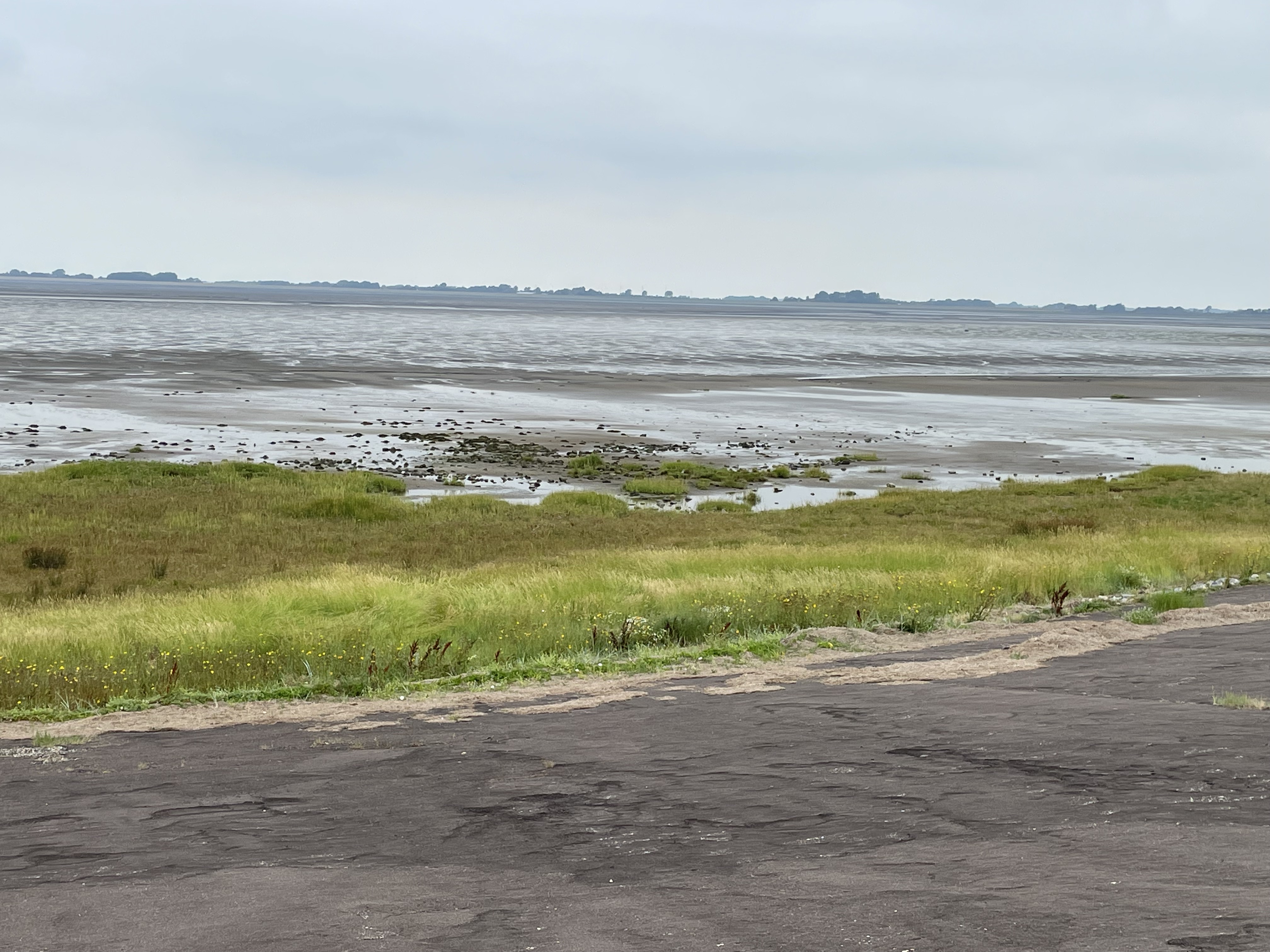
The mud flats schematically shown in Fig. 1 are covered with fence-like structures designed to catch mud brought in the the high tide (Fig. 3).

Figure 3. Image of nearshore area (covered by grass), sediment retention fences, and reinforcing riprap where erosion occurs. Note that in this image, the fences do not appear to be collecting sediment on the landward side (to the right).

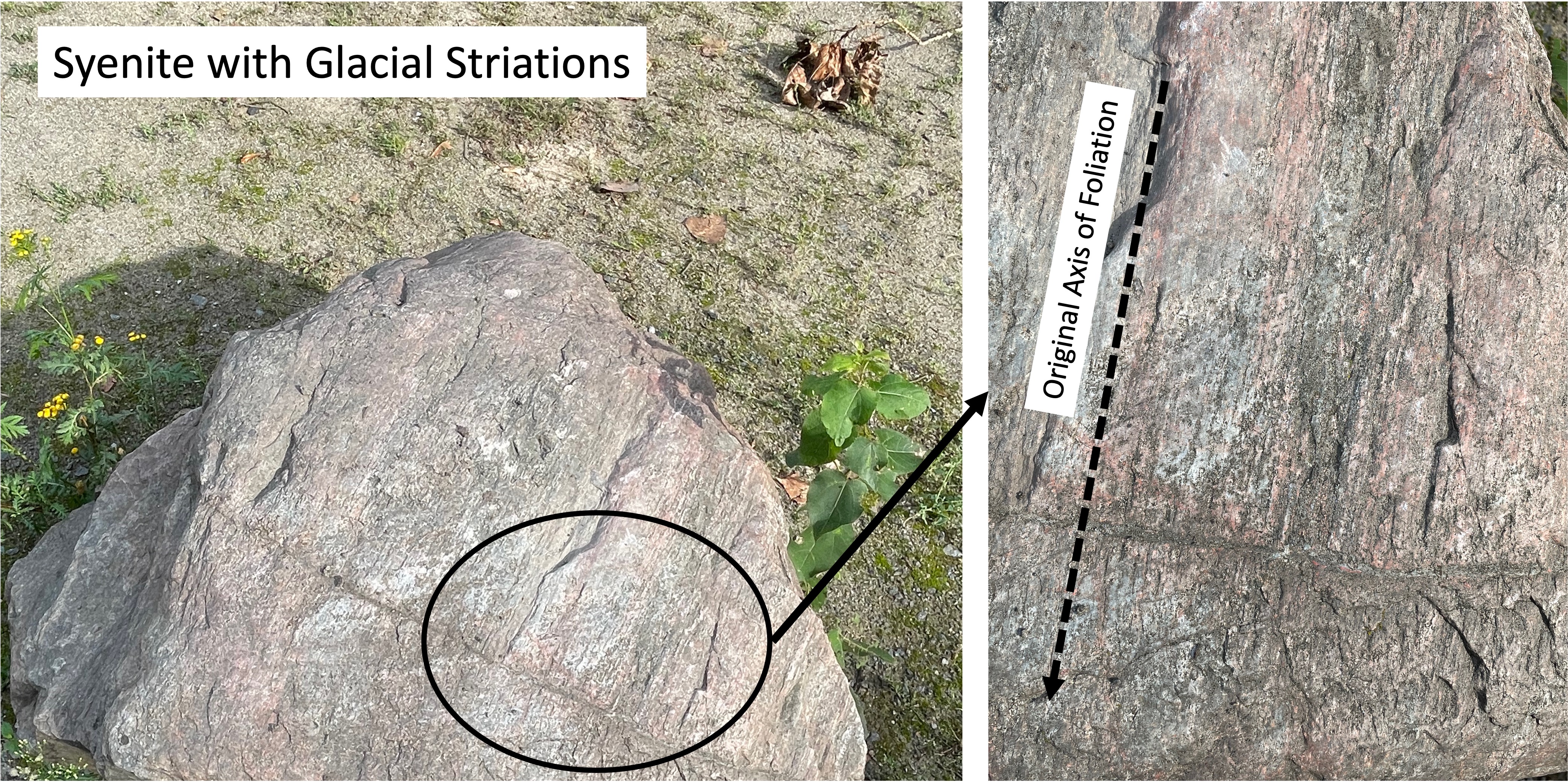
A quick look at the past. This area was covered by glaciers that filled the North Sea and transported rocks from Sweden to the north. These glacial erratics are rounded and scattered around the land in a random manner (thus the name). We found one used as street decoration in Husum (Fig. 4).

Figure 4. Close up of glacial erratic left along the coast. The boulder was about 3 feet in diameter. This close-up shows muscovite (shiny minerals), orthoclase feldspar (pink), amphibole and/or biotite (dark), and quartz (gray). This granitic rock was transported as much as hundreds of miles by ice, from Scandinavia.

In addition to boulders transported during the ice ages (less than a million years old), there are remnants of sandy sediment from the Quaternary, before the area was overwhelmed by mud (Fig. 5).

Figure 5. Image to the north in Fig.1, showing trees and a village on top of a low pile of quaternary sand, probably the erosional debris of a stream or coastal beach from the last ten-thousand years. This photo was taken to the east side of Fig. 1. Note the sporadic filling by grass, especially the sheep. This is interesting because sheep eat grass, so why they are loose in an area supposedly being reclaimed is confusing.

The result of the sediment retention project can be seen in Fig. 6.

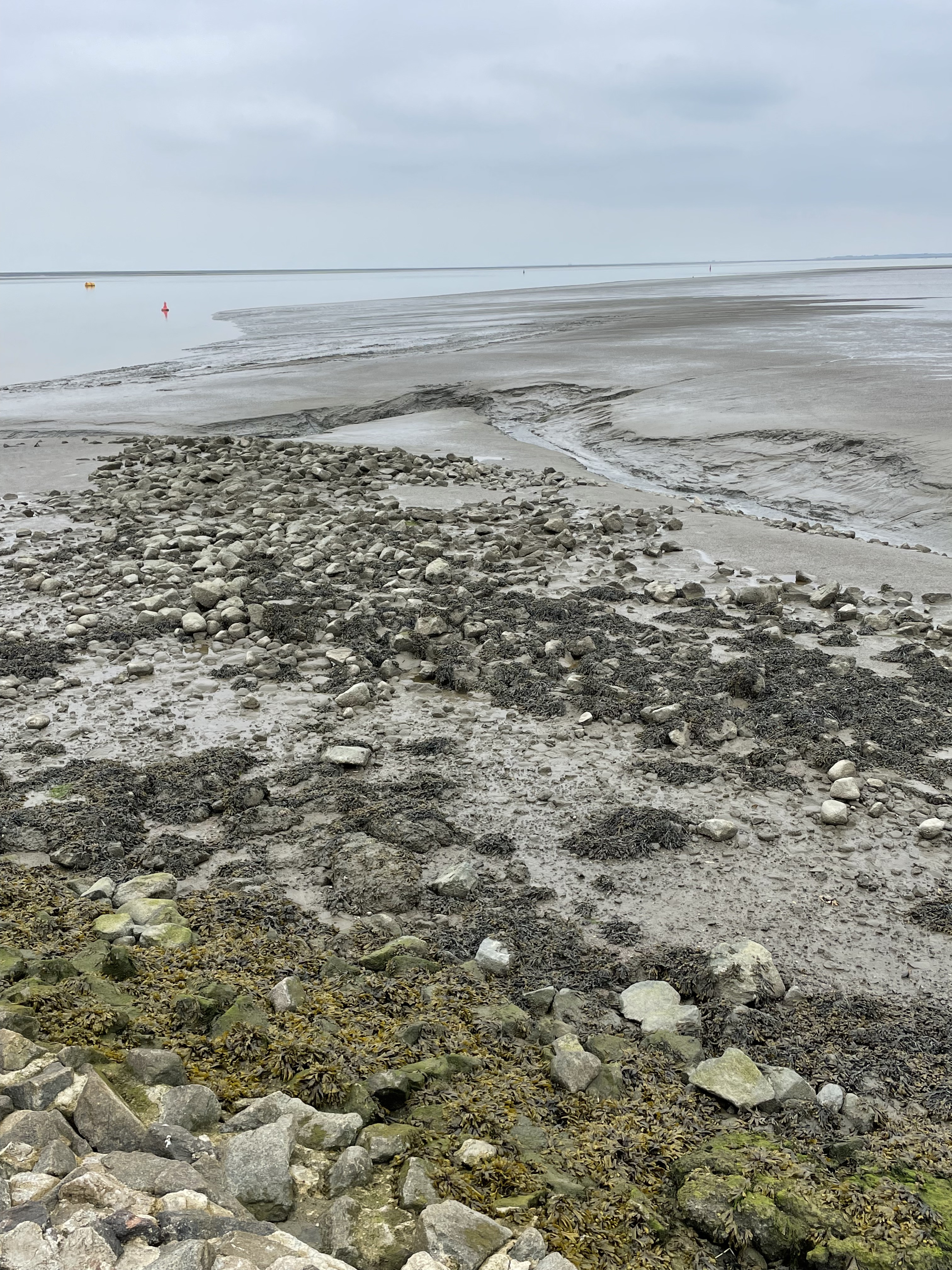
Figure 6. The landward limit of the fencing project, less than 100 yards from the levee. Note erosion along the fence, leaving it standing 2 feet above the exposed mud. This could have been the result of long-term erosion, or a single storm.

This are represents an attempt to reconcile the problem of coastal development (the port of Husum ships out grain) and the protection from storm waves provided by a wide mud flat (which dissipates wave energy). Another issue is the encroachment of sheep grazing, which appears to be legal (there are fences and gates, etc). And then there is entertainment; this is a popular swimming location during high tide. Not to mention environmental degradation and fish hatcheries. Several attempts at mixing these applications can be seen in the hardened and dredged channel leading to the port (Fig.7), and buried groins which were apparently intended to keep the shipping channel open (Fig. 8).

Figure 7. Shipping channel to the port of Husum hardened by mortared rock.
Figure 8. Groin in mud flat. These coastal engineering structures are designed to prevent sediment being carried along the coast and blocking channels, as well as retaining sediment between adjacent groins. This is probably contributing to the erosion seen in Fig. 6.

It is difficult to reconcile the many uses the coastline is required to fulfill. This trip revealed that it is unreasonable to mix methods designed to preserve the status quo (Figs. 7 and 8), and those intended to change it (eg. Fig. 6), especially when these techniques are mixed (Fig. 3). A difficult decision will have to be made soon, or the levee protecting the bustling cit of Husum will be in danger of breach during a severe storm, which is becoming more common in the North Sea.

The Last Few Miles

Figure 1. View looking uphill, along a small ravine in Rock Creek Park. This is a small tributary that shows what this post is about: the stream bed is interrupted by layers of rock every few yards.

This is going to be a brief post, mostly because it is very difficult to convey what I want to communicate in photographs; the camera lens (on my iPhone) simply doesn’t capture image depth well. For example, Fig. 1 was actually pretty steep, but it looks as unintimidating as my driveway.

Figure 2. Topographic map of Rock Creek Park. Note the steep gullies leading to Rock Creek from the west (indicated by dark shading). Figure 1 was taken in the deeply incised terrain east of the Nature Center (top-left of image).

I’ve been talking about the bedrock exposed along the bed of the Potomac in several posts (e.g., Geological Bottleneck and Great Falls), but those are specific locations. Those significant drops in river elevation are part of a larger pattern, one that is displayed even at the scale of Fig. 1. It doesn’t take much of a drop to generate enough potential energy to spin a waterwheel (Fig. 3), which can do a wide variety of work–from grinding corn, to operating a machine shop.

Figure 3. Waterwheel at Peirce Mill used to grind grains like wheat and corn into meal, constructed in the early 1800s, at the lower part of Rock Creek Park (bottom-center of Fig. 2). The stream’s flow was subdivided by channels like that seen in the left of the image to supply water to several mills in the area.

The staircase structure of streams along the transition from crystalline rocks to coastal plains (aka the Fall Line) is so important to the ecosystem that artificial barriers were constructed within the park to ameliorate the impacts of road and bridge construction (Fig. 4).

Figure 4. View looking downstream from a bridge near the top of the map in Fig. 2, showing blocks arranged to replicate the natural steps as seen in Fig. 1. This construction was completed to reintroduce the herring migration. They spawn in the upper reaches of Rock Creek.

Rock Creek National Park deserves its name, not just because of its rock bed. Cambrian sedimentary rocks exposure along the steep tributaries leading to the creek (river?) suggest that bedrock lies not very far beneath our feet (Fig. 5).

Figure 5. Large exposure of Cambrian sedimentary rock formation (image height is about 20 feet), consisting of interlayered sand, siltstone, and shale. Where sand is the predominant component, blocky outcrops like this occur. Siltstone and shale produce more fissile outcrops.

Water has been struggling with rocks for the last 200 million years, always trying to reach the sea. It exploits every nook and cranny in the bedrock until it forms a stream, then a river, and it cannot be stopped. Thanks to the perseverance of water, driven by the steady pull of gravity, the first European immigrants to North America were able to establish a toe hold on what was (to them) a new land…

Recap…

This is a quick post to summarize what I said about modern Japan being an analogue to the Taconic orogeny. For example, here’s a photo of Mt. Fuji, seen from the ocean (Fig. 1). (Imagine being in the back-arc basin during the Cambrian period.)

Figure 1. Mt. Fuji from the sea.

The Sea of Japan is more than 500 miles across at its widest point, so sediment eroding from the mountain chain that forms the backbone of Honshu is collecting along the western coast of Honshu as well as in deeper water offshore.

Here’s a schematic cross-section of the most-likely geography during the Taconic orogeny (Fig. 2). Imagine Honshu as the island arc shown offshore of the ancient North American continent (to the left in the cartoons).

Figure 2. Schematic cross-sections of North America and a hypothesized island chain during the Taconic orogeny.

Modern Honshu and the Sea of Japan are most representative of the Taconic orogeny earlier than 543 my, before subduction began on the western margin in the top panel. There is no subduction in the Sea of Japan today; in fact, spreading stopped about 20 million-years ago; details are hard to find because there are no easily accessible seismic sections of the Sea of Japan. Thus, to apply the cartoon from Fig. 2, ignore the subducting back-arc ocean crust (black layers) and focus on the deformed gray areas in the middle panel.

The lower panel is probably what will happen to Honshu in the distant future. For example, the Pacific plate is being subducted at ~10 cm/year (4 inches). We can use an average width of 1000 km (625 miles) to estimate that it will take 10 million years [1000 km/(10 cm/y)] for the lower panel of Fig. 2 to become reality.

With respect to the scale of the analogous processes occurring in the Japanese Islands and N. America (during the Taconic orogeny), we can do a simple comparison (Fig. 3).

Figure 3. The left panel shows the extent of rocks associated with the Grenville orogeny, associated with closing of a precursor to the Atlantic Ocean (Iapetus Ocean). The right panel shows the island of Honshu. The arrows show a hypothesized, similar-sized island arc (outlined in black) during the early stages of the Taconic orogeny, when sediments eroded from the earlier (Grenville) mountain belt (orange) were buried deeply beneath the back-arc basin between the Grenville Belt and the offshore island. They would have been subjected to intense heat and pressure. Note the immense scale of this geologic province, based on the similar size of Honshu and the island arc that became the rocks we’ve seen throughout eastern N. America.

This has been a very simple, hypothetical reconstruction, but I hope it helps you envision what the proto-north American continent was experiencing. The key point is that a massive mountain-building event, something like the Taconic-AcadianAlleghanian orogenies, which lasted throughout the Paleozoic era, wouldn’t have been an earth-shattering event…

Deja Vu

As we entered the Taconic Mountains on US 4 in Vermont, something didn’t look right, or it looked too familiar to be correct. It took a while to realized what was wrong with Fig. 1.

Figure 1. Road cut along US highway 4, near Rutland, Vermont. This is Precambrian (1000 to 500 Ma) schist with strong foliation dipping to the west.

These are the mountains for which the Taconic Orogeny (550-440 Ma) was named. They were deposited as long ago as a billion years in a shallow sea (e.g. Sea of Japan) and then buried, before being compressed and heated, finally being pushed onto the porto-north America continent by 440 Ma. During this long period of metamorphism, the clay minerals comprising the bulk of the sediments recrystallized into mica (mostly muscovite), a platy mineral that creates both a sheen and a fissile texture, the tendency to flake apart (Fig. 2).

Figure 2. Close-up of Fig. 1, showing the glistening caused by alignment of platy muscovite in the sun (upper center), and fissile texture caused by the same alignment and weathering as water works its way between mineral grains. Image width is about 6 feet.
Figure 3. Close-up of the foliation surface of the rocks seen in Figs. 1 and 2. Note the linear ripple-like texture, which may be remnant from the original sediment (note the surfaces seen in the last post), or a coincidence. The brightness is caused by aligned muscovite crystals. (Image is 2 feet across.)

The Taconic Mountains are the remnants of a mass of metamorphic rock that was pushed over younger, less-altered rocks in this region. This occurs along low-angle thrust faults when the rocks are buried less deeply, so that they break rather than fold like putty. Speaking of ductile deformation, we saw plenty of evidence of that in the White River‘s exposed bed (Figs. 4-6).

Figure 4. Photo of White River near the village of South Royalton, VT, showing exposures of Precambrian schist and gravel bars. The following photos were taken on this outcrop.
Figure 5. Detail of orthoclase (pinkish area) and albite (whitish) feldspar minerals squeezed out of the original muddy sediment during metamorphism. These minerals may have originally been present as lenses of sandy sediments or be the product of remineralization, which includes a component of concentrating incompatible elements. Very little quartz was present.
Figure 6. Image of nearly vertical foliation (i.e. layering) of schist in White River bed. This broad area of irregular feldspar and quartz may have been a large sand lens (e.g. a flood deposit) in the original sediments.

This post is titled “Deja Vu” because we saw schist with a similar composition and orientation in the Potomac River, more than 500 miles to the south, in a band tens of miles across, centered on Great Falls, Virginia. Such a broad distribution tells us that a vast mountain belt eroded about one billion years ago, and then its erosional remains were buried so deep that they nearly melted. The subsequent collision was no laughing matter. I have been using Japan as an analogue for the Taconic Orogeny for two reasons: (1) Honshu, the largest Japanese Island is about 800 miles long and it is depositing vast quantities of mud into the Sea of Japan; (2) using a modern analogue demonstrates that mountain building is a slow process, barely noticed by the inhabitants of island arcs destined to be smashed onto the continents facing them.

Rocks like those seen in this post are already buried beneath the Japan Sea and deformation has no-doubt begun. We just have to wait 400 million years for them to come out of the oven…

The Outer Limits

This is the first of several posts, reporting the roadside geology of western New York and central Vermont. Today, we will visit Binghamton, New York. This small city (urban population less than 50 thousand) sits at the confluence of two perennial, gravel-bedded rivers (Fig. 1).

Figure 1. View from Confluence Park in Binghamton, NY, showing the Susquehanna River (left side) and Chenango River (right). Note the weir on the Susquehanna, which maintained sufficient depth for a lock (Fig. 2), which permitted access further upriver.
Figure 2. Photo of submerged lock that operated in the 1800s along the Susquehanna River. Similar structures are present along the Potomac in VA and MD. The outline seen in this image may be only the foundation. The stonework was probably removed to create a clear channel for the modern bridge (Fig. 3).
Figure 3. Photo from the confluence of the Susquehanna and Chenango rivers, showing the bridge that has replaced the lock structure shown in Fig. 2. Note the gravel bar to the center right of the image, where a small tributary has been channelized but still is depositing large gravel and small boulders in the Susquehanna channel.

Enough of Holocene and Anthropocene geology. The fascinating thing about this region is that it preserves a huge volume of sediment eroded from mountains that were growing during the Devonian Period, about 350 million-years ago (Fig. 4).

Figure 4. Geologic map from Rock D, with Binghamton near the center. Note the tan-shaded area that expands from Albany westward. These rocks were originally sediments, deposited from a high mountain range located somewhere east of Albany, carried by ancient rivers as far as 500 miles to the west . (The scale is in the lower left of the image: 100 km is about 63 miles.) This humongous basin, collecting boulders, sand, silt, and mud about 350 my ago, was preserved because it was a precursor of what was to come 100 million years later, when Africa and N. America collided, burying these rocks deep enough to save them from erosion, but not deep enough for them to lose their sedimentary character. This perfectly preserved basin–frozen in time as if in a museum–is called the Catskill Delta.

We didn’t have the time or resources to go on a quest for rocks that would reveal what was happening during the Devonian Period, so we took some photos of charismatic blocks that had been removed from their original location and “deposited” along the path that followed the Chenango River through downtown Binghamton (Figs. 5 and 6).

Figure 5. Photo of slab of mudstone (not in original orientation), showing irregular ripples accentuated by silt against a matrix of mud. This is a very common environment in river flood plains during high-flow events, when gentle currents separate silt from mud. Flow during these intervals is insufficient to form unidirectional ripples, and the result is seen in this image. The sample is about two feet across.
Figure 6. Photo of silt surface in shallow water from unreferenced rocks from the Catskill Delta. Note that this bedding plane has a more criss-crossing pattern of “ripples” and contained more silt (light-colored). This sediment was probably deposited in a similar environment to Fig. 5. Both were quickly buried during a flood that occurred not long after these fragile sedimentary structures were created. If you were to step on these sediments in a modern stream, they would be what we term “mud” and avoided if possible.

The title of this post refers to the outer limits of a broad plain that was receiving gravel, sand, silt, and mud from a rapidly rising mountain belt–probably like western North America today (e.g. the Sierra Nevada mountains). It wasn’t a continental collision, but it was pretty massive, with elongate swaths of sediment subsequently buried by what came later.

I’m talking about a Clash of the Titans...

Difficult Run: Exploring Potomac Tributaries

Figure 1. View downstream in Difficult Run, towards the Potomac River. (See Fig. 2 for location.)

This week we went exploring south of Great Falls, along a tributary that cuts through Precambrian metamorphic rocks, before joining the Potomac River.

Figure 2. Topographic relief map of the Potomac River area southeast of Great Falls (circle at upper left). The irregular black line traces out path along several trails within the Difficult Run trail system. The photos were taken at the numbered points.

Difficult Run twists its way through a mass of hard rocks that we have met before, Precambrian Schist and gneiss, forming a series of quiet pools (Fig. 3) separated by resistant, rocky sections (Fig. 4).

Figure 3. Images taken at Site 1 (see Fig. 2 for location). (A) Gravel point bar deposited. (B) Flood plain about 10 feet above low-water level, incised with secondary channels, forming an anastomosing stream at high water. The floodplain sediment comprises mostly silt and mud, with minor sand, primarily in point bars. (C) Quiet pool formed between rocky sections.

It was a shady walk beneath a tall canopy of mature hickory, ash, and other temperate forest trees. There was plenty of evidence of the recent spring floods. Large trees were jammed up on rocky outcrops and among the trees covering the floodplain. After a short hike, we came to what looked like an abandoned quarry (Fig. 4), which can be identified by the bright spot in the relief map of Fig. 2, just above the label for Site “2”.

Figure 4. Photos of quarry located at Site 2 (see Fig. 2 for location. (A) The rear wall of the cutout was hidden between trees and vines, but the top of the ridge was irregular (blue line in Panel A). The white circle highlights some of the weathered rock from the area. Access was not possible. (B) Exposure in the east wall of the quarry, showing unconformity of contact between the reddish rock on the right, and the gray rock on the left of the yellow highlighter. Incongruous gray sediment is circled in white. Note the reddish sediment to the right of the hypothesized contact. This could be a fault or simply a change in lithology but apparent foliation across the contact was not uniform. The image is approximately 12 feet high.

I was able to examine several slabs of the rock exposed in the quarry and along the river bed (see Fig. 1 for appearance) at Site 2, revealing foliation and inclusions similar to other exposures of this rock (Fig. 5).

Figure 5. Close-up images of typical exposures of rocks along Difficult Run. (A) Loose boulders near their origin in the cliff. Note the juxtaposition of nearly original bedding (central part of lower rock), folded beds (upper part), and completely destroyed bedding accompanied by recrystallization. The white blebs in the lower part of the photo are feldspar minerals that formed from the original composition of the shales and siltstones before metamorphism. The boulder is approximately 2 feet across. (B) Close-up (4x magnification) of quartz squeezed out from a quartz-poor shale during metamorphism. (Image size is 2 inches). (C) Angular inclusions of feldspar (light-colored minerals) in a fine-grained matrix of Fe-rich minerals that weather to form a rust-colored surface. This area is analogous to the disrupted bedding in Plate A. The image is about 12 inches high.

We’ve seen the structures displayed in Fig. 5 before, in this same rock, at Great Falls and other locations along the Potomac River. I’m presenting these examples to give the reader some idea of the scale of these processes. For example, the juxtaposition of foliation in Fig. 5A suggests a frenzy of activity, like in a pan of boiling water; that analogy is reasonable if we adjust the viscosity, temperature, pressure, and time scale from water on the stove to rocks buried deep beneath the surface, but heated from below–just like the pan of water. I’m speculating here but, just to get an idea of what I’m talking about, the crazy structures in Fig. 5A probably took on the order of ten-million years to form.

It might help to see the problem from a more god-like perspective.

Figure 6. This is a hypothesized cross-section across Loudon County from west to east. It is based on thousands of geologic measurements. Note the pink/gray area with brown lenses pointing upward to the left. This represents the Neoproterozoic metamorphic rocks we’ve encountered all along the Potomac River. There are several points to note from this drawing: (1) the dominant foliation (brown lenses) is dipping to the east; (2) the contact with surrounding, older rock is folded (squiggly lines to the left); (3) it forms a massive bedrock structure that cuts the Potomac River almost at a right angle. (The Potomac would run approximately along the cross-section.) (4) It is filled with igneous intrusions from multiple orogenies, represented by the lenticular blebs and orange, white, and gray dikes trending up and to the left in the image (on the left side). All of that igneous activity supplied quartz and feldspar to fill voids. (The cross-section is approximately 25 miles across.)

As you might expect, the exposure of such a deformed and mineralogically diverse set of lithologies along the Potomac’s course produces features like Great Falls, as well as what we’re examining today.

Figure 7. Example, from Site 3, of a resistant ledge of metamorphic rock forming a cataract backed by a pool as in Fig. 3. The orientation of the ledge is approximately 30 degrees east, the same as the strike of the rocks we have examined throughout Virginia (so far). This is the regional structural pattern, which I discussed in previous posts.

There is more to these rocks than metamorphic structures, including folding, foliation, and inclusions. All of those were formed between 1000 and 500 million-years ago. After deep burial (maybe 15 miles) beneath an enormous mountain range, these rocks hardened and were exhumed by erosion of the overlying rocks. They were brittle and, as isostatic pressure relaxed, they cracked just like a cooling pumpkin pie, forming joints.

Figure 8. Analysis of joint sets from Site 3. The images have been rotated to approximately align with north and east. (A) Note the thin, white lines of (probably) feldspar filling joints, which are represented schematically by black lines labeled “X” and “Y” (east and north joints). I have no way of knowing what angle at which the joints intersected the surface of the outcrop, so this is speculative. (B) The same convention is used for labeling the joints, again seen as thin, intersecting white lines in the outcrop. Axes have been labeled “X'” and “Y'” for this photo (B). The northward joint is in good agreement between Plates (A) and (B), but there is a significant difference in the east joint. It was difficult to tell in the field, but my overall sense was that these two outcrops (separated by less than 100 feet), were oriented differently. I indicated my uncertainty with a question mark.

Confused by what I had seen so far (i.e. Figs. 4, 5, and 8), I followed the trail to the confluence of Difficult Run and the Potomac river (Fig. 9).

Figure 9. Difficult Run joins the Potomac River at a steep debouchment, with large boulders littering the creek bed at the large, angular bend in the Potomac (Site 4 in Fig. 2), seen in the background.

Looking across Difficult Run to the south at Site 4 (see Fig. 2 for location), I was once again bewildered.

Figure 10. The south bank of Difficult Run at its confluence with the Potomac River at Site 4. Note the exposure of Precambrian rocks along the base of the steep slope, large boulders, and a shallow ledge at the creek’s mouth.
Figure 11. Close-up image from Fig. 10, showing unconformity between the rocks with foliation (below the unconformity), apparently dipping about thirty degrees away from the camera, and overlying reddish-weathering rocks with similar orientation, except for the tan block, just to the right of center in the photo, which have an apparent dip of more than 45 degrees to the left.

It is tempting to assume that the overlying rocks in Fig. 11 are sedimentary, deposited on an erosional surface in the underlying metamorphic rocks (angular unconformity); however, the geologic map (Fig. 12) reveals that these are similar in age and lithology.

Figure 12. Geologic map of the study area (from Rock D iPhone app).The location of Fig. 11 is shown by the black marker. This lithology is described the same as the green unit to the west of Difficult Run. These units were probably given (forgotten) unique names before they were found to be similar. Nevertheless, differentiation is useful considering the unconformity in Fig. 11.

I summarized the geologic history of this area in a previous post, so I’d like to wrap up by demonstrating how pervasive deformation is, in this post. Imagine the deformation seen in Fig. 5A scaled up several orders of magnitude, to the scale of a bluff (Fig. 11). We also saw evidence of rotation of porphyroblasts at another location along the Potomac and again, more than a hundred miles to the south, in Lynchburg. This deformation actually extends to the microscopic scale, but we had neither proper samples nor a microscope to demonstrate it for these rocks.

Think of metamorphosis and ductile deformation as being like a peach pie, the contents trapped between the bottom of the pan (deeper, more resistant rocks) and the pie crust (overburden); the filling is boiling in the oven, overturning, even displacing smaller pieces of fruit. That is what’s happening miles beneath the mountains, on time scales of millions of years rather than minutes.

A Geological Mystery at Bears Den

Figure 1. View of the Shenandoah Valley, looking west from a crest of the Blue Ridge Mountains.

Beautiful landscapes and geological wonders are never far from your door here in Northern Virginia. Today, we took a hike to meet the Appalachian Trail near the border of West Virginia (Fig. 2).

Figure 2. Geologic maps of the study area, located NE of Washington DC (see small inset map), about 30 miles west of Sterling. We climbed about 1000 feet along Route 7 (purple line crossing E to W above the small inset map), crossing a Proterozoic metamorphic terrane represented in shades of purple and gray. The northern part of this zone is a light-colored (leucocratic) granite that has been metamorphosed whereas the southern part comprises a granitic gneiss. These batholithic intrusions are crosscut by a spectrum of metamorphosed granitic rocks known as Charnockite (orange lines). West of this area of Grenville intrusives, we crossed metabasalts of a somewhat younger age (green zone in map), the Catoctin Formation, which we saw in an earlier post. The leftmost inset map extends the large USGS map of Loudon county because the field area was just outside its domain. The oval indicates the area discussed in this report.

To reach the Bears Den rest area on the Appalachian Trail (see oval area in Fig. 2), we had to follow a winding path along one of the many irregular crests that define the Blue Ridge Mountains (Fig. 3).

Figure 3. Trail head for the short hike to Bears Den.

Along the way, we noted that the trail followed the top of a deeply eroded landscape, littered with boulders and weathered rocks (Figs. 4 and 5).

Figure 4. The path from the parking lot along Route 7 to meet the Appalachian Trail (see Fig. 2) was littered with boulders like these.
Figure 5. Large boulder dissected by a weathered joint. This was a local topographic high. This rock had faint lineations oriented nearly vertical that can be seen in the photo. However, as large as it is, this boulder may have rolled from an outcrop.

We finally reached the rocky point from which Fig. 1 was photographed. A large outcrop crosscut with veins greeted us (Figs. 6-8).

Figure 6. Top of the outcrop of (thus far) unidentified rock holding up the Blue Ridge Mountains. Note the white layer visible in the lower-left part of the photo.
Figure 7. Photo of the top of the outcrop in Fig. 6, showing joint sets filled with a light-colored mineral (either quartz or feldspar). The veins are standing out because the host rock has weathered, suggesting that they are quartz, which is very resistant to chemical weathering.
Figure 8. Close-up of thin, intersecting joints, but at a much lower angle than those seen in Fig. 7.

Intersecting joints like those seen in Figs. 7 and 8 occur when rocks that have been deeply buried are exhumed as overlying rocks erode. The upper mantle relaxes and lifts its overburden in a process called isostatic rebound. Rocks thus uplifted are no longer soft but respond like a solid in brittle deformation. What is intriguing about these rocks (whose age we haven’t yet determined) and the joints that permeate them, is the origin of the quartz and feldspar filling the joints.

It’s time to talk about the host rock seen in Figs. 4-8. The west side of the oval outlined in the inset map of Fig. 2 reveals that these are fluvial-to-shoreface sedimentary rocks deposited between 541 and 511 Ma (source: Rock D lists many sources for this interpretation).

Figure 9. Hand sample view of host rock, revealing a sandy texture that has been altered by thermal metamorphism, as indicated by the overall sheen (caused by quartz remineralization). The image is about 6 inches across.
Figure 10. The original sedimentary texture is evident in this photograph, although it has been modified after burial. There is no evidence of permeating ductile deformation (e.g. folding of sedimentary layers).

An intrusive magma filled joints (Figs. 7 and 8) and heated the country rock to the point of remineralization (Fig. 9), yet sedimentary textures are retained (Fig. 10). What’s going on?

Figure 11. Close-up (magnification is ~3x) of quartz vein in country rock, revealing a recrystallization aureole as seen in the gray area transitioning into mixed light and darker areas at the top of the image. This is a classic example of contact metamorphism. The host rock (as seen in Fig. 5 for example) wasn’t being deformed. It was actually fracturing (Figs. 7 and 8), when a new intrusion occurred, one not reflected in the Proterozoic granites found within the area (Fig. 2).
Figure 12. Photo (~4x magnification) taken from same exposure as Fig. 11, showing an intrusive texture, which is indicated by undeformed quartz (gray) and feldspar (white) crystals.

Summary

There are some general rules in determining relative geologic age. For example, layered rocks are younger as you ascend in a stack of them. This rule applies to both sedimentary and volcanic rocks, although the contacts aren’t as uniform in the latter. Another rule is that rocks that cut through other rocks (i.e. veins and dikes) are younger than the rocks they invade.

The sedimentary host rocks at Bears Den were deposited where rivers fed coastal deltas and a sandy beach (shore face) about 500 million years ago, long after the granites we see to the east (Fig. 2) were intruded and metamorphosed to become metagranites. In other words, the quartz veins and granitic dikes (Figs. 7-12) did not occur when the older (1600-1000 Ma) igneous rocks were emplaced; these veins and felsic intrusions must be associated with the Taconic orogeny, which started about 440 million years ago. The geologic map (Fig. 2) doesn’t show any evidence of granitic intrusions from this period, which could have filled joints created by isostatic rebound in these rocks.

These sedimentary layers were laid down during the collision that created Pangea, so they would have had to be buried deeply enough to become lithified, exhumed to a sufficiently shallow depth to form joints (a sure sign of brittle failure and thus uplift), then invaded by an undisclosed intrusive magma at a very shallow depth (probably less than 5 miles).

Alternatively, they could have remain buried until the breakup of Pangea, beginning in the Triassic period and progressing in stages. Magmatism has been associated with this event in Northern Virginia.

All of this is plausible, given the immense span of time involved, but…

Where are the rocks?

The Race to Ohio

Several of my posts in Northern Virginia have noted the presence of old canals which were part of the earliest transportation system to reach beyond the Atlantic Seaboard (e.g. The Potowmak Canal and Goose Creek canal). Today we crossed the Potomac River and followed the Chesapeake & Ohio Canal for several miles (between Locks 28 and 29), which took us along a scenic path through a metamorphic terrain in Maryland.

Figure 1. “Point of Rocks” tunnel at US-15 on the Maryland side of the Potomac River. This railroad was built at about the same time as the C&O canal (early 19th century) as they both negotiated this narrow right-of-way between Catoctin Mountain on the right and the Potomac. Note the cut wall of dark rock on the right. See Fig. 2 for location.
Figure 2. Map of “Point of Rocks” location on the Potomac River. The inset map shows the geology of the area indicated by the rectangle. Photos were taken at Sites A through C. Key to lithologies: L1 — Catoctin Formation (1000-541 Ma) comprises basalt metamorphosed to green-schist facies, with sedimentary rocks found as lenses, as well as flow bedding, formed from a rifting continent; L2 — Biotite granite gneiss (1600 – 1000 Ma), gray with black streaks; L3 — Pink leuocratic metagranite (1600 – 1000 Ma), gneissic foliation.

The cut for the tunnel (Fig. 1) reveals a dark rock with foliation oriented nearly vertical in the plane of the cut (Fig. 3) with blebs of pink and white material (Fig. 4).

Figure 3. Outcrop (photo is approximately 12 feet in height) of Catoctin Fm., showing irregular foliation based on original basalt bedding. Note the lighter colored area running diagonally from UL to LR, bounded on the LL by a very dark area. This is very likely a remnant of the original volcanic layering (basalt beds are often irregular).
Figure 4. Detail from outcrop in Fig. 3, showing a pinkish bleb and lens in the UR quadrant. Note how foliation flows around these zones, which are probably epidosite, a mineral produced by leaching of metals during thermal metamorphism of basalt. This image is about 2 feet across.

These basalts originally flowed out of fissures and volcanoes, probably at the seafloor, during rifting of a continent (according to Rock-D‘s summary). The origin of magma can be correlated to tectonic regime (e.g., mid-ocean ridge, rifting continent, island arc) based on the chemical signature of the whole rock (not minerals, which are altered during metamorphosis). At any rate, the age range of the Catoctin Formation (1000-541 Ma) spans the final closing of an unnamed ocean to form a hypothesized supercontinent called Rodinia during the Grenville Orogeny between 1100 and 900 Ma — and the subsequent rifting of Rodinia, which occurred between 750 and 633 Ma. Unraveling that time discrepancy is beyond the scope of this blog.

Let’s just say that these basalts (and minor sedimentary rocks) were created during the tumultuous assembly, pleasant life, and violent breakup of a hypothesized supercontinent.

Figure 5. Zoomed-in photo of irregular leucrocratic structure (estimated to be ~50 feet long) on a cliff that was more than 100 feet in height. This unusual feature may be a deformed sedimentary lens as mentioned in the Rock D description. It is too large to be analogous to the epidosite inclusion seen in Fig. 4.
Figure 6. Image of bedding in Catoctin Fm., seen from several hundred feet through thick foliage. Note the contrast between the dark and light beds. The difference is probably caused by subtle changes in the minerals that were produced during metamorphism, but they reflect original volcanic layering, squeezed and deformed during burial (maybe as deep as 15 miles). It is also noteworthy that large-scale folding is absent.

The Catoctin Formation (basalts with some sediments) were buried deeply and metamorphosed by heat and burial pressure but not compressed, at least not enough to produce folds visible at the scales of Figs. 3 through 6. This suggests that Rodinia wasn’t created by huge horizontal forces, crashing tectonic plates together like putty.

Jumping ahead in time to the present, we see these rocks still controlling the Potomac and the development of transportation during the early days of the United States.

Figure 7. View of the Potomac at Site B (see Fig. 2 for location), looking west towards Virginia. The rocky islands are the emergent parts of the basement rocks.

The outcrops seen in Fig. 7 occur very near the contact between the Catoctin Formation and a Pink leuocratic metagranite (1600 – 1000 Ma) with gneissic foliation (L3 in Fig. 2).

Figure 8. Outcrop of unidentified rock from Fig. 7, showing some sign of weak foliation but no evidence of an other texture or mineralogy, without breaking a piece off (which we don’t do in this blog). The irregular foliation was estimated to have a strike of 31 degrees (NNE) and a dip of 20 degrees ESE.

It is important to note that the outcrop in Fig. 8 has been exposed to the vagaries of the Potomac since the Pleistocene, so its irregular surface is not unexpected. Nevertheless, the estimated orientation is radically different than that of the Catoctin Fm, which is nearly vertical (see Fig. 6). One possibility is the presence of a fault between the two rock formations, as suggested by the geologic map (Fig. 2). The fault (indicated by the nearly vertical, black line south of Site B) may extend under the alluvial sediments around the Potomac and not be visible in Maryland.

Figure 9. Lock 28 of the C&O Canal operated from about 1834 to 1923. It was operated by a lock keeper, who lived with his family in the cottage to the left of the photo. The C&O canal is to the right (filled with debris and old trees) of the now-asphalt tow path, and the railroad now has two tracks to the right of the canal, out of the image.

We have one last stop today, Site C (see Fig. 2 for location), where we will try and get some closure on the fate of Rodinia (pun intended).

Figure 10. View looking SE along Catoctin Creek towards its confluence with the Potomac River.
Figure 11. The C&O Canal aqueduct at Catoctin Creek was one of many such structures, constructed to carry barges over the Potomac’s tributaries. Note the different hue of the blocks comprising this 188-year-old structure; the left abutment is original, constructed of pink granite (lithology L3 in Fig. 2), whereas the central span was rebuilt in the 1970s of a granite gneiss (lithology L2), after it collapsed.
Figure 12. View of outcrop along the B&O RR line that runs parallel to the C&O canal. The poorly exposed, and partly hidden by foliage, rocks we see are, according to the geologic map (Fig. 2), a biotite granite gneiss. About the only thing I can say about them from this distance is that they appear to have a foliation that is dipping steeply to the east (right in the photo).

Let’s take a look at some samples that were conveniently made available by the Maryland DOT, probably during construction of the park.

Figure 13. Large block (about 3 feet across) of biotite granite gneiss (lithology L2 from Fig. 2). Note that the large phenocryst in the inset (~2 inches across) has not rotated during deformation but, instead the foliation has deformed around it.
Figure14. Block of gneiss showing intrusive contacts. The red lines on the central photo indicate some kind of layering, which could be from burial of sediments or extreme burial stress on an igneous rock. There is no evidence of folding, not even at smaller scales. The right close-up shows a dark layer interacting with a pinkish intrusion. It is being drawn into the intrusive material and melting, losing its identity so to speak. Note how the thin black layer (top of right photo) has stretched right-to-left in the circled area. The left close-up shows minerals with no foliation in the intrusive (younger) rock, which was certainly in a molten form at the time. Note the presence of Cu-bearing minerals (shiny and metallic), which grew from metals drawn out of the host rock.

The rocks we saw today were of similar ages (determined by radiometric dating, not guesswork), and were deposited, deformed, and intruded during the Grenville Orogeny. In other words, based on my brief examination of the literature, these rocks represent the collision of continents to form Rodinia (1100-900 Ma), its long lifespan (900-750 Ma), and its breakup to form the precursor of the Modern Atlantic Ocean (Iapetus) between 750 and 633 Ma.

I’m going out on a limb here (again). It is significant that there aren’t a lot of sedimentary rocks (even metasediments) here, which means they were removed by erosion. Keep that in mind, when I add that even the oldest metamorphic rocks (the granite gneiss, L2) aren’t folded like the schists at Great Falls. These rocks were buried deeply, relative to the impact they survived, which apparently didn’t affect the deeper parts of the crust (at least not along the modern Potomac River). There probably was a lot of folding of the sedimentary rocks that covered these igneous and metamorphic rocks, but they were eroded away during the 150 million years that Rodinia was a (quasi) stable supercontinent. That’s a long time. The youngest of the Catoctin rocks (~540 Ma) were deposited just as the so-called Taconic Orogeny was starting up in modern-day New England…

It is extremely difficult to wrap our minds around such four-dimensional events playing out on such long time scales but, to make it even more fun, the mantle and core are dancing to their own tune and directly influencing everything we experience and can observe from our perilous seat atop the earth’s crust.

Just look at all those canals we dug to avoid the rocks…

Goose Creek

This week we didn’t have to go far to find a quiet place on the Potomac River, its confluence with Goose Creek, where low bluffs of reddish sedimentary rocks watched over the calm water of this sometimes violent tributary (Fig. 1).

Figure 1. Exposure of Balls Bluff Siltstone (237-201 Ma) on Goose Creek (photo looking north). These mixed sedimentary rocks have a reddish color (indicating deposition in rivers and lakes). They form a bluff ~20 feet high here. See Fig. 2 for location.

However, things aren’t as geologically simple as the sedate image in Fig. 1 would suggest. This photo was taken within a few hundred feet of the contact with thermally metamorphosed sedimentary rocks that were probably part of the original Balls Bluff Siltstone (Site C in Fig. 2).

Figure 2. Geologic map of the confluence of the Potomac River and Goose Creek. Figure 1 was taken at Site C, at the contact between the reddish and the purple areas. The metasedimentary rocks have been dated between 237 and 174 Ma, suggesting that they are part of the Balls Bluff Siltstone. They were altered by intense heating when several diabase intrusions (201-145 Ma) forced their way into the sedimentary rocks.

We saw diabase in an earlier field trip. Those dikes and sills were part of the same intrusive episode, when North America split away from Europe. Diabase is a fine-grained, intrusive rock with a chemical composition like basalt.

I was unable to measure the orientation of the sedimentary rocks seen in Fig. 1, but my “field estimate” is that they were dipping ~30 degrees away from the camera, with a strike of about (you guessed it) 30 degrees east of north. Such an orientation is consistent with what we saw in a previous post.

The presence of diabase crossing Goose Creek (see Site C in Fig. 2) is indicated by shallow water and a rocky bottom just west of Site C (Fig. 3).

Figure 3. Photo looking upstream along Goose Creek (west of Site C in Fig. 2), showing riffles over a rocky bottom.

Because of the shallow water over the diabase intrusion in an otherwise navigable stream, a canal was constructed to run from this point downstream to deeper water, parallel to the stream seen in Fig. 2. This was the Goose Creek Canal, finished in 1859 to reach grain mills as far as twelve miles upstream.

Figure 4. The stone lock constructed at Elizabeth Mills to allow boats to circumvent the shallow water seen in Fig. 3.
Figure 5. Gravel bed of the Goose Creek canal, west of the lock seen in Fig. 4.
Figure 6. Abutments to a bridge that spanned Goose Creek when there was an active mill at the site. The bridge was burned by the Confederate army in 1862.
Figure 7. Regolith soil profile near Site C, showing fine-grained sediment deposited by modern Potomac during flood, over boulders deposited by Goose Creek. Of course, there is also a contribution of material used to prevent erosion, including a few blocks of finished stone eroded from the Goose Creek canal’s sidewalls.

Moving back to the Potomac River, there are a few more surprises for us on this field trip (Fig. 8).

Figure 8. Summary of geology along the Potomac River downstream of its confluence with Goose Creek. The river’s flow along this stretch is determined by an outcrop of basement rock (probably Balls Bluff) at a narrow point (Plate 4). This resistant constriction (yellow area in the map) created a pattern of oscillations along the western shore for thousands of years(squiggly red lines in the map) that constructed minor headlands that collect debris during high river flow; Plate 1 is looking downstream whereas Plate 2 looks upstream. These two snags are separated by less than 300 feet. Plate 3 shows raindrop imprints in mud which will, if covered over before being disturbed (like in a sudden flood) become a feature recorded in sedimentary rocks.

This post worked forward in geologic time, in reverse to the counterclockwise path we followed (thin black line seen in Fig. 8). I was surprised to find so much geologic history on a short walk along the shore, surrounded by golf courses and million-dollar houses.

To summarize, as Pangaea began to be torn apart, the mixed sediments of the Balls Bluff Siltstone were deposited in grabens for millions of years, until oceanic crust intruded as diabase dikes and sills, heating these now-deeply buried sediments and altering them into what is called a hornfels metamorphic rock. The rocks we saw today were deposited and thermally metamorphosed between about 237 and 145 Ma (equivalent to millions of years), which is a very long time. But that 88 million-year span was brief compared to the 145 million years that have elapsed since these diabase intrusions forced their way into the picture.

As we’ve seen everywhere along the Potomac, modern fluvial processes are struggling to overcome tectonic events from a bygone era…