A Quick Visit to the Ko’olau Volcanic System

Let’s look at some of the rocks from the Ko’olau caldera, originally erupted in shallow water between 2.8 and 1.7 million-years ago, from a fissure that was below, or not far above, sea level.
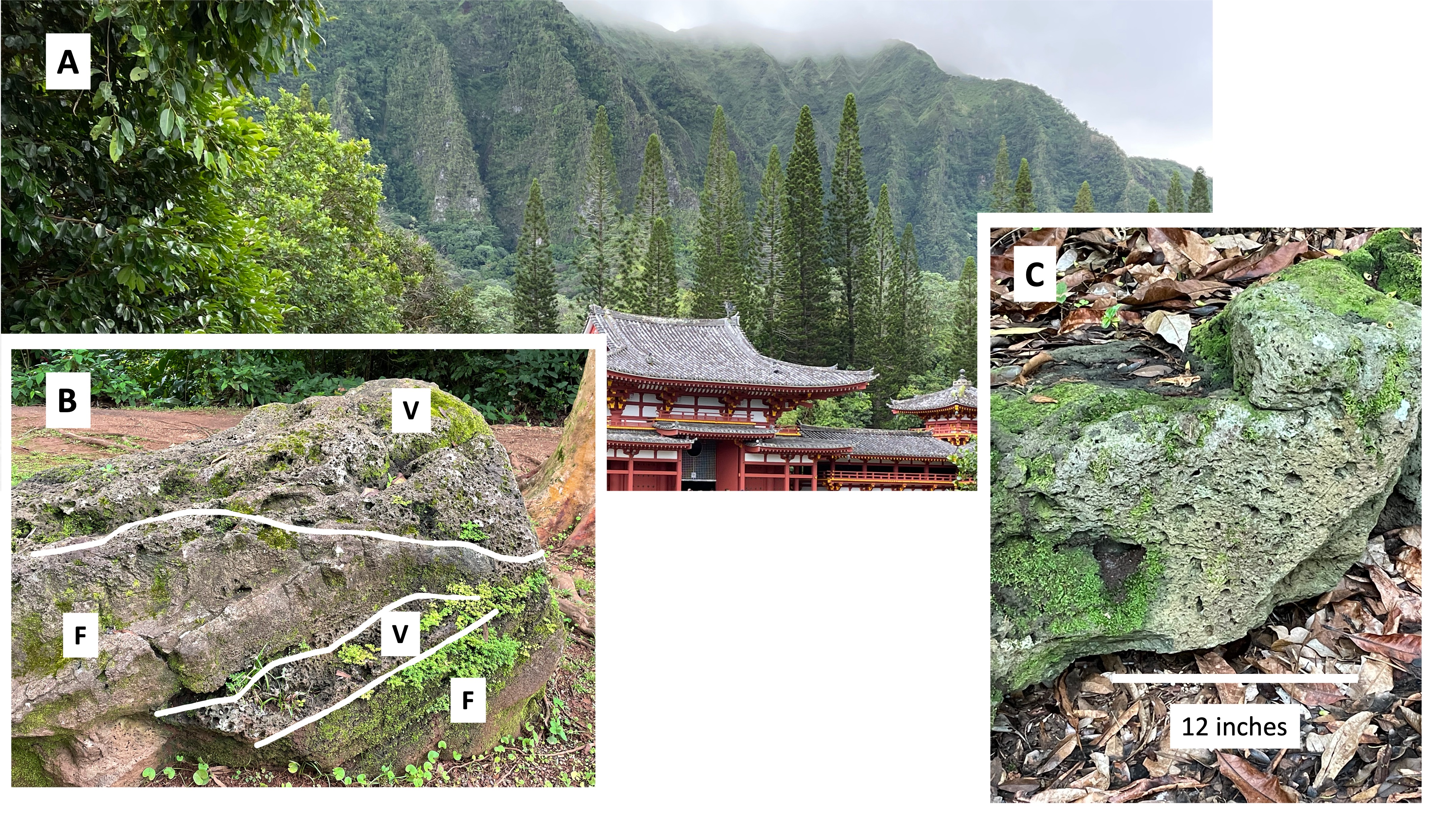
These rocks have been highly altered because of interaction with water when erupted, but the structures seen in Figs. 3B and 3C were preserved. Magma chambers contain a lot of gas, e.g., carbon dioxide and hydrogen sulfide, which expands when the magma moves towards the surface where pressure is lower. Small cavities (vesicles) remain when the gases escape (see Fig. 3C). The volcanic gases are not uniformly mixed within the magma however, so some of the erupted material will have vesicles whereas some will not (see Fig. 3B). Nevertheless, well-defined contacts between gas-rich (vesicular) and gas-poor (solid) magma when it flows onto the surface cannot be easily explained. The “V” and “F” layers in Fig. 3B were not necessarily flowing, although it is likely that they were moving if they were erupted onto a sloping surface. The contacts (white lines in Fig. 3B) could simply be the result of very hot lava flowing out from a common source, the differences that existed within the magma chamber mirroring fine-scale variations of the its chemical characteristics.
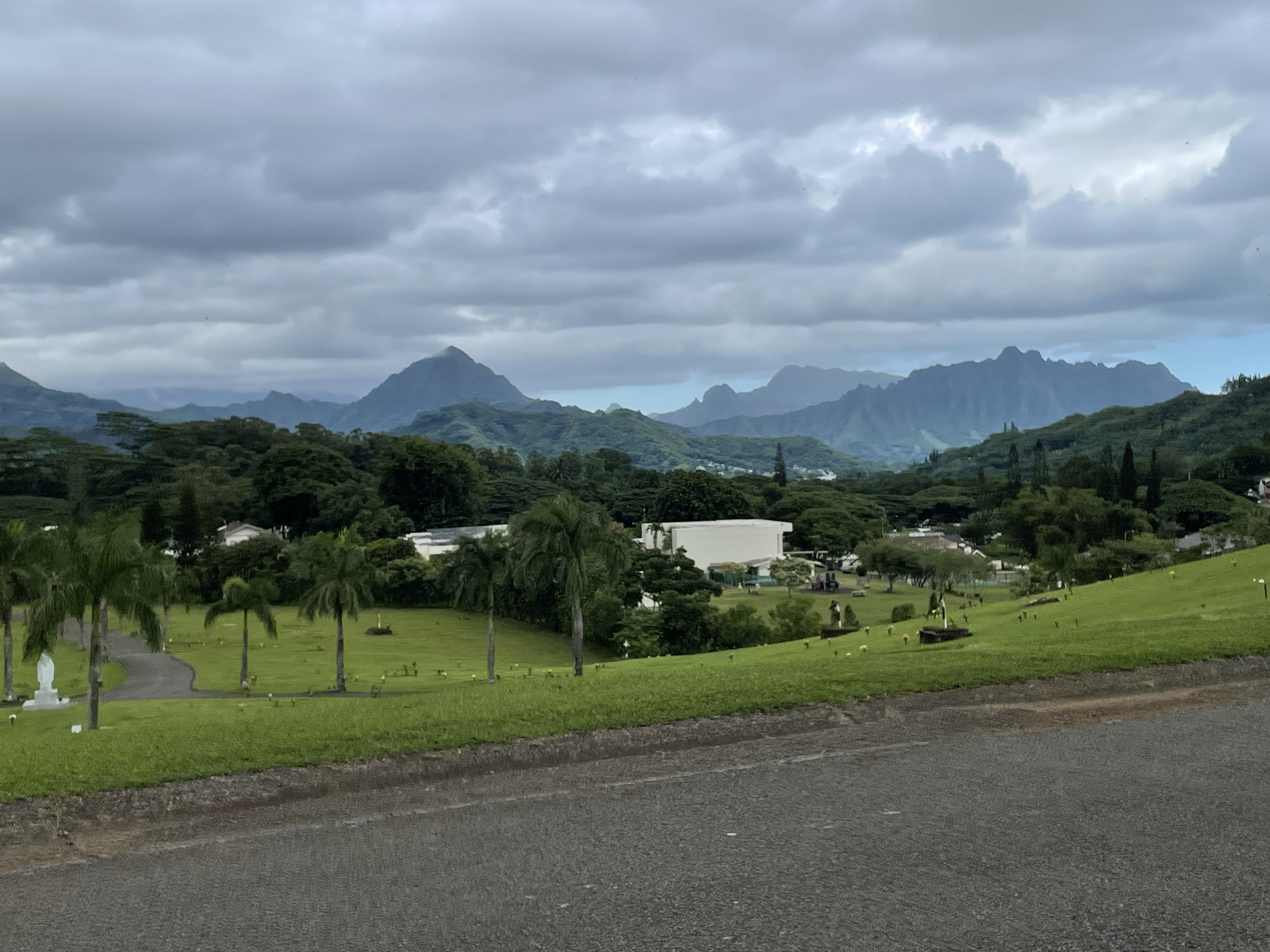
The Ko’olau volcanic system would have been venting along fractures, thus creating many, often overlapping, volcanos on the flanks of the main “super” volcano. Such an immense volcanic system couldn’t remain stable for long (i.e. millions of years) and it collapsed into a huge debris field (refer to Fig. 2A), leaving the fragile remnants of its glorious past naked to face the extreme weather that came from the arctic, creating the jagged peaks of the Ko’olau range (Figs. 1 and 3A).
The collapse of the Ko’olau caldera occurred sometime between 1.7 my ago and when volcanism began at several fissures to the southeast about 500 thousand-years ago, adding more land to the island of Oahu.
We’ll see what that was like in my next post…
Back to the Beach: Sand Transport at Waikiki
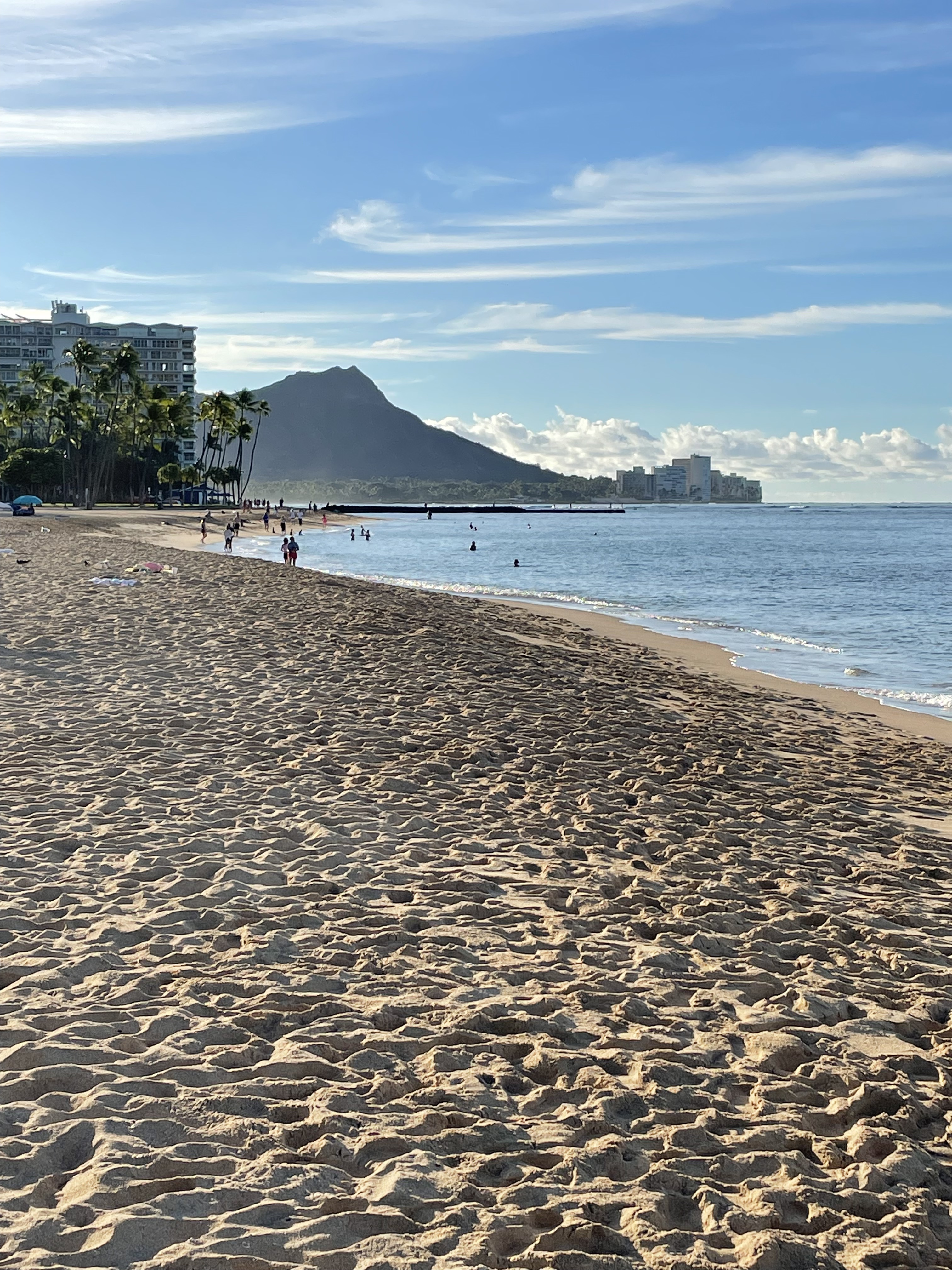
I have discussed beach erosion and topography in several previous posts (e.g. Australia’s east coast and The North Sea); and there is no reason paradise should be exempt from the ravages of wind and waves. Those two powerful tools of nature are on the minds of everyone who lives in Honolulu, as revealed through desperate efforts to keep these beaches from eroding.
Where is Waikiki Beach?

What does the beach look like?

The wind blows from a southeasterly direction for about six months of every year, generating moderate waves that strike Waikiki obliquely from the SE. The result is along shore drift of sand. One quickie solution to this problem is to construct resistant stone or concrete barriers perpendicular to the beach. They are called groins.
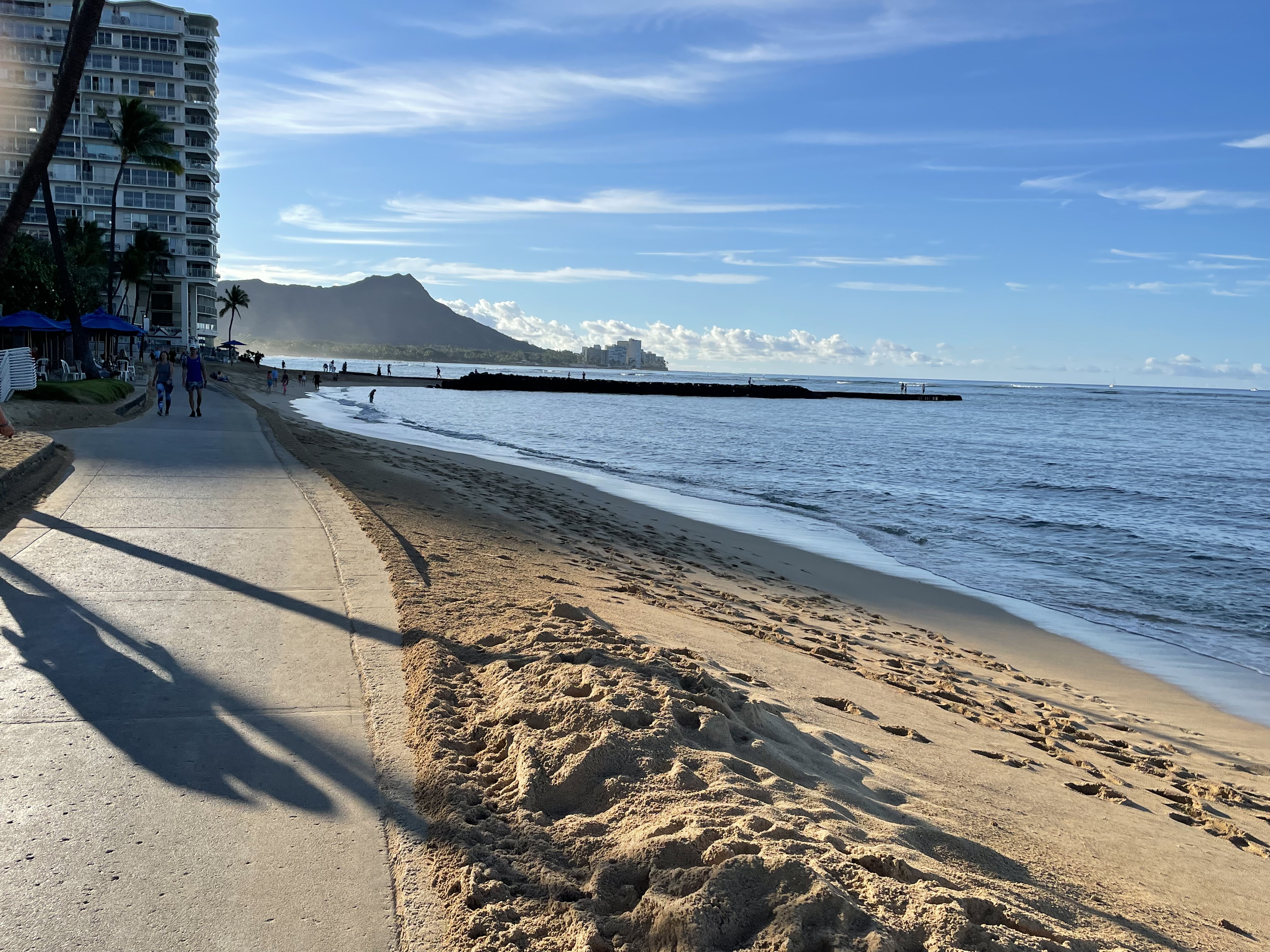
So, what happens on the upflow side of a groin, like that seen in Fig. 4? We can see the erosion on the down flow side (remember the waves are coming towards the camera), but what happens when moderate waves hit a solid wall?

The damage moderate waves can do over years, even decades, has been demonstrated, and Figs. 4 and 5 support those results. The wind blows steadily from the south-southeast between April and October on Waikiki beach. What is the impact?

The westward transport of sand by the SSE wind is obvious at any obstacle to its unimpeded flow, such as sidewalks protected by low walls (Fig. 3), where sand accumulates on the windward side and spills over.
The state of Hawaii is aware of the problems identified in this post, and their solution is beach replenishment. That would explain why the Waikiki beach I visited in 1991 is no longer white, but now as dirty as the beaches of Mississippi Sound, where beach replenishment from offshore sources has been the standard for decades.
Beaches are dynamic zones, where wind, waves, land, and biology interact in a never-ending dance, which is the primary reason (in my opinion) that people are drawn to the seashore. I expected this when I lived on the Gulf coast, but I am surprised to see reality showing its ugly face in paradise…
Claude Moore Park: How Geology Won the Civil War
That is a grandiose title and I admit it’s only part of the story. Nevertheless, the movement of General Lee’s Army of Northern Virginia was tracked from a lookout tower constructed on the ridge that bounds the northern margin of Claude Moore Park (Fig. 1), from where his troops were observed to be moving north, towards Pennsylvania. Because of this tactical intelligence, Union forces converged on Gettysburg and were able to repel the Confederate invasion. Most historians refer to Gettysburg as the high tide of the Confederacy.

The study area is located near the Potomac River, where it drops from the Appalachian Mountains to Chesapeake Bay (Fig. 1). The ancient rocks that underly this area have been deeply eroded by streams, producing a labyrinth of hills and valleys. This post begins at the Uplands (Fig. 1) and shows the dramatic change in both ancient and modern sedimentation that results from such a landscape.

The ridge probably follows the erosion-resistant channel of a river, with coarser sediment forming uplands because it is resistant to erosion. It is like a topographic inversion; what was once low (the bed of a gravel river) is now high because cobbles are difficult to move by water that is no longer focused in a river channel.
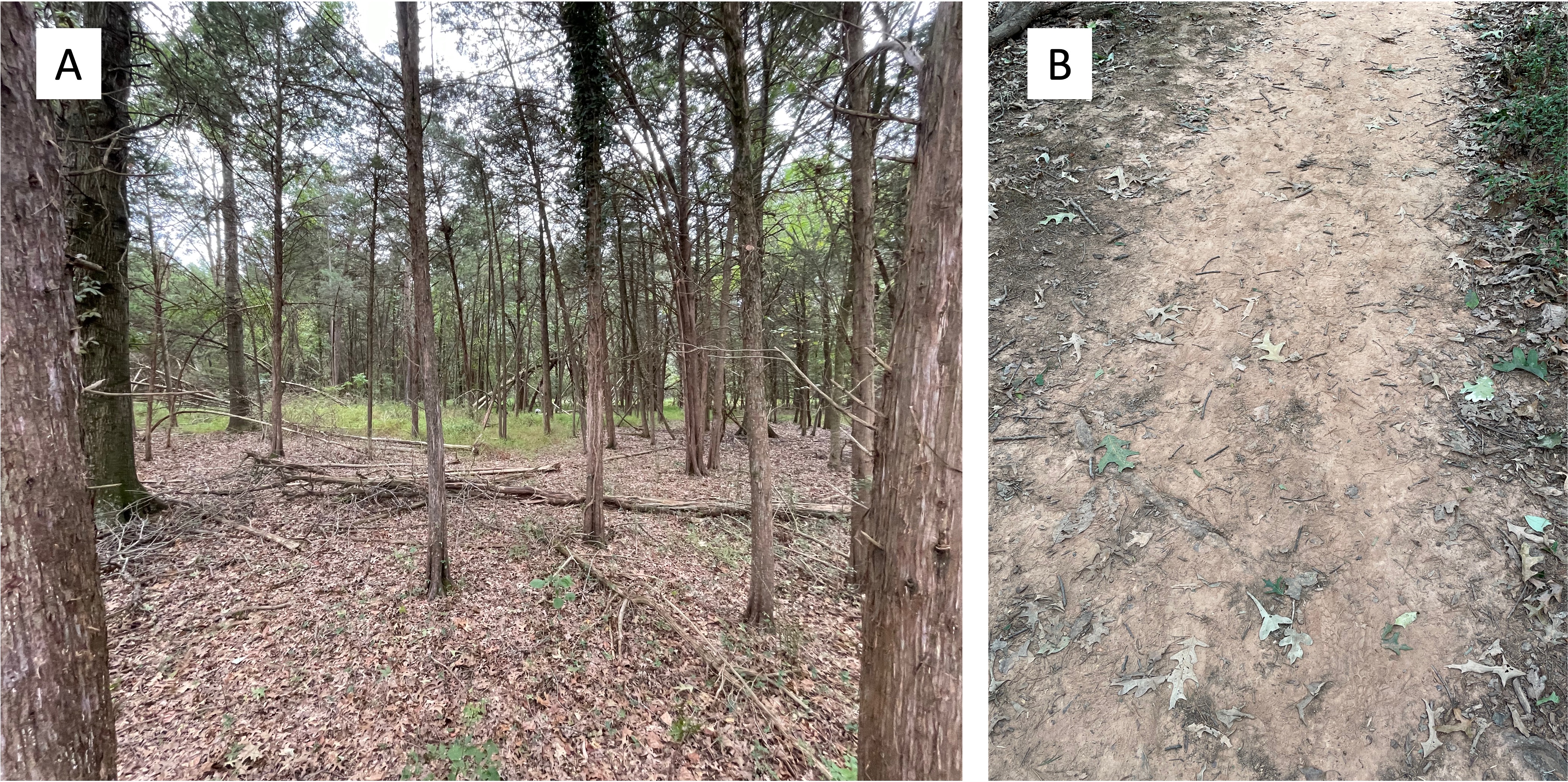
The slope reduces southward and drains into a pond (Fig. 1), which is simply the lowest topography and thus wet year round. However, the entire area labeled as “Wetland” in Fig. 1 is probably periodically inundated during wet times.

This post has shown how sedimentation can change over short spatial distances, and topography can become inverted. The wetland area was once the flood plain of a gravel river (e.g. Fig. 2), but the silt and clay that collects on a flood plain is easily eroded and weathered when it is exposed to the elements, creating local wetlands surrounded by ancient river beds.
This interpretation is speculative because bed rock is never far beneath the surface in northern Virginia. We saw no outcrops on the ridge, however, which doesn’t mean that there is no resistant rock beneath the gravel-covered slopes, but it is consistent (geologists love that word) with my interpretation. Further support for the ancient stream-bed hypothesis comes from the orientation of the ridge, which doesn’t follow the regional structural trend of NE-SW for basement rocks. Note that the Appalachian Mountains define this trend (see Fig. 1), as have all of the Paleozoic and Mesozoic rocks we have encountered in the area. The uplands (see Fig. 1) ridge is oriented east-to-west, which goes against the grain, geologically speaking.
Thanks to an ancient gravel stream, the Union army was alerted to the movements of the Confederate invasion and stopped them at Gettysburg. Geology saved the day again…
Review of “The World of Lore: Dreadful Places” by Aaron Mahnke

This was another random read, this time picked up at a local bookstore’s bargain table. I didn’t even read the back cover, so I had no idea this was a collection of mystical stories. The author has a podcast and seems to be a diligent researcher, and he presents a balanced picture of what can be explained and what cannot. I’m not a fan of this genre, but I found the stories well written and fun, with lots of background information on the places where the stories originated. Some of the tales made my hair stand up. Some were boring, most were informative and well presented.
It is an easy book to read, but for some reason it seemed to take a long time to finish. I mean, if you’ve heard one ghost story, you’ve heard them all; nevertheless, the depth of research and skeptical storytelling kept me interested. There really are unexplained incidents. That is a repeated message in this collection.
There isn’t much else to say. The book’s premise is clear and it is informative, rather than just retold stories. If you enjoy the lore behind the scenes, in many different locations, then I recommend this book.
I can’t help but wonder why such stories don’t occur today, despite the widespread use of smart-phone cameras and social media…
Review of “The Man Who Died Twice” by Richard Osman

I didn’t know this was part of a series when I bought it at Copenhagen International Airport. It wasn’t a problem, however, because the references to previous exploits are vague and don’t directly impact this story. The personalities and relationships of the characters are presented in sufficient depth that a fan of the series would probably find the detail redundant.
One thing I found disconcerting is the use of the present tense with a third-person narrator for most of the chapters. This approach is so awkward and inappropriate that the author kept resorting to the past and present perfect to present past events, and they made a lot of grammatically clumsy (if not erroneous) constructions doing it. It just made no sense. There is a first-person narrator who shares her view periodically, and that works fine in present tense. Some people talk like that.
As you can imagine, there are a lot of cliches (English not American) and stereotypes for the characters, but they kind of seemed the same to me most of the time. Now and then, one of them would suddenly behave differently than they had before; that is a risk with an ensemble cast of characters, and I only mention it to be as complete as memory will allow. The central character (not the narrator) seemed to have a rush of inspiration at the end, realizing her fallibility; it made me wonder if she does it in every book?
The plot was obvious because there really was only one person with the resources required to pull off the crime; thus, a variety of red herrings were introduced to keep the reader from figuring it out, and show the weakness of egotism (I still don’t understand the title).
Overall, a fun romp with some elderly people, filled with anecdotal observations of aging and nonsense. I didn’t finish it on the flight, but I remembered to read a few chapters (they’re short) every day.
A final comment: One crime solved by the “Thursday Murder Club” is enough for me…
Review of “The End of the World is Just the Beginning” by Peter Zeihan

Many knowledgable reviews of this book have been written, and it started a firestorm of debate about the impacts of globalization, and its demise. That is the premise to all 475 pages. It is stated in the Introduction and repeated at least once on almost every subsequent page. The problem is: the author never explains why America would suddenly stop supporting an international convention it helped create. It is treated as an axiom, a given assumption from which all kinds of predictions can be made. There isn’t the slightest attempt to explain, much less justify, this fundamental premise. Because of this glaring deficiency, the scenario described in detail for many countries and industries is no more than an alternate history of a world that hasn’t appeared yet, like if the Axis powers had won World War II.
The details are culled from Zeihan’s experience as an international consultant, and he has plenty of them. They are reasonable, given the axiom of unilateral American withdrawal from the international scene. The strengths and weaknesses of various nations are interesting and will, of course, contribute to the future economic development of those economies. So, the book is worth reading, as a summary of the history and current state of various economic sectors (e.g. mining, petroleum, agriculture), and it is worth having around as a reference, a partial explanation of global trends. No doubt, many of his predictions will come true because they are based on facts, even if not supported with a bibliography.
I have another complaint, however; there are no references, and the footnotes consist of often witty comments rather than details not given in the text. There isn’t even a list of supporting sources. Nothing. I guess we’re supposed to trust the author, as an expert. Nevertheless, if taken in a humorous light (a perspective apparent in the author’s comments), like a conversation on the front porch with a beer in your hand (maybe a rum and coke), it is entertaining.
I enjoyed reading it, but I’m taking his predictions with a grain of salt.
The Rest of the Story: The Harz Mountains
This post is a continuation of previous posts on northeast and central Germany, but we won’t be seeing direct evidence for glaciers in the Harz Mountains (Fig. 1).
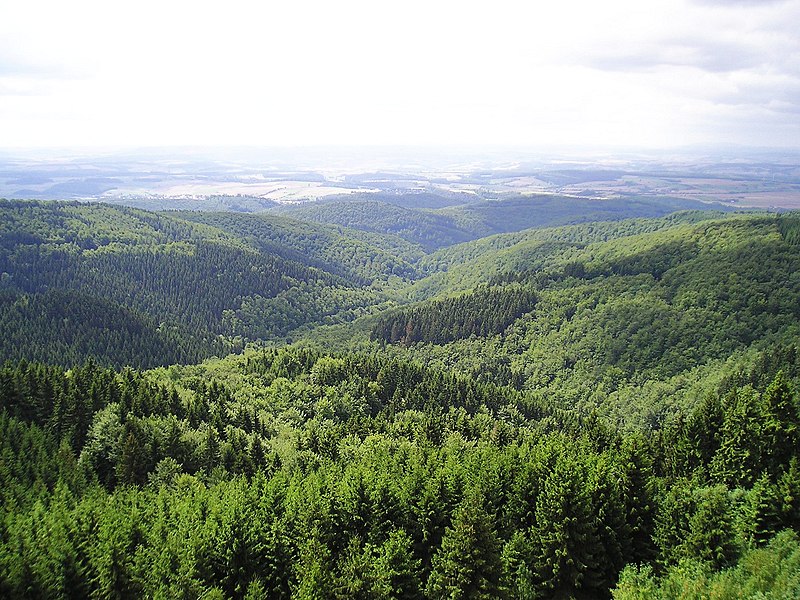
Today’s post discusses some of the rocks exposed in the valleys, gorges, and road cuts that dissect the Harz Mountains (Fig. 2).

We approached the Harz uplands from the east (site A in Fig. 2), where we encountered mines based on removing sedimentary rocks for use as building material (Fig. 3).

The mines in Fig. 3 were removing desired beds from the Tanner Graywacke ( age ~360-320 Ma), a poorly mixed sedimentary rock (e.g. graywacke) originally deposited in ocean trenches associated with volcanic island arcs. The Tanner graywacke ranges from mudstone to conglomerate. It forms medium beds with variable texture, and has been tilted to varying degrees (Fig. 4).
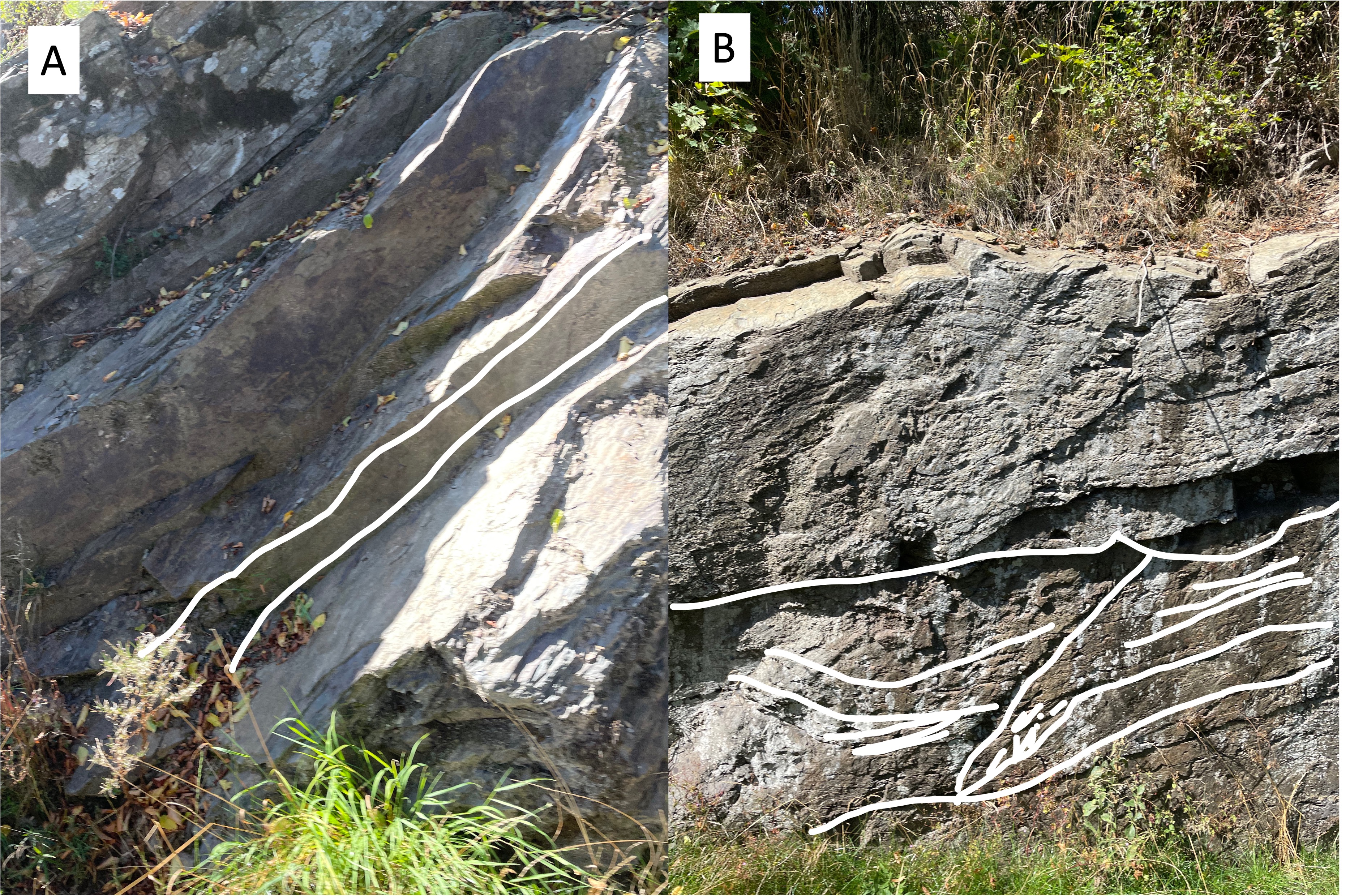
Our route east of the Harz Mountains (red line in the inset of Fig. 2) took us to site B, where we encountered more facies of the Tanner Graywacke (Fig. 5).

Our path (red line in Fig. 2 inset) led us into a valley between the small highlands where Figs. 4 and 5 were taken. This valley is filled with a lake, and probably follows a fault zone between Site B and the main Harz Mountains to the north (Fig. 6).

Our journey followed the southern margin of the Harz Mountains (red line in Fig. 2 inset), taking us by Site C, where we found nearly horizontal beds of Tanner Graywacke exposed along road cuts. We couldn’t stop until we found a rest area, where a large block was available for close examination (Fig. 7).

We continued around the western end of the Harz Mountains and found exposures of the marine deposits (including evaporites and carbonates) that underlay the town of Kelbra (Fig. 6), including a thick sequence of either salt or anhydrite (Fig. 8).
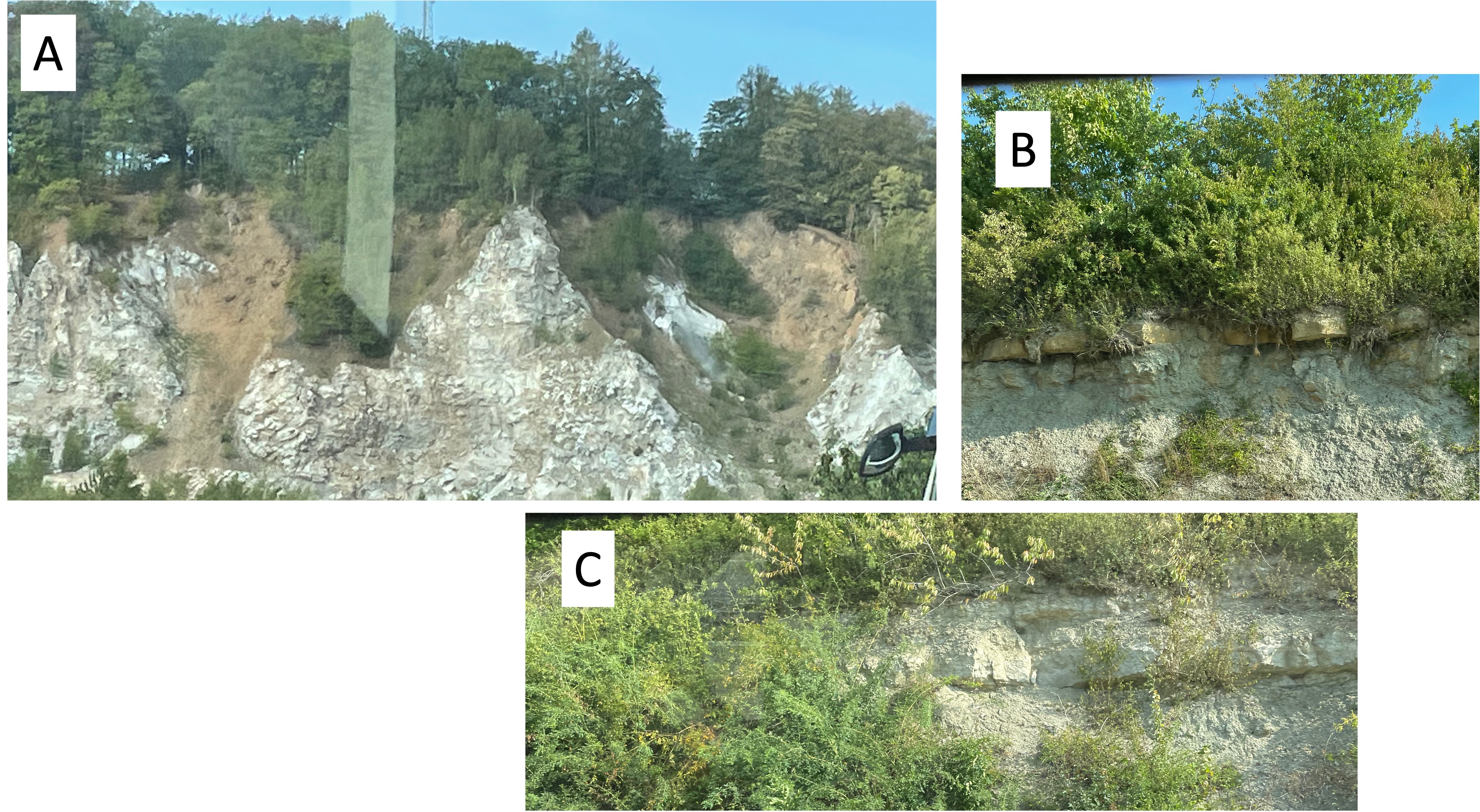
This post reveals rocks that are widely separated in time while being found near each other, supporting the Harz uplift as they do (Fig. 2). As the title of this post suggests, geology is not a series of isolated events. Let’s get the rest of the story.
The Tanner Graywacke was deposited in an island arc, a tectonic region in which oceanic crust is being subducted beneath either a continental (or less often an oceanic) tectonic plate, about 350 million years ago. What was happening on the opposite shore of this proto-Atlantic ocean (aka Iapetus)?
I have encountered rocks of similar age in northern Virginia and discussed them in previous posts. On the west side of Iapetus, during a mountain-building event called (in America) the Acadian Orogeny, a series of island arcs were being subducted/accreted to form a series of suspect terranes. This orogeny was only a phase of the collision of Laurentia (porto-north America) and Avalon (proto-Europe), which endured for most of the Paleozoic era.
The next problem is what happened during the ensuing 100 million years, between deposition of the Tanner Graywacke and the evaporites and carbonates we encountered west of the Harz uplands (Fig. 8)? The collision was completed and Pangaea had been born of two continents…
The mountains rose and they were eroded almost as quickly by wind, rain, and ice, creating massive layers of sediment to the east (modern Europe) and the west (e.g. the Catskill Delta in New York). By 230 million-years ago, the earth’s upper mantle changed its mind and tore the newly formed supercontinent apart, creating rift valleys like that of East Africa in what is now Virginia. Splitting a continent can take as long as building one, but this was a relatively rapid event in geological time; by 200 million-years ago, diabase dikes were injected into the sedimentary and metamorphic rocks created by the closing of the porto-Atlantic Ocean (Iapetus) and the split was well under way. Alluvial and fluvial sediments were collecting in isolated basins in what is now Virginia, and evaporites were settling to the bottom of lakes and brackish coastal waters in Europe, as the ocean invaded…
Jump ahead 200 million years…
I love it when I can understand what the rocks are telling me…
The Forest and the Trees: Glacial Topography of the Central German Plain

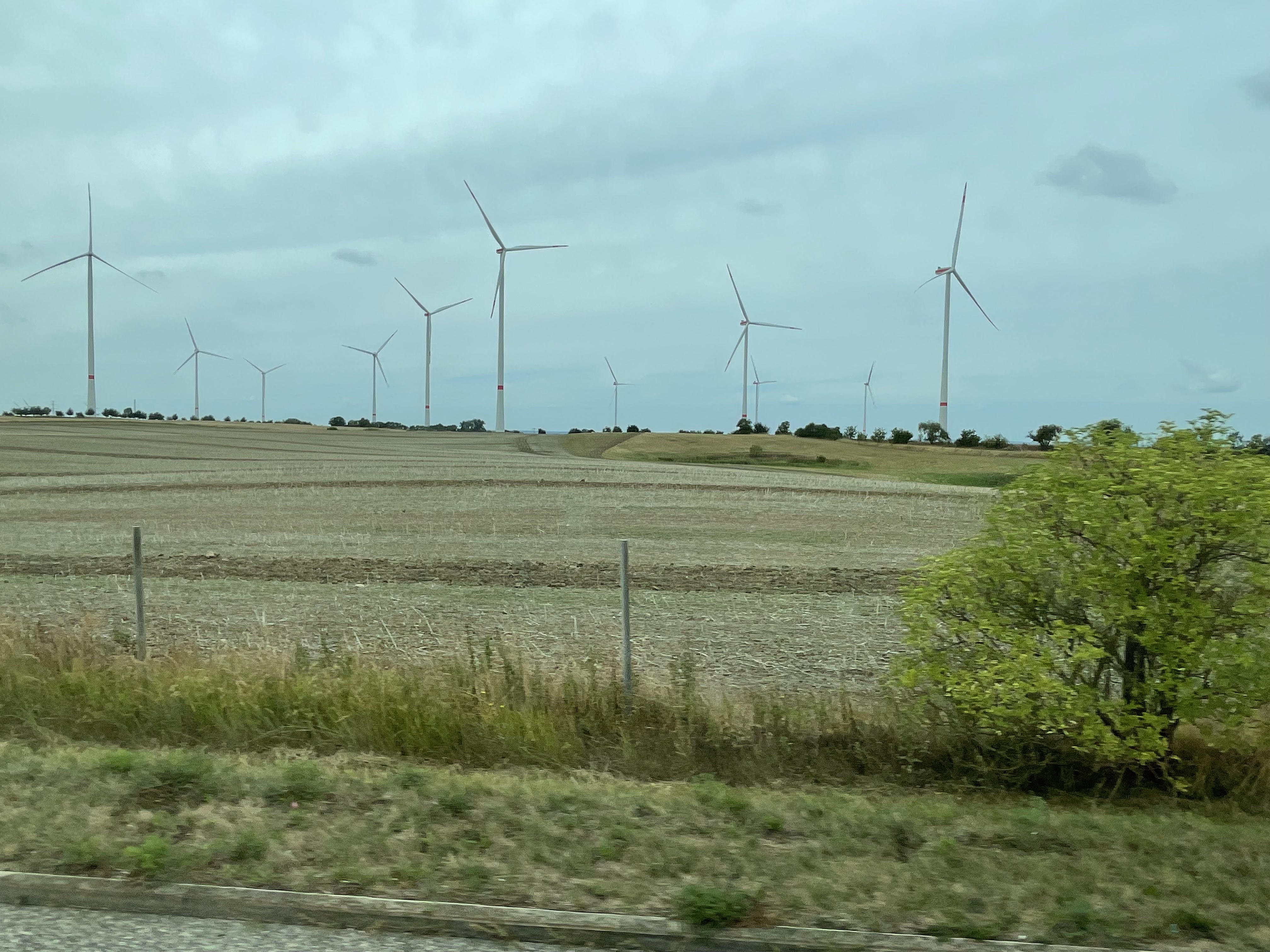
The wind blows pretty steady over the North German Plain and Central Uplands, so there are wind turbines everywhere, scattered among the hay fields (Fig. 1).

The topography of the Central Germany Plain is very similar to Nebraska, Kansas, and the Dakotas, because they were all created by the advance and retreat of multiple glaciers during the Pleistocene Ice Age. As we saw in the last post, advancing ice sheets as thick as a mile push rock and soil in front of them, before melting back for a few millennia, leaving piles of soil and boulders behind. They are like gigantic bull dozers.
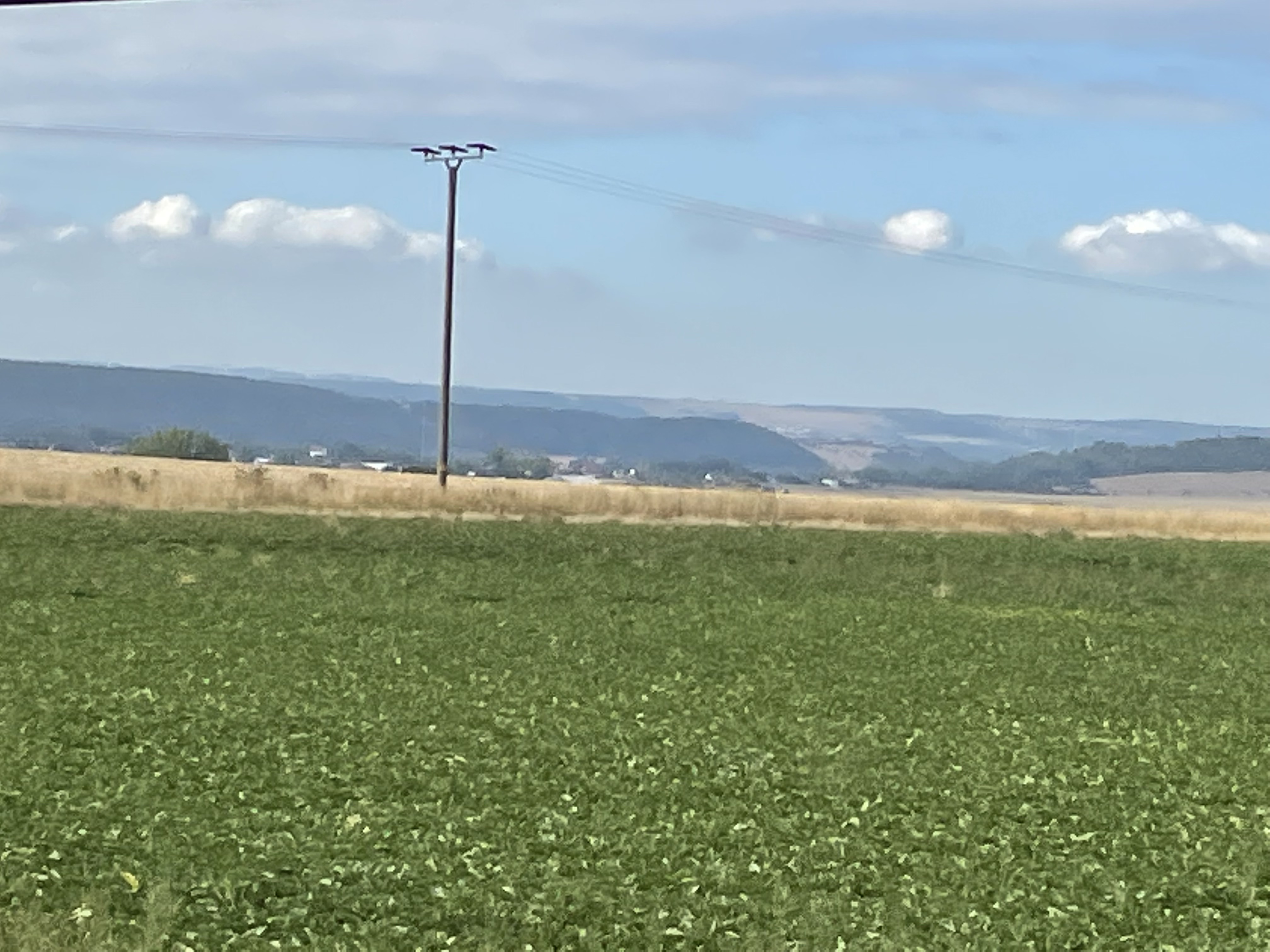
As ice slides over the landscape, scraping off whatever gets in its way, the ice at its base can melt from the friction, creating streams that transport already ground-up rocks. The usual rules of sedimentology apply to these ice-encased streams. They can deposit their sediment load as eskers, which identify these sub-glacier streams, or as piles of scraped-off soil (terminal moraines). I don’t know which I’m looking at in Fig. 4, but this image gives a good impression of their impact on the landscape. Keep in mind that the ice was approximately ONE-MILE thick above the landscape shown in Fig. 4…

As I alluded to in the previous post, geology isn’t a sequence of static processes; there is always more than one cause of what we see today, and none of them are stationary. Thus, the landscape produced by the continental glaciers that advanced over the Central German Plain during the Pleistocene were constantly in competition with alpine glaciers created in the valleys and peaks of the Alps. The huge ice sheets had the power to overcome any obstacle…but they couldn’t surmount the steep slopes of the Alps.
The glaciers that originated in the Alps waited until the last retreat of the great ice sheets that originated in Scandinavia, before they could make their play in the Holocene. Vast quantities of easily weathered feldspar were washed down their steep slopes into a panoply of rivers, which cut through the moraines left behind during the retreat of the continental ice sheets, creating broad river valleys like that of the Saale River (Fig. 5). Germany’s central plain and uplands were cut to ribbons by these growing streams, resulting in one of the most water-navigable regions in the world.
You always have to watch your back…
An Erratic Path: Glacial Geology in Usedom, Germany
This post finds me on the Baltic Sea, although I never actually saw it first hand. But this report isn’t about coastal geology; instead, I will be talking about an unusual feature of glacial terrains.


I haven’t explicitly described glacial terrains in previous posts, and this is not going to be a summary. As always, I’m only going to discuss what I saw with my own eyes. The flat, poorly drained topography of glacial areas (Fig. 1) is often interrupted by linear mounds of loose gravel, sand and silt. These features are called moraines and they are ever-present in northern Germany, especially in Usedom (Fig. 3).
The primary glacial feature I encountered on this trip is the titular Erratic–large, rounded boulders scattered around a featureless landscape (Fig. 4).

Let’s look at a couple of examples and see what they tell us about their source.

The first erratic boulder I found (Fig. 5) contains no more than 5% quartz (left photo caption), and is dominated by K-feldspar, which is unusual. The magma from which this rock formed (deep beneath the surface where it cooled for millions of years) didn’t contain very much water, which is indicated by the small amount of quartz. The chemistry of the magma is quasi-frozen in the minerals, the second-most-abundant of which is Na Feldspar. The feldspars form a continuum that depends on the relative abundance of potassium (K), sodium (Na), and calcium (Ca); K and Na both form lighter-colored minerals whereas Ca forms dark feldspar minerals. Based on the mineralogical composition of this rock (inset in left image of Fig. 5), this would be classified as a syenite (middle left side of Fig. 6).
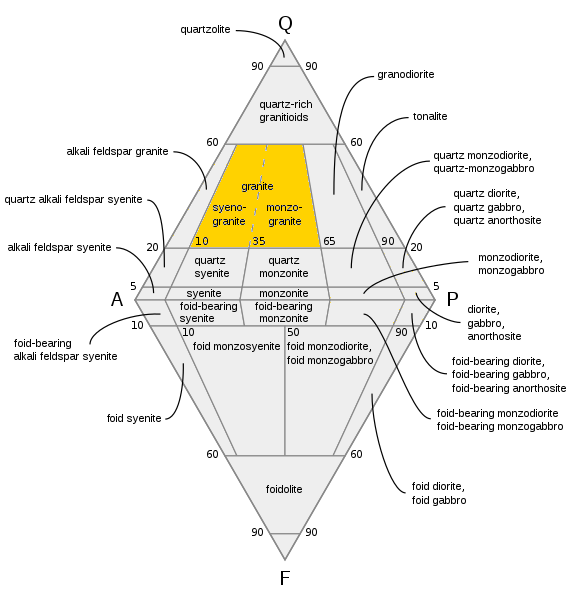
Syenites are formed in thick, continental crust. An example today would be the Alps (far beneath them) or the Himalayas, where subduction of denser oceanic crust is not occurring. In other words, the rock shown in Fig. 5 was created deep beneath the surface (~30 miles) when continents collided.
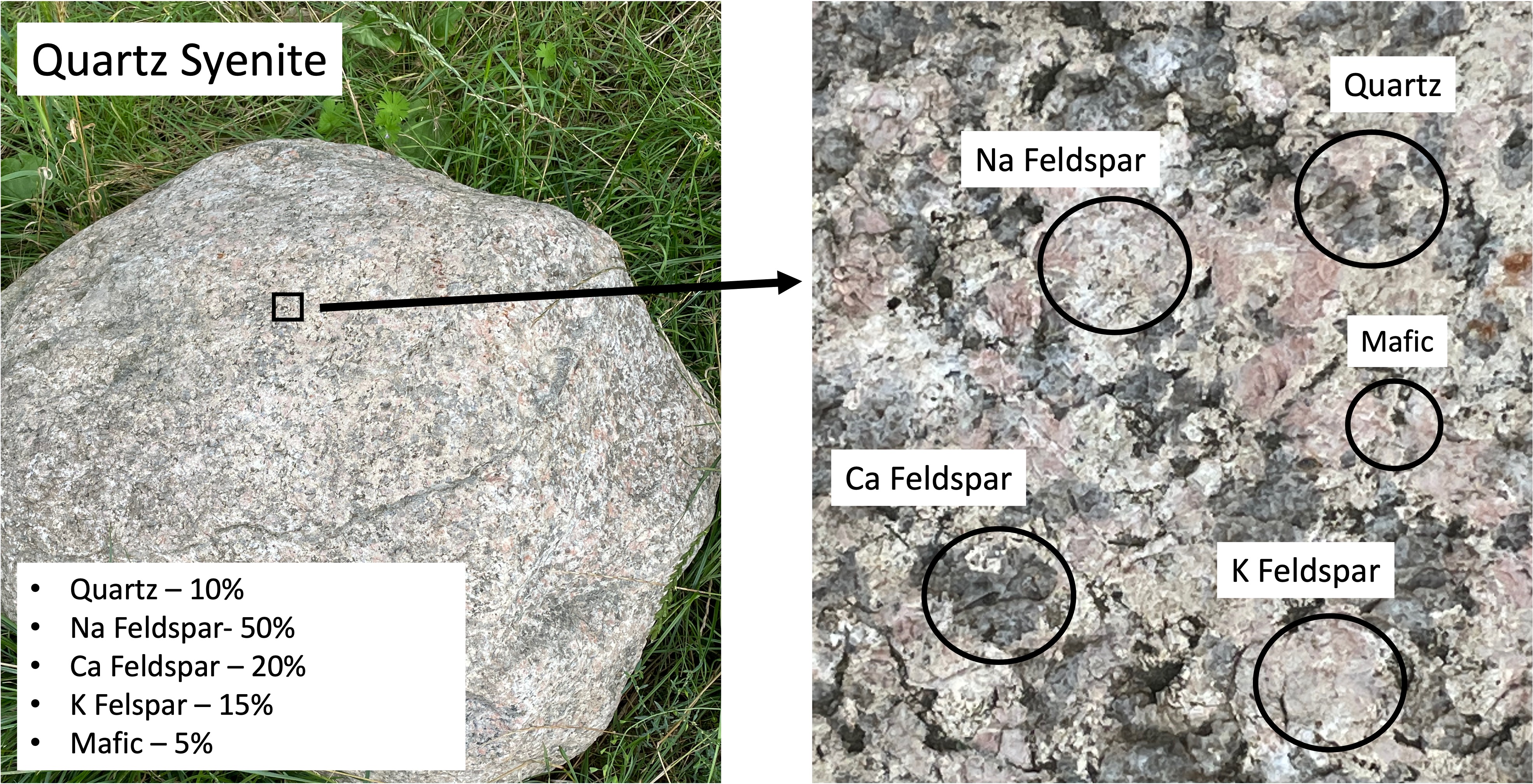
The boulders seen in Figs. 5 and 7 could have come from the same magma chamber because, as you would expect, there would be variations in local chemistry in a magma chamber tens of miles in diameter, and slow rates of convection wouldn’t mix the magma to a uniform consistency, even over millions of years. Magma, even when heated to 2000 F and buried tens of miles beneath the surface, is still thicker than molasses; it doesn’t mix well.

Phenocrysts like those seen in Fig. 8 are created in intrusive igneous rocks when they go through a multistep cooling process; for example, magma near the edge of the magma chamber loses heat to the surrounding rock and forms crystals like those seen in Fig. 8. These phenocrysts are then captured by the still-molten components of the magma and dragged along for probably hundreds-of-thousands of years (at a very slow speed, like inches per thousand years).
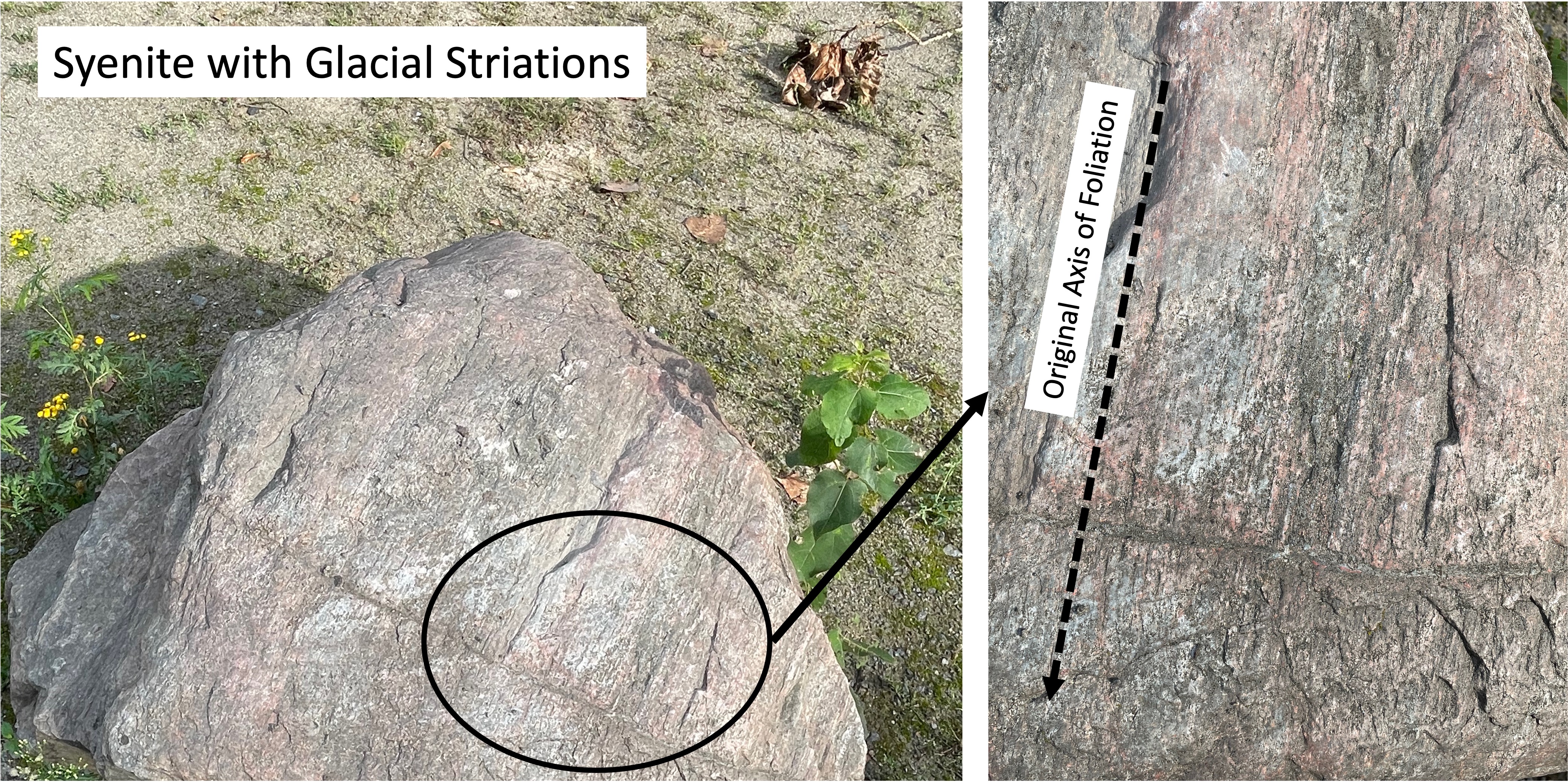
When the magma finally cools enough to become solid rock, it is uplifted as overlying rocks (of all kinds) are eroded by wind and water, not to mention ice. They are finally exposed in great mountain ranges like the Himalayas, where the rock breaks into smaller-and-smaller pieces along joints. When these pieces become small enough to be transported at the base of glaciers (you’ve heard the phrase glacially slow), they are dragged along, scraping over more rocks, sand, and gravel, which leaves evidence of their precarious journey (Fig. 9).

This post has been erratic, starting out looking at a glacial terrain (Figs. 1-4), then taking a detour into igneous petrology, the chemistry of magmas, and mineralogy, with a little plate tectonics thrown in. That’s how geology is; everything is an ongoing process that never quite reaches equilibrium (e.g. the phenocrysts in Fig. 8), and the journey is unending.
I didn’t investigate the origin of the syenite boulders examined in this post, but (if memory serves) they match the mineralogy of intrusive rocks from Sweden, which is a long way from Usedom.
Stockholm is about 500 miles north of Usedom…
Eidersperrwerk: Keeping Out the North Sea
My last post explored the mud flats bordering the North Sea in northern Germany, where we found conflicting methods applied to control and protect the levee system. This post investigates more aggressive measures implemented at the mouth of the Eider River. We will briefly look at the Eidersperrwerk, a gate system designed to control both storm surge incursion up the Eider, and river outflow
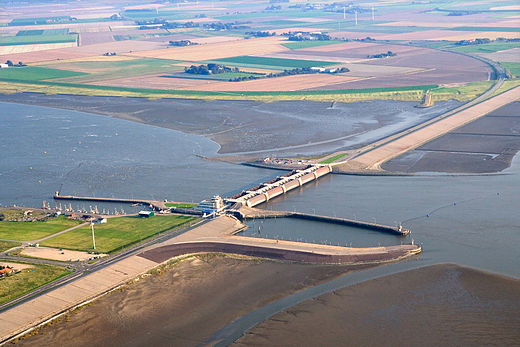
We will focus on the seaward mud flats in this post. Let’s take a look at the south side of the river first (upper-right of Fig. 1).
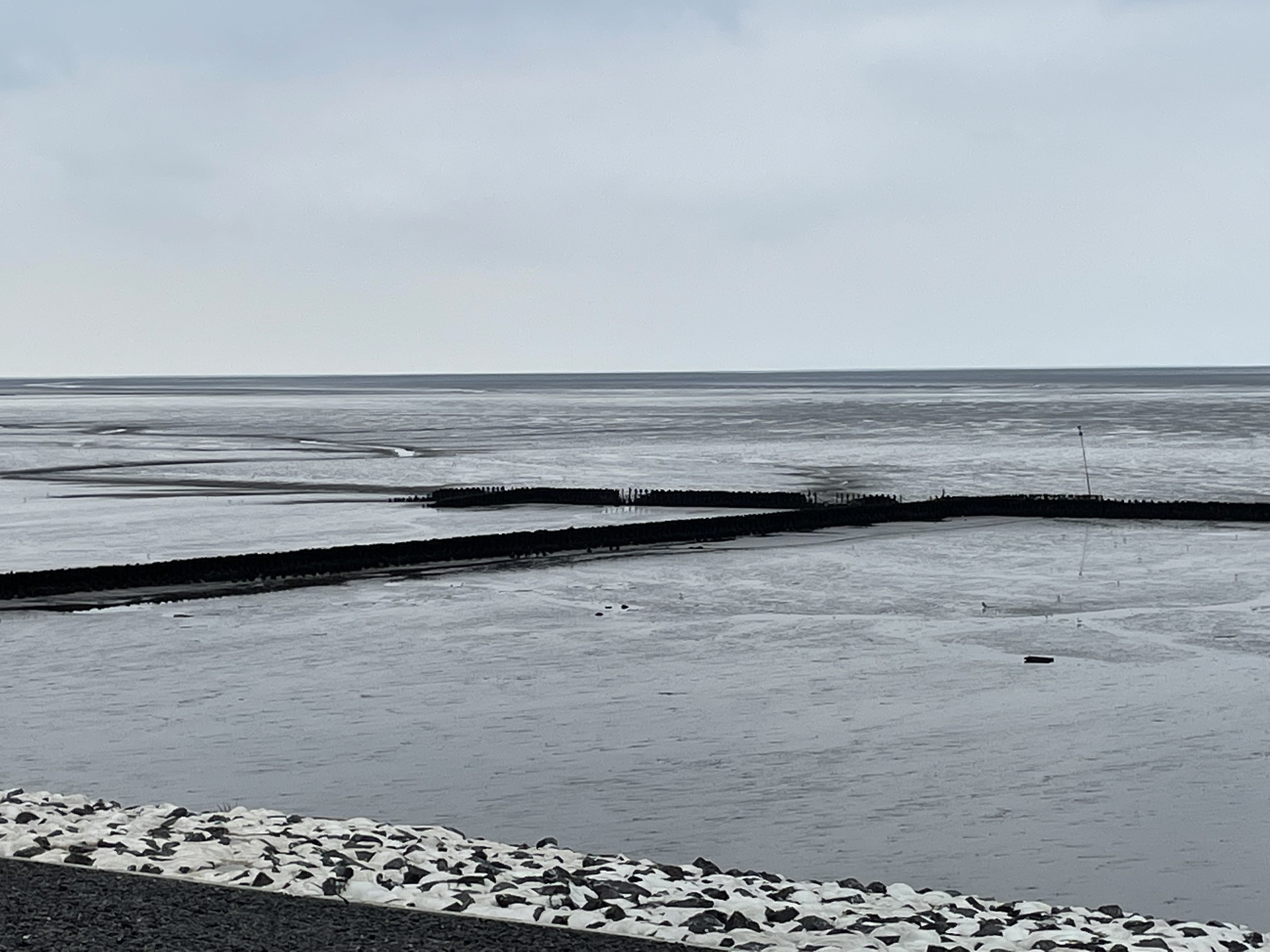


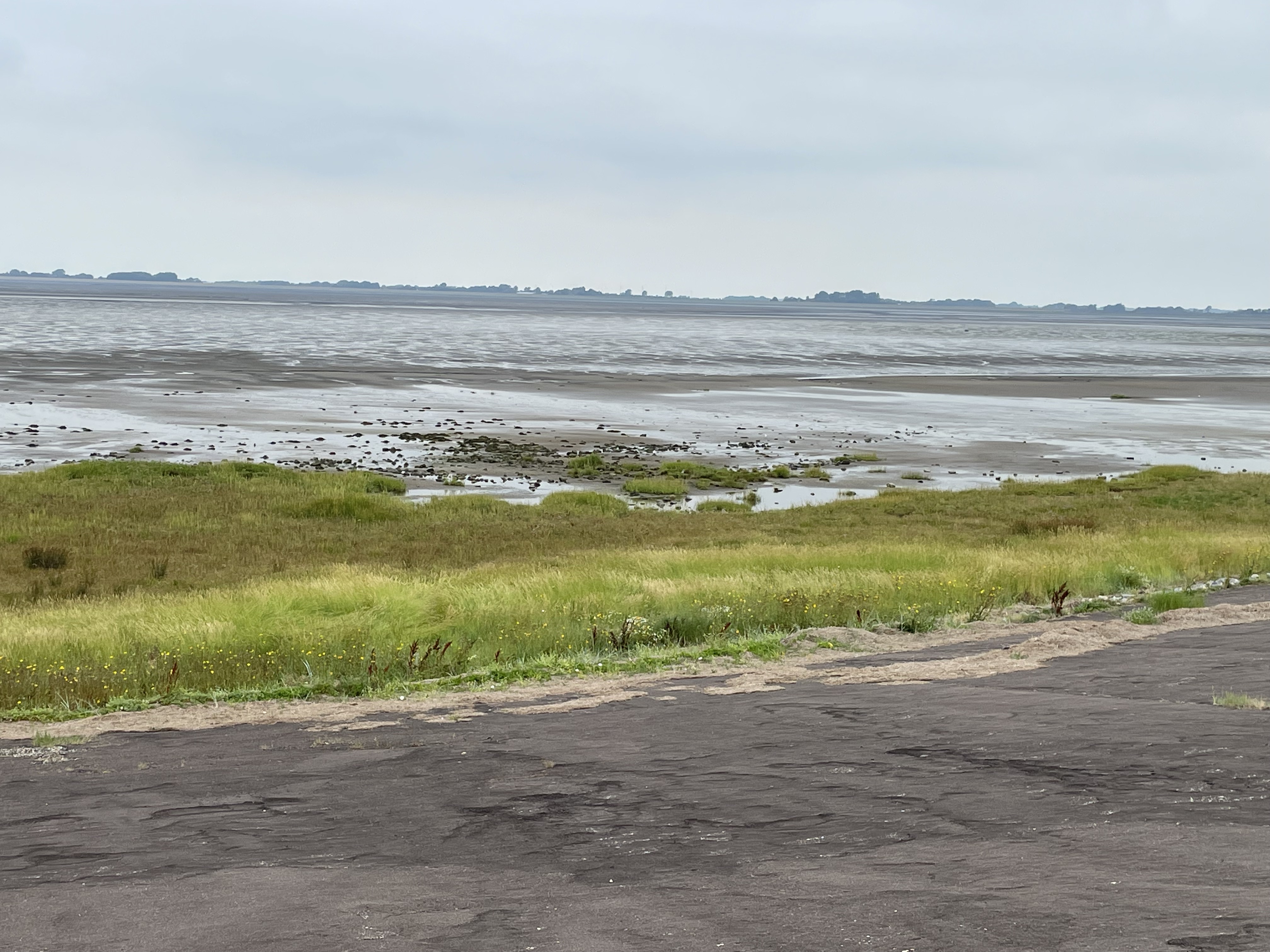

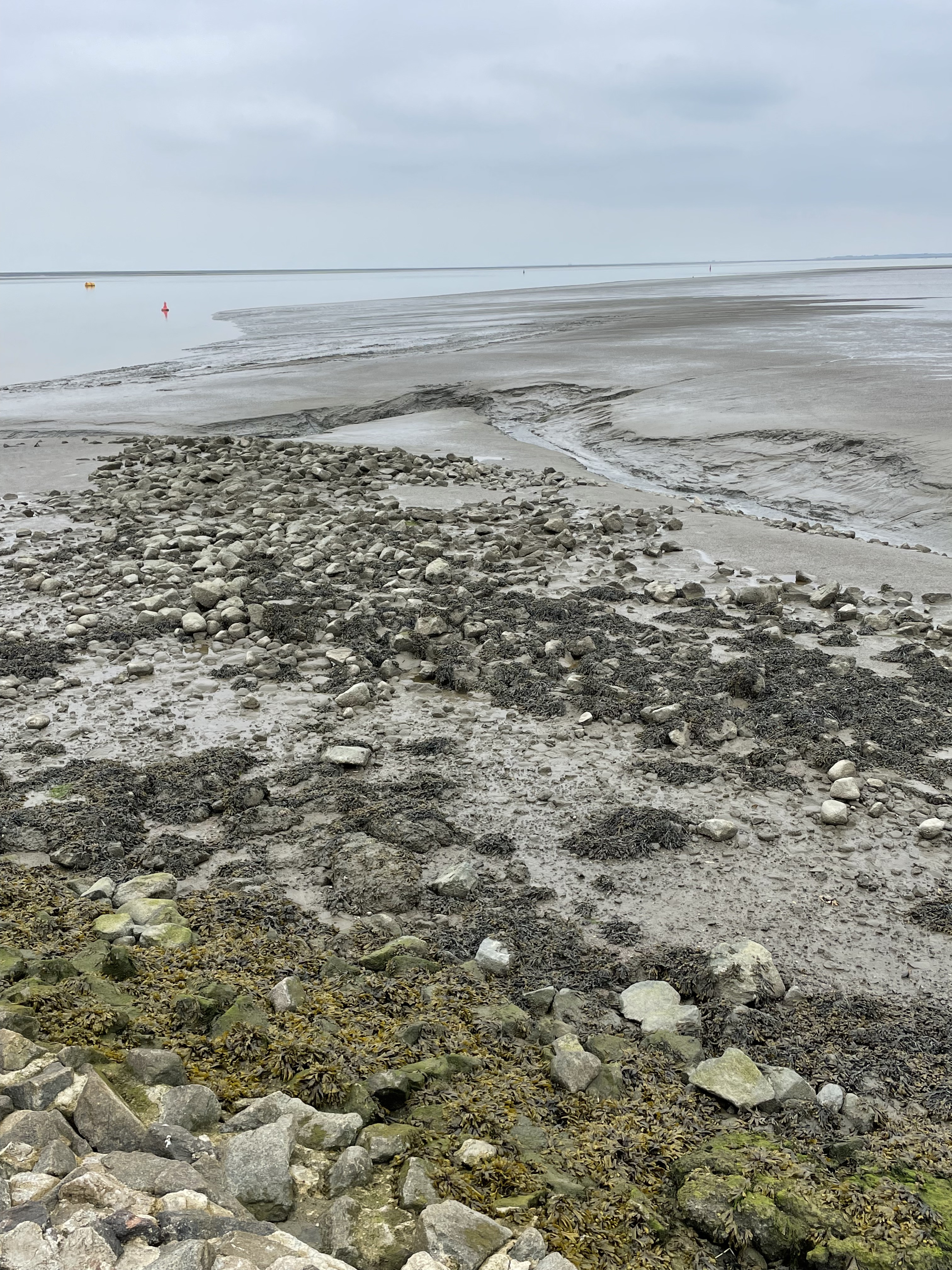
Comparing Fig. 1 to Figs. 2 and 5-8, we can see the effects of years (probably decades), during which interval the northern margin of the river mouth filled with sediment and grass was established (Fig. 5). Subsequently, it seems that erosion removed some of this soil and grass (Fig. 6). Meanwhile, storms have been slowly wearing away the boulders armoring the base of the levee (Fig. 8) and a semipermanent fair-weather berm was constructed (compare Figs. 1 and 7).
In summary, something appears to have changed in the dynamic environment around the mouth of the Eider. It should come as no surprise that constructing a gate system and cutting off a major sediment supply for at least half the time had dramatic effects on the nearshore. Mud flats are very sensitive to sediment supply, and it could have been either reduced alongshore transport from the north, or the almost-complete denial of rive-borne mud that led to the current situation.
Some scientists propose that storminess varies on many scales, from decadal to millennial as climate fluctuates…

 Timothy R. Keen
Recent Comments