Horsepen Run in December
I wrote a post about streams traversing the Potomac River flood plain in a previous post. Horsepen Run is a meandering stream that has cut down several feet across the gently undulating sediments blanketing the mile-wide flood plain at this point on the Potomac (Fig. 1).
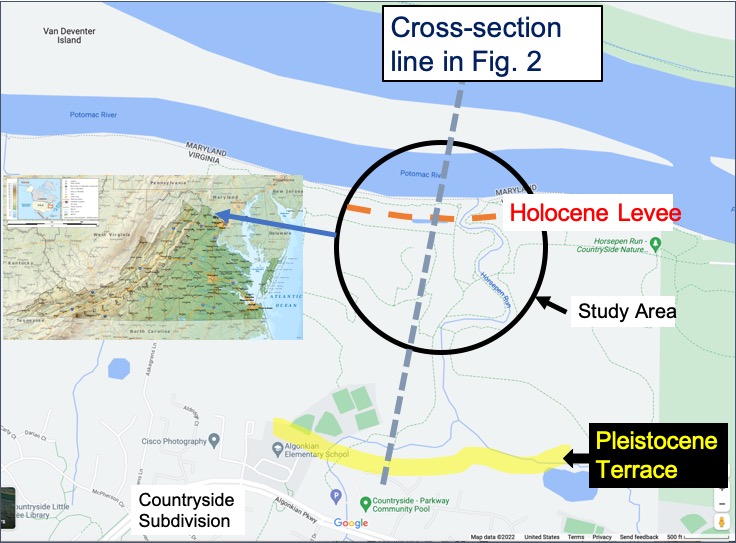
Figure 1. Map of Horsepen Run area. The reference to Fig. 2 is from the original post.
It had rained for 24 hours prior to this field trip, and then temperatures plummeted to well below freezing. It never snowed but there was some sleet. We are going to see some interesting features that resulted from this unique event. The watershed for Horsepen Run is rocky, with bed rock never more than a few feet beneath the surface, except on the floodplain (Fig. 1).

Figure 2. Shallow ditch along the path leading to the Potomac River, just entering the black-circled area in Fig. 1.
When I first came across the curious ice structures in Fig. 2, I thought someone had ridden a bicycle along the ice for fun. I didn’t figure it out until later.

Figure 3. Meander in Horsepen Run. The surface appears to be ice. Note the ice lying along the opposite shoreline. A curious structure.

Figure 4. The surface of Horsepen Run where it empties into the Potomac is solid ice. We tossed a branch out and it broke, indicating the ice is several inches thick.

Figure 5. Close-up of Horsepen Run at the Potomac. Note the broken ice about one inch thick lying along the opposite bank.
It’s time to put it all together. The water level during the steady rain was elevated so close to the stream’s outlet. The temperature was low enough (~10 F) to freeze the surface while water continued to flow beneath the ice. Even though the temperature remained very low, when the floodwater ran out from under the ice, it cracked and collapsed like a pane of glass. The newly exposed subsurface water at the lowered level then froze. This process occurred even in a few inches of water (Fig. 2).
The ice sheets (Figs. 4 and 5) serve as a high-water marker that melted away with the next thaw, serving as markers of how much water can collect during a light rain on nonporous soils and rock.
Geology integrates rock and soil with the atmosphere and hydrosphere into a holistic system that can surprise us at every change in the weather.
Fraser Preserve
We had a chance this week to see what the Nature Conservancy does with our donations. They buy land and either maintain it or return it to the state or local government as public parks.

FIGURE 1. This post takes us back to the Potomac River, where we hiked around Fraser Preserve, a plot of land owned by the Nature Conservancy and open to the public. The photo above shows a stream flowing under an old concrete bridge as it cuts its way to the Potomac River. Downcutting here was similar to what we’ve seen elsewhere along the VA side.
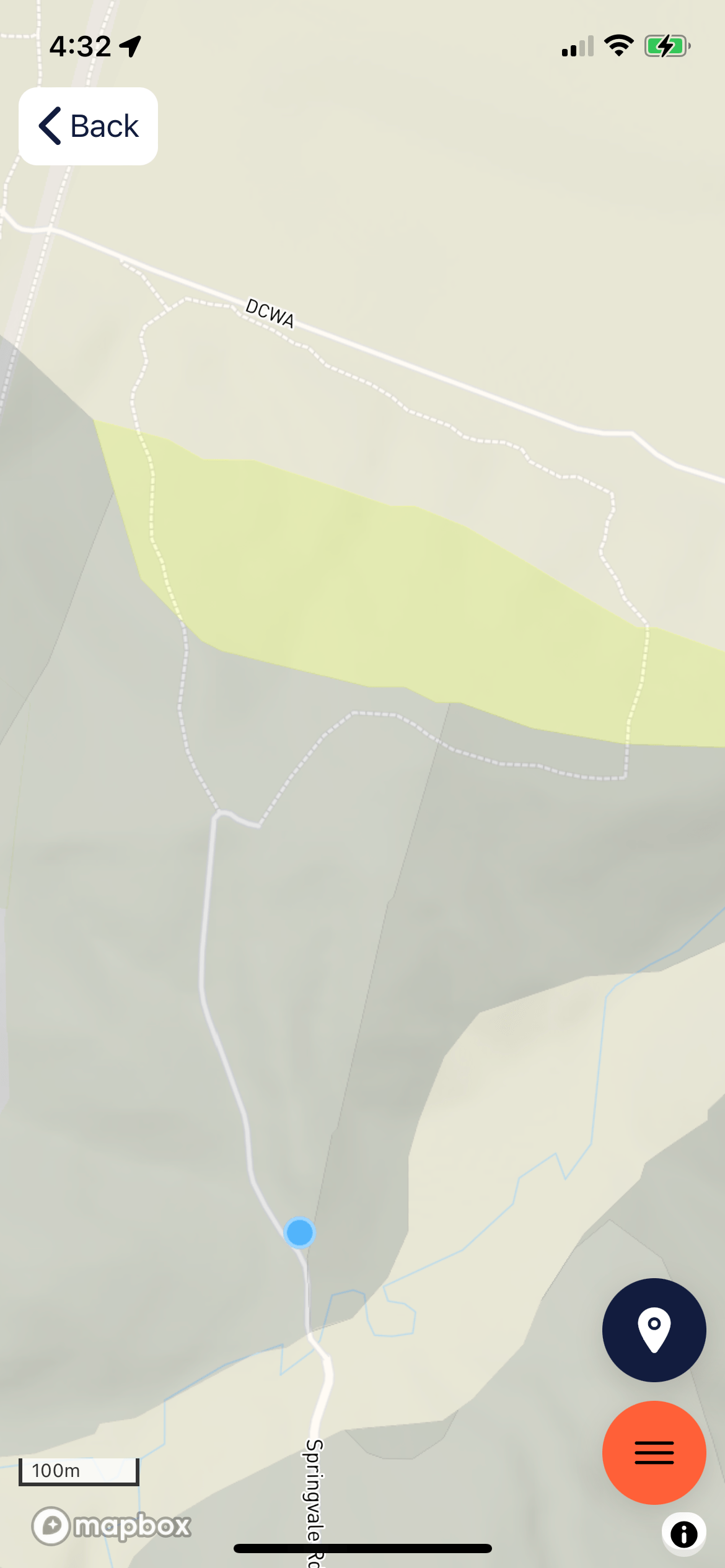
FIGURE 2. The blue dot marks the gravel road that leads to the trail we took, which is indicated by the dashed line. The light-green area to the left is the schist (1000-511 Ma) we’ve seen along this stretch of the Potomac. The darker area to its right is a metagraywacke from the same era. These rocks were originally deposited in an ocean trench where ocean crust was being subducted beneath continental crust. They were buried along with the ocean crust and deformed into medium-grade metamorphic rocks.
We left the nature preserve and briefly entered Seneca Regional Park (north of the road marked DCWA in Fig. 2) to get access to the Potomac River.

FIGURE 3. A side channel of the Potomac River with a gravel bed and pristine water flowing over outcrops of schist. The elongate dark areas are lenses of schist on the river bed. Similar features were observed at River Bend park and discussed in a previous post. The banks here are gravel and would be a great place to cool off on a hot summer day.

FIGURE 4. This is a view of an abandoned channel of the Potomac River, taken from the top of a steep bank, probably 40 feet above the river. This area is about a half mile downstream of Fig. 3. The water seen through the foliage is part of a cut-off lake that is active only during high-water. Similar features have been seen further upstream but with some water flow year round, as discussed previously.
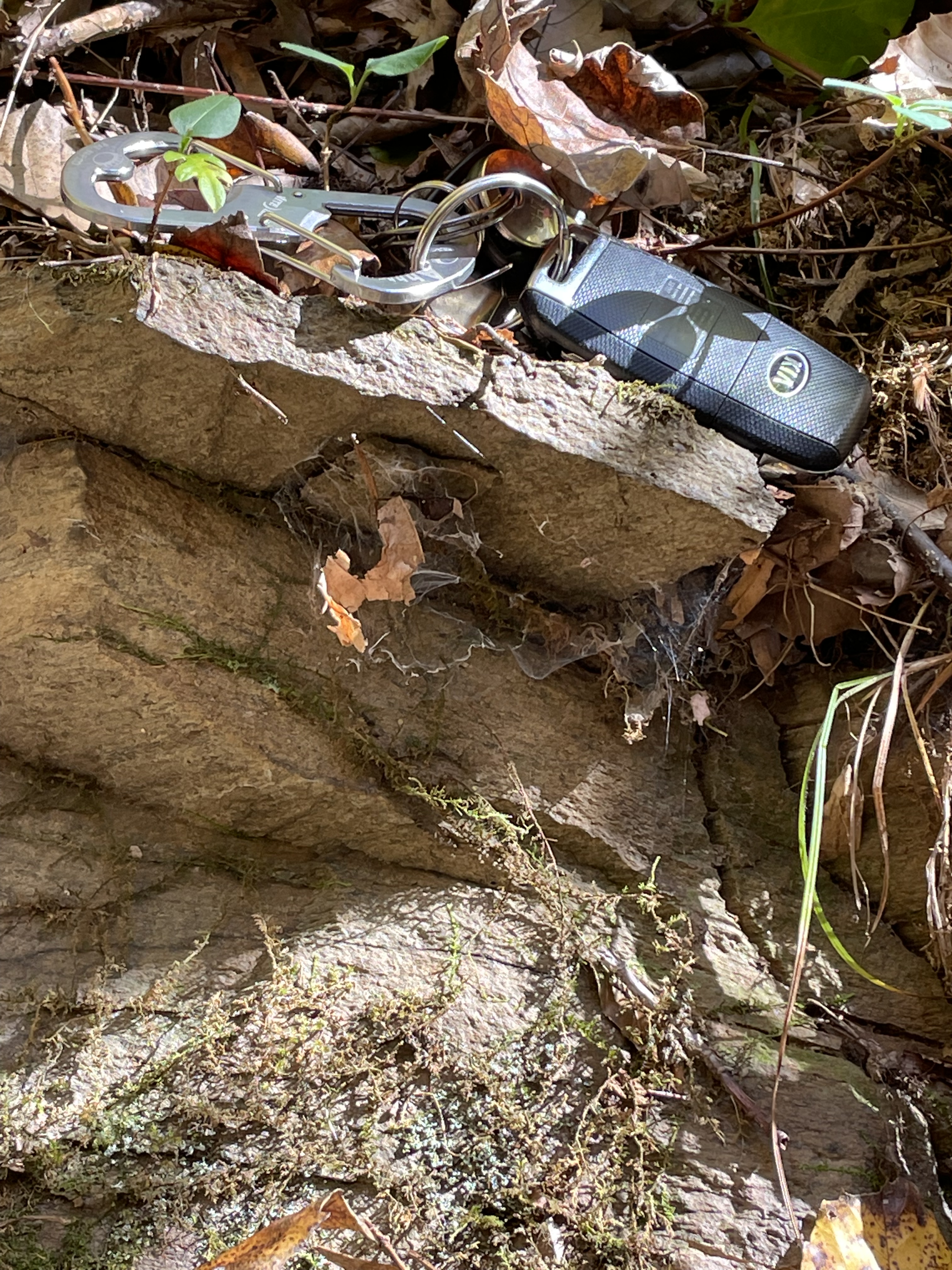
FIGURE 5. Close-up of a small exposure of metagraywacke along the access road at the blue dot in Fig. 2. Note the thin bedding and striations aligned perpendicular to the hillside. These are probably sole marks that indicate the flow direction in the original sediments. These rocks appear as lenses within the larger volume of schist, which was originally deep-sea mud. Imagine submarine flows flowing down the steep face of a submarine fan as turbidites.
This is a short post because we have seen most of these rocks and geomorphic features before. The novel feature that prompted me to write this was the wide floodplain (at least 300 yards across) and totally abandoned channel (Fig. 4). I also haven’t seen such clear water with no mud deposited at the shoreline. This location isn’t far from the narrow chasm that created Great Falls, where the river turns southward. I also noted a large number of steep gullies that appeared with no warning, indicating recent erosion from the surrounding hills, which are a couple hundred feet above river level. It seemed that some of the higher ridges were supported by cobblestones rather than bedrock, a feature we noted in Claude Moore Park that suggests ancient point bars.
Photographs can’t capture the complex topography of Fraser Preserve, especially with such colorful foliage interfering, so I encourage anyone who has the time to get out and see this beautiful landscape for themselves.
One final note: I support Nature Conservancy in their efforts to preserve natural lands and keep rampant development in check…
Diamond Head
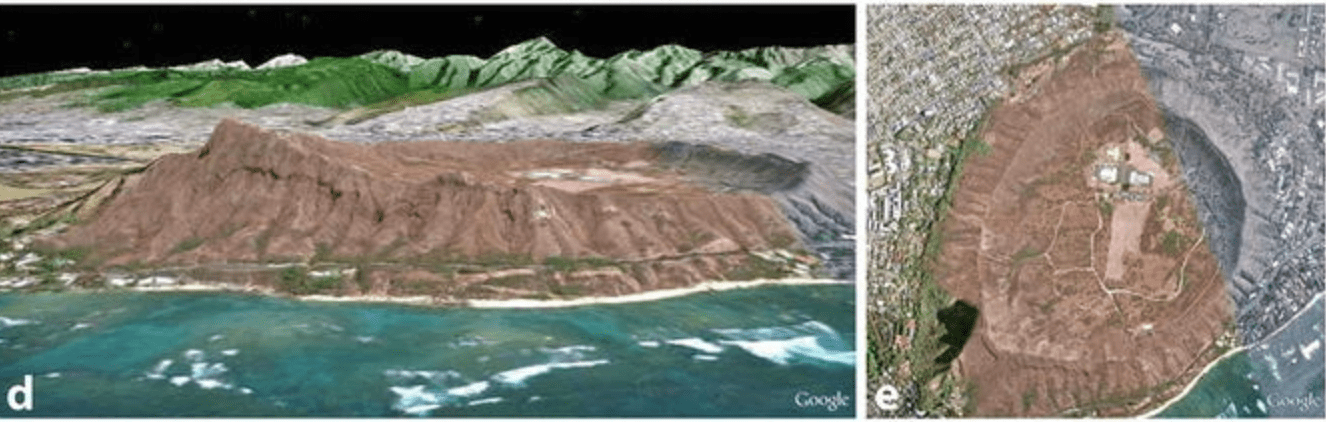
After so many posts from the volcanic island of Oahu, you wouldn’t think there was much left, but I couldn’t overlook the most famous volcano of all, although technically Diamond Head (Fig. 1) is a tuff cone like Koko Crater. This brief post is going to examine the internal structure of one of its limbs, on the seaward side.

The lighter color of the rocks in Fig. 2, compared to what we saw at Koko Crater or elsewhere on Oahu, suggests that the underlying magma chamber was depleted of mafic minerals. Dark hues associated with basalt are caused by minerals like plagioclase feldspar, amphibole and pyroxene, and biotite mica. The lighter color of the road cut (fresh and unweathered) suggests that the magma contained felsic minerals like albite and orthoclase feldspar, quartz, and muscovite mica. I could be completely wrong about this but there is no doubt that the rocks in Fig. 2 are not dark gray or black…
My hypothesis is consistent with what is known about the crystallization sequence of minerals from a melt and the resulting viscosity of igneous rocks. Mafic minerals and the lava they form have low viscosity and flow readily, as we’ve all seen in videos of eruptions on the island of Hawaii. These magmas bubble, flow, shoot fire into the air, and release pressure easily. However, felsic minerals (especially quartz) are sticky and have high viscosity, which causes them to resist flow, contain gasses, and eventually explode spectacularly (e.g. Mt. St. Helens).
I think the Diamond Head vent (i.e. volcano) tapped a part of the magma chamber that had already lost most of its mafic minerals, but it wasn’t as explosive as Mount St. Helens.

Another surprising feature I saw along the seaward margin of the Diamond Head tuff cone was a set of vertical joints filled with reddish rock (Fig. 4).
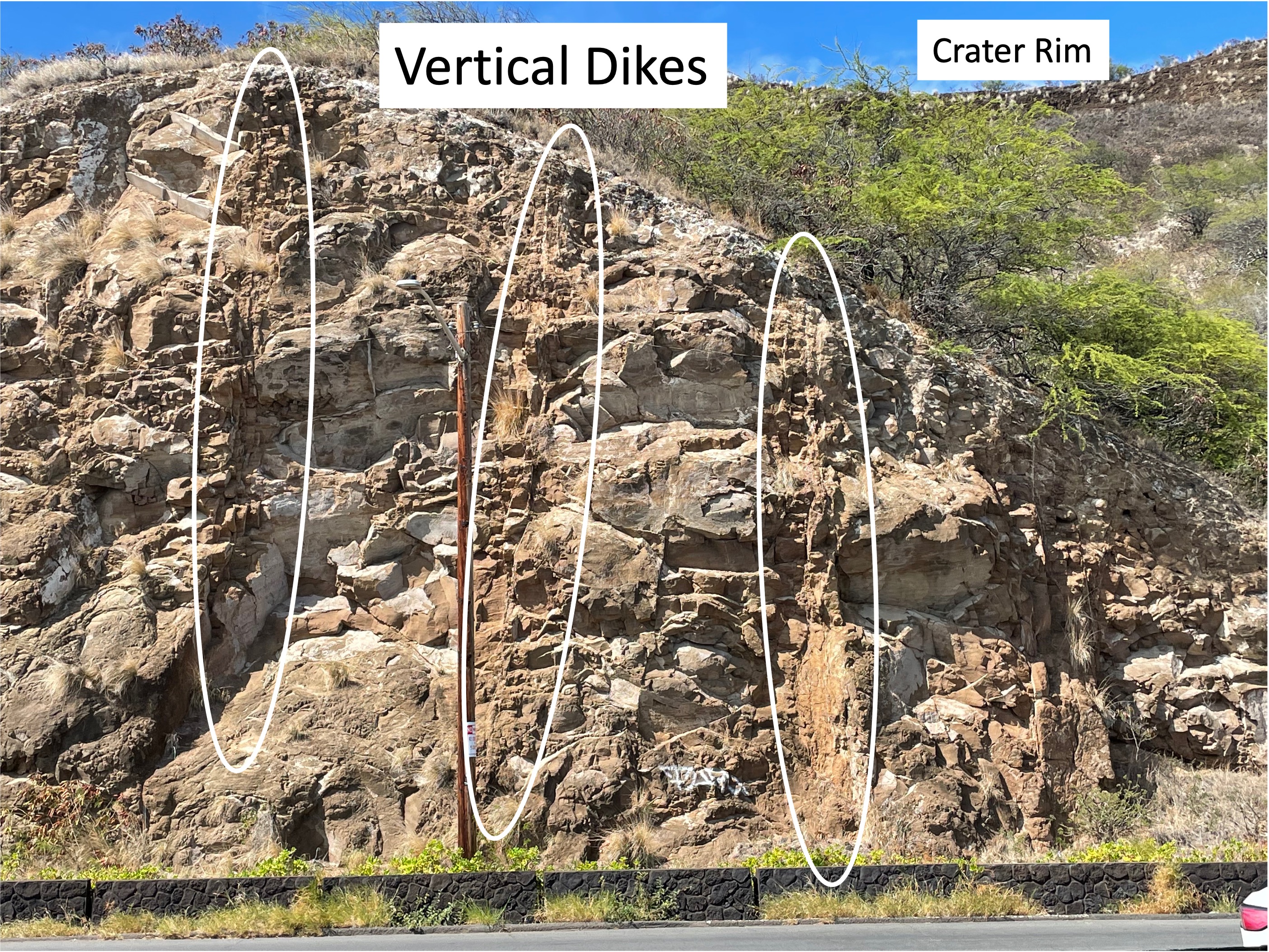
It is important to remember that the entire island of Oahu was constructed by magma escaping through innumerable fissures like those seen in Fig. 4, at first creating thick lava sequences deep beneath the Pacific Ocean’s surface, then flowing through breaks in the jumbled mass of previous flows. By the time the pile of basalt reached the water’s surface to form Oahu, the magma chamber was running out of gas (so to speak), and the lava was thicker and more viscous.
Diamond Head and Koko Craters were the result of these last gasps.

This post concludes my visit to Oahu, an island that rose from the sea less than five million years ago, formed by a huge magma chamber that was created when the Pacific plate slid over an upper mantle hot spot so concentrated that it melted ocean crust an constructed the Hawaiian archipelago, more than 1500 miles long.
I encourage anyone reading this post to explore the amazing story of this new land as it was populated by plants and animals, culminating in the incredible story of how Polynesian culture reached this remote land…
Inside Koko Crater
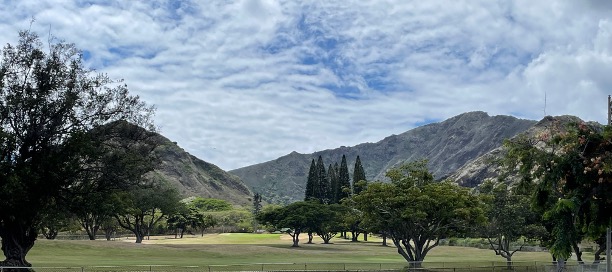
For this post, we went inside Koko Crater (Fig. 1) on the north side (Fig. 2), where the cone was breached, allowing easy access. A road had been constructed and the interior is now filled with a botanical garden and an equestrian center.

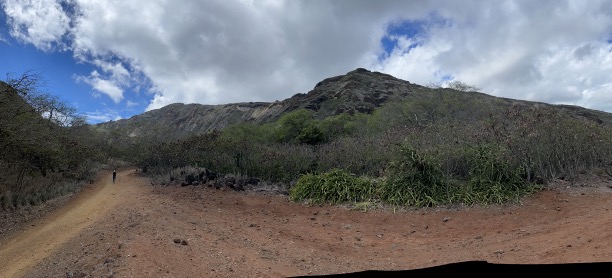
Parking is just outside the crater and a trail leads inside (Fig. 3), where a three-mile trail goes around the periphery. We didn’t have time to complete the circuit, so we settled for entering the main crater (see Fig. 2), where the walls were visible but not accessible for close examination (Fig. 4). However, the lower parts that were visible were covered with coarse debris less than 6 inches in diameter. There were some large boulders of vesicular basalt lying around, but they were loose and could have come from anywhere.

The extreme weathering seen on the inner slope in Fig. 4 suggests that the cap rock at least has a different composition, even if it is built from layers of ash. It is important to remember that tuff cones like Koko crater don’t continually erupt for centuries or millennia; they are local phenomena that vent part of the magma chamber that underlies a truly massive volcano like Ko’olau caldera (see Fig. 2). Thus, they are only active for a while, although dating is a problem for such short time scales.

It is important to note that Koko crater as we see it today has been eroded and the interior filled with breccia and ash during and between eruptions. We can’t say how much time passed between the layers seen in the middle of Fig. 5, but it could be hours to weeks. Most tuff cones are active for a couple of months, so the active period of Koko was on the order of a few years. Volcanic vents can produce a lot of ash very quickly.

This is my last post from Koko Crater. I didn’t have time to climb the 1048 steps to its summit, and I’m pretty sure my knees are glad.
In a nutshell, a vent formed along a fracture zone associated with the Ko’olau volcanic system and spewed ash and minimal lava flows onto the surface, where they interacted with the nearby shoreline, all of it lasting only a few decades at most.
Erosion has been minimal so we see Koko pretty much the way Pele left it….
Rebirth of Ko’olau Volcano

These volcanic rocks were erupted more than 1.7 million years after the devastating collapse of the Ko’olau Caldera. It was probably a last gasp to release pressure within the magma chamber. Exact dating of these younger tuff cones is problematic, but they were all created within about a 50 ky window.

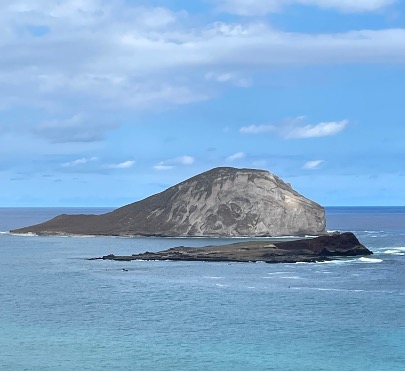

The kinds of volcanic tephra produced by the original Ko’olau volcano and the younger tuff cones shows a tendency towards more ash and less basalt. Certainly, Koko, Diamond Head, and this unnamed crater were part of monogenetic fields. These cones degassed a part of the magma chamber then became dormant; others appeared to perform the same function in another part of the chamber, part of the overall development of the Ko’olau volcano.
With the extinction of the fires here and at Koko Crater, it is safe to say that Ko’olau is dead and the goddess Pele has moved to her new home in the Kilauea volcano, on Hawaii…
Beach Erosion at Kailua
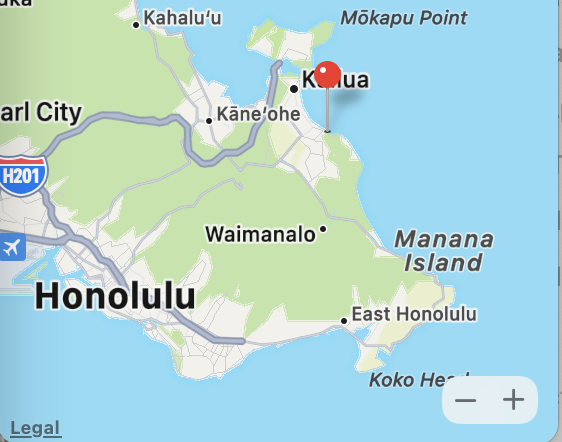
This is a quick post to summarize some effects on the beaches of the windward side of Oahu, where basalt rocks of the Ko’olau volcano don’t protect the coast. Kailua isn’t far from Honolulu (Fig. 1) and the climate is similar. The wetter coastline, such as at Nu’uanu park, doesn’t extend this far. Kailua is a broad flat area, unlike the deep valleys of the north shore. The caldera is set back much further from the coast and the basalt is buried.
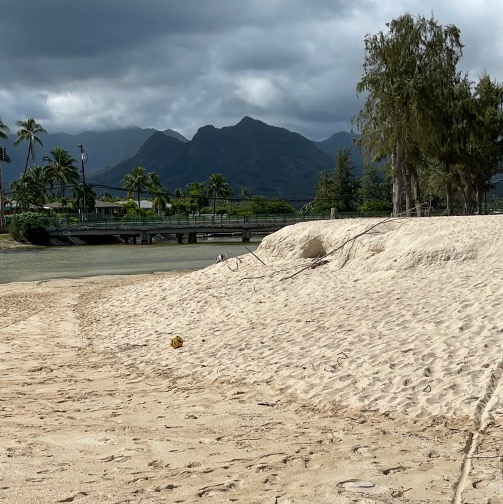


There is nothing surprising about what we saw at Kailua beach. Beach erosion is ubiquitous around the world; for example, it takes years for scarps like that seen in Fig. 3 to recover from a tropical storm in the Atlantic Basin. Recent studies suggest that in general, sandy beaches are being eroded; the proximate cause is a lack of sediment or increased wave energy, but the root cause most-often blamed is climate change and sea level rise.
We need to stop blaming the climate and reconsider all of the dams and diversions we’ve constructed on rivers that feed the world’s beaches, and ill-considered engineering projects completed in coastal zones.
The beach isn’t a play pool…
Remnants of Ko’olau Caldera


Today, we can see some of these rocks up close. Also, these are not as weathered as we saw previously. The lava flows are well preserved at Nu’uanu Pali park (Fig. 4).
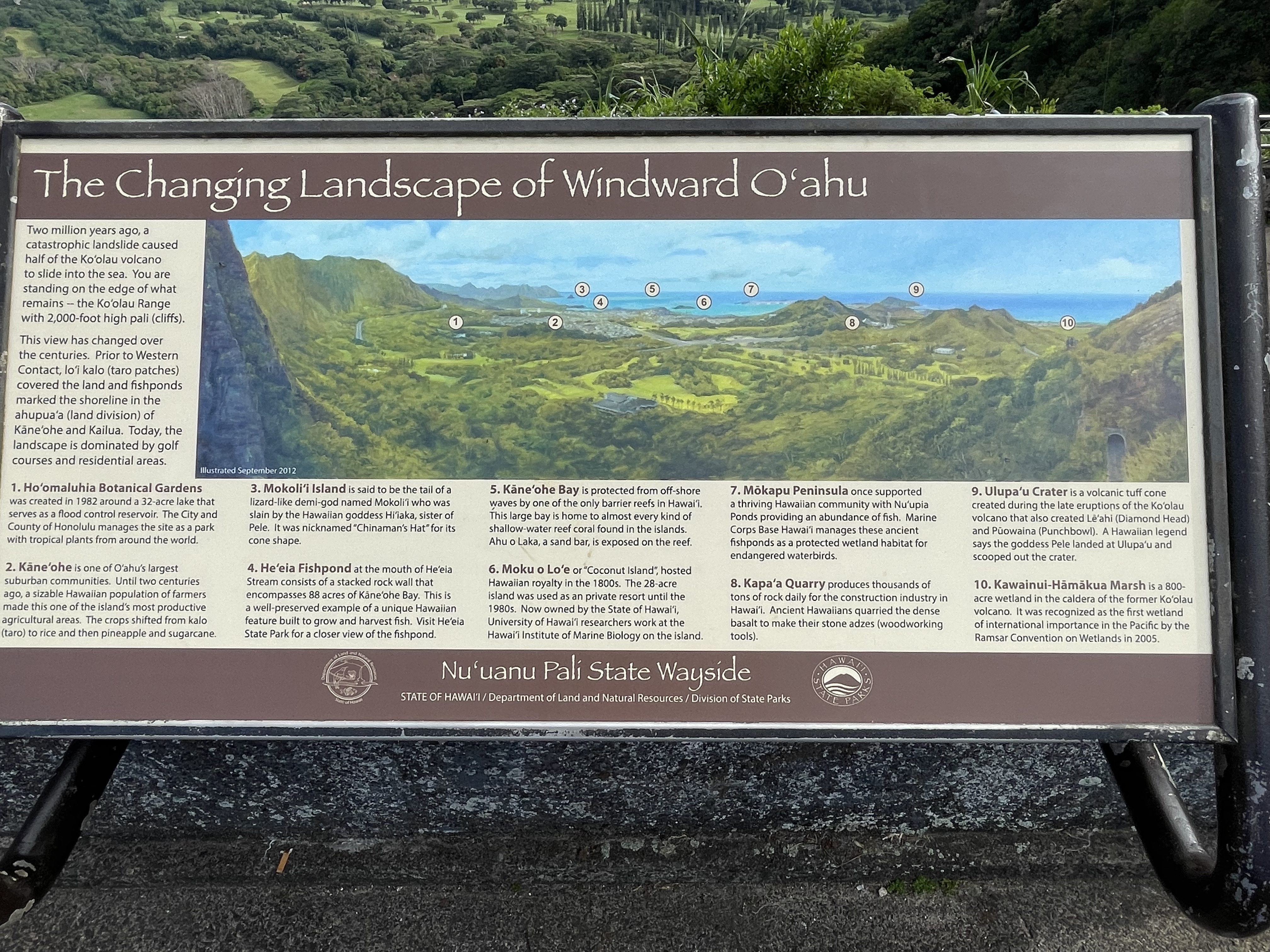

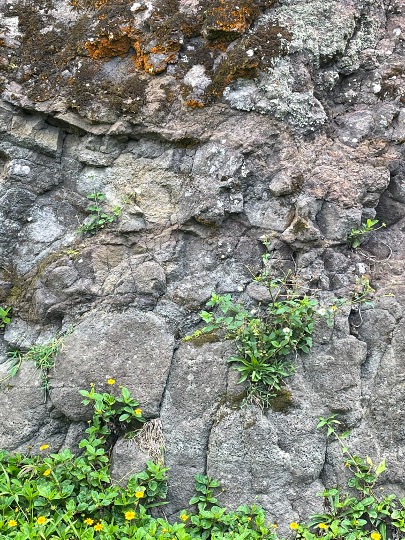


This post visited the remains of the Ko’olau volcano, which exploded/collapsed/disappeared into the Pacific Ocean about 1.7 my, leaving a sharp mountain range that was the edge of the central caldera. A much younger tuff cone erupted about 100 thousand-years ago as part of the rejuvenation of the magma chamber. Its last gasp as it were.
Ko’olau Volcanic Rocks
This is going to be a relatively short post about some of the older volcanic rocks on Oahu, basalts from the Ko’olau volcano, with an age between 2.8 and 1.7 million years ago (my). I introduced these in a previous post. This post examines some of these rocks up close.


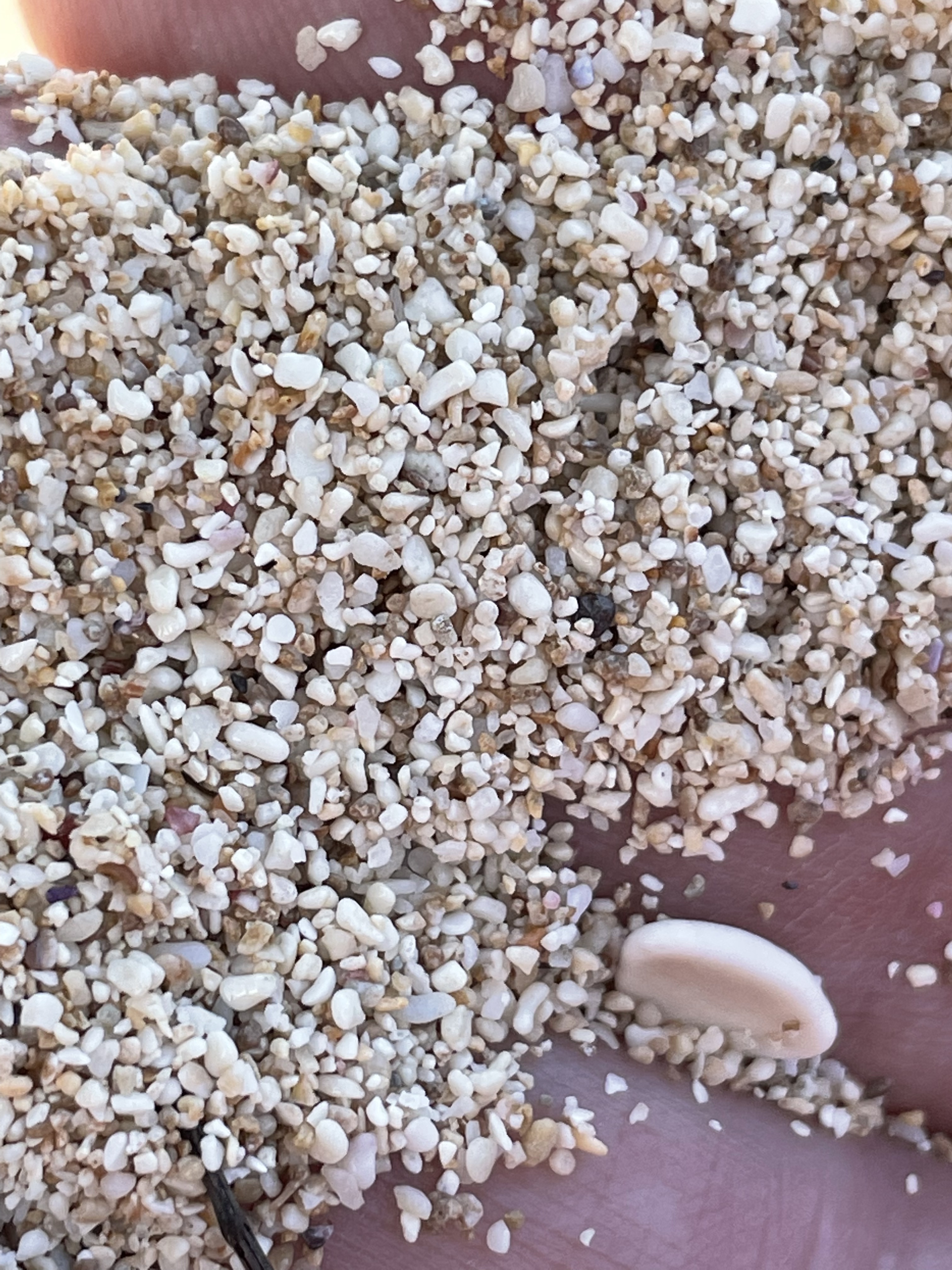
Low rainfall along this coast has brought erosion in the mountains to a standstill. None of the streams that penetrate the Ko’olau Range reach the ocean during the summer and fall. There probably are episodic floods that deliver find-grained sediment from the highly weathered volcanic rocks.


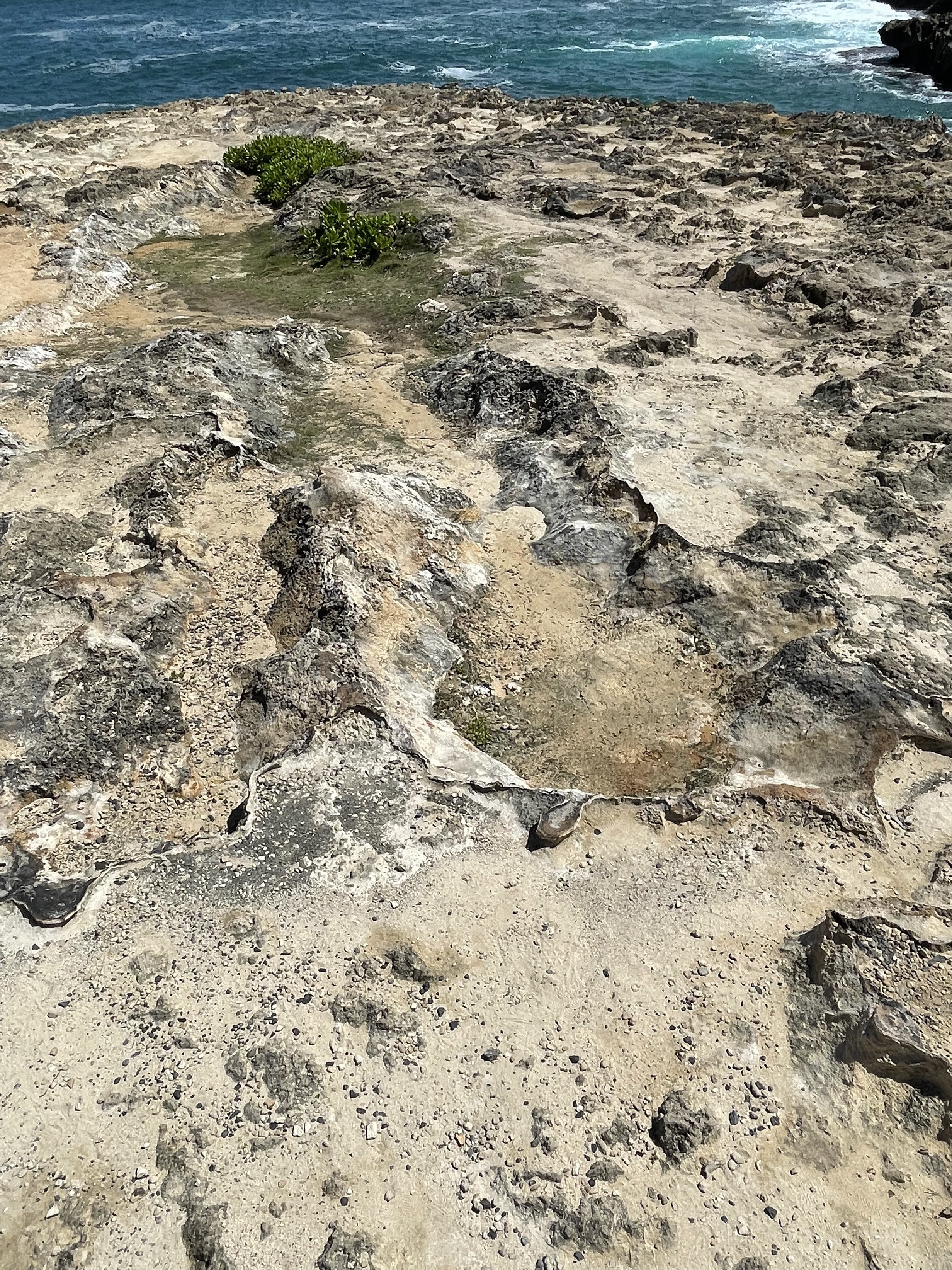

This post has shown some of the characteristics of the Ko’olau Volcano and its associated basalts. The original lava has been chemically altered to produce clay minerals, which are easily transported. There are no mud flats because of the slow weathering and delivery to the coast, although soils can be very rich in the inland parts of Oahu. A previous high-stand of sea level created a bench that is found throughout the island, as noted in a previous post.
We’ll look at what the Ko’olau Volcano looks like today in a later post.
Volcanism at Koko Crater

This was a great opportunity to examine geologically recent (less than 1 my old), large-scale volcanism up close. I’ve seen small cinder cones in northern Arizona that are part of the San Francisco volcanic field, but they were small enough to be surmounted in a couple of minutes; other volcanoes I have seen were either huge (entire mountains) or so old that they were unrecognizable. Koko Crater is a perfect fit. It is 1200 feet high and young enough to preserve a range of volcaniclastic textures, yet easily accessible from a safe parking area.

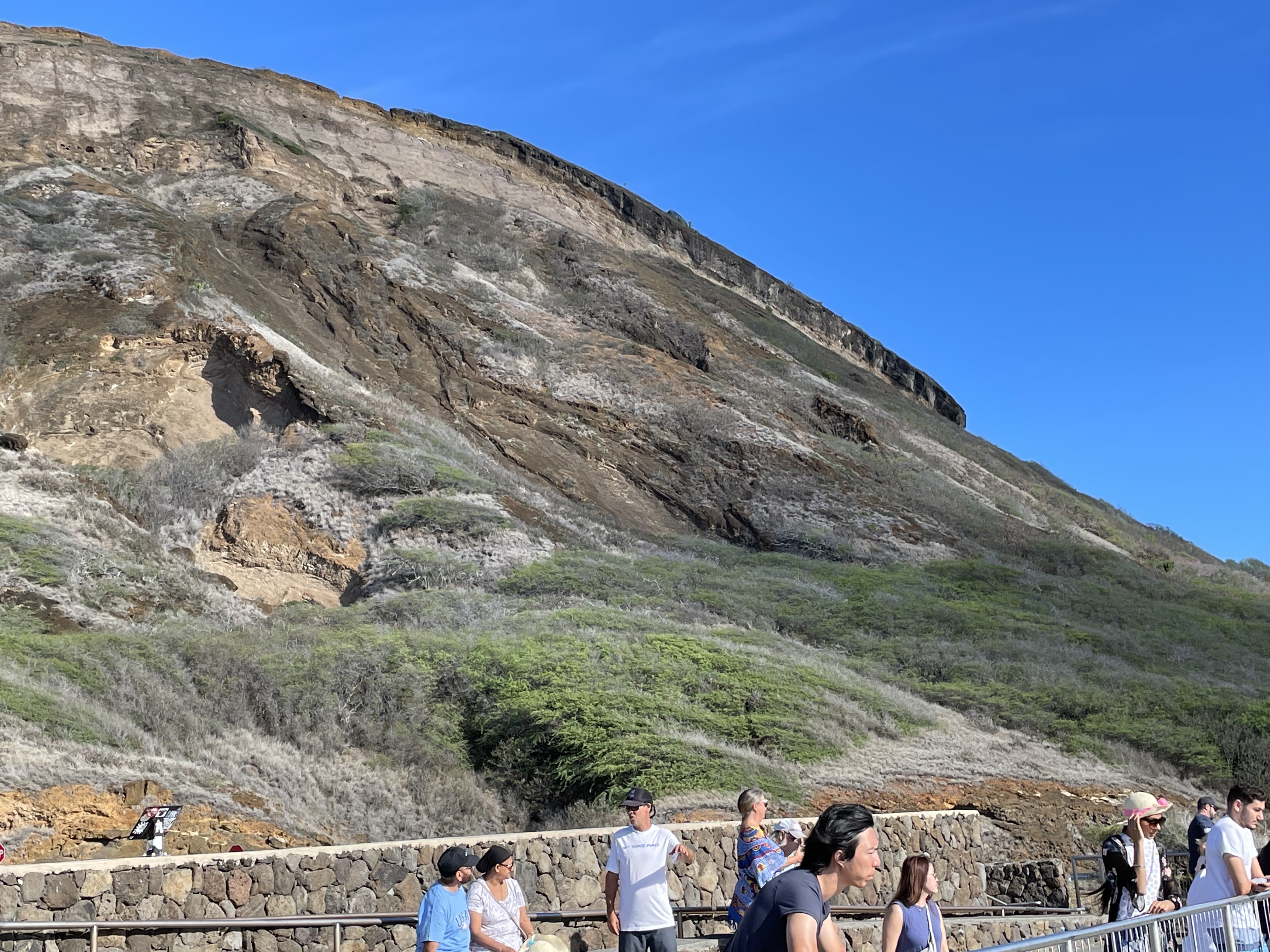

Field Relations
Figures 3 through 5 show us the lay of the land, but we have to get a bigger picture to understand what we’re looking at; and that is difficult in such an immense landscape. I will try.

Structural Trend 1 appears to be close to its original orientation because it conforms to the steep sides of the crater. This alignment is seen on other “ribs” projecting from the crater’s rim. Ash at a temperature of 800 to 1500 F would have stuck wherever it landed and formed horizontally uniform laminae (less than 1/16 inch) and thin beds. This was primary depositional orientation of the ash layers. Of course, ash will fall into steep valleys and fill low spots, just like snow, which is also sticky.
Trend 2 cuts across Structure 1 at more than 30 degrees, but it appears to be local .
Trend 3 dips about 20 degrees towards the crater but its primary orientation is towards the canyon bisected by other ridges seen in Fig. 6. This is a post-eruption feature, as is Trend 2, both of them created as thick layers of ash consolidated, settling more in preexisting valleys than hills. My interpretation is that the valley cutting across (left to right) in Fig. 6 was the edge of the crater when Koko was active. Tephra and basalt collected there to form a plateau (indicated by white ellipse in Fig. 1), which was subsequently eroded, before a few tendrils of basalt flowed out of the crater (e.g. upper parts of Figs. 4 and 6), forming resistant ridges. This post will focus on the stratigraphy of one of these ridges.

Figure 7 reveals at least two unconformities; the fault that dropped the seaward block down a few feet as it rotated, and what appears to be an erosional surface (the cyan line delineating layer “4…5?”). The complex pattern of episodic eruption, erosion, and deformation on the eastern margin of Koko crater is not unusual for a monogenetic volcanic cone, which remains active for a short while, until the magma chamber decompresses (so to speak).
Volcaniclastic Examples
It is time to speak to the rocks, hear their side of the story, and listen to them if we can. All wisdom comes from the earth, and thus it behooves us to hear with our eyes and our imagination (rocks don’t talk), the story that has been written in … stone.


Sedimentary Examples
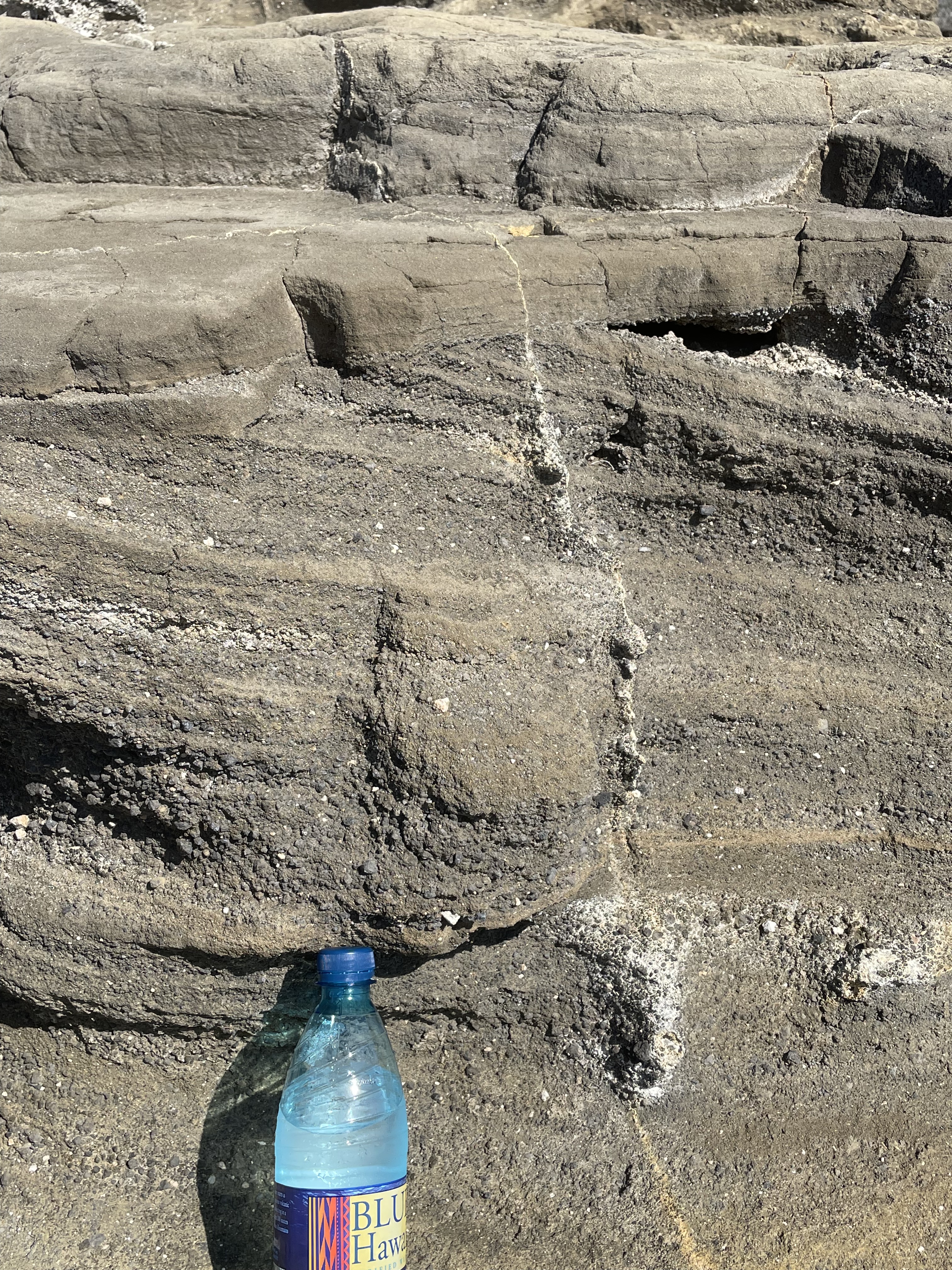
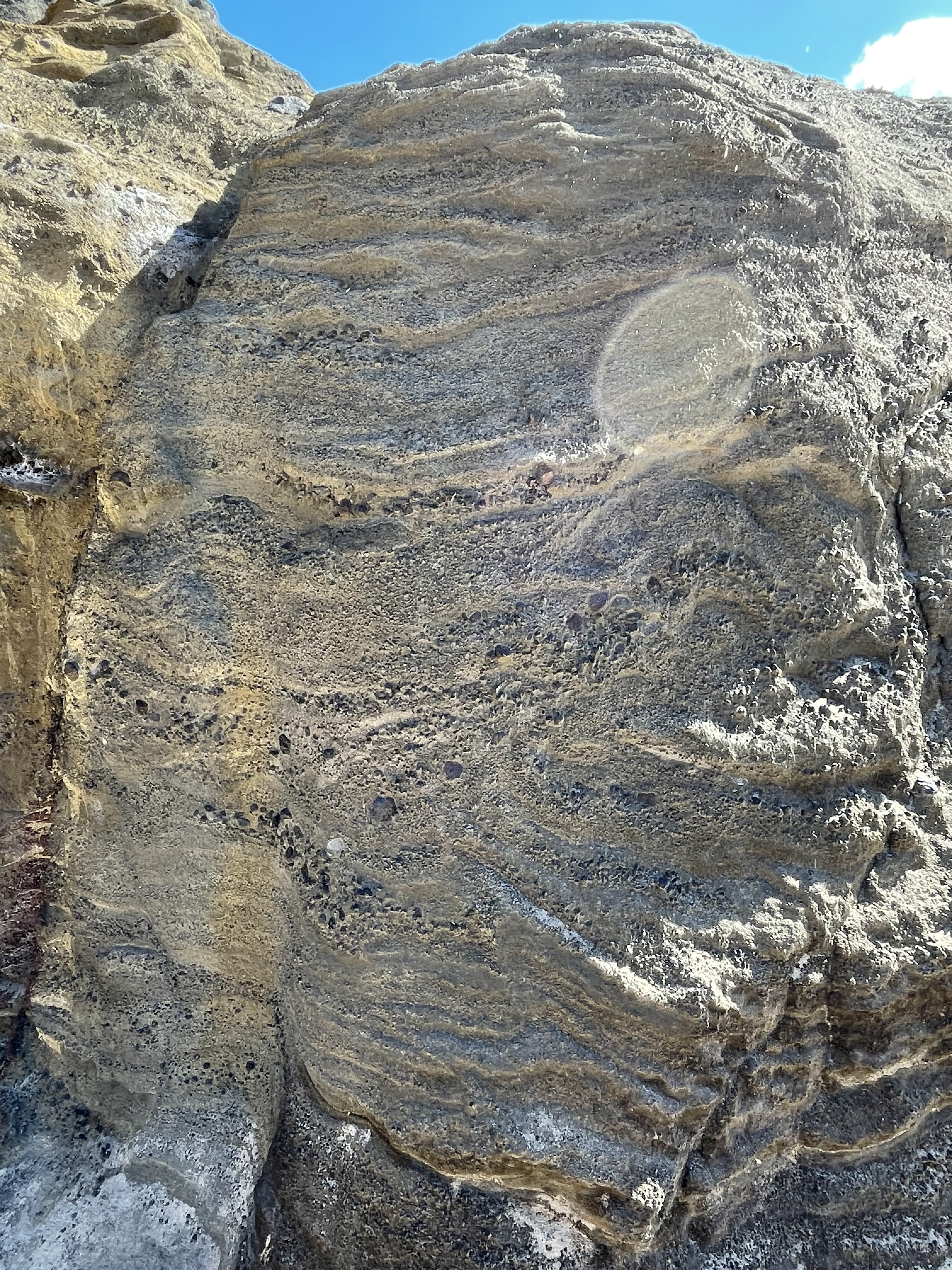
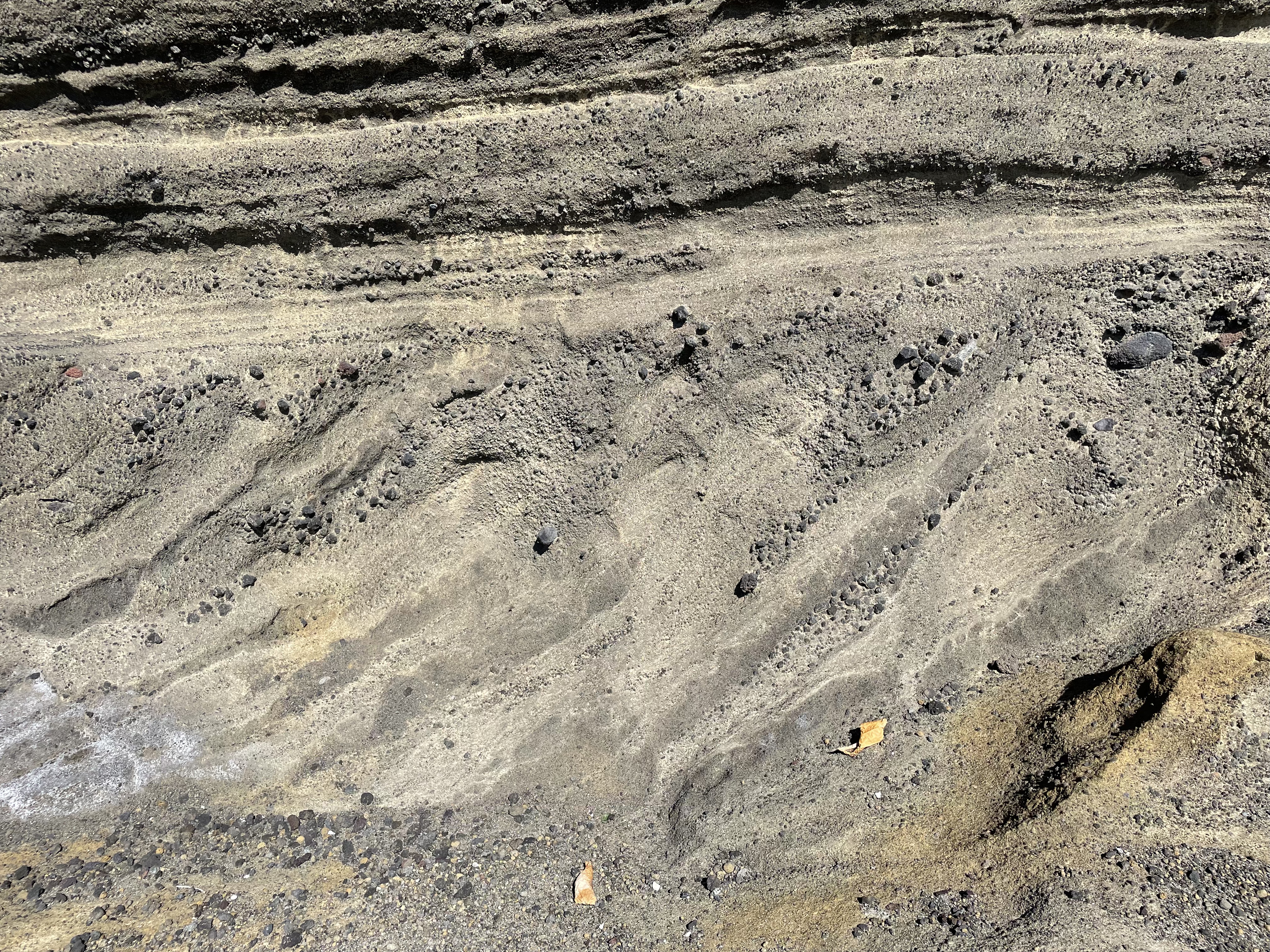
Figures 8 through 12 unambiguously show that volcanic tephra of every size and shape were thrown into the air and landed in hot and sticky ash, where these bombs became clasts, forming volcaniclastic rocks. Now we will look at some examples of rocks that are just as hard, but that reveal sediment transport by wave action.
Summary
I’ve presented a lot of data on volcaniclastic rocks at Koko Crater. Before I summarize I’d like to present one last annotated photo, which shows the stratigraphy as well as I can tell from my limited access to good cross-sections (aka road cuts).

I would like to add a few points to Fig. 16. First, older sediments were seen at the current beach (Figs. 14 and 15) which clearly indicate a surf zone environment. These rocks may be from as much as 100 feet down-section (older), which is consistent with changing relative sea level caused by global sea level fluctuations during the last 100 Ky, and uplift and settling of the Koko crater itself, as magma pushed up and relaxed.
Rocks from~50 feet further up section (younger) demonstrate that the ash was deposited at or slightly above sea level (Figs. 8-12). The total section has a thickness of approximately 100 feet (guesstimate not based on careful measurements, but eyeballed), which must have been deposited within a few thousand years because of the young age of Koko Crater (~50 Ky).
Finally, Koko crater is a tuff cone, which means that it mostly created hot ash as a magma chamber locally depressurized. This kind of eruption doesn’t reoccur once pressure has dropped below the strength of the overlying rocks. Tuff cones are part of larger volcanoes, in this case the Ko’olau volcano, one of three that created Oahu and dominated volcanism for the last four-million years (Fig. 2).
One last word–I have never seen photographs like those I took for this post, not in a text book, Wikipedia, or anywhere else. I don’t know why that is, maybe academic geologists are too busy teaching geology to stop and smell the roses…
A Quick Visit to the Ko’olau Volcanic System
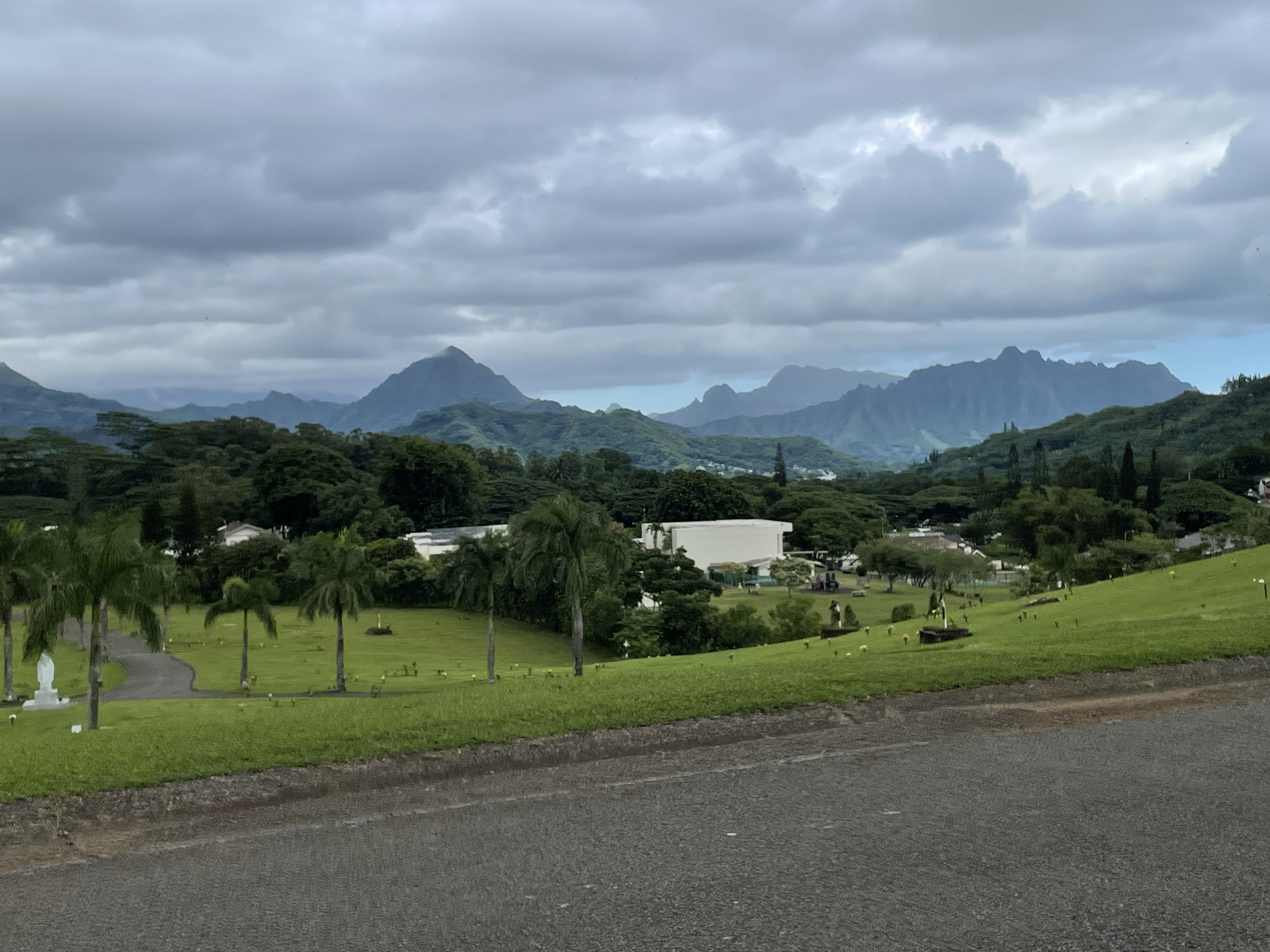

Let’s look at some of the rocks from the Ko’olau caldera, originally erupted in shallow water between 2.8 and 1.7 million-years ago, from a fissure that was below, or not far above, sea level.
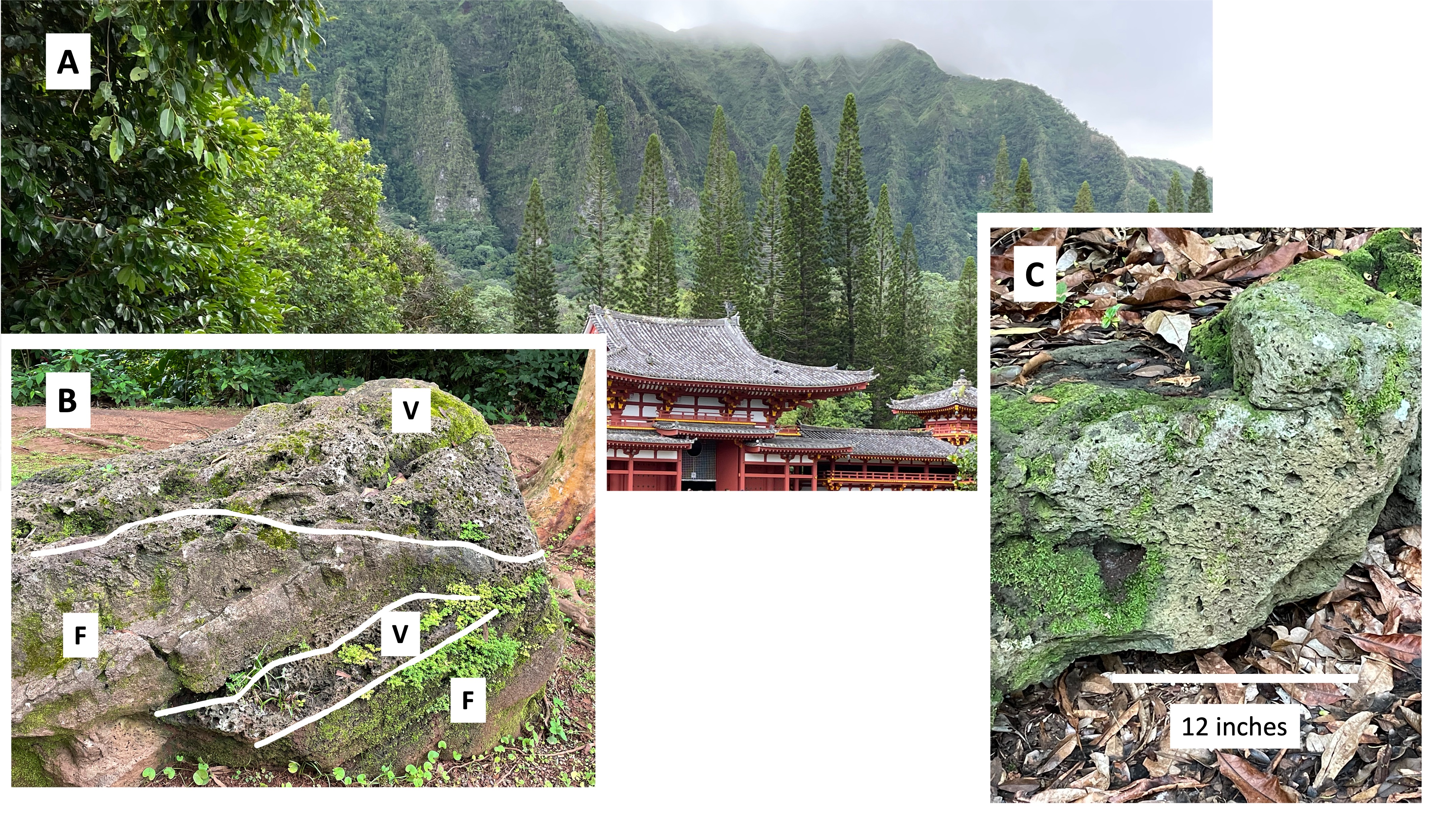
These rocks have been highly altered because of interaction with water when erupted, but the structures seen in Figs. 3B and 3C were preserved. Magma chambers contain a lot of gas, e.g., carbon dioxide and hydrogen sulfide, which expands when the magma moves towards the surface where pressure is lower. Small cavities (vesicles) remain when the gases escape (see Fig. 3C). The volcanic gases are not uniformly mixed within the magma however, so some of the erupted material will have vesicles whereas some will not (see Fig. 3B). Nevertheless, well-defined contacts between gas-rich (vesicular) and gas-poor (solid) magma when it flows onto the surface cannot be easily explained. The “V” and “F” layers in Fig. 3B were not necessarily flowing, although it is likely that they were moving if they were erupted onto a sloping surface. The contacts (white lines in Fig. 3B) could simply be the result of very hot lava flowing out from a common source, the differences that existed within the magma chamber mirroring fine-scale variations of the its chemical characteristics.
The Ko’olau volcanic system would have been venting along fractures, thus creating many, often overlapping, volcanos on the flanks of the main “super” volcano. Such an immense volcanic system couldn’t remain stable for long (i.e. millions of years) and it collapsed into a huge debris field (refer to Fig. 2A), leaving the fragile remnants of its glorious past naked to face the extreme weather that came from the arctic, creating the jagged peaks of the Ko’olau range (Figs. 1 and 3A).
The collapse of the Ko’olau caldera occurred sometime between 1.7 my ago and when volcanism began at several fissures to the southeast about 500 thousand-years ago, adding more land to the island of Oahu.
We’ll see what that was like in my next post…


 Timothy R. Keen
Recent Comments