
Review of “Sleeping Giants” by Sylvain Neuvel
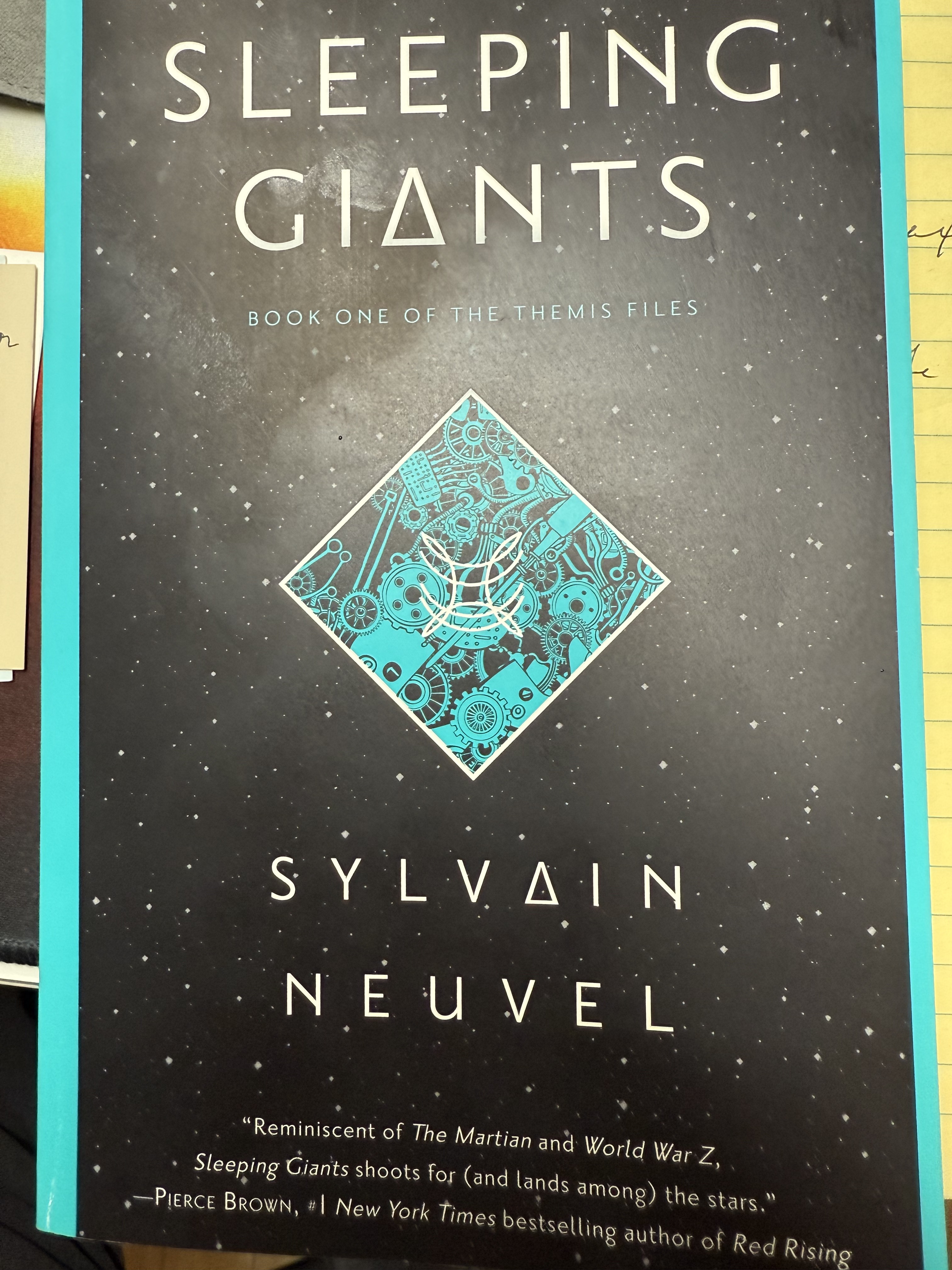
I’ve been reading science fiction in preparation for a writers workshop, focusing on the First Contact sub-genre. This commercially published book violates most of the rules that were introduced … we were also warned that publishing is a crap shoot. This isn’t actually as bad as you might think.
For one thing, this is a great title. It grabbed my attention on the lower shelf at Barnes and Noble, and that takes a lot of effort (kneeling down, trying not to be trampled). It was nestled between a lot of second and third books in trilogies. I guess not many people get past the first one. In fact, the fine print says this is book one of the Themis series. Fortunately, it is fine as a standalone story, ending on a hopeful note but giving the curious reader the chance to see how humanity screws up this galactic opportunity. I like the happy ending and skip the sequels.
The story begins with a little girl falling into an unexpected hole and landing in the palm of a twenty-foot hand. I thought the newspaper story style was convenient, but the entire book is written as interviews, reports, and diary entries. I eventually decided that the unnamed interviewer was the narrator and central character. As you might imagine, this killed the action scenes. They aren’t nearly as exciting when related after the fact. To reveal how the characters feel and their romantic lives, the narrator asks rather personal questions; they aren’t a therapist but only a program manager.
A lot of backstory is introduced by characters introduced simply to supply information. I felt I was missing need-to-know information because of this plot gimmick, until it was too late. Kind of like Perry Mason and his suddenly appearing witnesses.
There isn’t a lot of action, even accounting for the delayed reporting used, but there is a love triangle, jealousy, and even a suddenly psychotic evil scientist. The author’s choice of using an interviewer is interesting but it makes the entire story feel distant, like reading the newspaper, and that isn’t why I read novels.
I’m ambivalent about this story. It isn’t bad and, fortunately, not drawn out, so my recommendation is that it won’t put you to sleep … nor will it keep you on the edge of your seat. After what I said above (about the publishing business), I applaud a publisher willing to take a chance …
Review of “Dreams in the Eternal Machine” by Deni Ellis Béchard
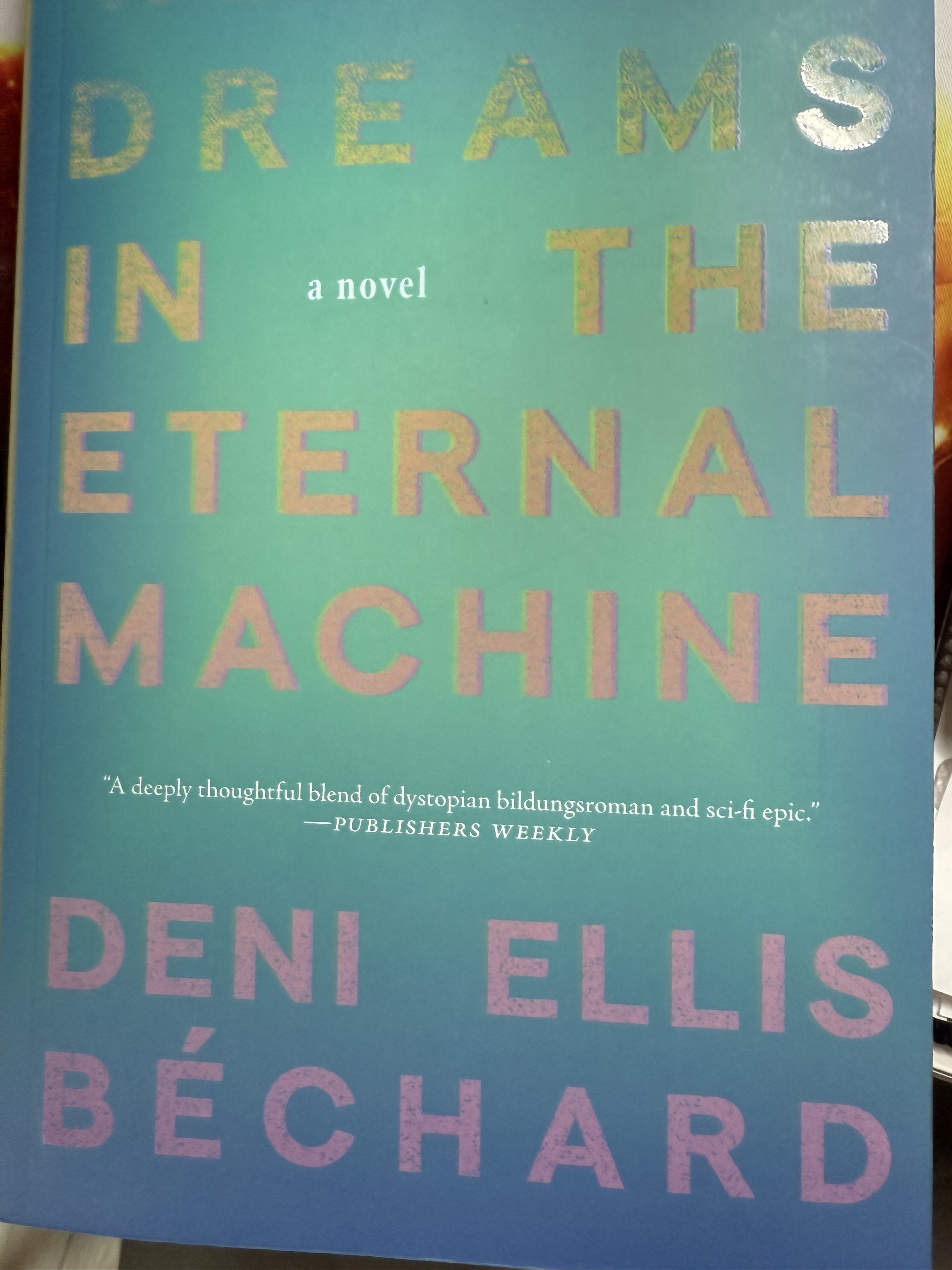
There is no surprise ending to this speculative science-fiction novel. The secret is in the title and explicitly introduced in the first few pages. Everyone on earth, including the planet itself, has been assimilated by an artificial super intelligence whose rapid development far surpassed its creator’s imagination. So what is the plot?
Wrapped in a science fiction cover is a Shakespearean story of betrayal between young people who accidentally meet in an American divided by civil war. Their story is integrated with their separate experiences after assimilation into the machine, and it remains unresolved. The only other evidence of a plot is the general decline in cognitive and emotional wellbeing of the majority of people. This process is explored through several characters whose importance to the plot is never clear. In fact, no one really stood out as being the central character, other than the two young people mentioned above. Having a plot doesn’t require the central character to succeed; failure is the stuff of tragedy and perfectly okay, but no one really struggled against the antagonist (obviously the eternal machine). Their situation is hopeless and there is no chance of escape — not even the slightest. Hopeless.
Given the lack of a coherent plot or even a central character, this story is fundamentally about the response of people to a hopeless situation in which there are no threats of any kind. The machine not only feeds and cares for its dependents, it creates any world they want to see and experience. Spoiler alert: Heaven gets old after a few centuries.
The writing is very good, and the author doesn’t miss a trick to get an agent’s attention and produce a popular book. It seems to me that agents probably don’t think very hard about the books they represent. And, of course, the reader doesn’t find out until it’s too late, the money spent. That’s how I felt. As far as the reviews, I never cease to be amazed at the glowing reviews written about this novel; I guess critics don’t read books either.
Review of “Earth Abides” by George R. Stewart

This story unfolds in the aftermath of a global pandemic that kills 99.9% of humans. It was first published in 1947 but, as the cover shows, it is coming soon to streaming services; nevertheless it is grounded in the post-WWII era. The author does a reasonable job of making the story independent of the era. The central character, Ish, witnesses the regeneration of culture but not civilization.
This novel focuses on a graduate student who isn’t a genius, nor is he stupid. In fact he focuses on the intelligence of his fellow survivors continuously. He carries a weight of intellectual solitude throughout his long life, even as The Tribe grows in number. The author interweaves the emotional torment of Ish with the deterioration of the accoutrements of civilization, leading to a not-unexpected finale. The grammar is clumsy, probably because of a lack of writing skill, but the effect is (mostly) positive because of the disintegration of knowledge that can’t be learned outside the classroom , including written language.
Ish continuously contemplates many ideas that plague modern society over the course of this simple and repetitive story. Nevertheless the author does an excellent job of following one person’s interpretation of such a catastrophic event, even if he isn’t as smart as he thinks he is — that may be Stewart’s greatest achievement: no one is as smart as they think they are.
This is a good story that might even bring a tear to your eyes …
Review of “The Forge of God” by Greg Bear

This “First Contact” novel was published in 1987. The back cover was intriguing, so I found a used copy at ThriftBooks. It does not have a (very) happy ending; the story unfolds to a backdrop of hopelessness. The author didn’t wait long to introduce the antagonist. The protagonist was more difficult to identify from an ensemble cast of characters; they were pretty similar in their responses to the crisis. Just to add some spice, there are several characters who bring nothing to the plot other than their response to the end of the world. A lot of dead-end threads.
The grammar is simple but effective whereas the sentences are often awkward; I had to reread them too often.
There is too much going on in this story … and not enough. The author carefully described every character, even if they were only fillers. I appreciate what Greg Bear was (probably?) doing: he wrote a literary science fiction novel in the manner of Arthur C. Clarke (e.g. The Martian Chronicles). I never cared for Arthur C. Clarke’s novels, and this one goes even further, often for no obvious reason. It might work for someone else, however, because it is fairly well written.
I always wince when I see an epilogue. They indicate that the author is running too long and has to wrap up the story ASAP. That was the case here, and I was still left with fundamental, unanswered questions …
Review of “The Brothers Karamazov” by Fyodor Dostoyevsky
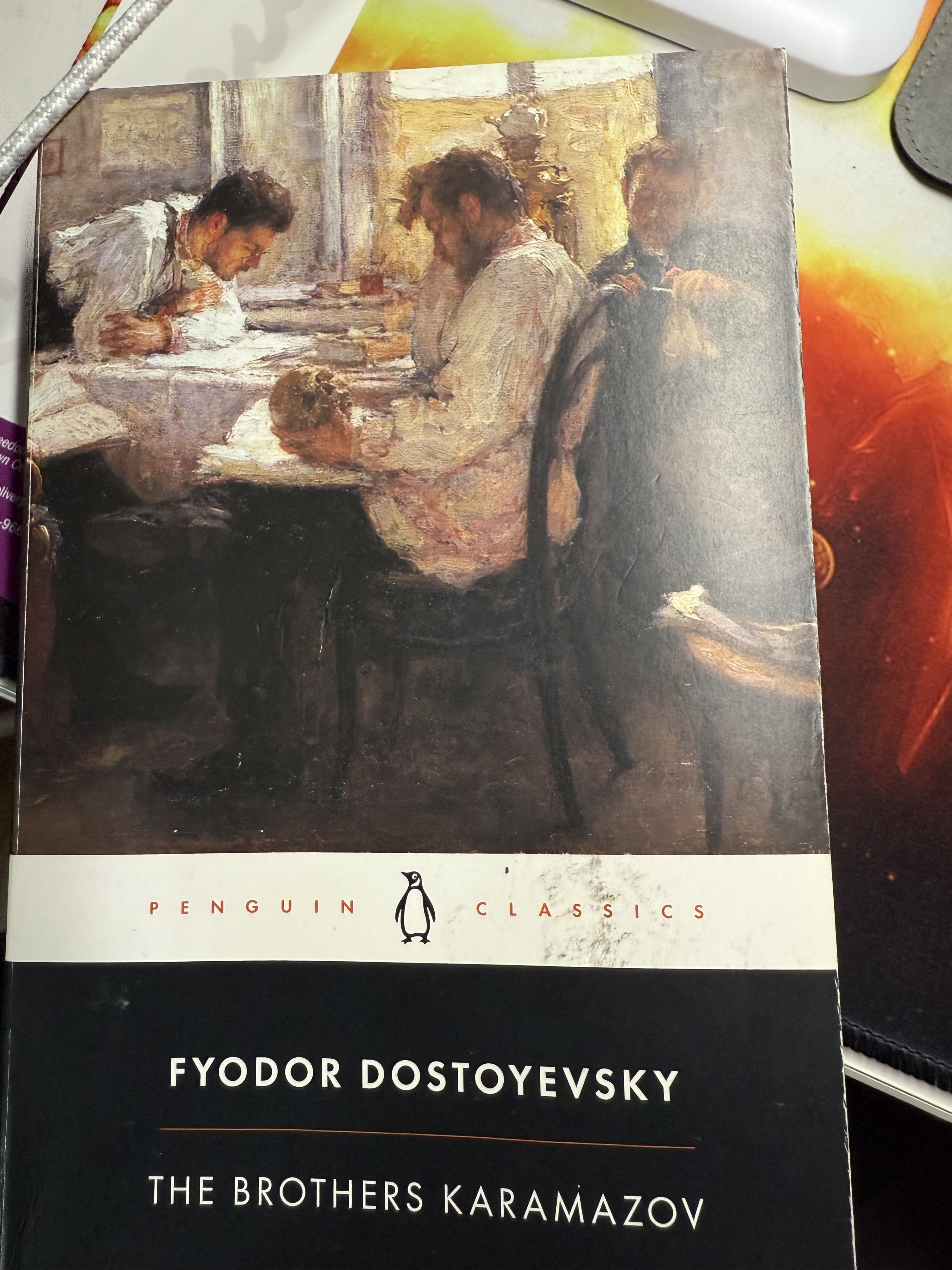
This review isn’t going to be as long as this literary classic (985 pp). I’ll skip all the usual analyses about the author’s commentary on contemporary Russian society (circa 1880), although it is set in a small village during the 1840s. The three brothers, Dmitry, Ivan and Aleksey, represent three types of character: rash and brutal; thoughtful and intelligent; emotional and sympathetic. The story centers on Dmitry, who has an ongoing conflict with their father Fyodor over his inheritance from his deceased mother. They are also in love with the same young woman. The tension is palpable and leads to violence. Eventually, Fyodor is murdered and Dmitry is tried for the crime and found guilty by a jury in a fair trial; the incriminating circumstantial evidence is simply too much to overcome. Enough of plot details.
No character is too minor to have their life described in detail, even if they have no relevance to the story. These ancillary stories make up about half the book, including entire chapters, filled with characters who serve no purpose other than showing something about life and death in nineteenth century Russia. The writing is extremely wordy. Some sentences are half a page long; some paragraphs several pages long; none of this makes sense from a literary perspective but appears to be whimsical. No thought by any character is left untouched by a narrator who claims to live in this village, but has the superpower of reading everyone’s mind. Nothing is left for the reader to figure out; every act, desire, emotion is fully explored through contrived scenes that make certain of this.
This book is considered a classic of existentialism for good reason: the characters make no attempt to change or even offer excuses; their innate personality is the reason for the most scandalous behavior — take me as I am or leave me alone! This is the appeal of this gritty story of bad decisions leading to foreseeable outcomes. The take-home message is that people cannot change who they are and should embrace their weaknesses as much as their strengths.
I cannot recommend this book. It is simply too long, filled with extraneous stories, and poorly written. However, if you want to have a taste of the Russian love of pain and suffering, I would suggest some short stories by Chekhov.
Revisión de “La Ciudad y los Perros” de Mario Vargas Llosa
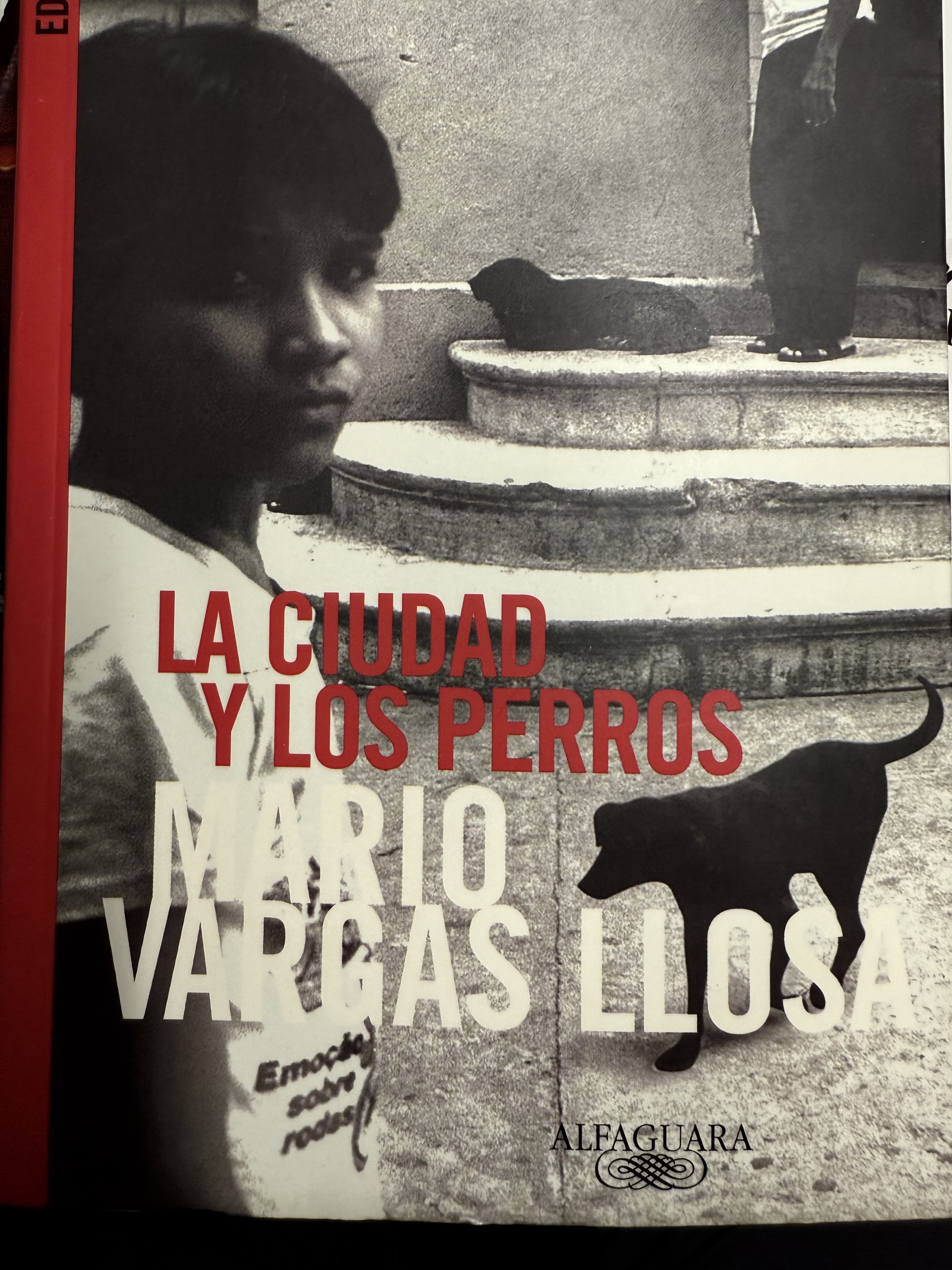
No entendí este libro hasta que lo terminaba leer. El título lo dice todo. Es la historia de dos niños en el colegio militar. El clase de primer año se llama “perros.” Se exploran sus vidas por recuerdos mientras crecen entre otros estudiantes militares. Ellos se convierten hombres jovenes, aliadas y finalmente enemigos después de una muerte trágica. Sus diferentes vidas civiles enfocan en una nińa que crece una mujer joven como lo ven a través sus ojos. Muy confuso para una lectora española principiante como yo. Sin embargo el autora insinúa la diferencia pero pensé que … no sé … estaba confundido.
Este libro es una obra de ficción literaria. Las dos historias se les dice magistralmente: los descripciones de las escenas de colegio y ciudad, diálogos, pensamientos, sentimientos y lucha son excelentes y muy interesantes. Sin embargo nunca cerrarás el diccionario de inglés y español. El vocabulario es enorme.
El autora se mezcla varias temas suavemente: la vida en Perú durante un periodo preocupante; el contraste entre ricos y pobres; adolescencia; crimen y castigo; disciplina y camaradería; violencia y calmada. La lectora se queda con un final agridulce: algunas cosas cambian pero no mucho.
La lectora no se deja colgada: el último capítulo explica y diferencia los dos vidas. Me reí de mi ignorancia. Lo leería de nuevo … cuando mi español sea mucho mejor.
Review of “Modern Philosophy. An Introduction and Survey” by Roger Scruton

This was quite a different presentation of philosophy than Bertrand Russell’s historical approach. The wide field of Western philosophy is covered by topic, with references to many philosophical systems and their relevance to each topic. Thus, philosophy is presented as a series of problems that fall between science and religion. No answers are given, but the reader is led to the cusp of the philosophical envelope in a very interesting style.
The overall scholarly writing style is interspersed with literary humor (some of these serious ideas are indeed bizarre). The sentences are too long (again), but well constructed.
The book is almost 500 pages, but most sections are the length of encyclopedia entries. In fact, he is structured very much like an encyclopedia. I plan to keep it on the shelf because you can’t do an internet search if you don’t know where to start.
Review of “Other Voices, Other Rooms” by Truman Capote
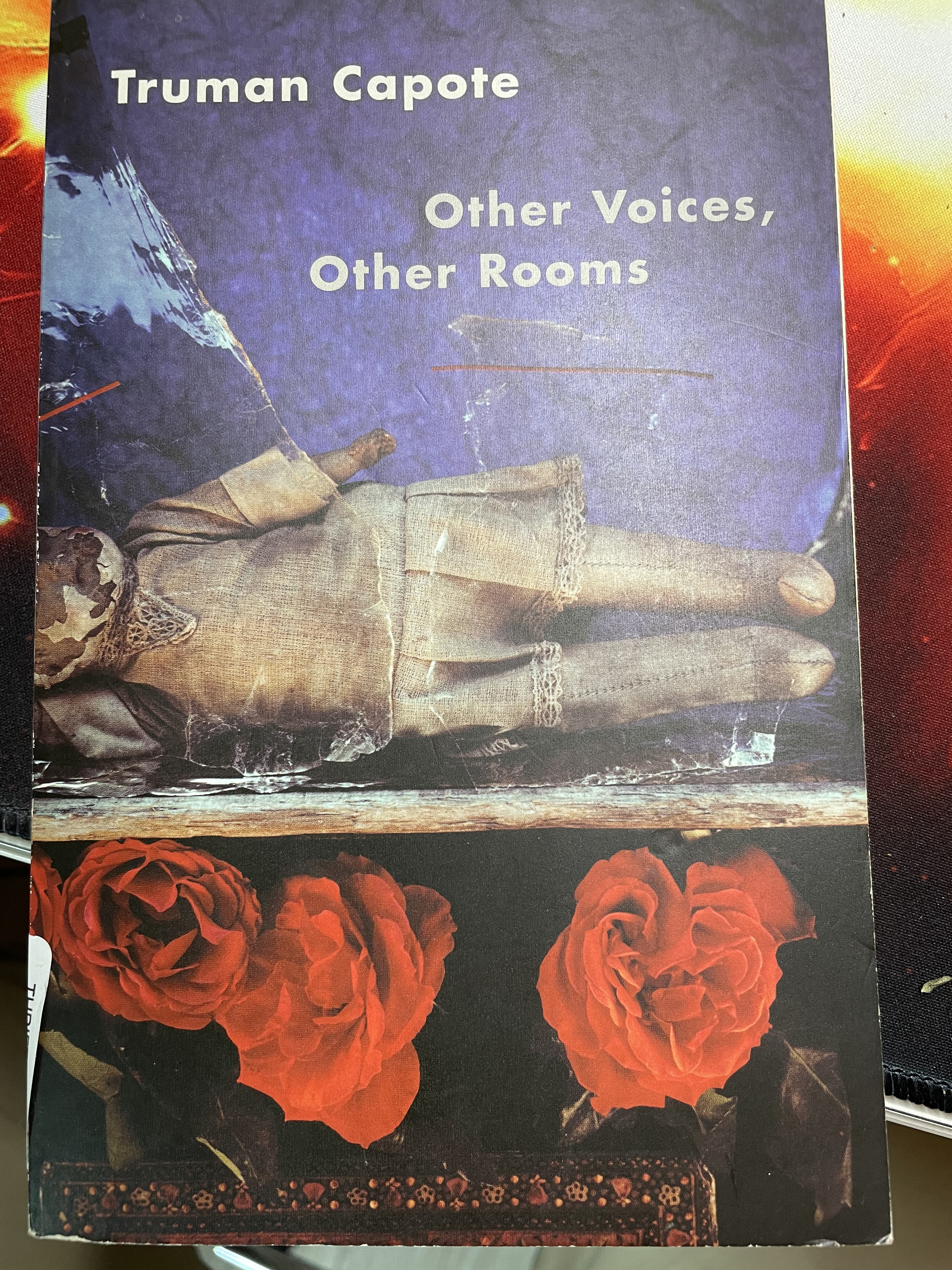
This is the author’s first novel. I read it because I enjoyed In Cold Blood, but it wasn’t fiction. I wanted to see how he wrote in my genre. This is obviously a first novel. It is both overwritten and underwritten; I will address these bold statements in this review.
First, the grammar and punctuation are excellent, and the writing style is easy to read and quite clear.
The author must have used every metaphor and simile available in English. He was apparently trying to write his “great American novel” so he packed in colorful, often nonsensical, metaphors. Some entire paragraphs are allegory. He must have read Ulysses. However, this is not a literary masterpiece; for one thing it is too short …
Underwritten, what do I mean by that? While written in the style of a nineteenth century English novel (e.g. Pride and Prejudice) this book is incomplete. As written it is 186 pages, much too short for such a writing style, and there’s a reason: the author didn’t have the stamina to complete it. Several interesting threads arose and were built up but, when they occurred, they were either wrapped up in a few sentences, or dropped like a hot potato. As with most novels I’ve reviewed, at about the halfway point, the author lost interest. They started using metaphors with no obvious connection, shutting down side subplots, and (seemingly) just trying to wrap it up.
This is a painful story told from the perspective of an optimistic boy of twelve (or so), although not in the first person. That was one of the disconnects I found in the use of metaphors: many of them were beyond the experience of the protagonist. Perhaps if Capote had gotten closer to his main character, he would have completed the book.
This is the last book by Truman Capote I’ll be reading …
Repaso de “Yo no soy tu Perfecta Hija Mexicana” por Erika L. Sánchez

Este libro fue escrito por jovenes. El carácter central tiene quince años y tiene que tratar con la muerte de su hermana mayor. Ella está deprimida y comparte sus pensamientos pero la historia es repetitiva. Entiendo que es muy triste perder una hermana pero ellas no estaban cerca. Julia descubre un secreto sobre su hermana que no puede contar a sus padres. El grande momento de su dolor no es descrito pero solo mencionado más tarde.
Este libro es bueno para lectoras españolas intermedias porque tiene vocabulario simple. Trama sencilla. Personajes simples. Es creíble pero yo no estaba convencido que Julia haría lo que ella hace. La autora nos muestra los pensamientos más oscura de Julia pero ellos no indicaron problemas emocionales tan serios. Sin embargo tal vez así es la depresión. Bueno.
Review of “Existentialism from Dostoevsky to Sartre” edited by Walter Kaufmann
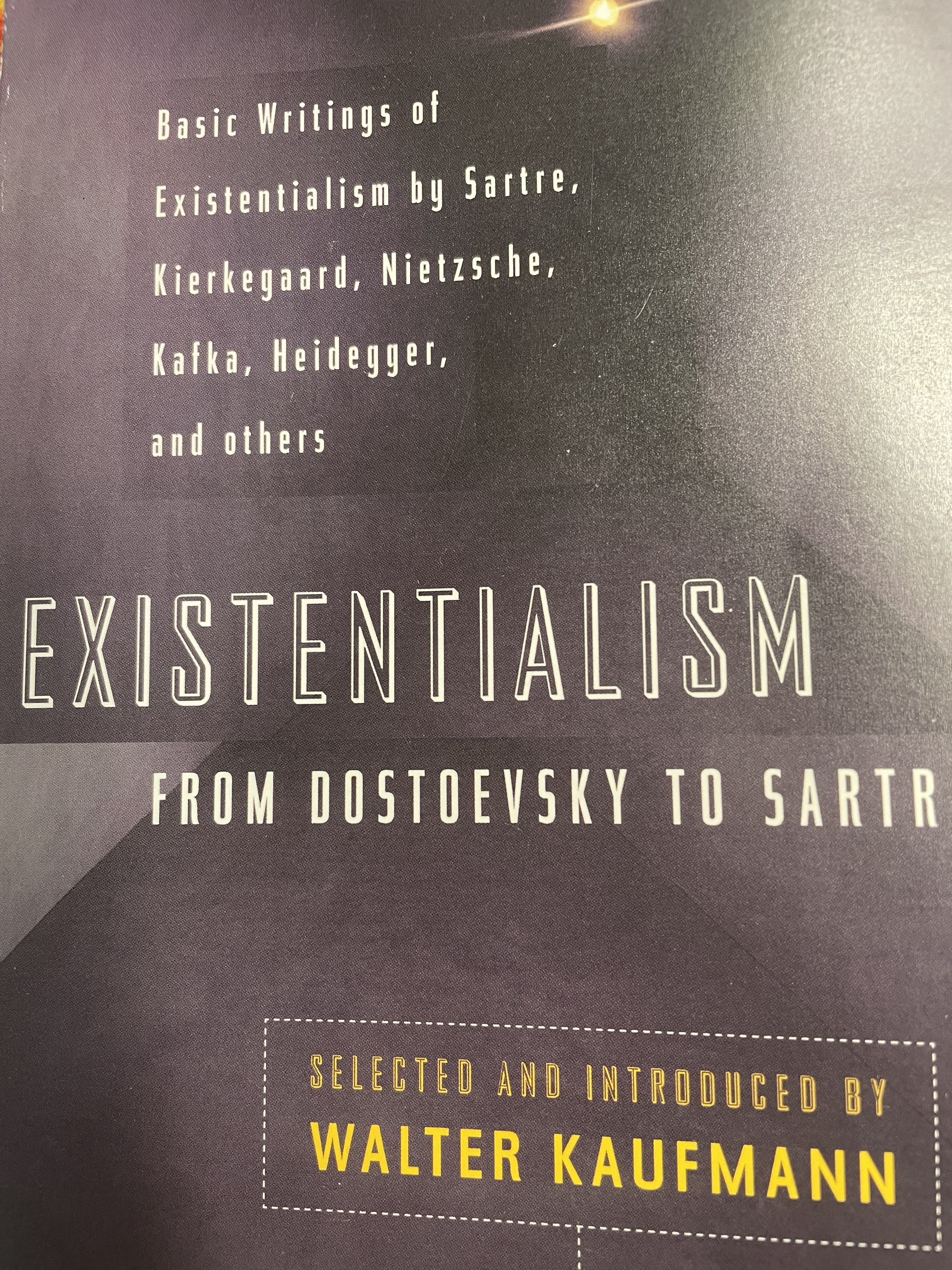
This book contains excerpts and essays written by a number of writers who’ve been identified with Existentialism. Apparently, no one wanted to be identified with the new philosophy; furthermore, the common thread between these authors is the analytical method associated with this movement, but they were interested in different questions. Some of them are simply writers who revealed Existentialist ideas through their characters; several were theologians looking for a way to find the roots of Christianity; it wasn’t until Sartre that someone called themself an Existentialist.
These authors (except the professional writers like Dostoevsky and Camus) write horribly; even the best of the philosophers (Sartre) wrote obscurely, whatever he was trying to say lost in recursive, circular reasoning that abused common words like “being” to the point of insanity. His fiction was fine, however, which leads me to conclude that these serious thinkers were struggling to describe what today might be called “mindfulness”, by which I do not mean meditation but, rather, awareness of the whole mind-body system and how it is impacted by our actions and thoughts. I could be way off base there because I really couldn’t say what Existentialism is, after reading these critical works.
But I don’t feel too bad because this was a complaint mentioned by Kaufmann (a renowned philosopher); Existentialism isn’t a dogma or ideology, but instead an incomplete and abstract approach to being in yourself and true to who you really are all the time.
I’ve heard various rumors about several of the authors included in this anthology (especially Nietzsche and Sartre), but the editor addressed some of these in the prefaces. I think, from this brief introduction, that their ideas changed over time and the statements accredited to them are both taken out of context and from earlier periods of their careers, when they were more likely to say outlandish things for the hell of it.
I can’t really recommend this book because so many of the essays are unintelligible; however, I wrote copious notes within its pages and plan to revisit it.
I hate finishing a book and don’t know what it was about …


Recent Comments