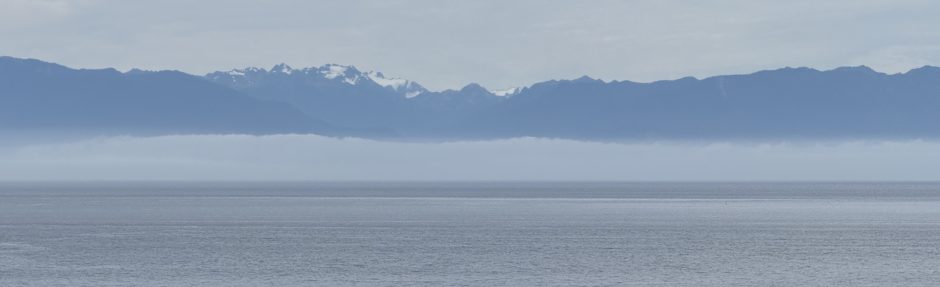
Ecology Notes from Vancouver, British Columbia
Every time I go outside here in the Pacific Northwest I find something new and mysterious, so I’ll keep posting these notes on my discoveries. This time I crossed the border and entered our northern neighbor, Canada. It’s only a three-hour drive, not counting the time spent at the border patrol station.
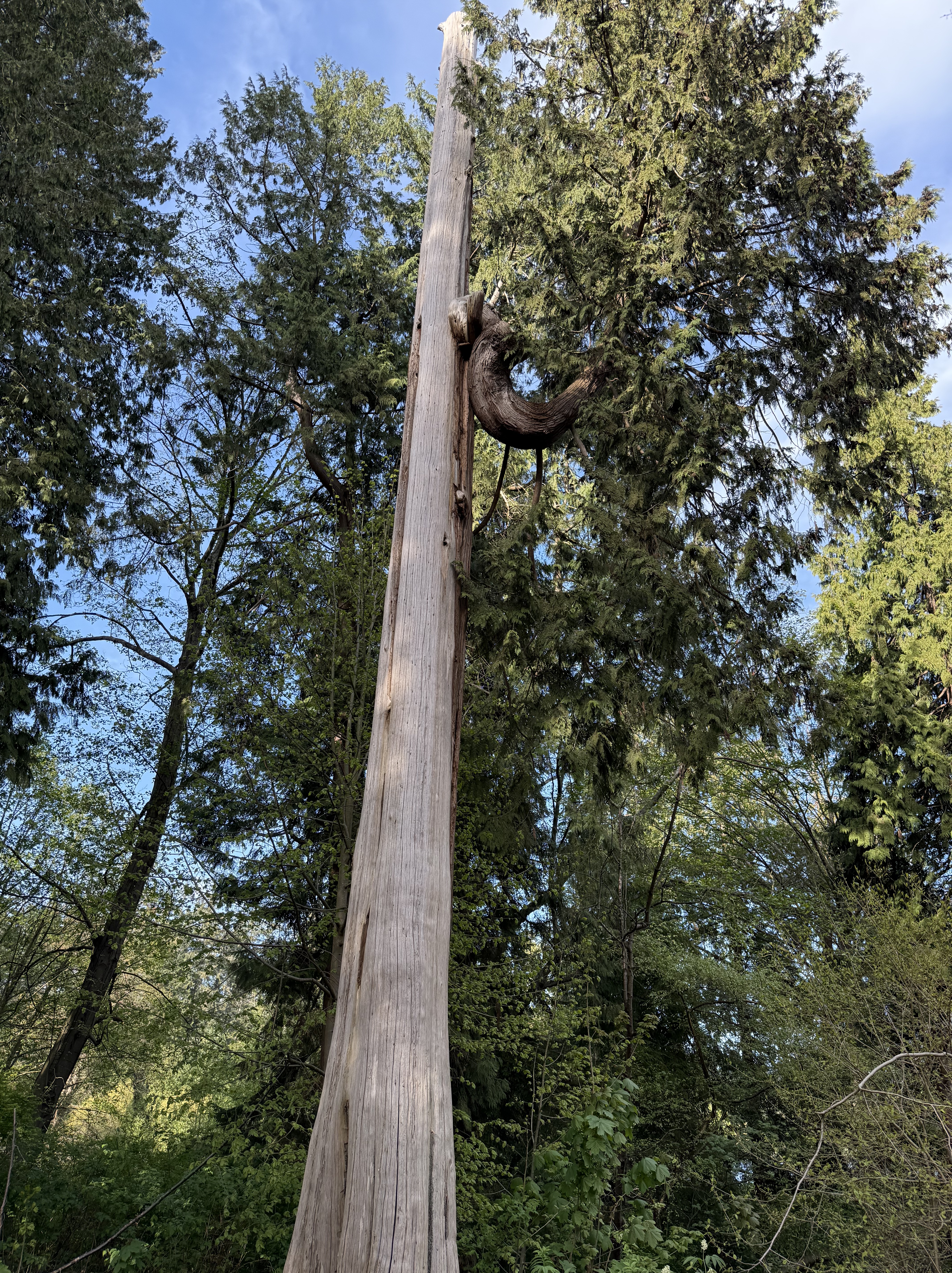
There is no old-growth forest in this part of British Columbia but that doesn’t mean the forest has died. It is regrowing and adapting to a more urban environment. We were strolling through Stanley Park, on the waterfront of Vancouver, when this bizarre tree caught my eye. The tree looks dead, including no crown and a trunk that appears ready to fall over; but near the top a curved branch has appeared. It is almost as large as the trunk and has a thick canopy. Unbelievable!
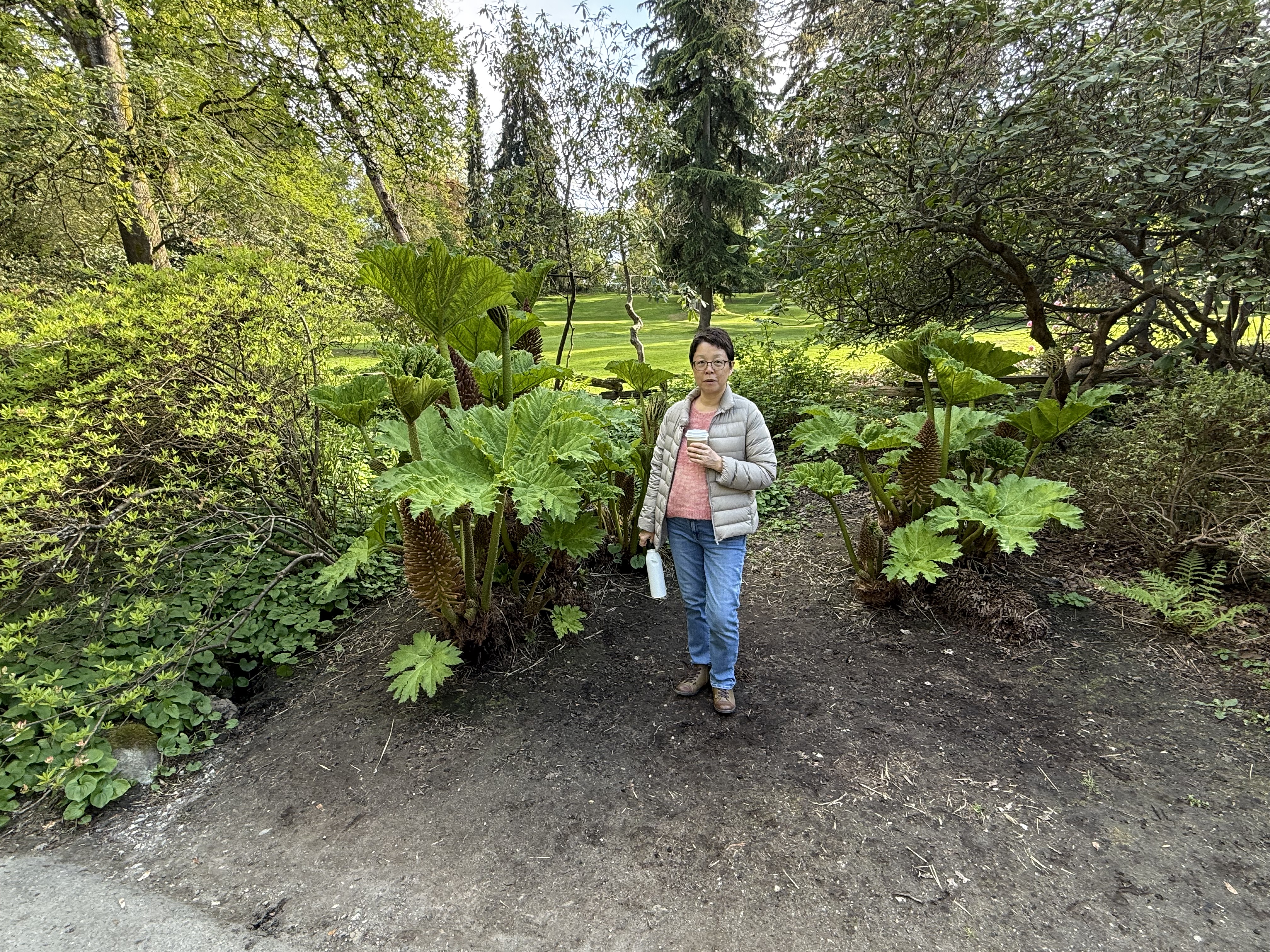
This tropical appearing plant is Gunnera manicata, also known as giant rhubarb (according to CoPilot). It is originally from Brazil, but it does well in the PNW because of the wet climate and mild winters.
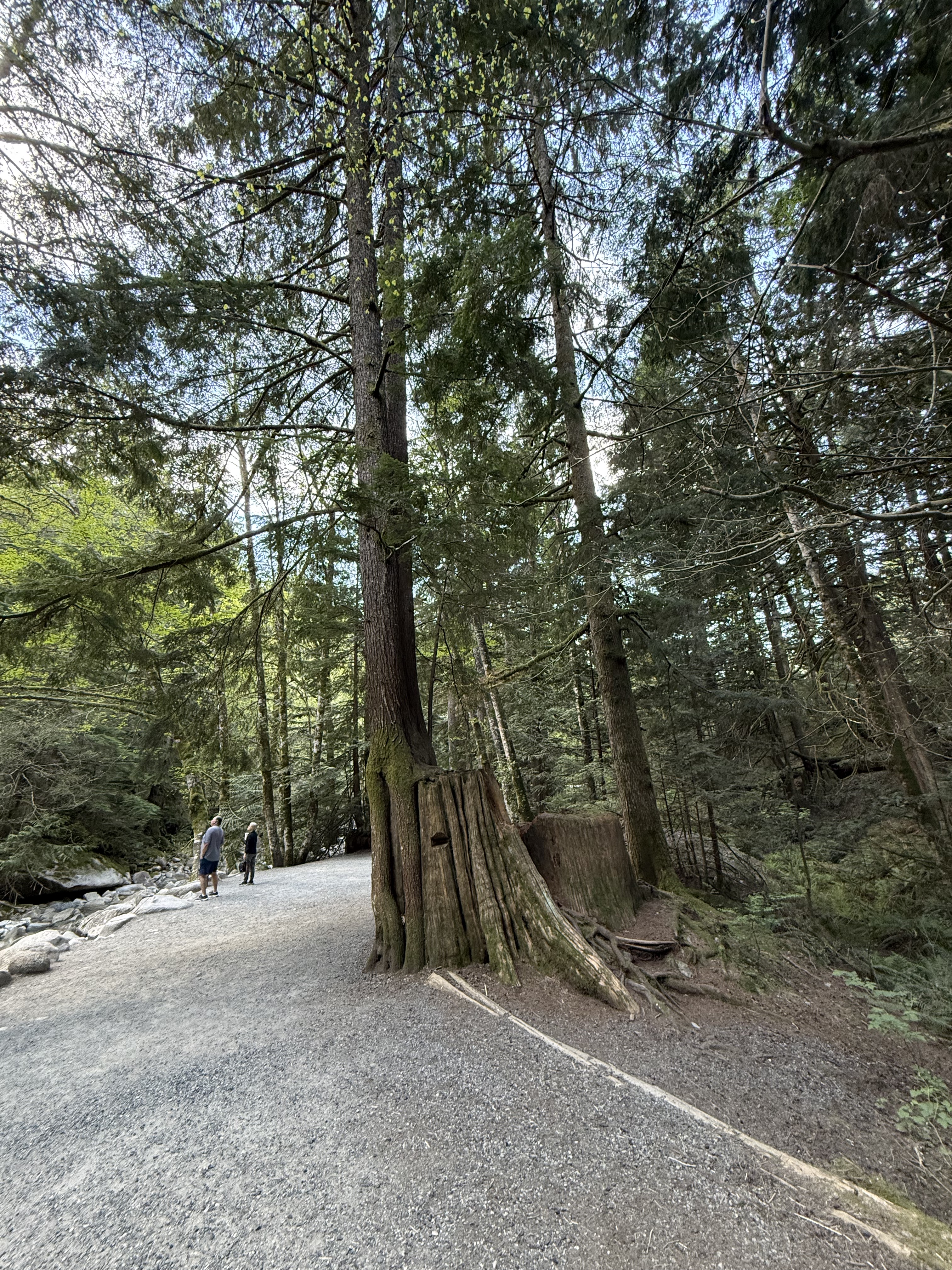
We drove a little up a fjord to Shannon Falls and discovered that nurse-log trees occur here as well as in Washington. This one is probably a Western Hemlock growing from a stump comprising multiple roots from clumped trees that merged into one. That’s why it looks like a bamboo thicket.
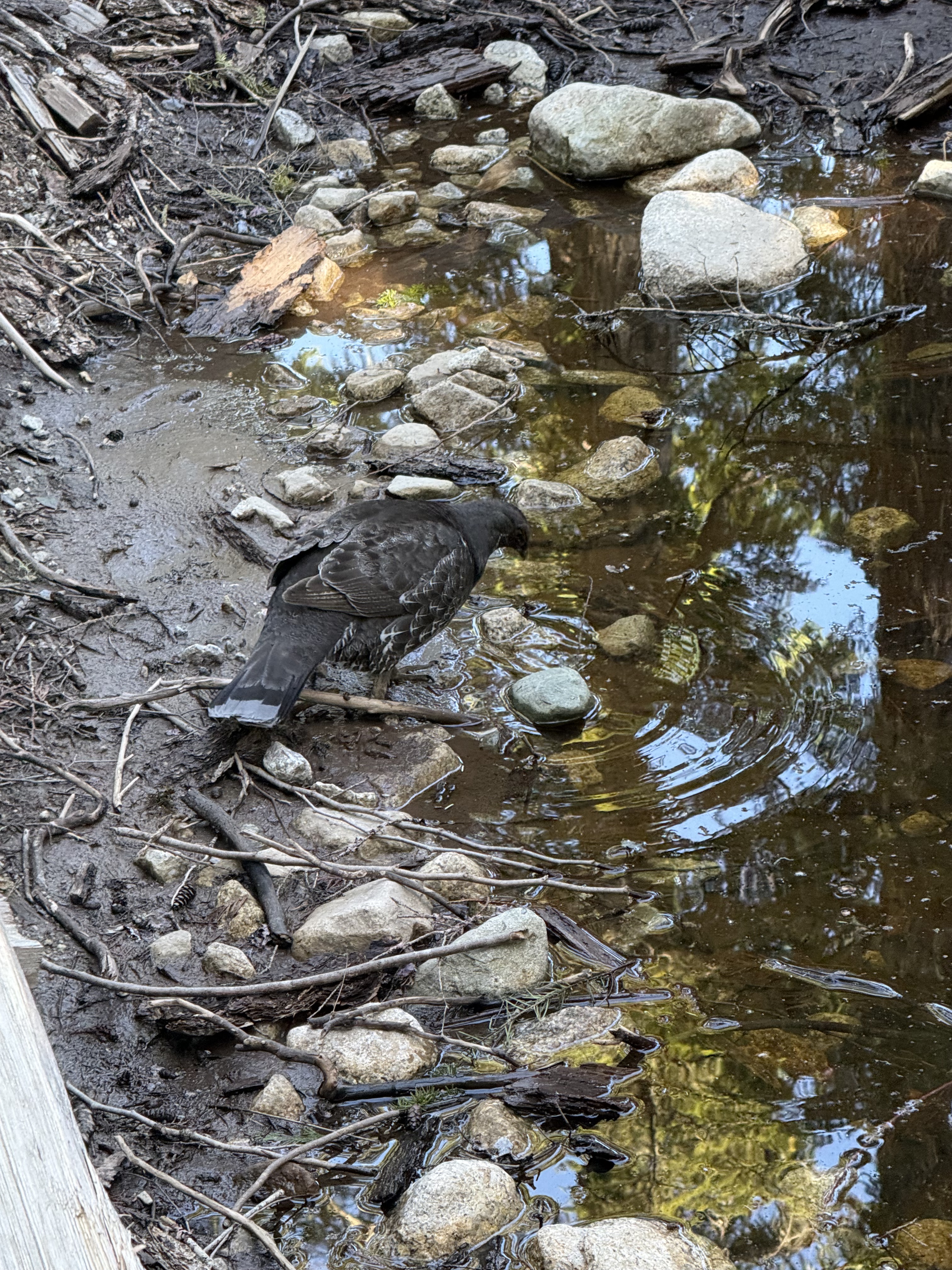
This Sooty Grouse didn’t seem to mind being photographed as it poked around this water hole in Squamish and Chief Viewpoint park.
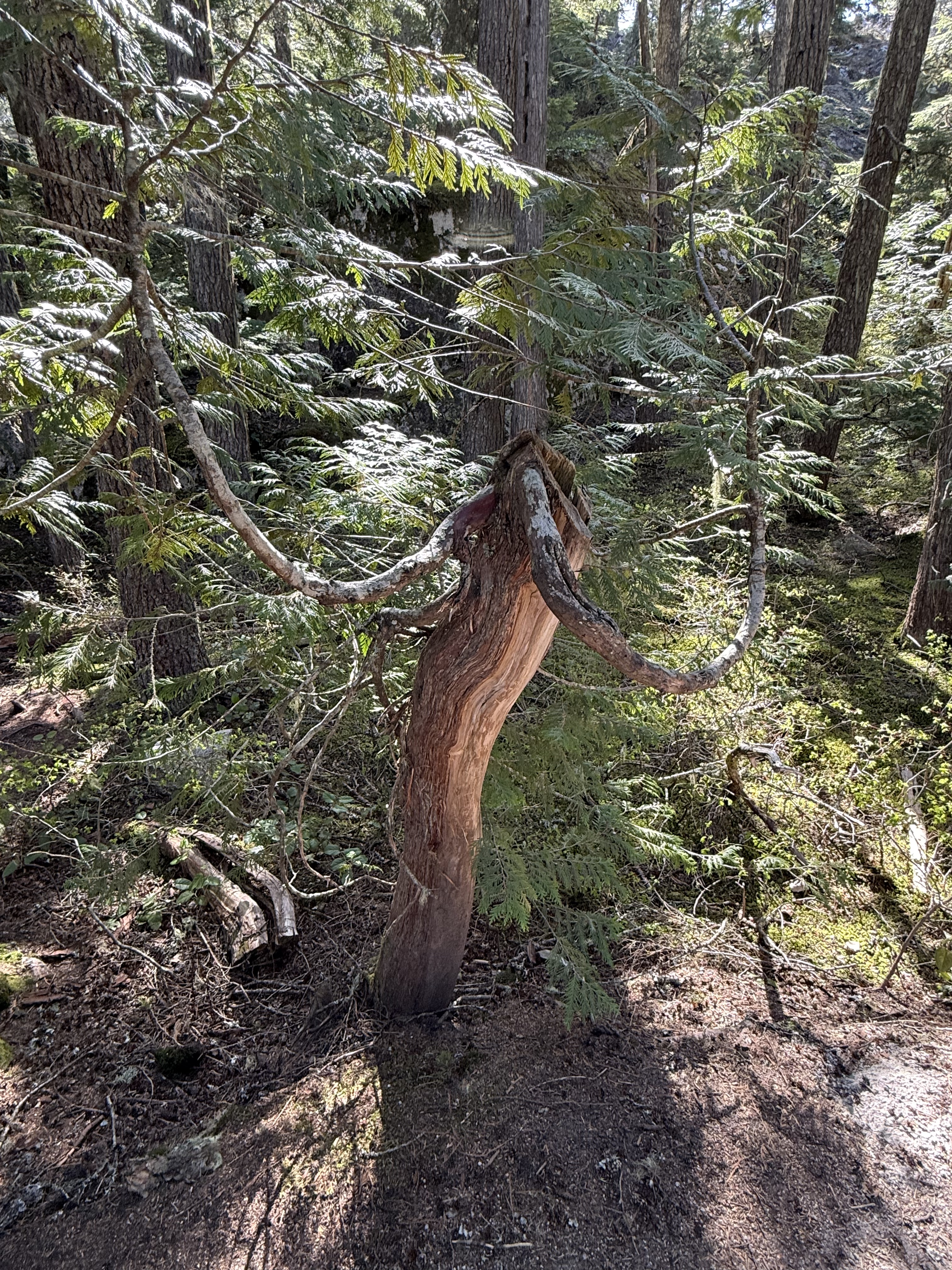
This reminded me of the tree I saw in Stanley Park, a dead stump with curved growth full of foliage. I asked CoPilot about it and, surprisingly, it had a plausible explanation. It is so damp in the coastal PNW that trees don’t just grow out of stumps, they can actually grow from dead trees well above the ground. Apparently, the young tree has sent roots down through the decaying stump to reach the ground…another biological wonder. Simply awesome!
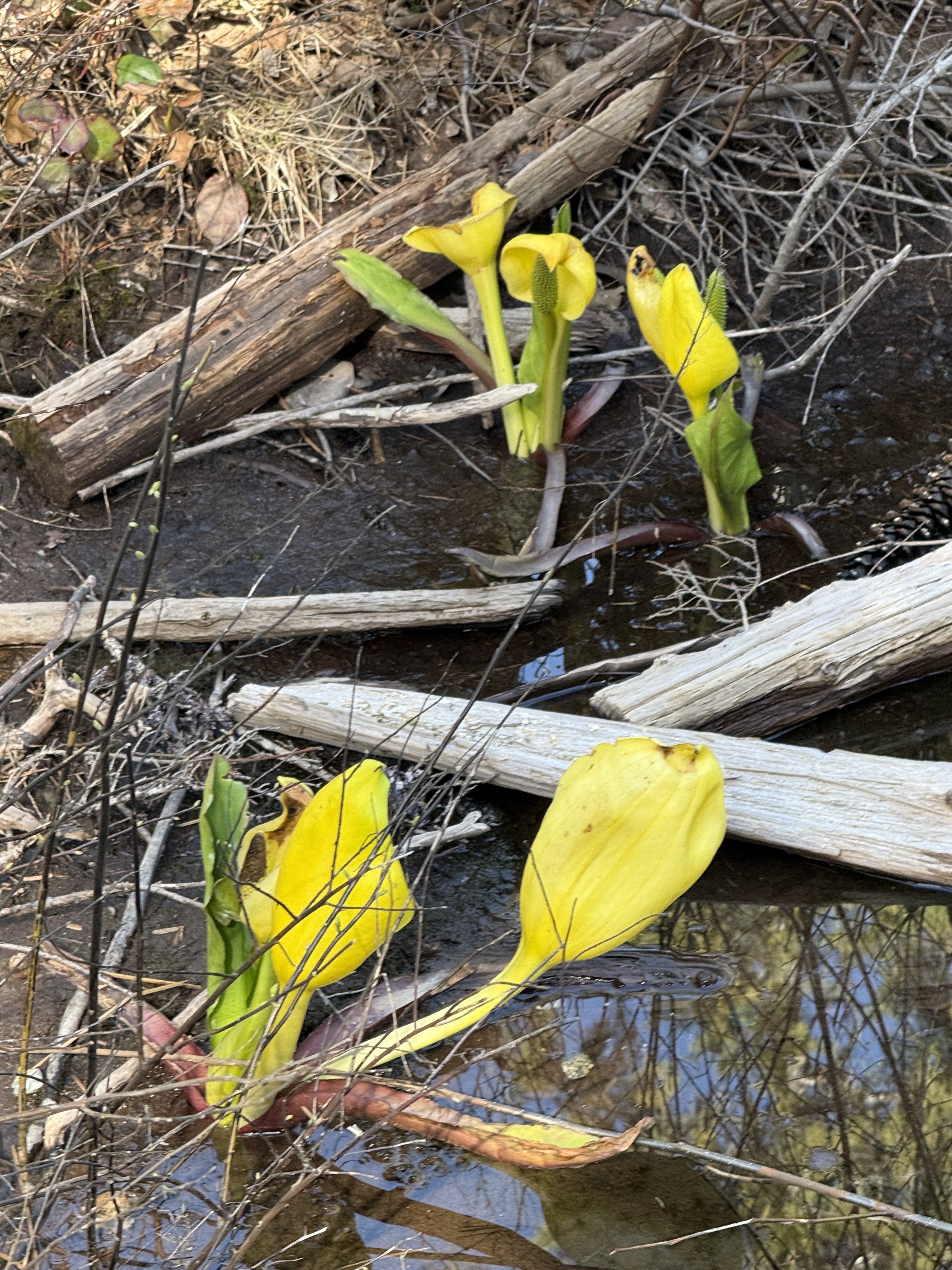
I thought these bright flowers looked familiar, but I don’t trust my intuition on biological matters (all yellow flowers are the same); as it turns out, according to CoPilot these are Western Skunk Cabbage–the same plant I saw in a wetland along the Olympic Peninsula. I was right…but I had forgotten the name. LOL!
I enjoyed this trip and writing this post, thanks to CoPilot. Its identifications may be wrong but they are better than mine. I think of its comments as those of someone who took a biology class in college.
I hope you enjoyed it too.
Cretaceous Intrusive Rocks in British Columbia
This post finds me in British Columbia (Fig. 1), where I explored fjords cut into mostly intrusive rocks that form an immense batholith composed of many overlapping plutons. The tectonic regime of this area is collision between the many small plates that comprised the Pacific Ocean as well as any island arcs and microcontinents that got in the way of N. America on its westward journey, which began about 200 million years ago (Ma). A collision between ocean crust and the N. American tectonic plate would have created a subduction zone, in which the denser ocean crust was driven beneath the continent. However, recent work suggests that this process was interrupted for uncertain intervals when islands collided with N. America; furthermore, there is evidence for a lot of strike-slip fault movement along transform faults. You can learn more about this complex history at Nick Zentner’s web page.
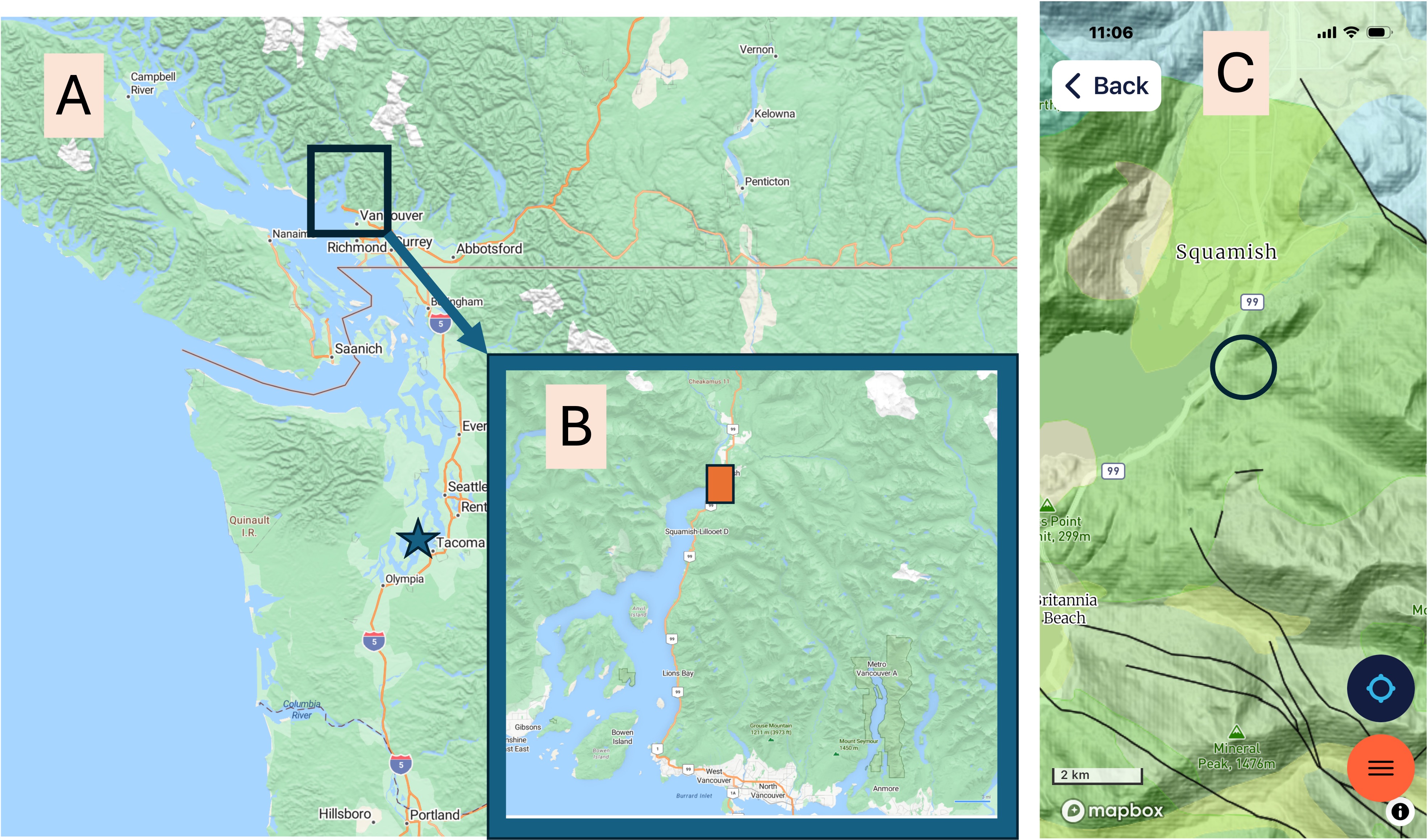
Figure 1. (A) Regional map showing the location of the study area in SW British Columbia, about 230 km (140 miles) north of Tacoma (starred location). (B) Detail map of the inlet (I couldn’t find a name for it), showing the location of the Sea-to-Sky gondola I rode to Squamish and Chief Viewpoint park. (C) Geologic map from RockD, showing the fairly uniform occurrence of diorite intrusive rocks intruded between 143 and 66 Ma (covering the entire Cretaceous geological period). The town of Squamish sits at the head of the fjord. Faults of unidentified type (i.e., normal, reverse, strike-slip) are common but don’t appear to control the location of major drainage basins, which have been excavated by glacial action during the Pleistocene epoch. The circle indicates the area reported on today, except for Fig. 2.
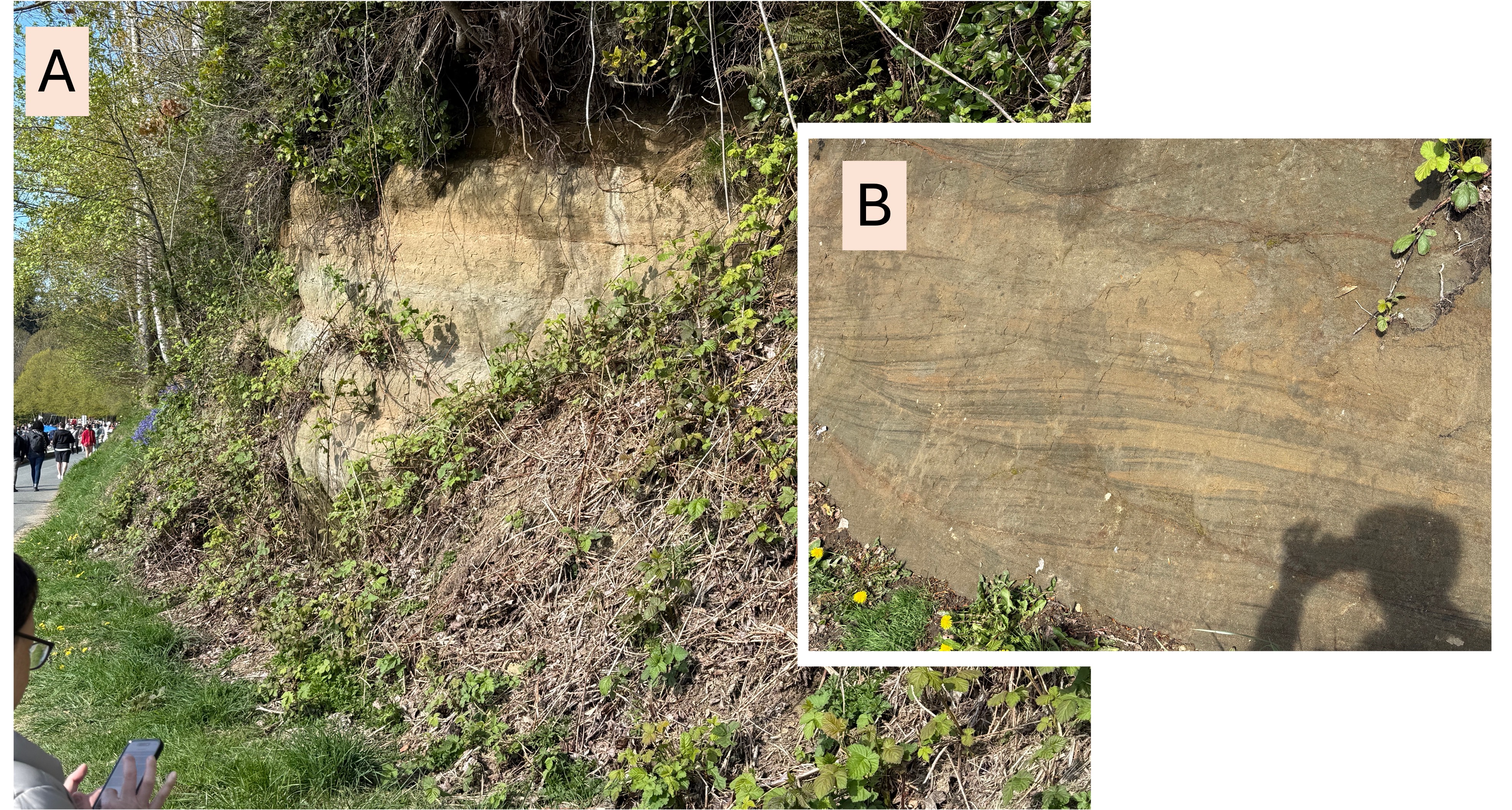
Figure 2. (A) Exposure of Late Cretaceous (100-66 Ma) sedimentary rocks at Stanley Park (bottom center of Fig. 1B). These rocks look unconsolidated, but they are actually well cemented. (B) Close-up showing lamination and sets of unidirectional cross-bedding, which indicates transport in a stream rather than a marine environment. Transport was generally to the left, but each set of cross-beds is a slice through a three-dimensional form like the bars seen in modern rivers.
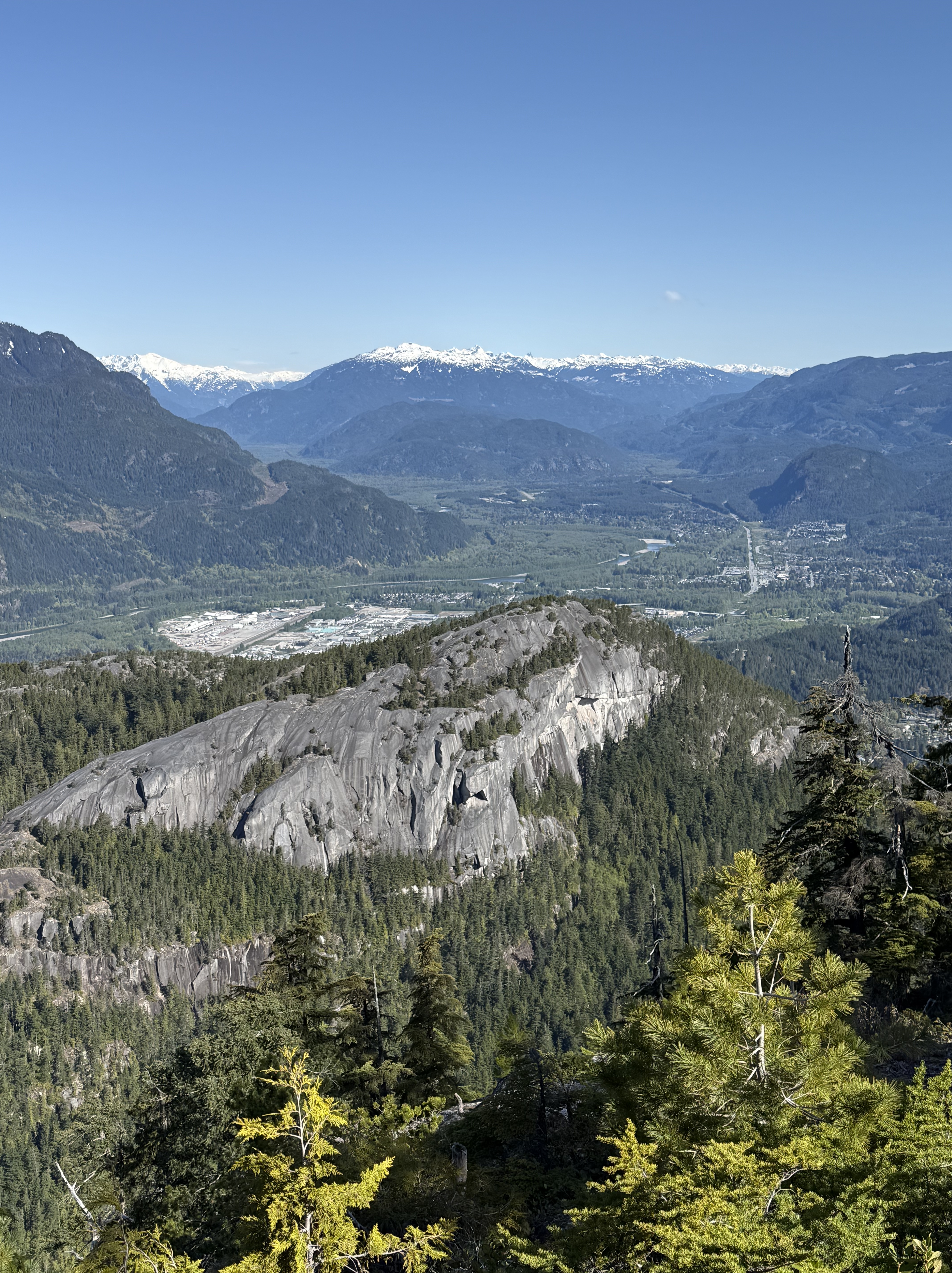
Figure 3. View looking northward from Squamish and Chief Viewpoint park (circled in Fig. 1C). Besides offering a breathtaking view of the northern Rocky Mountains, this photo reveals several interesting geologic phenomena. The small peak in the foreground is solid diorite that was intruded between 143-66 Ma more than 20 km beneath the surface at that time. It has been uplifted as overlying rocks were removed by erosion. It may represent a single intrusive episode because typical plutons are 2-3 km in diameter; batholiths comprise multiple intrusions spanning millions, if not tens of millions, of years. Note the lineations running up the side. These reflect the scraping action of ice sheets during the last two million years as they flowed towards the sea. The valley in the background is the classic U-shape caused by the advance of glaciers. It has been filled in by glacial deposits very similar to those found in NW Washington. Glaciers in this area originated locally and were up to several kilometers in thickness. They flowed both towards the sea and inland to form a continental glacier.
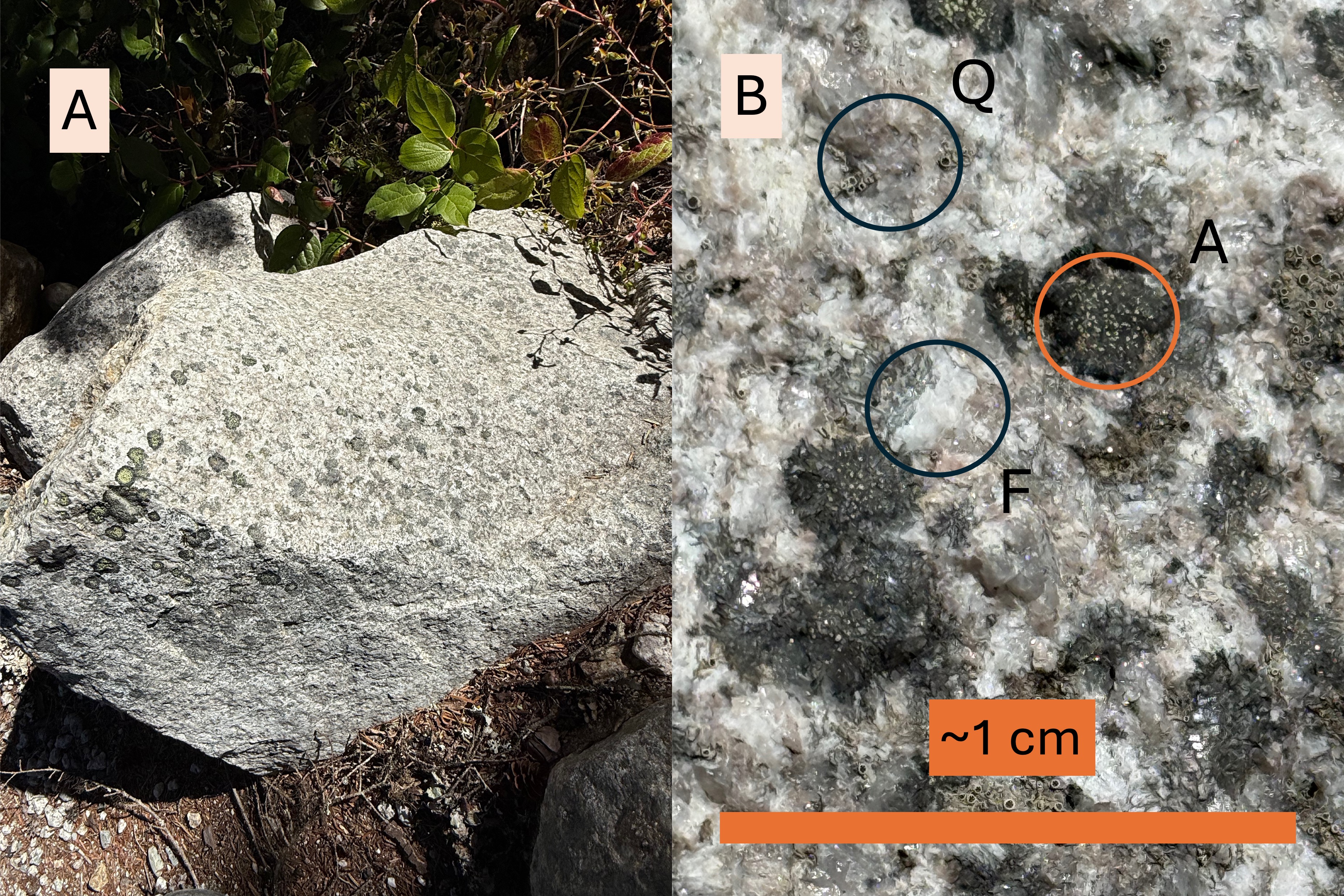
Figure 4. (A) The rocks within the park are fairly uniform in composition because they were intruded as part of a single pluton. This boulder shows the typical salt-and-pepper appearance of dioritic rocks. This sample is relatively fine grained, which indicates that it wasn’t emplaced more than a few tens of kilometers deep; i.e., smaller crystals indicate faster cooling which occurs nearer the surface. (B) Close-up at the highest optical magnification available on my phone, about 5X. RockD generally describes the igneous rocks from this area as granodiorite, a type of diorite that contains 20-60% quartz (labeled Q in the photo), and primarily feldspar (labeled F) that contains sodium and calcium with little potassium. The dark minerals are amphiboles (labeled A), probably hornblende. These are typical granitoid rocks from a subduction zone.
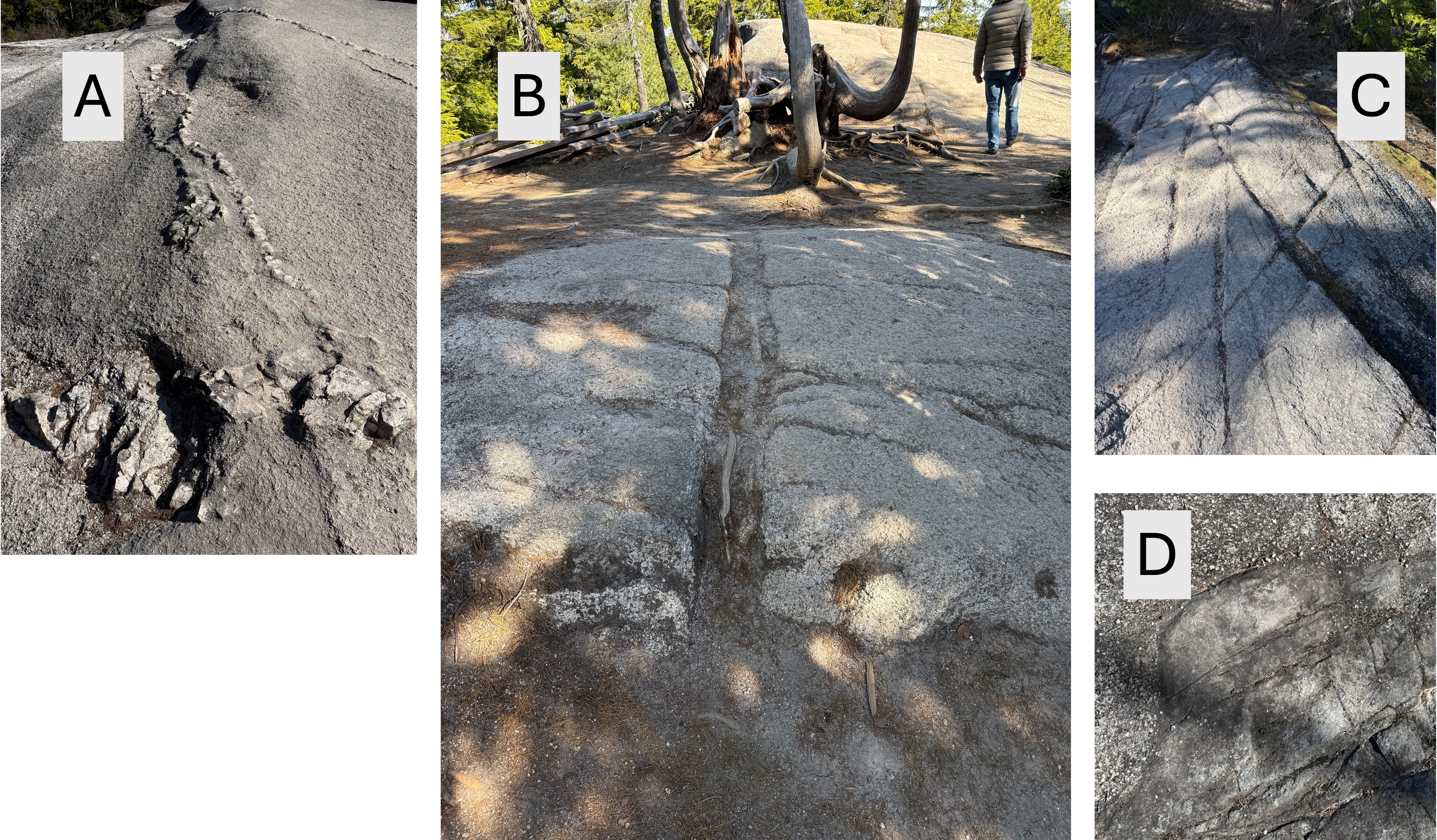
Figure 5. (A) Surface showing a vein filled with a harder mineral that is probably quartz. The softer feldspar and hornblende has weathered more easily and been removed by the scraping of ice sheets containing rocks. Note the irregular shape of the vein; minerals like quartz have the lowest temperature to solidify and fill cracks in the slowly cooling magma. (B) This vein is straighter than that in A and is filled with minerals that have weathered more than the main rock. (C) This photo shows joints (X pattern in the center of image) and lineations (top to bottom) that indicate ice moving over the surface with embedded rocks that scratch the exposed rock. (D) This image shows a finer grained material filling a void in the original magma. The pebbled appearance of the coarser material results from preferential weathering of minerals like hornblende and feldspar. These images imply that the magma had solidified sufficiently to form joints as it cooled, but was then injected with more fluid. This isn’t surprising in a region where so many plutons were being created; there was certainly a lot of overlap in their intrusion.
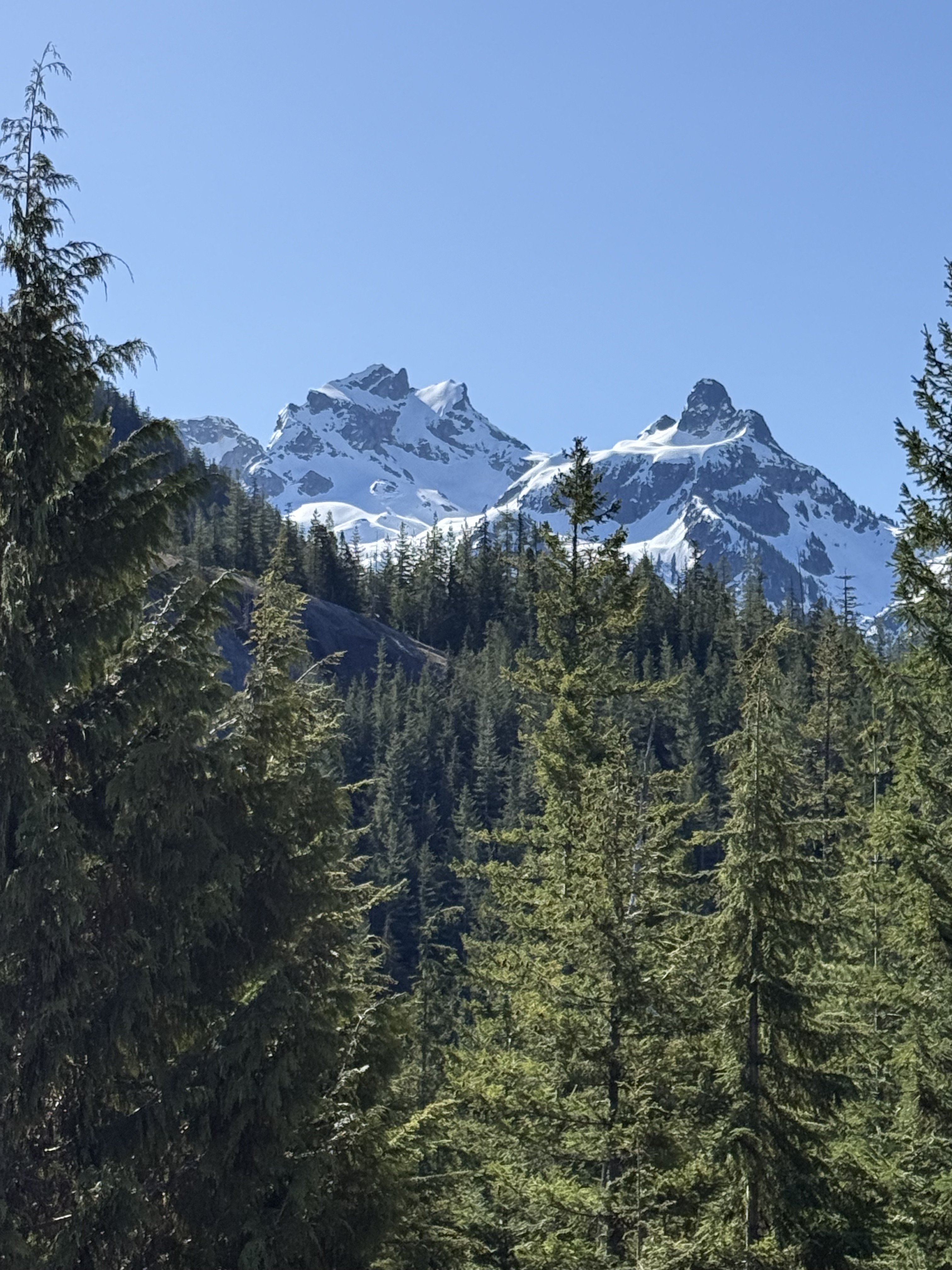
Figure 6. This final photo shows two pointed peaks that result from ice cutting away at any rock that protruded above the main surface. Remember that the ice was up to three kilometers thick here whereas the peaks are less than two km above sea level. It is hard to imagine that much ice.
SUMMARY
This post describes only a small part of one pluton of the hundreds exposed within the Northern Rocky Mountains in British Columbia. The scale is difficult to visualize, but they represent only a tiny fraction of the immense volume of oceanic crust that was subducted beneath the nascent west coast of N. America during the Cretaceous period. Nevertheless, what we’ve documented shows that this was a continuous process that lasted almost 70 million years. And it is continuing to this day, as evidenced by volcanism within the Cascades Range of Washington, Oregon, and N. California.
Deep igneous intrusion doesn’t necessarily create volcanoes, however; surface eruptions occur when magma is emplaced at shallow depths, which was probably not the case for these rocks from the Cretaceous. We can’t know for sure because so much rock has been removed by wind, water, and glaciers during the uplift of these intrusive rocks, from tens of kilometers beneath the surface.
Even if our picture of the earth’s history in the Pacific Northwest is incomplete and mysterious, it is awe inspiring to look back in time and deep within the crust.
And it isn’t science fiction…
Vancouver, British Columbia
I’ve never been to Canada…officially. I canoed into Ontario once and spent a frigid spring evening on an island in the Boundary Waters; and I briefly crossed into Quebec when visiting a friend in Presque Isle, Maine; but this time I crossed at the border station on I-5 north of Seattle.
The drive to Vancouver is about three hours, but there is a wait at the border. It was less than thirty minutes entering Canada…
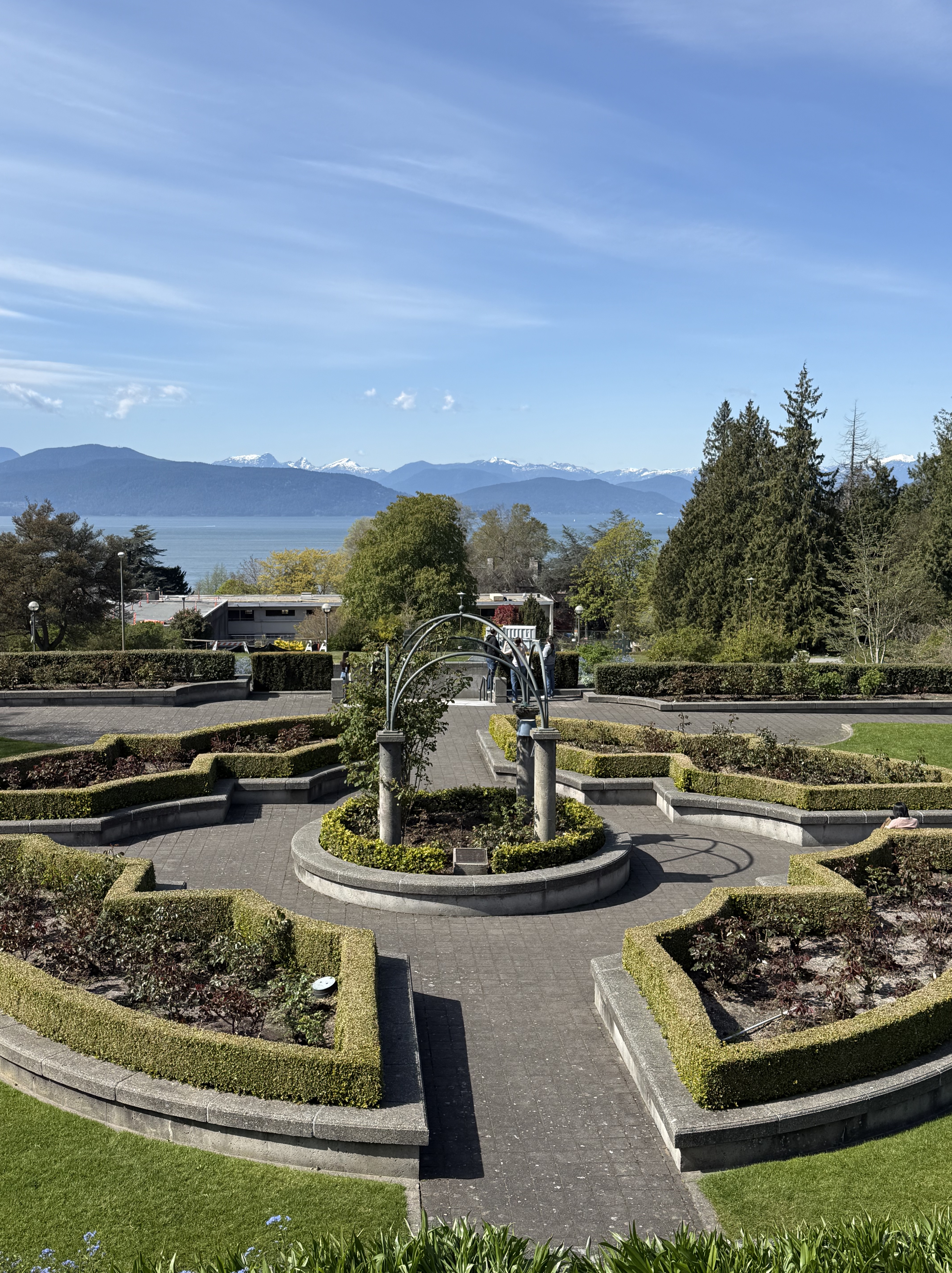
It was beautiful weather, so we did as many outdoor activities as we could in the short time we were there. Our first stop was the University of British Columbia, which has about sixty thousand students. It is a very large campus located on the Strait of Georgia. This photo is looking westward towards Vancouver Island.
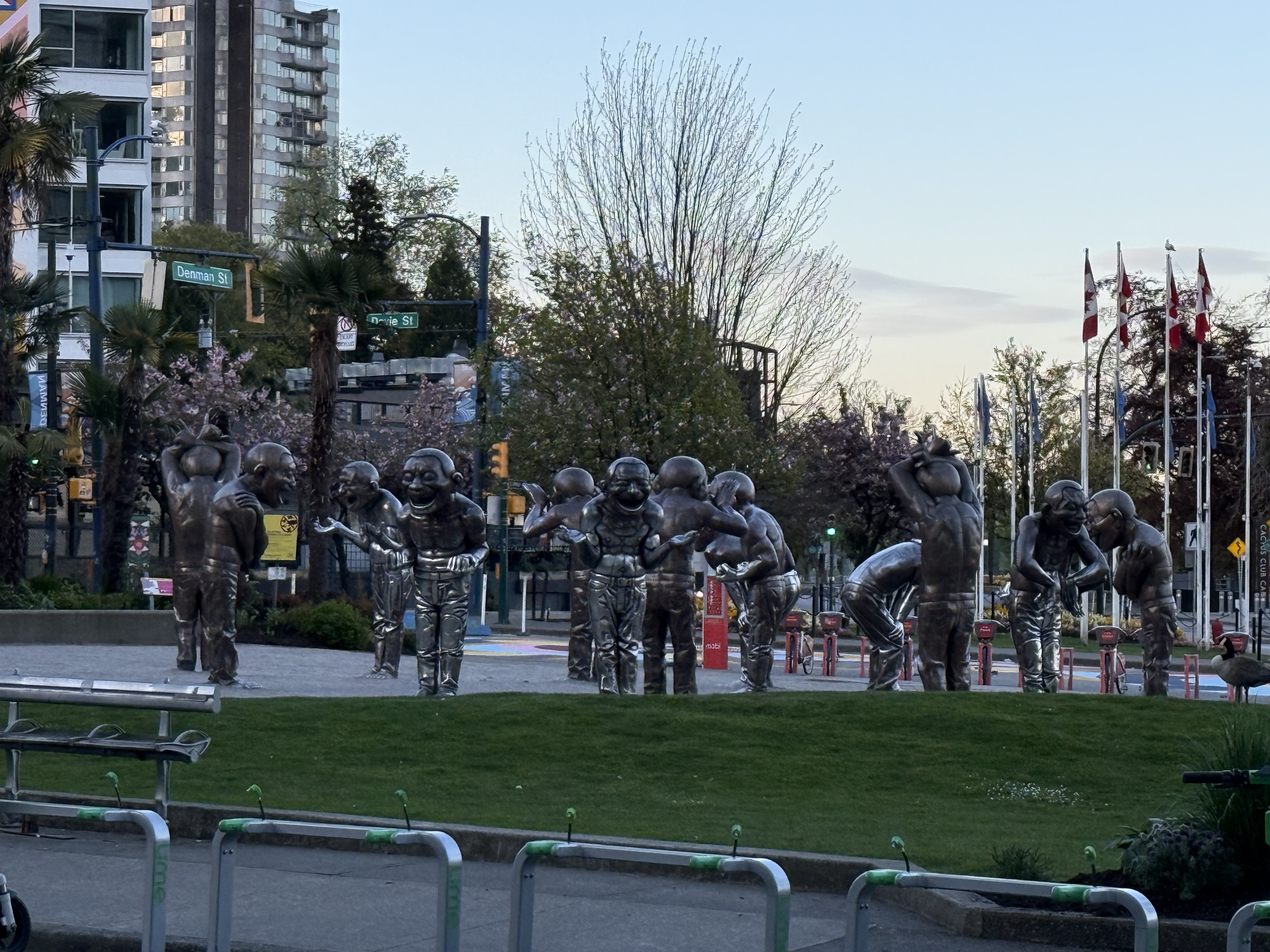
We spent the night near Stanley Park, which was filled with locals enjoying the weather. These metal statues are about eight feet tall, depicting the same shirtless man laughing and gesticulating. He was actually kind of creepy, but humor is in the eye of the beholder.
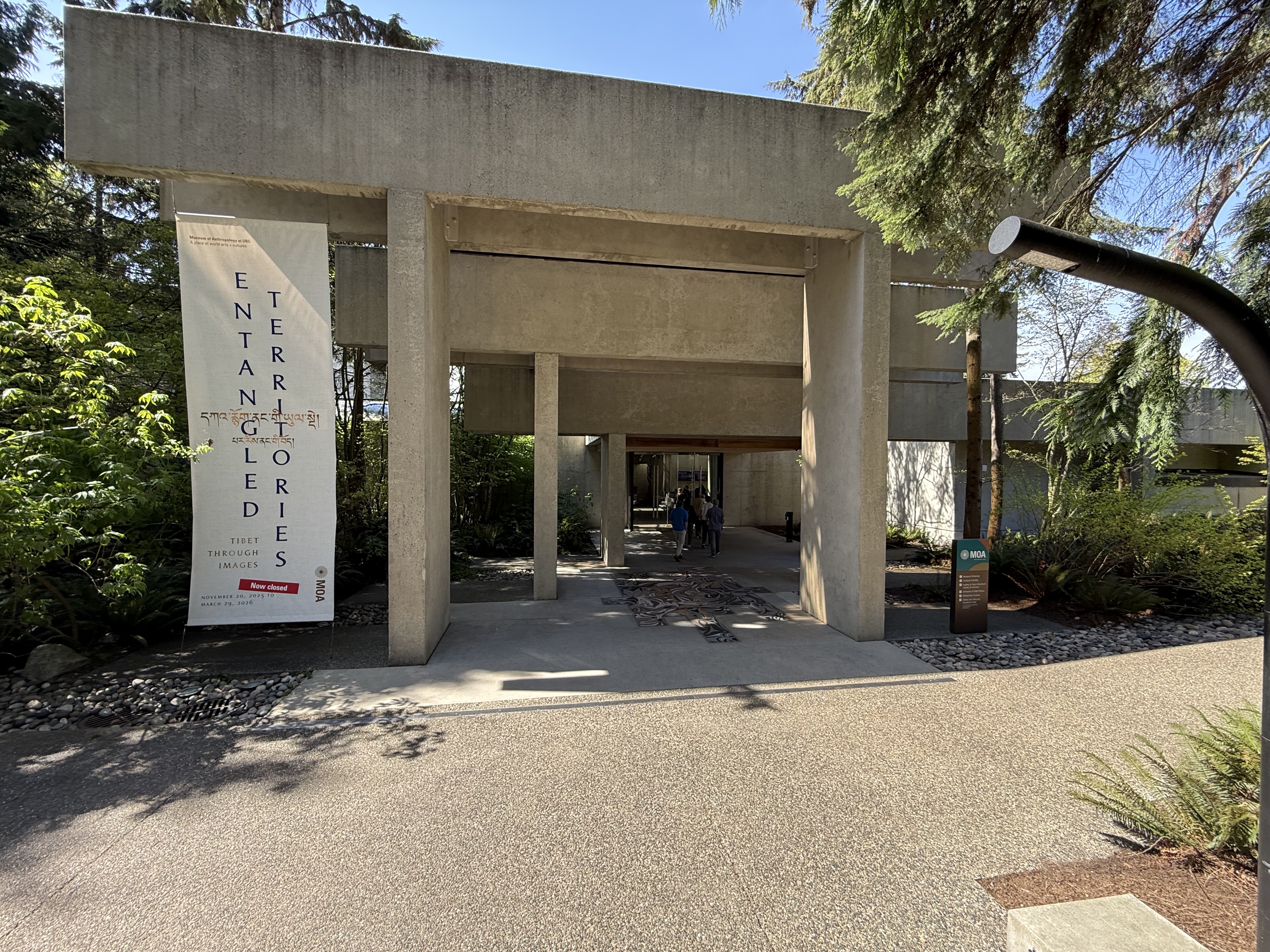
The Museum of Anthropology at UBC has a permanent exhibit of sculptural artwork by several native artists.
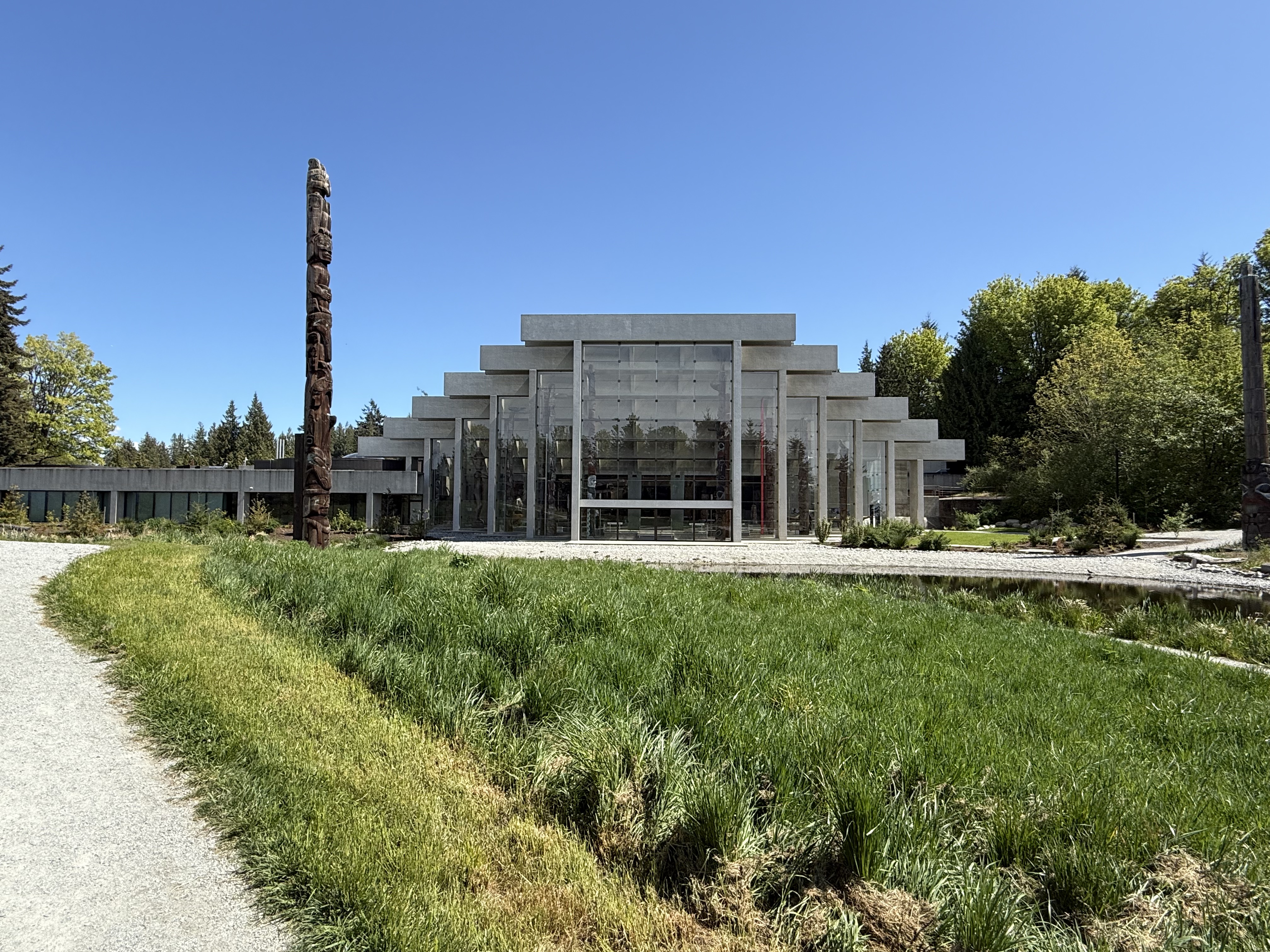
Totem poles are very popular still among the indigenous people. Several originals are on display as well as recent creations.
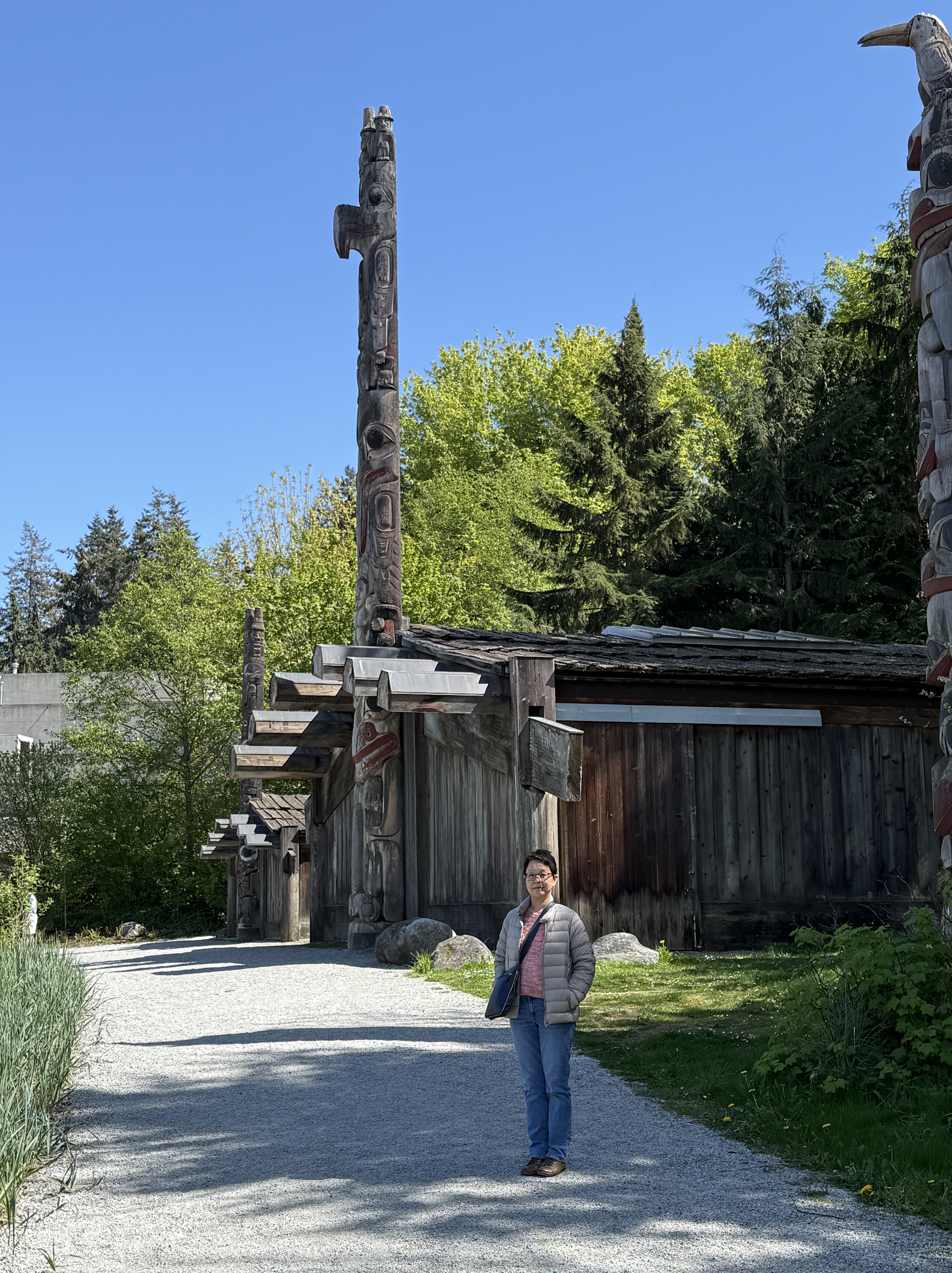
The outdoor display includes mock-ups of a tribal living area, including several poles. Apparently these are updated now and then as the family grows. They aren’t religious, but simply a traditional way of recording major events.
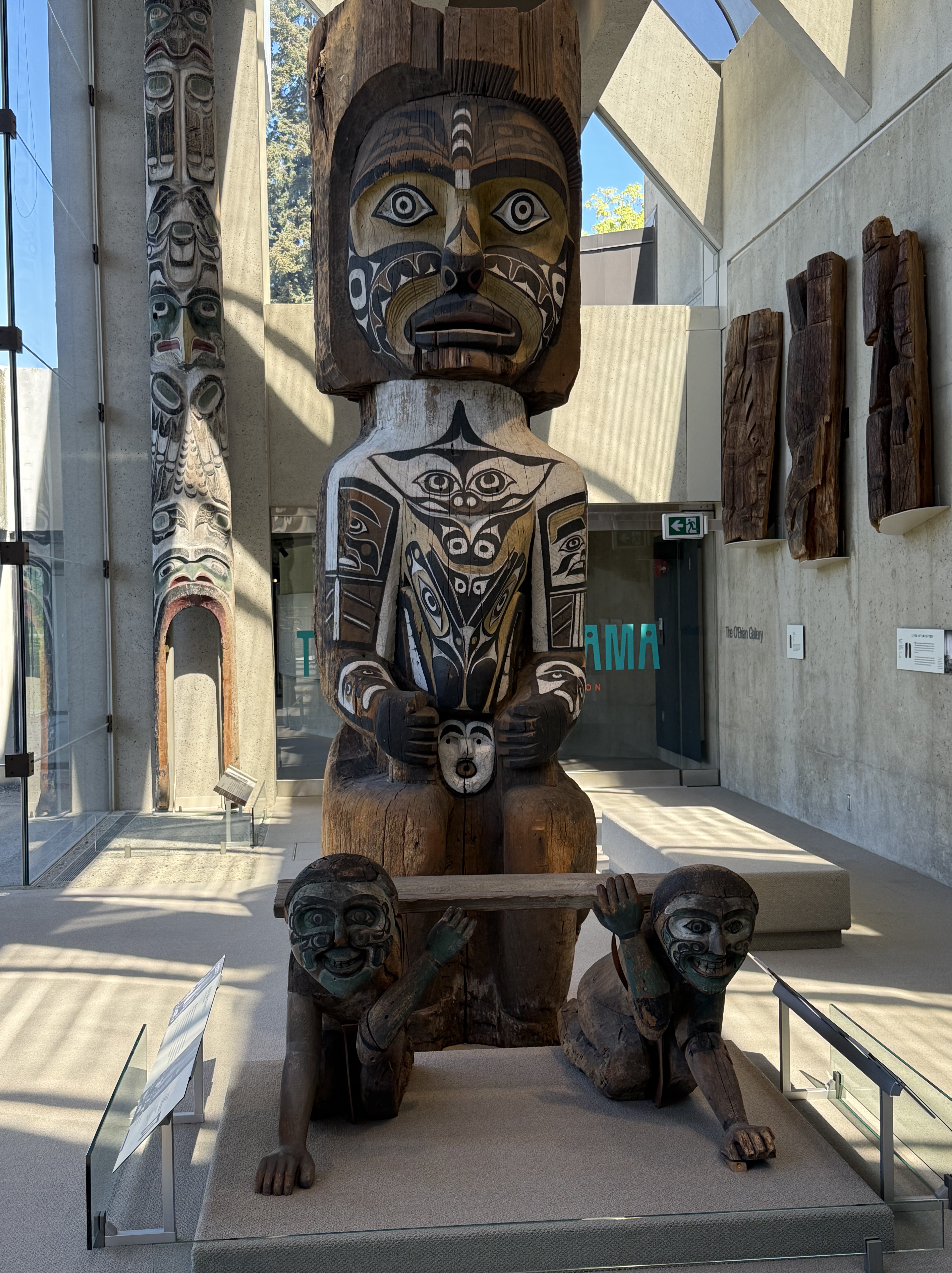
This recent creation represents a successful life, including owning slaves; that’s right, the locals had slaves but not in recent times. This is a historical piece of art rather than reflecting modern times.
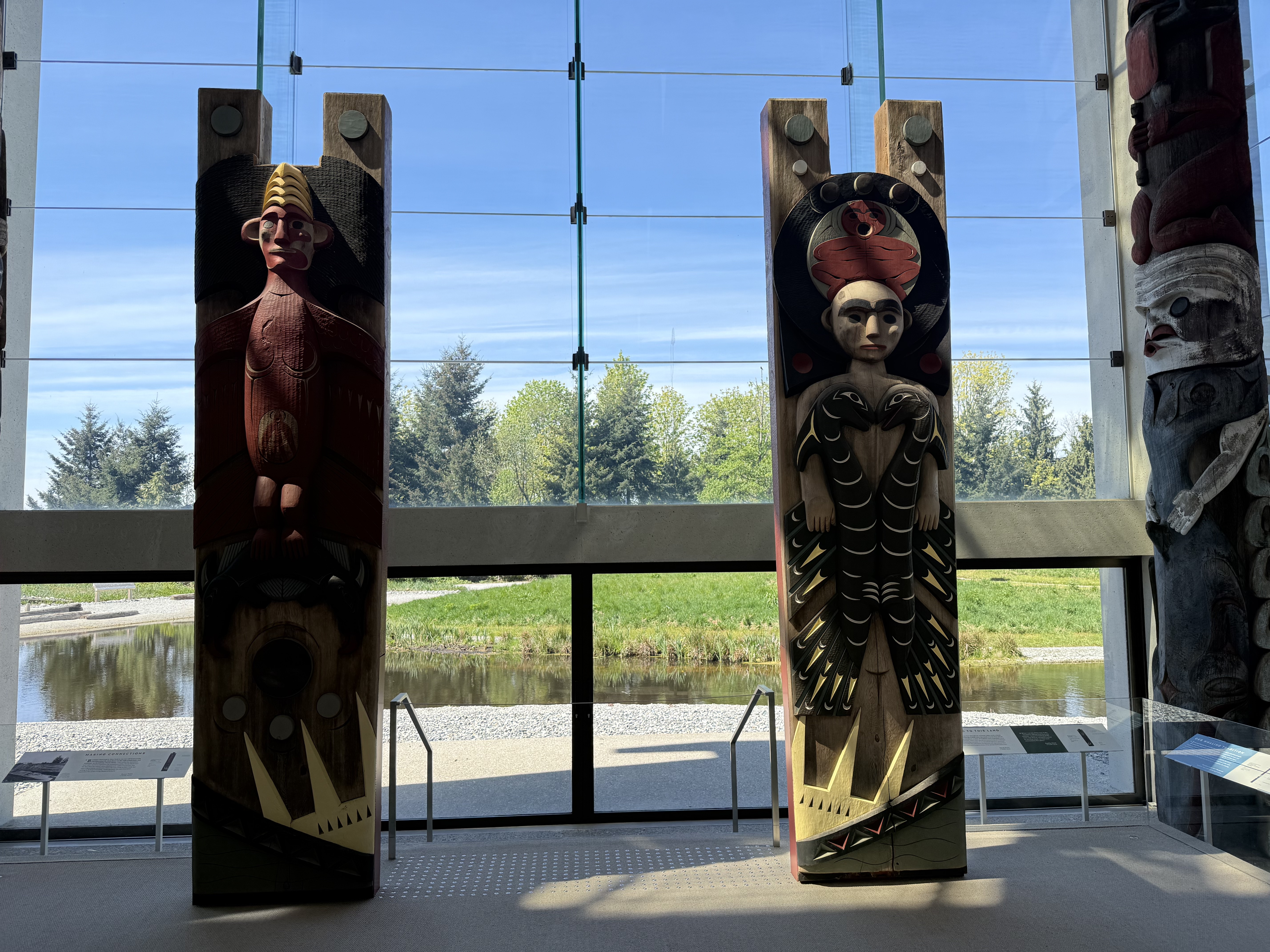
These two pieces represent the east coast, on the left with a rising sun; and the west coast with a setting sun.
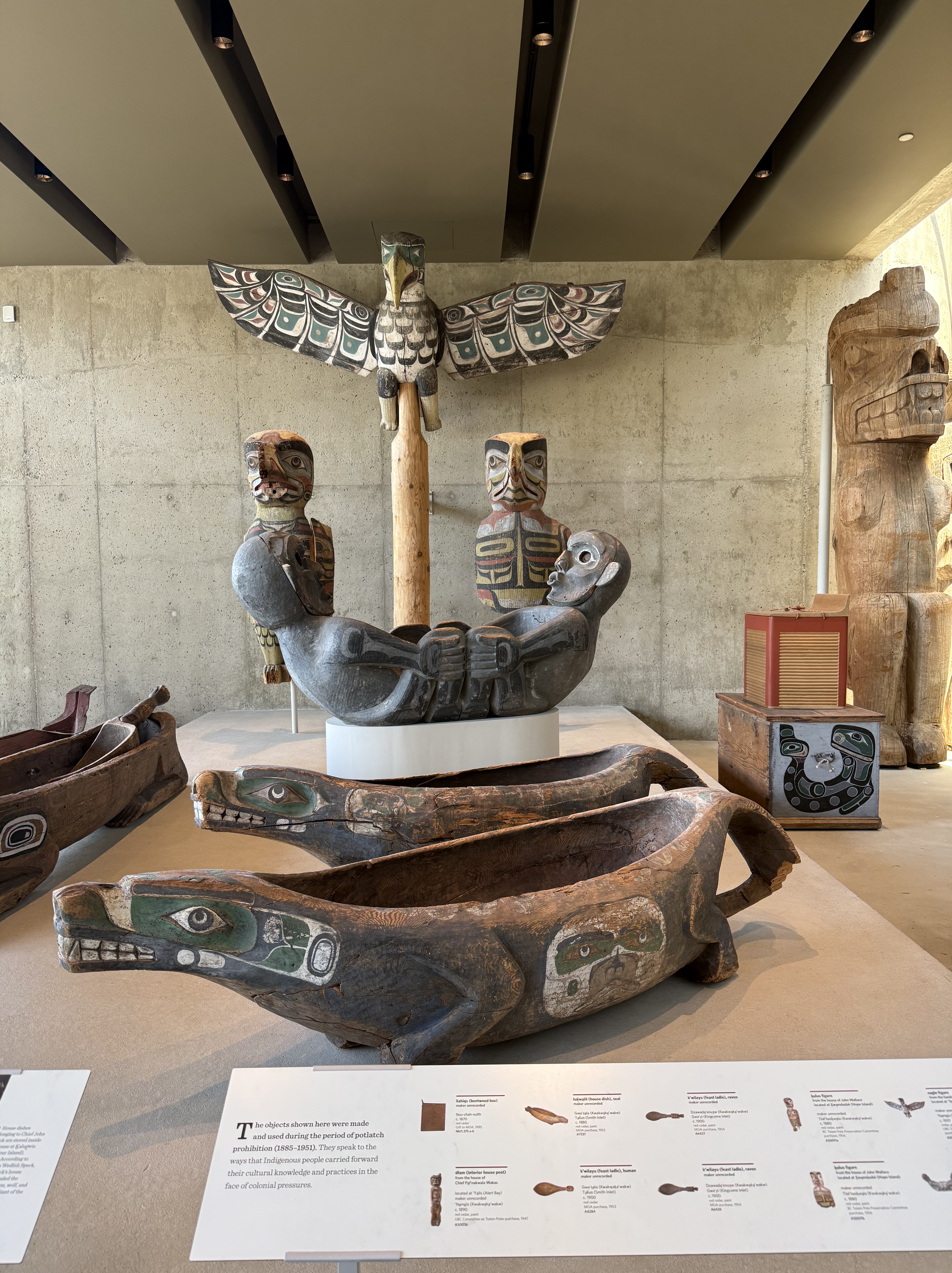
I was surprised at the variety of carved artwork the locals have created. Some of this is old and some is recently created by the active local artisans.
We drove to Shannon Falls, which cascades over 1000 feet.
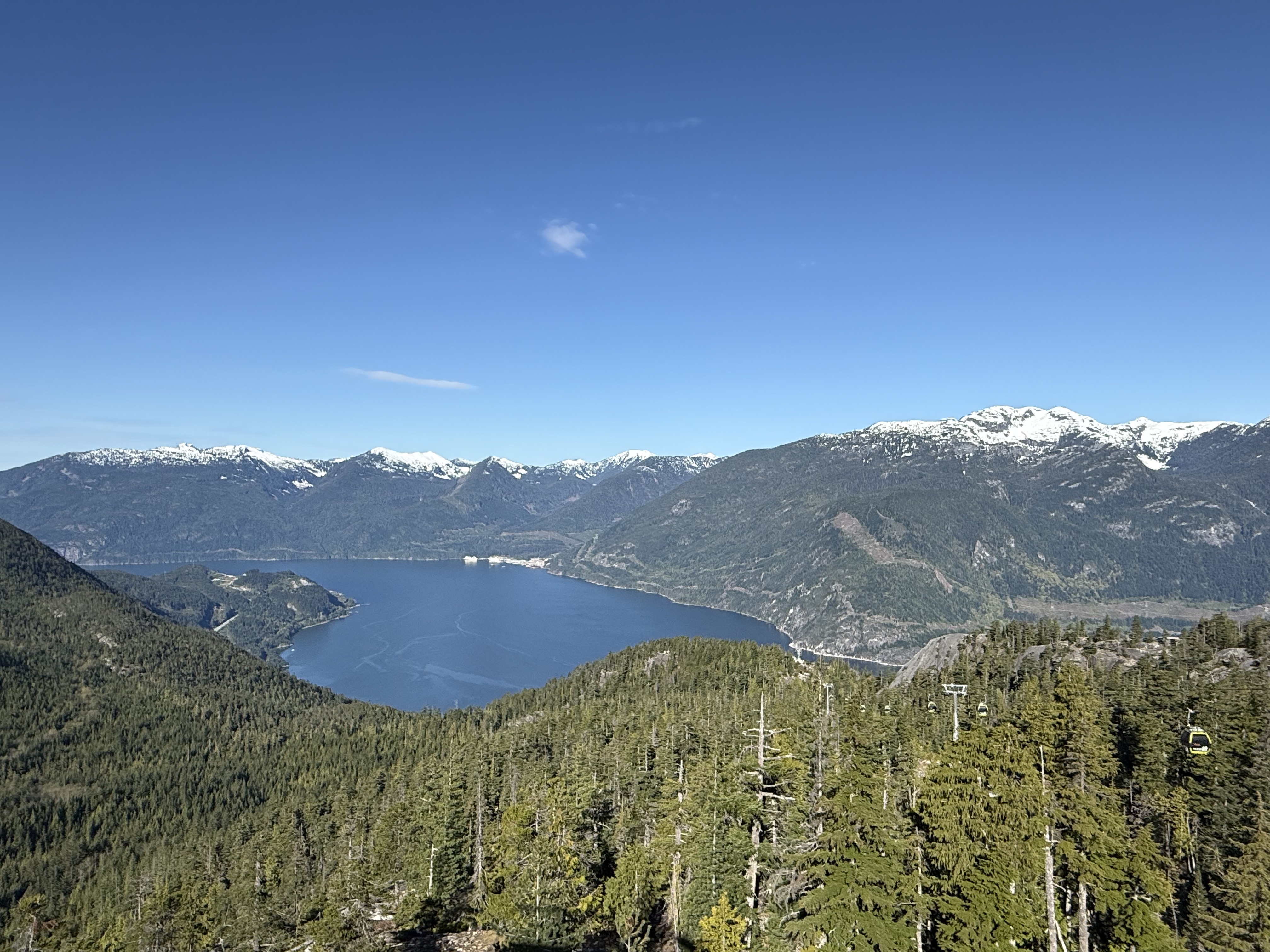
Then we rode a gondola for the 2300 foot climb to the top of Stawamus Chief and followed a good trail around to see the glacial topography from several vantage points. It was impressive, but I declined to use the suspension bridge for a better view. It’s a LONG way to the bottom.
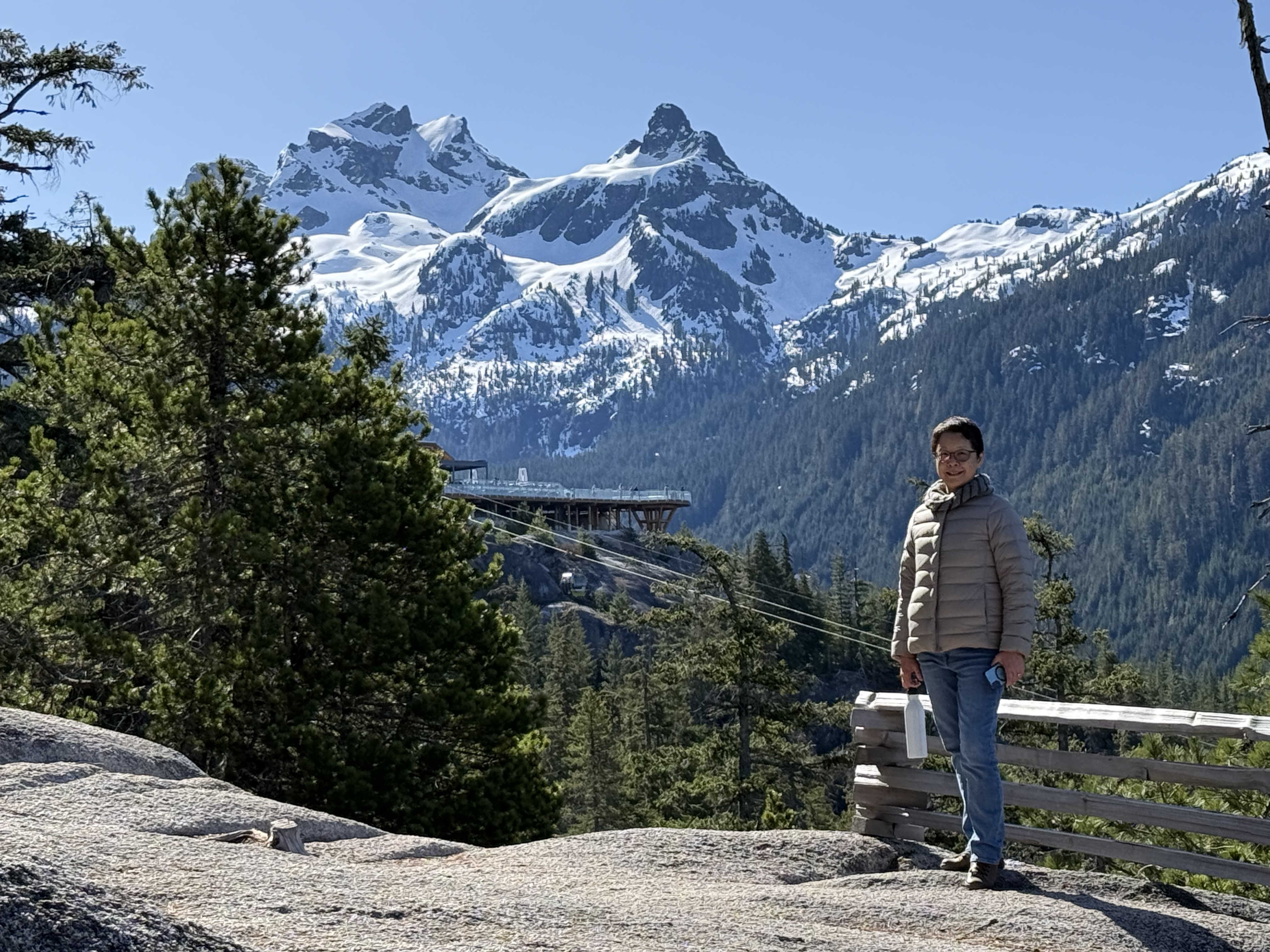
These pointed peaks are the remnants after alpine glaciers carved away at the mountain. Note their similarity to the famous Matterhorn in Switzerland.
We had to say goodbye, but we’ll probably return to Vancouver. It’s a beautiful city filled with friendly people who speak just like Americans in a city that could easily be mistaken for Seattle; perhaps some day Seattle and Vancouver will bridge the international border and merge into a megalopolis. I think we’re halfway there already.
The southbound border crossing wasn’t as pleasant as entering Canada; the American border was understaffed, ill-equipped, confusing and, generally, a clusterfuck. We spent 90 minutes to move three-hundred yards, to find that the passport-reading equipment in our line wasn’t working properly.
We plan to get a Nexus card for future trips…
Review of “Delights and Shadows” by Ted Kooser

There isn’t much for me to add to Ted Kooser’s critical acclaim for this well-named book of poetry. His skill with words, metaphors, and creating imagery is remarkable, even to someone like me. You don’t have to be a poetry lover to appreciate the tapestry he weaves with simple words in this impressive work.
It could be that this particular collection is mostly upbeat and doesn’t languish over the past or the future. From memories as a child to the observations of an elderly man, these poems present at most a melancholy side that never ventures into the depths of despair some poets wallow in. Maybe the difference is like preferring action novels over romances. Whatever you call this style of poetry, it really hits the spot with me.
There isn’t much to say about grammar and punctuation; I don’t understand how poets decide where to break lines, even if they don’t use commas. Thus, I never know exactly how to read them; sometimes I treat each line break as a pause, even if it has no punctuation. Other times I read right through and only pause at commas or semicolons, but sometimes his multi-line sentences are pretty long. I’ll get a chance to practice because this author has convinced me to continue reading poetry.
I don’t keep the books I read after writing my reviews, but I think I’ll keep this one handy to bring some delight or shadows into a moment of my day…occasionally.
I definitely recommend this book of poetry.
Tacoma Chinese Reconciliation Park
I enjoy walking along the shore of Commencement Bay in Tacoma because it is lined with industrial relics, parks, modern shipping facilities, and memorials to my new home’s international connections. But Tacoma, like so many cities, also has a dark past that it acknowledges in many ways. Today’s post is a memorial to one of those darker times.
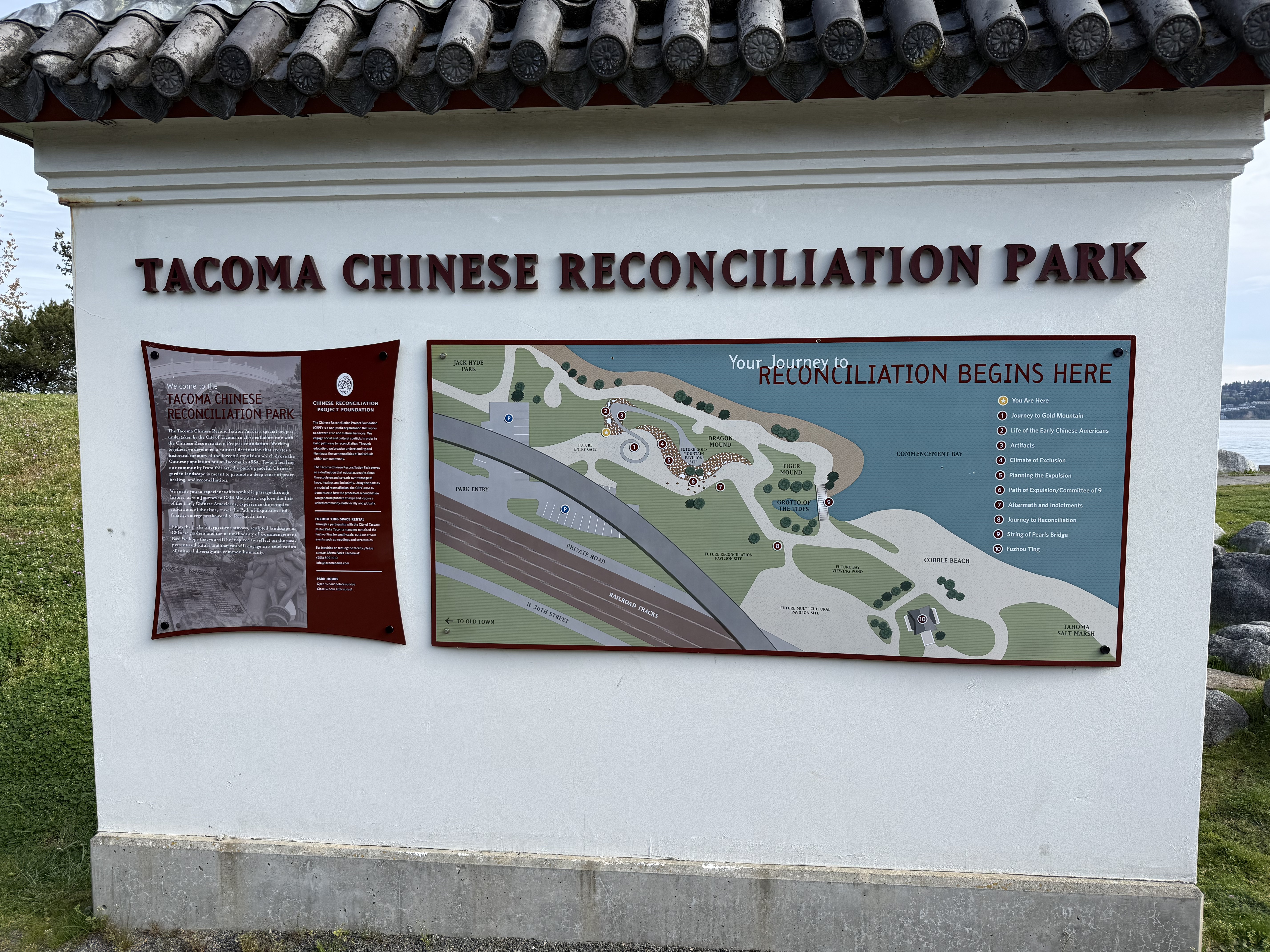
The memorial park is only a few acres, strung along the narrow stretch of land between the railroad and the sea.
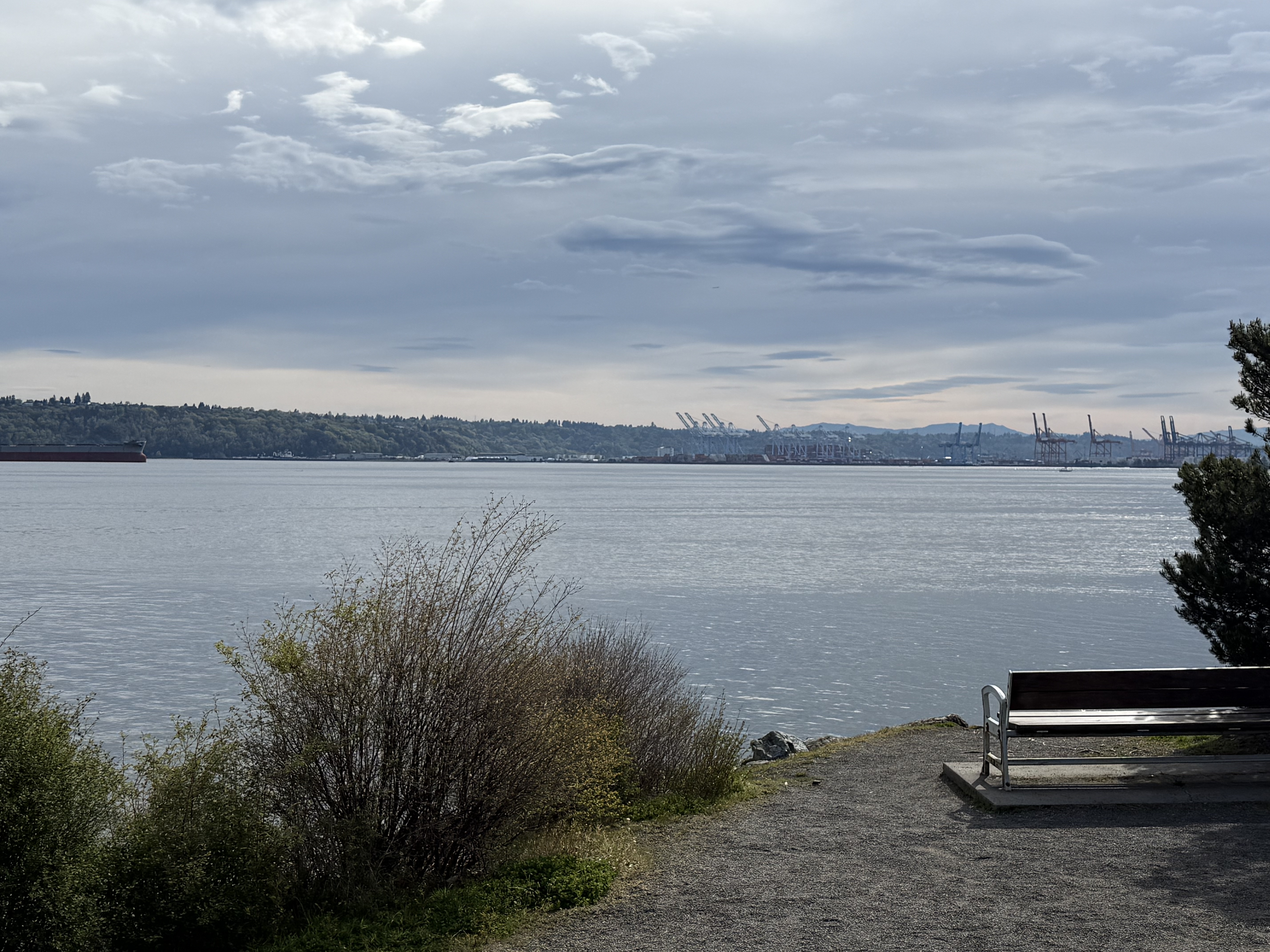
The port of Tacoma’s container handling facilities can be seen in the background, a reminder that life goes on despite the too-often shameful past.
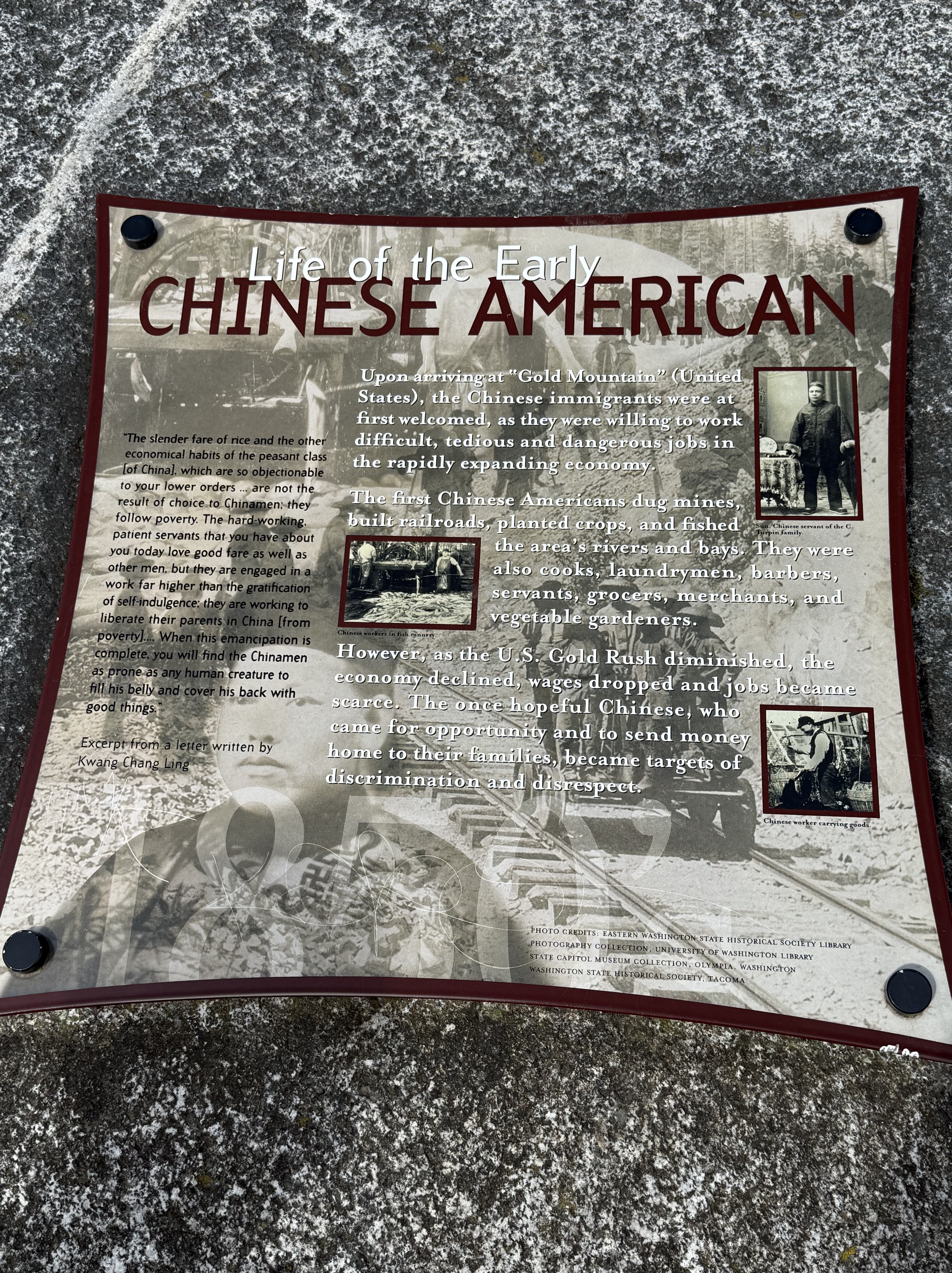
China was suffering from famine and misery in the late nineteenth century. America was seen by some as an escape from poverty and certain death, just as for immigrants from Europe. Immigrating didn’t require visas or approval; if you arrived, you were welcomed, especially the Chinese who took menial jobs to support the industrial development of the Pacific Northwest. They came looking for gold, but settled for whatever they could find. They were welcomed…until economic hard times made them the scapegoats of overall business downturns. Tacoma residents evicted them with extreme prejudice. They sued but were defeated in a court system as racially discriminatory as the people persecuting them. They never received compensation for property or business investments stolen from them.
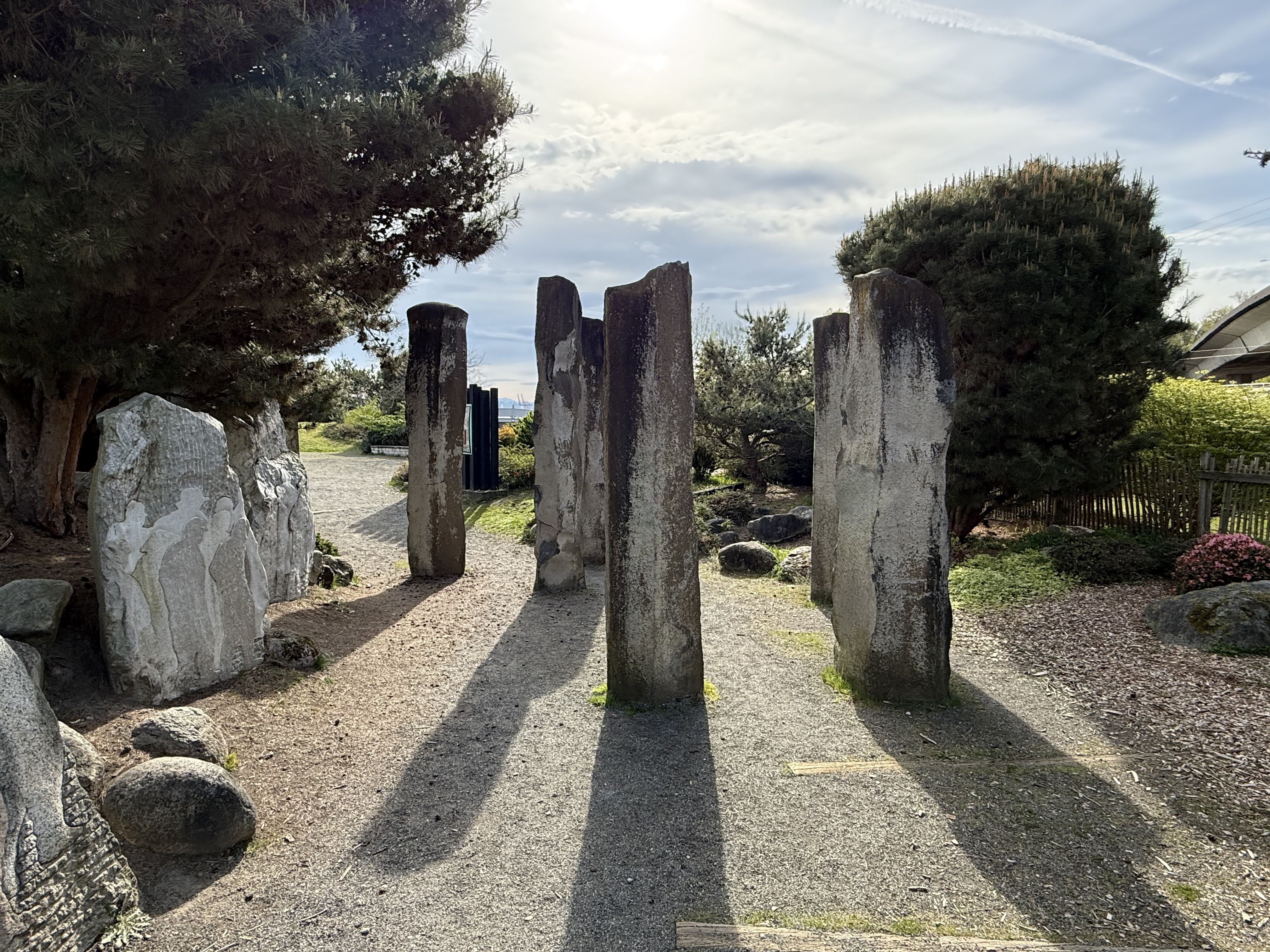
This is my favorite display because it uses rocks to make its point: the bowed backs of Chinese immigrants are carved in bas relief on blocks of diorite; columnar andesite stands in mute witness to their plight.
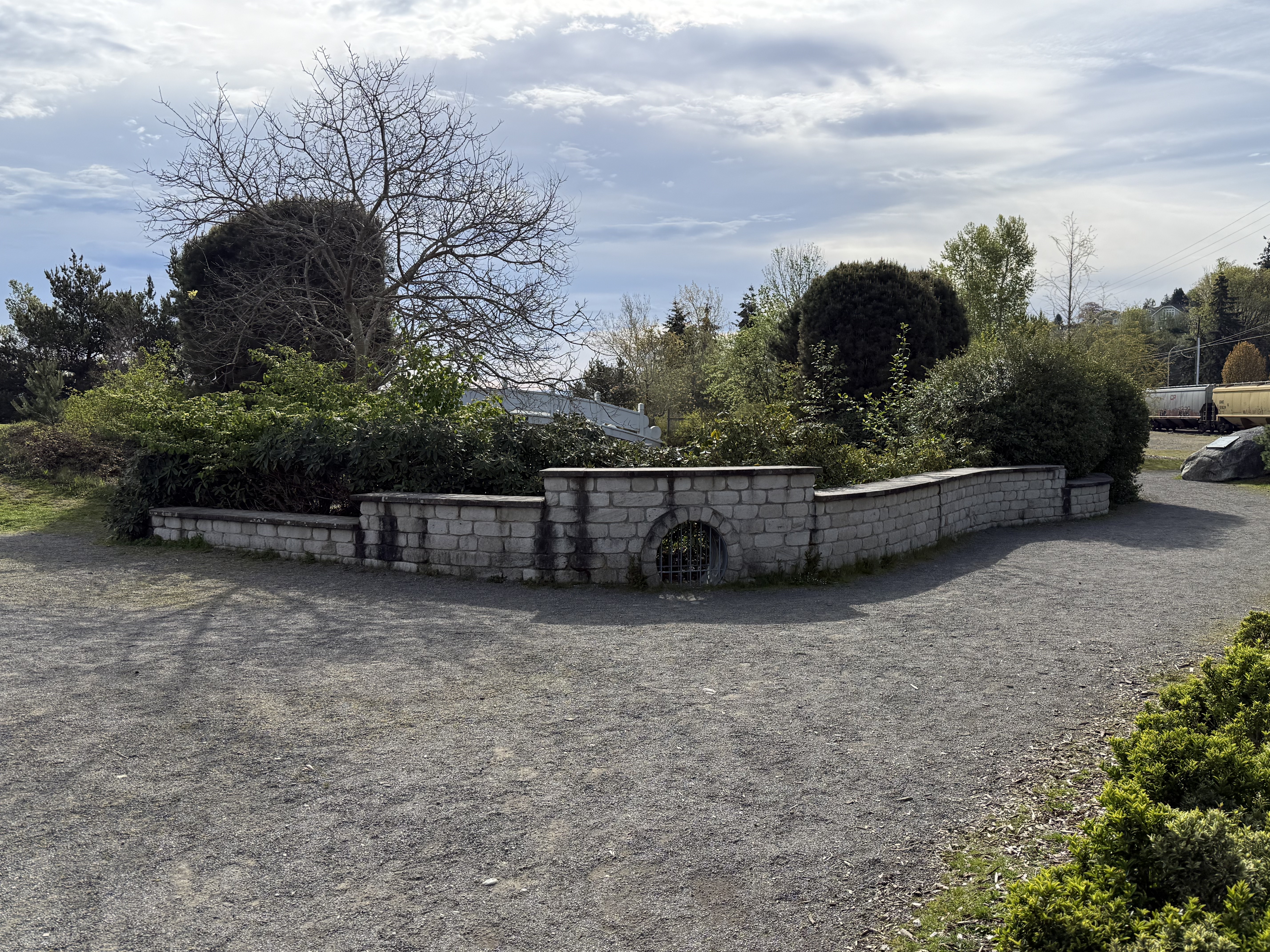
This beautiful display has to be seen in parts, but one interpretation is fairly simple: a minor barrier confronts the immigrant, but life abounds behind it, if you can only climb over the low wall…
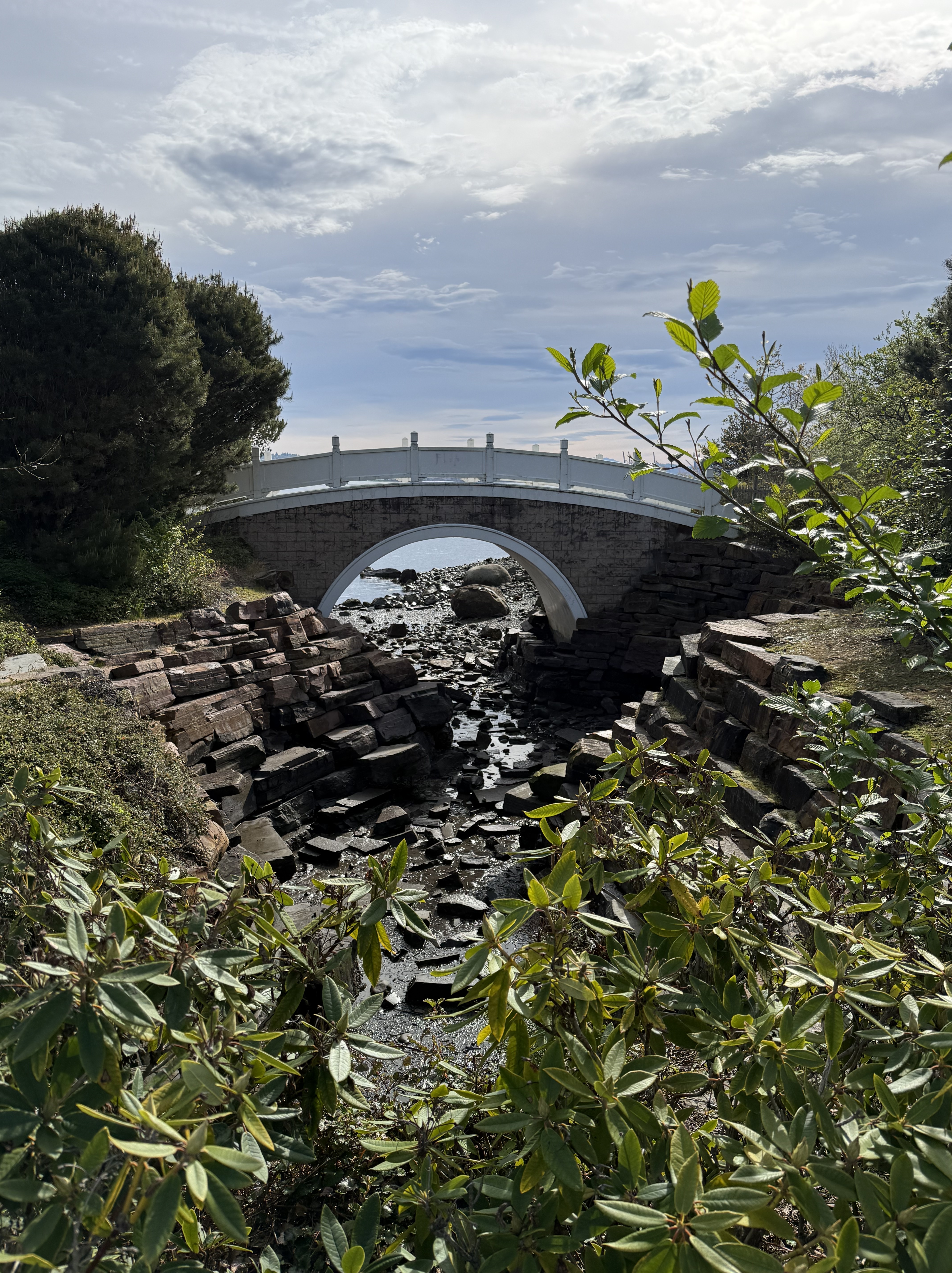
Beyond the wall is the sea, whose level rises and falls with the tides of history and human events…
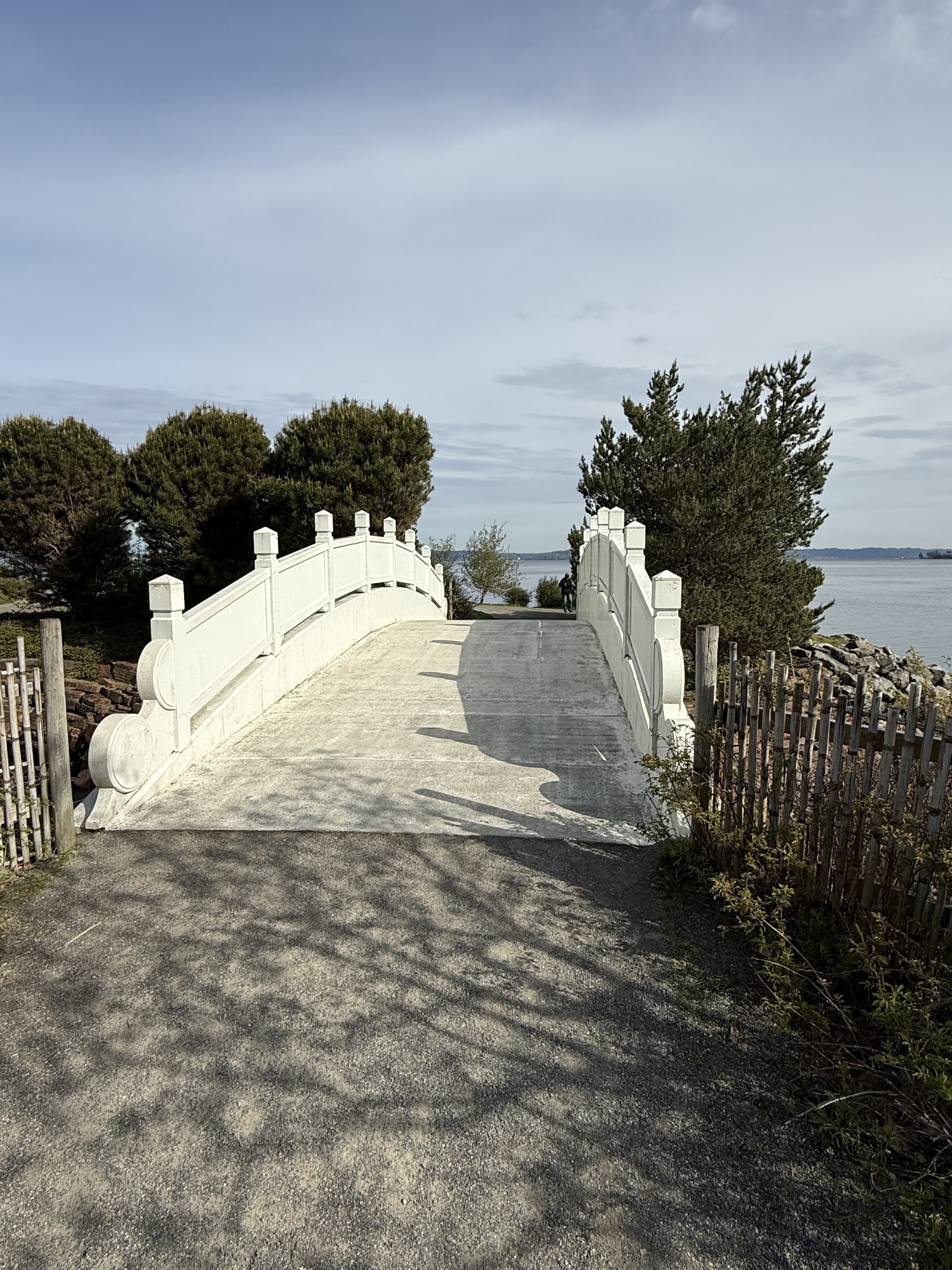
A well-constructed bridge will take you over the sea to the promised land…
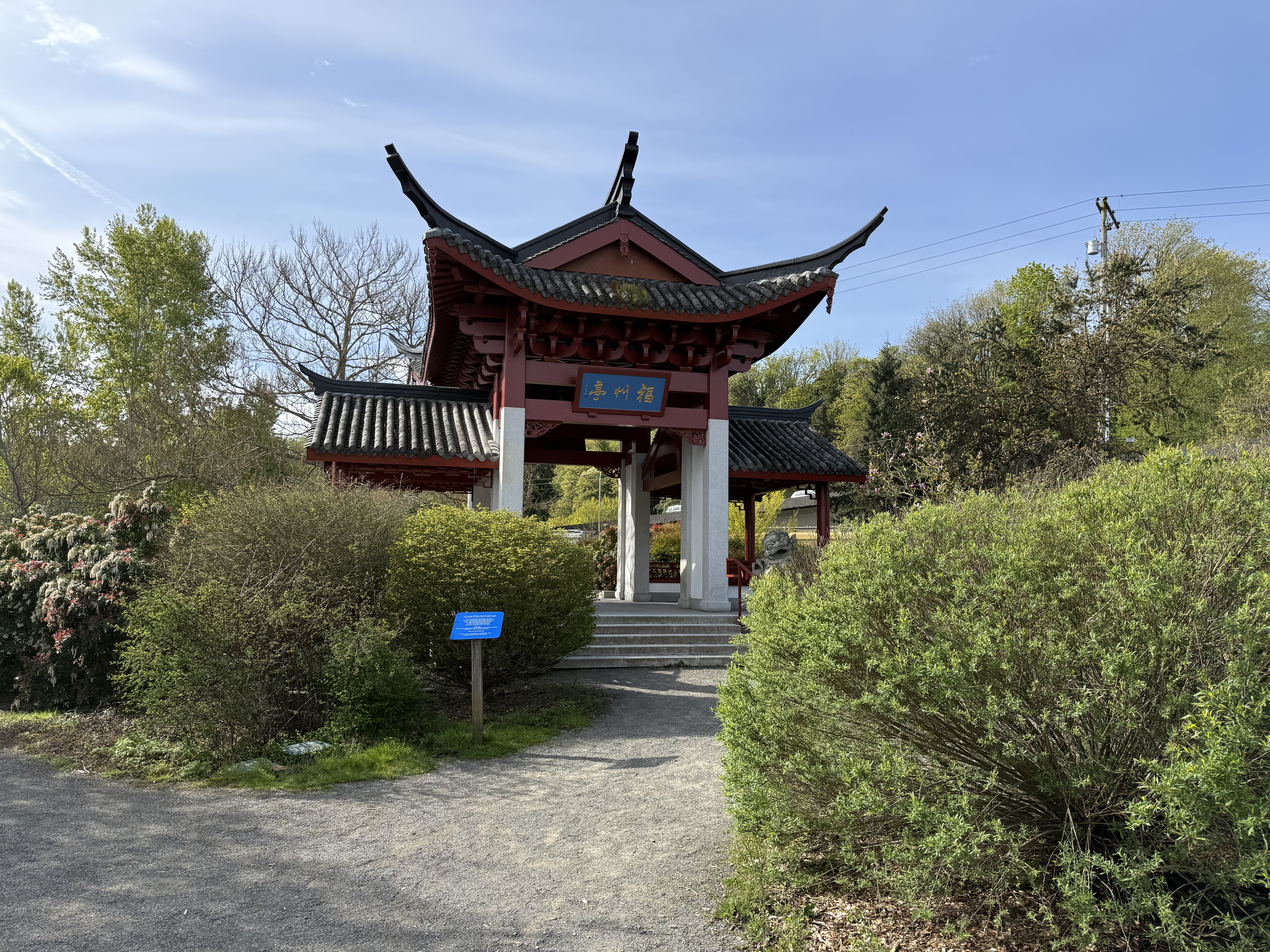
To a home that is linked to the land you left behind. This pagoda was given to Tacoma by Fuzhou, China–a sister city of Tacoma where many of the immigrants came from. It was built there and transported to this location after the park was authorized by the city in 1993.
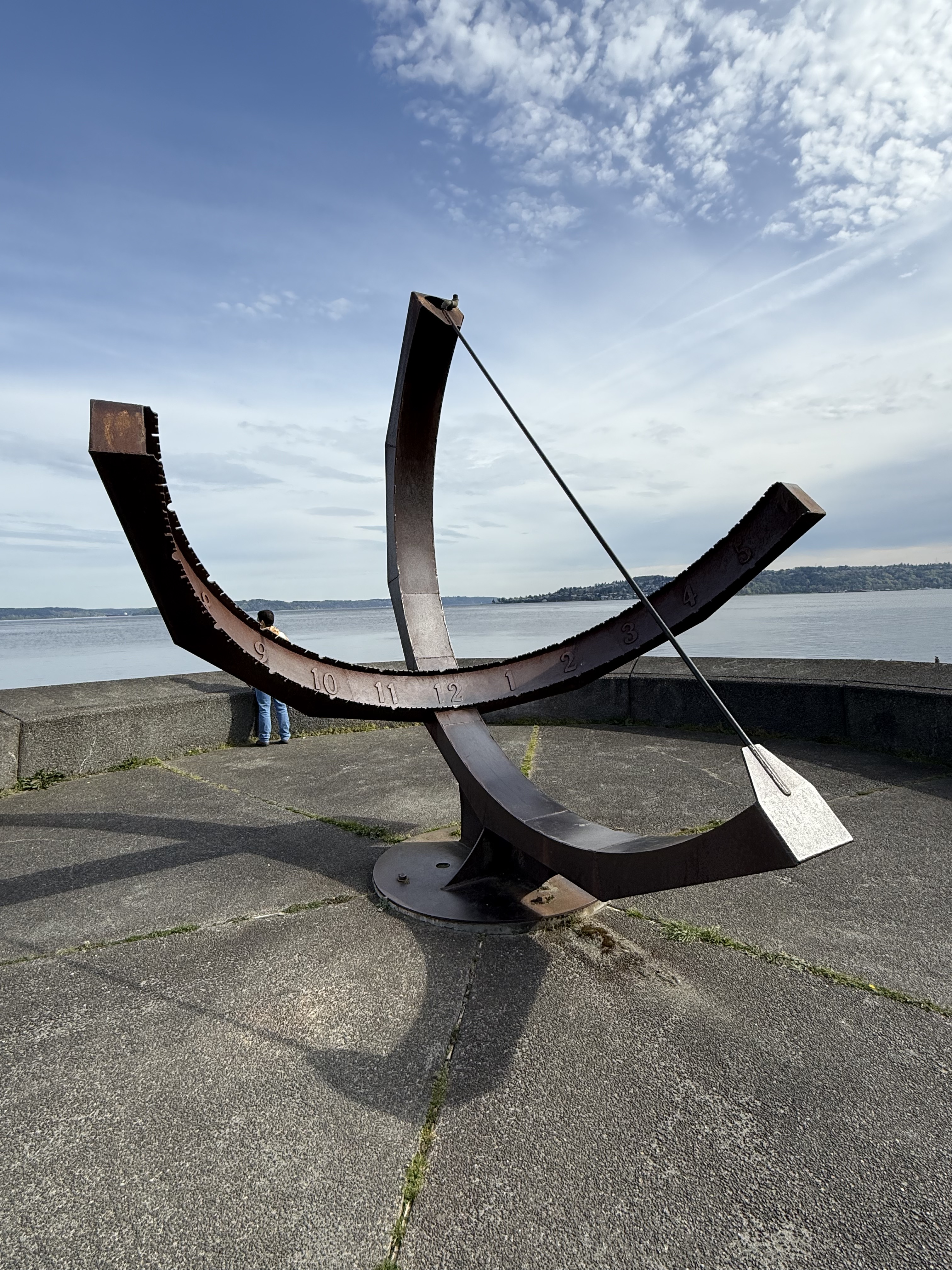
I’m not sure what this is about. There was no plaque or explanation anywhere to be found. Tacoma is filled with artwork, but it usually has an explanation. I looked at the park’s web site, but this sculpture wasn’t shown. It faces almost due north…
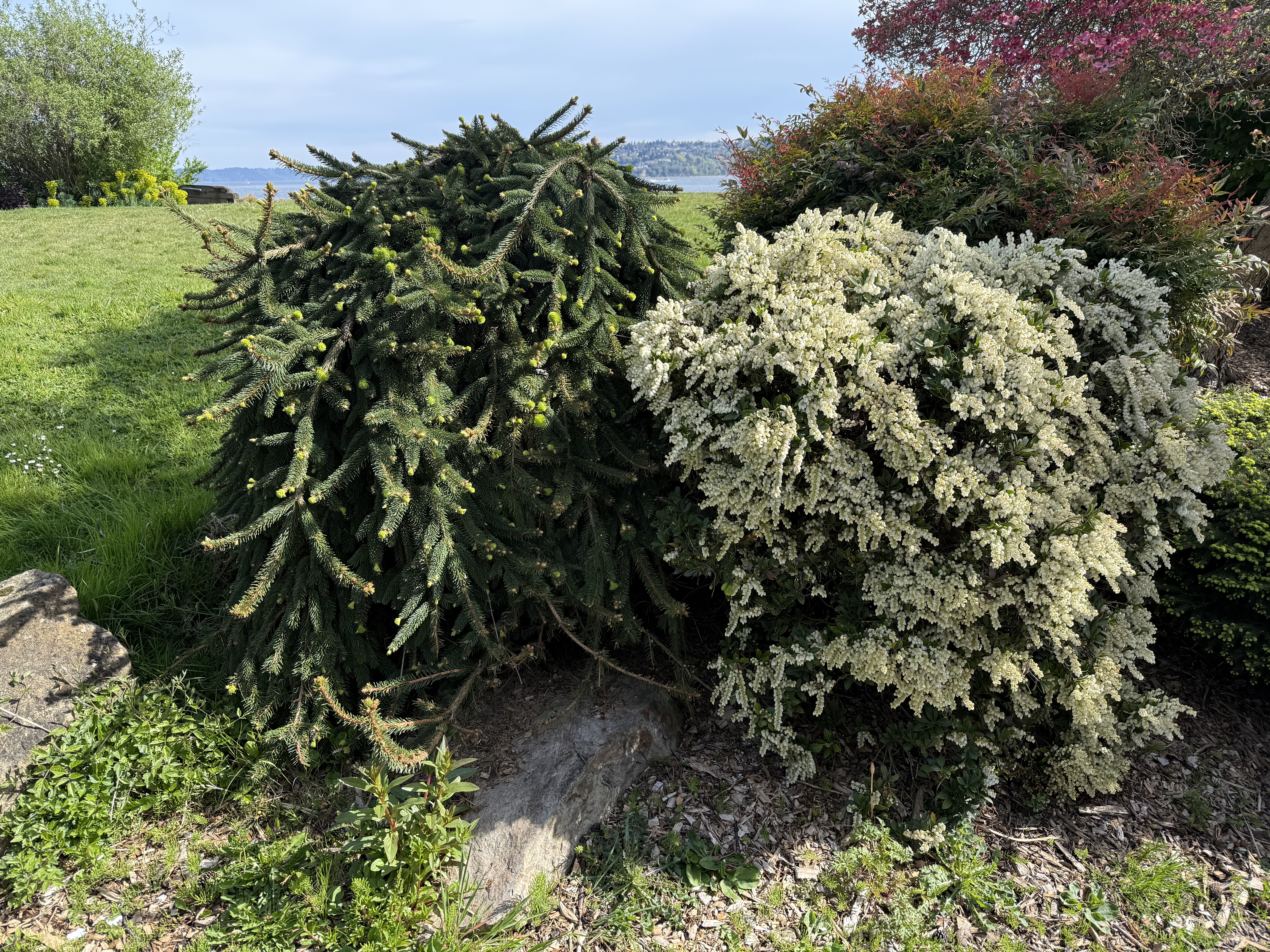
There was a lot of tropical/Asian vegetation, just as there is throughout the Pacific Northwest. CoPilot thinks the flowered shrub here is Pieris japonica. Japanese. The dwarf conifer is also probably native to Japan. Americans have trouble differentiating different Asian countries, but we also don’t know where Hungary is, or even Switzerland for that matter.
Sights around Lake Washington
It promised to be a beautiful day, so we decided to take a look at Lake Washington, just east of Seattle. This elongate water body was carved by glaciers between 19 and 16 thousand years ago. It was part of Puget Sound until about 5700 years ago, when river sediment isolated it from the sea, allowing it to become fresh water. The original outlet at the southern end wasn’t good enough for early American settlers, so they got approval from Congress to construct a canal with locks to connect Lake Washington to Puget Sound, a drop of 20 feet in elevation. As fans of technological progress, we wanted to see this for ourselves.
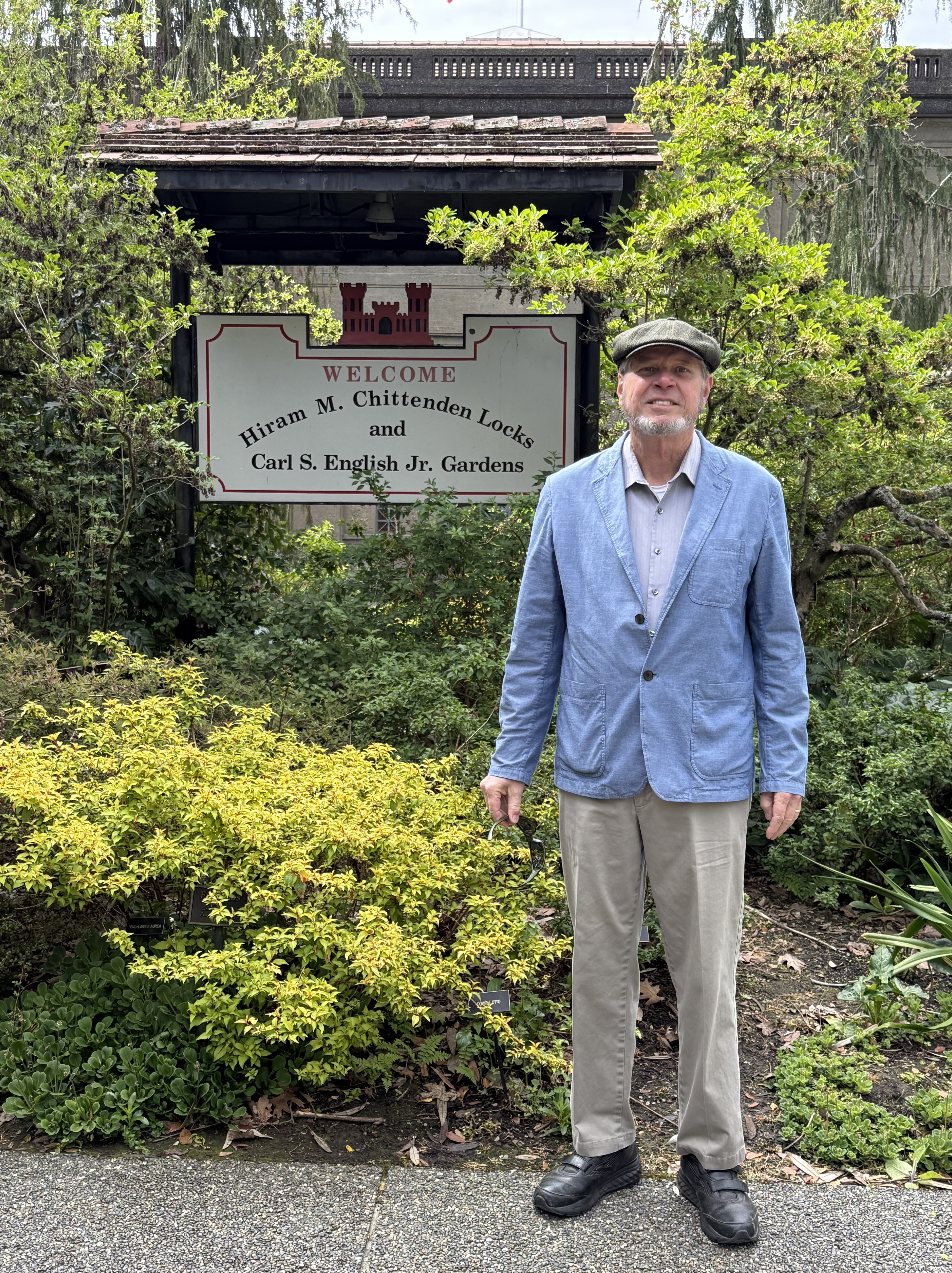
The Army Corps of Engineers began construction of a set of locks in 1911, under the supervision of Hiram M. Chittenden. As the sign proclaims, his name remains associated with them; however, they are more commonly known as the Ballard Locks after the city where they were built. The site includes a number of stone-faced buildings and has since come to include a botanical garden.
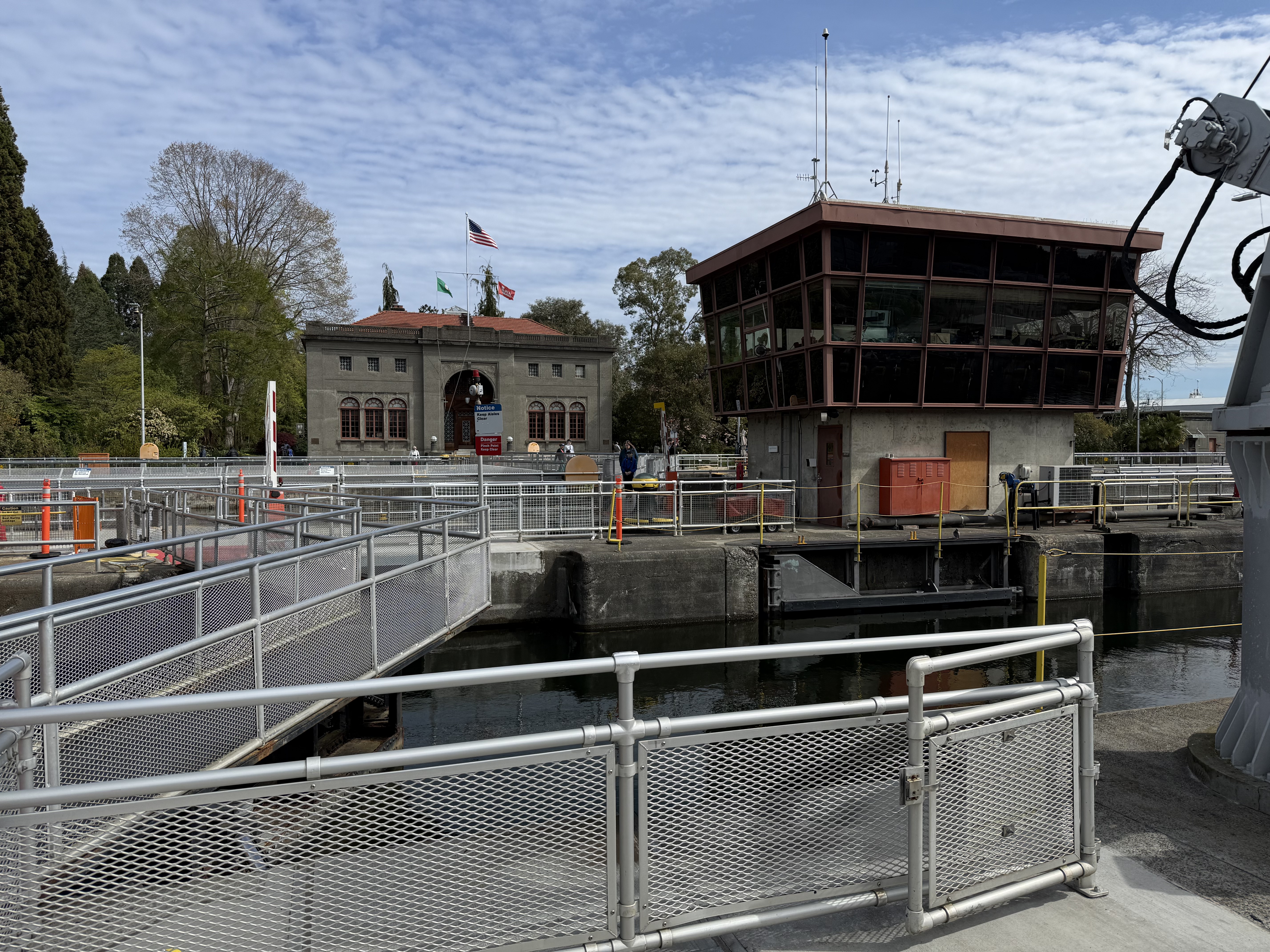
There are two locks, one for larger, commercial vessels (on the other side of the control building) and a smaller lock. The larger one has two sets of gates to accommodate barges.
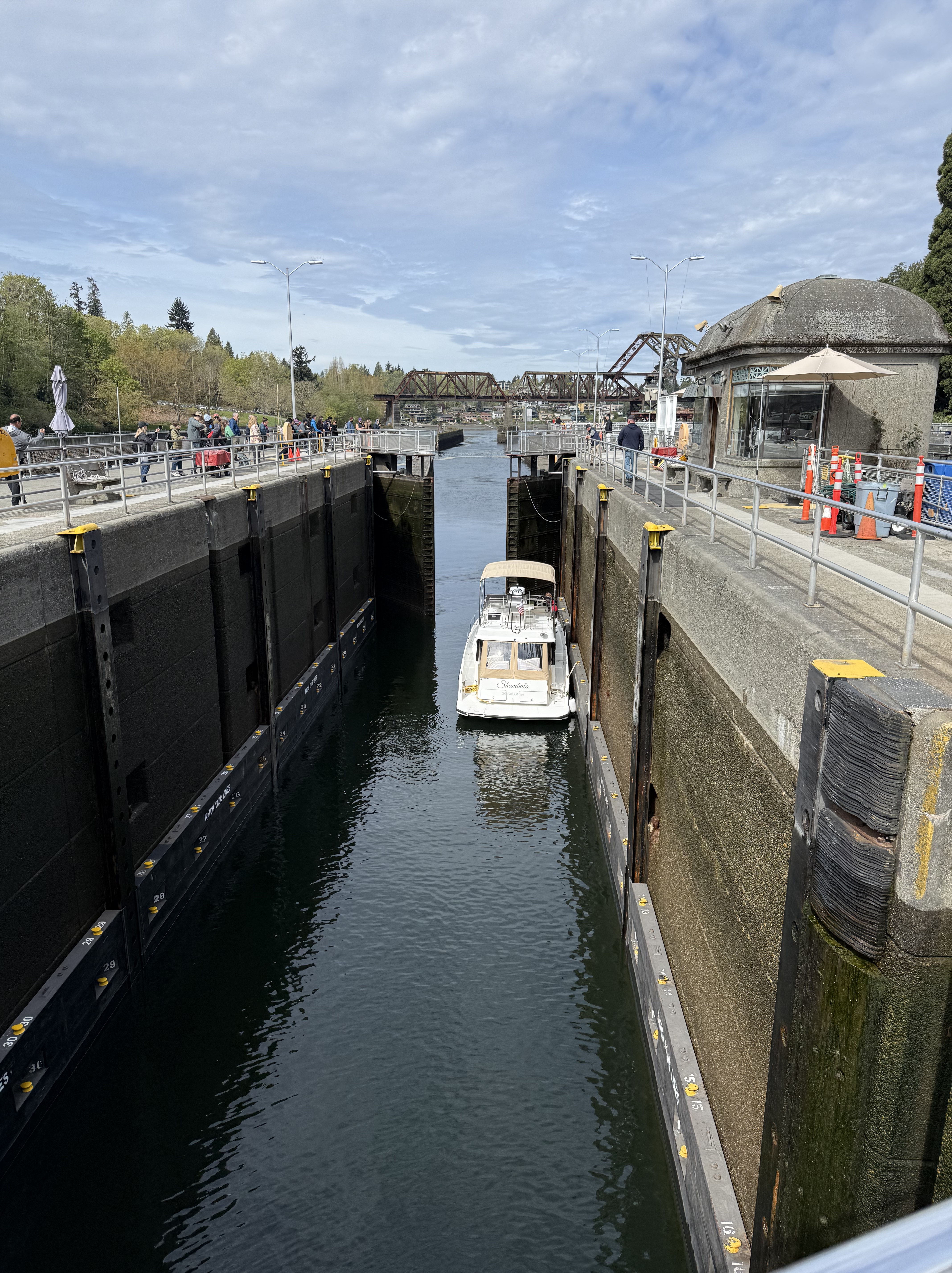
Several private boats used the lock while we were there. It takes maybe 15 minutes for the water level to equilibrate whether going upstream or downstream (towards Puget Sound).
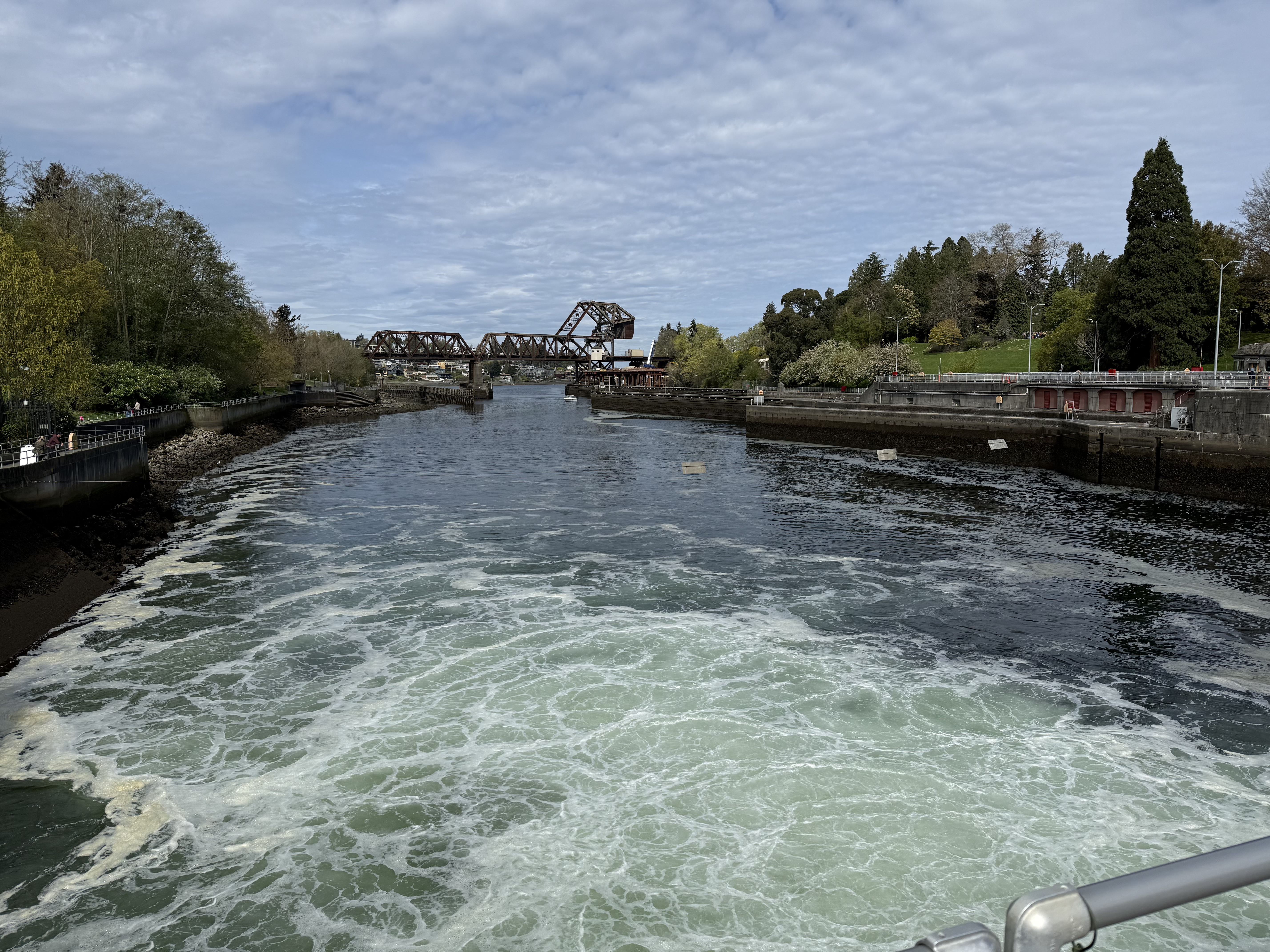
The spillway was partially open and the turbulent flow created a very dangerous scene. I wouldn’t want to fall into that water.
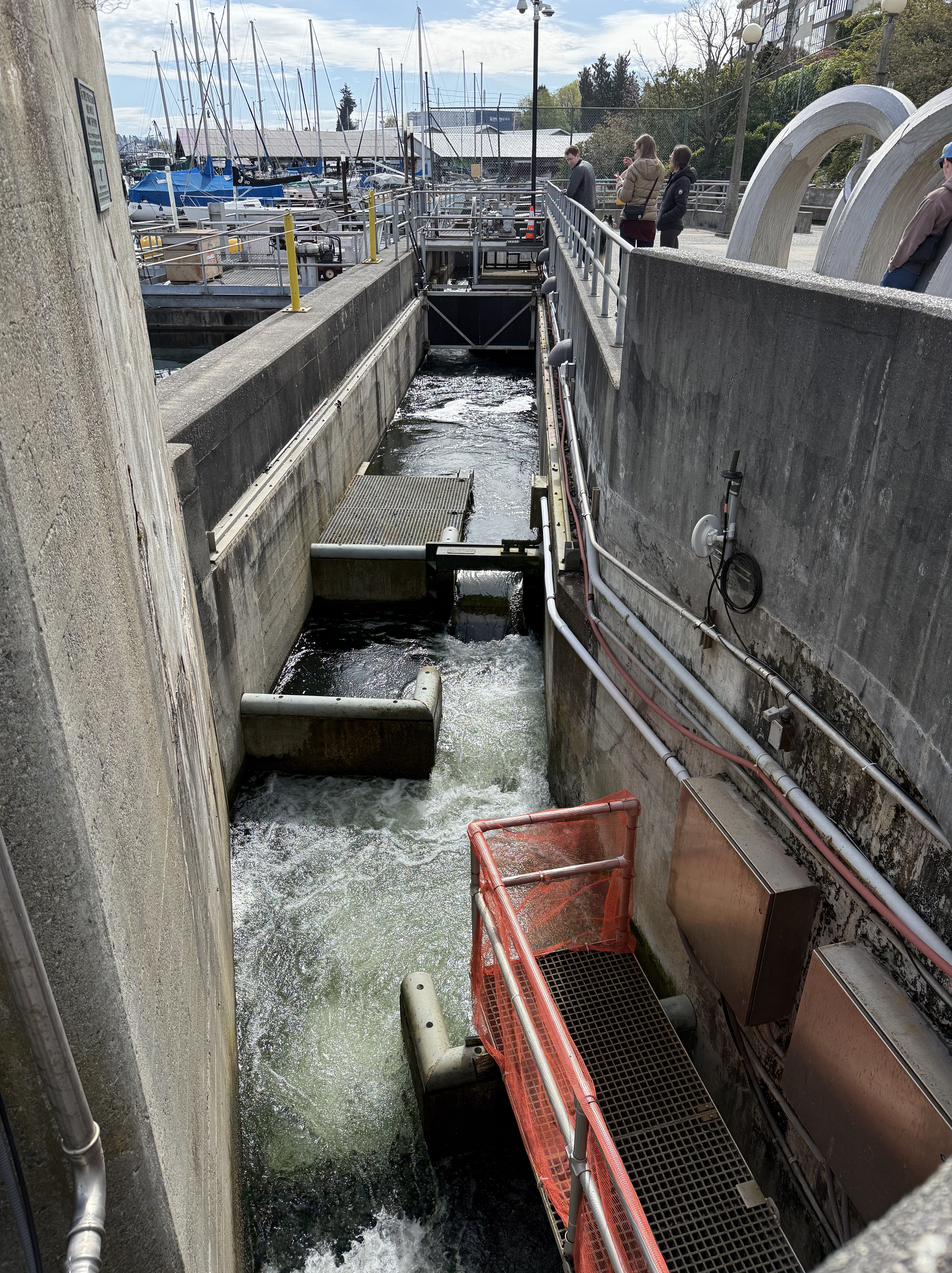
Salmon have historically swam into Lake Washington to spawn through the small river (Black River) that drained it before the ship canal was constructed. That outlet is apparently filled with sediment now and the area completely covered with development, including Boeing Aircraft’s main plant, where the Museum of Flight is located. The lock design includes a series of pools called a fish ladder that allows the salmon to get to their spawning areas. I guess they figured out the new route. There’s a viewing room to the right where the fish can be seen making their way up the ladder, but there were no fish on this day; and I forgot to take a picture.
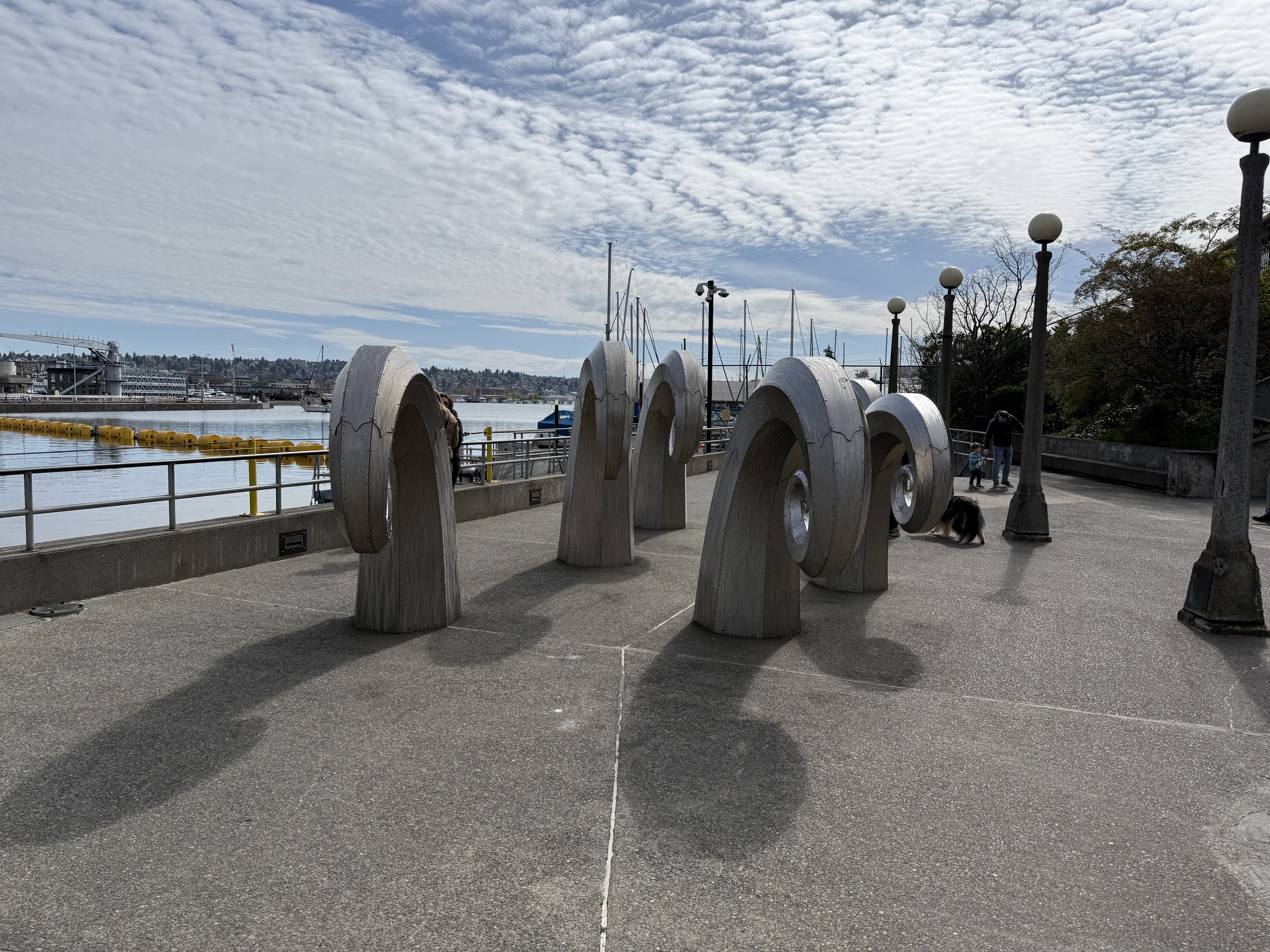
The roof of the fish ladder observation room is decorated with this unlabeled artwork.
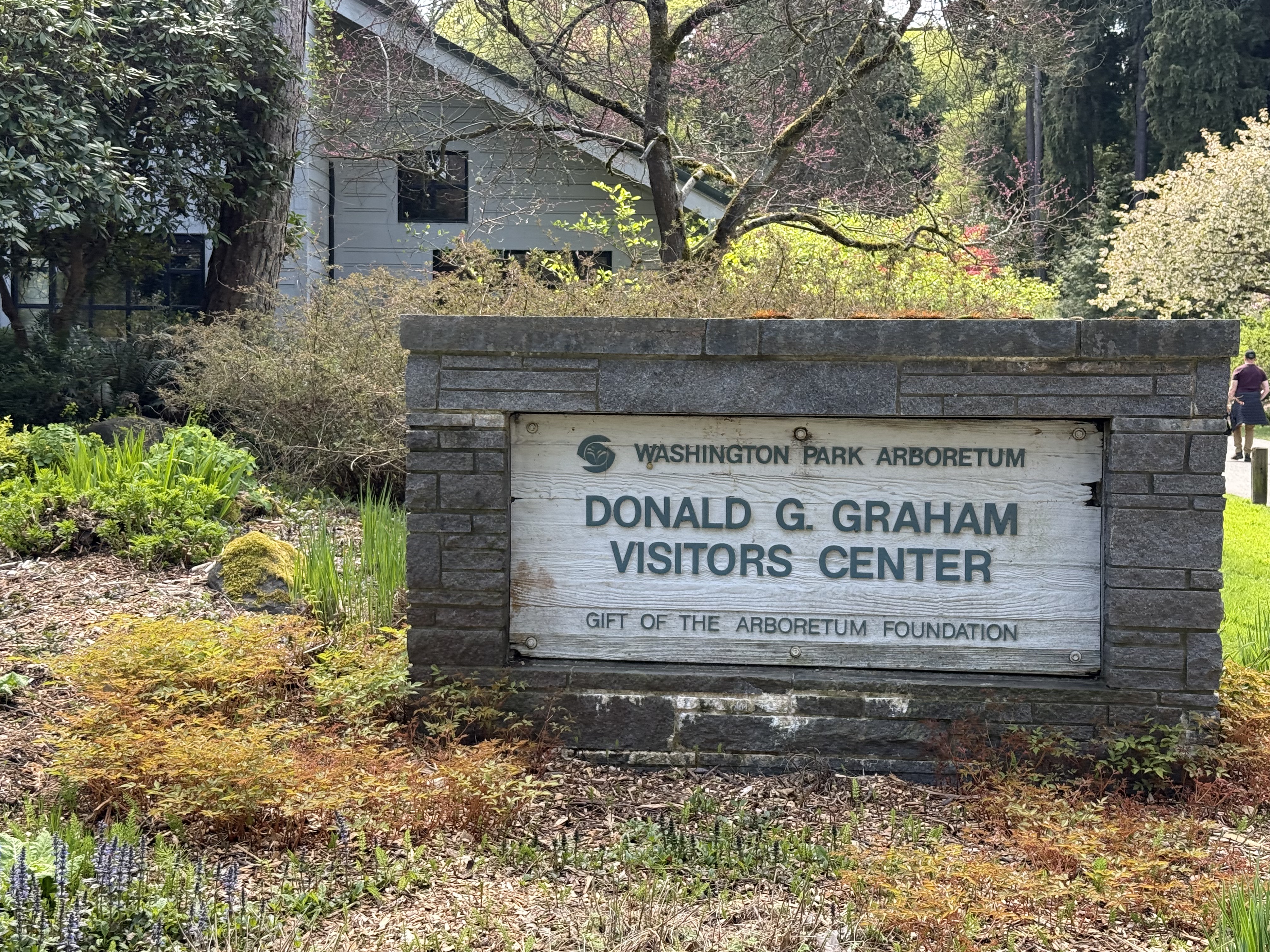
Just a short drive from Ballard Locks is Washington Park, which includes an arboretum and Japanese Garden. We took a long walk around the park but didn’t make it to the Garden, which has its own parking area.
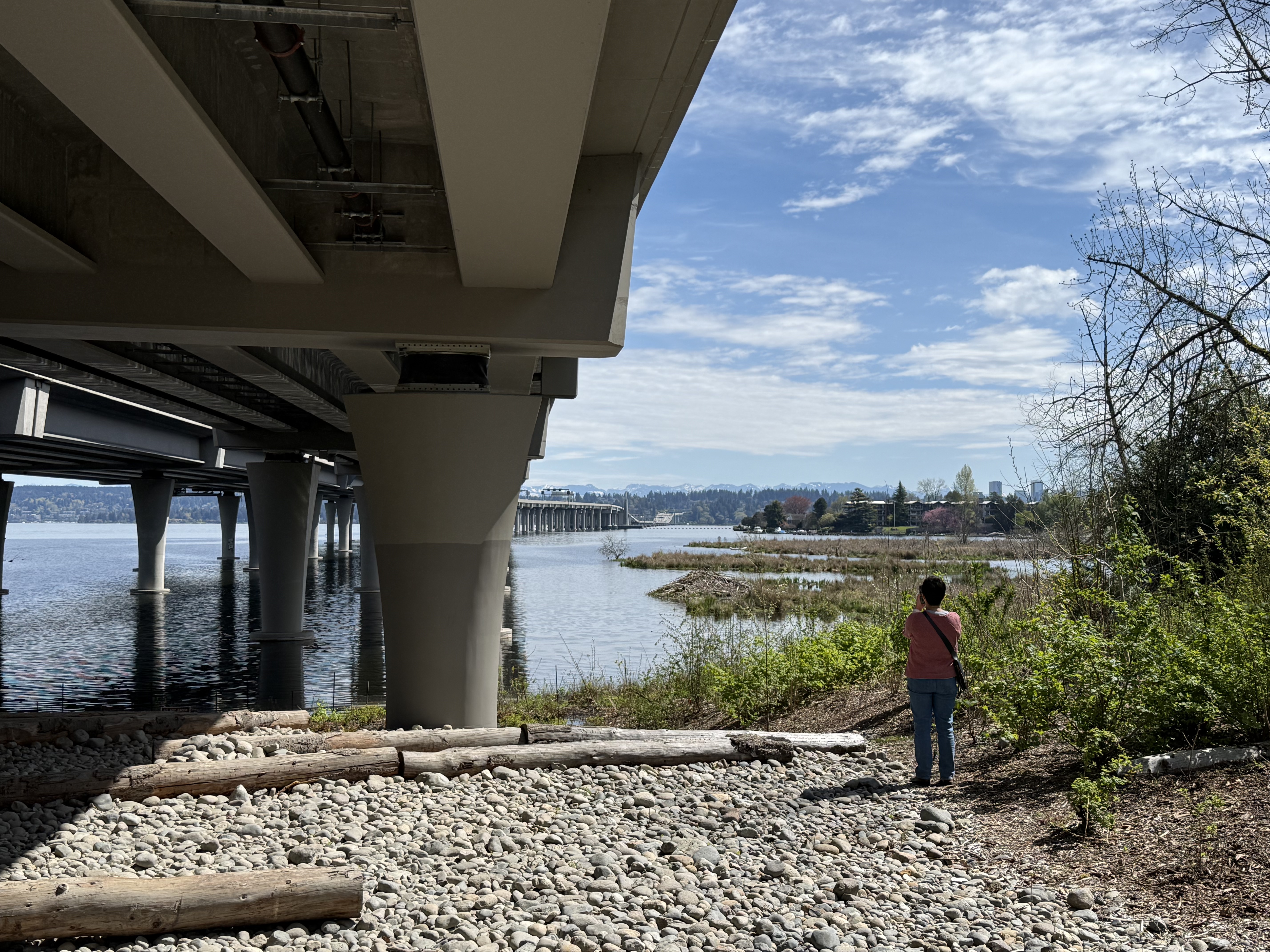
The walking paths go out to an island, where State Route 520 crosses Lake Washington, partly using a unique floating bridge construction. Traffic was pretty loud out there. I wouldn’t enjoy having lunch on one of the picnic tables.
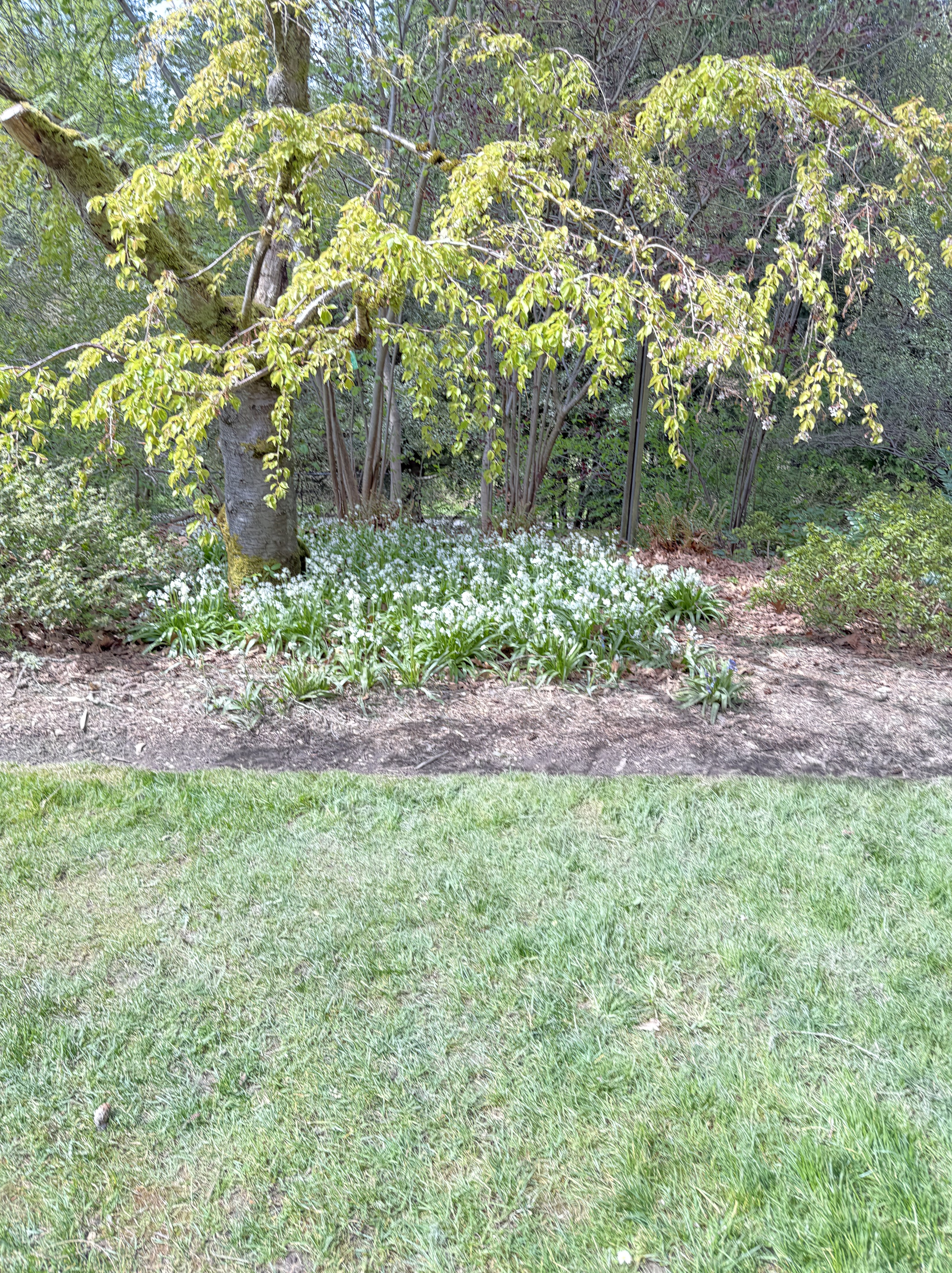
These are typical plantings along the paths in the arboretum. I don’t know anything about plants, so I asked CoPilot (giving it the location): the low, flowering shrub is probably Pieris japonica (aka Lily of the Valley shrub); and the tree may be Stewartia.
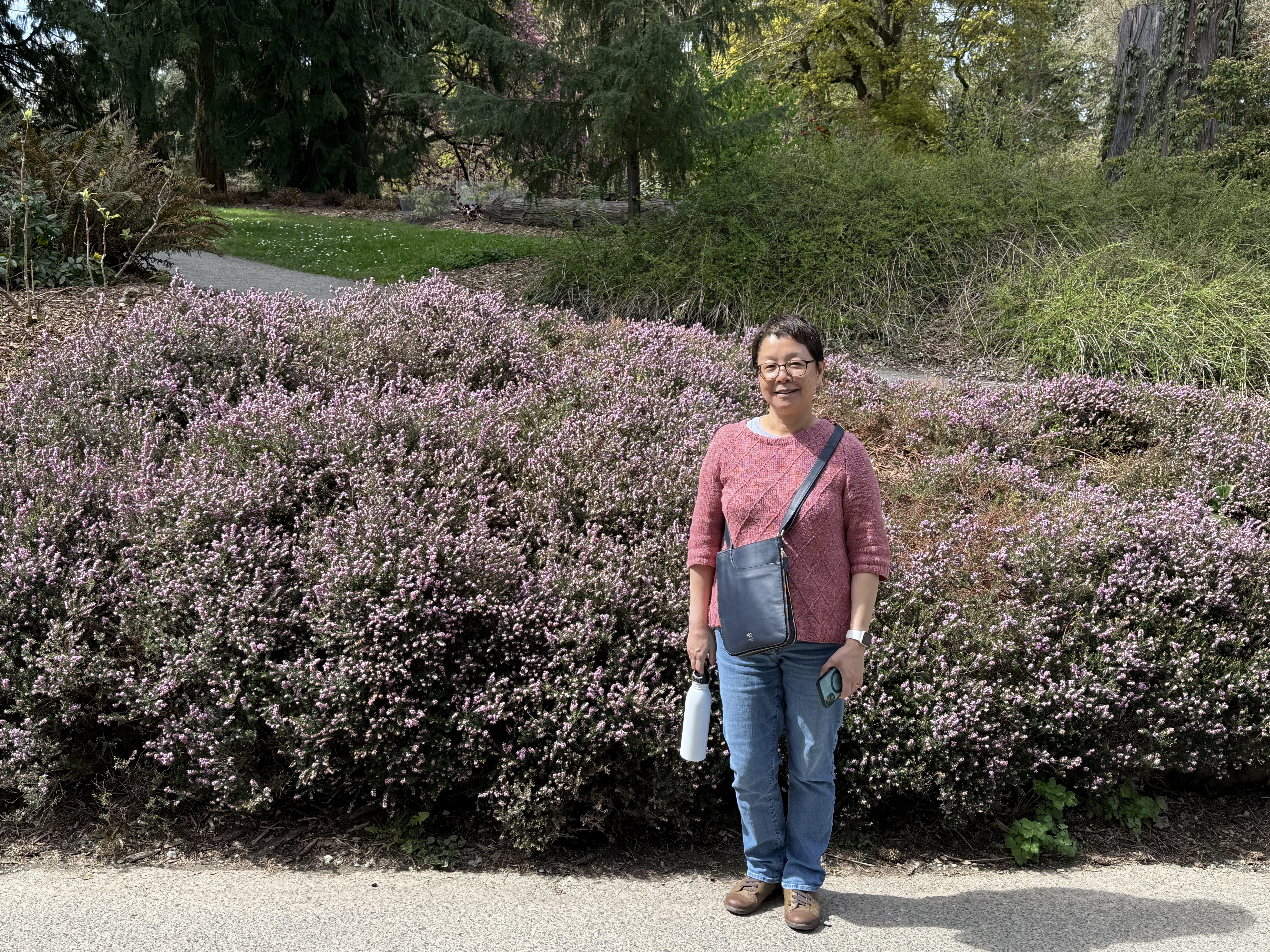
There were numerous masses of flowering shrubs like this, which is probably a dwarf Rhododendron (according to CoPilot). There were a lot of plants within a group, which didn’t look anything like each other; however, the signs explained that the arboretum had large collections of Rhododendrons and Magnolias, for example.
It was a beautiful spring day, and Lake Washington was the perfect place to spend it. I won’t post a photo of the excellent, home-made hamburger and cold beer I enjoyed at Skillet and Vine after a tiring morning of basking in a warm sun.
Mount St Helens After Forty-Five Years
Introduction
I was a geology student at Arizona State University in May, 1980, when Mount St. Helens made the headlines. It is the largest volcanic eruption in North America, and when one-cubic-mile of mountain collapsed, it became, and remains, the largest landslide in human history. I followed the progress of geological investigation into the eruption with interest as I pursued my education, but progress was slow. It isn’t easy to reconstruct an event that occurred in a few minutes. The area was too dangerous to approach for more than a year because of gas explosions from within the pile of debris, which reached 600 feet in thickness.
Mount St. Helens faded from memory for decades, eventually becoming just another geologic event in a long chain of cataclysms covering billions of years. I never thought about it until I found myself living less than 100 miles from ground zero. I had to check it out. This post is a brief summary of what I found when I visited Mount St. Helens National Volcanic Monument. I hope I can convey some of the excitement I felt at stepping on ground that was literally on fire less than fifty years ago.
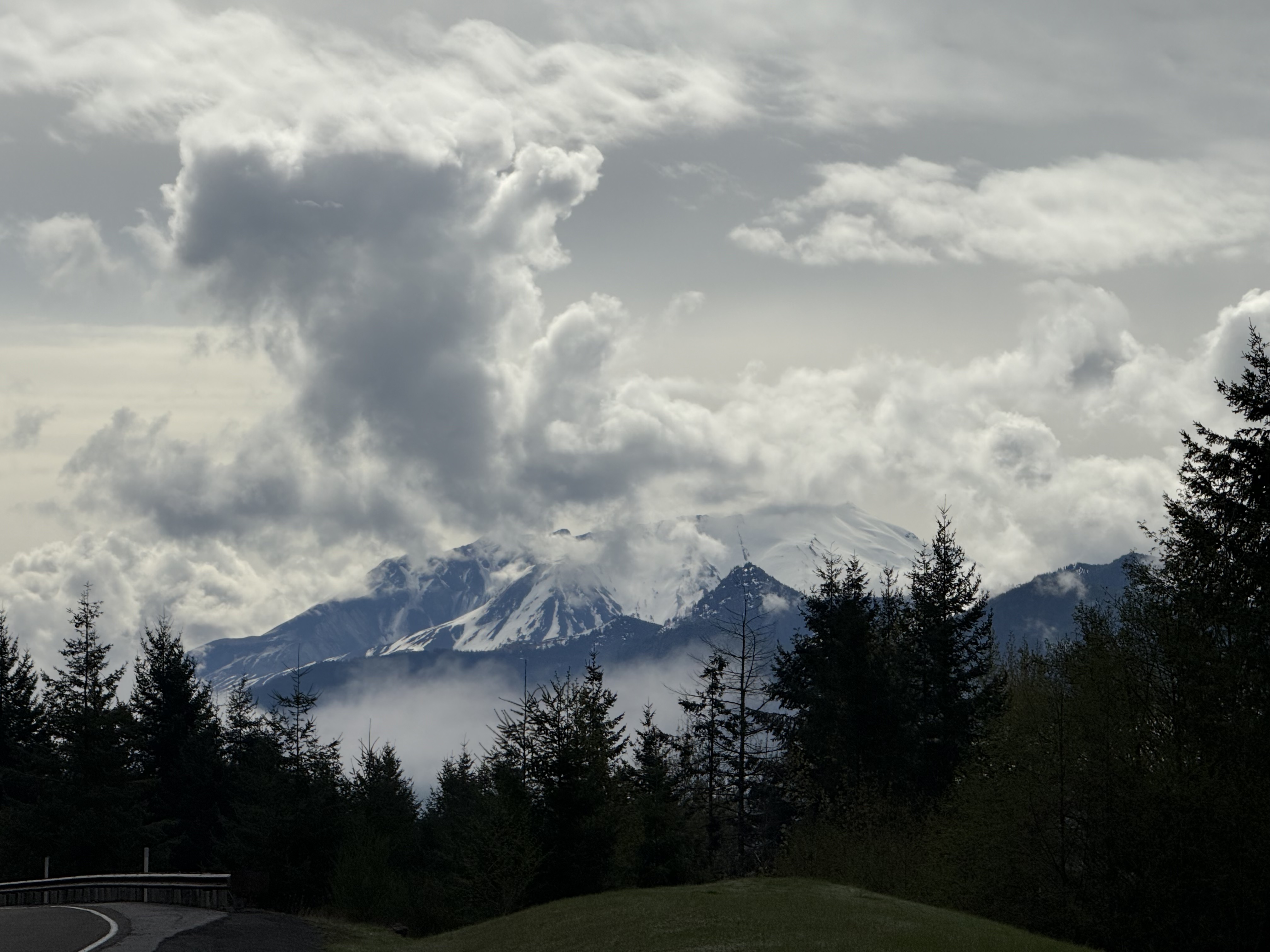
Figure 1. I arrived at about 10:30 in the morning and got this image before low clouds settled in, accompanied by fog later in the day. The characteristic volcanic cone is missing; the top of the mountain slants slightly upward to the right in the center of this image. That isn’t a lake in front of St. Helens, just fog collecting in the valley that feeds the Toutle River.
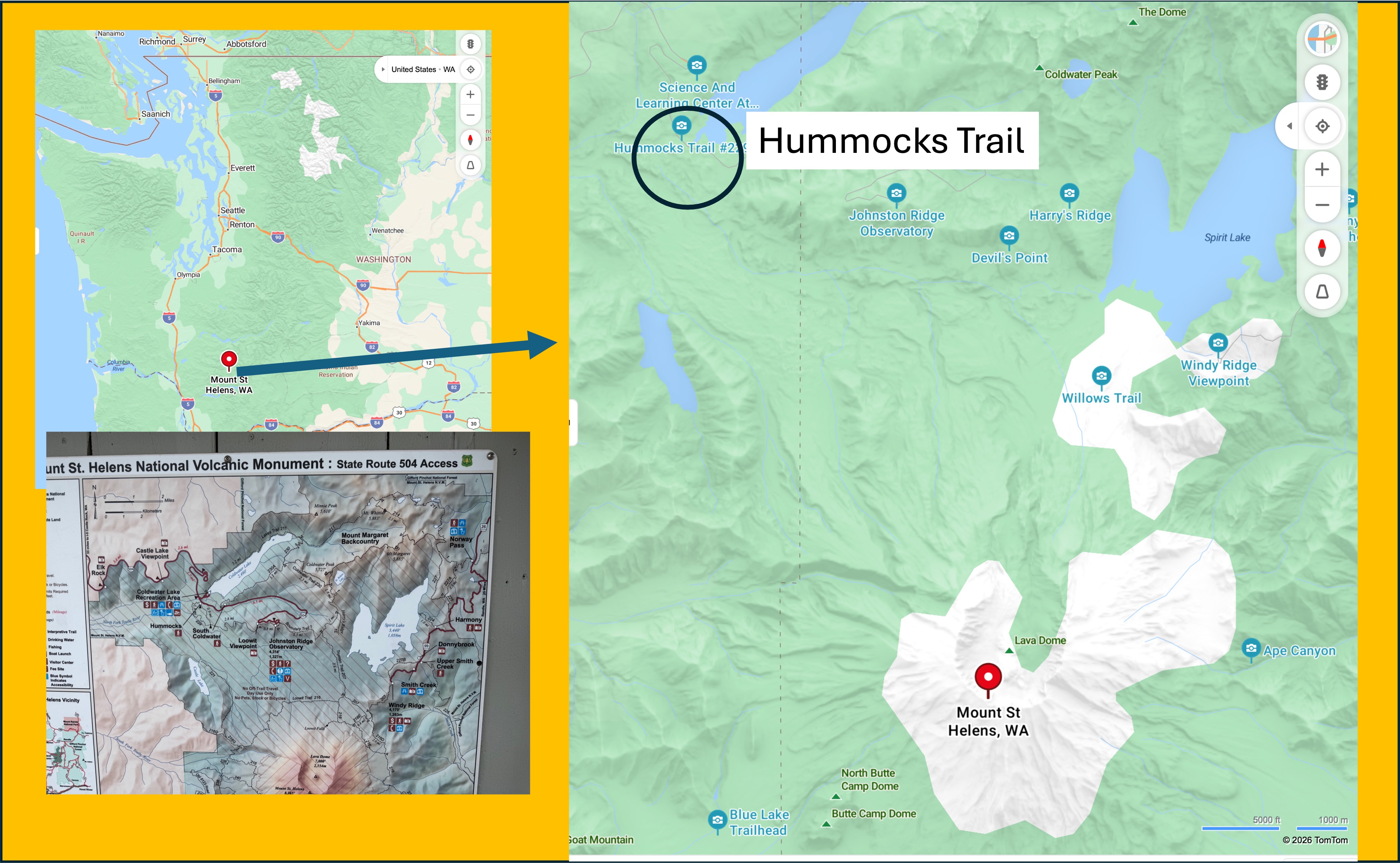
Figure 2. Mount St. Helens is about 2.5 hours from Tacoma. The closest you can drive is Hummocks Trail, but a four-mile hike will take you to the rim of the caldera. Maybe another time.
Older Volcaniclastic Rocks
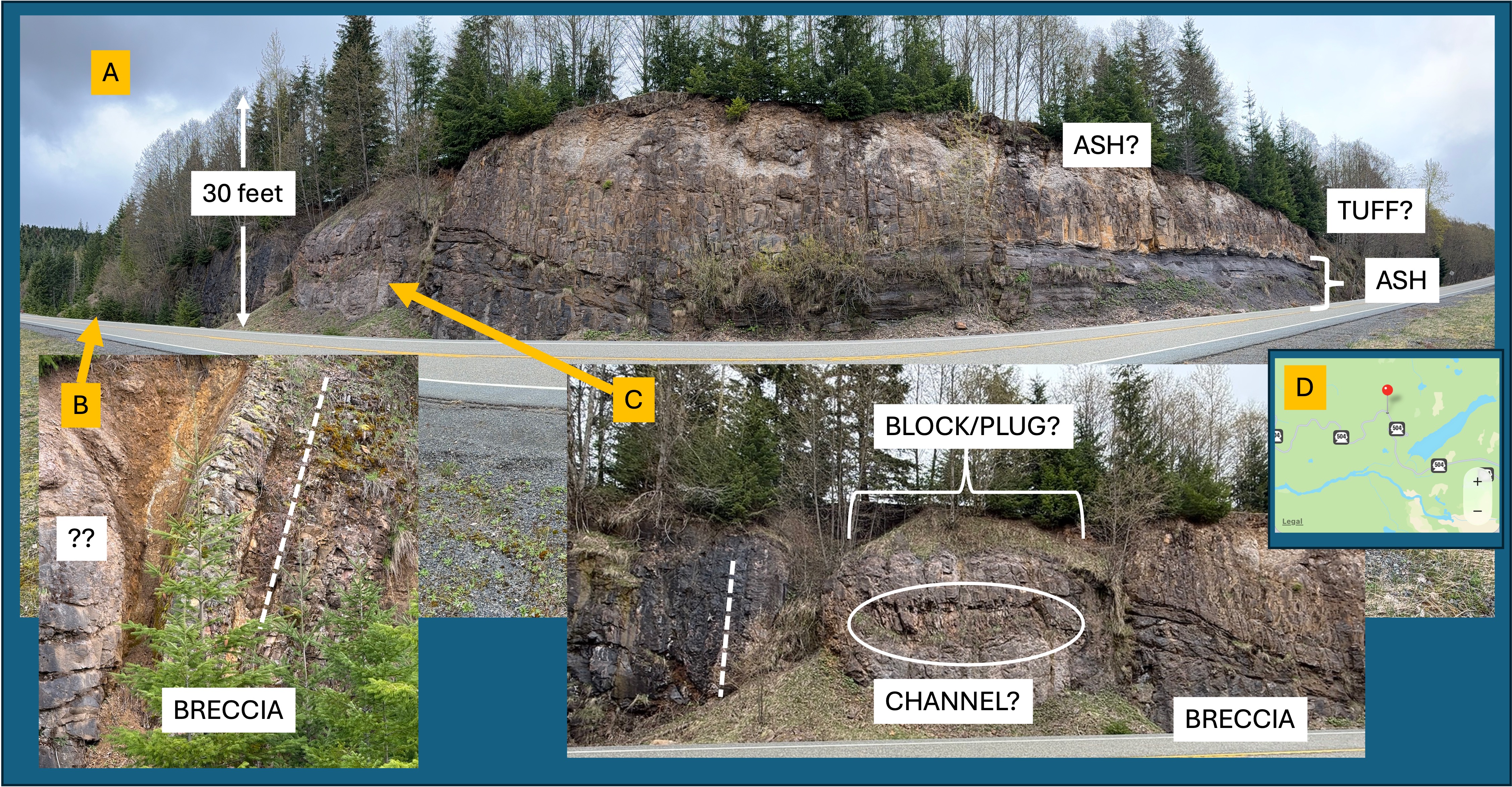
Figure 3. Mount St. Helens is less than forty-thousand years old, but it is constructed on a thick sequence (~2 miles thick) of volcanic rocks as old as 300-thousand years. Beneath these Pleistocene volcaniclastic rocks mixed rocks of uncertain age that comprise “bed rock” in this area; however, these igneous and sedimentary rocks are much older–spanning the Oligocene epoch (~34-23 Ma). I stopped to look at several road cuts along the new Highway 504 (the original is buried under debris).
A. Exposure of andesite volcanic rocks showing a complex eruption history, which includes ash layers and what looks like tuff (ash so hot it melted together to form a glass-like volcanic rock).
B. Close-up from the left side of (A) showing a layer of volcanic breccia that is now vertical. Individual clasts are visible but there is very little matrix. The dashed line indicates the approximate bedding plane of the layer. The rounded block labeled with ?? is about 12 feet in diameter. This is a puzzling structure. My guess is that there was a collapse of one or more volcaniclastic layers into a ravine after deposition. A jumble of material.
C. Photo of a complicated structure separating the left side of the exposure (tilted beds and blocks) from the right side (horizontal ash layers). The dash line is meant as a reference to the vertical beds in (B), but it was difficult to determine orientation. However, a clear change in texture suggests a depression, which may have been a conduit for volcanic material to erupt. The BLOCK/PLUG label reflects this interpretation. Within this “BLOCK” there is a discrete region of thin, irregular bedding that I’ve labeled (for convenience) as a CHANNEL? The question mark reflects my doubts about this identifier. Nevertheless, this road cut exposes a sequence of events: lava and ash being erupted onto an irregular volcanic landscape; probable surface erosion for some period of time; physical disruption and collapse, probably while still hot, of some part of later volcanic material. I don’t have enough experience with volcaniclastic sediments to say anymore than that.
D. The pushpin shows the location of this road cut. The blue ribbon is Coldwater Lake, where Hummocks Trail is located (see Fig. 2); this exposure is more than ten miles from the caldera, and hundreds of feet above the valley floor.
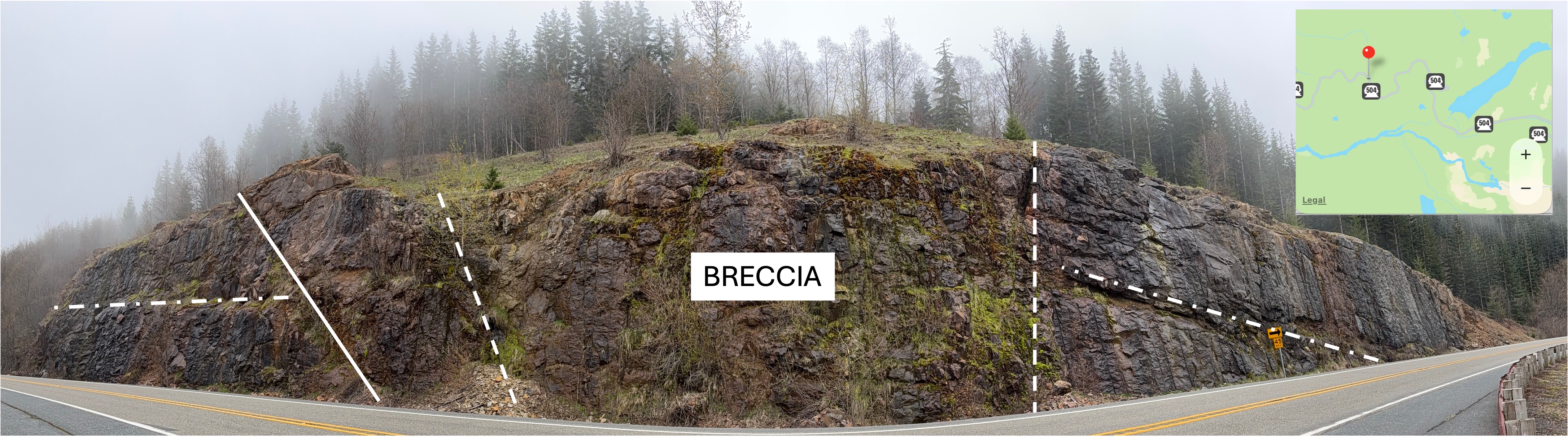
Figure 4. This post-eruption road cut is a mile or more further from the caldera. The solid line was a striking lineation that could be a fracture or possibly a contact between eruption beds. The dash-dot lines are apparent bedding planes between andesite flows. There is no ash present at this location. The dash lines delineate what I’m calling a BRECCIA because there is no evidence of bedding and the overall appearance is irregular; also, some large blocks were evident, although they could be a result of differential weathering. Lava flows are notoriously difficult to trace any distance laterally. Nevertheless, this exposure is similar in appearance to Fig. 3 with respect to the discontinuity between identifiable volcaniclastic deposits.
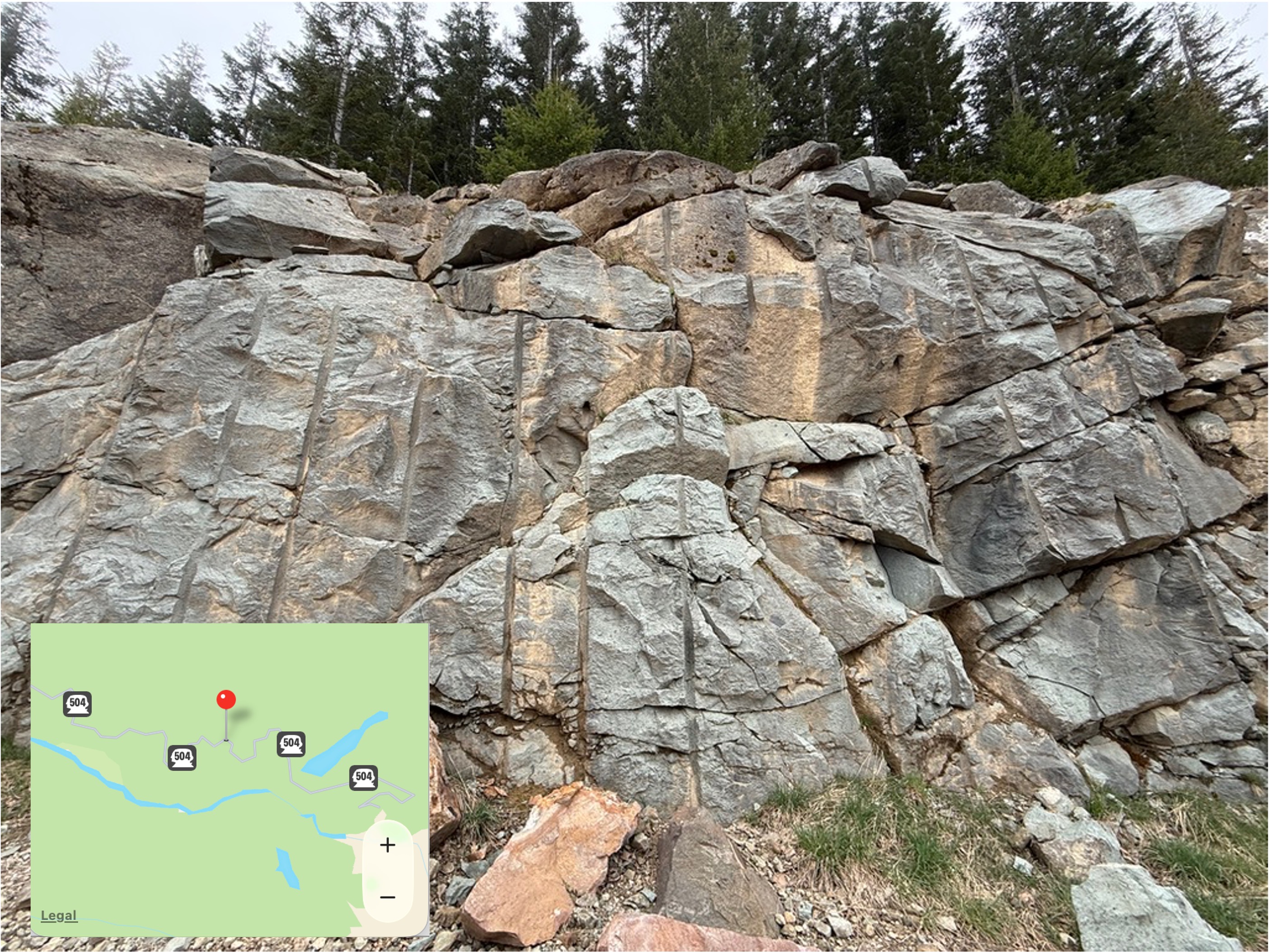
Figure 5. This road cut is located (see inset map) in an area the geologic map (Rock D) identifies as volcaniclastic rocks of Oligocene age (33.9-23.04 Ma). This is a smaller exposure than seen in Figs. 3 and 4, but it is also very different in appearance. That could be an optical illusion; close examination of the photo (I took it from my vehicle stopped in the middle of the road) suggests to me that this is ash that was so hot it formed what is called a welded tuff when it fell, after being blown into the atmosphere by an eruption. The light color suggests a magmatic composition more like granite than gabbro, or even diorite. That wouldn’t be surprising in the complex magmatic environment of a subduction zone, where partially melted, oceanic crust (e.g. gabbro and basalt) chemically mixes with continental crust (e.g. granite and diorite).
This completes my survey of older volcanic rocks near Mount St. Helens. There are no rocks exposed that explain the apparent hiatus in volcanism between about 23 and 2 million years ago. That is a story for another day…
Volcaniclastic Deposits from May 1980 Eruption
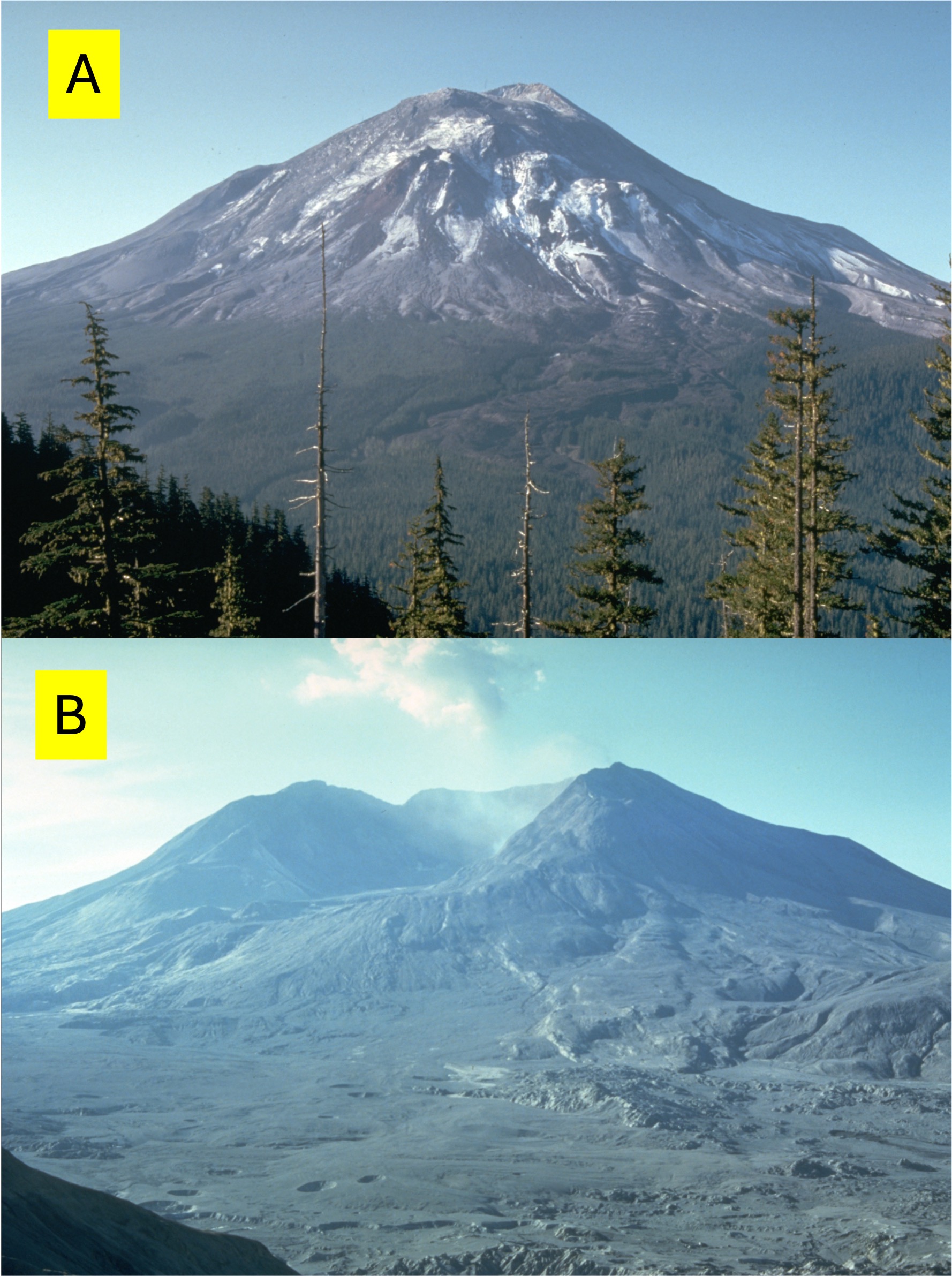
Figure 6. Photo A was taken a few days before the eruption in May, 1980. Image B was taken a few days afterward. The pre-eruption volcano was 9677 feet tall, but the obliterated peak is only 8365 feet. The total volume of material displaced exceeded one cubic mile, most of which was rock that collapsed during the rock slide preceding the actual eruption. The flat area fronting the volcano in (B) is a large fraction of the previous peak, which filled in several channels originating at the volcano. Note the holes in (B), which are probably blow-outs of gases trapped in the debris.
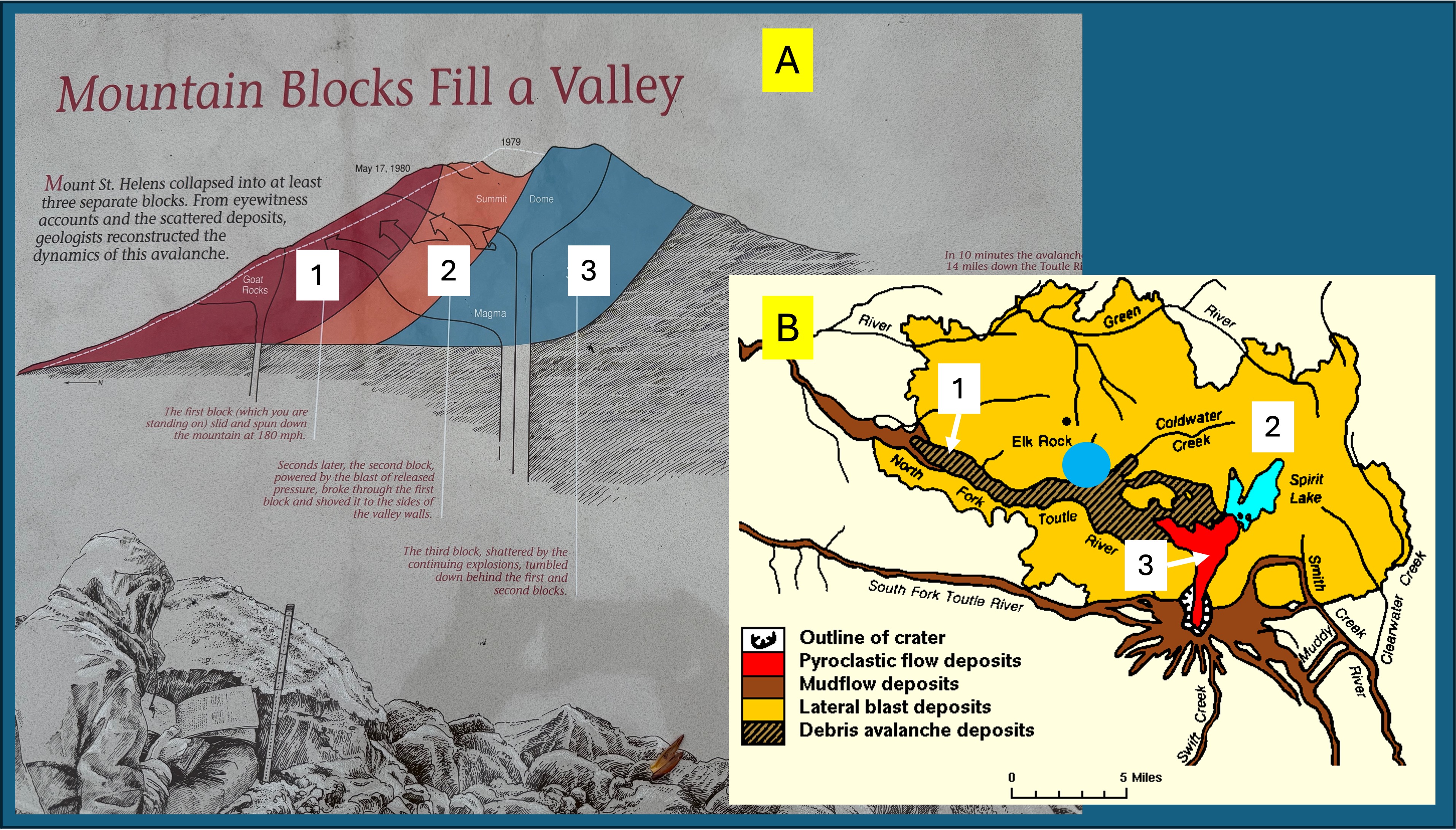
Figure 7. (A) This plaque was located along Hummocks Trail. I’ve supplemented it with the map of volcaniclastic deposits shown in (B). I will focus on the three major volcaniclastic deposits I encountered at Hummocks Trail (blue circle in B), which are numbered 1-3 in both figures.
The first stage was collapse of the north flank of Mount St. Helens (brown in A and cross-hatched in B). This was a run-of-the-mill massive landslide that followed existing drainage, until stage two occurred.
When the rock containing the highly pressurized magma was removed. The resulting release of pressure created an explosion equivalent to 10-50 megatons of TNT; although a volcanic eruption is not analogous to a nuclear explosion, the energy released was roughly 1600 times the energy of the Hiroshima atomic bomb. It moved a lot of rock. This blast occurred seconds after stage 1 began; the hot gases overtook the rock slide, driving rock and debris up the sides of the valley, removing everything, including top soil, within a few miles of the volcano. The orange area in B shows how widespread this explosion was.
Stage 3 was a pyroclastic flow (red in B), which was limited to the immediate vicinity of the caldera; however, what goes up must come down, so several inches of ash were deposited as far as Spokane, Washington–400 miles distant.
Video 1. This video shows debris from the landslide (Stage 1) that was pushed at least 300 feet from the original valley floor to the ridge by the unimaginable blast of Stage 2. The main slide followed Toutle River (North Fork), but with this impetus, debris was launched over the canyon walls. That’s what this video shows. It’s like the heavy stuff collected at the top of the ridge whereas the sand/gravel-sized debris was blown miles further.
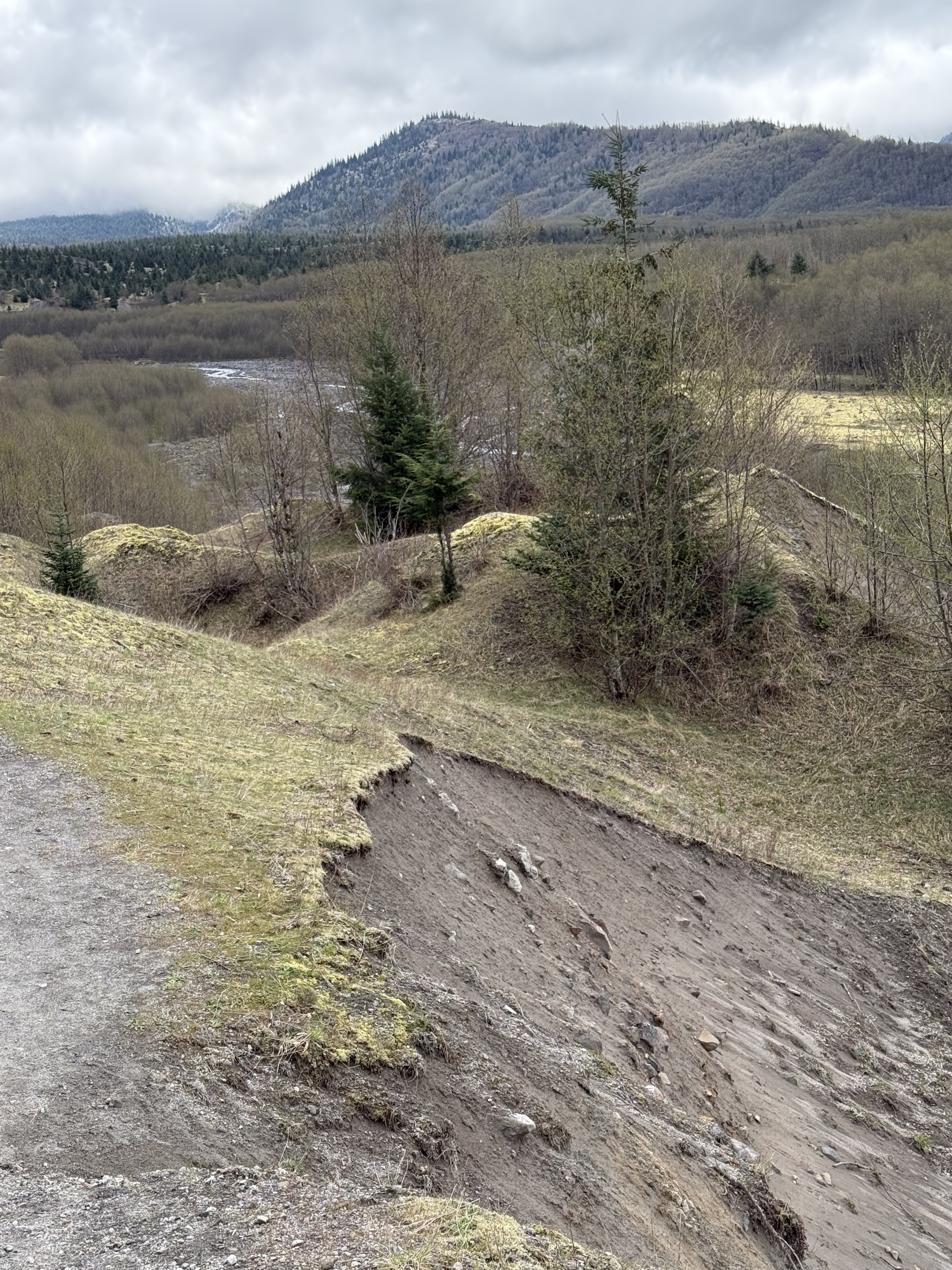
Figure 8. This photo is looking south towards Mount St. Helens from Hummocks Trail (see Figs. 2 and 7B for location) along the Toutle River (North Fork), which is more than a hundred feet lower, even after being filled with debris from the 1980 eruption. Note the difference between this scene and the deposit from Video 1. It’s difficult to comprehend the dynamics of a blast (Stage 2) capable of pushing rock (Stage 1) up this slope; when the explosion lost energy it simply dumped its load, creating a surreal landscape. The debris has very little clay and is thus non cohesive; thus slumps like this are common. Note the small hill and “ridge” in the middle of the photo. This terrain makes no sense, other than erosion has been etching it for 40 years.
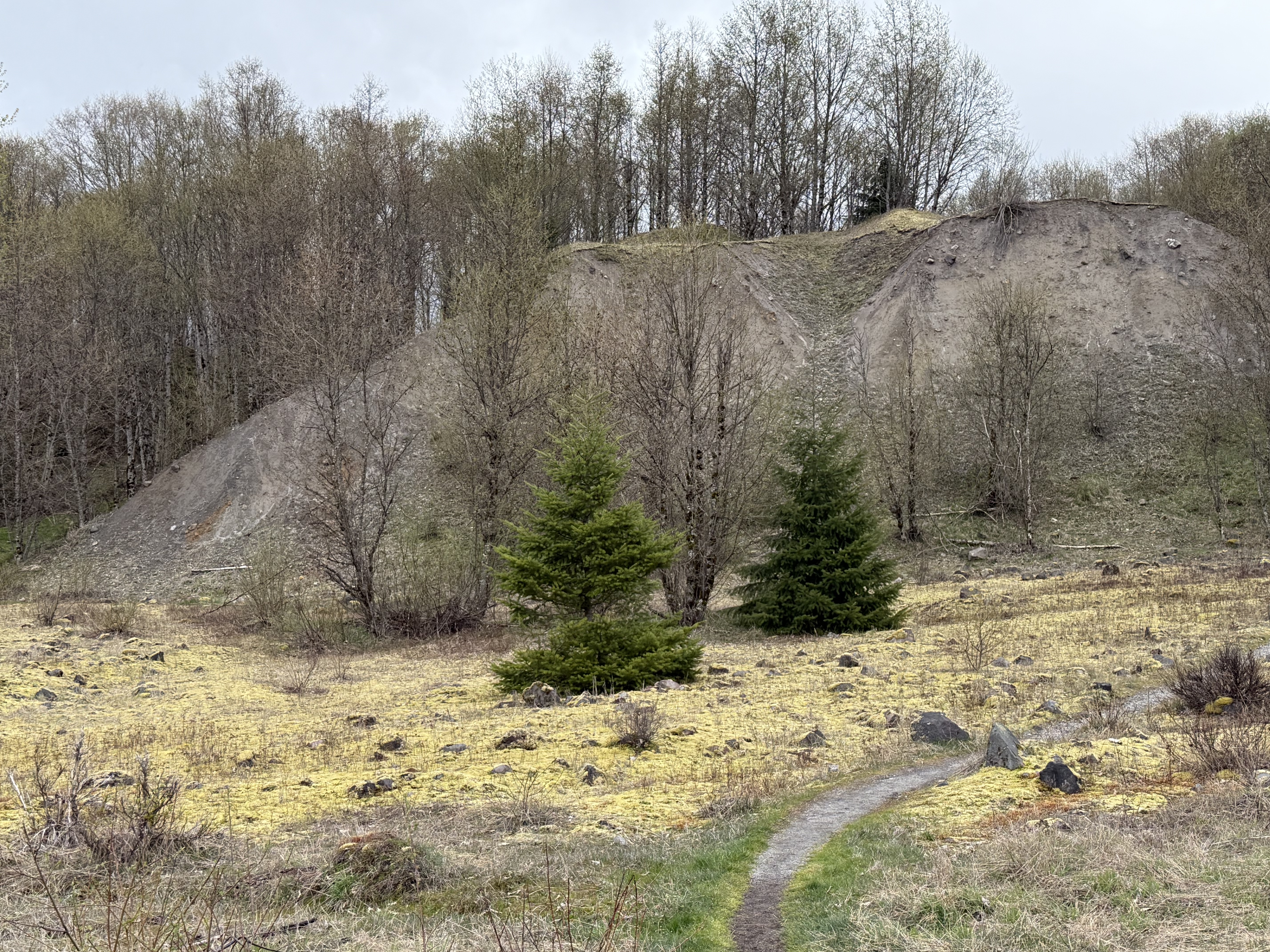
Figure 9. This layer of ash I encountered along the Hummocks Trail is a remnant of a vast sheet originally deposited during Stages 2/3–breaking such a continuous eruption sequence into stages is useful but not particularly elucidating. It all happened too fast to comprehend. You might call this an “over-bank” deposit, like when a river tops its natural levee and deposits fine-grained sediment on its floodplain.
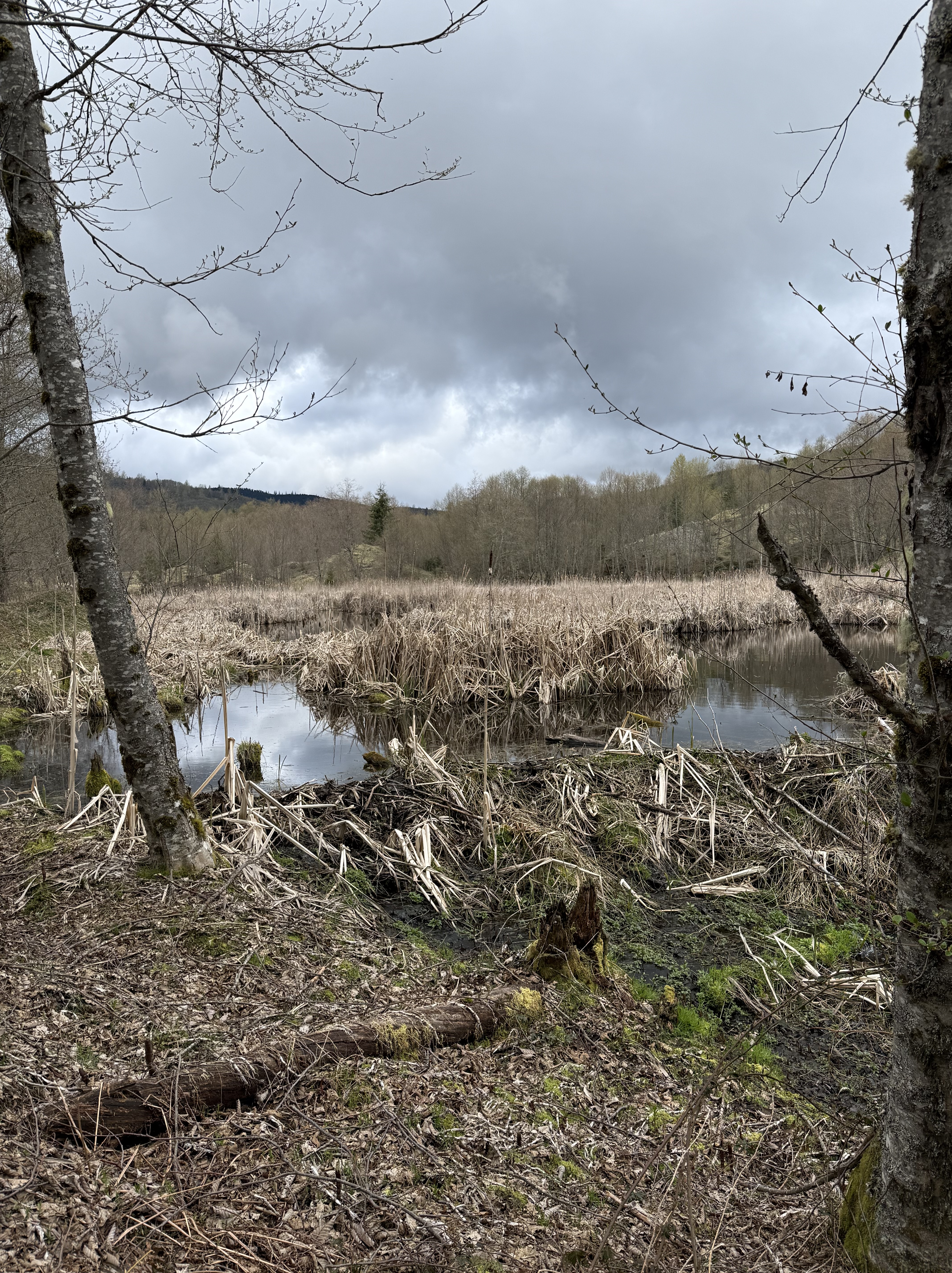
Figure 10. Hummocks Trail followed a small stream through a bizarre landscape comprising multiple small ponds like this one. A dam constructed of eruption debris (left-to-right in the center of the photo) has blocked the stream flow, creating a meandering channel during low-water conditions; but I can imagine all those dormant grasses erupting later this spring. I encountered several of these marshes, each one defined by water trying to find a way out of this labyrinth. According to Fig. 2, this is the outflow from Coldwater lake; the eruption partially blocked its path but nature is finding a way through this discombobulated landscape.
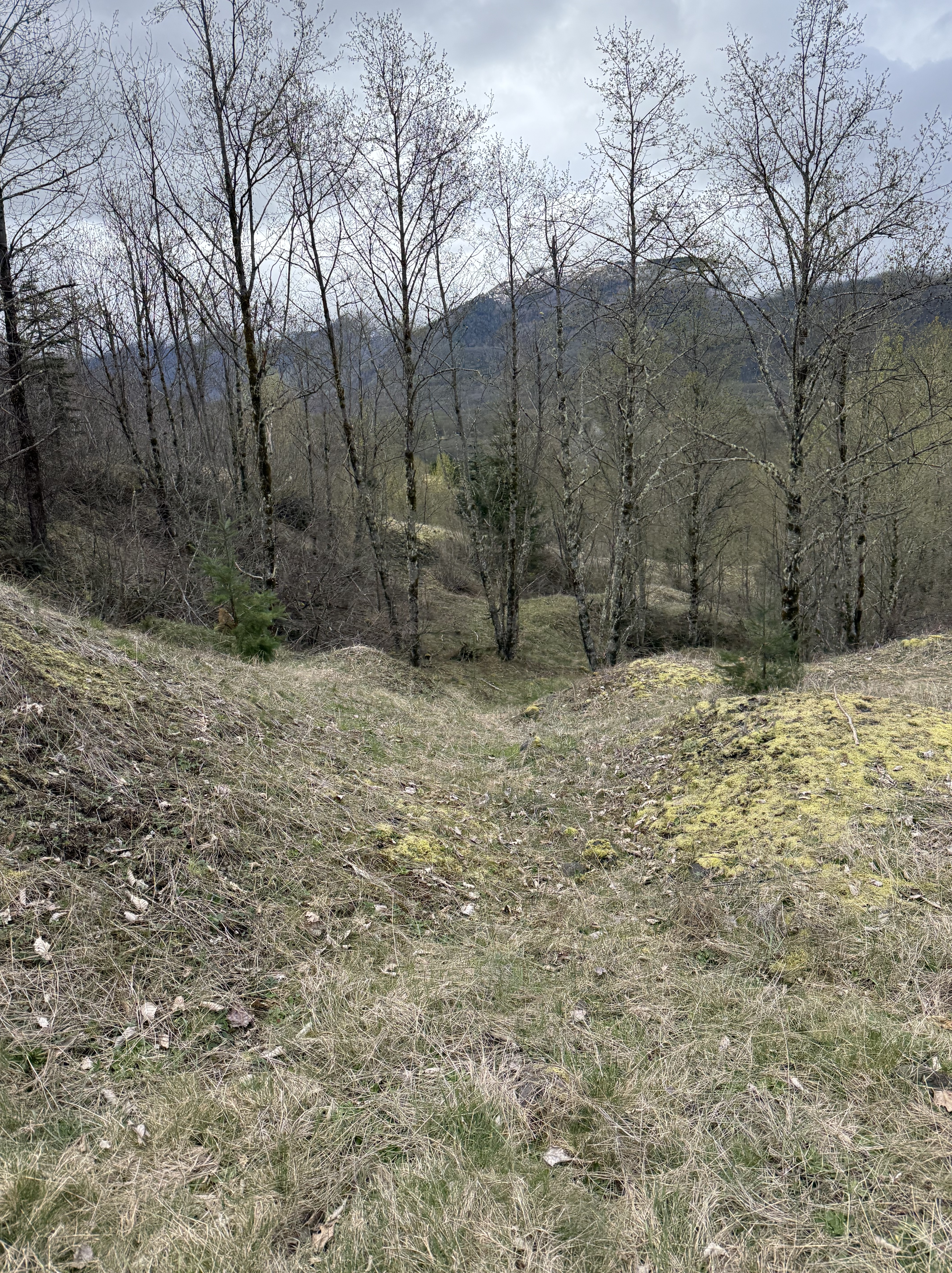
Figure 11. This photo perfectly captures the topography of Hummocks Trail. This is the northern end of the trail, which is a little higher; the Toutle River (North Fork) is more distant and the cliffs we saw in Fig. 8 have receded, replaced by moderate slope; however, note the fine-scale nature of the hummocks here. They are ubiquitous but contain only a few scattered boulders.
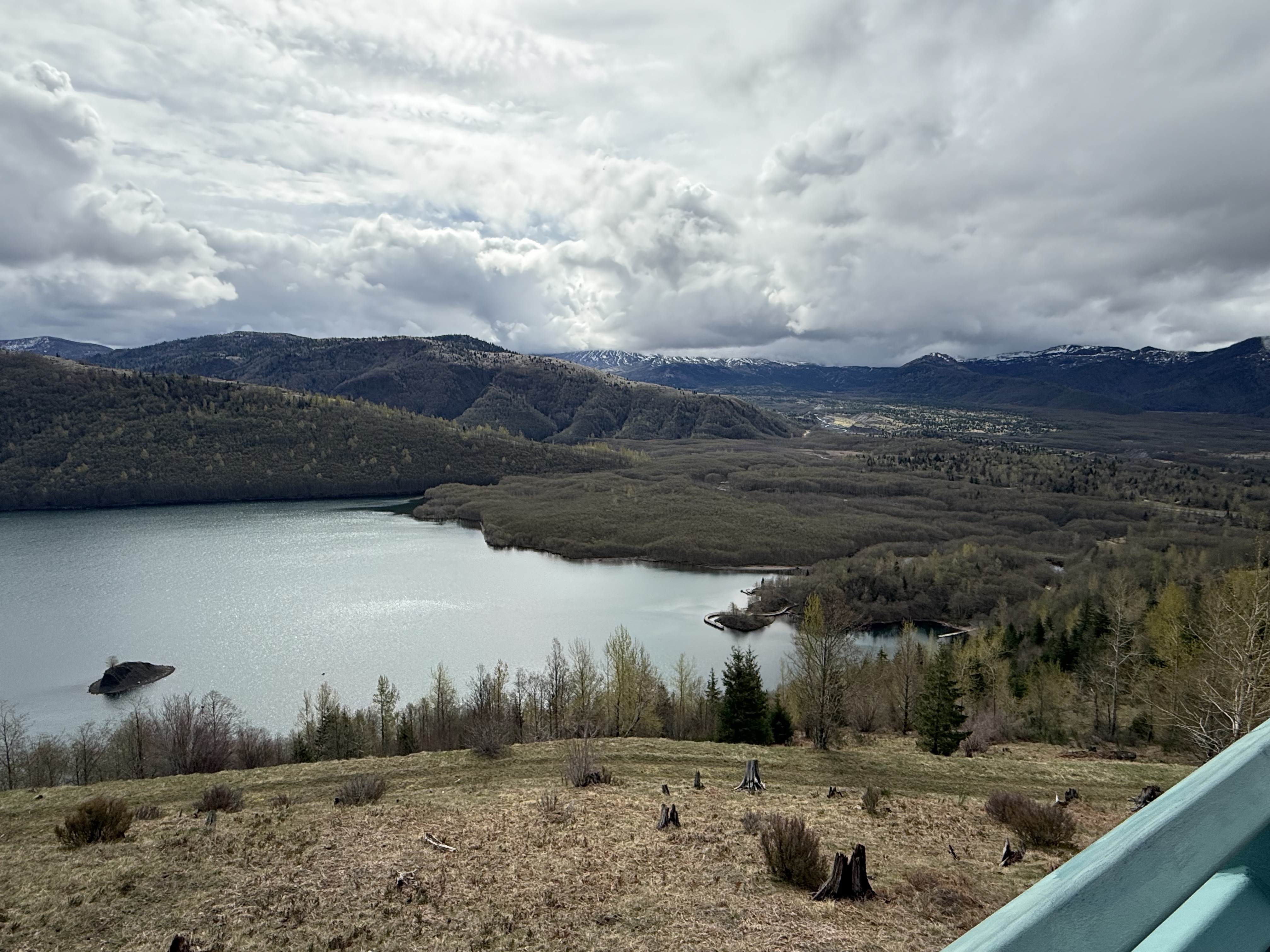
Figure 12. This is a view of Coldwater Lake from the visitor center, looking south towards Mount St. Helens. There are two things to note from this image: 1) the Toutle River valley is a broad, flat plain because it was filled with debris from Stage1; 2) the overflow deposits (e.g. Video 1) have blocked the lake and raised its level. The source of water we saw in Fig. 10 is evident in the center of the photo. This isn’t a sedimentary dam, created by flood deposits, or even a glacial dam produced from the debris scraped up by thick ice sheets. The shoreline was modified when Mount St. Helens collapsed and then exploded with unbelievable violence.
Final Thoughts
The eruption of Mount St. Helens in 1980 gave geologists a rare opportunity to see how Earth produces sausage. Let me explain my metaphor.
Ocean crust is denser than continental crust it encounters at a convergent plate boundary, and at a lower elevation. It is thus overridden by the continent, forcing it to dive into denser and hotter rocks at depths of hundreds of miles. This obviously displaces hot and ductile rocks, heating the subducting rocks even more; the sausage-making operation has begun. Still pushed from behind by the conveyor belt of oceanic crust being subducted, this basalt/gabbro mixture heats enough to boil off the water contained in its sedimentary cover as well as any constituents with a reduced melting point (e.g. silicon-rich minerals). This superheated material rises through tens-to-hundreds of miles of crust, heating it and producing a mixture of oceanic and continental crust.
Plate tectonics keeps turning the crank on the sausage machine for tens (even hundreds) of millions of years. The molten mass of magma keeps rising because it is less dense than the rocks through which it is passing, until the pressure has decreased enough for it to find cracks in the solid crust. The magma fills these cracks, which often lead to fissures in the surface; the magma erupts. The magma cools and begins to solidify, forming a pluton at depths of several miles to tens of miles.
This process keeps operating, in fits and starts, until the tectonic plates change direction. In the meantime, the upper crust has been filled with multiple plutons (solidified magma chambers), sometimes squeezed into the volcanic rocks from previous eruptions. Individual magma chambers/plutons are about one mile in diameter, although they take many shapes, and remain active for less than one-hundred-thousand years (often much less). These are injections of fluid rising through weak points in the crust, driven by pressure paths–not missiles launched from the mantle. They are like the sweat on your brow after a hard workout.
Mount St. Helens has released a lot of pressure, although it is still very dangerous at human scales. Chances are that this magma chamber will solidify within the next hundred-thousand years; but the unstoppable sausage machine will continue cranking out more mixed material in a molten form until it has filled every nook and cranny in the upper crust. That’s how mountain ranges like the Sierra Nevada were formed. It takes a really long time.
Mount St Helens probably won’t erupt again at the scale of the 1980 event, but that doesn’t mean much if you happen to be camping near the caldera when a smaller eruption occurs. After all, the magma chamber is still extruding lava in an unsteady process that is currently pretty slow. However, we humans can’t see fractures in bed rock; thus, the next and the next, etc, magma chamber could appear anywhere from Northern California to British Columbia. There are plenty of young volcanoes in the Cascades that haven’t blown their tops yet.
Who’s next?
Ecosystem Notes from Quinault Rainforest
Introduction
I’ve spent the past few months wandering the Olympic Peninsula with my attention fixed mostly on rocks—tilted beds, breccias, sea stacks, and the stories they tell about deep time. But along the way I’ve been noticing the living world with the same quiet fascination. I’m not a biologist and I don’t pretend to be; I can’t name any of the plants I pass. What I can see is how each organism plays a role in the larger system, the way geology shapes life and life responds in turn. These are simply notes from a wanderer paying closer attention.
I’ll try to remember to label these environmental posts as NOTES to avoid any confusion, especially on my part. This first post arises from a short walk on a semi-muddy trail through the Quinault Rainforest, on the Olympic Peninsula. I won’t have much to say about the photos, and all identification will come from CoPilot (aka ChatGPT). I’m certain its identifications will be better than mine after hours of searching the internet.
Quinault Rainforest in Olympic National Park
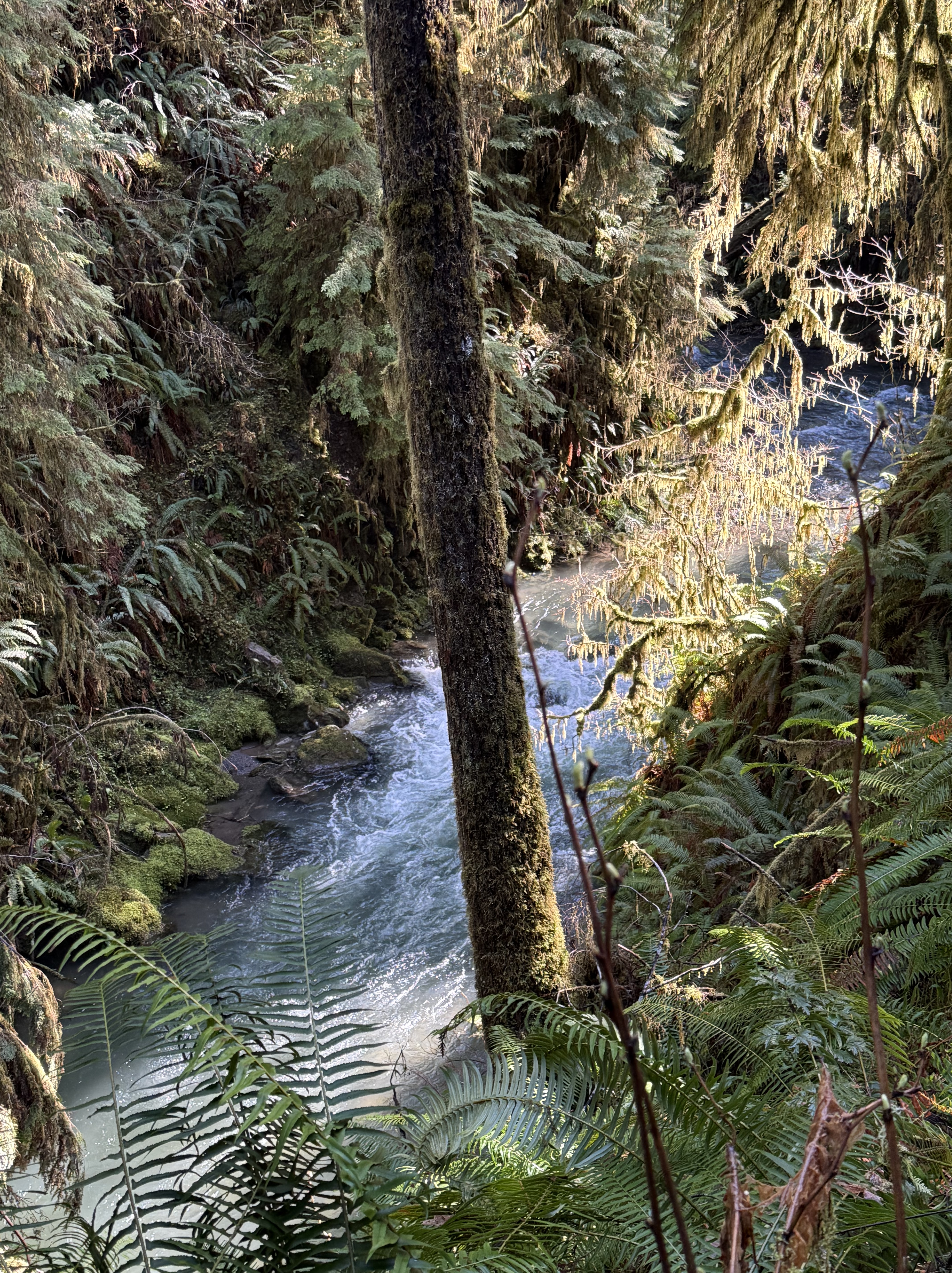
Plate 1. That raging stream about 50 feet below me is one of hundreds draining this temperate rainforest, which gets about 12 feet of rain per year. Note the ferns, which are everywhere, even in the temperate forests of northern Virginia. Ferns must be the most common plant in cooler forests. I am in a narrow strand of Olympic National Park that has never been logged. This is primordial nature, viewed by a geologist, but I’ll do my best.
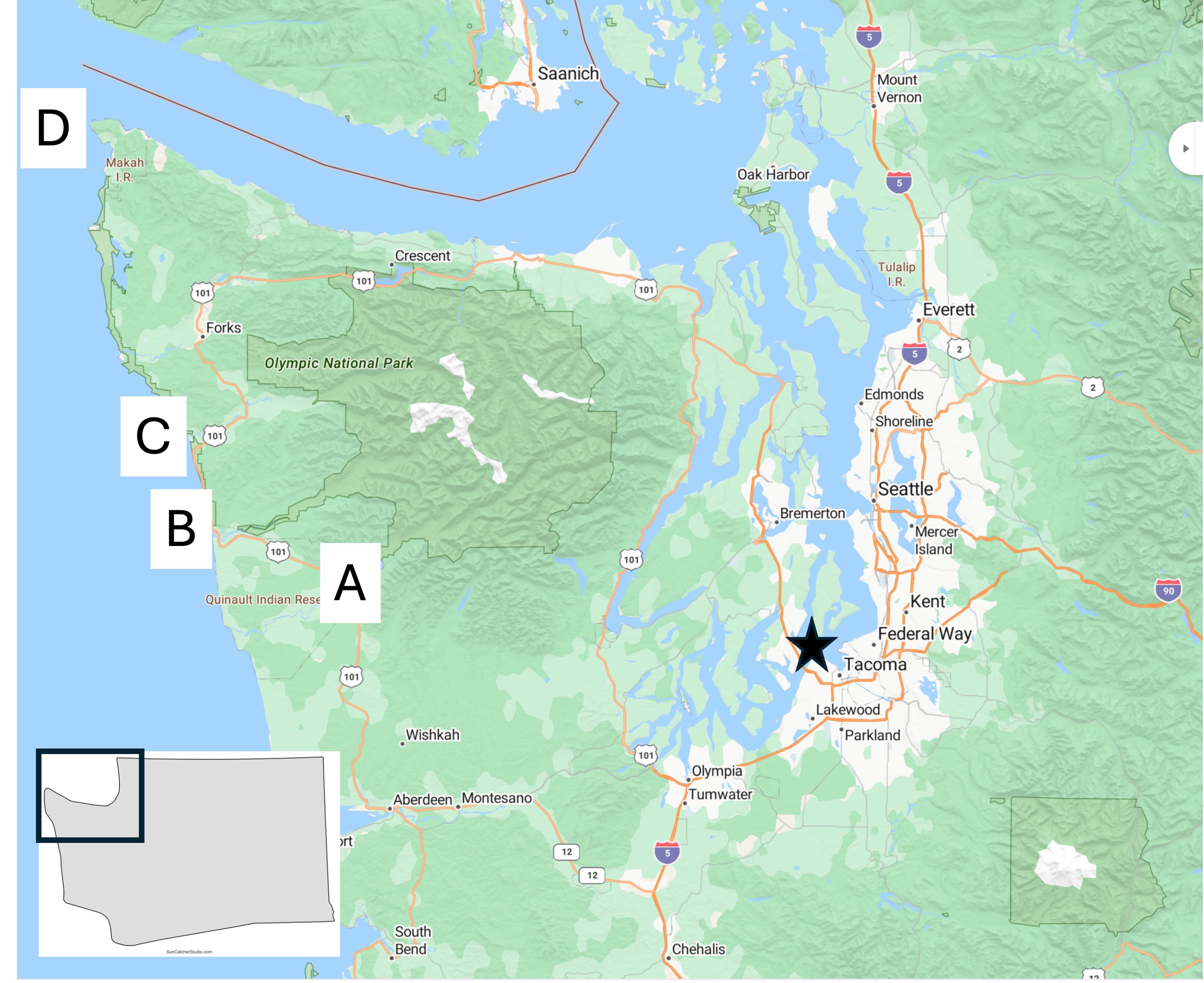
Plate 2. Map of the Olympic Peninsula showing the areas I reported on in previous posts. I’m going to be focusing on Site A today, with a few photos from D.
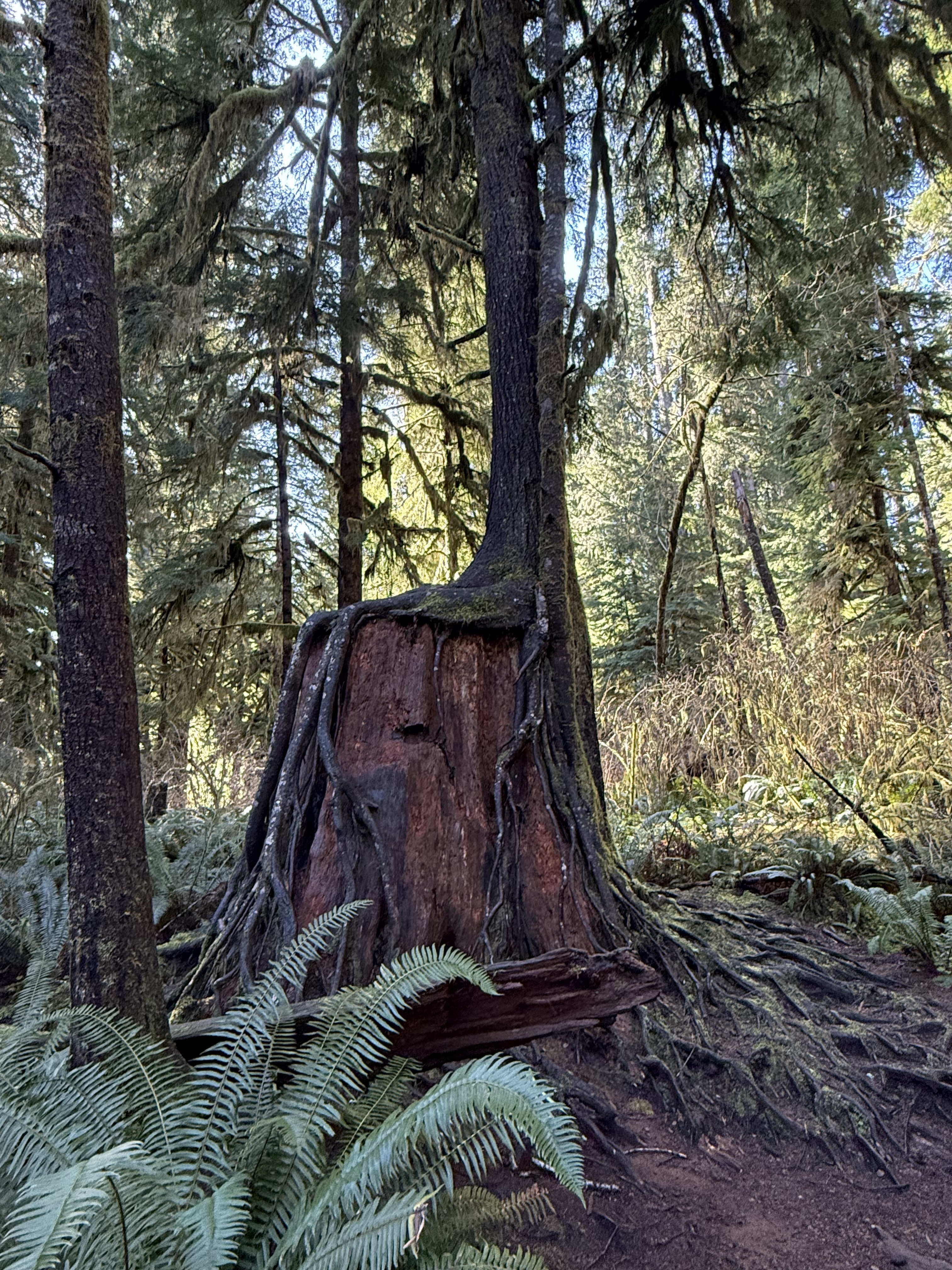
Plate 3. I haven’t seen this anywhere else I’ve lived, not even northern Virginia, but they occur everywhere here in Washington. Apparently this is a common occurrence in rainforests, where the ground is a dangerous place for seeds. I couldn’t identify the species in this photo, but this practice is very common for hemlock.
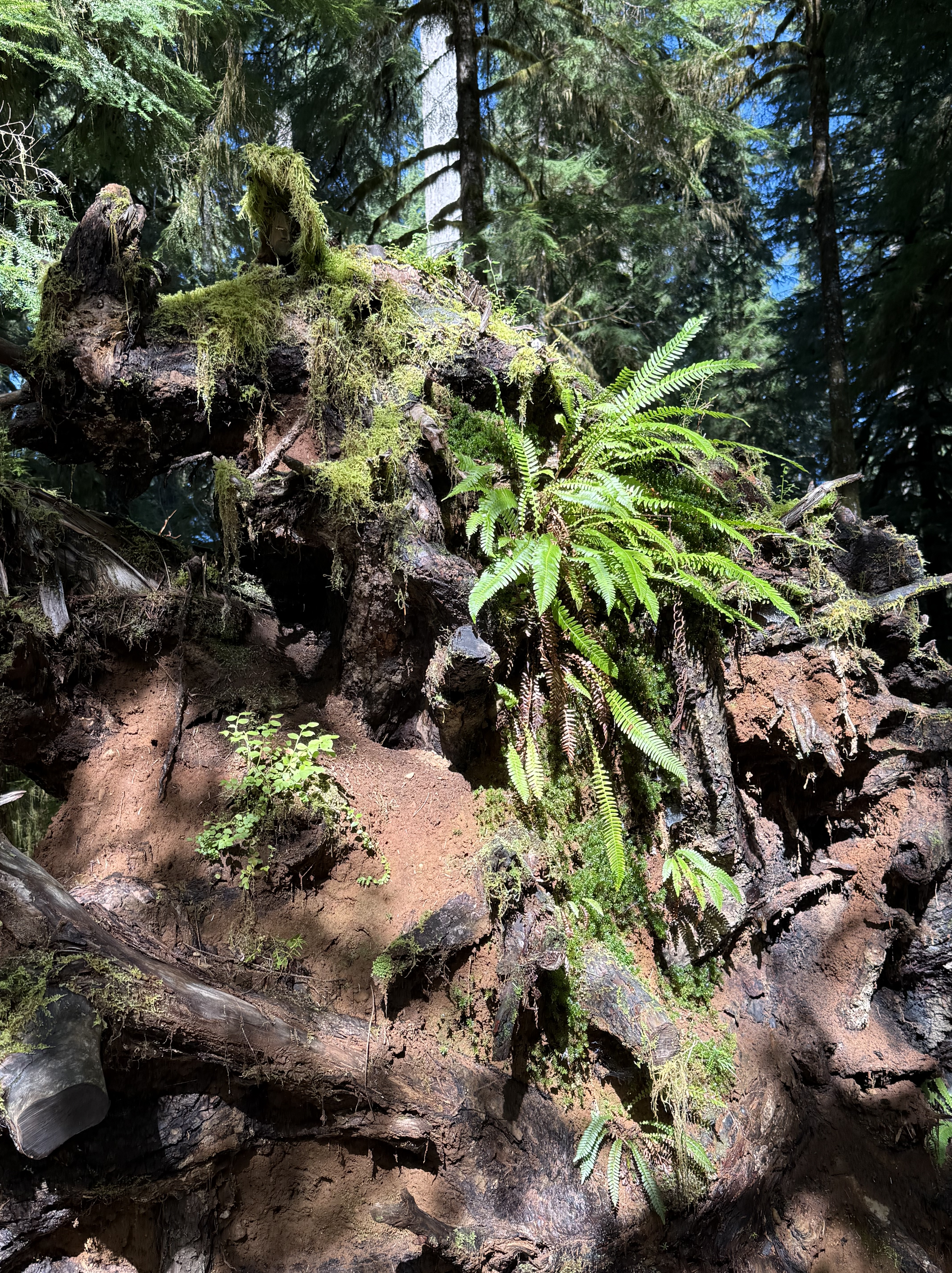
Plate 4. This pile of debris is a large log turning into compost and supplying nutrients to a variety of plants. The top of the photo shows the base of a young tree growing out of all this chaos. According to CoPilot and the Olympic National Park map, this area has never been logged, so I am in wonder of this pile of “forest garbage”. Is that sandy soil I see? Where did it come from? I don’t know.
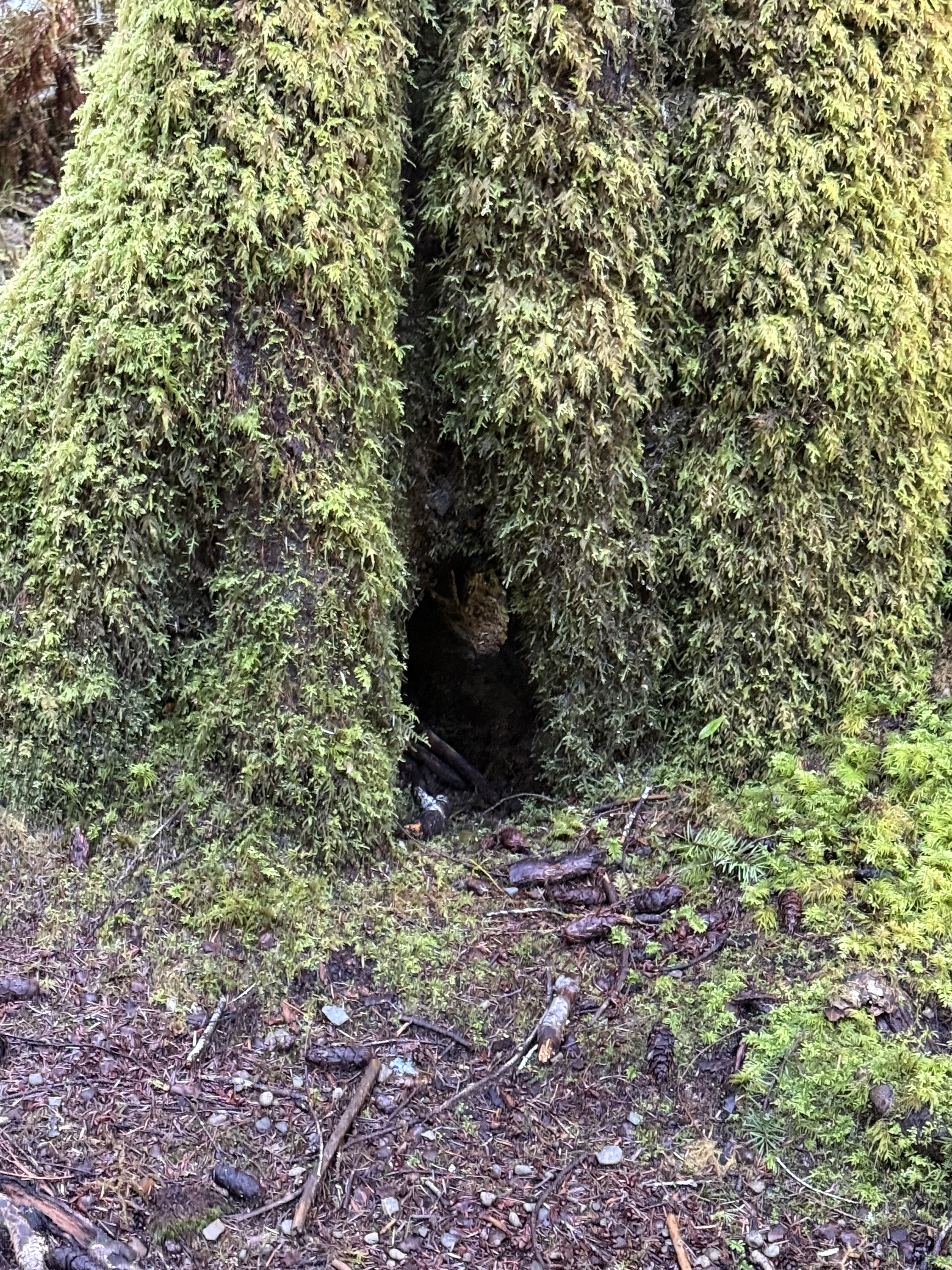
Plate 5. If you look close in the exact center of this photo, you’ll see daylight on the other side of the base of this unidentified tree. It’s about six-feet in diameter and covered with an epiphyte community of mosses and liverworts. Those aren’t leaves or fronds, but communities that mimic ferns–for their own reasons.
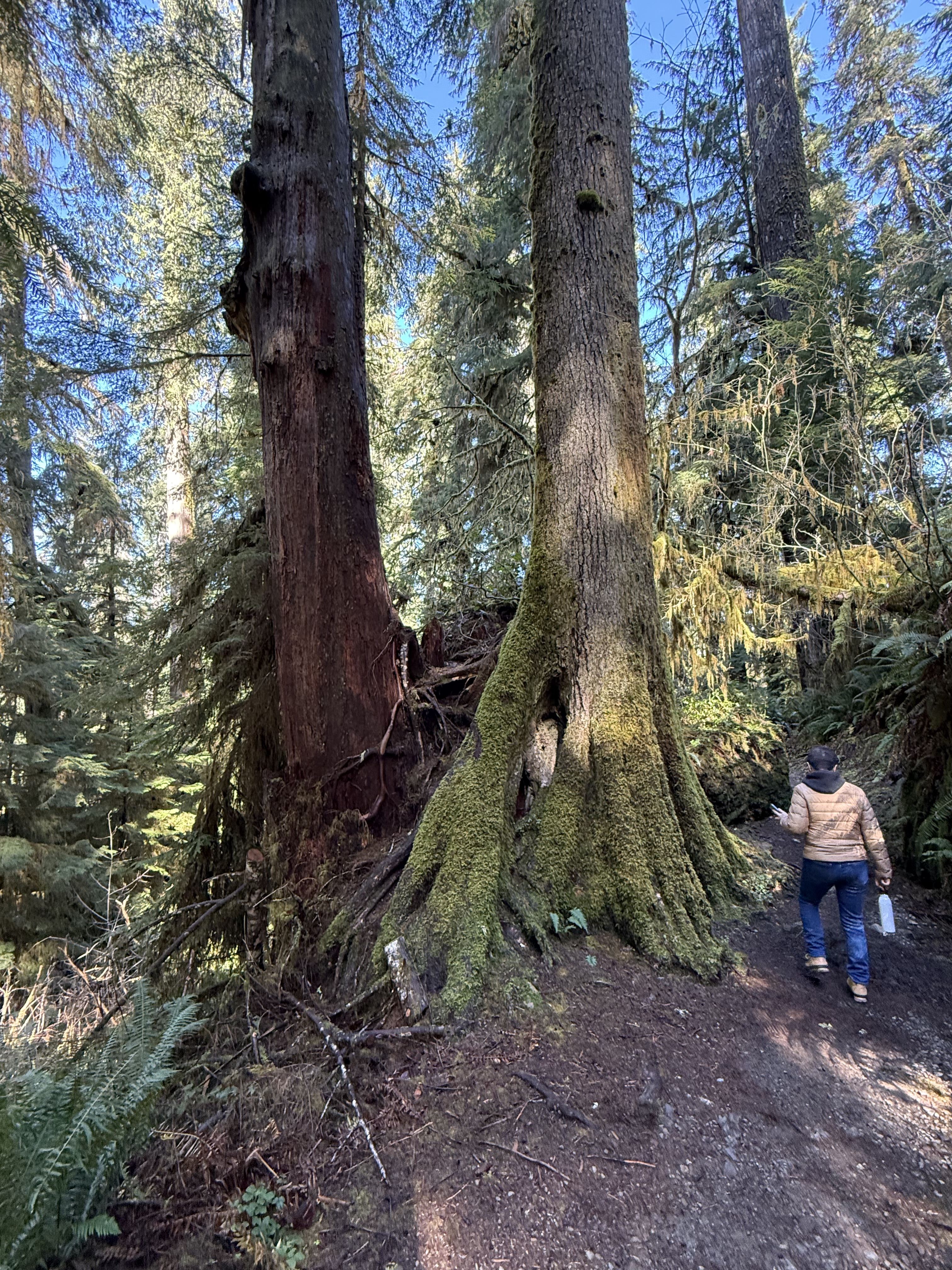
Plate 6. Here’s an example of a Western Red Cedar that has grown into a mature tree after being nursed by a stump. I guess it will eventually absorb the rotting stump and grow to full height, but this is the largest I’ve seen so far in the region.
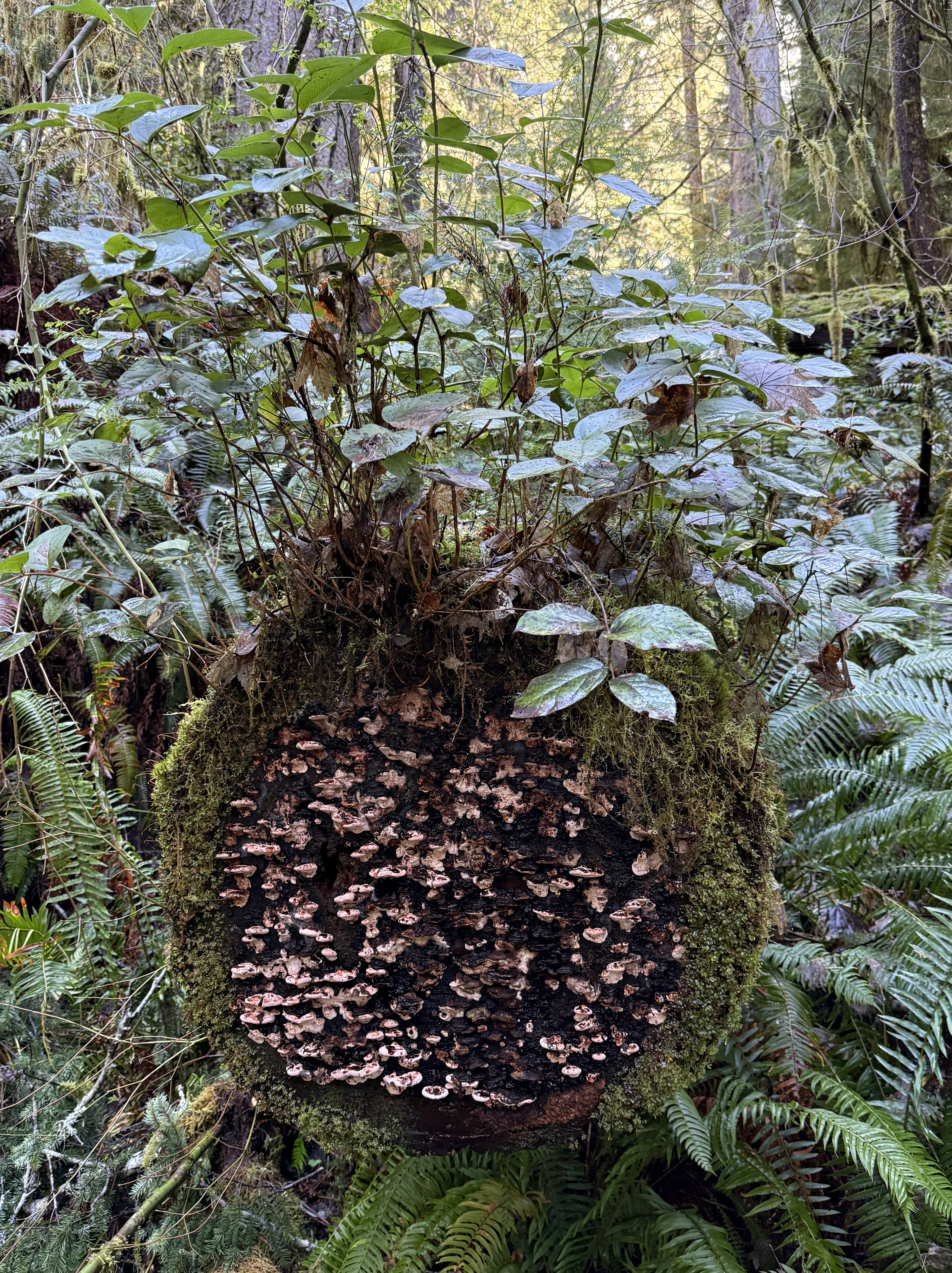
Plate 6. This miniature ecosystem caught my eye, but I had to turn to CoPilot to get an idea of what’s going on. As a tree trunk decays it goes through five stages: 1) moss; 2) liverworts; 3) fungi; 4) shrubs; and 5) young trees. This one seems to be in stages 1-4. I didn’t see any seedlings on it. The shrub is probably huckleberry and the mushrooms a bracket fungus, probably Trametes or Stereum.
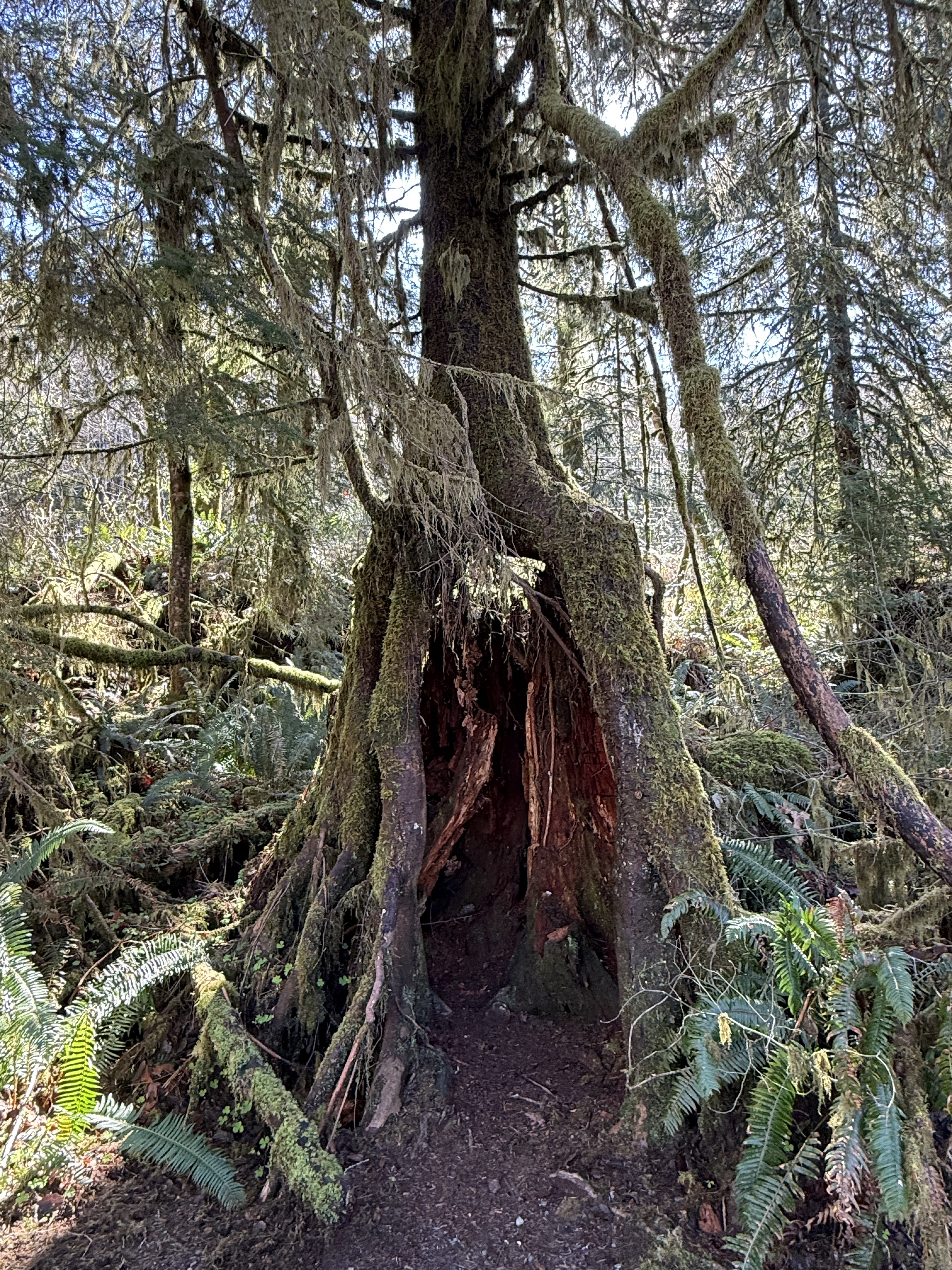
Plate 7. I am fascinated by these nurse trees after seeing species of fig trees in Australia that devour living trees, like a giant fungus or alien. These are nursing on dead trees, however, so it isn’t as gross; but this one is now standing on its own legs after the original stump has begun to collapse.
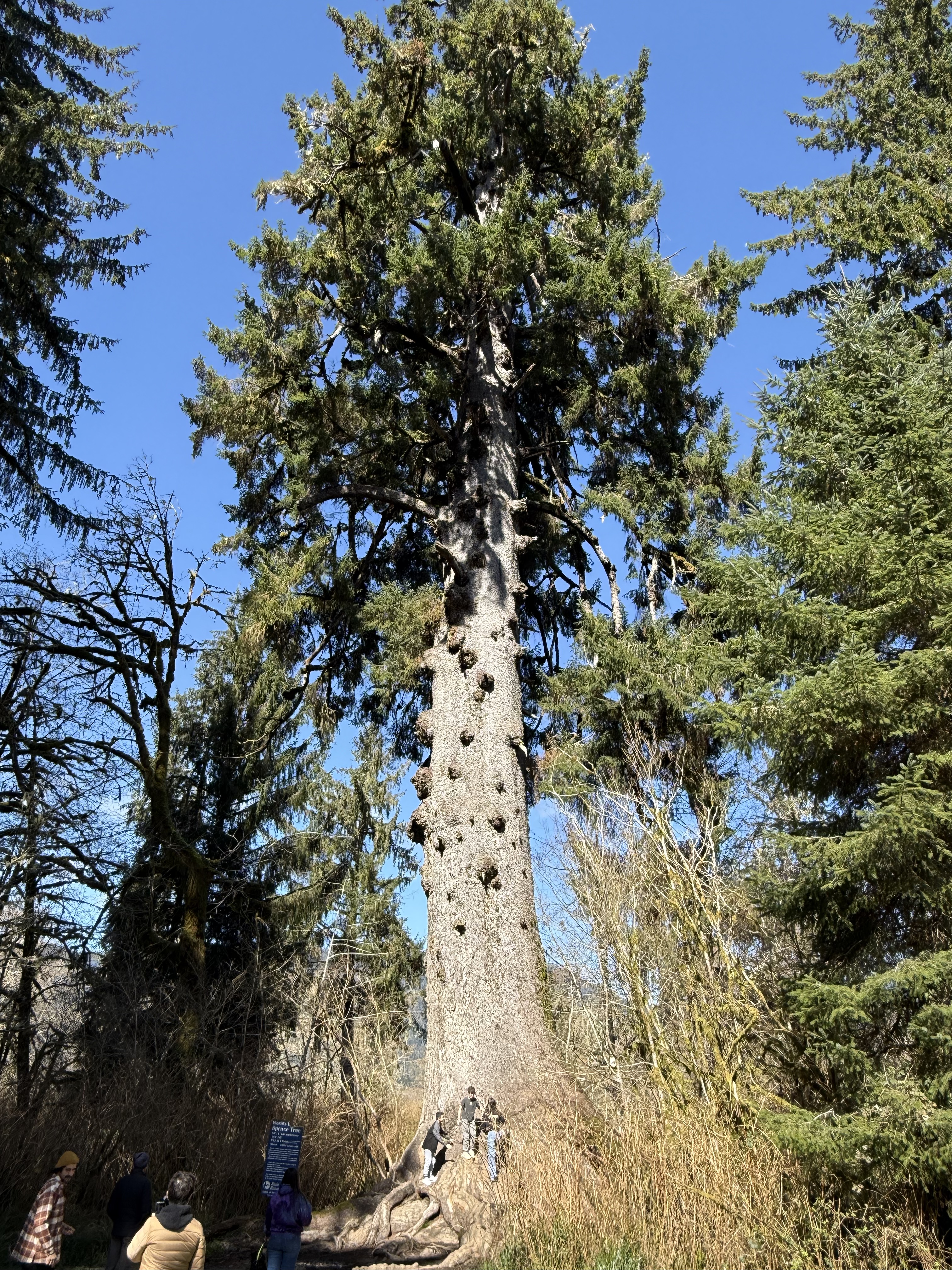
Plate 8. This is the largest Spruce tree in the world. It’s 191 feet tall and about 1000 years old. It is growing in a swampy wet land at the inflowing stream to a glacial lake, Lake Quinault.
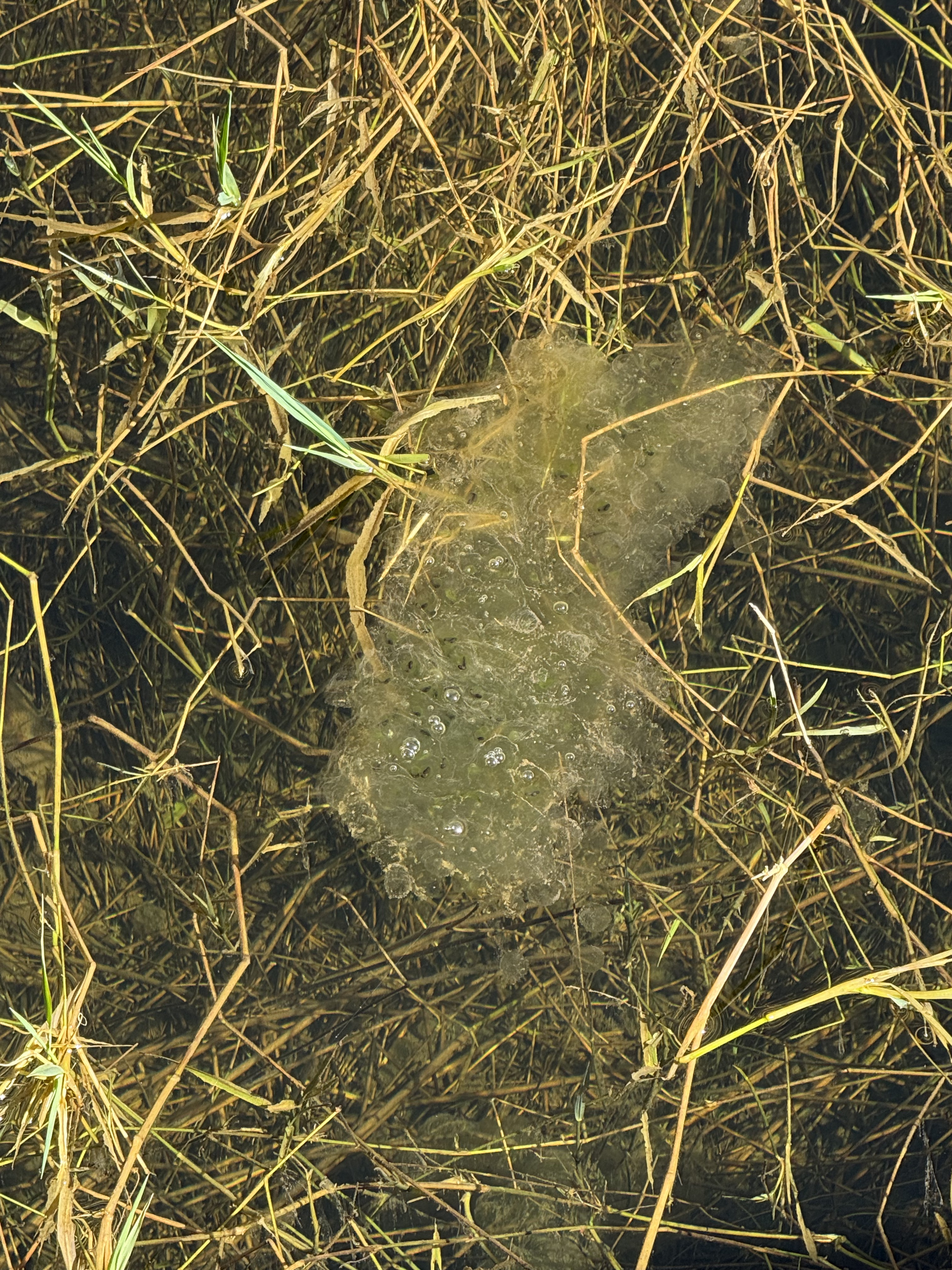
Plate 9. I thought this was toxic waste until CoPilot took a look at the photo: this is a mass of frog eggs (probably northern red-legged frog). There were several more at the shallow, marshy wetland where a stream fed Lake Quinault. The water is so clear you can see the bottom, which is only a couple of feet down.
Kalaloch Beach in Olympic National Park
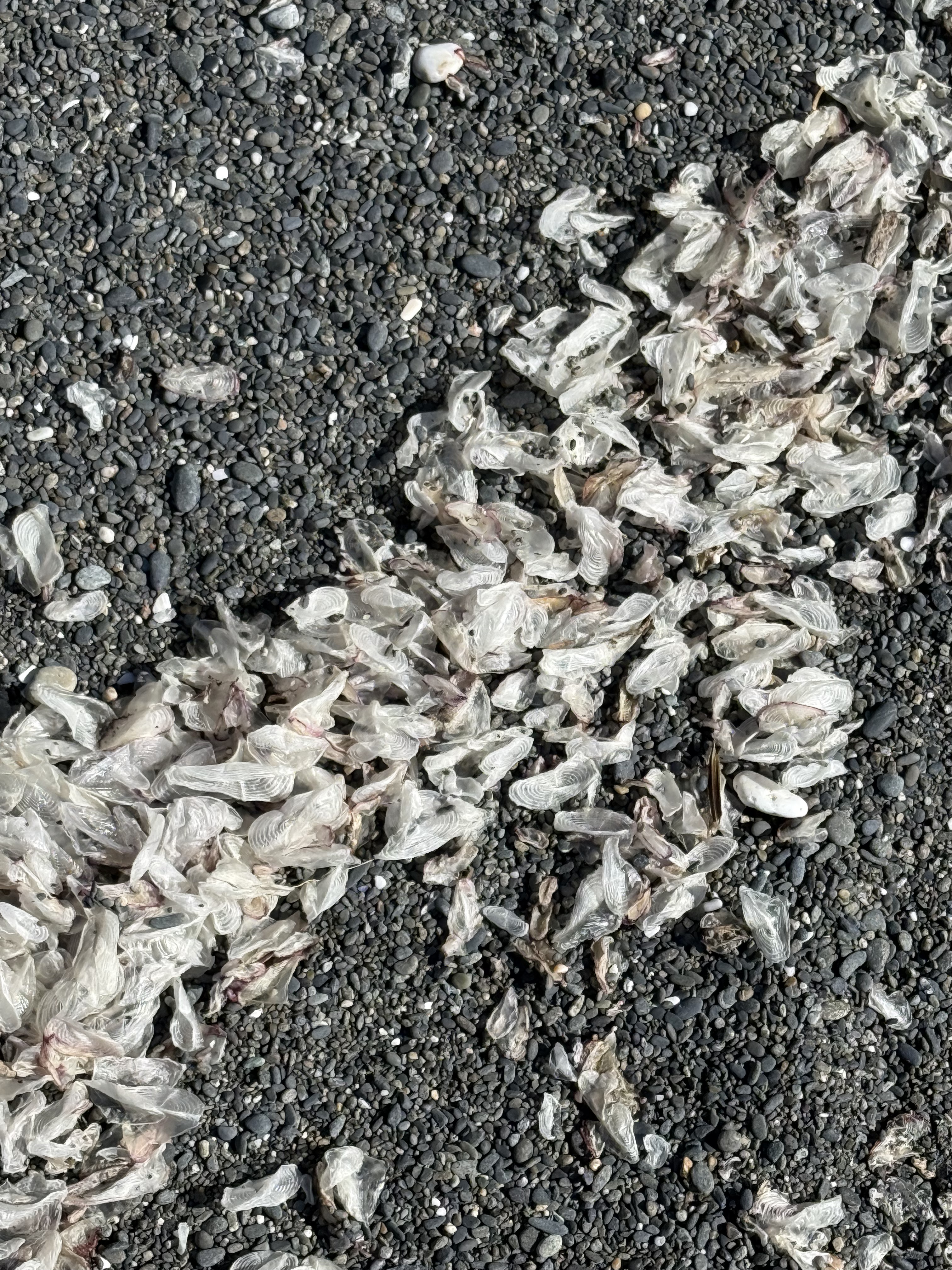
Plate 10. This one was a doozy. These objects are one-two inches long, thin, translucent, and oval in general shape. At first, CoPilot suggested insect wings (until I told it the size), then gull secondary feathers (until I said, “no way”), then settled on small fish cranial bones–e.g. the opercula, the bone that covers the gill. I asked for references, but it supplied me with titles and no links (how did it find them?). I spent longer on this photo than I wanted to. I don’t fault CoPilot for its ambiguous response because I found nothing when I looked very specifically. This phenomenon is either so common that no one bothers mentioning it, or infrequently observed that no serious beachcombers have stumbled across it. I’m going to have to agree (for now) with CoPilot that these are small bones from a school of fish that was decimated by either predation, coastal fishing, or disease and only these translucent cranial bones survived by floating, until waves concentrated them on this beach. This is the only beach where I saw them. I guess there are no easy answers to some questions–unless someone who reads this is a marine biologist.
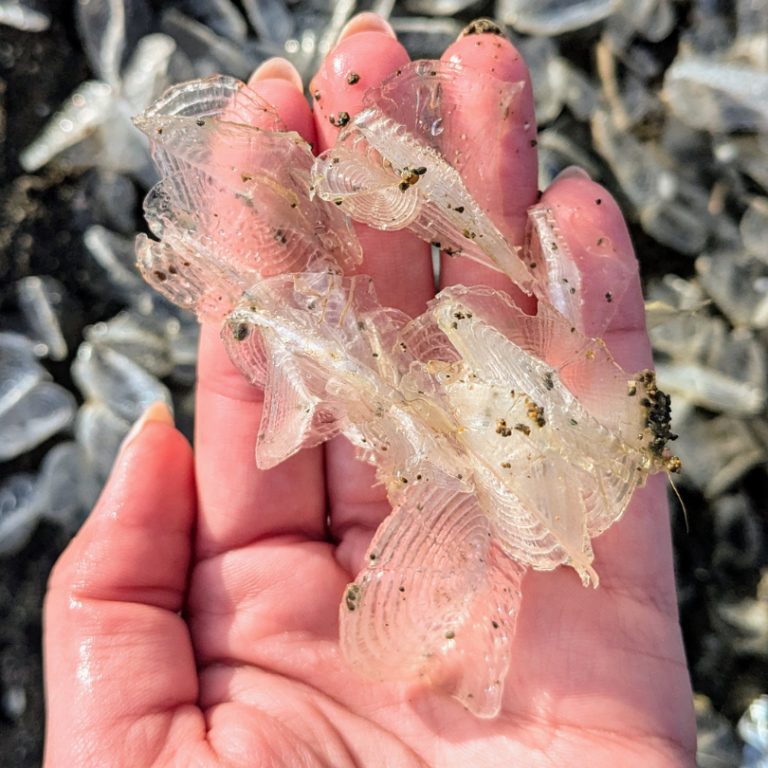
Plate 11. I solved the mystery of the white objects on the beach (Plate 10). I spoke to an ecologist I know who suggested they are a Hydrozoa called Velella-velella, which floats on the ocean like a jellyfish. They are a colonial organism that is blown about by the wind. They don’t swim so they are easily blown onto a beach and carried by waves. (Here’s a good article about them.)
Cape Flattery
I reported on this amazing location in a previous post. You can scan that post to get an idea of where these photos were taken.
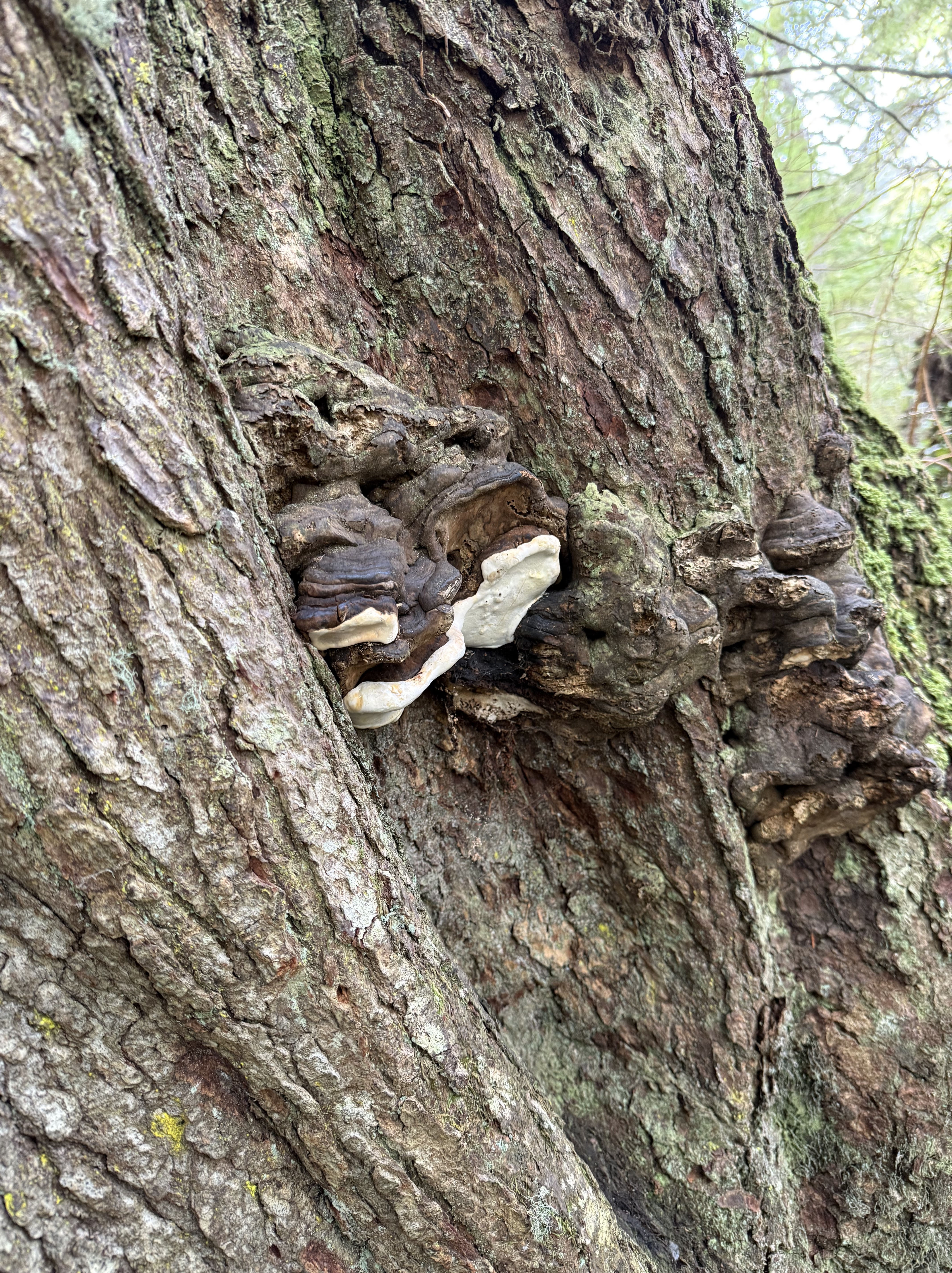
Plate 11. I don’t know if this living (it looked healthy to me) tree was stressed or not, but CoPilot thinks these are perennial bracket fungi, which favor environmentally stressed conifers. There were only a few on this tree. I noticed that this forest didn’t show nearly as many signs of decay as Quinault Rainforest, despite its exposed location.
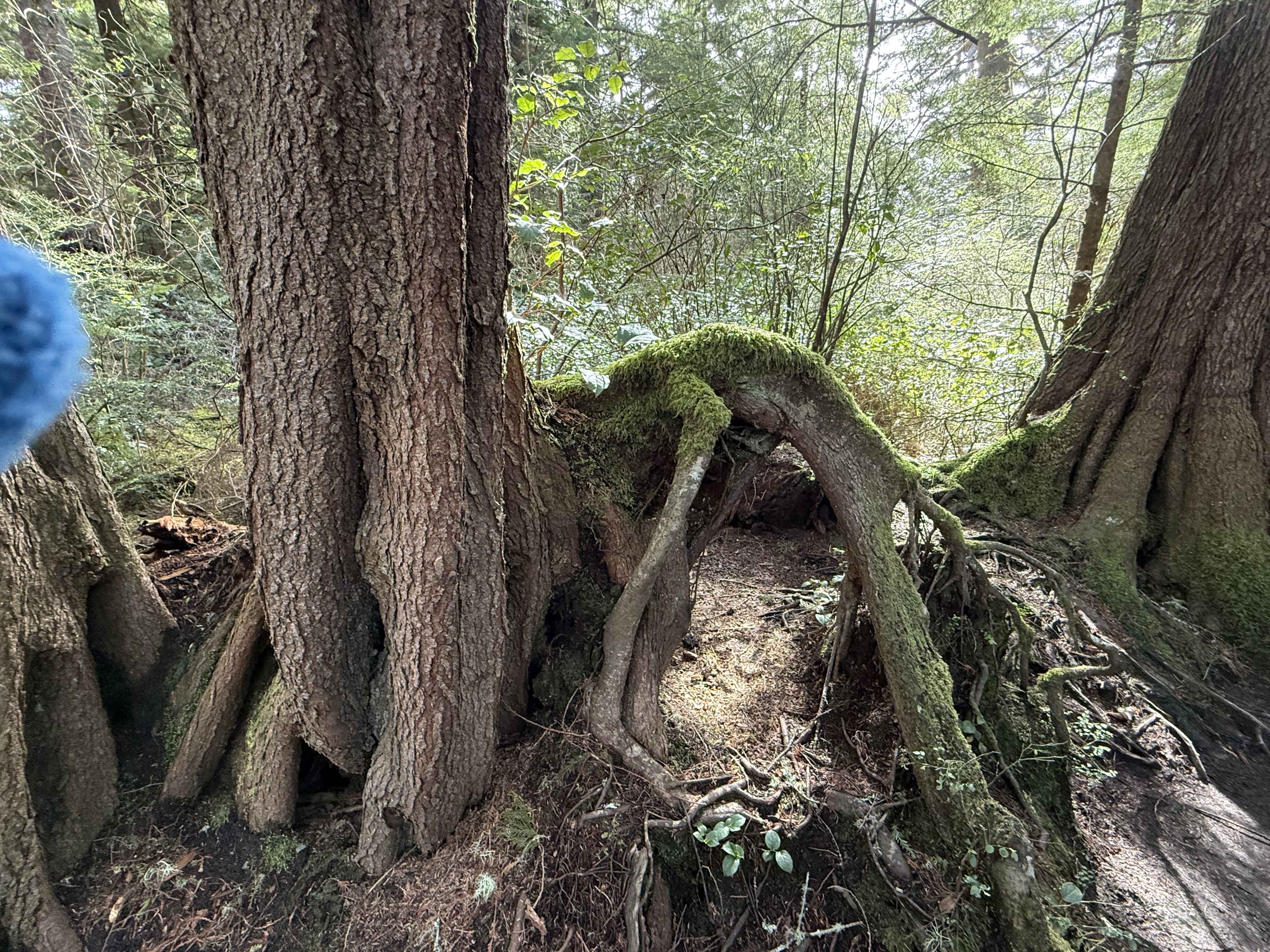
Plate 12. I had to throw this photo in because the root growing out of the tree(s) on the left looks like a dog that got its head caught in a hole, and died there. Its limbs of limp. Overactive imagination, I know. Nevertheless, this is a bizarre image because the dog is lying on top of a mound of soil. I’d bet there was a stump there that has decayed because the trees visible in this image are both composed of multiple trunks. A large tree died here (like the dog) and these are its adopted offspring. I would add that Cape Flatters, which is part of the Makah Reservation, has never been commercially logged. This is old-growth forest and this is a naturally occurring phenomenon.
Summary
Moisture drives everything on the Olympic Peninsula, soaking old volcanic and sedimentary foundations until the forest grows straight out of its own decay. Fallen logs become elevated nurseries, their wood breaking down under fungi and mosses until they’re more sponge than tree. Hemlock, cedar, and huckleberry take root on these platforms, sending roots around stumps and into the thin soils draped over ancient bedrock. Even the beaches tell the same story: waves sorting bones, shells, and driftwood carved from headlands shaped by tectonics and storms. It’s an ecosystem built on slow collapse and constant renewal.
Acknowledgment
I am experimenting with using CoPilot (aka ChatGPT) to help as I pursue my growing interest in ecosystems. I have been up front about where it contributed. It has been a great help, as well as an inspiration; if not for CoPilot, I wouldn’t have had the time of inclination to add these ecosystem NOTES to Rocks and (no) Roads. In fact, I’m tired of this entire series of posts, for which I get no compensation other than sharing my observations of the world. As a final note, CoPilot wrote the Summary and I stand by it.
Now I have to think about more than just rocks…


Recent Comments