Breaking Ground on the Rain Garden and Pond
This is going to be a long-term project, but that doesn’t mean I can wait for someone else to do the work. Actually, I enjoy working with soil and rocks, maybe because I’m a geologist. After 20 years living along the Gulf Coast, where rain falls by the bucketful, and the land is often flat and impermeable (when it isn’t waterlogged), I’m familiar with drainage projects like this. I prefer surface drainage over buried pipes because they are easy to monitor and keep clear of debris.
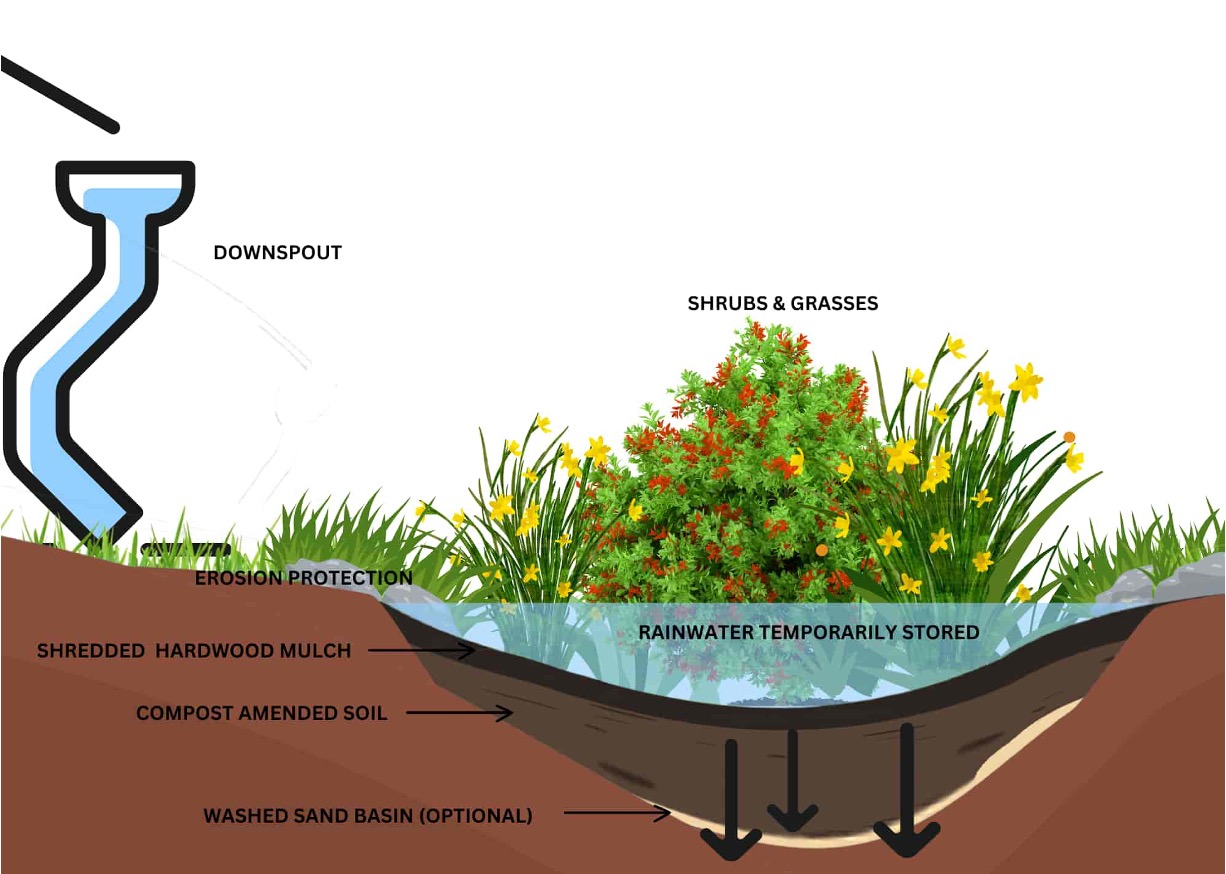
This schematic drawing of a rain garden pond summarizes our plan pretty well. The pond isn’t intended to have standing water, so it isn’t lined; instead the bottom is typically filled with a mixture of sand (easy for us) and compost or some equivalent material. We already have a lot of mulch for covering the area.

The hole is going to be about 18 inches deep in the center, and filled with a mixture of the removed soil and compost/mulch. I don’t need to increase infiltration or water retention; the soil contains a lot of silt and thus holds moisture surprisingly well, while being well drained. Inflow will be through a sluice cut into the soil from the deck (the shovel location) to the edge of the pond. I plan to use the stones collected from the soil to armor the inflow; from the looks of the refuse so far, I should have plenty.
Other than dealing with all the rocks I’m finding in the soil, it isn’t too difficult to remove.
The outline has been set with a couple of hours work, but now the hard work begins. I am going to remove the inner soil to match the perimeter depth, then cut a smaller area down six inches deeper. This process will be repeated until I reach the design depth. The refuse is being used to fill the 4-inch area where the mulch was removed; it will also be used to build a low berm.
The next few months are going to be slow going, but I’ll keep you posted.


Trackbacks / Pingbacks