Stormwater Retention Project
I always heard that the Pacific Northwest gets a lot of rain. Having lived in southern Louisiana for 25 years, I was a little skeptical. So when I moved here last year, to discover that all of the yards were brown, but the flowers and trees were flourishing, I became interested in the annual rain pattern. It doesn’t rain here in the summer. No thunderstorms twice a week. Nothing.
Water isn’t particularly expensive here, but I don’t like using clean tap water on plants. It turns out that most of Tacoma’s water comes from glaciers on Mount Rainier (Tahoma to natives). They melt naturally in the summer, so we aren’t using groundwater and have no control over their rate of melting.

We inherited a number of young fruit trees, which need a lot of water. Seeing how nice many of our neighbor’s yards were, we decided to collect plants. I watched water flowing out of the downspout during spring rains, flowing down the driveway into the street, and directly into Puget Sound. We installed a couple of rain barrels to collect some of it; you would be surprised how fast they fill during the light rains (compared to the Gulf coast) I’ve experienced here in Tacoma.
It turns out that Pierce County has a stormwater retention program, to prevent pollution of Puget Sound, and one can get free consultation on home projects that reduce storm runoff. There is even a competitive proposal system to get limited financial assistance. We jumped at the opportunity to contribute to the continued health of the place we’ve already fallen in love with.

The back yard was a basketball court at some point, complete with 3-4 inches of concrete. The previous owners removed the concrete (thank god!), but left some irregularly cut tree trunks. We were thinking about planting a garden in this area, but now we were part of something bigger than our back yard. We could get assistance on the whole project, from collecting rainwater to distributing it, and keeping it out of the pristine waters of Puget Sound.
But there were some engineering hurdles to clear…
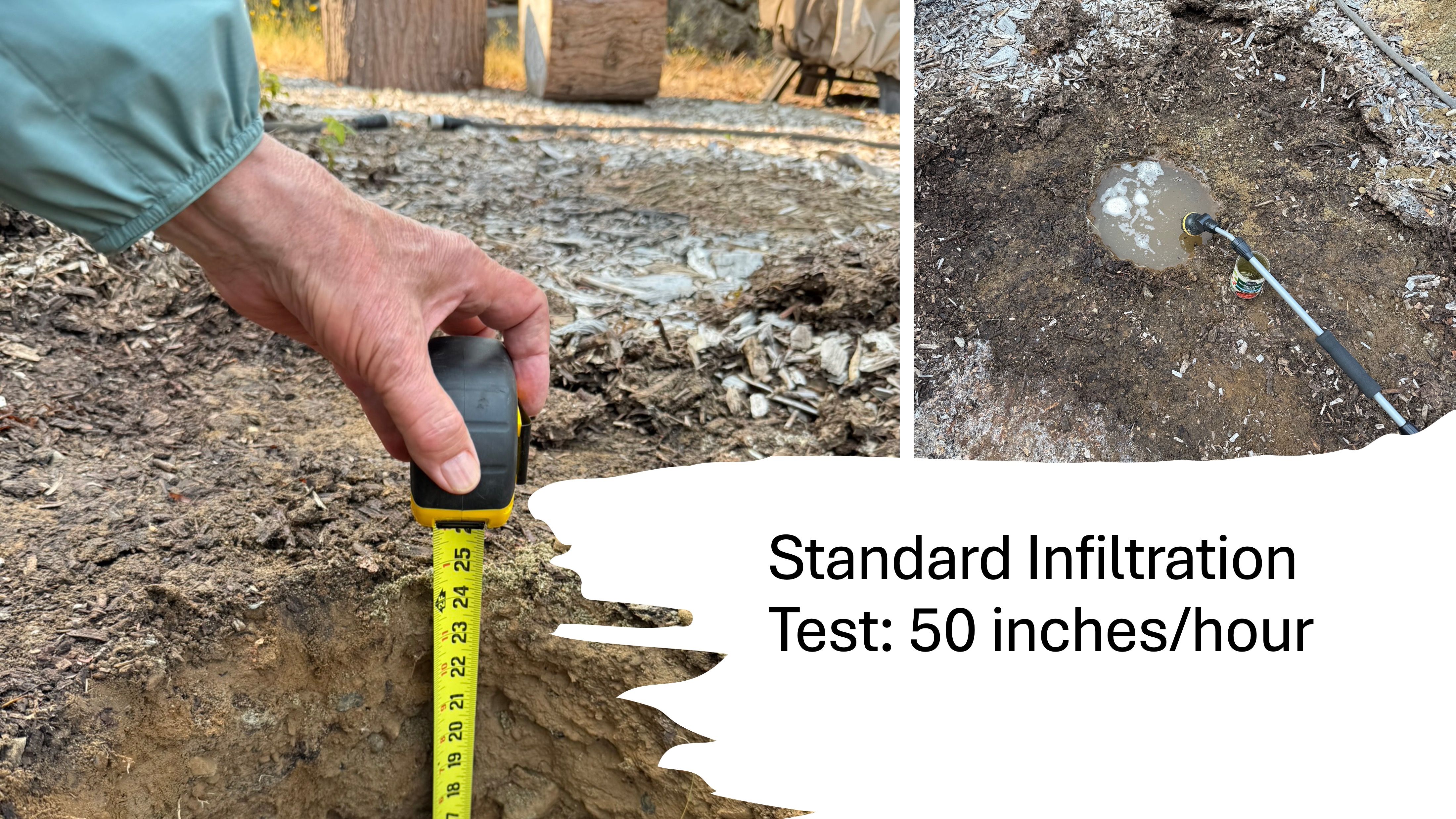
We had to demonstrate that the soil under our back yard would absorb a reasonable amount of rainwater, which necessitated digging a hole and filling it with water. That sounds easy enough. The catch is that the soil in the hole has to be saturated before the test can be conducted. To assure saturation for all soil types, this means keeping a two-foot deep hole full of water for three hours. I had to keep the garden hose running at half-volume, tweaking it constantly, to meet this standard.
I spent the morning babysitting a one-foot-diameter hole with a hose running constantly.
But I kept the hole full for three hours. Finally, I could conduct the test. I filled the saturated soil to 12 inches and waited, but not for long! As I already knew, it drained in 17 minutes, as measured by a stopwatch. We have well-drained soil (mostly sand with some clay and rock cobbles).
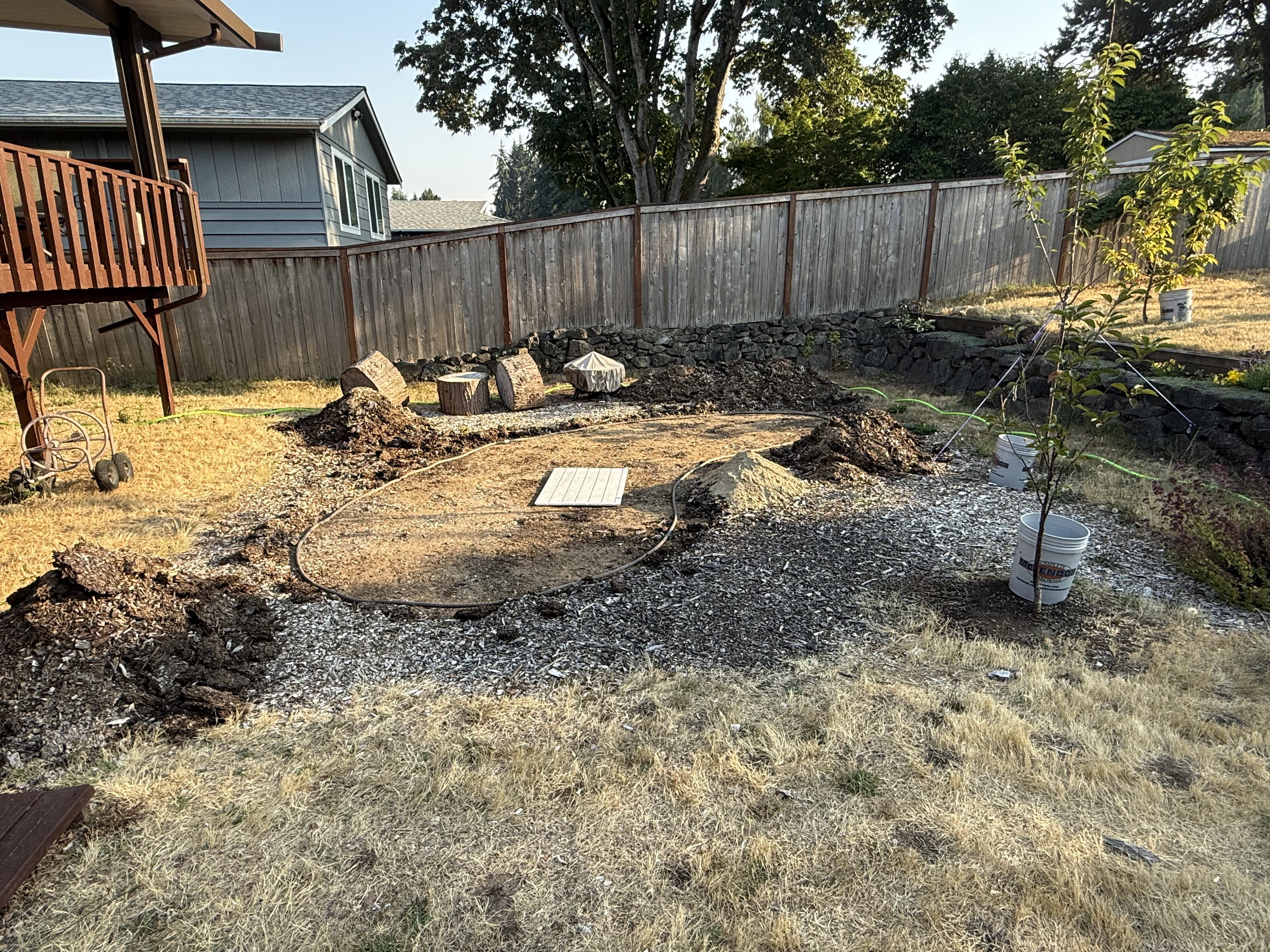
While my garden hose kept the ground saturated, I kept myself busy, removing 4 inches of mulch filling the 4-inch deep depression left by the basketball court. I’m going to keep the material on-site as much as possible, to avoid hauling it up the slope seen to the right in this photo, where it would (please, god, no!) be spread to form a slight hump in my back yard.
You would be surprised how fast soil is used to fill a 4-inch deep area the size of the remaining mulch seen in this photo.
I can’t wait to begin digging the pond. I’ll see you then.
Disarray Along Commencement Bay
This morning we went for a walk along the western shoreline of Commencement Bay, which was home to many sawmills, even a smelter, between the 19th and late 20th centuries. Rather than removing all of the industrial debris, the city has left the remaining infrastructure as a kind of museum. There are signs explaining a lot of the history and even a piece of sculpture integrated with an original saw.
The shoreline is a dynamic environment where plants struggle to keep up with the sea and weather. Thus, pioneer plants dominate the flora.
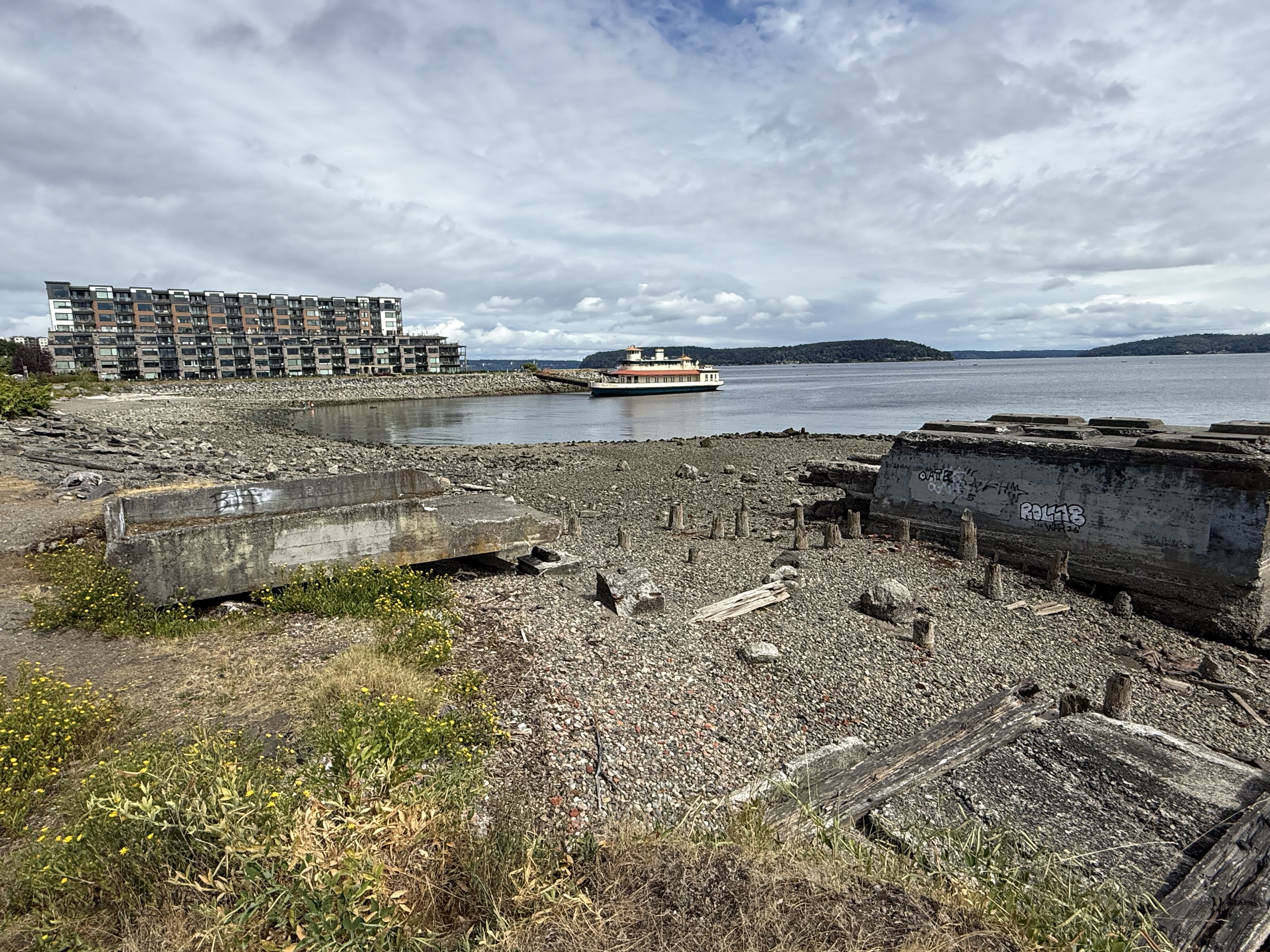
This view is looking to the NE. This is the last sawmill site along the bay, but it doesn’t have any signage explaining its history. Nevertheless, this image, taken at low tide, says a lot: The large concrete structure was the foundation for a piece of heavy equipment like a saw or winch; the piling stubs reveal where it was connected to land, where a receiving platform (left of image) was constructed. The remnants of a dock are in the lower right. There are a line of pilings further seaward that demarcate a dock that would have served as a wharf for ships.
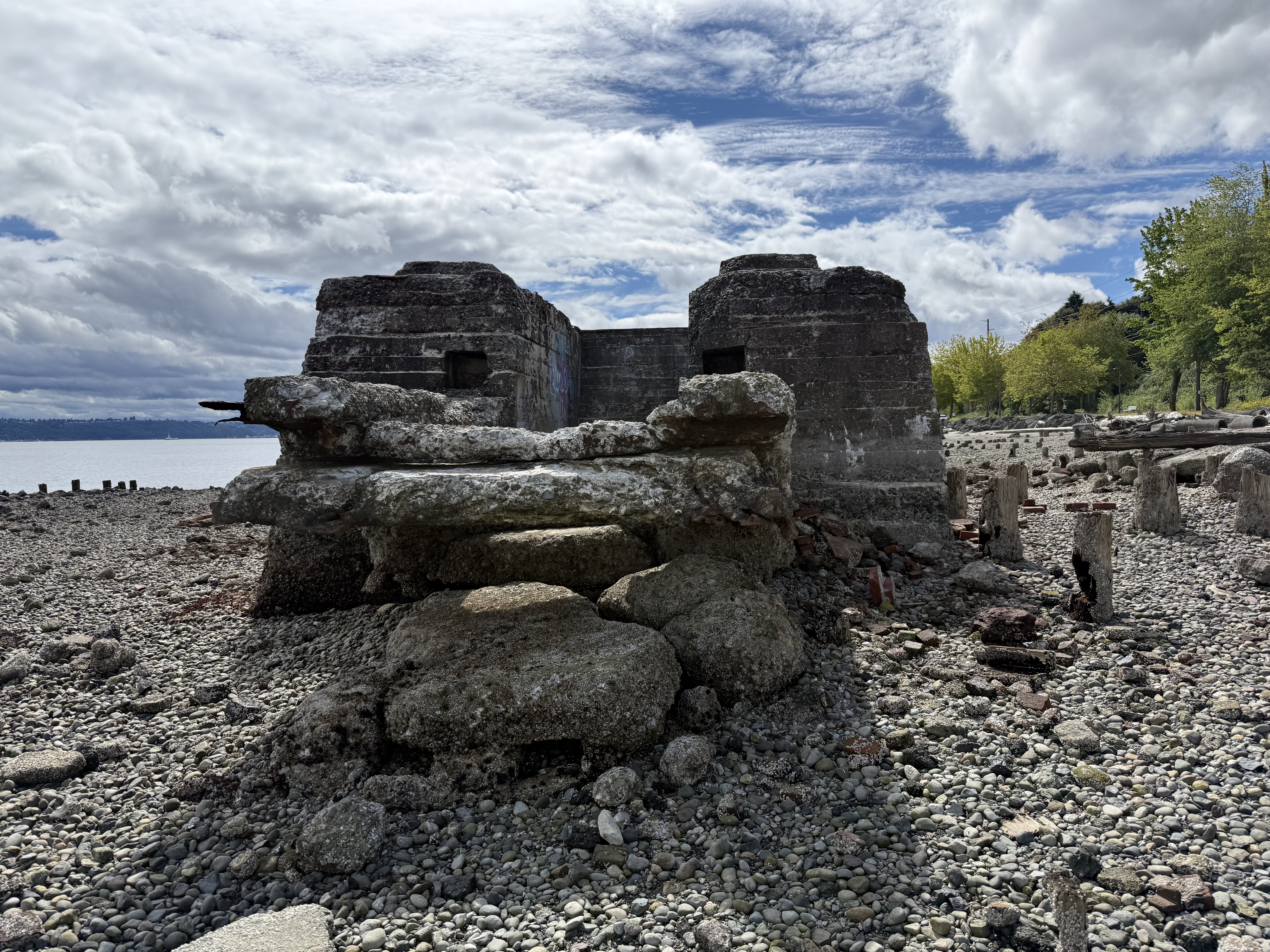
Most of this structure would have been submerged at high tide (7-10 feet, twice a day). This reinforced concrete structure probably was the base for the saw, the channel likely designed for pulleys, chains, etc, that ran the saw or pulled trees (up to 14 feet in diameter) into it. The sawmills often located their saw heads offshore to make processing logs, which arrived by raft, easier.
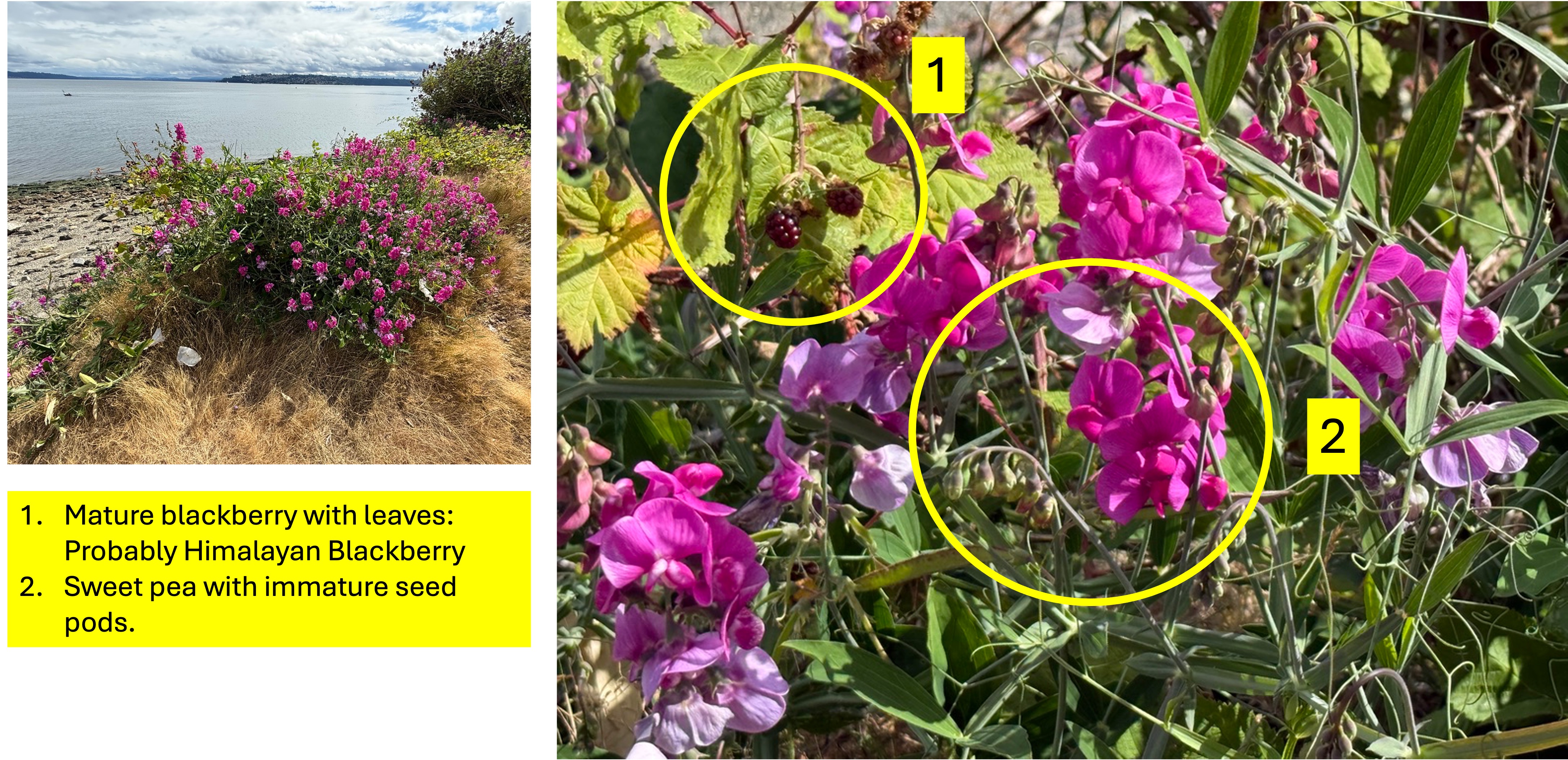
This bramble caught my eye, so I took a closer look. It is a mixture of two pioneer plants. Sweet peas of different species are native to the PNW (I don’t know which exactly this is), but Himalayan blackberry is invasive and threatens ecosystems across the region. They are fighting it out, so I’m cheering for the sweet pea — to fend off the foreign invader.
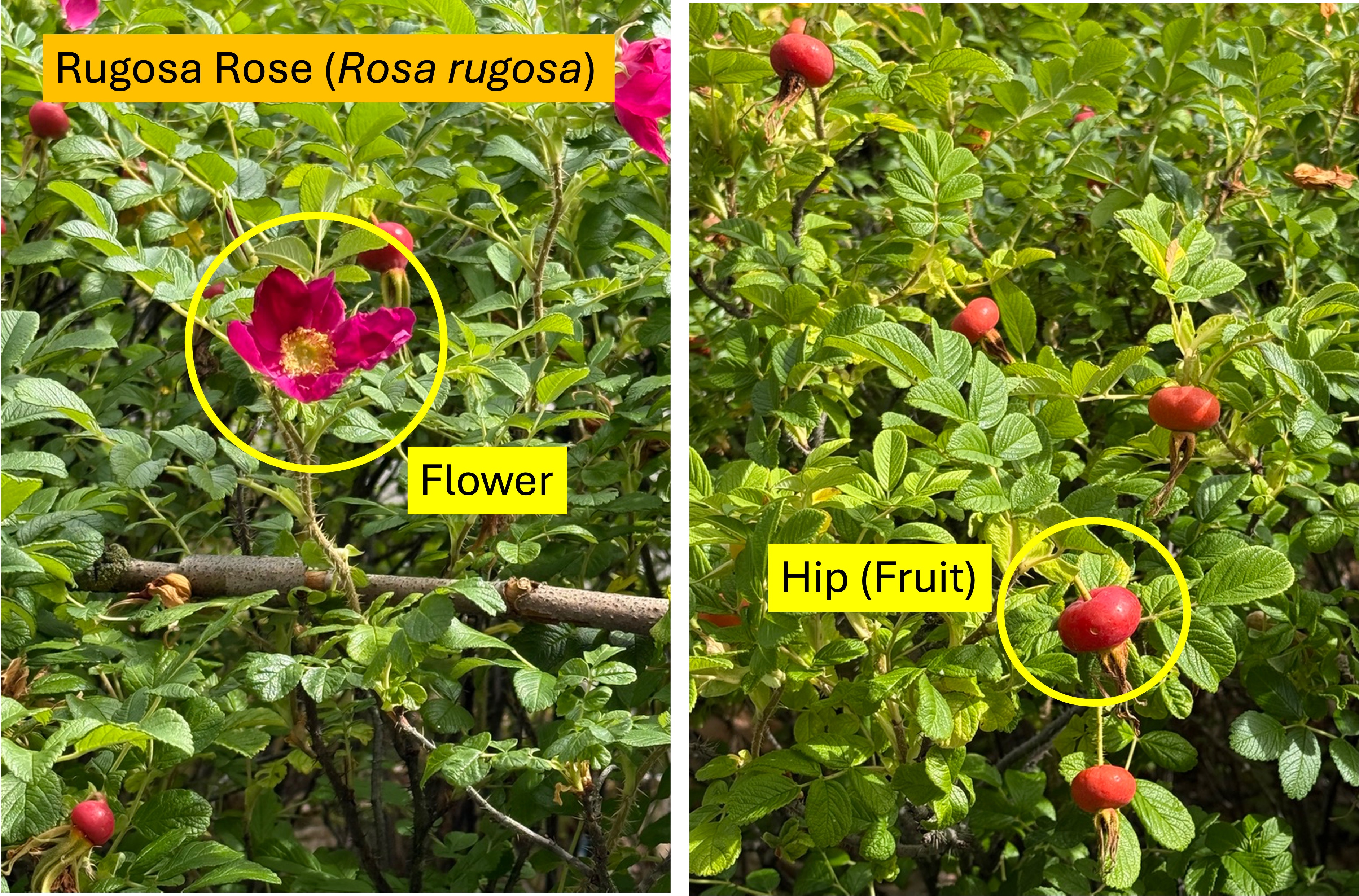
This wild rose species caught my eye because of the huge fruit (golfball sized), which is apparently edible. Just put enough gravy on it and it’ll taste fine.
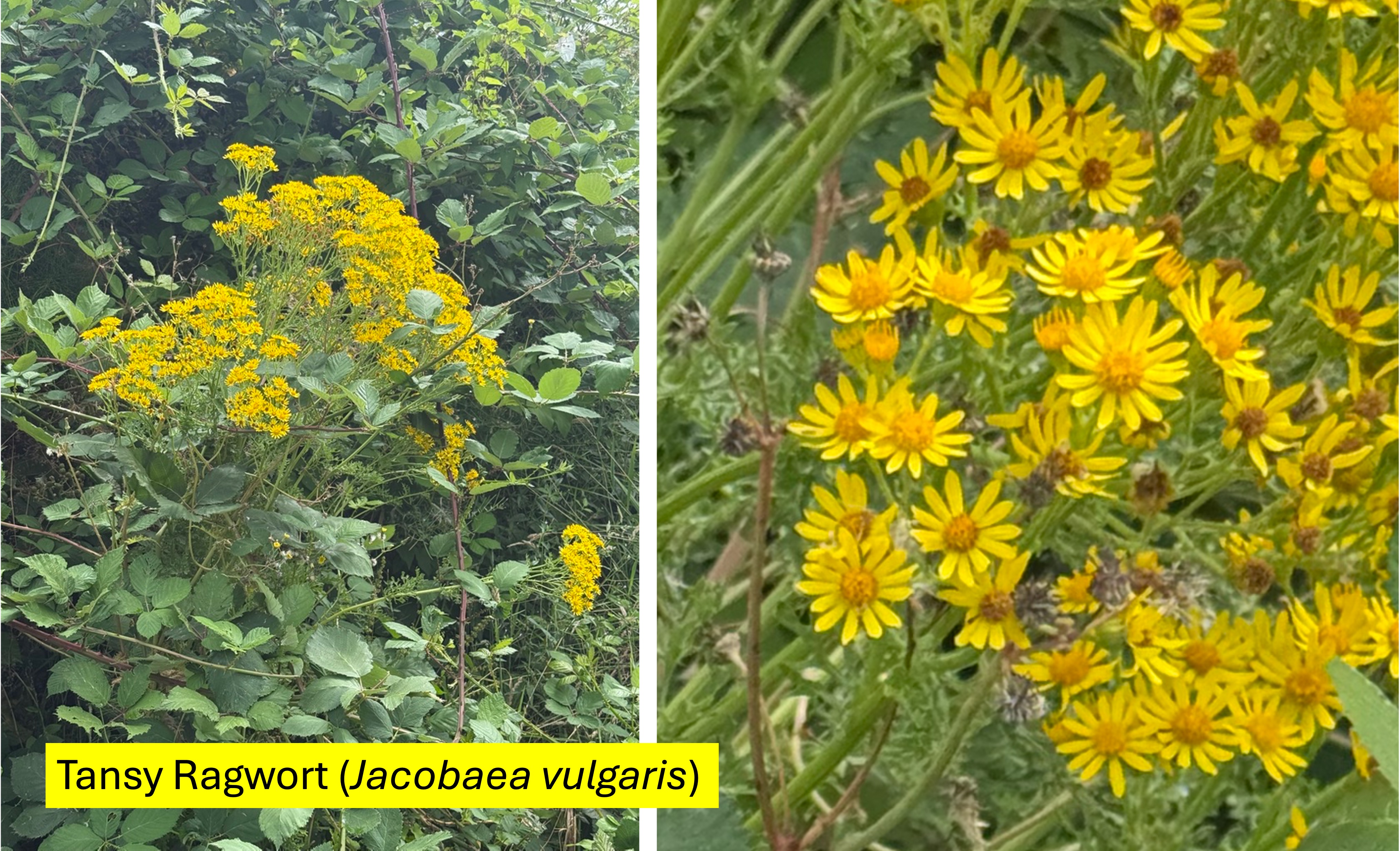
I thought these bright, yellow flowers looked familiar. I checked a previous post to discover that the flowers are not common tansy. The flowers are curved upward and the centers are large, orange domes. It is invasive and toxic to animals (and people), so it is actively monitored. This example is growing in a thicket along with Rugosa Rose, which is also invasive; and yes, there are native plants that thrive in a coastal environment but they have natural controls that are lacking for these alien species.
Final Thoughts
I didn’t mean to photograph anything today, but the flowers are so eye-catching. And I love old industrial sites.
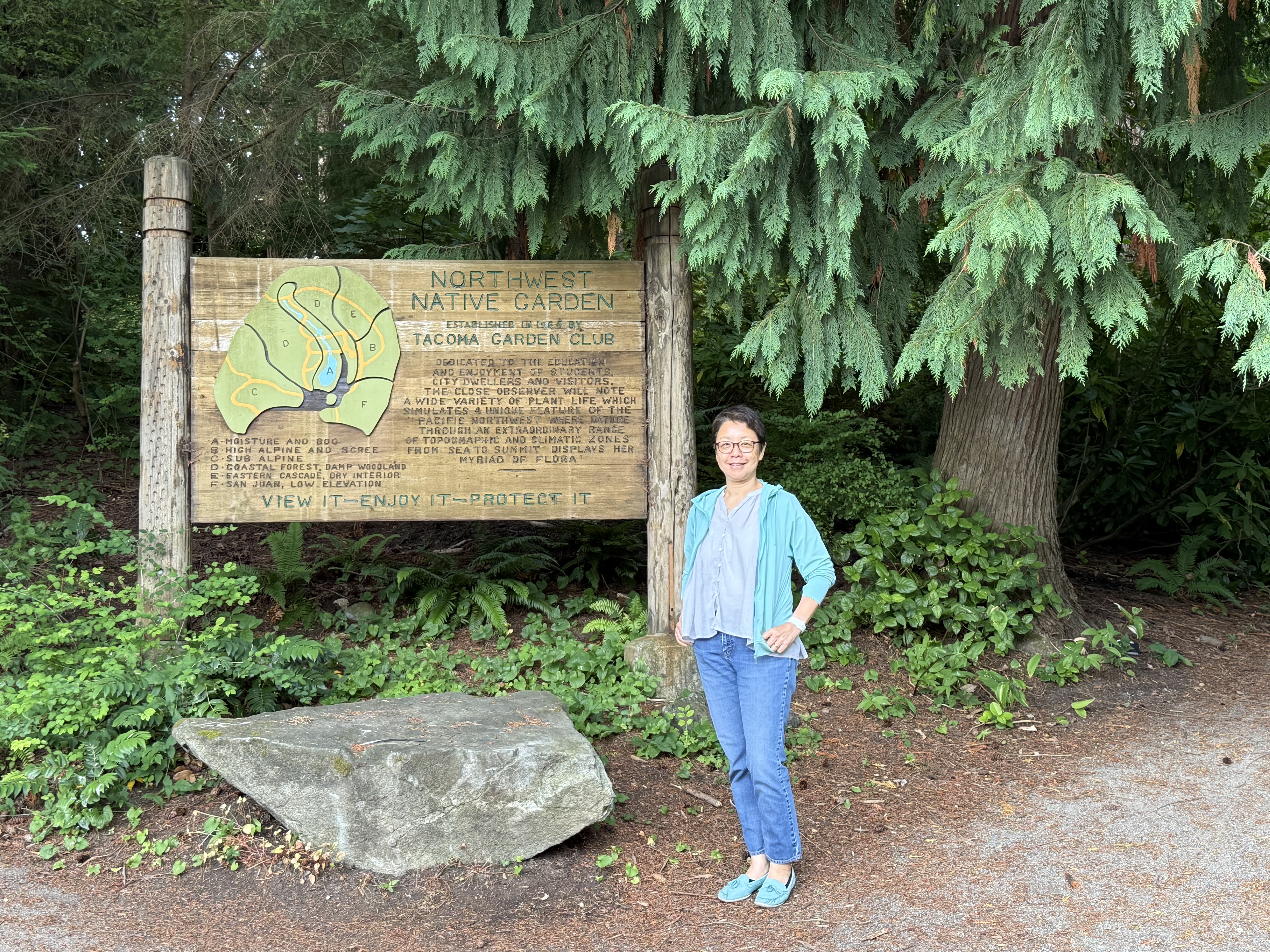
The Northwest Native Garden
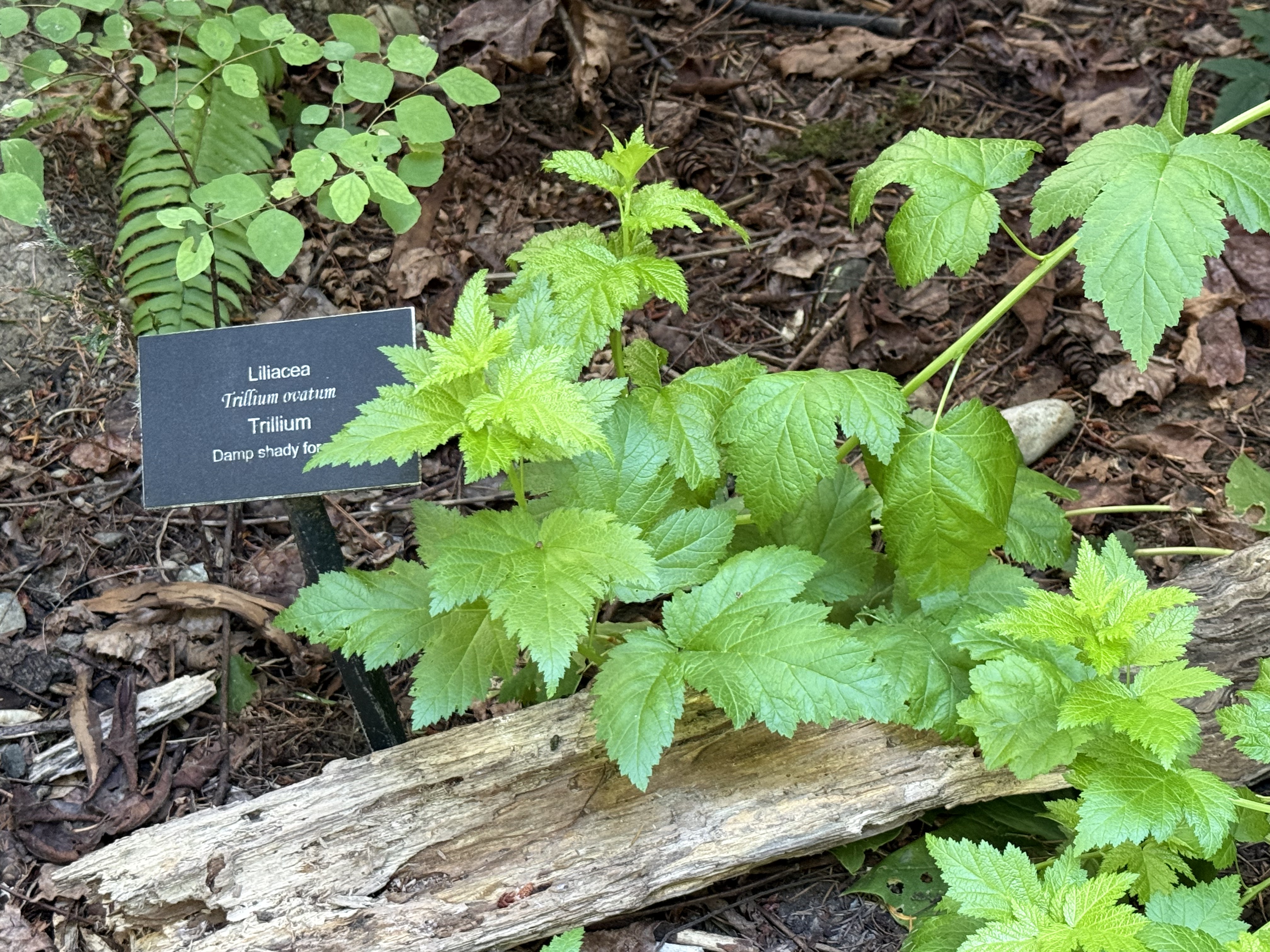
Like the (rare) sign says: Trillium likes moist coastal forests.
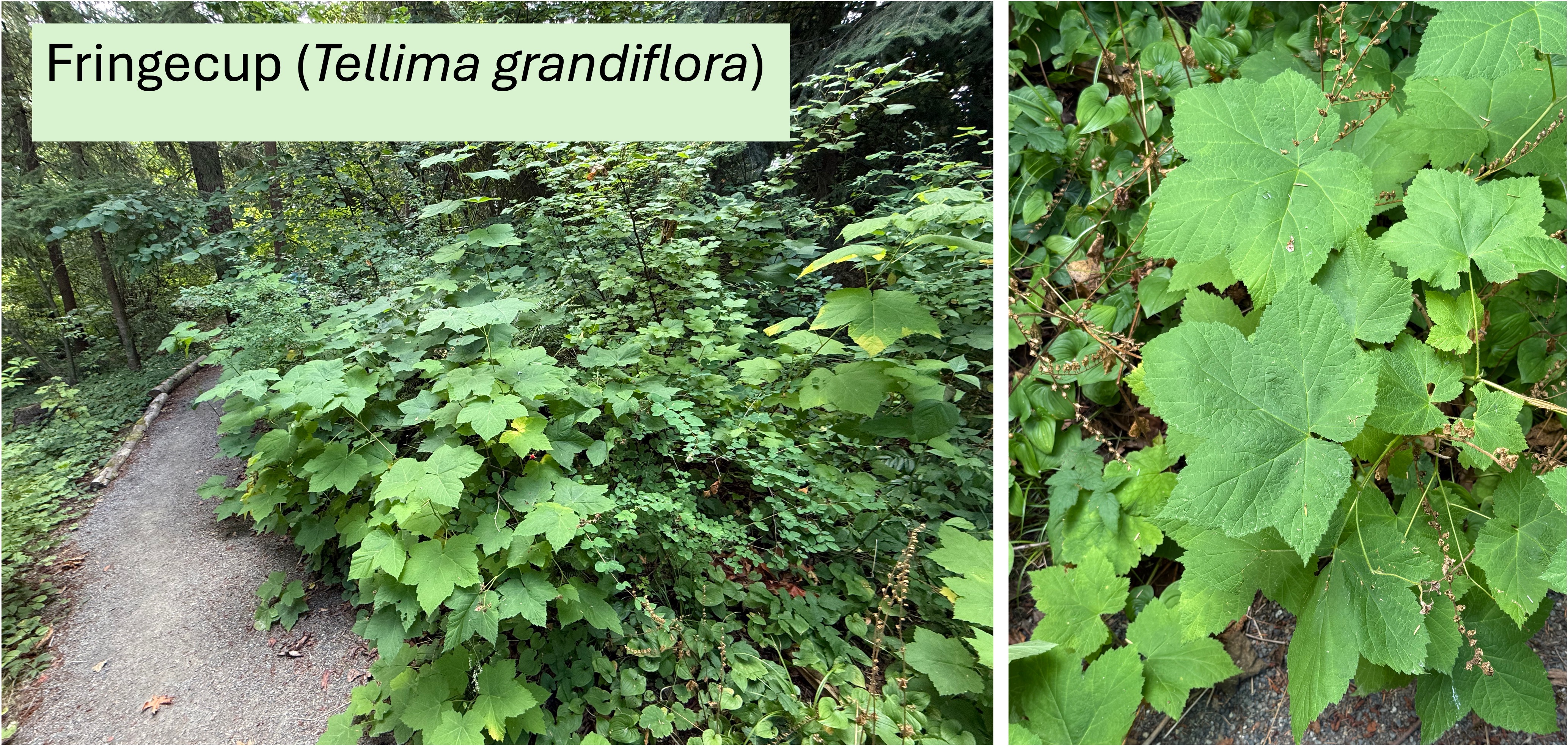
This common PNW shrub thrives in moist coastal forest environments.
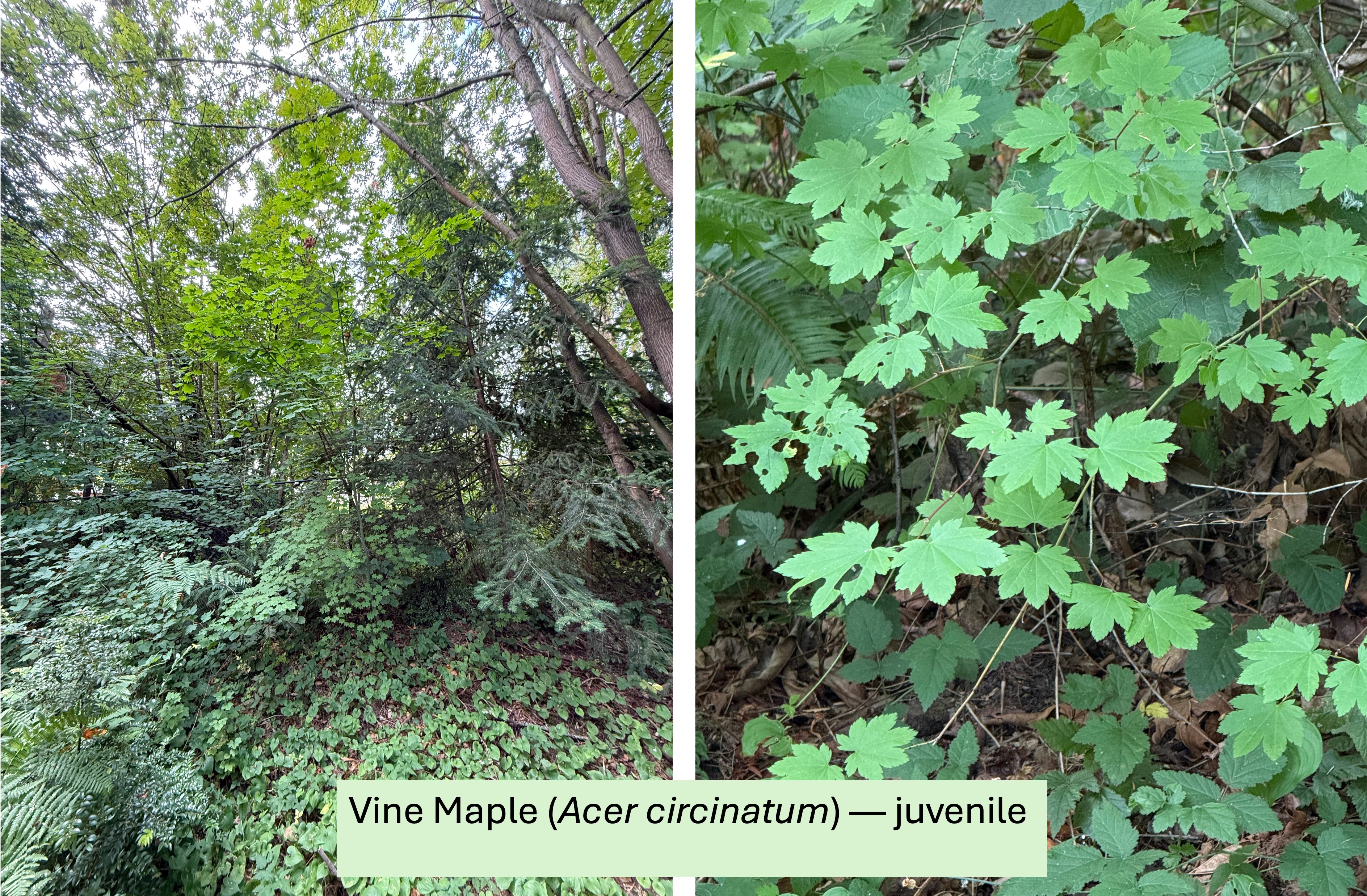
Vine Maple is an understory tree, which doesn’t grow high enough to compete for full sun; instead, it grows beneath the conifers and gives even more shade to the shrubs. This sapling is just starting to get some height. Moist coastal forest.
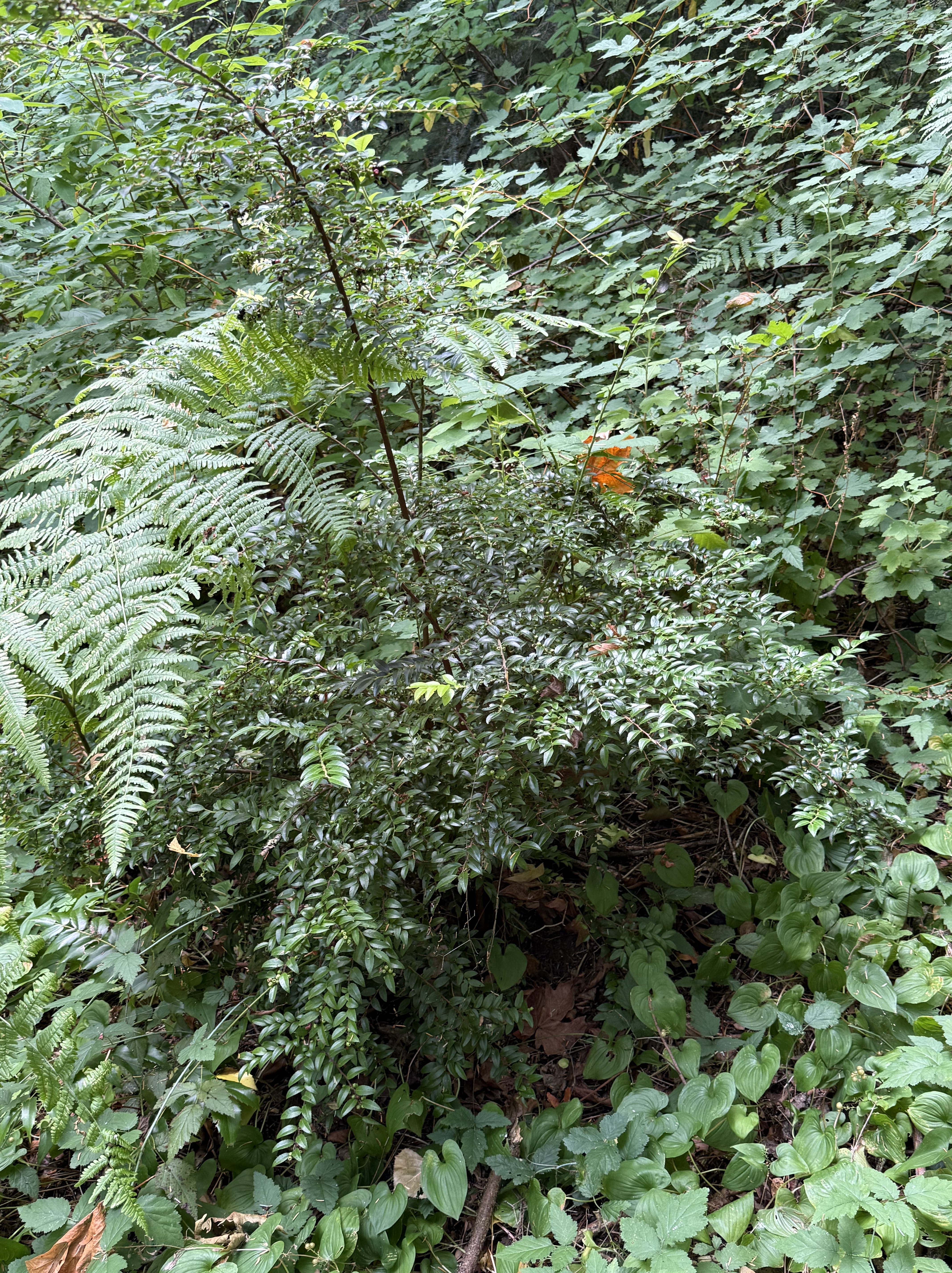
This is Salal (Gaultheria shallon). It grows in an environment similar to Vine Maple, in nutrient-rich, well-drained soils, often near water. Moist coastal forest.
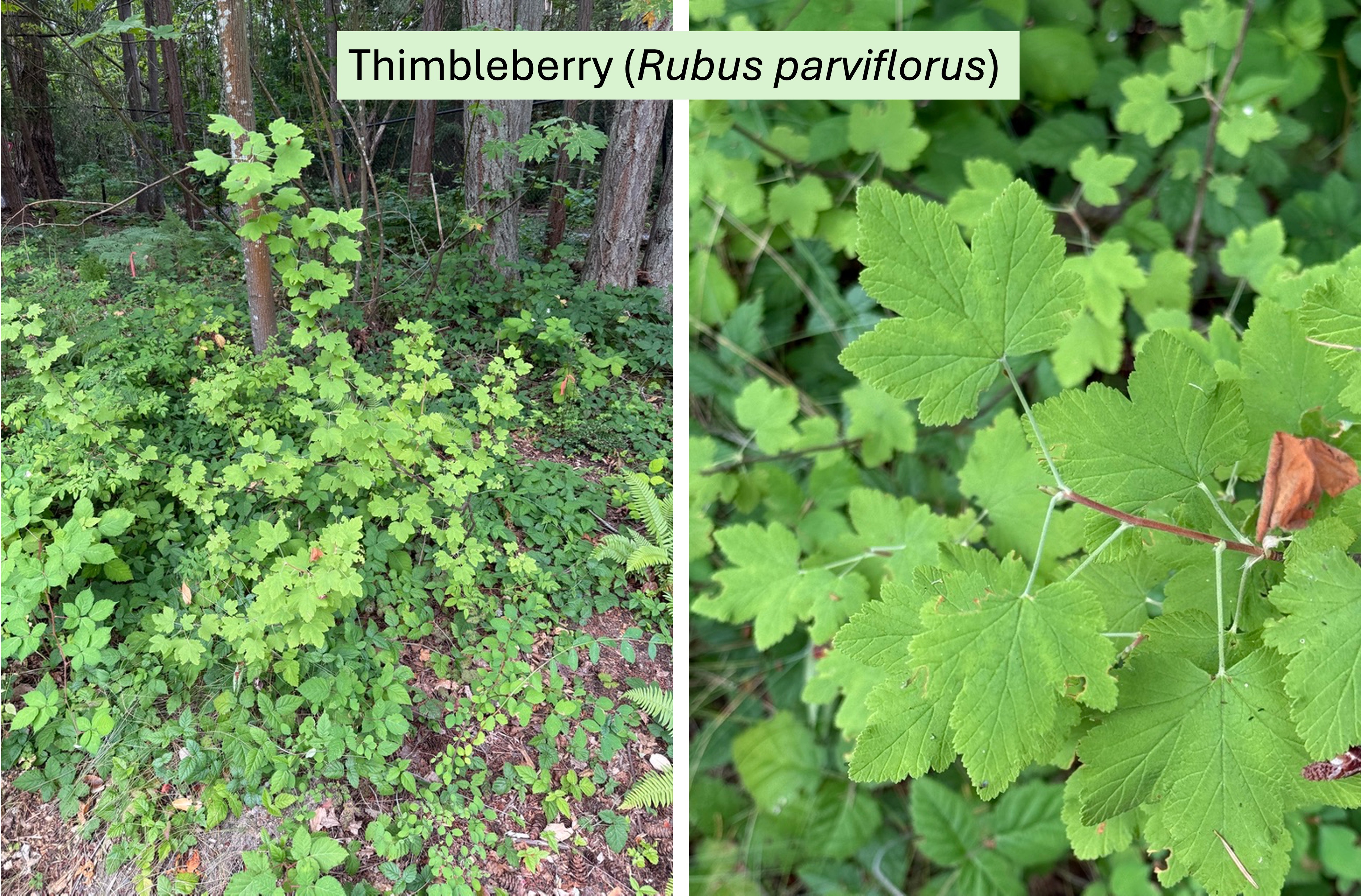
This shrub forms colonies in mesic forest patches, where partial sun is available although it is shade tolerant. The identification is difficult because of so many plants with similar leaf shapes, but I agree with CoPilot. A denizen of moist coastal forests.
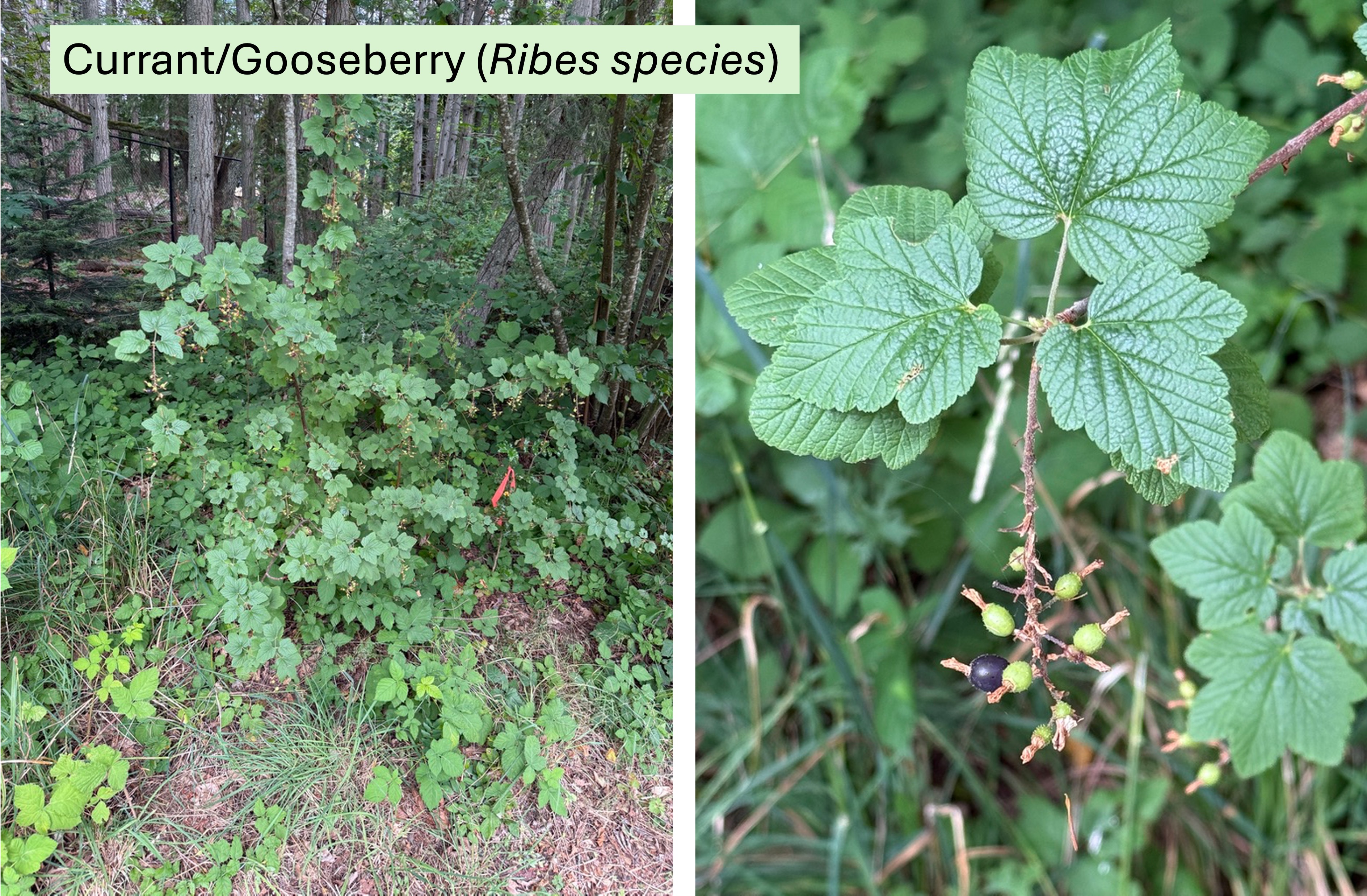
This plant is common to shrub thickets and riparian edge habitats.
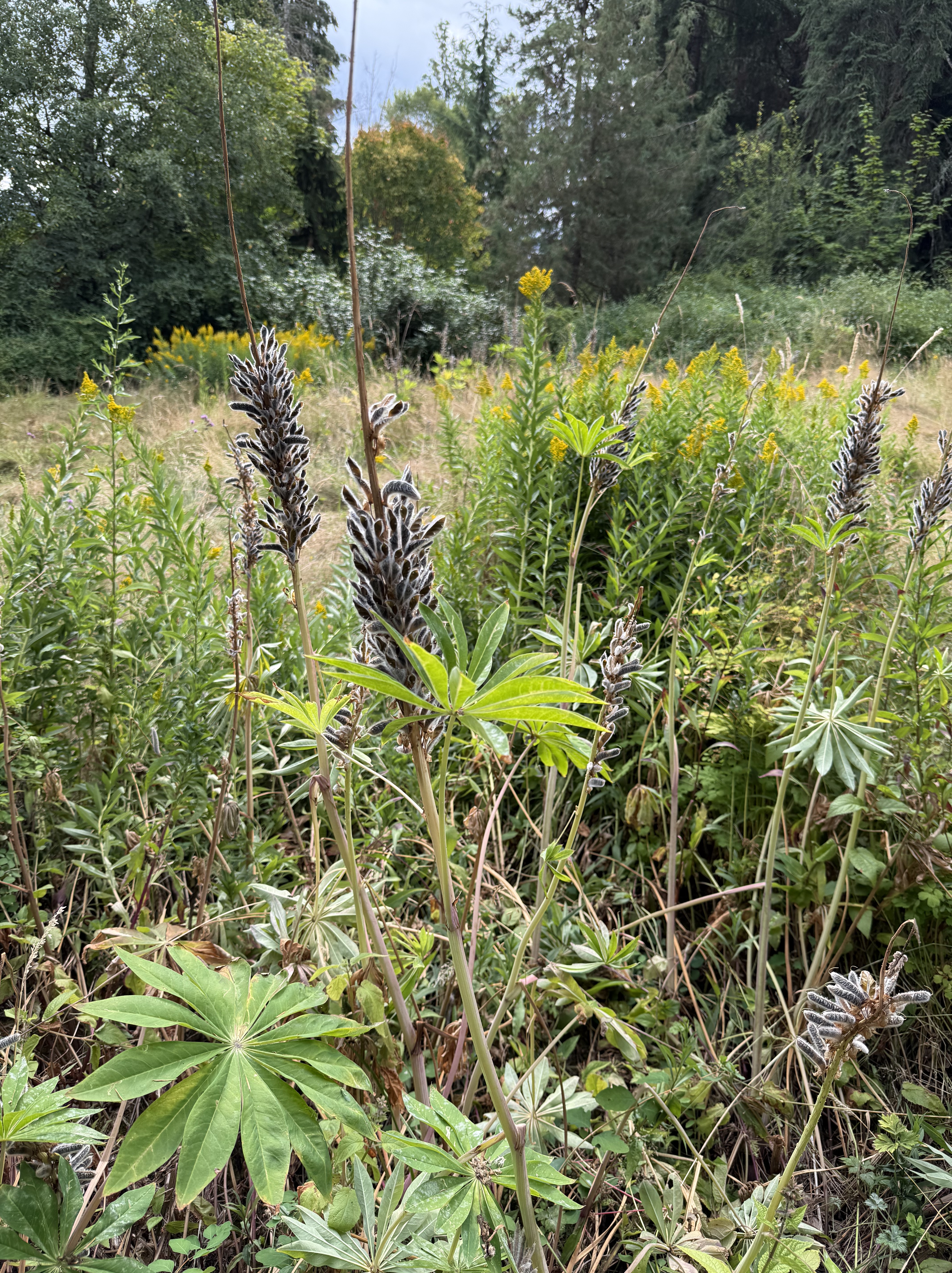
This distinctive plant is Bigleaf Lupine (Lupinus polphyllus). It thrives at the edges of meadows in a full-sun environment with moist to dry soil. Those lovely appendages are seed pods, so I don’t know what the flowers look like. This plant thrives in prairie/oak woodland habitats.
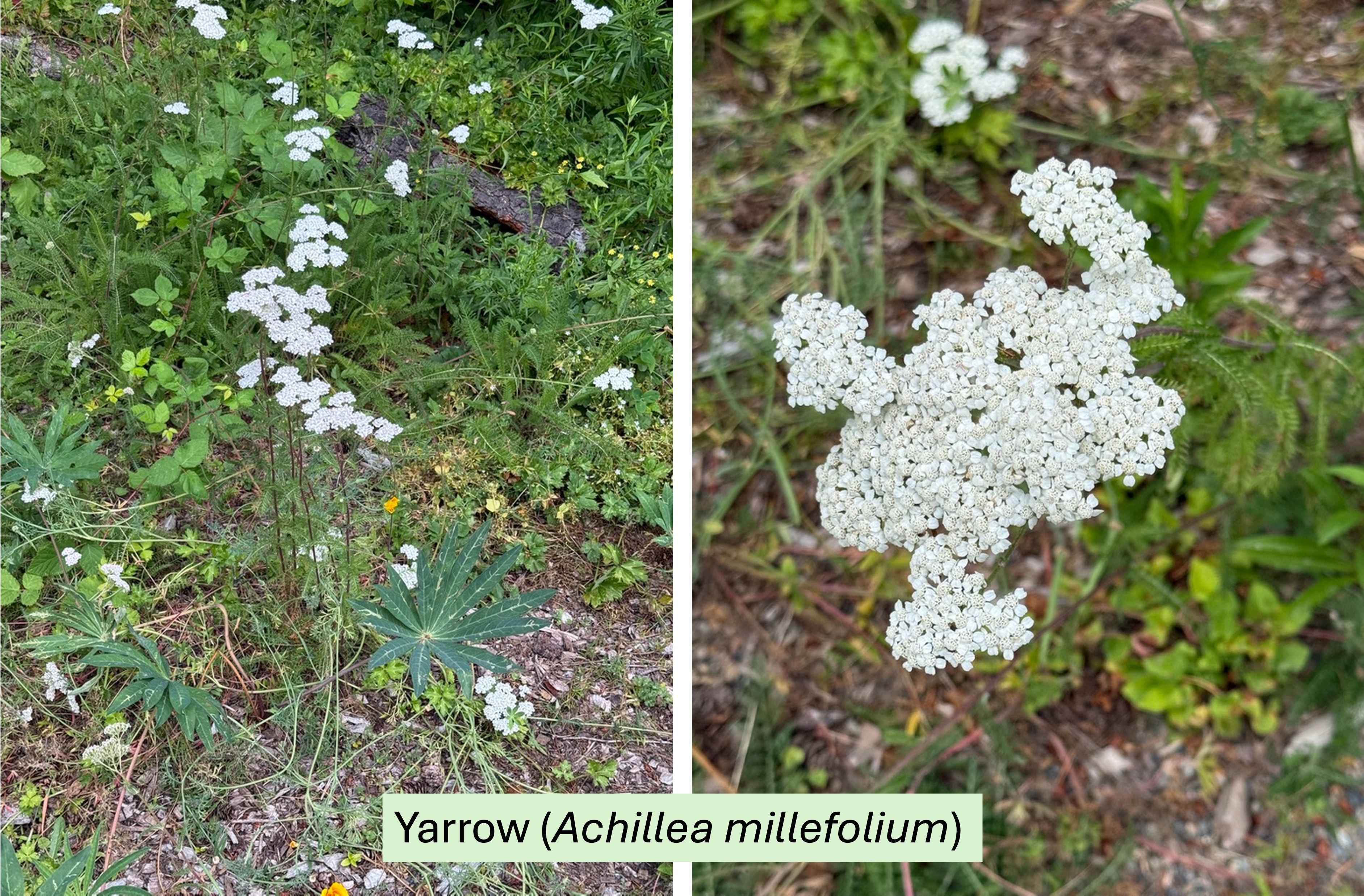
This slender, flowering plant is thriving in the prairie section of the garden. Prairie/oak woodland environments.
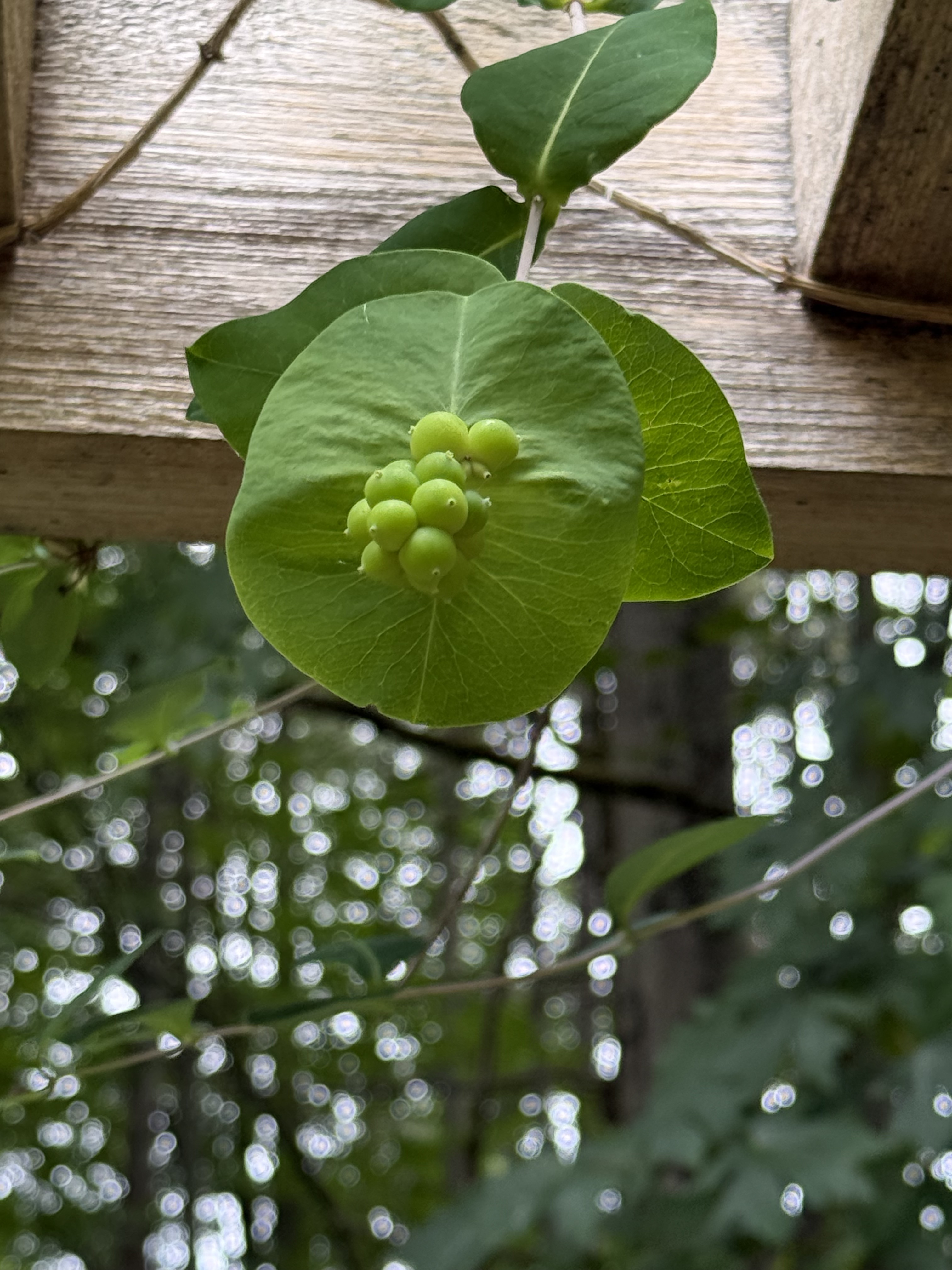
This vine is Perfoliate Honeysuckle (Lonicera caprifolium). It is a non-native variety that is commonly planted on trellises and fences. This one was hard to identify; CoPilot failed completely but, with help from Claude (Anthropic’s AI), we finally figured it out. We could still be wrong, however.
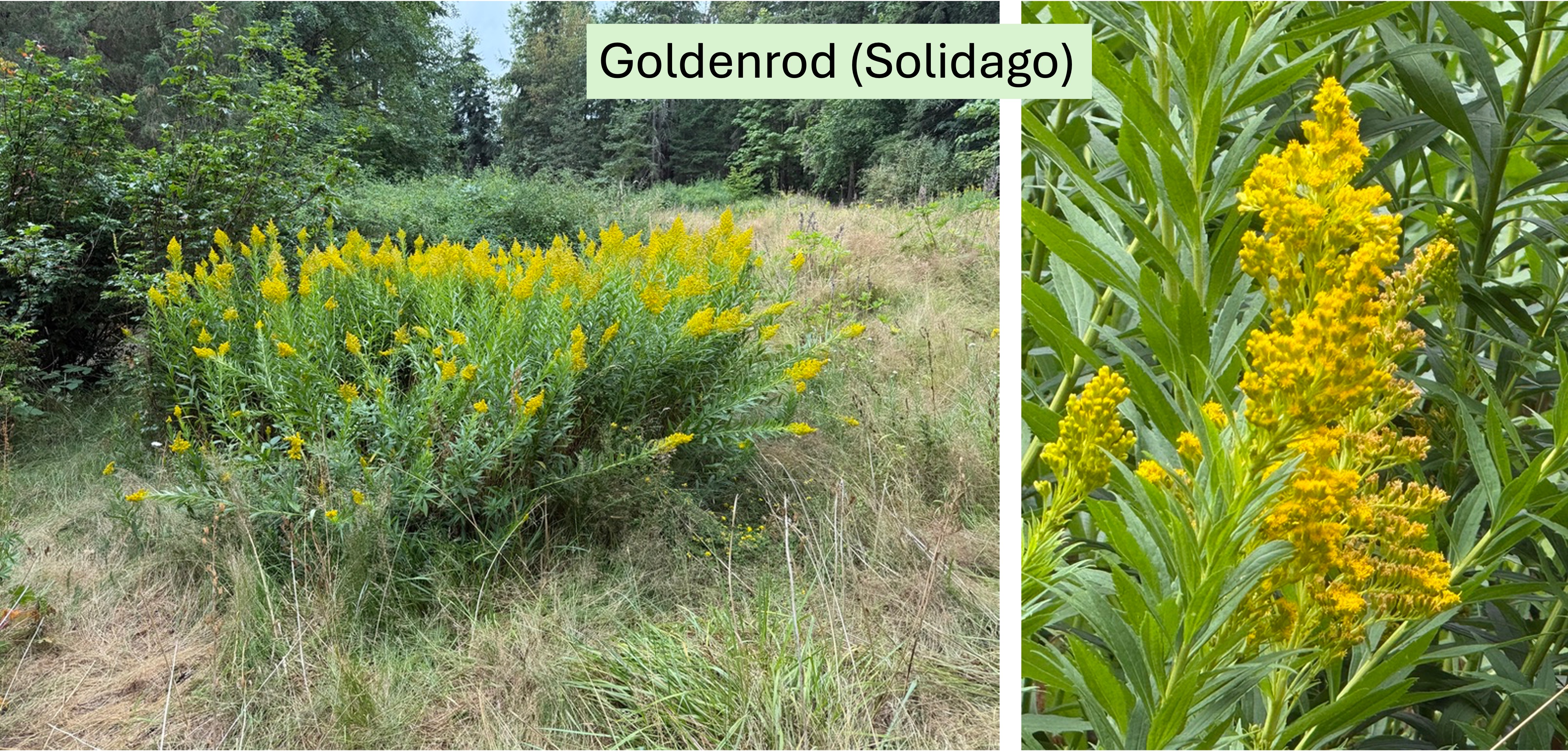
This flowery shrub grows in meadows like the micro-environment at the Northwest Native Garden. Prairie/oak woodland habitats.
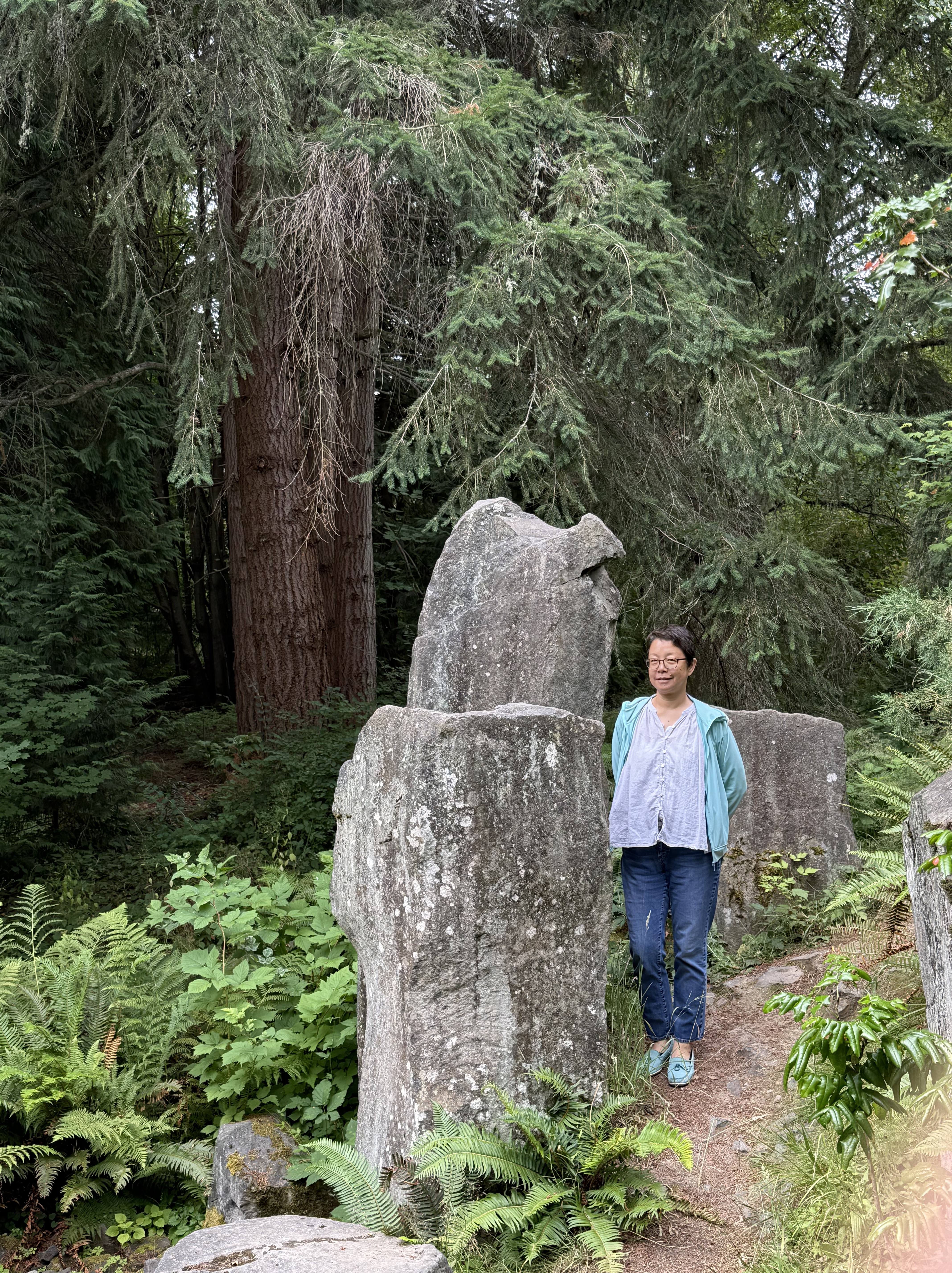
These non-native (to Tacoma) columns of volcanic rock show up everywhere in the PNW. They originate within the Cascades Range, near volcanic vents and volcanoes.
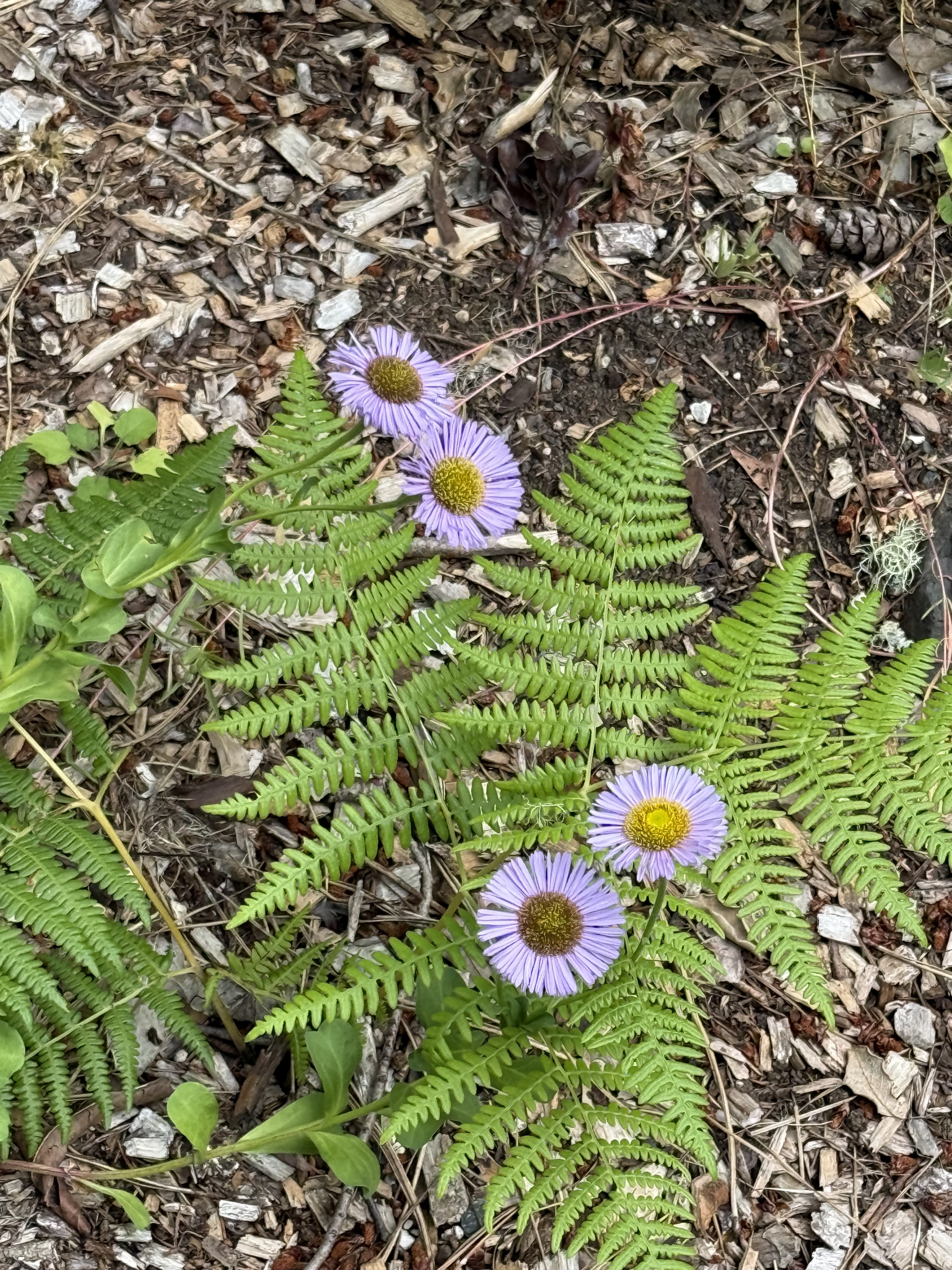
This lovely flower, growing through some ferns, is Douglas Aster (Symphyotrichum subspicatum). It is common in moist meadows and forest edges. I verified the identification from CoPilot. Common in moist woodland/forest edge habitats.
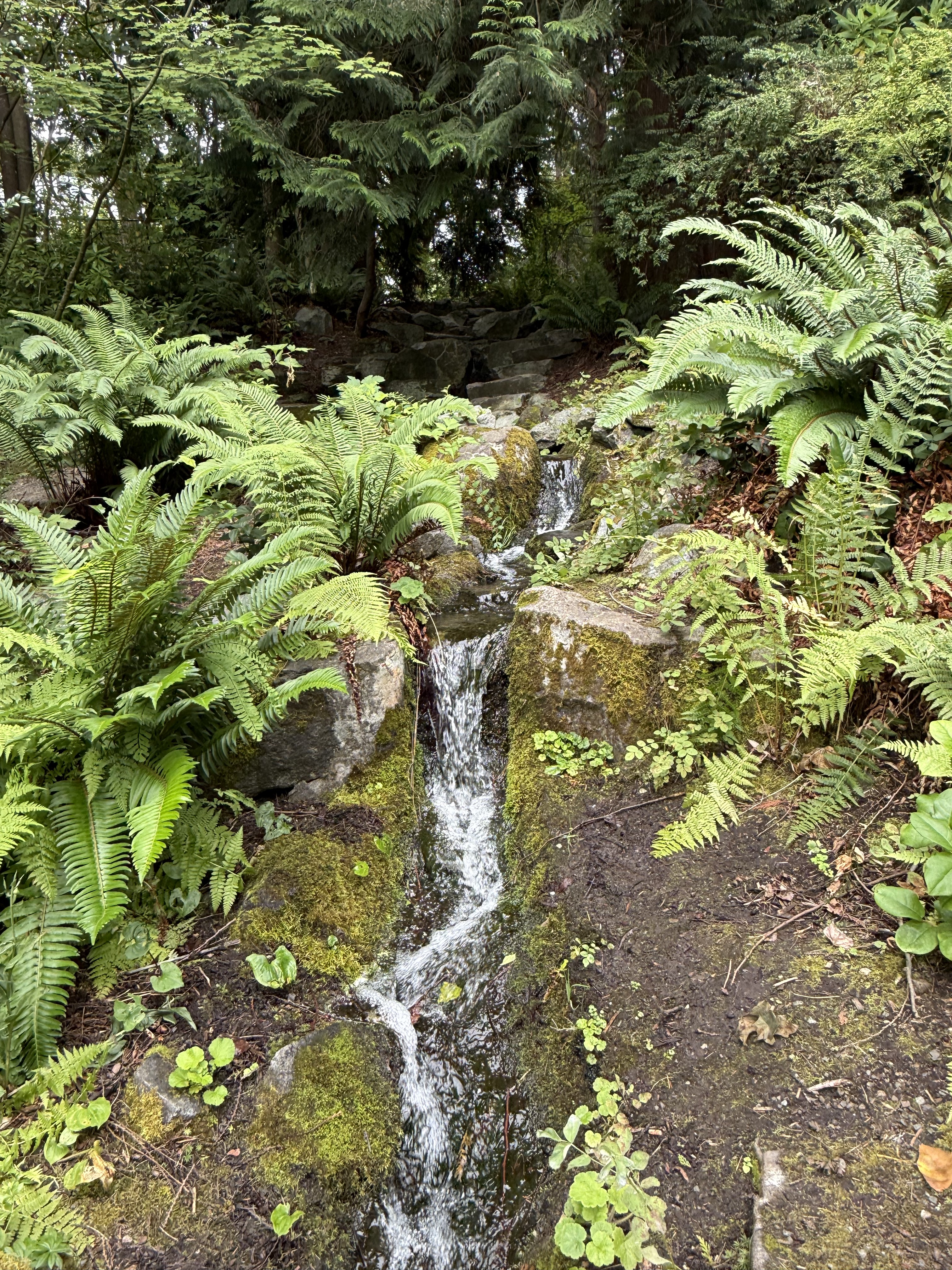
There is a small, articficial stream flowing through the garden and feeding a small pond. I don’t know where the water comes from … is it natural or recycled? No idea.
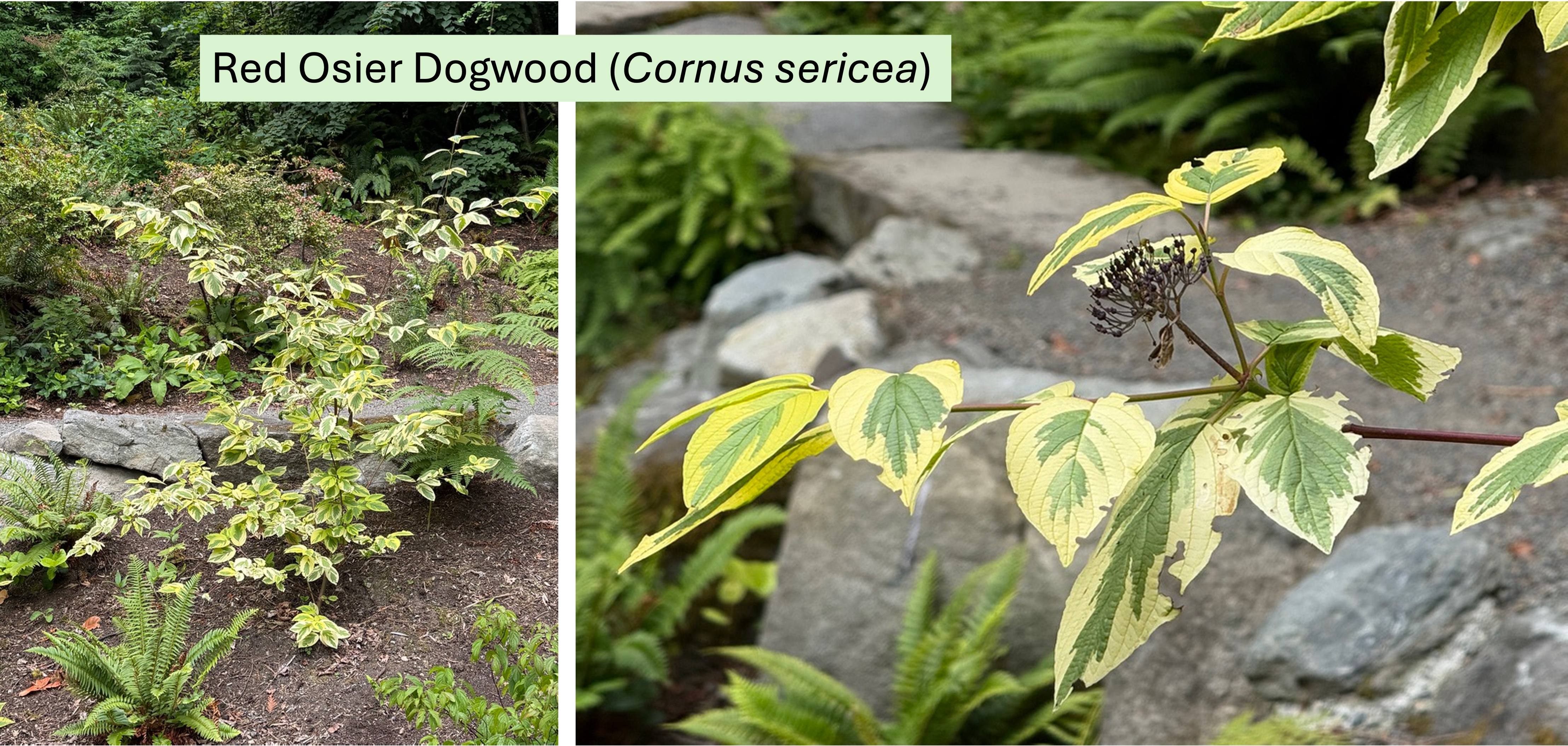
This is a rare non-native species planted in the garden for contrast. I checked this myself, and this variety is variegated.
Final Thoughts
The Northwest Native Garden is a great place to see many of the ecosystems in the PNW in one place. However, the lack of identification is a problem, which I addressed using CoPilot. But I had to check it a lot because it is a Large Language Model, not a specific plant-identification model. Nevertheless, it always got me into the ballpark; and it is easy to work with, like collaborating with a human who knows a lot but tends to jump the gun sometimes.
We spent about an hour strolling through four PNW environments, which was a lot easier than driving around. It reminded me of a Japanese garden, like the one in Portland. Very peaceful and colorful.
I hope that anyone who got this far enjoyed my trip through the Northwest Native Garden as much as I did. I plan to revisit it and learn about some more native PNW flora.
The Flora of Point Defiance Park
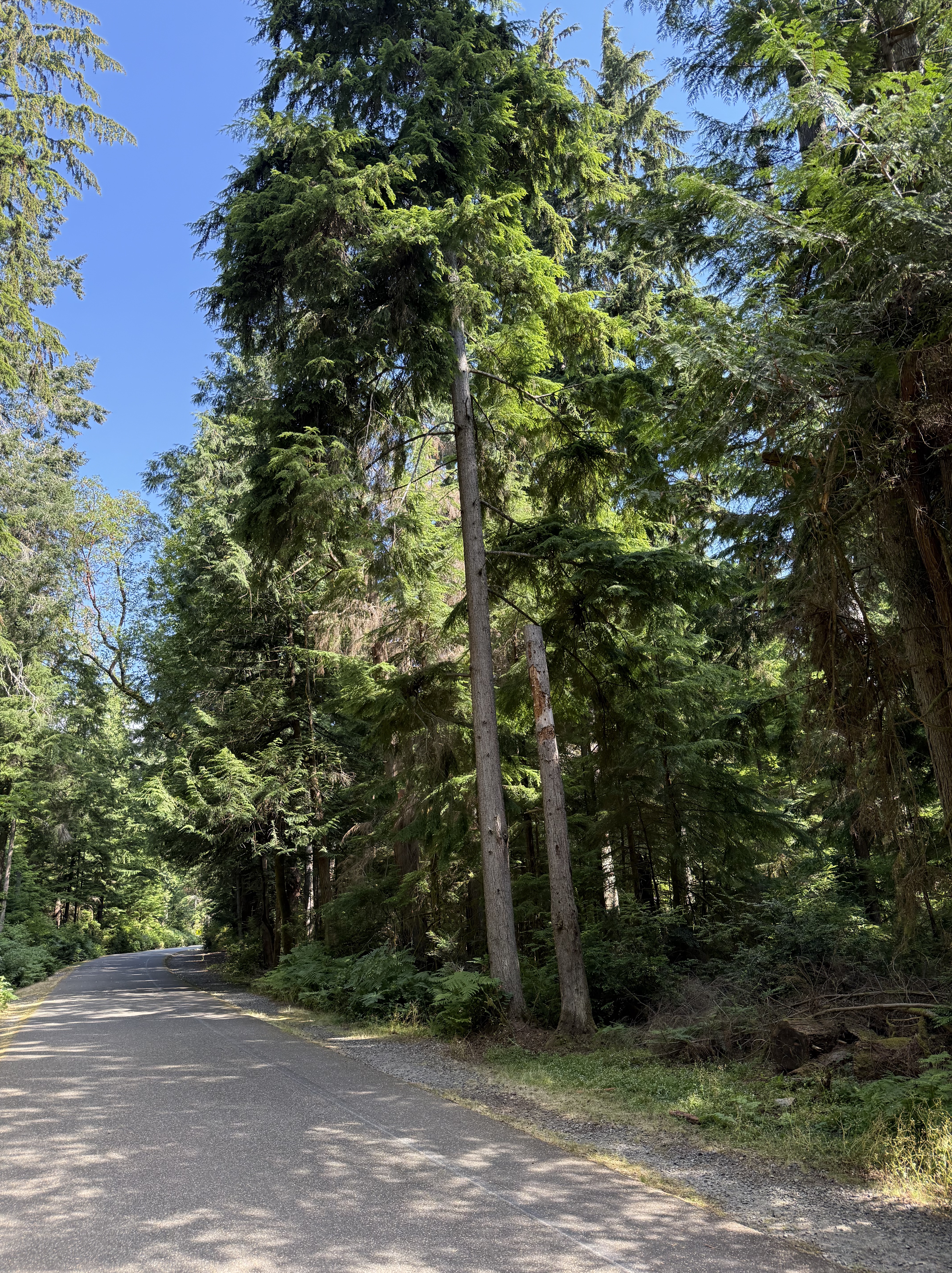
This beautiful, mature second‑growth coastal temperate rainforest is only ten minutes from my house. I should get there more often, and perhaps I will after taking an interest in ecosystems in addition to geology. Today’s outing was an opportunity to begin acquainting myself with the ecosystem I inhabit, so I made an effort to identify several plants along Five Mile Drive, a road that circumnavigates the forest and is permanently closed to auto traffic. When I started walking along this path, this forest was nothing but a lot of green trees and stuff. My perspective changed over an hour or so, and about 2.5 miles.
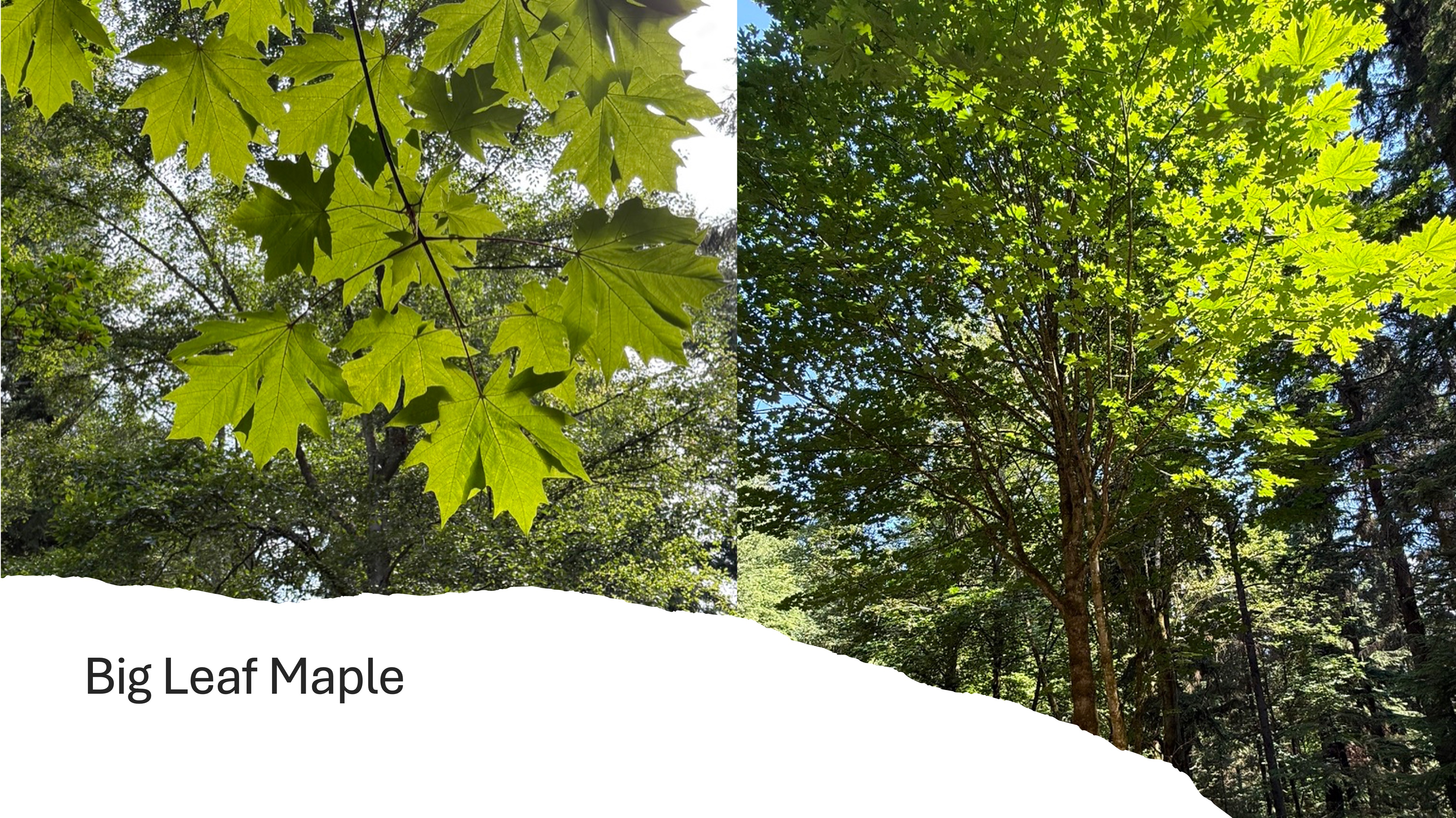
This colorful maple tree is a native to Puget Sound. It earns its name because those deeply lobed leaves are up to a foot across. But what are its roles in this forest? CoPilot had a lot to say about that. The Big Leaf Maple is fundamental to this ecosystem because it creates a huge amount of leaf litter that contributes to the forest floor and thus supports a vast microbiome, as well as a nurturing environment for conifer seedlings. This large tree (50-150 feet) fills in gaps in the forest canopy, supplying shade and catching rainwater, as well as dew. Its dappled shade creates a diverse understory for new growth. It is important in the success of birds, insects, bats, squirrels, and deer. They all hang around it and depend on its large mass for homes and meals. Its large root system contributes to hydrologic stability by stabilizing slopes, slowing runoff (and erosion), retaining moisture, improving soil infiltration.
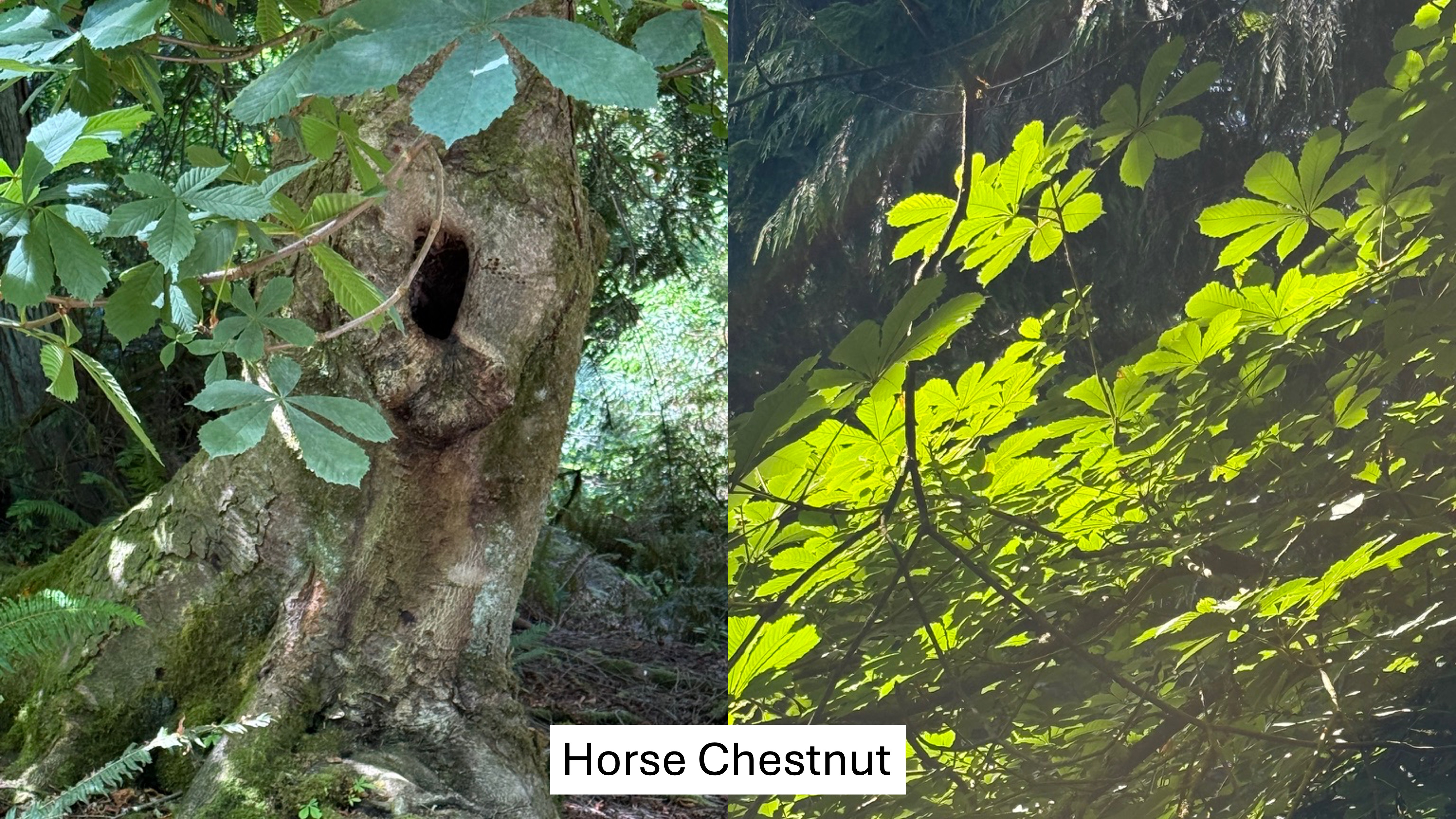
This large tree is native to SE Europe and they were introduced after the logging boom led to immigration. However, it is not an aggressive invader; this lovely tree does not form thickets, outcompete conifers, spread wildly, alter soil chemistry, suppress understory diversity, or create monocultures. In CoPilot’s words, “It’s a polite non-native.”
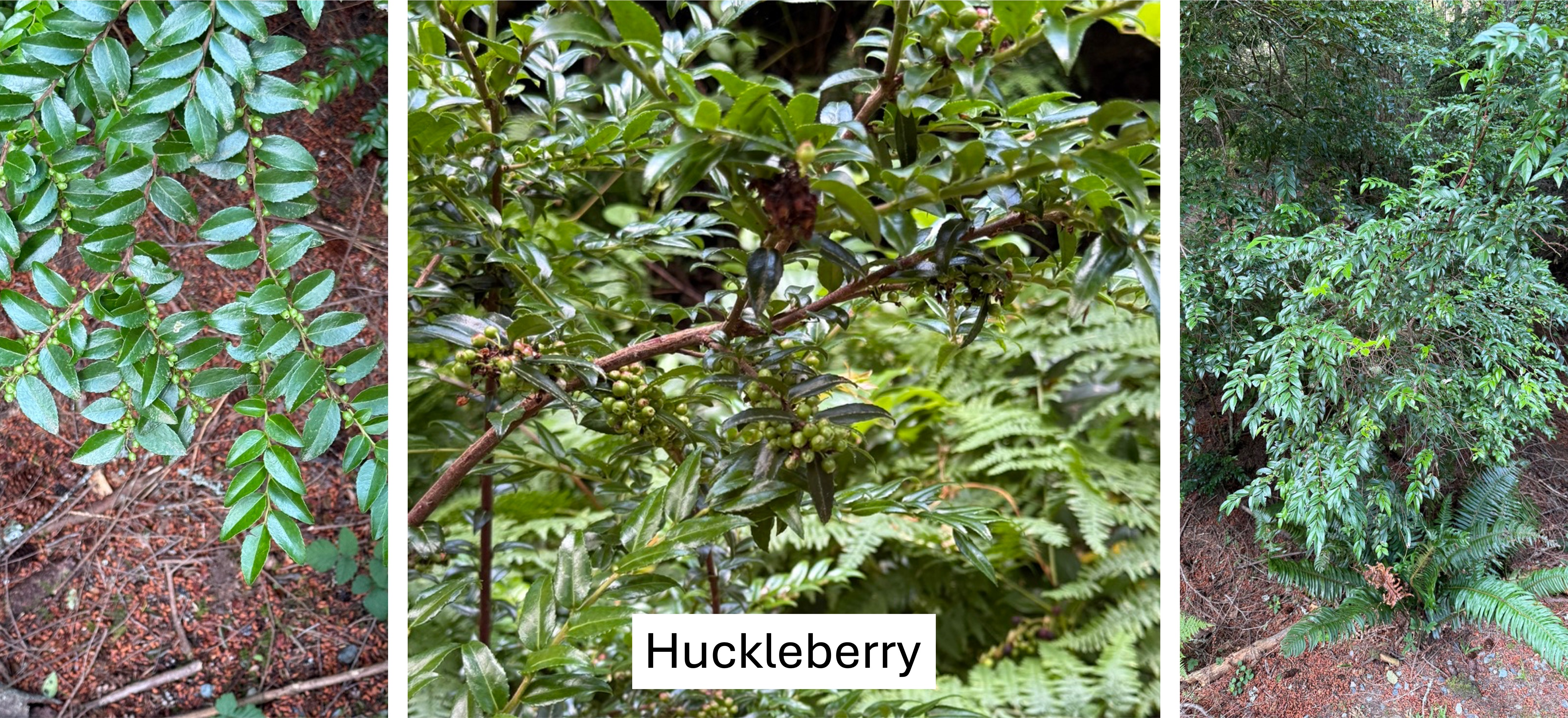
This nondescript shrub gives the forest its lush, evergreen understory identity. It is one of the top berry producers in the Puget Sound lowland forest but, more importantly, its berries ripen later in the season, extending the berry window into early fall. It also thrives in the acidic soils Douglas fir and hemlock create, in turn moderating soil conditions. It bridges the gap between ecological disturbance (i.e. logging) and late-successional forest. One could say that it serves as a node in the forest’s ecological web. This is an unrecognized keystone species in the understory.
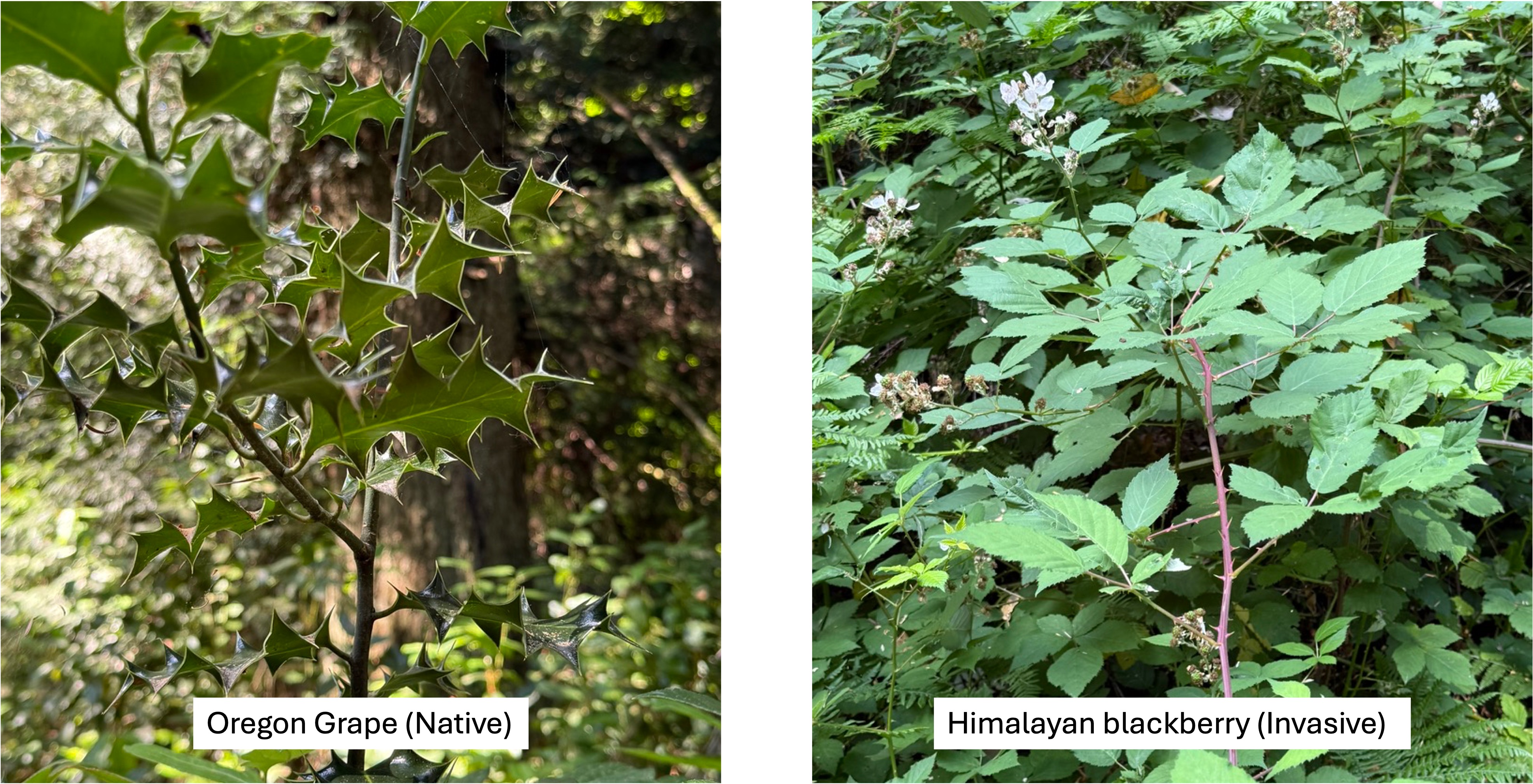
Oregon grape is the huckleberry’s silent partner in keeping the understory secure because it is also an evergreen shrub. In addition, it supplements the food web by blooming in March-April, providing nectar when few other shrubs are in bloom. Its berries ripen by mid-summer, bridging the gap between early berry producers like salad and late huckleberries. It precedes huckleberry in forest succession but persists as the canopy creates a shadier understory.
Himalayan blackberry is less like the fruit-bearing huckleberry and Oregon grape, and more like the Trojan Horse. The fruit are abundant and sweet, produced for a long season, and loved by all the denizens of the forest; thus, they are spread like wildfire, colonizing the entire forest–without predators in Pt. Defiance. The result of this invasion includes impenetrable thickets, root masses that choke other species, spreading by long, arching canes, and monocultures. It kills all the other stabilizing shrubs and creates a single mass of Himalayan blackberry. If left unchecked it can destroy an entire ecosystem, including the conifers. Holy shit!
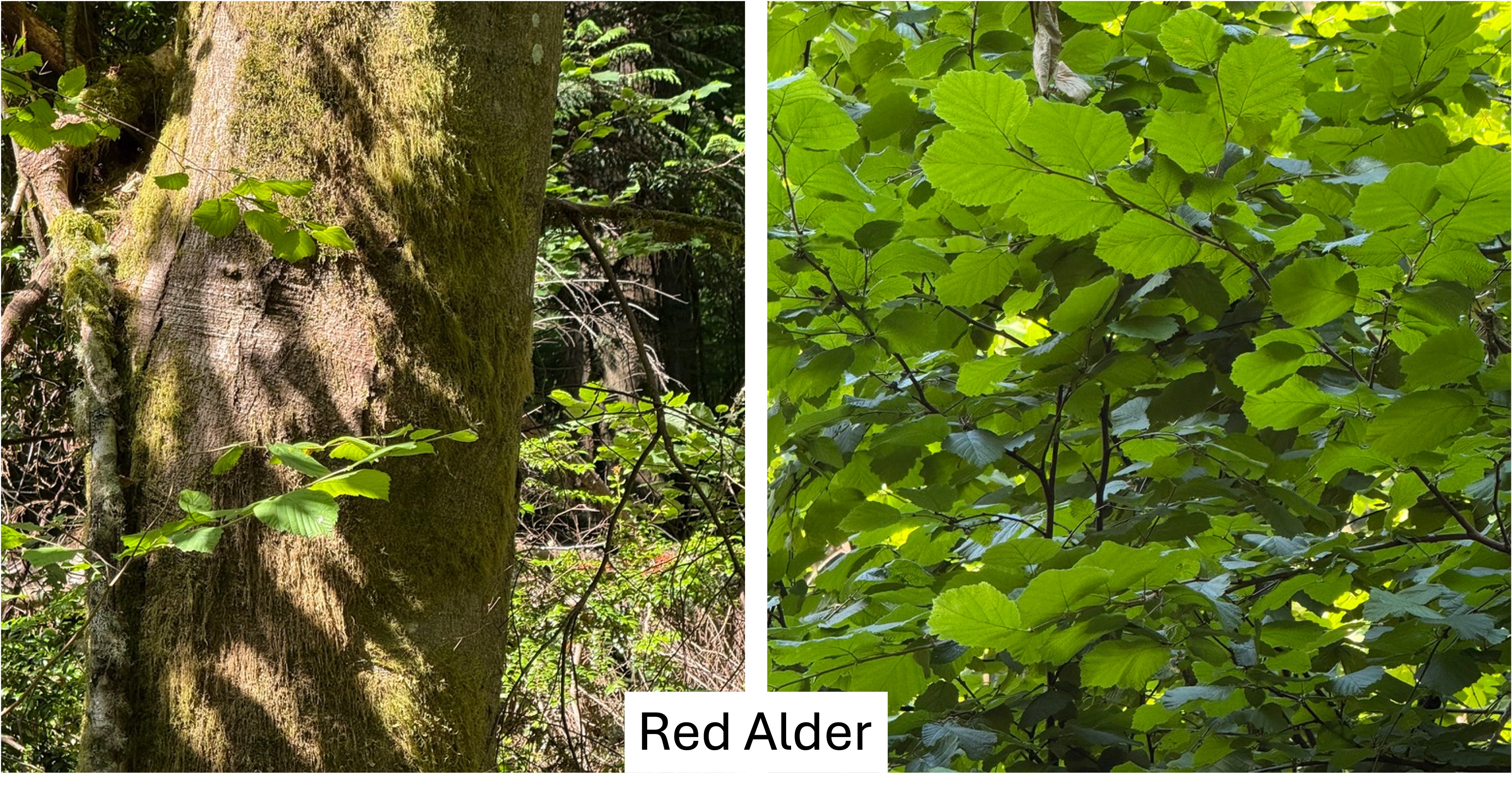
This nitrogen-fixing tree is the first responder when the forest is disturbed. As such it enriches soil, accelerates forest recovery, feeds the next generation of conifers, increases understory diversity, boosts fungal activity, and generally improves growth rates of proximal plants. Alder is the first tree to reoccupy damaged land, preparing the site for the conifers that will come later. Wherever alder stands exist, the biodiversity of the forest is increased. Because it gives so much to the forest, alders only live 40-60 years, thus acting as a continuous healing agent as a forest recovers from an environmental shock. This is the pioneer tree of the lowland forest. I hope it can defeat the Himalayan blackberry.
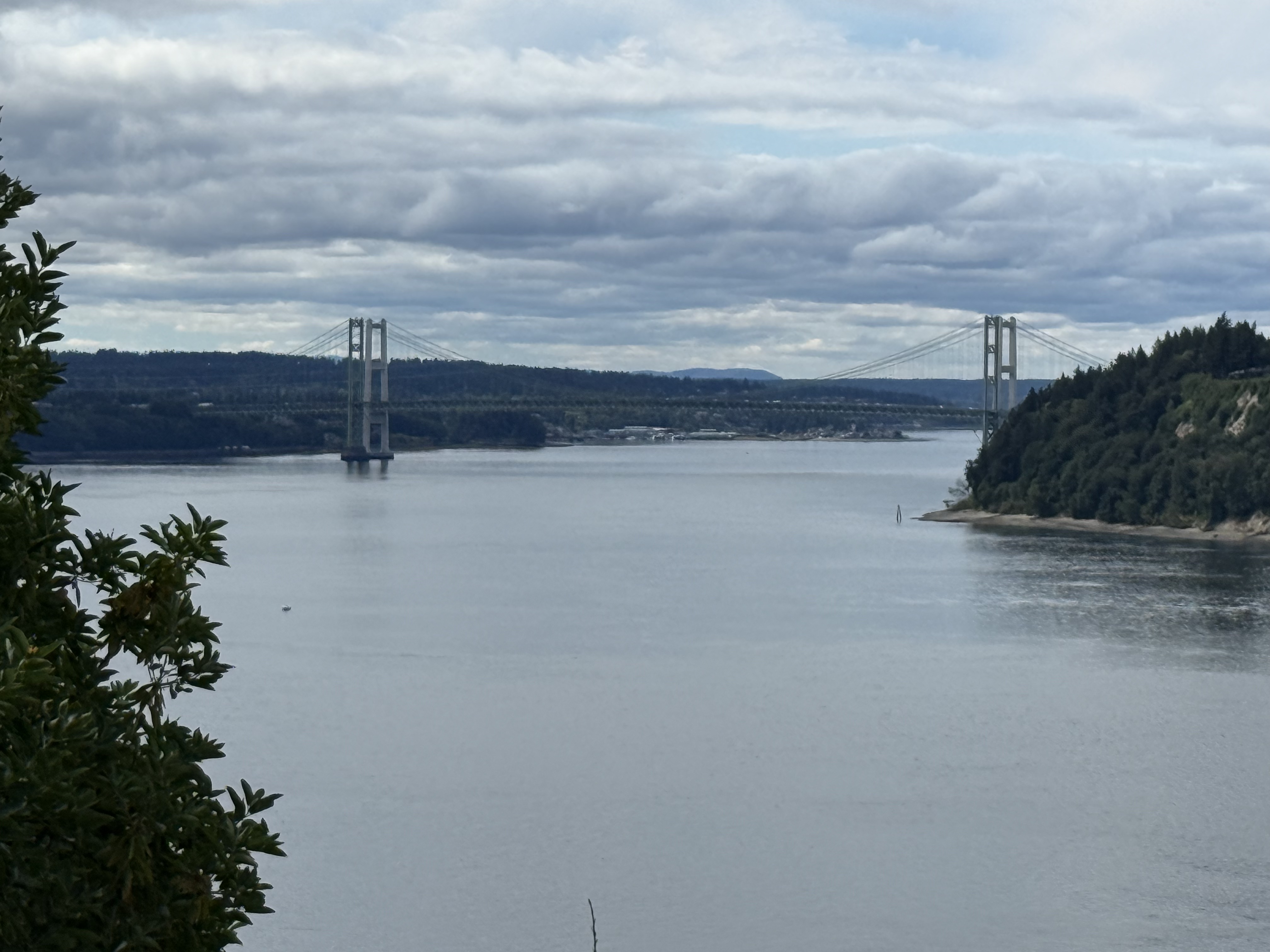
This view of the Tacoma Narrows bridge through the thick forest reveals a green landscape perched atop high bluffs overlooking Puget Sound. As far as the eye can see, from this vantage point, the forests were clear-cut to make profits and fuel the economic development of the Pacific Northwest.
But at what cost?
Hood ornaments through the ages: A visit to Lemay–America’s Car Museum
This wasn’t my usual visit to the local automobile museum. Instead of glimpsing the big picture, as seen through the evolution of car bodies from wagons to sleek, steel superstructures sitting on rapidly changing chassis, I am going to take a rather myopic view of automobile development in the twentieth century. Cars and airplanes co-evolved once lightweight, powerful motors were developed; but, unlike aircraft, autos weren’t substantially influenced by wars. In fact, the redirection of civilian manufacturing to wartime needs was an impediment to progress in land transport. Nevertheless, similar lofty ideas influenced automotive design, especially their adornment with signs of the modern, technological age.

Inspiration for this post came from my son, whose attention to detail constantly reminded me to focus on the details. Thus, this post begins with a ~1903 Studebaker electric buggy, which has no adornment despite being painted an eye-catching red.

By 1913, International Harvester designed a logo for the radiator of this cargo wagon.

Pierce Arrow added a bit of flair to the insignia. A good part of this post will focus on the development of radiator caps, from fancy adornment of the cap, which was required to add water for the internal combustion engine, to …. let’s see what happened.


Graceful designs appeared early, as in this 1920s Cadillac. I think the flowing pattern behind this woman’s head represents water as she burst from the surface of the sea, as suggested by the fluted base. She is taking flight.

Lincoln turned to the graceful greyhound on the radiator cap to imply beauty and speed. Note the lean ribcage, coincidentally similar to the louvers used for cooling in early models.

The Nash corporation created the Metropolitan car to compete in European markets during the 1950s. Small, economical, but stylish, it nevertheless had an ornate hood ornament that was no longer attached to the radiator cap.

No long hair streaming in the wind here. This idealized female figure wears her hair in a bun and is … I don’t know what she’s lying on, but it looks like some kind of jet pack.

Chevrolet caught my attention because of the evolution of their logo. This 1940s grill looks like an idealized shield, i.e., coat of

By the 1950s the Chevrolet “coat of arms” had become wider to fit the full-body designs made possible by improvements in metal working, but they still added meaningless details like the crown icons on this design. Accompanied by a V that filled that gap in the wider hood.

By the 1960s the emblem was surrounded by an ellipse, which made it easier to attach it to the larger grill required for more powerful engines.

This 1950s Ford integrates several elements from different eras: The name of the model, the stylized coat of arms, and an icon representing the jet age–the hood ornament is reminiscent of the iconic F86 Sabre, the hero of air combat during the Korean conflict (it was never officially declared as a war).


This 1950s Oldsmobile integrates similar emblems: It adds a map of the Western Hemisphere, and updates the fighter jet to a bomber.

Mercury takes another twist by updating the old “coat of arms” to a minimalist Mercury icon (the head wearing wings on his hat), combined with a stylized M to fill that wide hood.

This 1930s Plymouth attempts to represent a mythical past by including a Valkyrie taking flight with what looks like a Mayflower ship–probably homage to the name, “Plymouth”.

This 1950s Ford looks like it has a pistol attached to the hood.

The color scheme on this 1930s Ford may not be original, but it is obvious that Ford wanted to advertise that this car was powered by an eight-cylinder motor, probably the famous flathead V-8 which they introduced to the working class.

Ford purchased Lincoln and claimed their greyhound, added a V8 emblem to make it clear this was NOT a straight eight, which was a powerful but problematic motor, and glommed their still-in-use emblem onto the grill of this late 1930s/early 1940s era car.

This early 1930s Ford dropped the decorative, exposed radiator cap but included a support bar to get the message out that this was a V-8 automobile.

When pressurized cooling systems were introduced in the early decades of the twentieth century, it was necessary to monitor water temperature, but in-dash gauges hadn’t been invented yet. This radiator cap incorporates a thermometer. This photo shows the side that the driver didn’t see: in a time before owner’s manuals, it tells the operator what the proper temperature range is. The other side, which faces the driver, shows hot water filling a bulb.

This temperature gauge is the only example I saw of a biplane, and it’s supplied by the instrument manufacturer.


According to ChatGPT, this youth is drawing a bowstring on the radiator cap of a Pierce Arrow (circa 1930). Note the bow he’s sitting on. I don’t quite understand the position, but I’m not an archer. It makes more sense than a child about to ride a slide, and it explains the curved, cylindrical object he’s sitting on. Who would’ve thunk…

The Buick Riviera, introduced in about 1962, had this unimpressive R set in a groove in the hood.

A couple of stylistic changes to Lincoln in the 1940s: The greyhound was swapped for what looks like a ball and bat; and the coat of arms became a body-sized shield.

The driver has to read this temperature gauge from behind the steering wheel. The strange symbols around the edge look like fish bones or trilobites …

Bentley wanted to be certain that people next to you at the traffic light knew how wealthy you were.

This 1950s car mixed a jet aircraft symbol with knight holding a shield.

This 1940a hood ornament pre-dated jet aircraft, but that androgynous figure is going pretty fast…


The proud owner of this 1920s Buick receives a crown (of thorns?) from an angel.


I wonder what this wading bird is looking for? According to ChatGPT, it is the Packard “Goddess of Speed”, an art deco representation of coiled power about to explode. I guess people looked at things differently in the 1930s…


International Harvester incorporated only their iconic IH symbol on the Scout’s hood in the 1960s, but culture doesn’t wait for corporations to add their own “art deco”. I don’t know how much more of this I saw at the museum, including all those Motometer temperature gauges…

This 1950s Pontiac Bonneville sports a jet on each fender instead of only one.


What the hell? CoPilot (aka ChatGPT) thinks that the weird arrowhead on top was just that–meant to imply as fast as an arrow. That’s a long way from an airplane or valkyrie. This bizarre hood ornamentation might explain why Hudson went out of business in the 1950s.

Since Earth doesn’t have any rings, this 3D circle must represent a satellite’s orbit. Pretty advanced for the mid-1950s. Too bad Oldsmobile didn’t make the cut when it was time to downsize GMC in 2004. Bummer.


They barely had room for the coat of arms between the jet intake and the aircraft on the hood on this 1950/51 Studebaker Champion. Despite the optimistic ornamentation, this car had a six-cylinder with about 100 hp. Bummer.


Mercedes added a badge for those who weren’t familiar with its iconic star.


There’s a lot going on here: a pair of “8”s for, presumably, the straight-eight engine that was a real powerhouse in the 30s; wings; an explicit acknowledgement of both Dodge boys; a Star of David; and a set of pipes, maybe for an organ, on the radiator cap.
Final Thoughts
If you made it through this long post, I hope you enjoyed the journey as much as I did. I have never examined one aspect of the evolution of automobiles in such detail before. It was worth it, even if hood bling isn’t as exciting as engines, brakes, body styles, and all the other mechanical components.
Two concepts seem to have been central during the twentieth century: having a coat of arms was probably an extension of custom-made coaches to horseless carriages; and associating cars with flight, either through birds, mythic creatures, or airplanes. The combination was often ludicrous but always entertaining. The phrase, “They don’t make them like they used to,” is nowhere more applicable than to stylistic choices in bodies and the chrome trim they sport.
Tacoma Chinese Reconciliation Park
I enjoy walking along the shore of Commencement Bay in Tacoma because it is lined with industrial relics, parks, modern shipping facilities, and memorials to my new home’s international connections. But Tacoma, like so many cities, also has a dark past that it acknowledges in many ways. Today’s post is a memorial to one of those darker times.
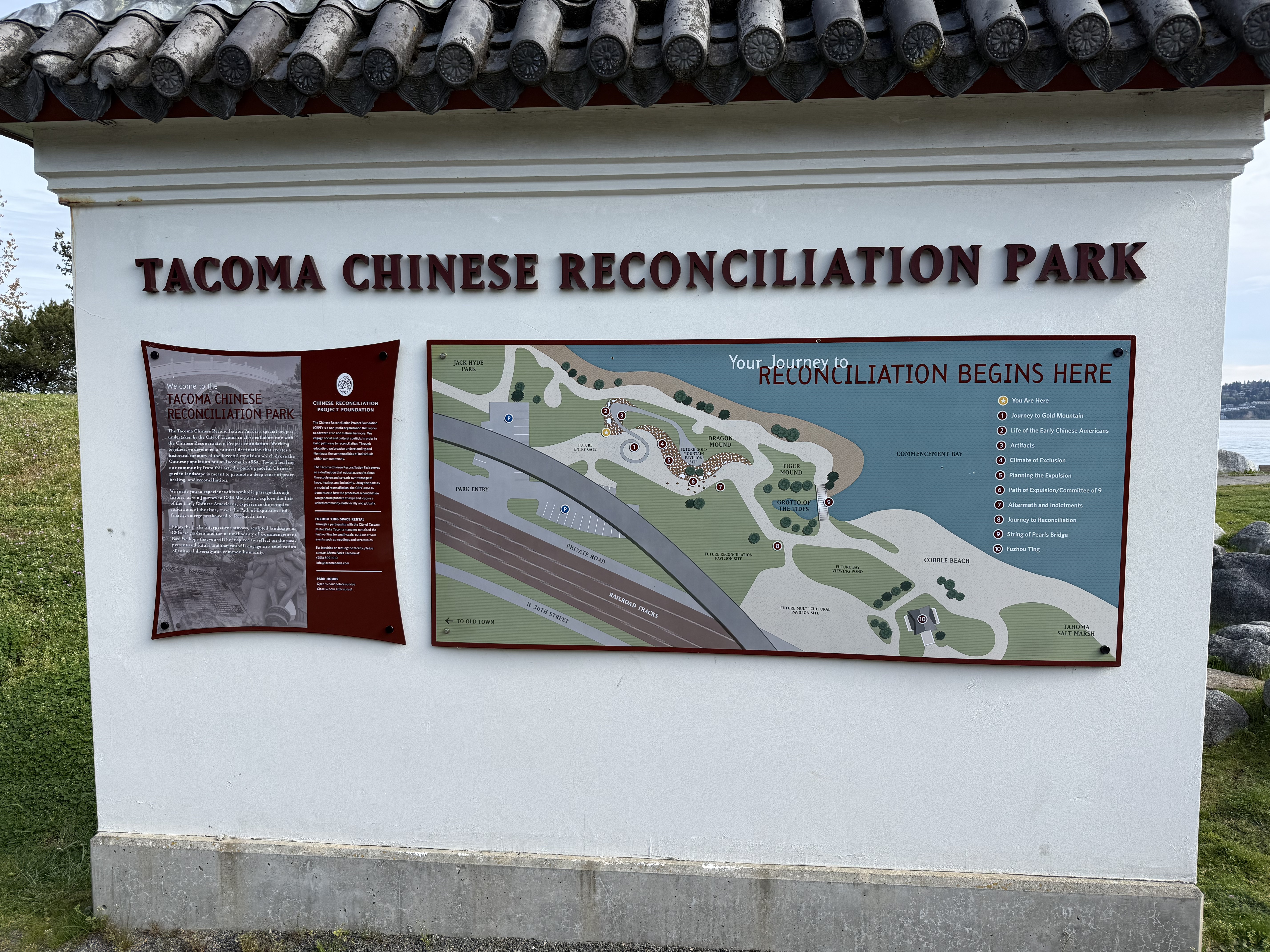
The memorial park is only a few acres, strung along the narrow stretch of land between the railroad and the sea.
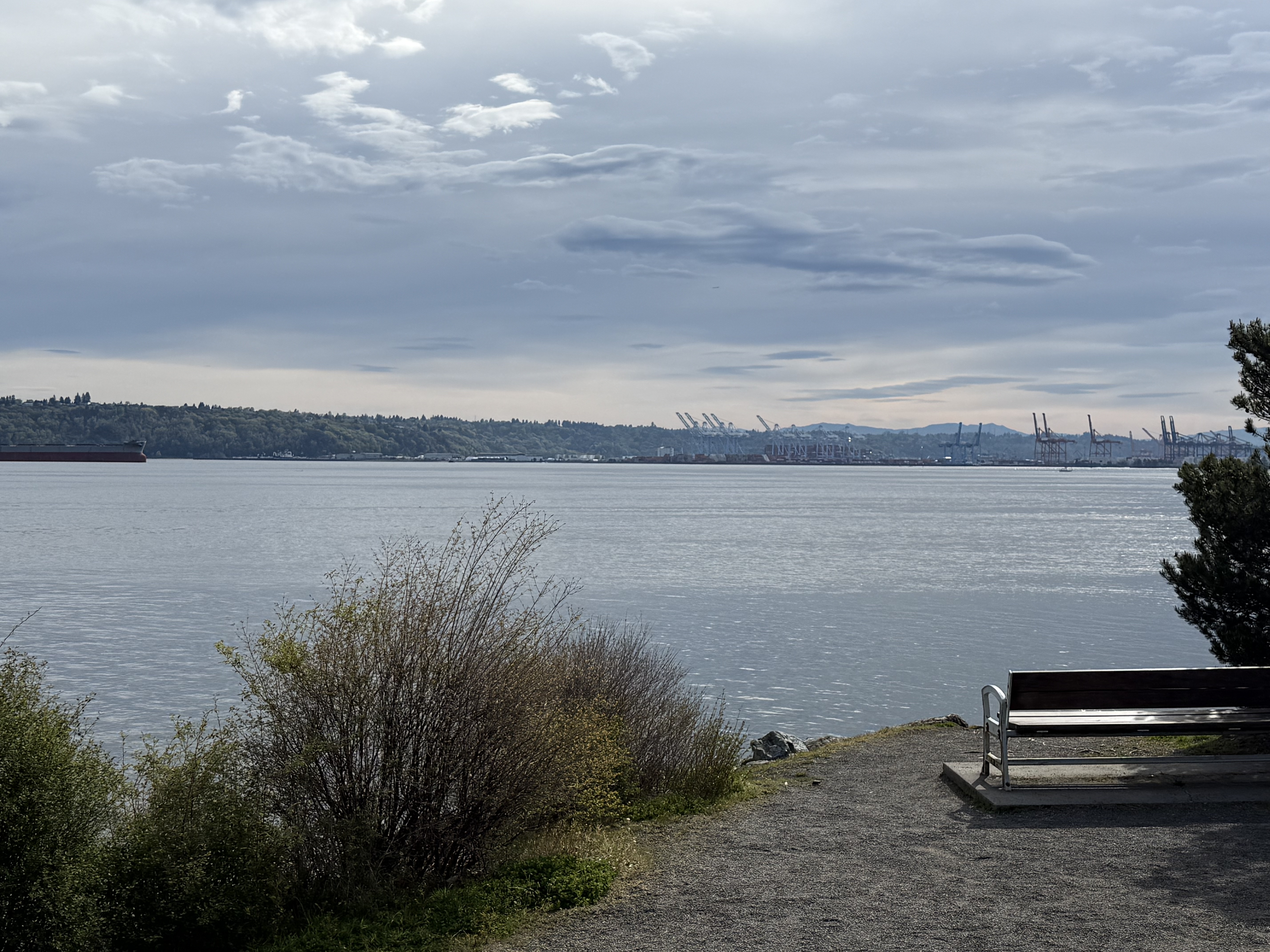
The port of Tacoma’s container handling facilities can be seen in the background, a reminder that life goes on despite the too-often shameful past.
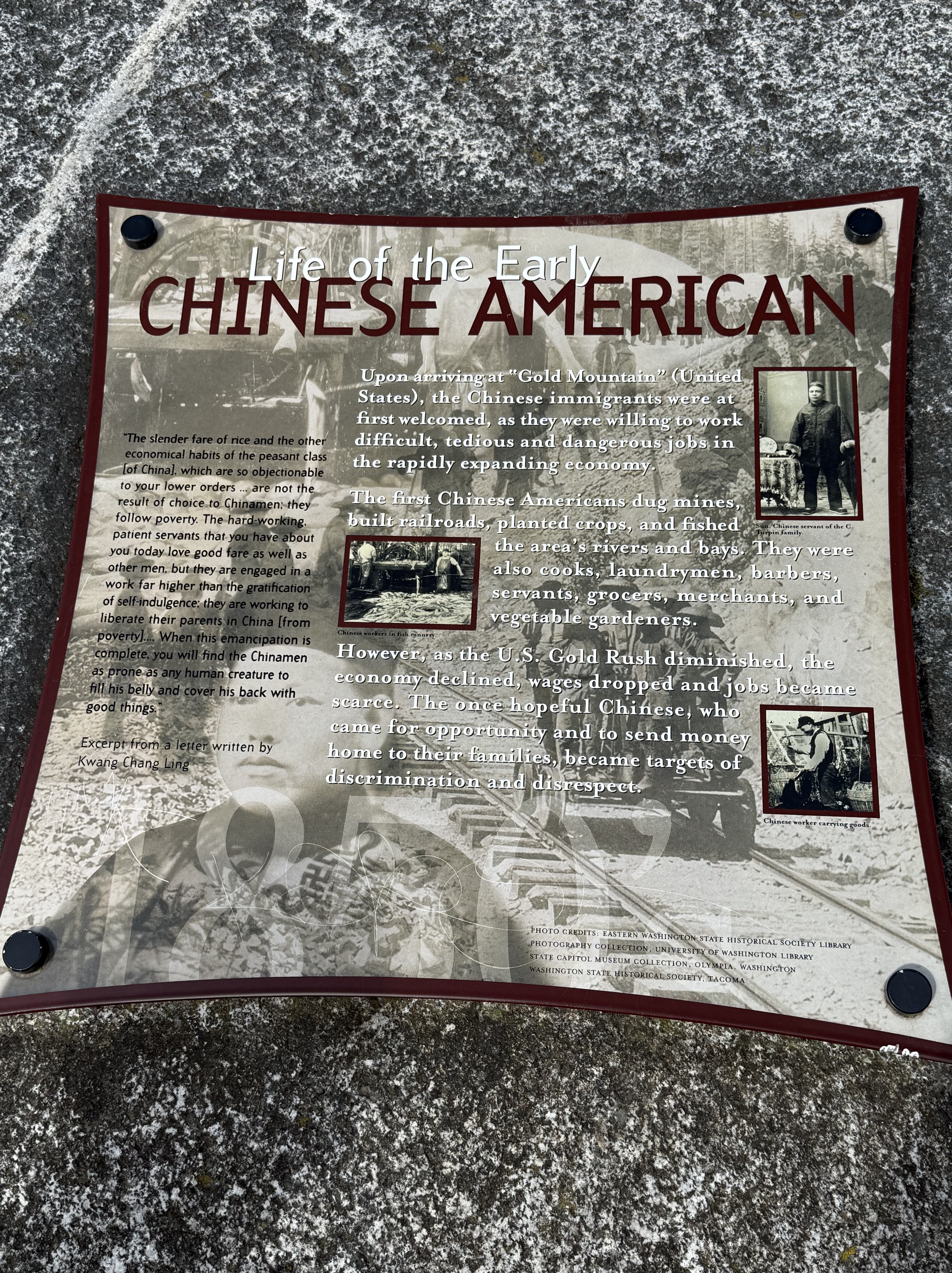
China was suffering from famine and misery in the late nineteenth century. America was seen by some as an escape from poverty and certain death, just as for immigrants from Europe. Immigrating didn’t require visas or approval; if you arrived, you were welcomed, especially the Chinese who took menial jobs to support the industrial development of the Pacific Northwest. They came looking for gold, but settled for whatever they could find. They were welcomed…until economic hard times made them the scapegoats of overall business downturns. Tacoma residents evicted them with extreme prejudice. They sued but were defeated in a court system as racially discriminatory as the people persecuting them. They never received compensation for property or business investments stolen from them.
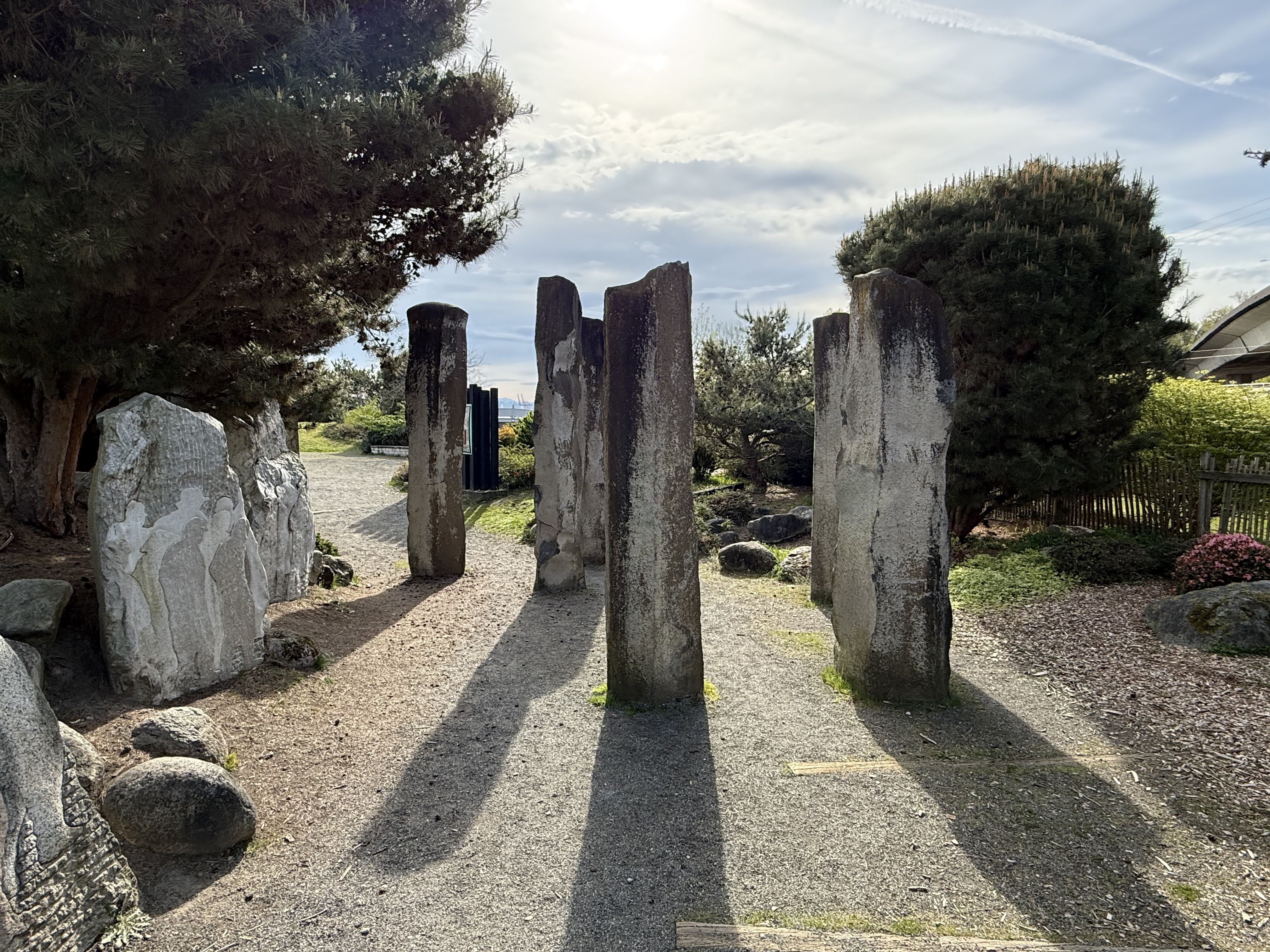
This is my favorite display because it uses rocks to make its point: the bowed backs of Chinese immigrants are carved in bas relief on blocks of diorite; columnar andesite stands in mute witness to their plight.
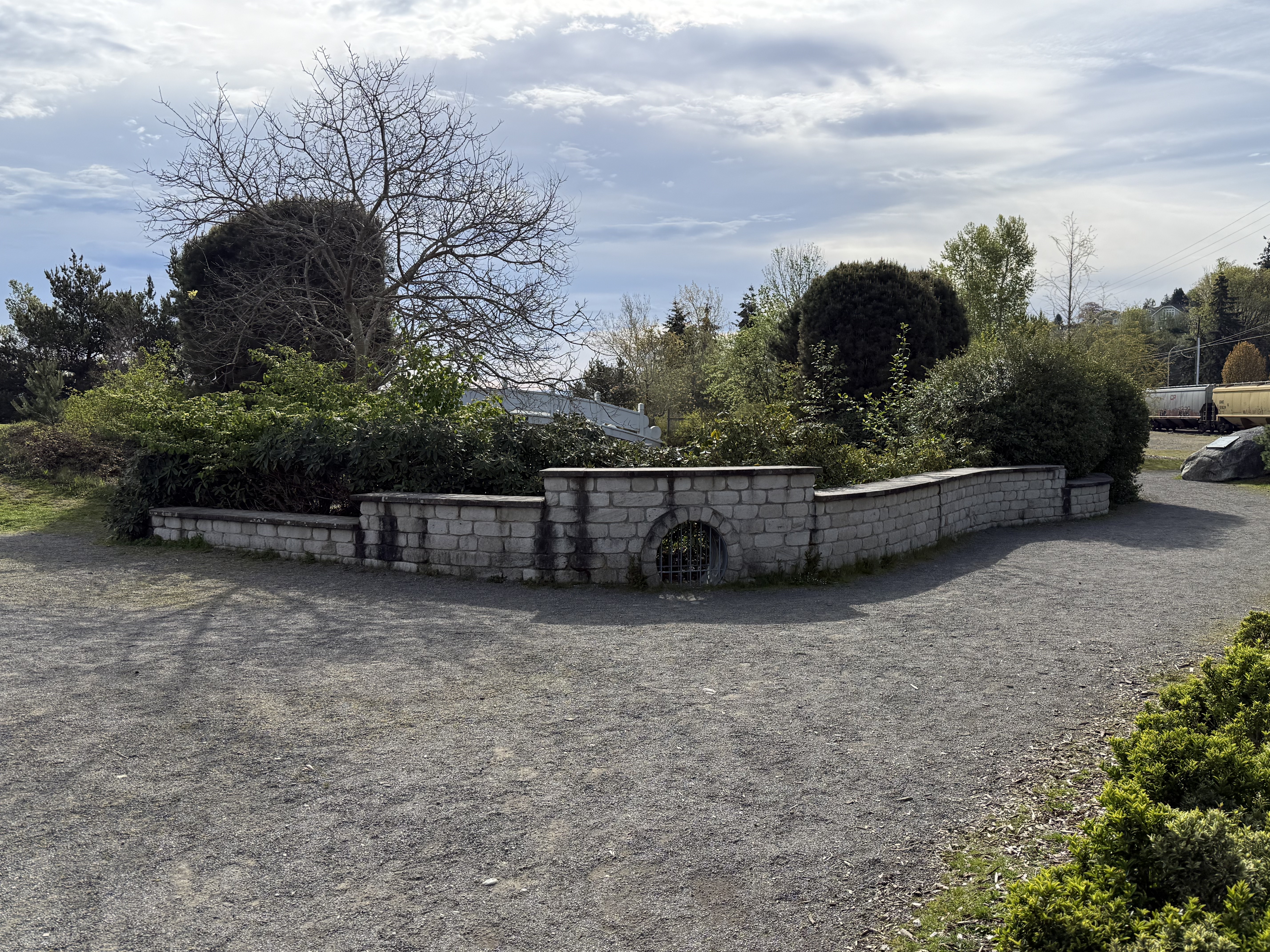
This beautiful display has to be seen in parts, but one interpretation is fairly simple: a minor barrier confronts the immigrant, but life abounds behind it, if you can only climb over the low wall…
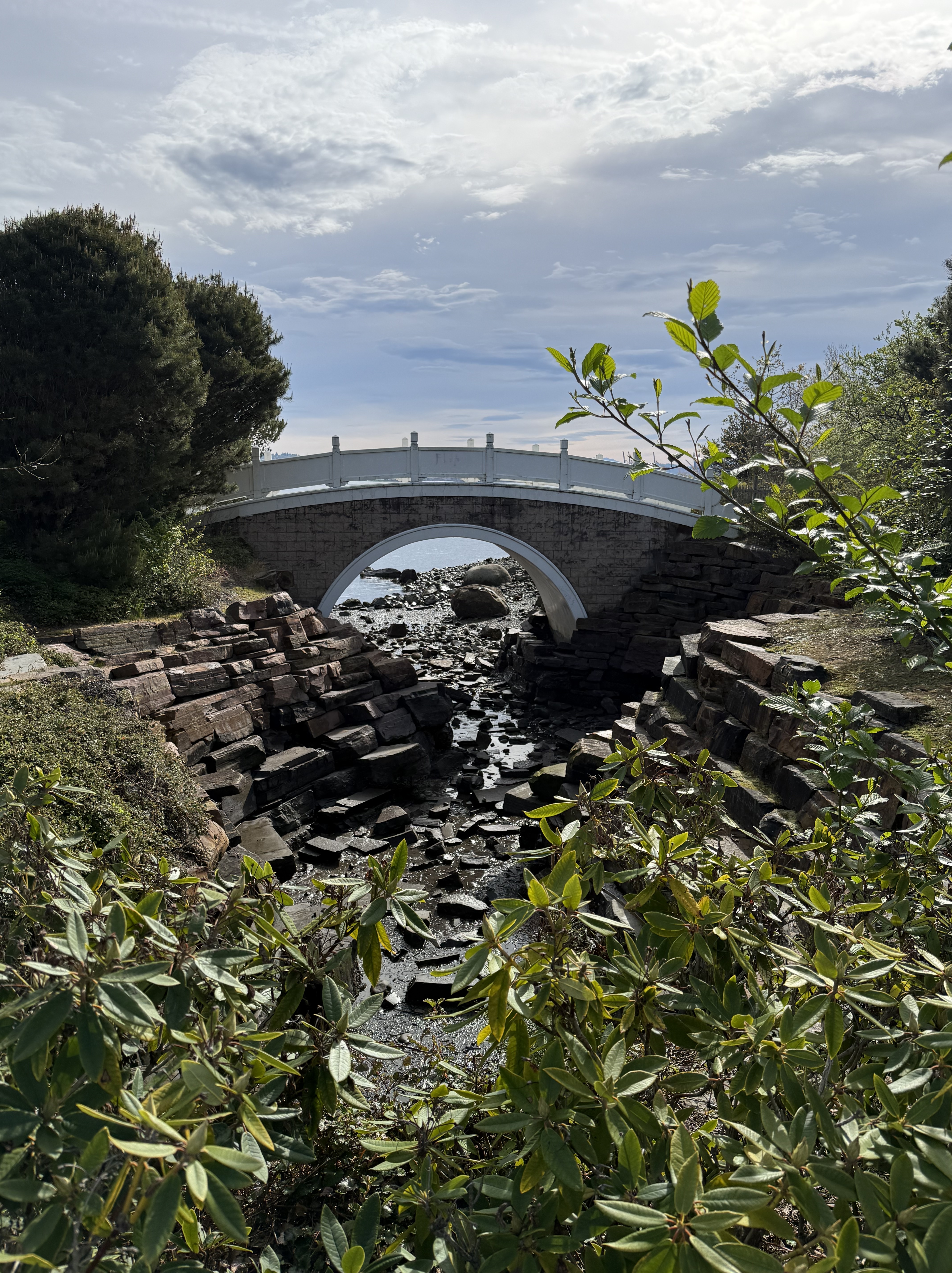
Beyond the wall is the sea, whose level rises and falls with the tides of history and human events…
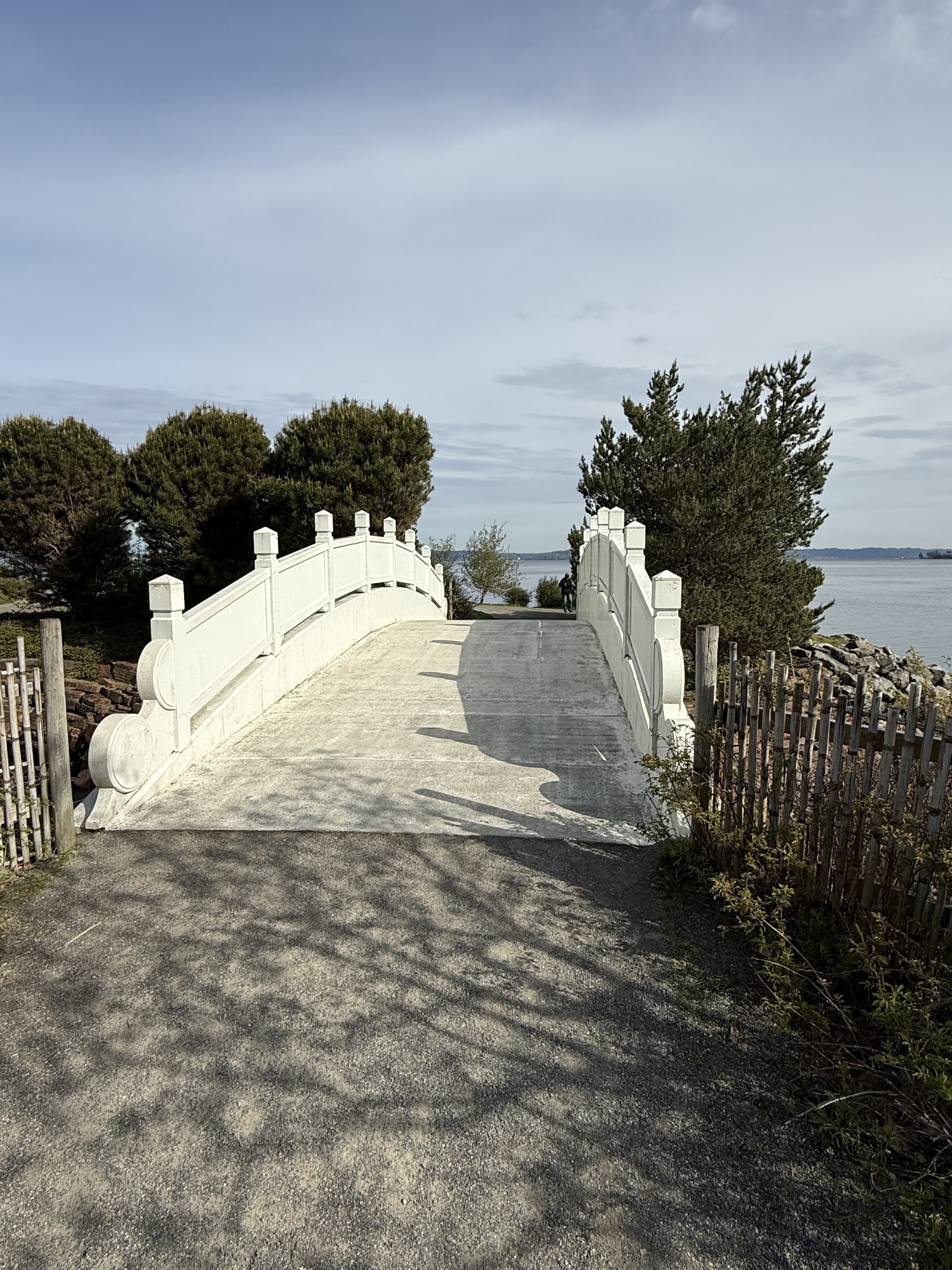
A well-constructed bridge will take you over the sea to the promised land…
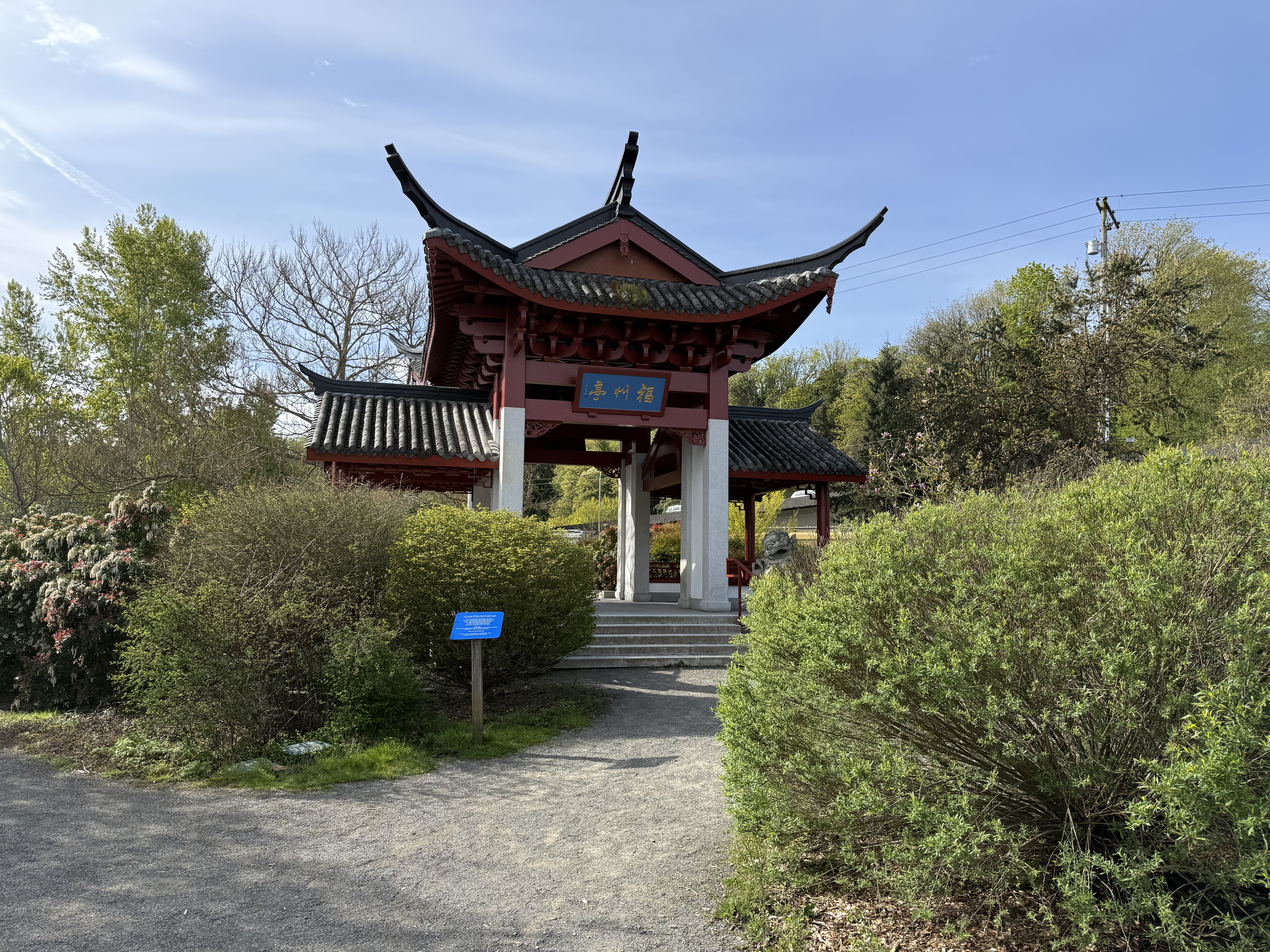
To a home that is linked to the land you left behind. This pagoda was given to Tacoma by Fuzhou, China–a sister city of Tacoma where many of the immigrants came from. It was built there and transported to this location after the park was authorized by the city in 1993.
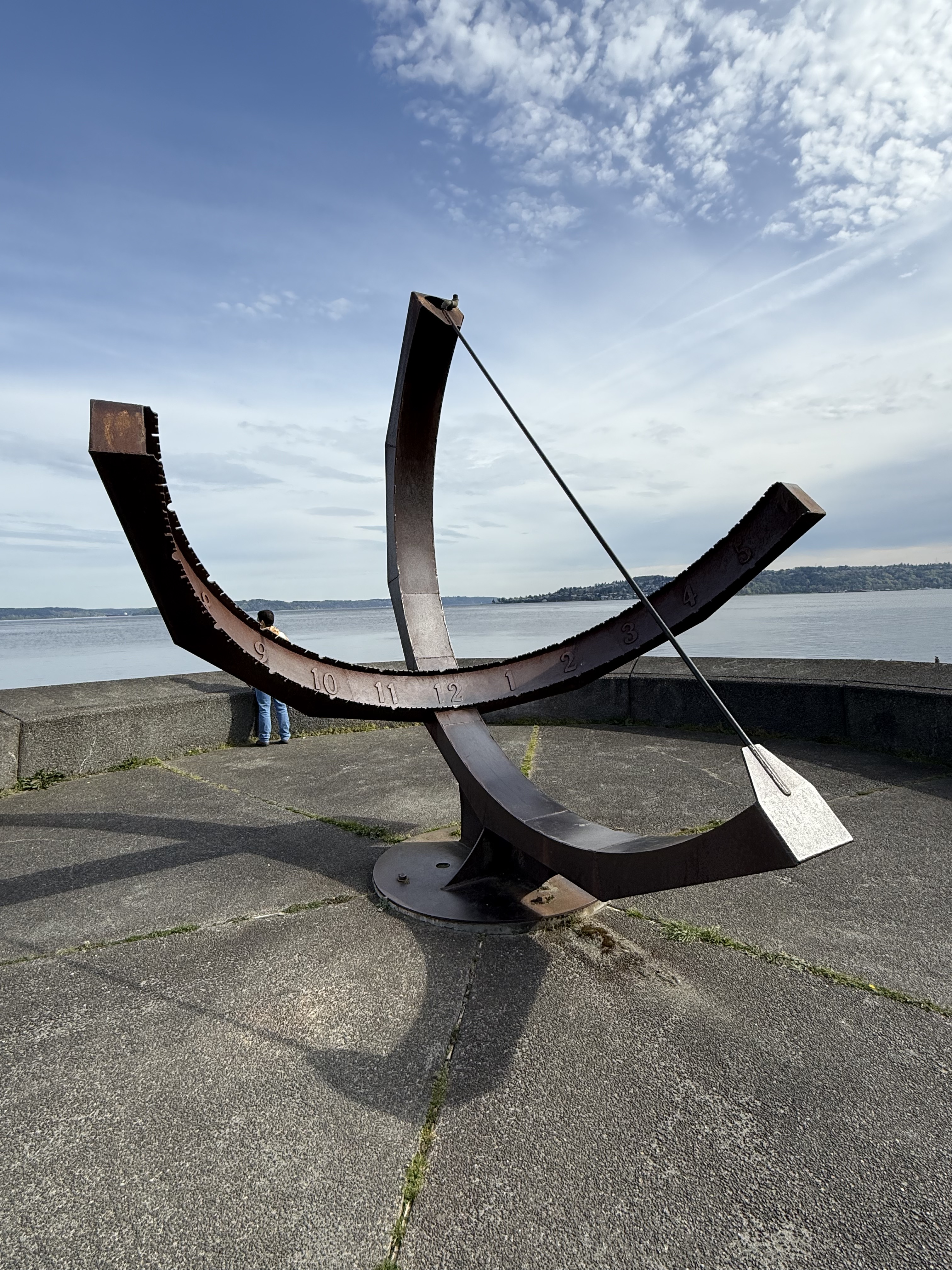
I’m not sure what this is about. There was no plaque or explanation anywhere to be found. Tacoma is filled with artwork, but it usually has an explanation. I looked at the park’s web site, but this sculpture wasn’t shown. It faces almost due north…
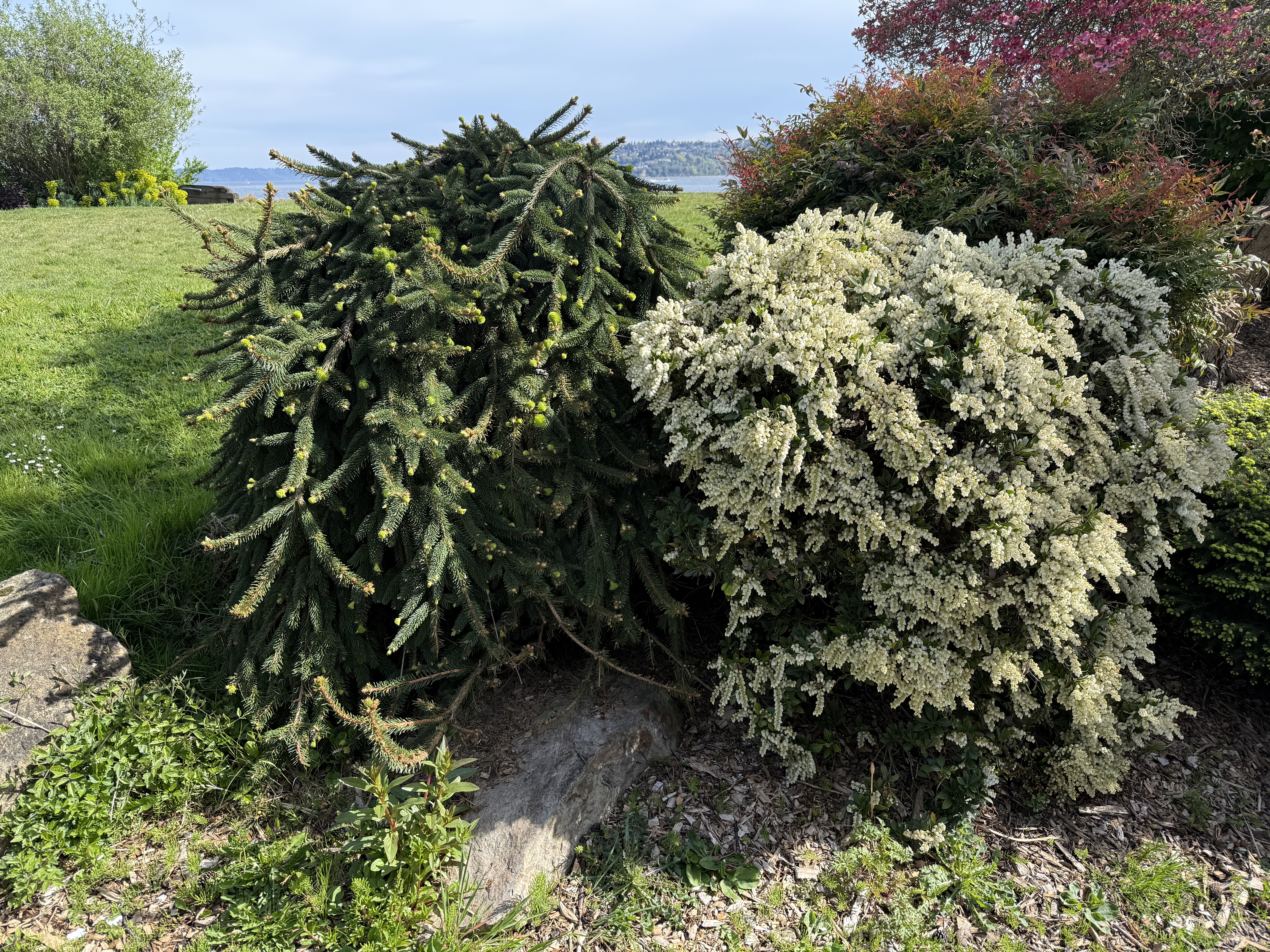
There was a lot of tropical/Asian vegetation, just as there is throughout the Pacific Northwest. CoPilot thinks the flowered shrub here is Pieris japonica. Japanese. The dwarf conifer is also probably native to Japan. Americans have trouble differentiating different Asian countries, but we also don’t know where Hungary is, or even Switzerland for that matter.


Recent Comments