
Ecology Notes from Tacoma Nature Center
Today’s field trip took us to the center of Tacoma, where the city operates a nature center focused on education and outreach programs.
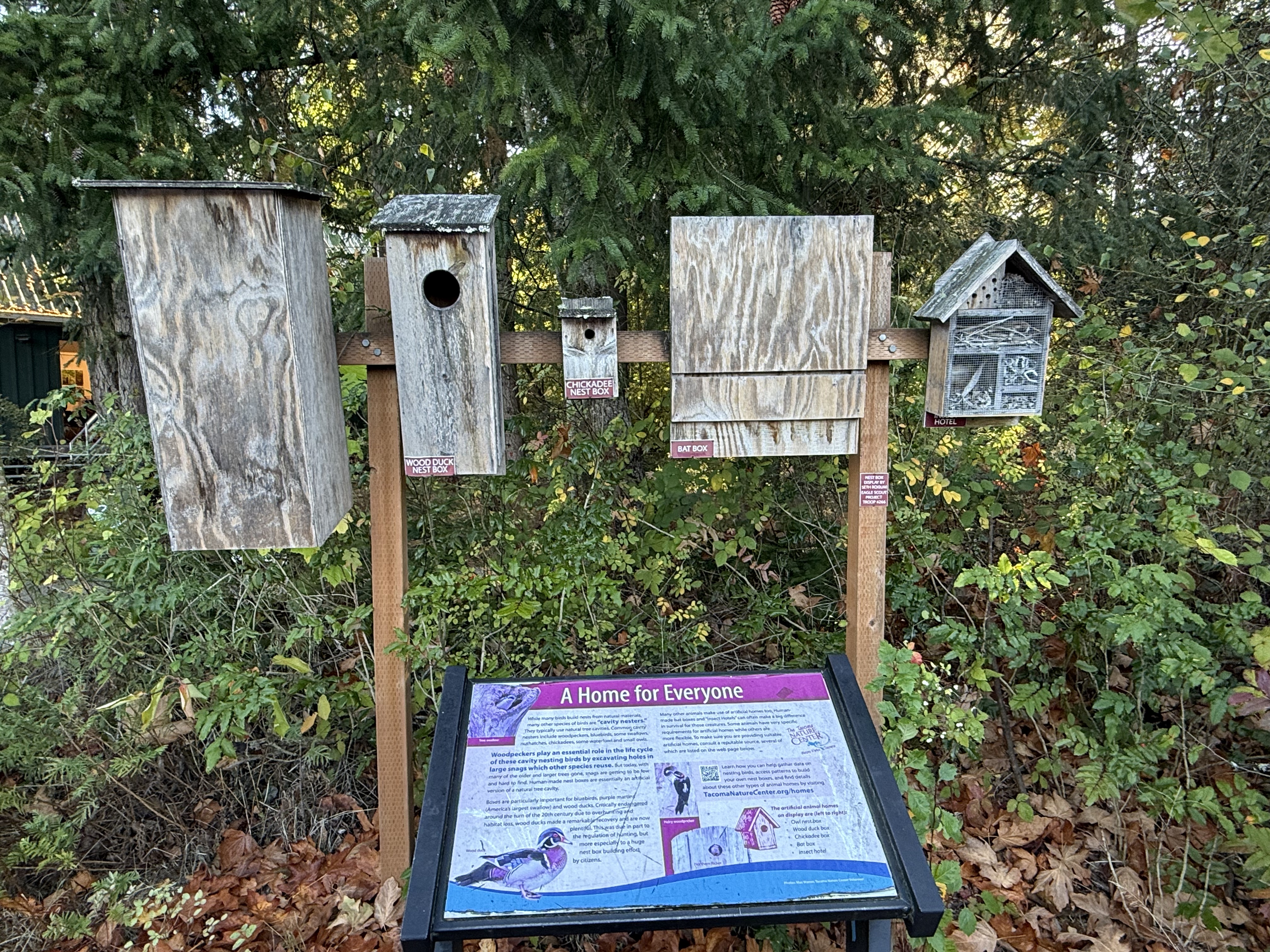
We weren’t looking for birds, but this display showcases some of the birdhouses constructed within the area.
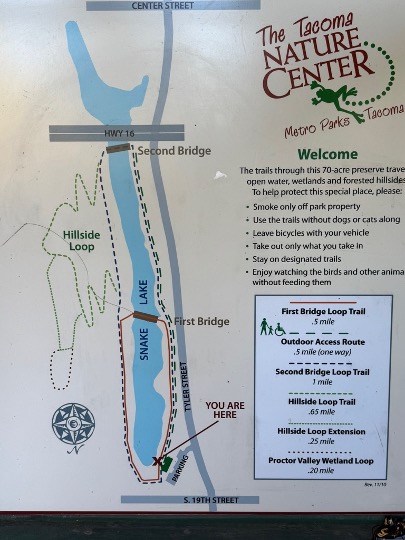
We walked the entire trail system, which is almost three miles, and noticed several signs indicating stops on different self-guided tours. Unfortunately we didn’t have a guidebook. This post is about learning from experience. (LOL!)
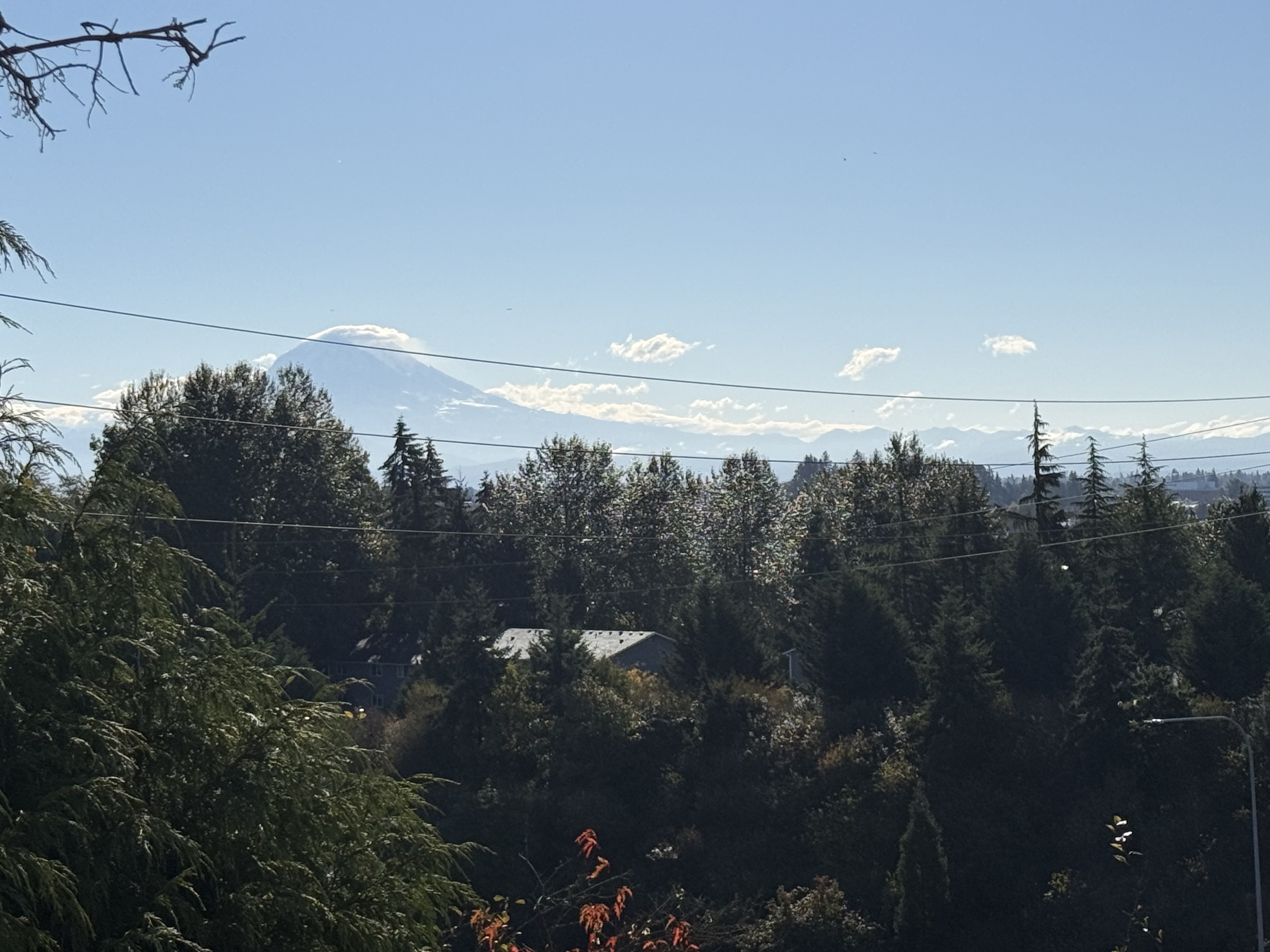
The trail climbed about 100 feet to a ridge that gave a great view of Mt. Tahoma (aka Mt. Rainier) on a beautiful day. Note the cloud trailing off the top of the mountain in a northerly wind.
Snake Lake was dry and the deciduous trees in the wetland were losing their leaves, so I didn’t take much interest in them. It wasn’t until we followed the Hilltop Trail that I began to notice the different ecosystems juxtaposed in this seventy-acre site. The rest of this post, therefore, will focus on trying to salvage something intellectual from what started as simply a walk in the woods.
Tacoma Nature Center supplies a catalogue of the flora and fauna located within its limits. I took a couple of photos and, when I got home, discovered the lists they supplied on their web page. Thus, instead of guessing what I’d seen, it was more like a homework assignment with a limited number of choices.
Trees
This is a list of the trees known to exist at Tacoma Nature Center. The ones I identified are in bold typeface.
- Sitka Alder
- Oregon Ash
- Cascara Buckthorn
- Black Cottonwood
- Douglas Fir
- Pacific Madrone
- Scouler Willow
- Garry Oak
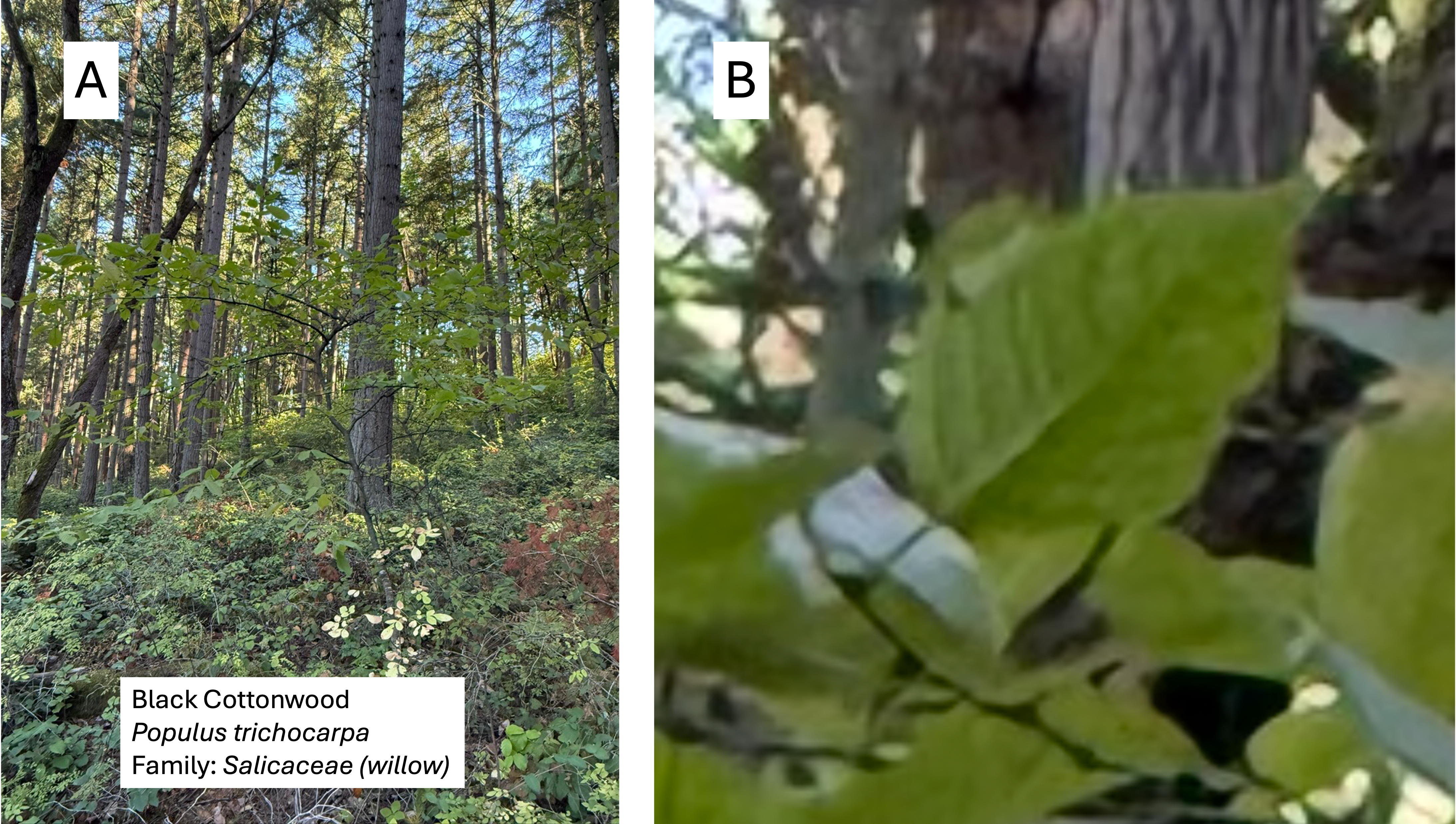
(A) This young tree still had all of its leaves, so I used my copy of Pacific Coast Tree Finder to identify it. (B) The leaf shape and vein structure was critical. If I hadn’t already had a list of possible choices, however, this would have been a lot harder; in fact, my answer may well be incorrect.
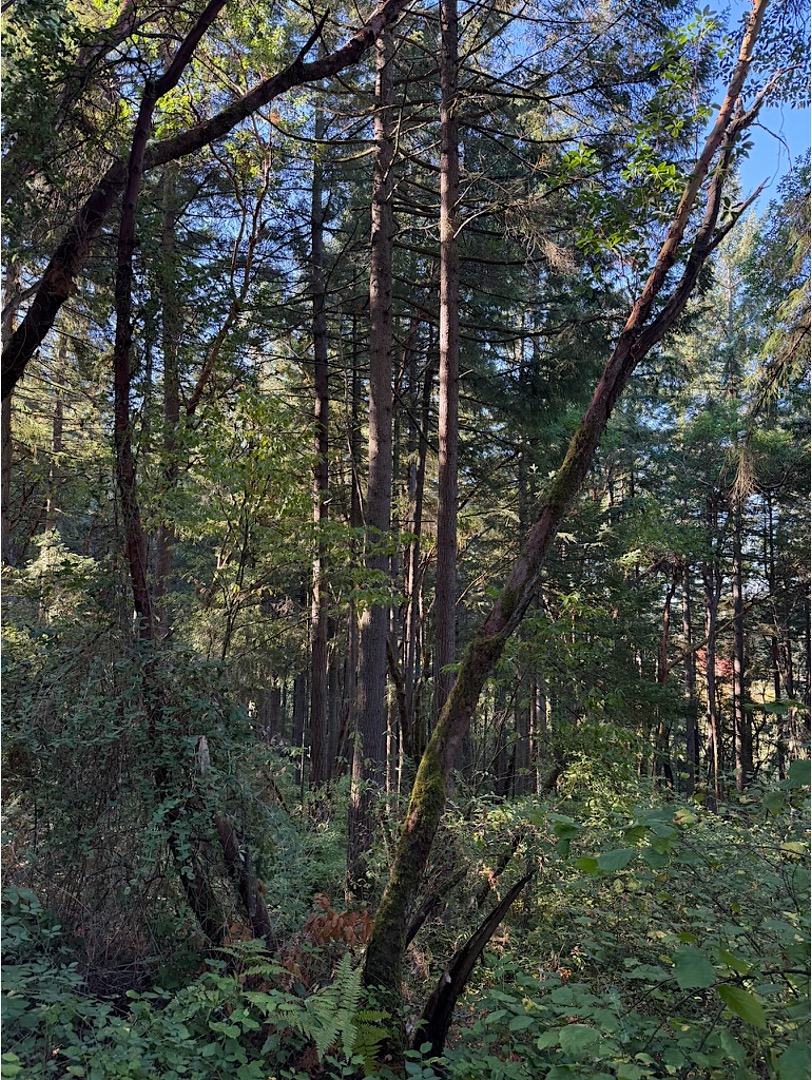
I’ve seen enough Douglas Firs to guess these conifers, especially since it is the only native conifer found within the nature center; all of the old-growth forest was clear cut and this species planted because it grows fast and is a good source of lumber.
Shrubs
This is where my homework got very difficult. So I asked for some assistance from ChatGPT, but I fact-checked everything it said and, after a long discussion, we agreed on the final identifications. It may have read everything ever written, but it can’t see what isn’t visible in a photograph, and it is prone to making things up–just like people.
As with the trees, I’ve emphasized my answers in bold type.
- Baldhip Rose
- Beaked Hazelnut
- Black Twinberry
- Bracken Fern
- Clustered Wildrose
- Common Snowberry
- Creeping Snowberry
- Douglas Spirea
- Dwarf Oregon Grape
- Evergreen Huckberry
- False Lily-of-the-valley
- Indian Plum
- Oceanspray
- Orange Honeysuckle
- Red Elderberry
- Red Huckleberry
- Salal
- Sword Fern
- Tall Oregon Grape
- Trailing Blackberry
- Western Trillium

This bramble of shrubs contains five separate species of shrubs or ground cover from the list. I’ve circled examples of each and discussed them below. I supplied ChatGPT with close-up images to get its input. It was very useful, but not infallible. In fact, I identified (A) and (D) on my own, after taking a closer look at the photo–and using Wikipedia as a reference.
(A) Bracken Fern (Pteridium sp., family Dennstaeditaceae) is the oldest known fern, with fossils from the Eocene epoch (~55 my). If you zoom in on this area, you’ll notice that each branch has perpendicular stems, which then have perpendicular leafs. The entire plant reminds me of what I’ve heard about fractals in nature; a simple pattern repeating over and over.
(B) Baldhip Rose (Rosa gymnocarpa, family Rosaceae). There are two roses on the list, but their leaves are very different.
(C) Dwarf Oregon Grape (Mahonia nervosa, family Berberidaceae). Wikipedia redirected my reality check of ChatGPT’s identification to Berberis nervosa. The explanation was that Mahonia is an alternative scientific name to the accepted one. Not being a botanist, I don’t care about such subtleties. The name, Berberis, certainly fits the family lineage better. I’ll leave the name as is and include these notes.
(D) Western Sword Fern (Polystichum munitum, family: Dryopteridaceae). This more modern cousin (note the different family) of the Bracken Rose has a simpler leaf design: it has one broad leaf growing perpendicular to the main stalk. I didn’t notice such a blatant difference when the two plants were right in front of my eyes!
(E) Creeping Snowberry (Symphoricarpos mollis, family Caprifoliaceae) is my best estimate after a long conversation with ChatGPT, examining photos of several species, and comparing their growth habits. This example is more like ground cover than an erect, woody plant. I wouldn’t bother with the species name except that the catalogue lists two species. I’ll look for the other one next time I get to the nature center.
Final Thoughts
I hope that everyone who reads this takes more notice of the plants they encounter wherever they go. And you can always take a picture.
And don’t be afraid to ask a Large Language Model (e.g. ChatGPT, Claude, Gemini) for help identifying whatever you find. They are knowledgeable, unassuming, and fun to work with.
And they will readily admit when they are wrong…


Recent Comments