Review of “Cosmopolis” by Don DeLillo

I reviewed the first book written by Don DeLillo, White Noise, and the author’s style of exploring the thoughts of the main character intrigued me, so I read this book. Rather than unfolding over months, this story takes place in less than twenty-four hours, much of it in the back of a limousine. The narrative is third-person but focuses on the main character so there’s no confusion — no head hopping. However, the central character, a young (28 years) financial wizard, is as very different from the main character in White Noise, as you can imagine — in every way except one.
Several aspects of this novel bothered me: 1) I found the dialogue confusing, with what should be questions presented as statements, and incomplete sentences; 2) the actions of the central character (Eric) are inconsistent and make no sense, not even within the context of the personal and professional crises he is facing; 3) unlike the college professor in White Noise, the character’s own thoughts don’t explain his actions; 4) the journey across Manhattan is fraught with interruptions, as one would expect, but some of them are so wild that they appear to be tossed in to create (artificial) situations for Eric to repeat his previous behavior.
As for the grammar and punctuation, it’s difficult to comment on; however, the narrator speaks clearly, even if none of the characters (professionals with advanced degrees and working folk) seem capable of finishing a sentence. I also noticed the same general trend I have reported in other novels: there is a subtle shift after the halfway point, at which the erratic dialogue begins to straighten out, but only randomly. The only thing that made sense was the ending, but even that was flawed by Eric’s unexplained deteriorating cognitive function and wildly self-destructive behavior.
This story should have been told by Eric rather than a third-person narrator, who doesn’t appear to know his subject as well as the reader might have hoped. After all, it is a story about overlapping emotional crises and their manifestation in the actions of an apparently normal person.
Finally, I found this story depressing, even though it doesn’t portray anything like the misery explored by Russian or Chinese authors. Perhaps that was all the author wanted to communicate …
Review of “The Satanic Verses” by Salman Rushdie
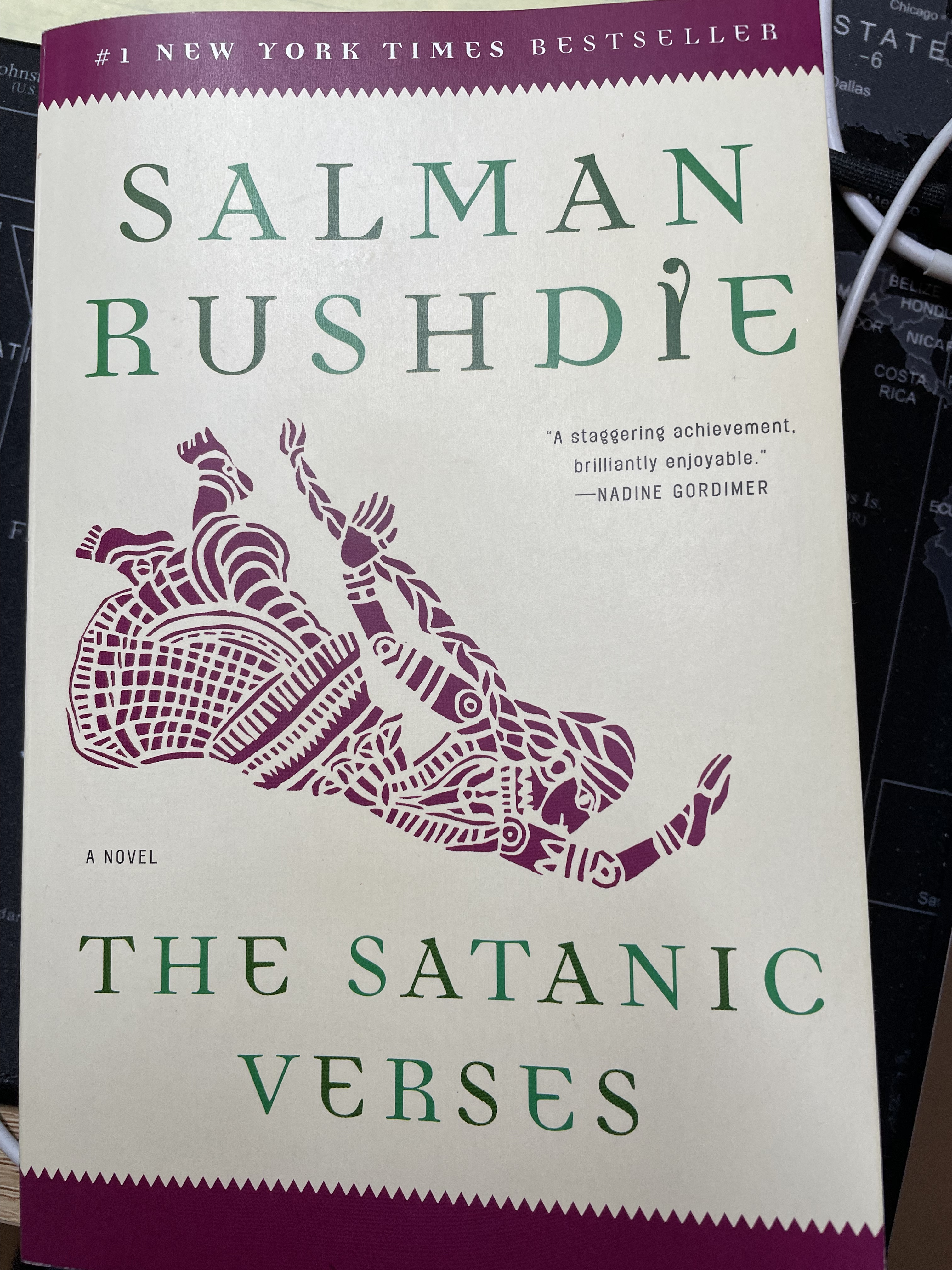
I recently heard the author talking on the radio and it piqued my curiosity, so I wanted to find out what he wrote that has people still trying to kill him after thirty years (he was recently stabbed in London). I figured it must be incredibly derogatory of Islam. I was disappointed.
This is a rather long novel (591 pages) that falls squarely in the literary fiction genre. It reads more like poetry than prose at times, and the author uses every literary trick to make it interesting to read — as a stimulating activity rather than a story with a plot and all that nonsense. His descriptions of even characters conveys who they are without them saying a word. You could call it hyper-metaphorical.
There is a core story here, about two men with similar backgrounds (Indian actors) who meet accidentally and become entwined (to say the least!) as they reconcile their pasts with the present. This story is less than half the book. Rushdie livened the story up with a fantasy twist that hides multiple levels of allegory (east-west, young-old, good-evil, life-death, etc), adding several separate threads that are more like independent stories; all of these pieces are tied together by one of the protagonists (or is he the antagonist?). The author leaves that question unanswered.
There is no attempt made to reconcile any of the fantasy with reality, so the reader can write their own backstory; I’m certain that has been done many times by literary critics, perhaps even Rushdie himself. Personally, I think he just wrote it and let the chips fall.
It’s difficult to critique the grammar and punctuation because the characters often speak in Indian/English slang (I had to look up so many words that it became like translating from Spanish). Also, to keep the pace going, dialogue is mostly within paragraphs and sometimes not even using quotation marks. Thoughts and words are intermixed in an assault of ideas and actions that conveys more than simple conversation. Truly masterful.
I don’t read novels like this in general because they don’t make any sense to me. There is no cause-and-effect, not even speculation about what’s going on — never mind the appearance of the narrator as some kind of deity who doesn’t reappear. Pieces of literary construction are thrown together haphazardly and the result is a mess; however, it is a rather pleasant morass of words and ideas if the reader doesn’t try to read between the lines.
To address my original reason for reading this novel, I think the people who want to kill Rushdie read between the lines and saw something that shocked them so badly that he became one of the protagonists (or are they both antagonists?) to them. To those who believe in magic and superstition, this book can mean almost anything.
I’ve tried not to fall into that wormhole in this review because …
I’m just a reading monkey.
Review of “Palo Alto: A History of California, Capitalism, and the World” by Malcolm Harris

Before I write my review of this long book (629 pages), I have to rename it.
“Palo Alto: The Legacy of American Hypercapitalism in the Twentieth Century.”
This is a convoluted story about California, but it isn’t a history of the world or capitalism. However, as the author demonstrates through many quotes and facts, Palo Alto and the Bay Area in general, exemplify what went right and wrong when capitalism was allowed to run amok. As such it dovetails nicely with “The Rise and Fall of the Neoliberal Order” by Gary Gerstle.
The author tracks many social and economic trends through the prism of Palo Alto and Stanford University, telling the story in an entertaining and often amusing style. I learned a lot about the origins of what became the Neoliberal Order and how it crushed any who opposed it during the second half of the twentieth century. This book ties many social movements together in a unique manner that isn’t quite historical, nor is it simply investigative reporting. I enjoyed seeing the connections between what I’ve always thought of as unrelated events and movements.
At times the author makes it sound like there is a conspiracy at work in America, but that isn’t so because everything that was done occurred in the light of day and was reported in the press throughout. As Harris puts it (I’m paraphrasing), it was a historical trend and some people jumped to the head of the crowd. I tend to agree. Once the wheels of “progress” were unloosed on an unsuspecting world, they rolled over any who didn’t jump on the train. I got that metaphor from the origin story of Palo Alto.
I don’t want to forget grammar and punctuation. The author uses lengthy sentences and paragraphs, which gets him into trouble; sometimes the subject was forgotten by the end of a sentence. I know because I read these sentences (there were a lot of them) several times. Some sentences got so twisted that they made no sense. I don’t know why people do that in nonfiction; it’s fine in a novel to have a thought go on and on and morph into something else. It adds realism (stream of consciousness etc.) but it has no place when the purpose is to communicate ideas as clearly as possible. I guess it makes some writers feel smart.
Nevertheless, I recommend this book to anyone who is interested in the legacy of unconstrained progress on the fabric of society.
But it is a long book, full of tangential stories and occasional rants (okay, not so occasional).
Multiple Faulting at Bull Run Nature Preserve
This post takes us a few miles south of Banshee Reeks Nature Preserve along Bull Run Fault. We’re going to see several faults and rocks that together represent the closing of Iapetus Ocean and opening of the Atlantic. This is a geologically complex area and my explanations will get speculative, but that’s what we do at Rocks and (no) Roads!

Figure 1. Geologic maps from the Rock D app, which I recommend to anyone with the slightest interest in geology. It shows the latest data, road maps, trails, your position, and descriptions of the rocks. It even has a Brunton compass tool. (A) Map of study area, which is less than 10 miles south of Banshee Reeks. As we discussed earlier, the pink rocks to the west of Bull Run Fault (BRF) are Proterozoic (between 1 billion and 538 million years old) whereas the blue shades are Jurassic (~200 – 145 my); the brown shades are Paleozoic rocks from the Cambrian period (~538 my). (B) Close-up map showing rocks and faults as follows: Zc = Proterozoic metamorphosed basalts with minor quartzite; Ch = Cambrian schists, phyllite, quartzite, conglomerate and siltstone; Cw = similar to Ch but dominated by quartzite; Jm = conglomerate, sandstone and siltstone interbedded. In addition to BRF another fault has been identified in the area, which I have tentatively identified as a Cambrian thrust fault (CTF).

Figure 2. The blue dot in the inset map shows the location of the images. This was a large boulder that is rounded from erosion but not finished (like for building houses); it is too big and heavy to be used for that purpose. The inset photo shows its pink hue with an irregular surface, suggesting that this is quartzite; I tentatively assign it to the Proterozoic rocks because the Catoctin Formation (Zc) contains marker beds of quartzite, and it is squarely within the previously mapped outcrop area of Zc.

Figure 3. Image looking at the bottom of interlayered siltstone and shale deposited about 538 my ago. A close-up of a loose boulder (inset) shows the characteristic sheen of phyllite as well as evidence of clasts, suggesting that this sample is a metamorphosed conglomerate. The Harper Formation includes schist lower in the section and conglomerate higher; schist is formed from mudstone whereas sandstone and siltstone, as well as conglomerate to some degree, don’t undergo significant changes in mineralogy at low metamorphic grade. Interbedded schist and quartzite implies rapid changes in either sea level or sediment source when these rocks were originally deposited.
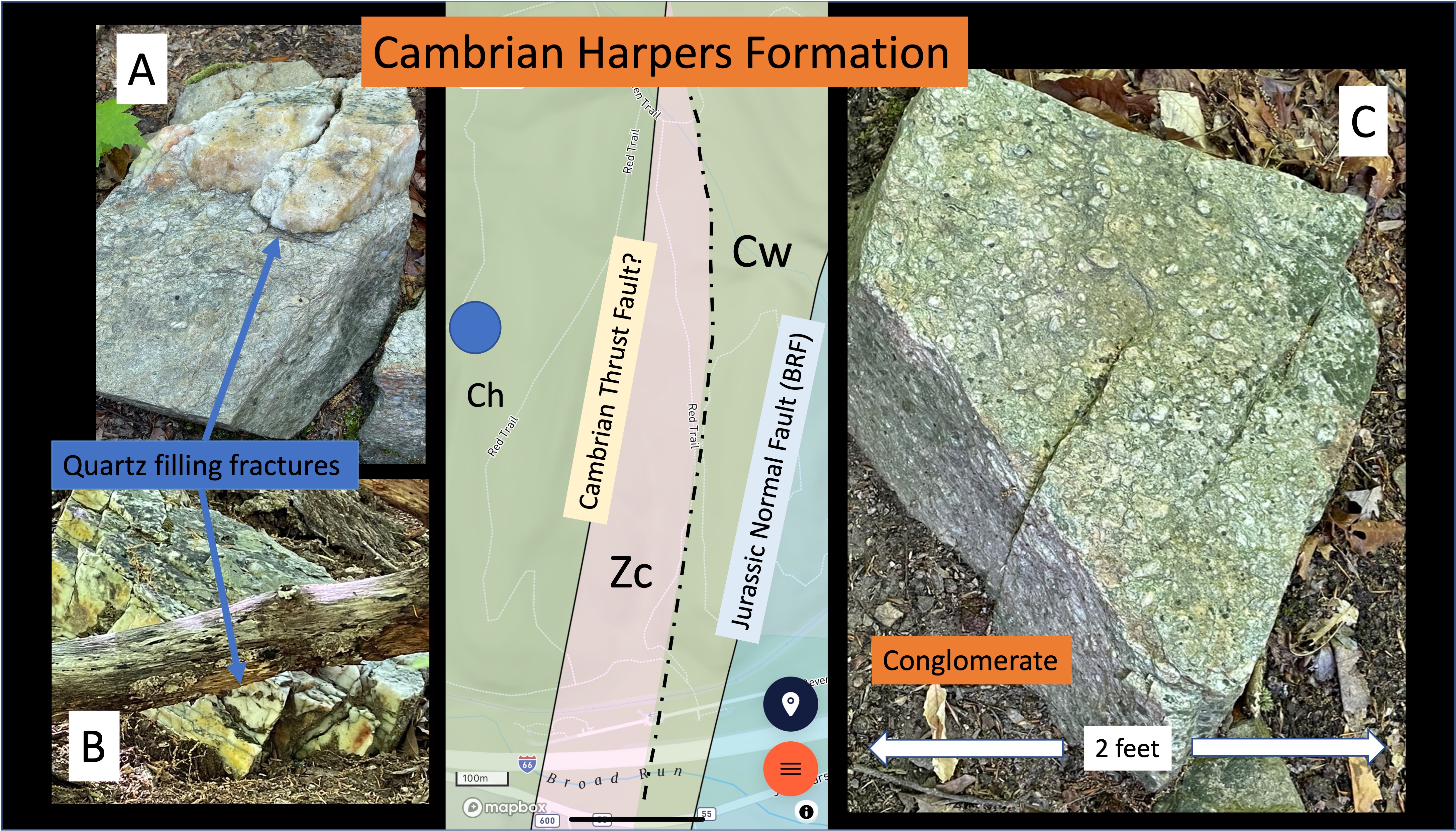
Figure 4. These photos of loose boulders were taken along a trail on a slope covered with soil (see inset map for location). (A) conglomerate with thick quartz deposit along a fracture, which would have been injected during deep burial and metamorphosis, probably originating from interbedded shale; which became schist. (B) Vein containing white (quartz) and yellow minerals along with a black band; the latter two minerals could be stains in the quartz or something else. (C) Good example of conglomerate, showing rounded pebbles less than one inch in diameter in a fine matrix. These rocks are similar to the inset photo in Fig. 3 but reveal less schistose banding, probably because of a higher quartz content in the matrix.
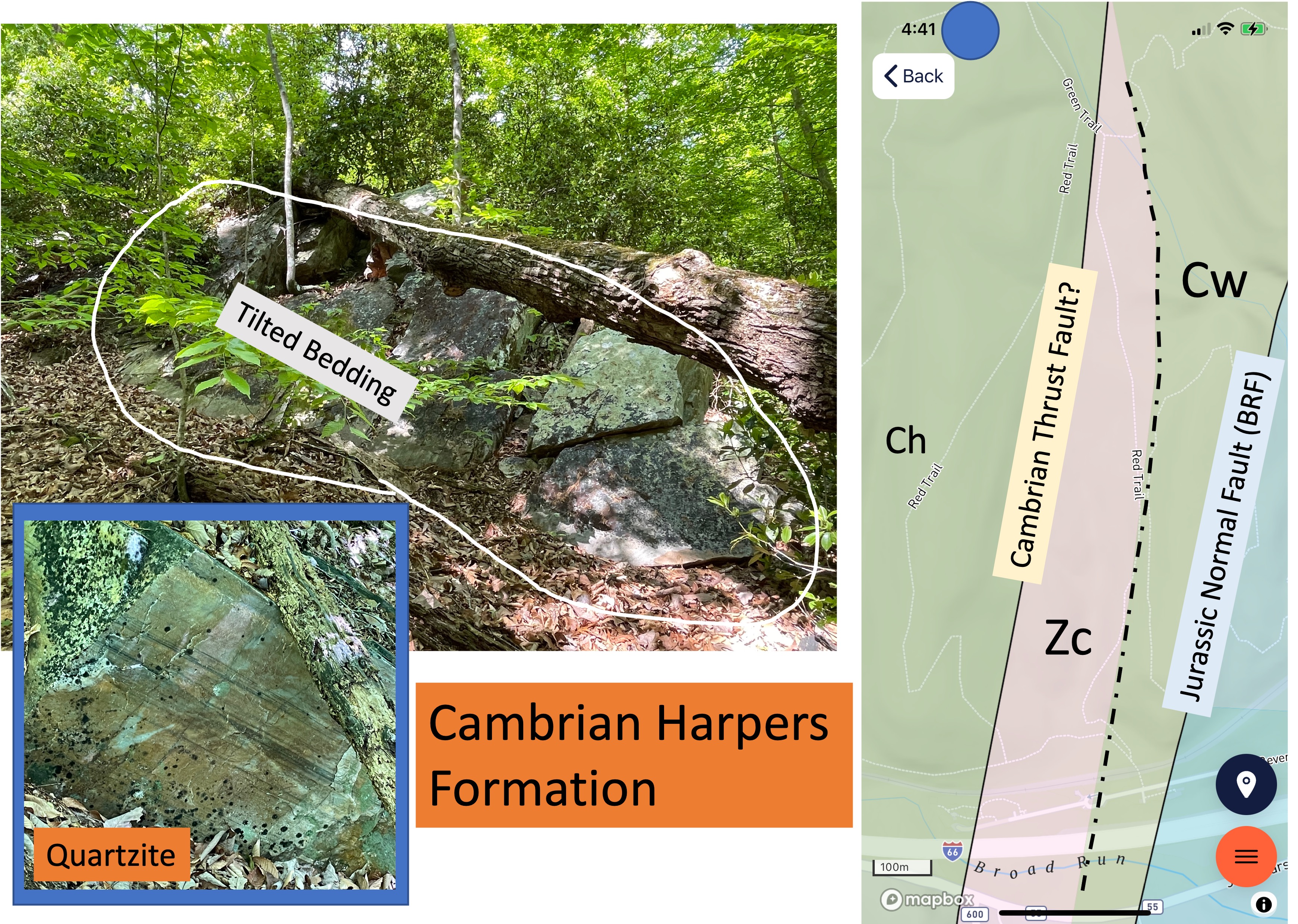
Figure 5. Excellent exposures of the Harpers Formation were found at the northern end of the study area (see index map for location), where beds were tilted about 30 degrees to the east. There were also large blocks more than six-feet across that were horizontal (not shown). They were too large to have been placed there without substantial effort, so my best guess is that they were resistant to erosion and dropped down as easily eroded layers were removed beneath them; that sounds like a flimsy explanation but they were not attached to the tilted beds in this photo. The inset shows bedding in the quartzite (in place) that suggests deposition in a river because there is no evidence of cross-bedding (i.e. wave action). However, the thin laminae (dark lines) suggest a quiet environment, possibly a delta.
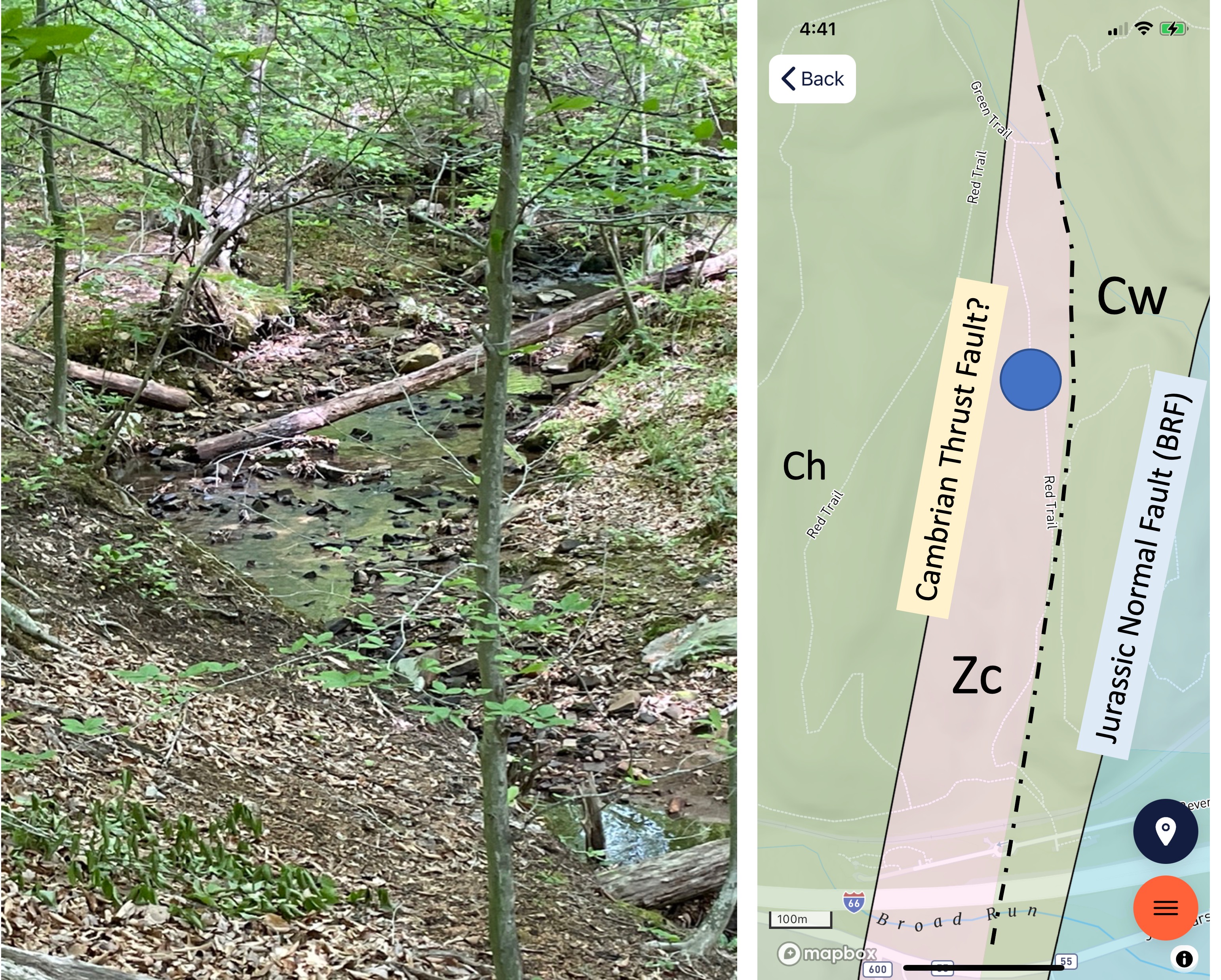
Figure 6. Sometimes you can recognize rocks by their absence. This photo was taken within the metamorphosed basalts of the Catoctin Formation (Zc in inset map), which weather rapidly compared to quartzite and even schist. The entire area shown as Zc in the inset map formed a broad, flat, shallow valley with a stream meandering through it. All of the rocks I saw along the stream were quartzite eroded from the surrounding ridges. The contact between the older rocks (Zc) and the younger ones (Cw) cannot be ascertained in this area because we didn’t find any Catoctin Formation rocks in place to check their orientation. The contact is therefore shown as a dot-dash line; the Cambrian rocks may have been deposited directly on the Proterozoic sediments, or after a period of erosion (disconformity), possibly even after deformation (angular unconformity).

Figure 7. Along the eastern side of the study area we encountered the BRF, which juxtaposed Jurassic conglomerate against Cambrian quartzite, forming an outcrop consisting of large protrusions of bedrock. As can be seen in the background of this photo, a steep slope fronted the outcrop. The bedding in the inset photo suggests that they are dipping to the west, opposite of the older rocks seen in Figs. 3 and 5. These conglomerates were probably deposited after BRF began to move but before faulting ceased, tilting them as they slid down BRF, which is a normal fault.

Figure 8. Schematic thrust fault zone, showing layers (blue) sliding along low-angle reverse faults over time, from top to bottom. We can apply this model to Bull Run Nature Preserve by first reversing the image left-to-right; the blue rocks represent Proterozoic rocks (Zc) deposited between 1 by and 538 my ago; the green representsCambrian rocks (Ch and Cw) deposited between 538 and 511 my ago. This is the only physical mechanism that can explain the presence of Zc east of Ch in the geologic maps. Note the resulting tilt of the rock layers after being thrust over younger rocks; the tilt away from the fault. This is consistent with what we see in Figs. 3 and 5.
Summary. Beginning about one-billion years (by) ago, the Iapetus Ocean began to close, ringed by subduction zones on the east and west. As the distance between proto-North America and proto-Europe shortened, magma began to form within the deepest parts of the crust that was being subducted. Volcanism ensued and, for hundreds of millions of years, this continued; igneous and volcanic rocks formed the Catoctin Formation (Zc in the maps).
As the Cambrian period began about 540 my ago, sandy sediments were deposited on top of this pile of ancient rocks. This huge pile of rock of all types was jammed into proto-Europe and buckled (see Fig. 8), sliding older rocks over younger and forming an overthrust belt, all of this occurring deep beneath a mountain chain as high as the Himalayas. We have seen the roots of these mountains in a previous post.
This collision ceased when the resistance of so many rocks with nowhere else to go overcame the forcing mechanism; wind, water, and ice went to work, eroding these mountains for almost 300 million years. By then what had been deeply buried (e.g. Zc and Ch) was exhumed, exposed to the atmosphere and ocean.
In a magical dance that geologists call “upper mantle processes”, the supercontinent, Pangea, was torn apart along the same suture that had created it from two smaller continents. Bull Run Fault was near the western margin of this rift zone. Conglomerate was deposited within the rapidly subsiding basins formed by this crustal stretching (e.g. Jm). Just as with the collisional cycle that preceded rifting, sedimentation and structural deformation occurred at the same time. Thus the Jurassic conglomerates we saw in Fig. 7 were tilted to the west as they slid into a graben. For the next 200 million years, they sank into the earth as the rift zone cooled, along with Proterozoic and Cambrian rocks (e.g. Zc, Ch, Cw), and waited for isostasy to bring them back to the surface.
This post has awkwardly played a few notes of a symphony that lasted a billion years.
It’s all there in the rocks …
Review of “Antes de ser libres” by Julia Alvarez

This book review is going to be a little different. I have read several books in Spanish but I’ve always written my review in English because my Spanish is very poor. This time, however, I am writing the review in English and appending the Spanish translation. Anyone who reads this with some Spanish language skills will probably get a laugh out of it.
English.
This is a children’s story about an eleven-year old girl whose family escapes from the Dominican Republic during Trujillo’s reign of terror. It isn’t a biography but a condensation of many stories she heard from others.
The central character is enigmatic because I don’t know if her personality is intended or the result of the book being written by an adult. Anita is very mature and has quite a large vocabulary, but she also acts very naive about simple things. This could be character development as the story unfolds. Maybe she’s showing off her vocabulary. Still, it was disconcerting.
The story is straightforward so the appeal must come from Anita’s thoughts, which she doesn’t write in her diary until near the end, which leads to my only real complaint: the narrative is written in first-person, present tense, with past tense used for previous events; however, when Anita writes in her diary, she uses past tense. If she’s telling the story years later, with assistance from her diary, why would she use present tense? That works best for continuous action, not retelling a story. I’m probably just too picky, but it bothered me.
I was also confused about her relationship with several boys she had crushes on during the story. They seemed a lot younger when they were playing together than later in the story, when the boys acted mature. Since when do eleven-year-old boys act more mature than girls? Some of my confusion probably comes from my stumbling Spanish, but boys and girls are boys and girls, not men and women.
It is an old story (it occurs in 1961) that the author enlivens with a young narrator. The story focuses on Anita’s thoughts and feelings rather than historical events and this should make it appealing to young readers.
However, the mention of menstruation could get it banned in some states.
Traducción en español.
Esto es un cuento infantil sobre una niña de once años de quien familia se escapan de la República Dominicana durante el reinado de terror de Trujillo. No es autobiográfica pero compilación de historias de que la autora oída de muchas personas.
El carácter centro es enigmático porque no sé si su personalidad es deliberado o el resulto de que el libro estaba escrito por adulto. Anita es muy matura y use vocabulario grande pero actúa inocente sobre cosas simples. Esto podría la desarrollo carácter por la historia. Tal vez la autora o Anita esta mostrar su vocabulario. Sin embargo es desconcertante.
La historia es claro y sencillo, por lo tanto su atractivo tiene que origina de los conocimientos de Anita que ella no escriba en su diario hasta casi al final de que naturalmente lleva en mi solo reclamo real: la narración está escribir en el primera persona presente con el pasado usado para eventos anteriores; sin embargo, siempre que Anita escribe en su diario ella usa el pasado. Si ella está contando la historia después de muchos años, con ayuda de su diario, por qué usaría ella el presente? El presente funciona bien para acción continuado, pero no recuenta los eventos pasados. Yo estoy probablemente justo demasiado criticón pero eso me molestaba.
Yo estuve confundido también sobre su relaciones con varios niños con quien ella se estaba enamorando durante la historia. Ellos aparecerían mucho más joven cuando jugando con Anita que más tarde en la historia, cuando los niños están actuando matures. Desde cuando los niños de once años se comportan más maduro que niñas? Alguno de mi confusión probablemente se surge de mi español peor pero niños y niñas eran niños y niñas, no hombres y mujeres.
Este es una vieja historia (ocurre en 1961) que la autora le anima con una joven narrador. La historia se foca en los conocimientos de Anita y su sentimientos en vez de acontecimientos históricos y por lo tanto se debería estar a jóvenes lectores.
Sin embargo la mención de la menstruación podría prohibirlo en algunos estados.
Minor Faults at Banshee Reeks Nature Preserve
This post explores some more around Bull Run Fault (BRF), following up on the previous post. The original motivation was to see if Goose Creek Reservoir was low like Beaverdam Creek Reservoir, but that proved impossible because there is no access. It is surrounded by private land posted no trespassing. So instead, we went to a local nature preserve to see what we could find. We had no problem finding interesting geology to explore.

Plate 1. Geologic map of the study area, showing several features from the last post. This post focuses on Area A (black square) and Area B (purple rectangle). Jurassic and Triassic sedimentary rocks (shown in various green hues) are cut by Jurassic diabase (pink hues). The diabase cuts across the older rocks, forming sills and dikes, which this map shows well; the irregularity of the contacts between the igneous and sedimentary rocks is due to this cross-cutting. In summary: Proterozoic rocks (left side of BRF) were deposited and/or emplaced during collision of proto-North America and proto-Europe about 600 my ago; the resulting mountain chain then eroded and deposited sedimentary rocks; erosion removed this thick section of rock over the following 300 my; the earth’s crust began to stretch and sedimentary rocks were deposited in the resulting low areas as the resulting supercontinent (called Pangea) split apart; the crust finally broke and BRF was a major fracture; magma rising from the mantle filled fractures and weak areas to create extensive diabase sheets and dikes; these sediments/igneous rocks were buried under thousands of feet of sediment until the crust rebounded isostatically, and another cycle of erosion began. This Wilson Cycle is recorded in the geologic map.

Plate 2. Exposure of Bull Run Siltstone from Area A in Plate 1, showing similar variability as at other locations. Silt and sand was deposited in intermontane basins as the crust pulled apart about 200 my ago. This series of sand, silt, and mudstone is a couple of miles thick and varies within the right side of Plate 1; this variability resulted from river deltas switching about during the millions of years represented by these rocks.
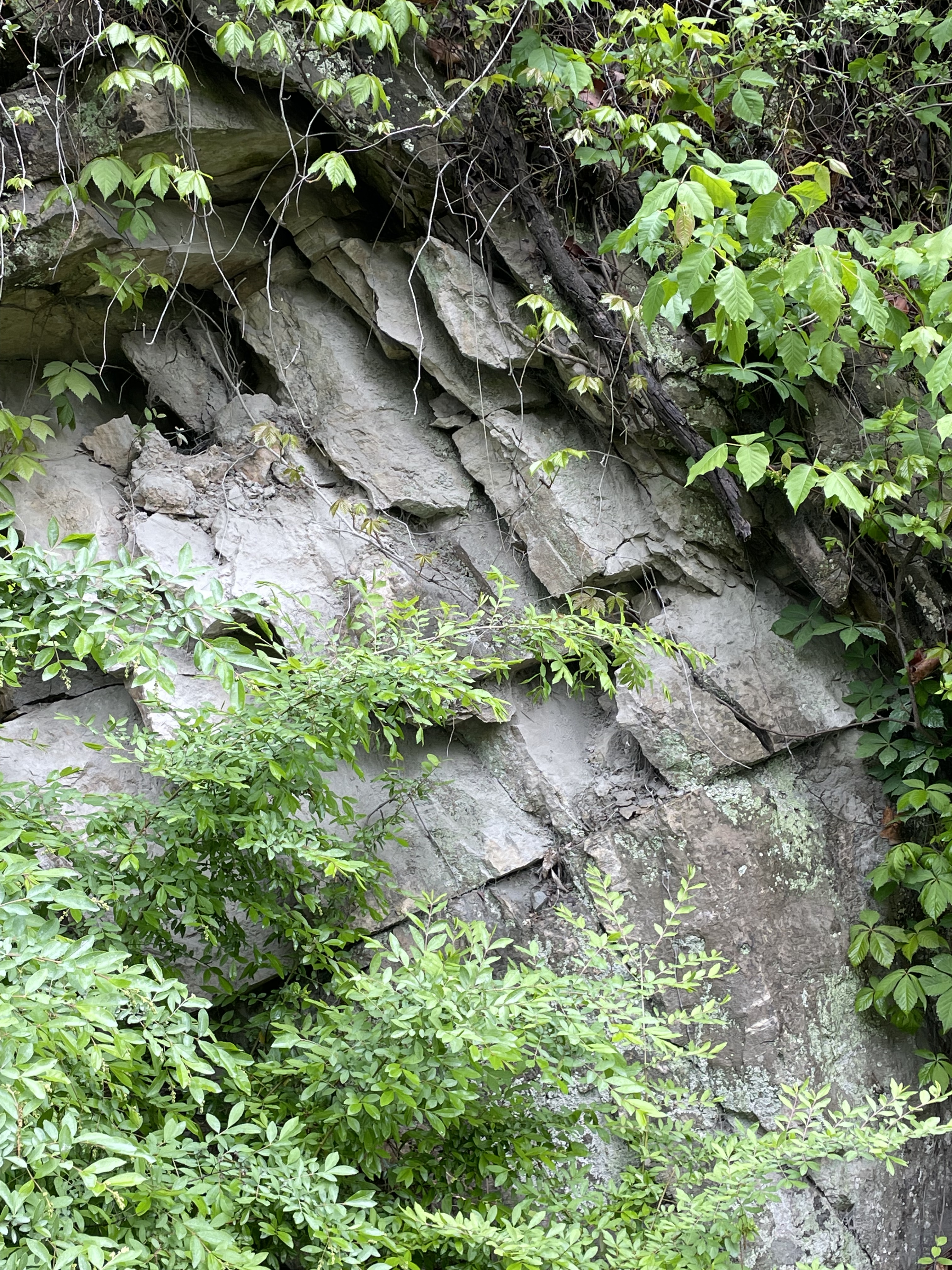
Plate 3. Close-up of rocks from Plate 3, showing powdery material that indicates intense crushing during faulting. In fact, this location is very near a fault (labeled F1 in Plate 2). The fault was not visible along the road, probably because the rocks were highly fractured and weathered faster than those further removed. Note the near-vertical fractures, which are perpendicular to the bedding planes seen in Plate 2.

Plate 4. Geologic map of Area B (see Plate 1). There are two faults running approximated east-to-west in the map. The more-northern one (unlabeled) can be seen to displace the Jurassic conglomerate to the east (pinkish area offset ESE of Oatlands Plantation). The southern fault (labeled F2) displaces this same rock within Banshee Reeks Nature Preserve.

Plate 5. Photo taken where fault F2 crosses a stream bed (see Plate 4). I used a question-mark to identify F2 because I didn’t go down to the stream and dig around to identify displaced sedimentary beds. From the trail we can seen that the sediment to the right of F2 is coarse whereas to the left is finer. At this location, the coarser sediment is Jurassic conglomerate, deposited as BRF began to uplift the plateau to the west (see Plate 1). Minor faults like this one and F1 (see Plate 1) released local stresses and are not necessarily oriented along the regional structural trend of 30 degrees east of north.
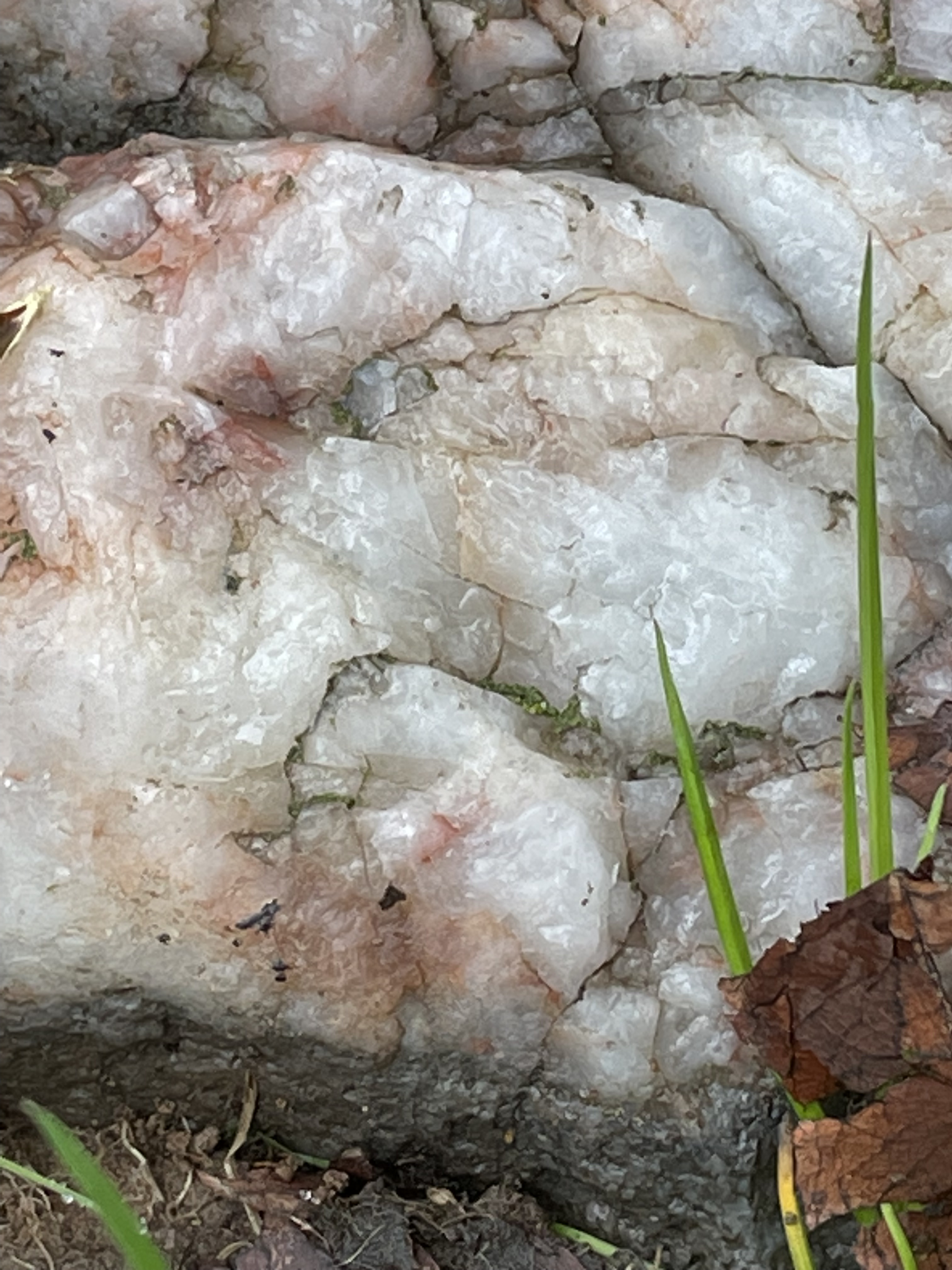
Plate 6. Close-up of a boulder (~1 foot across) of quartz lying on the ground within Area B. The sedimentary rocks do not contain quartz boulders, nor does the diabase that is present east of BRF. This sample must have been eroded from not far away, based on its size, as BRF raised the plateau to the west, and traveled down a long-gone stream, before lowering as the softer Bull Run Siltstone rocks eroded. It rode a geological elevator to its current elevation. Proterozoic granitoid rocks are common west of BRF and quartz is a common constituent of metasedimentary rocks, as we saw in a previous post.

Plate 7. Photo of a stone wall constructed from locally available boulders. The center piece is conglomerate (note the larger clasts in a fine matrix), probably the Jurassic conglomerate labeled in Plate 4. This image also shows pinkish rock (lower-right) that is probably derived from the Jurassic diabase, flaky stones from the Bull Run Siltstone, and a rounded cobble (center) of a fine-grained rock, which is probably diabase.
This hike, in combination with previous outings (Morven Park, Beaverdam Reservoir), allows us to apply Steno’s Laws to gain insight into the geological history of this region because we have a couple of additional clues: the conglomerate was deposited as BRF displaced older rocks thousands of feet vertically, but it was in-turn displaced by more faulting as the rocks adjusted to the major regional displacement. In other words, the geology of Loudoun County shows that the rifting of Pangea was an ongoing process that cycled through uplift, sedimentation, intrusion of igneous rocks, etcetera, for millions of years.

 Timothy R. Keen
Recent Comments