
Review of “You Don’t Want to Know” by Lisa Jackson
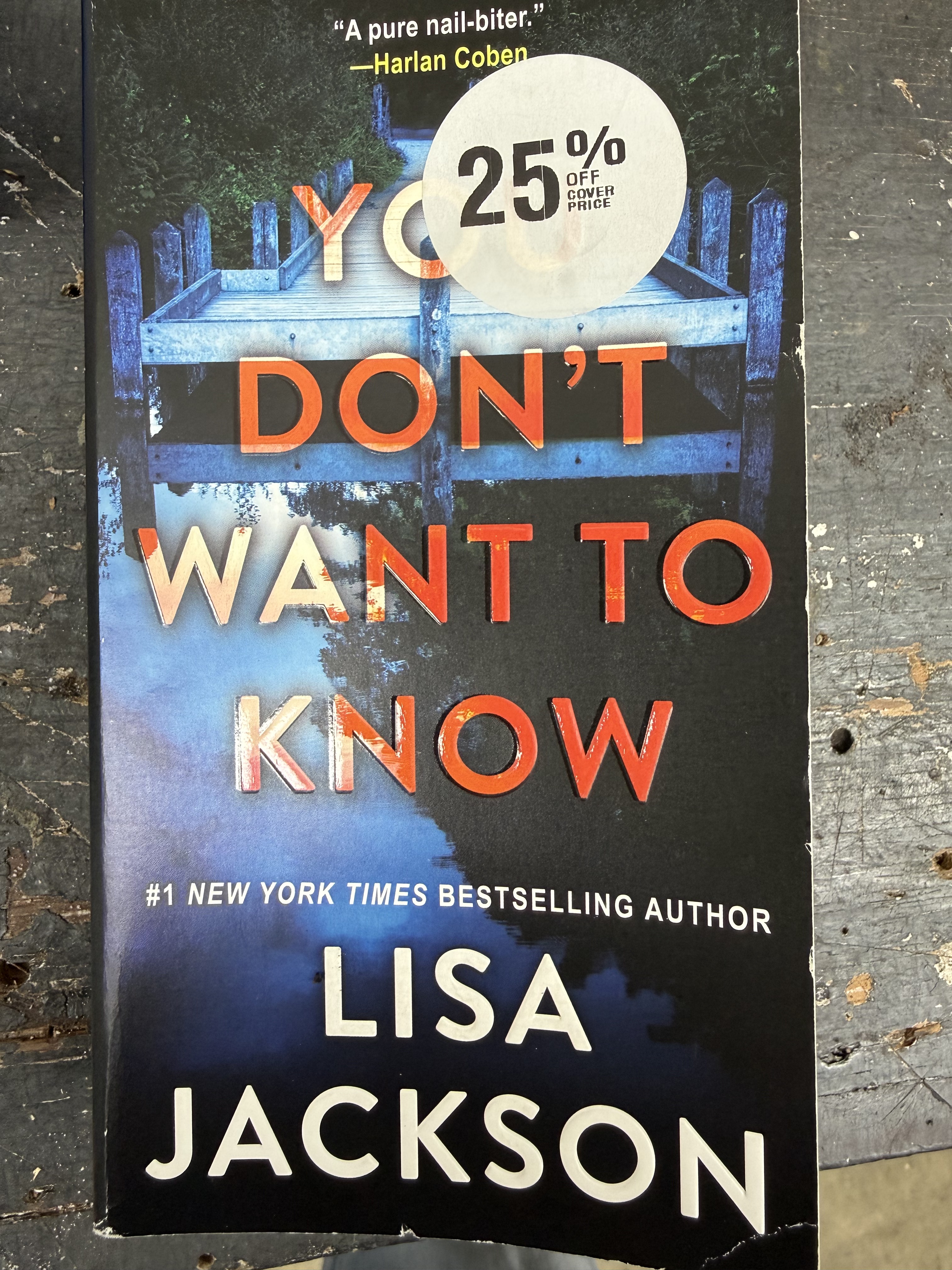
The title says it all.
I bought this book because the back cover suggested that this is a story about a woman who had a mental breakdown and finds herself doubting her own sanity after attempting suicide and hallucinating her missing son’s presence after two years. The author does a great job on the character arc. I had to keep reminding myself that the central character’s self-destructive behavior was due to her mental condition. That’s where my interest ended.
I don’t read mysteries in general because they are formulaic. The reader can’t help trying to figure who did what, which is a waste of time because the author can do anything they want to spice up the story and maintain interest. One of the comments read, “Multiple red herrings and a host of sinister characters help keep the pages turning.” I guess I don’t know what makes a good red herring because I was tabulating points for/against each character’s likelihood of being the bad guy, rather than jumping at every insult and personal snub.
I don’t think a 604-page book can be a page turner. More than 200 pages passed in boredom before anything happened, partly because the author kept repeating the biographies of the many characters. Things sped up after that, but I’d already lost interest. I truly didn’t want to know who did what to Ava Garrison.
The author used a technique I’ve used myself, which unfortunately paints the narrative into a corner. Many of the chapters begin in a scene and then summarize an event from the past, which requires use of the past perfect tense (e.g., she had gone to work). This is great until it isn’t. This book abuses it, often relating pages of past events and overusing the past perfect, sometimes with two phrases like the example above in one sentence. I don’t know if there are any rules about this, but I use readability as my guide; the author pushes this well past that point.
There were some well-written scenes with “nail-biter” tension. I guess that’s what Jackson is known for. Overall the book is okay, but way too long and repetitive. It’s too long to be a quick read and the subject isn’t worth 600 pages–maybe 350.
I think that authors/editors don’t read books from the reader’s perspective.
Review of “Satantango” by László Krasznahorkai
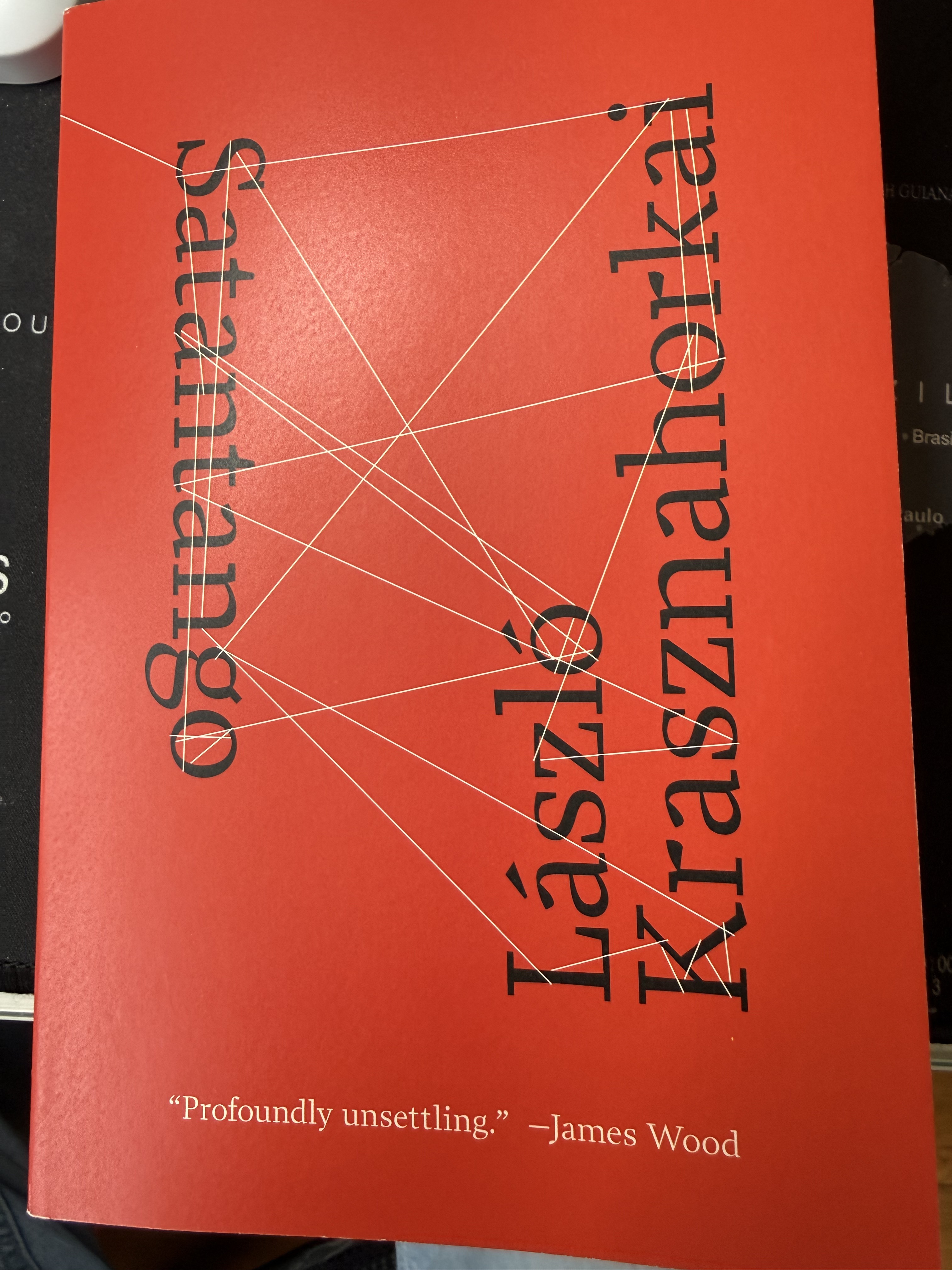
I don’t agree with James Wood, whose summary review is printed on the cover of this post-modern novel. This story is not profoundly unsettling; however, I think I know why they used that phrase.
This book was translated from Hungarian. I give two thumbs up to the translator, George Szirtes, because this was undoubtedly a monumental effort. There were very few grammatical errors and only a few missing words. The reason I am so impressed is that each twenty-plus page chapter comprised a single paragraph, which ranged across time and multiple characters, rather than focusing on a single character’s state of mind. Needless to say, this was a page turner; I couldn’t put it down until I finished each chapter/paragraph.
I couldn’t easily identify a plot, character arcs, or any other common literary themes in this work. The best way to describe it is as a literary journey into the lives of several individuals left behind in a changing society. No one is spared having their minuscule existence laid bare for the reader, even those who think they are in control. Everyone is portrayed as an unnecessary and redundant piece of machinery that is being tossed into the garbage after the social system on which they depended has broken and cannot be repaired. But none of them suspect the truth as they drag their tired minds and bodies through rain and mud towards a goal they know to be futile. If they are lucky, they can remain in stasis until they die, hopefully soon.
This bleak summary may sound “profoundly unsettling”, but only from an existential perspective. The reader shouldn’t be upset by their pathetic lives, however; there is no undue violence perpetrated on the characters, no shootings, not even self-recognition of their sorry state. They are oblivious. Perhaps that is why James Wood found it so disturbing; they didn’t even notice that the world had left them behind. I try not to read too much into novels, so maybe I don’t give as much weight to such literary analyses. I’ll leave that to scholars of literature.
You might be surprised to hear that I recommend this book, not for its literary value or deeply spiritual insight into post-modern civilization. It was simply fun to read a book where I didn’t have time to think about what came next. The author succeeded in bringing me, the reader, into a stream-of-consciousness experience in which I lost track of time.
I was just along for the ride…
Review of “The Folded Sky” by Elizabeth Bear
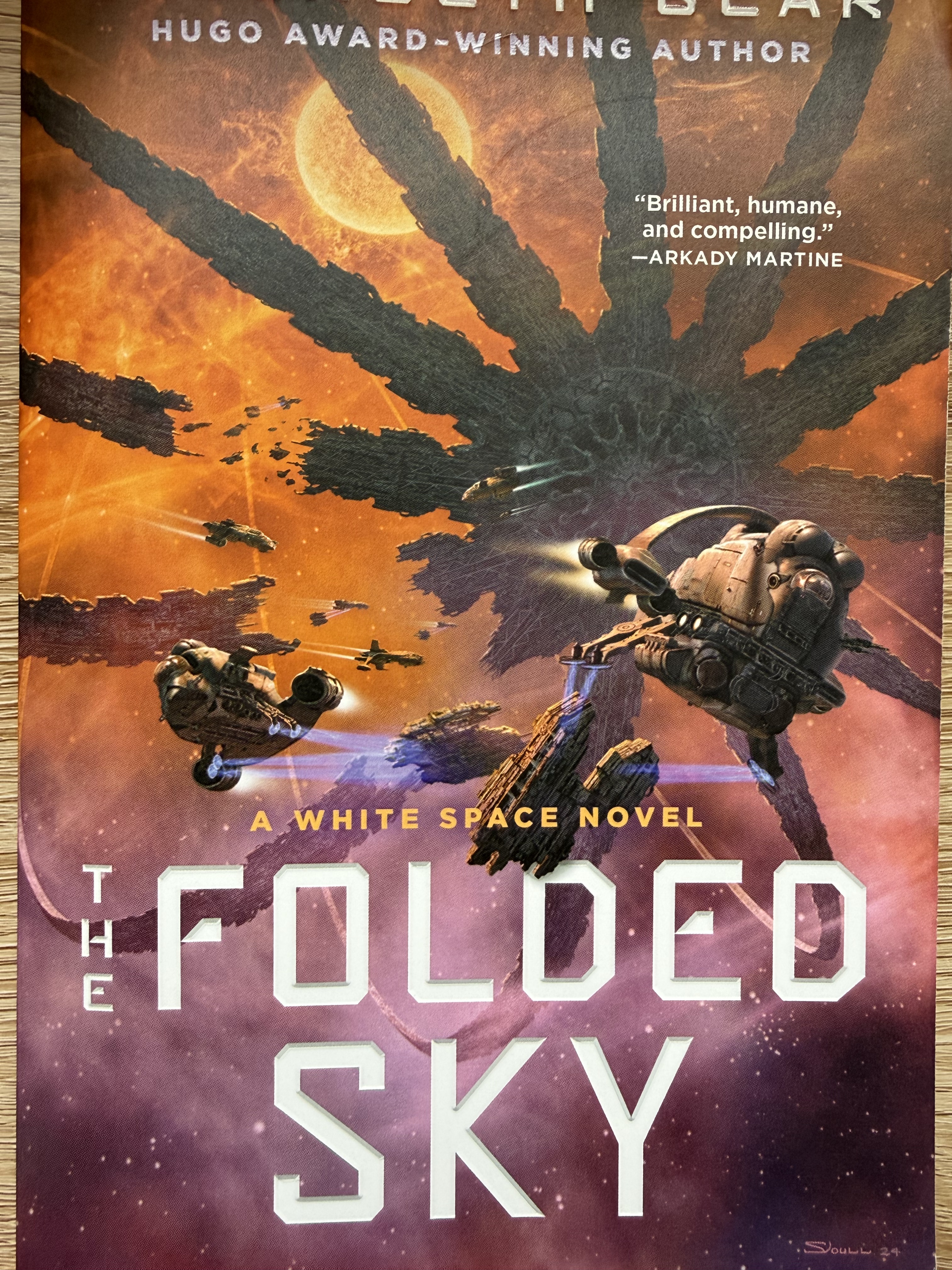
I’ll start with the easy part. The author has created an entire galaxy of worlds, which I assume define the “White Space Novel” series. There are even pirates, humans who want nothing to do with the modern world or aliens, which there are plenty of in this story. The action scenes aboard various spacecraft are well written and exciting.
The story is a mix of banal family drama and high-energy action scenes, all set to the backdrop of an imminent stellar explosion. The combination doesn’t work for me. I’ve been trying to figure out why, and I finally decided that there are too many antagonists. The story gets convoluted and it is hard to know who or what is an actual threat. The family scenes took up most of the first third of the book; I think the author realized they had lost track of the plot and jammed all the action they could into the last third.
At least twenty percent of the book is wisecracks by the first-person narrator. They used every simile and metaphor in the TWENTIETH CENTURY books. Maybe this is because the central character studies ancient civilizations, but her family had left earth only a few generations before the story takes place. It was very difficult to remember that they are a serious scientist with all the supercilious comments. Overall, this unnecessary self-reflection seriously detracts from the story, and adds a lot of pages.
There’s too much going on…but nothing. Once it became obvious that the pirates were just background noise, the book reduced to a whodunnit about a couple of attempted murders. Every seemingly hopeless situation is miraculously overcome with more fantastical alien powers. In other words, the story is contrived to fit the author’s predetermined ending. All authors do that to some degree, but it was a little too obvious in this book.
If you like space operas you’ll probably enjoy this book.
Review of “Dreams in the Eternal Machine” by Deni Ellis Béchard
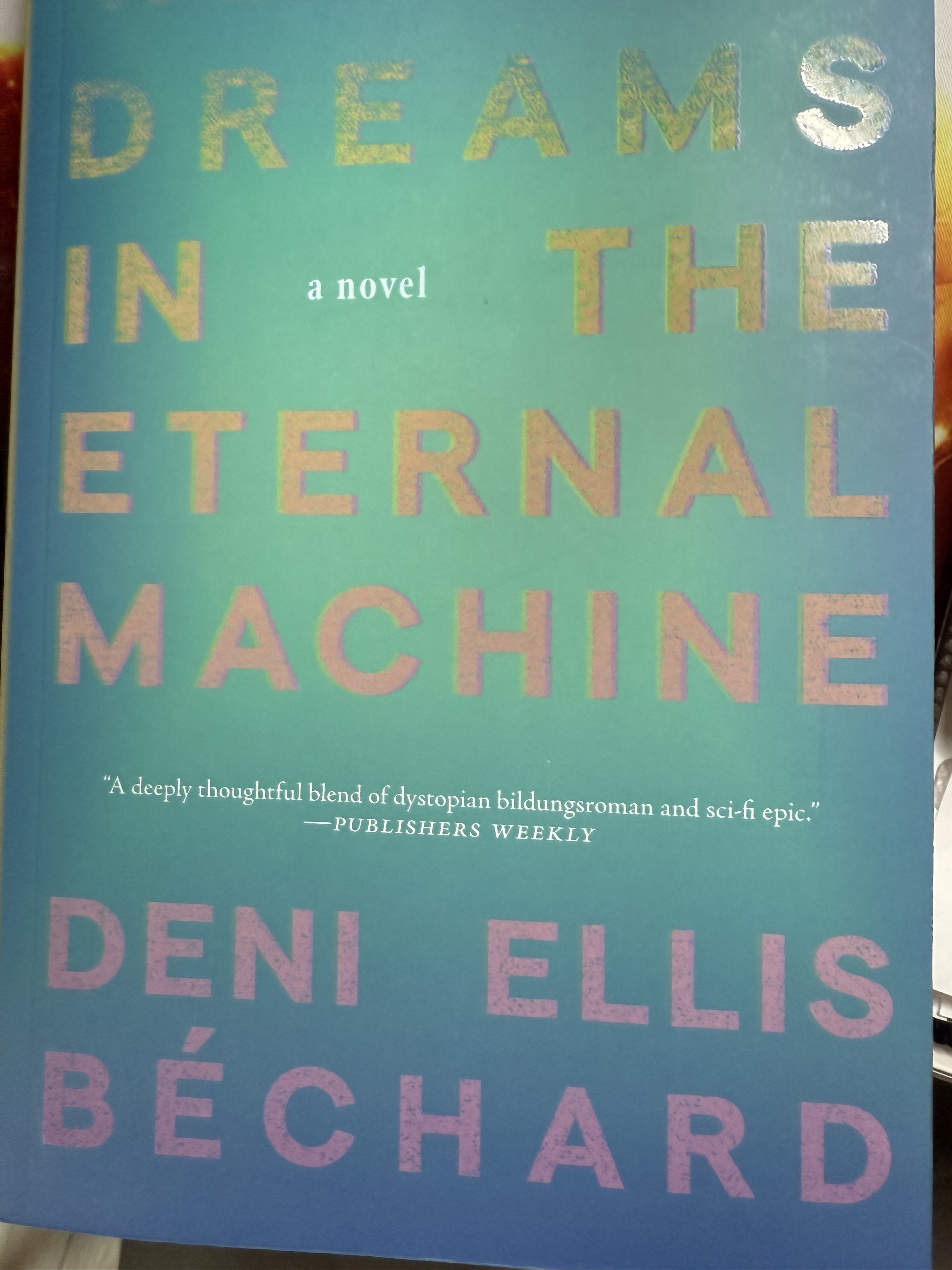
There is no surprise ending to this speculative science-fiction novel. The secret is in the title and explicitly introduced in the first few pages. Everyone on earth, including the planet itself, has been assimilated by an artificial super intelligence whose rapid development far surpassed its creator’s imagination. So what is the plot?
Wrapped in a science fiction cover is a Shakespearean story of betrayal between young people who accidentally meet in an American divided by civil war. Their story is integrated with their separate experiences after assimilation into the machine, and it remains unresolved. The only other evidence of a plot is the general decline in cognitive and emotional wellbeing of the majority of people. This process is explored through several characters whose importance to the plot is never clear. In fact, no one really stood out as being the central character, other than the two young people mentioned above. Having a plot doesn’t require the central character to succeed; failure is the stuff of tragedy and perfectly okay, but no one really struggled against the antagonist (obviously the eternal machine). Their situation is hopeless and there is no chance of escape — not even the slightest. Hopeless.
Given the lack of a coherent plot or even a central character, this story is fundamentally about the response of people to a hopeless situation in which there are no threats of any kind. The machine not only feeds and cares for its dependents, it creates any world they want to see and experience. Spoiler alert: Heaven gets old after a few centuries.
The writing is very good, and the author doesn’t miss a trick to get an agent’s attention and produce a popular book. It seems to me that agents probably don’t think very hard about the books they represent. And, of course, the reader doesn’t find out until it’s too late, the money spent. That’s how I felt. As far as the reviews, I never cease to be amazed at the glowing reviews written about this novel; I guess critics don’t read books either.


Recent Comments