
Review of “Eyeless in Gaza” by Aldous Huxley
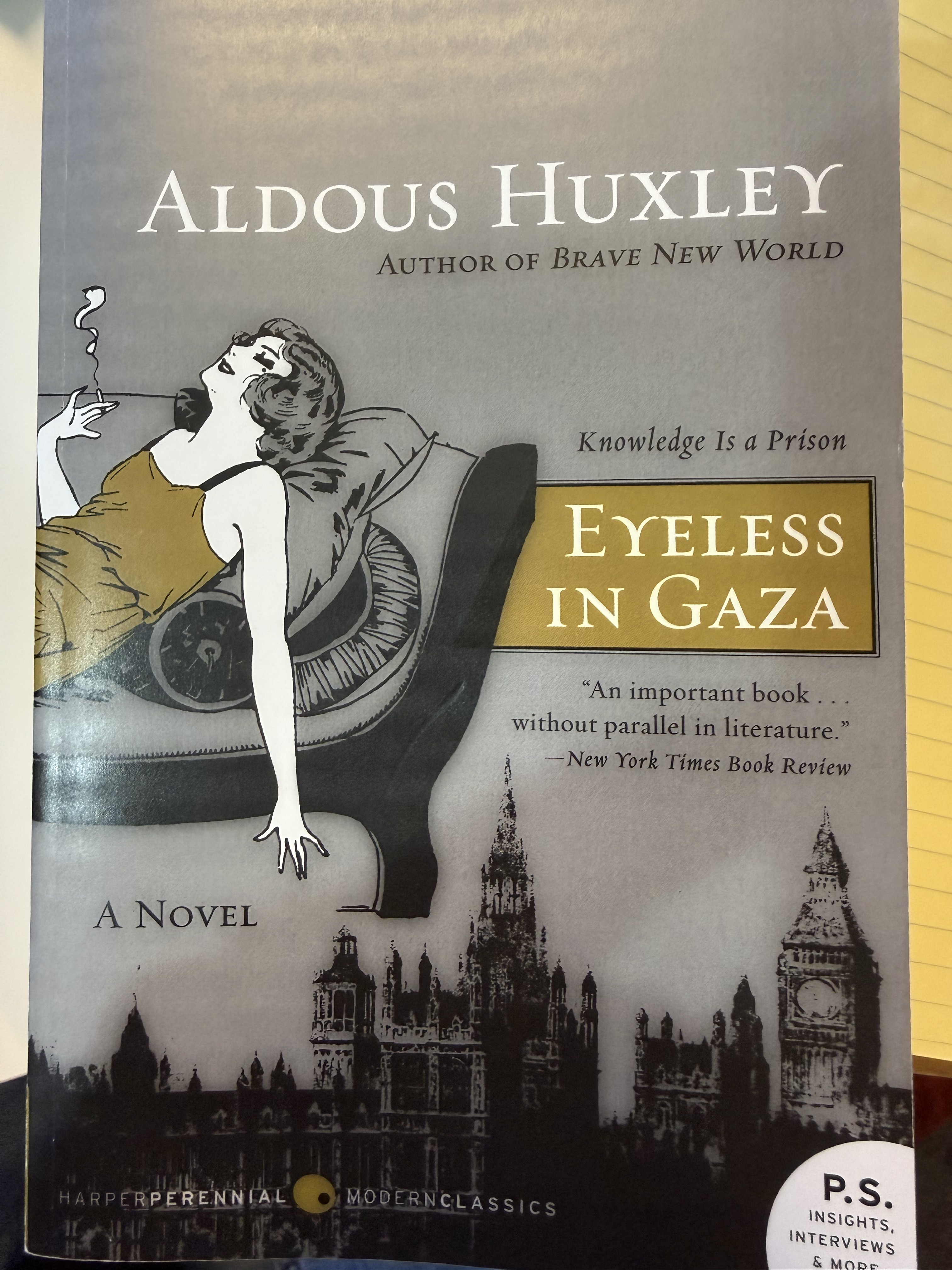
This was a difficult review.
Gaza is never mentioned in the book, but apparently (according to ChatGPT) it is taken from rom Milton’s Samson Agonistes. How appropriate. I never read Milton, but its fundamental influence supports the theory that this book is a pseudo-autobiography. I admit to bias when I saw Huxley’s picture, in his thirties (maybe?) on the back cover. He looks like the central character … let’s get to it.
This is a troubling story about a young man who is a member of the British elite in the 1930s. Anthony Beavis is an intellectual who finds hedonistic pleasure in reading and seducing women. He is not pleased with his lifestyle, but it satisfies his urges, so he sees no reason to change. The conflict arises as he recognizes the dissatisfaction he feels from this lifestyle. That’s where the story begins to fall apart.
The story of Anthony’s self-realization is one of disillusionment in his social status. The story is told, not in actions, but rather by inaction. He can never act, not because he doesn’t know the proper response to events, but because he is encased in concrete — social and personal. The entire novel is about his struggle with recognizing other people as being human and not objects to be avoided or exploited. This makes the author’s job more difficult because he must try to change Anthony without invoking supernatural effects.
He fails in this primary objective, in my humble opinion. The protagonist (Anthony) never truly confronts the obvious problems with his social behavior.
Anthony himself says that divine intervention caused him to meet Dr. James Miller, a physician who just happened to be approaching the hamlet where Mark was dying of gangrene. I have seen this kind of writing time and again. How do I transform this incorrigible person into the saint I want them to be? No problem. Invoke a miracle. Voila! Anthony is a new man, except …
The story ends with the same old Anthony, but with a slight adjustment: he is willing to risk his life for something he doesn’t really believe in.
The grammar is okay but relies, to an excessive level, on commas. I think Huxley lost track of some of his prepositionally dominated sentences. I’ve seen that before.
This is a story that follows a meandering path through the past to lead to a present that is no different from the past. Maybe that was the author’s intent. We struggle with our thoughts but fail to control them, barely managing, if we’re lucky, to nudge them in a slightly different direction.
I recommend this novel to anyone who has ever wondered if other people are as confused and misinformed as them.
Review of “Across the Sand” by Hugh Howey
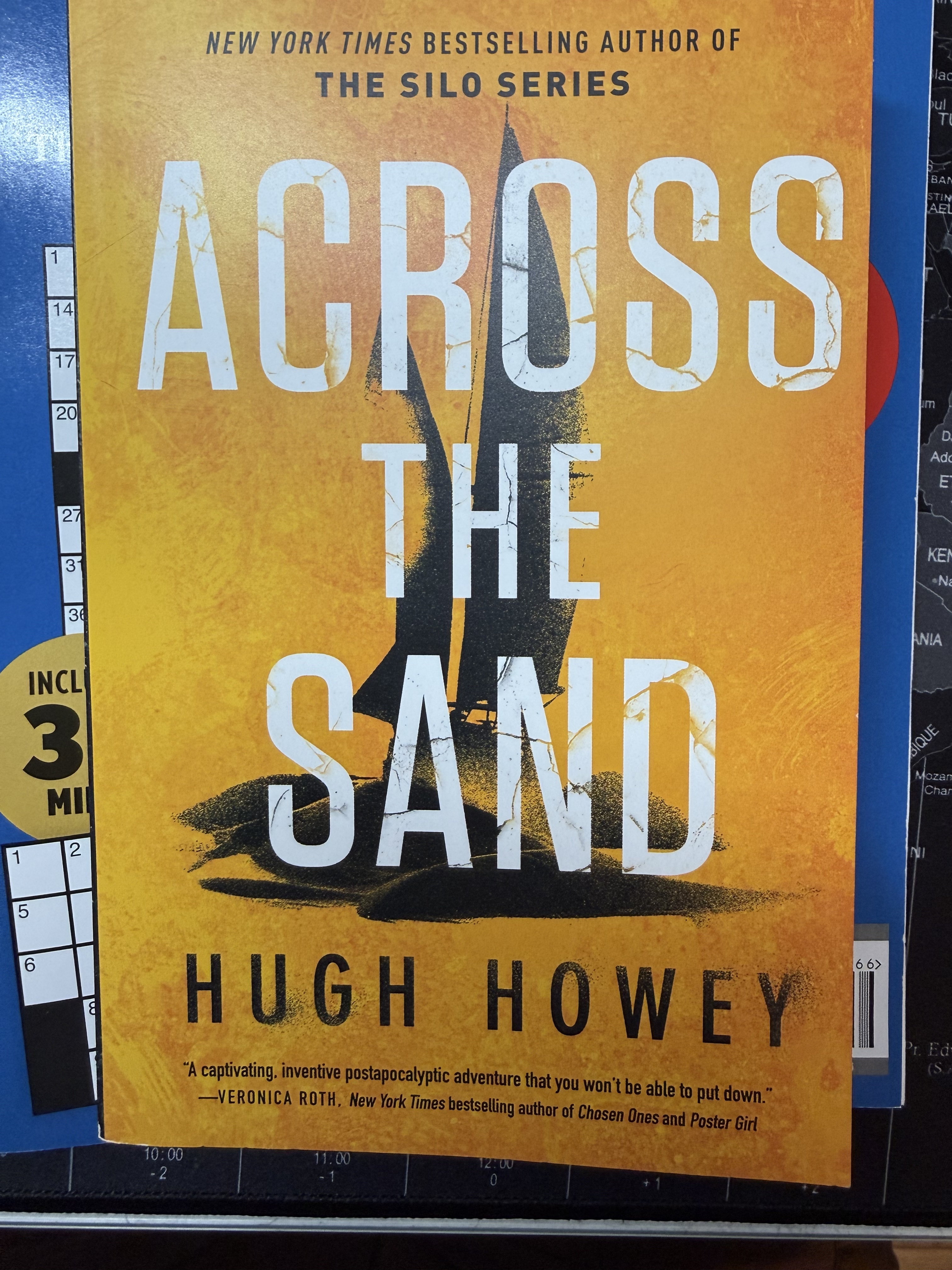
After seeing all the series of books written by the author, I was worried this was going to be a piece of a larger puzzle. I was glad to see that this is a standalone novel, albeit it occurs in the same world featured in his other books. Nevertheless, there were plenty of clues that this is one story from an entire world Howey has created.
The story takes place sometime in the future, mostly in eastern Colorado. However, the landscape is so drastically altered that it reads more like a fantasy, e.g. the Dune series by Frank Herbert. I think the author wrote a fantasy/sci-fi story and added some distorted, but familiar, place names to make it read like a postapocalyptic story. The world is so altered that it would take thousands of years, and that isn’t postapocalyptic–that’s the inevitable fate of all civilizations.
The central characters are children who take matters into their own hands to find their destinies. Overall it reads like a story for teenagers because the prose slows down and accelerates with the action; short, punchy sentences when something’s happening, and more refined writing for less dramatic scenes. Keeping that in mind, the writing is okay if uninspired. The erratic writing style is intentional because the story is told through multiple perspectives; however, the author keeps slipping up and reading everyone’s mind in several scenes. Another annoying habit the narrator had was referring to parents as “her father” and such, then using their name in unexpected situations. This dichotomy led to several passages I had to reread several times, and finally interpret it to what I thought the author meant.
It isn’t nice to confuse your readers.
The plot is well crafted, telling two stories through several perspectives (mostly children and young adults), eventually merging them in a climactic ending. The reason for the main conflict is never explained or even mentioned, so I was left feeling like this was a clever story written around a neat idea with no consideration of plausibility or realism. I’ve read enough science fiction to suspend disbelief for a few hundred pages.
As modern science fiction goes, this is a good story–but it shows signs of being rushed and not carefully edited. The premise is great but it was removed from the oven before it was finished.
Review of “Our American Israel” by Amy Kaplan
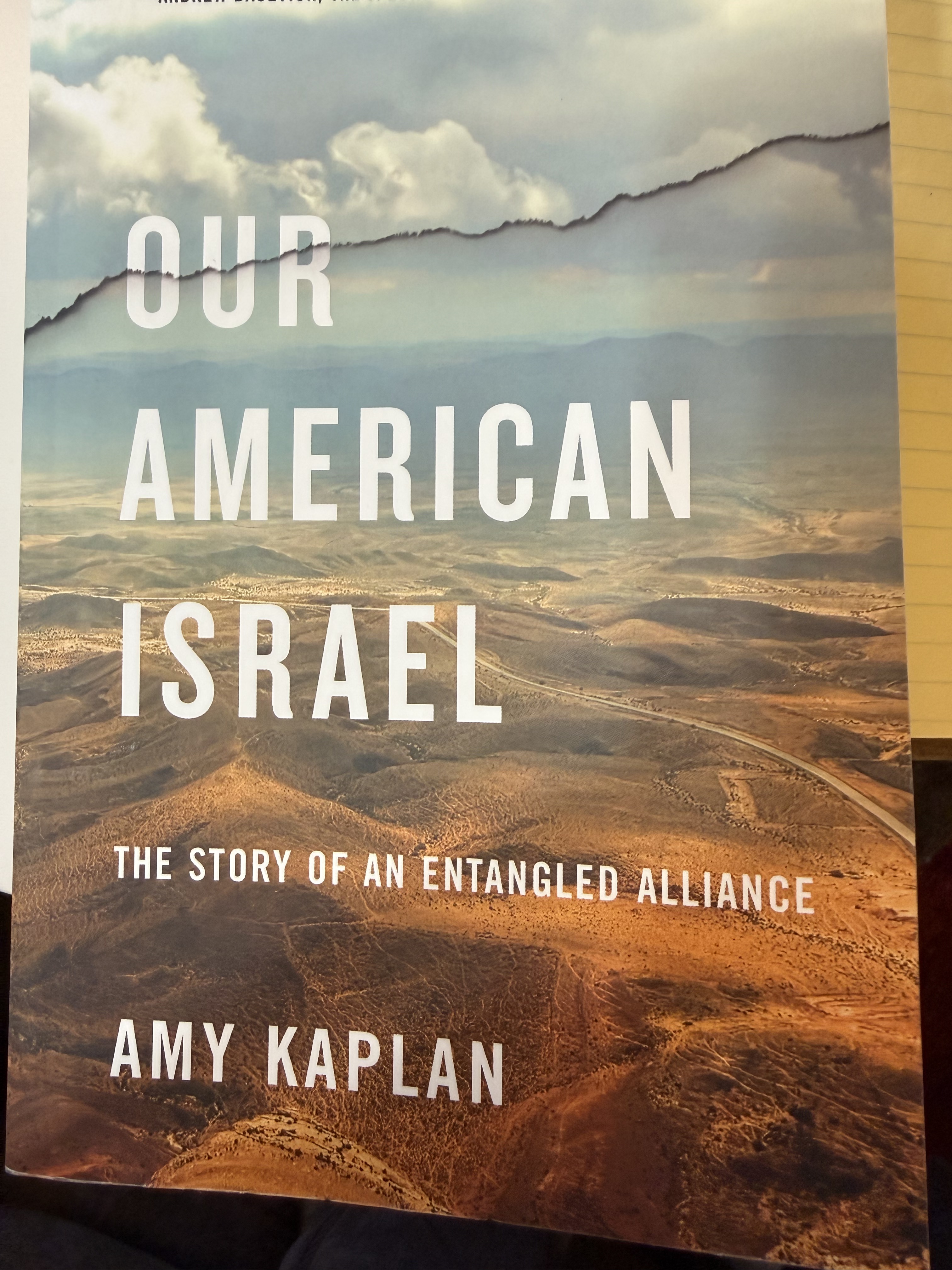
This book is an objective, if potentially disturbing, history of America’s relationship with Israel. The author does a good job explaining a lot of what I witnessed during my life, but she ties all those disparate news stories into a coherent picture of the myriad special interests and fantasies comprising America’s global perspective. Kaplan is a professor of English, so the writing and punctuation are very good and mostly readable. However, I started finding cut-and-paste errors in the last third–better than most authors accomplish.
A lot of the public perception of the American-Israeli relationship is told through detailed descriptions of Israel as presented in movies and newspapers, including short quotes from cited sources listed in the appendix. This got a little excessive in my opinion. Nevertheless, it served as the cement that bound the news into an accurate depiction of this complex relationship.
The picture is presented in a balanced approach for every aspect of this alliance, leaving the reader to make up their own mind; however, I suspect that Kaplan is skeptical of the mainstream story as portrayed in the press and government statements. I applaud her discipline in not saying what I voice daily; but this book was published in 2018, and a lot has happened since then.
I definitely recommend this as background for anyone trying to understand what the hell is going on in the Middle East, and America’s role in this unstable part of the world. While I was reading this book, I stumbled on a YouTube video by Andrei Jikh about recent events in this region and their potential impact on the global economic system, which proposes an economic reason for America’s support for Israel–the root cause for instability in the region.
This book should be treated as a primer for understanding why U.S. presidents have reaffirmed America’s unwavering support for Israel, no matter how the rest of the world interprets its actions.
Review of “The Break Down” by B. A. Parks
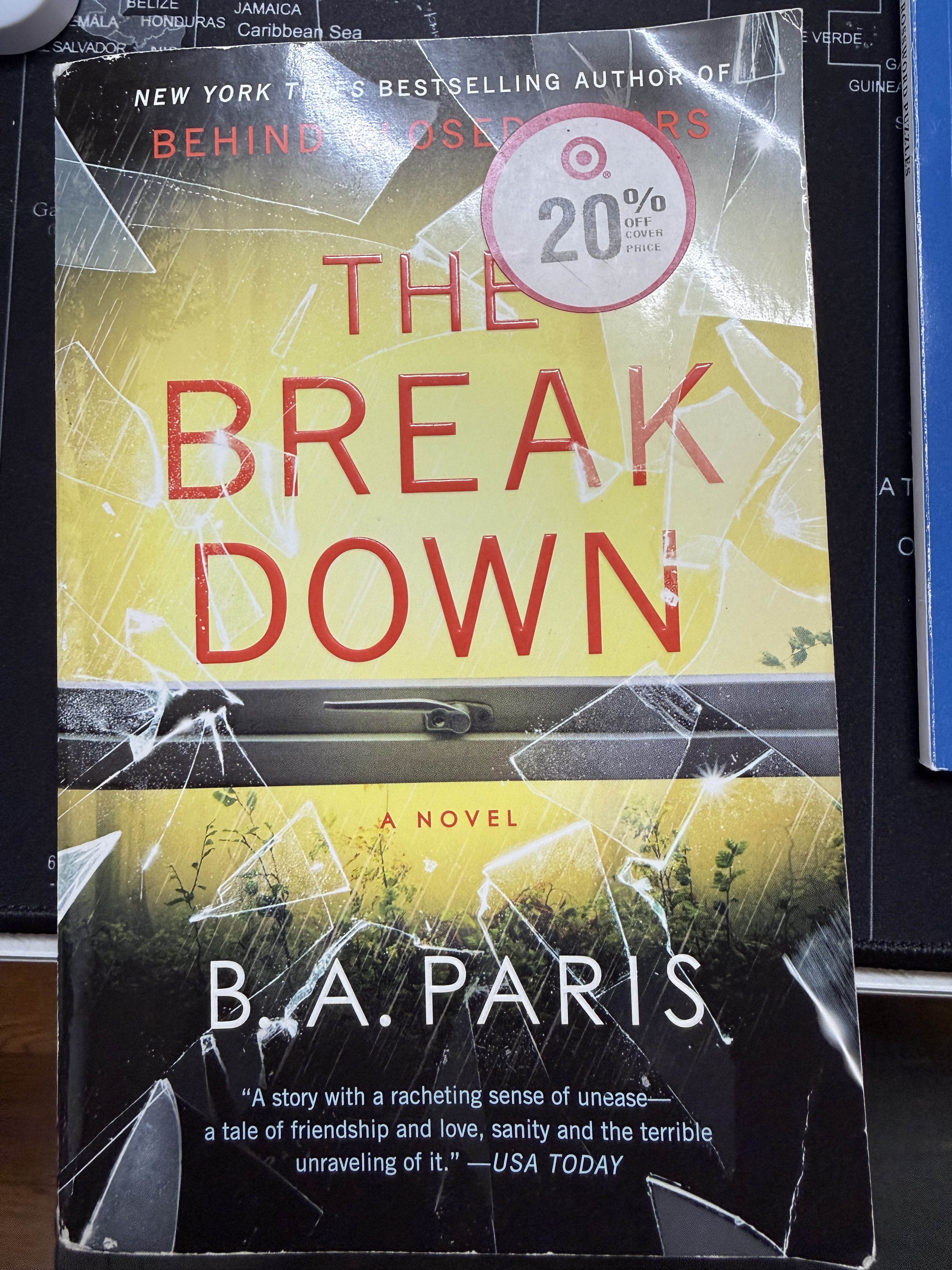
It’s difficult to avoid comparisons between this mystery novel and one I reviewed recently because they are so similar, even though this book was written in 2017 whereas You Don’t Want to Know was written in 2025. I don’t want to give away the plot, so I’ll only say that they could have been written from the same outline. I guess that means that gaslighting has become a standard tool in mystery novels.
The author does a good job presenting the break-down of the central character’s mental state as the days go by. The reader is reminded of passing time by chapter headings using the date. The victim is the first-person narrator, so the story involves a lot of introspection. Sometimes this internal dialogue gets more than a little repetitive. The lack of another perspective also means that the reader only knows what Cass (the protagonist) thinks about explicitly, which requires a clever gimmick to avoid the antagonist telling all in Act III. The author pulls this off very well.
The suspense is somewhat downgraded because we know that Cass is losing her mind, so whatever boogey man she’s imagining isn’t really there. However, her state of mind, including fear and paranoia, is presented in a believable way. I could sympathize with her apprehension about a murderer being on the loose in her remote neighborhood, given her disintegrating sanity.
This is a decent story that kept my attention enough to read a few pages every day. Some books feel like a homework assignment. I have to admit, however, that I wasn’t surprised by the ending because I had just finished You Don’t Want to Know. I greatly prefer this story because it has fewer meaningless characters and subplots, and it is 300 pages shorter.
I found the narration and general tone pleasant enough, so I don’t have any major complaints.
I recommend reading The Break Down if you stumble across it.
Review of “You Don’t Want to Know” by Lisa Jackson
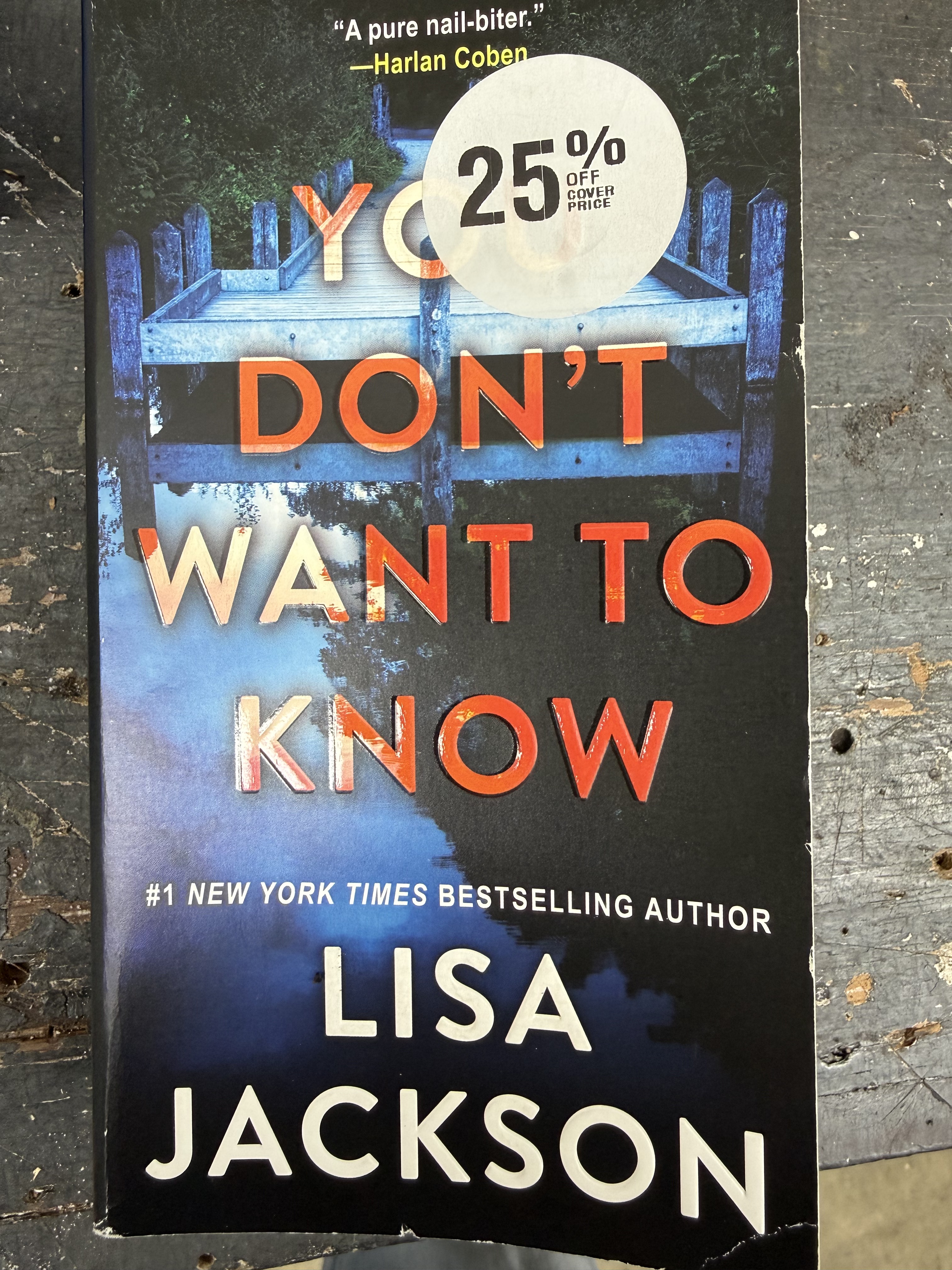
The title says it all.
I bought this book because the back cover suggested that this is a story about a woman who had a mental breakdown and finds herself doubting her own sanity after attempting suicide and hallucinating her missing son’s presence after two years. The author does a great job on the character arc. I had to keep reminding myself that the central character’s self-destructive behavior was due to her mental condition. That’s where my interest ended.
I don’t read mysteries in general because they are formulaic. The reader can’t help trying to figure who did what, which is a waste of time because the author can do anything they want to spice up the story and maintain interest. One of the comments read, “Multiple red herrings and a host of sinister characters help keep the pages turning.” I guess I don’t know what makes a good red herring because I was tabulating points for/against each character’s likelihood of being the bad guy, rather than jumping at every insult and personal snub.
I don’t think a 604-page book can be a page turner. More than 200 pages passed in boredom before anything happened, partly because the author kept repeating the biographies of the many characters. Things sped up after that, but I’d already lost interest. I truly didn’t want to know who did what to Ava Garrison.
The author used a technique I’ve used myself, which unfortunately paints the narrative into a corner. Many of the chapters begin in a scene and then summarize an event from the past, which requires use of the past perfect tense (e.g., she had gone to work). This is great until it isn’t. This book abuses it, often relating pages of past events and overusing the past perfect, sometimes with two phrases like the example above in one sentence. I don’t know if there are any rules about this, but I use readability as my guide; the author pushes this well past that point.
There were some well-written scenes with “nail-biter” tension. I guess that’s what Jackson is known for. Overall the book is okay, but way too long and repetitive. It’s too long to be a quick read and the subject isn’t worth 600 pages–maybe 350.
I think that authors/editors don’t read books from the reader’s perspective.
Review of “Satantango” by László Krasznahorkai
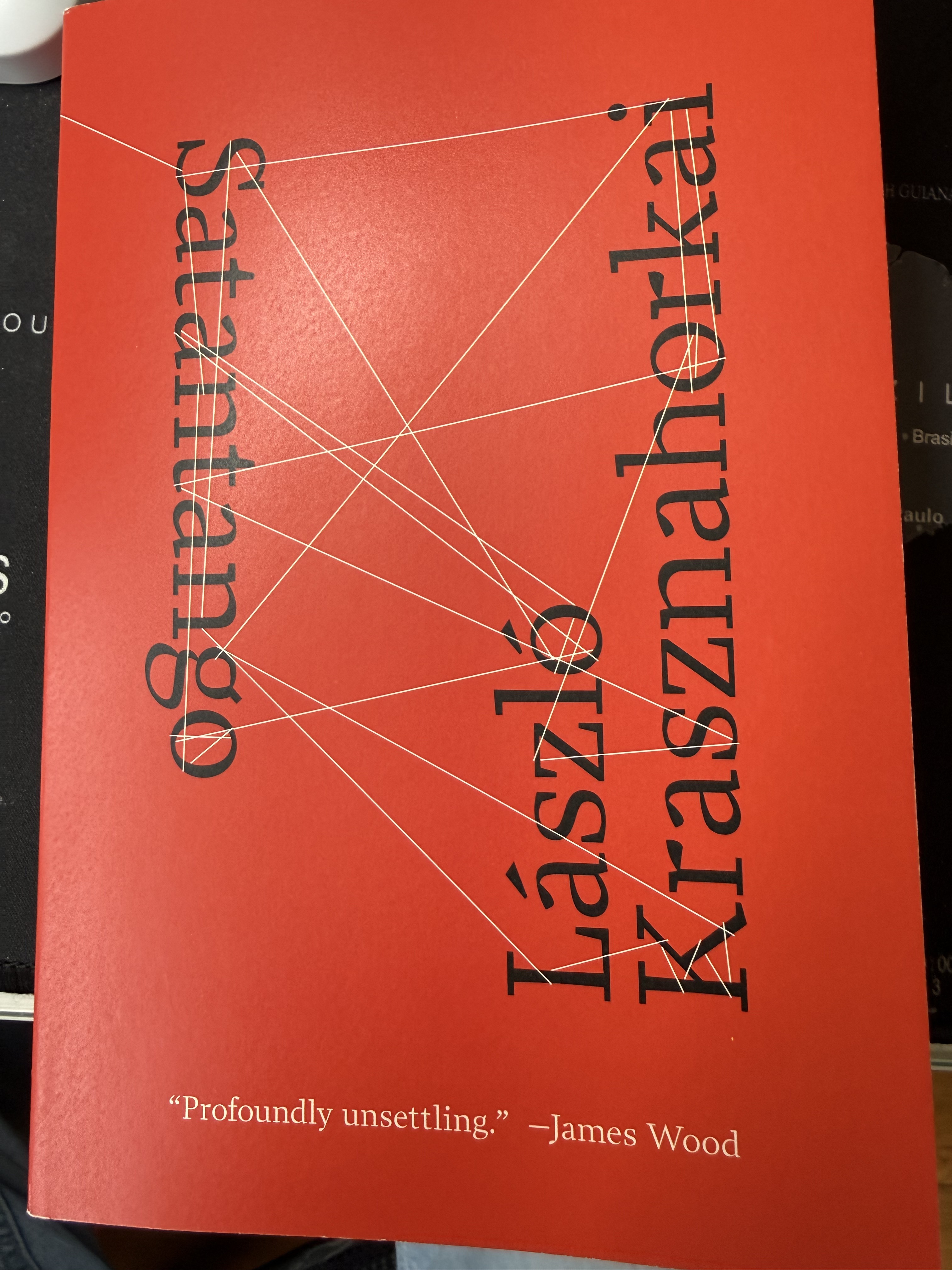
I don’t agree with James Wood, whose summary review is printed on the cover of this post-modern novel. This story is not profoundly unsettling; however, I think I know why they used that phrase.
This book was translated from Hungarian. I give two thumbs up to the translator, George Szirtes, because this was undoubtedly a monumental effort. There were very few grammatical errors and only a few missing words. The reason I am so impressed is that each twenty-plus page chapter comprised a single paragraph, which ranged across time and multiple characters, rather than focusing on a single character’s state of mind. Needless to say, this was a page turner; I couldn’t put it down until I finished each chapter/paragraph.
I couldn’t easily identify a plot, character arcs, or any other common literary themes in this work. The best way to describe it is as a literary journey into the lives of several individuals left behind in a changing society. No one is spared having their minuscule existence laid bare for the reader, even those who think they are in control. Everyone is portrayed as an unnecessary and redundant piece of machinery that is being tossed into the garbage after the social system on which they depended has broken and cannot be repaired. But none of them suspect the truth as they drag their tired minds and bodies through rain and mud towards a goal they know to be futile. If they are lucky, they can remain in stasis until they die, hopefully soon.
This bleak summary may sound “profoundly unsettling”, but only from an existential perspective. The reader shouldn’t be upset by their pathetic lives, however; there is no undue violence perpetrated on the characters, no shootings, not even self-recognition of their sorry state. They are oblivious. Perhaps that is why James Wood found it so disturbing; they didn’t even notice that the world had left them behind. I try not to read too much into novels, so maybe I don’t give as much weight to such literary analyses. I’ll leave that to scholars of literature.
You might be surprised to hear that I recommend this book, not for its literary value or deeply spiritual insight into post-modern civilization. It was simply fun to read a book where I didn’t have time to think about what came next. The author succeeded in bringing me, the reader, into a stream-of-consciousness experience in which I lost track of time.
I was just along for the ride…
Review of “The Folded Sky” by Elizabeth Bear
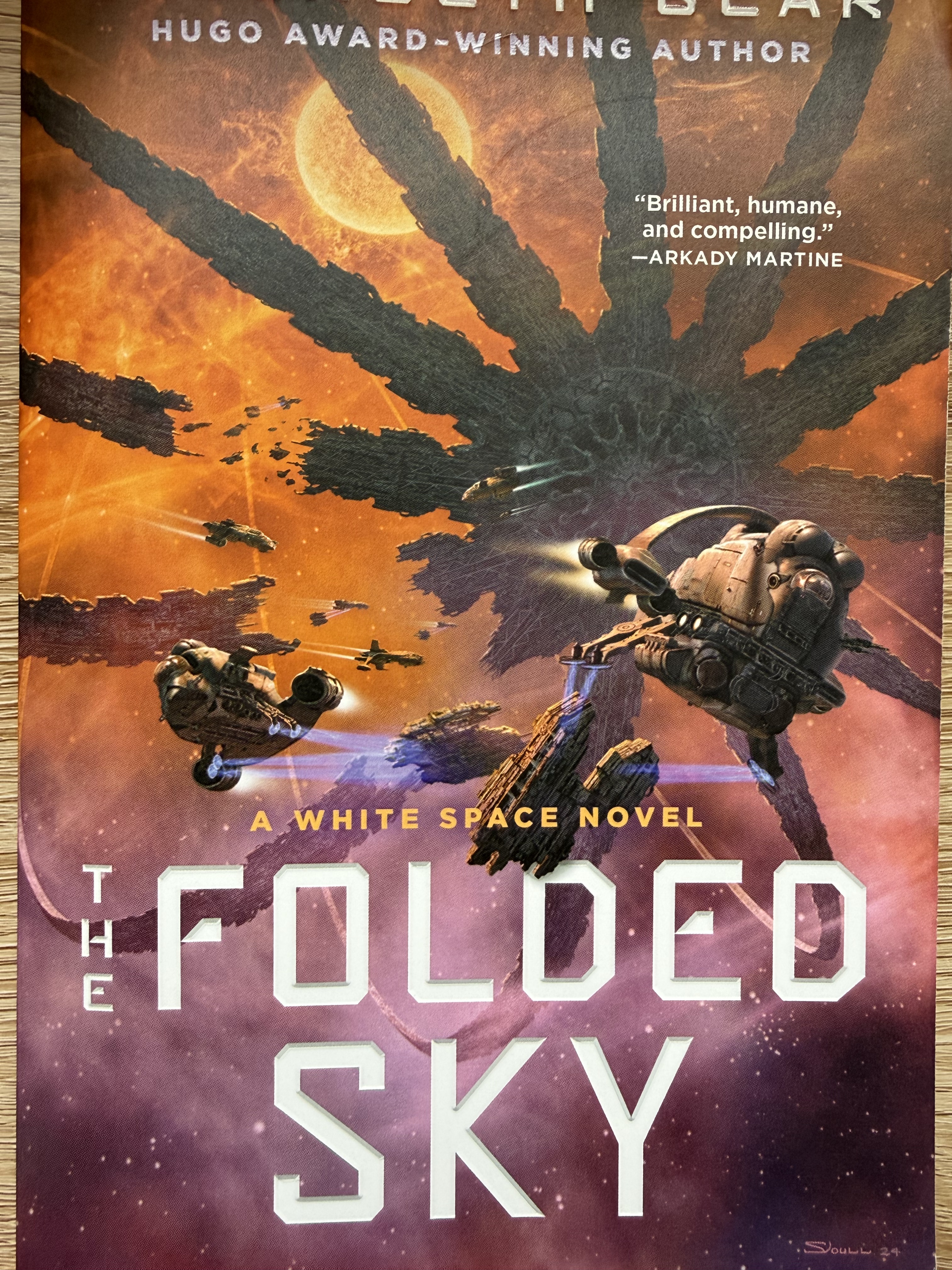
I’ll start with the easy part. The author has created an entire galaxy of worlds, which I assume define the “White Space Novel” series. There are even pirates, humans who want nothing to do with the modern world or aliens, which there are plenty of in this story. The action scenes aboard various spacecraft are well written and exciting.
The story is a mix of banal family drama and high-energy action scenes, all set to the backdrop of an imminent stellar explosion. The combination doesn’t work for me. I’ve been trying to figure out why, and I finally decided that there are too many antagonists. The story gets convoluted and it is hard to know who or what is an actual threat. The family scenes took up most of the first third of the book; I think the author realized they had lost track of the plot and jammed all the action they could into the last third.
At least twenty percent of the book is wisecracks by the first-person narrator. They used every simile and metaphor in the TWENTIETH CENTURY books. Maybe this is because the central character studies ancient civilizations, but her family had left earth only a few generations before the story takes place. It was very difficult to remember that they are a serious scientist with all the supercilious comments. Overall, this unnecessary self-reflection seriously detracts from the story, and adds a lot of pages.
There’s too much going on…but nothing. Once it became obvious that the pirates were just background noise, the book reduced to a whodunnit about a couple of attempted murders. Every seemingly hopeless situation is miraculously overcome with more fantastical alien powers. In other words, the story is contrived to fit the author’s predetermined ending. All authors do that to some degree, but it was a little too obvious in this book.
If you like space operas you’ll probably enjoy this book.
Review of “ALL THE DARK WE WILL NOT SEE” by Michael B. Neff

If only my sore eyes, bloodshot from pollen, stress, and lack of sleep, had noticed the first ill omen, waving like a red flag on Waimea beach when surf’s up, on the scintillating cover of this book. A list of names that reads like the playbill for Superman, after he had saved the world yet again, whose meaning I didn’t grasp until my mind had been dulled by drinking in this tale of star-crossed lovers swimming in a shark-infested bay connected to an ocean filled by prehistoric behemoths, a vast chasm only glimpsed by their perspicacious intellects, unobserved by unsuspecting mental midgets like myself. The forbidding cover, a vigilant guardian of truth and their giant eagle, reached into the depths of my soul, like a Stephen King novel on a stormy night, and warned me as clearly as a sunny day, to go no further. Yet I was driven by the will of Vishnu …
Enough of that. My point is that this book is written like poetry, filled with allegory and metaphors. At first I thought this was a great way to reveal Edison Eden’s tragicomic perspective, but the author used it for the narrator … pretty much everyone whose point of view is displayed in this tragic tale of deception, manipulation, betrayal and outright insanity. The feelings of the characters are amplified wildly by the writing style. It was a bit much for me.
This is a well-written book with some annoying grammatical errors, e.g., systematic missing possessive apostrophes in the same person’s name. Almost like a machine wrote it. Probably the publisher’s editing software.
This is a work of fiction, so the Office of Special Counsel and several other whistleblower protection agencies, were replaced by the fictitious Office of Whistleblower Counsel in the novel. The author weaves a believable imaginary world around this dim space in a concrete bastion erected on K Street, populate by gods, demons, acolytes, and other celestial beings.
It isn’t my cup of tea, but it’s a good read if you like metaphorical writing …
Review of “Sleeping Giants” by Sylvain Neuvel
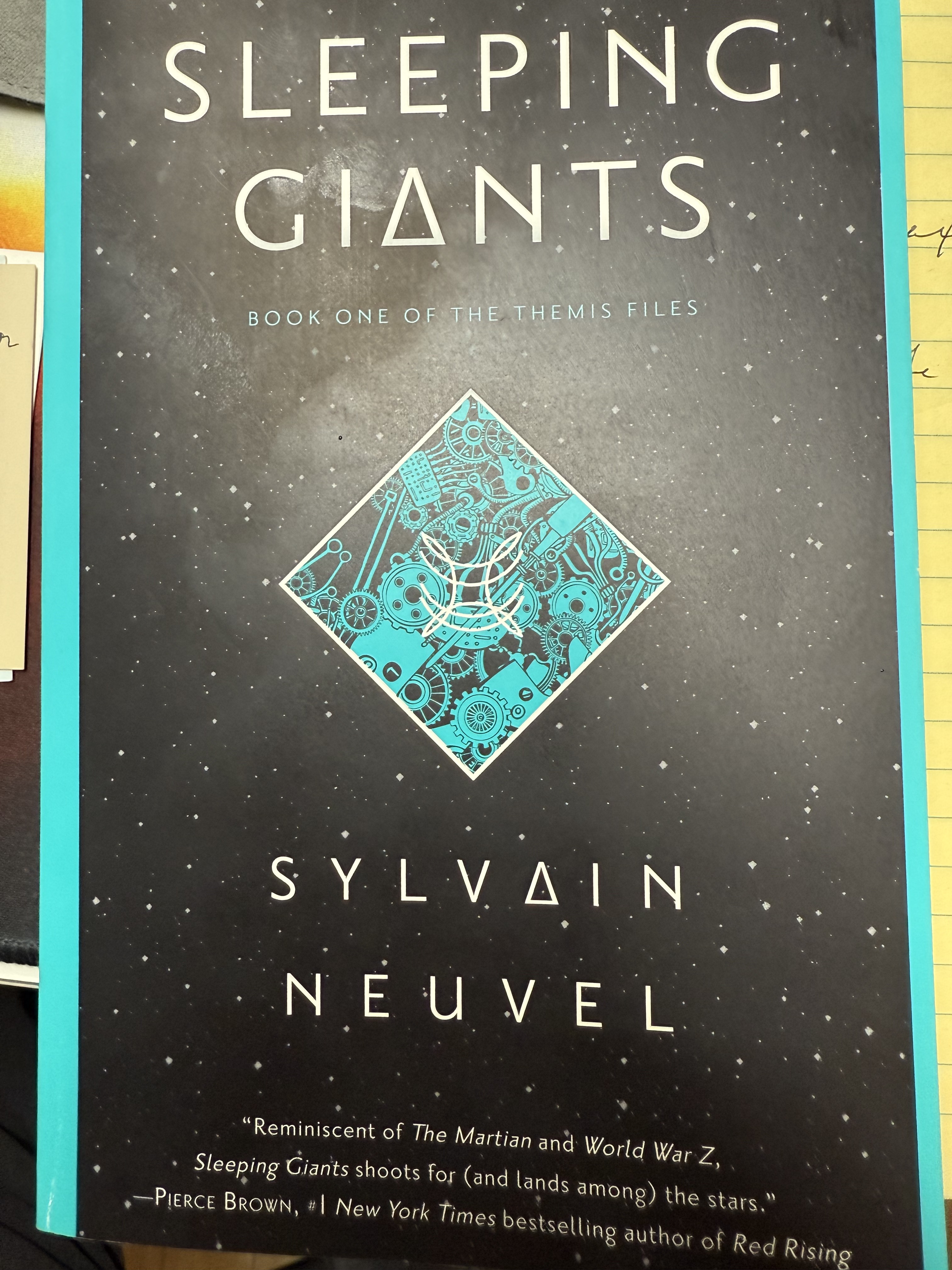
I’ve been reading science fiction in preparation for a writers workshop, focusing on the First Contact sub-genre. This commercially published book violates most of the rules that were introduced … we were also warned that publishing is a crap shoot. This isn’t actually as bad as you might think.
For one thing, this is a great title. It grabbed my attention on the lower shelf at Barnes and Noble, and that takes a lot of effort (kneeling down, trying not to be trampled). It was nestled between a lot of second and third books in trilogies. I guess not many people get past the first one. In fact, the fine print says this is book one of the Themis series. Fortunately, it is fine as a standalone story, ending on a hopeful note but giving the curious reader the chance to see how humanity screws up this galactic opportunity. I like the happy ending and skip the sequels.
The story begins with a little girl falling into an unexpected hole and landing in the palm of a twenty-foot hand. I thought the newspaper story style was convenient, but the entire book is written as interviews, reports, and diary entries. I eventually decided that the unnamed interviewer was the narrator and central character. As you might imagine, this killed the action scenes. They aren’t nearly as exciting when related after the fact. To reveal how the characters feel and their romantic lives, the narrator asks rather personal questions; they aren’t a therapist but only a program manager.
A lot of backstory is introduced by characters introduced simply to supply information. I felt I was missing need-to-know information because of this plot gimmick, until it was too late. Kind of like Perry Mason and his suddenly appearing witnesses.
There isn’t a lot of action, even accounting for the delayed reporting used, but there is a love triangle, jealousy, and even a suddenly psychotic evil scientist. The author’s choice of using an interviewer is interesting but it makes the entire story feel distant, like reading the newspaper, and that isn’t why I read novels.
I’m ambivalent about this story. It isn’t bad and, fortunately, not drawn out, so my recommendation is that it won’t put you to sleep … nor will it keep you on the edge of your seat. After what I said above (about the publishing business), I applaud a publisher willing to take a chance …
Review of “Dreams in the Eternal Machine” by Deni Ellis Béchard
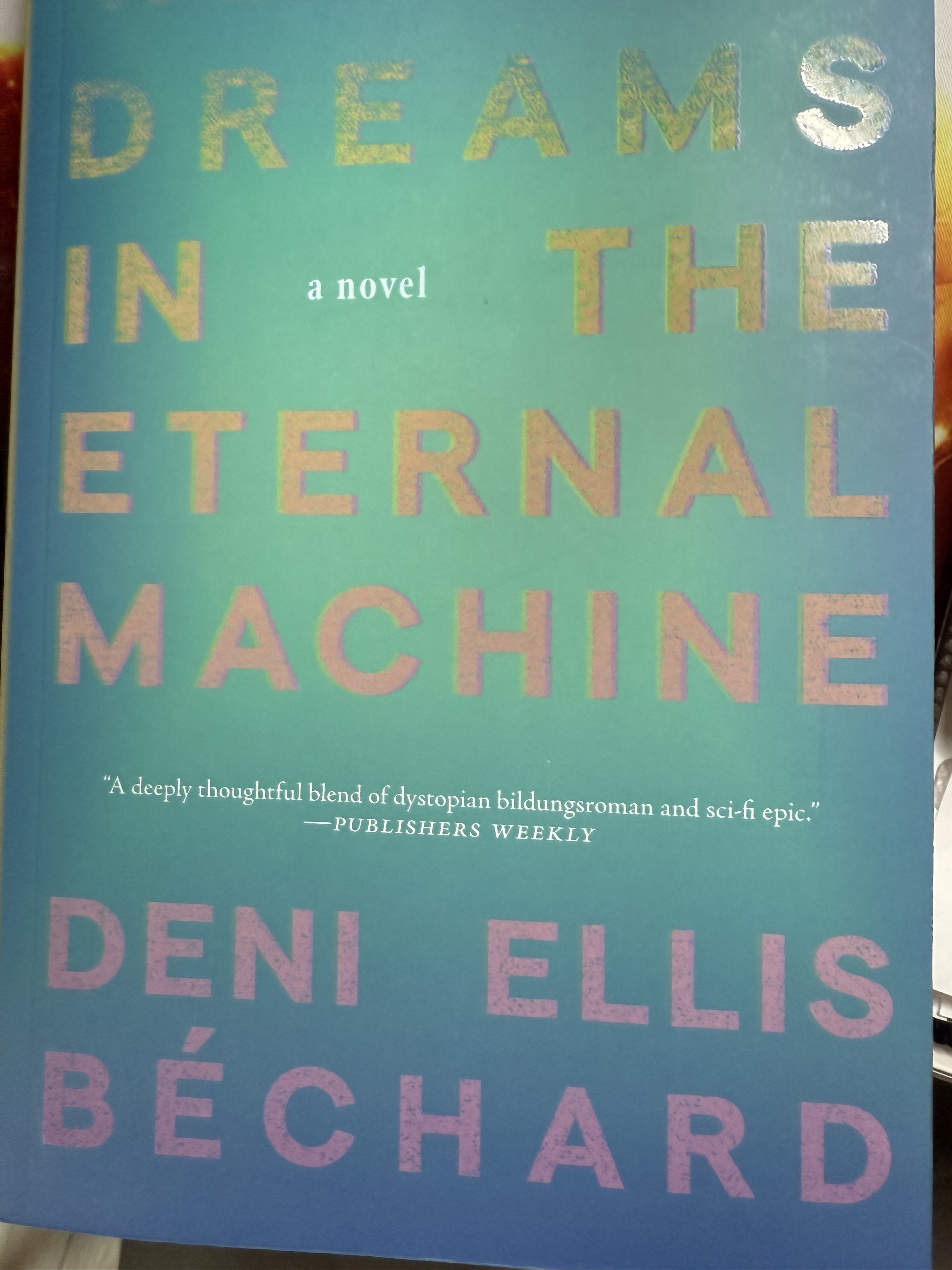
There is no surprise ending to this speculative science-fiction novel. The secret is in the title and explicitly introduced in the first few pages. Everyone on earth, including the planet itself, has been assimilated by an artificial super intelligence whose rapid development far surpassed its creator’s imagination. So what is the plot?
Wrapped in a science fiction cover is a Shakespearean story of betrayal between young people who accidentally meet in an American divided by civil war. Their story is integrated with their separate experiences after assimilation into the machine, and it remains unresolved. The only other evidence of a plot is the general decline in cognitive and emotional wellbeing of the majority of people. This process is explored through several characters whose importance to the plot is never clear. In fact, no one really stood out as being the central character, other than the two young people mentioned above. Having a plot doesn’t require the central character to succeed; failure is the stuff of tragedy and perfectly okay, but no one really struggled against the antagonist (obviously the eternal machine). Their situation is hopeless and there is no chance of escape — not even the slightest. Hopeless.
Given the lack of a coherent plot or even a central character, this story is fundamentally about the response of people to a hopeless situation in which there are no threats of any kind. The machine not only feeds and cares for its dependents, it creates any world they want to see and experience. Spoiler alert: Heaven gets old after a few centuries.
The writing is very good, and the author doesn’t miss a trick to get an agent’s attention and produce a popular book. It seems to me that agents probably don’t think very hard about the books they represent. And, of course, the reader doesn’t find out until it’s too late, the money spent. That’s how I felt. As far as the reviews, I never cease to be amazed at the glowing reviews written about this novel; I guess critics don’t read books either.


 Timothy R. Keen
Recent Comments