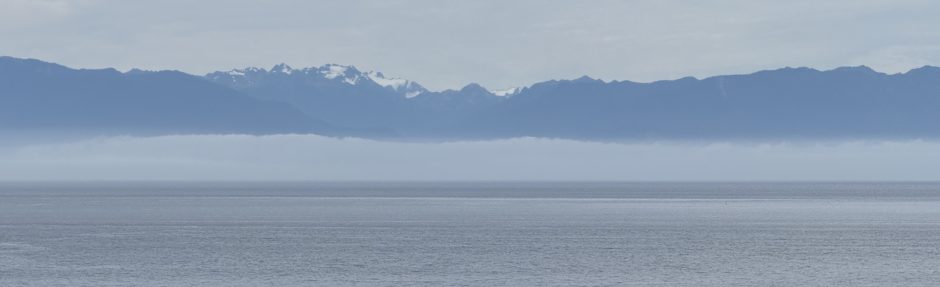
Flaming Geyser State Park
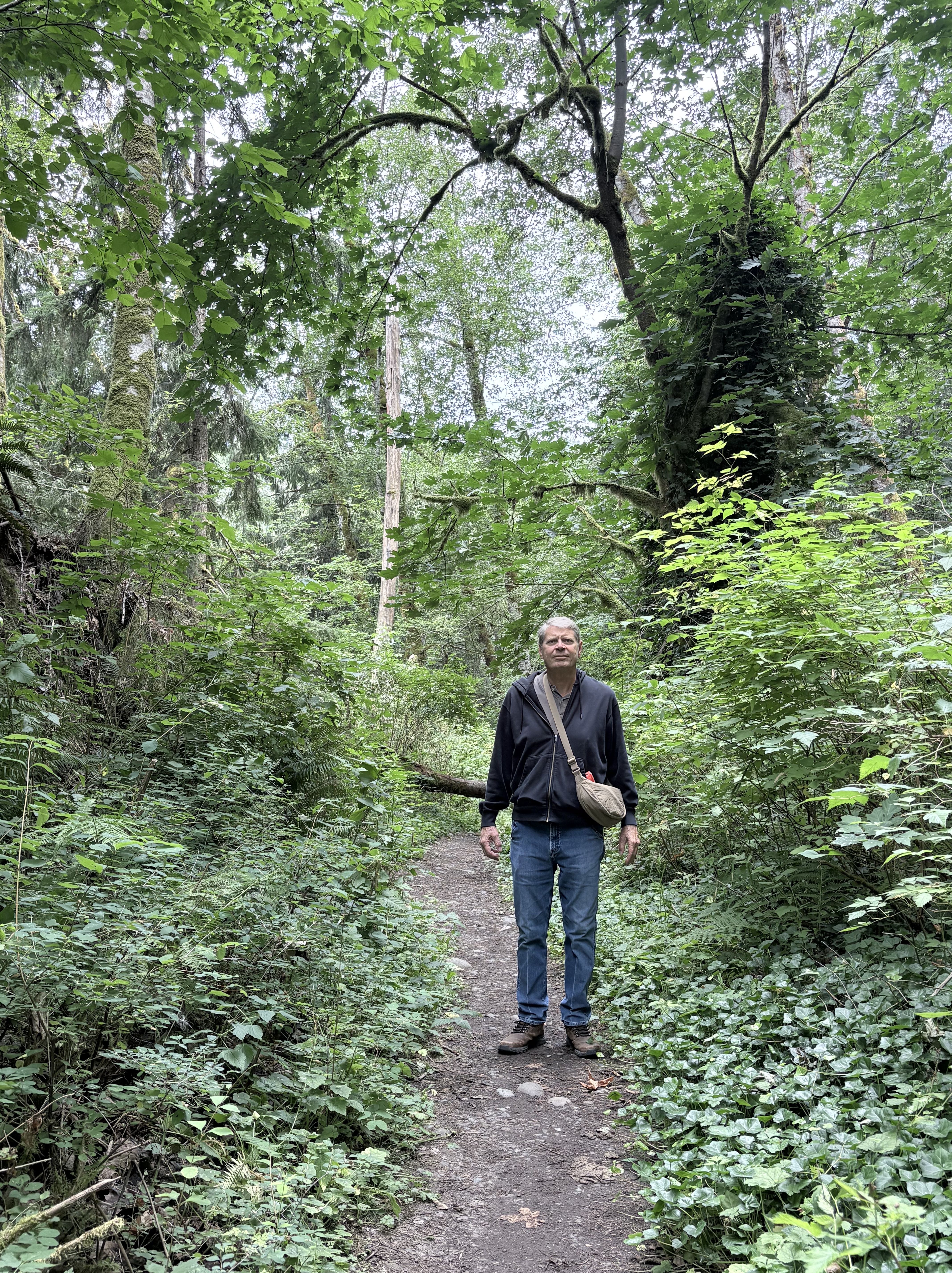
The park is located at the upstream end of Green River, where it enters a gorge. This is one of the best places I’ve seen anywhere for taking a stroll through nature; the path is moist but not muddy, and well trimmed, with breathtaking natural scenes like this. A veritable Garden of Eden. This post is an overview of the park; I discuss the geology and flora in other posts.

With a name like that, I’m expecting a spectacular show…
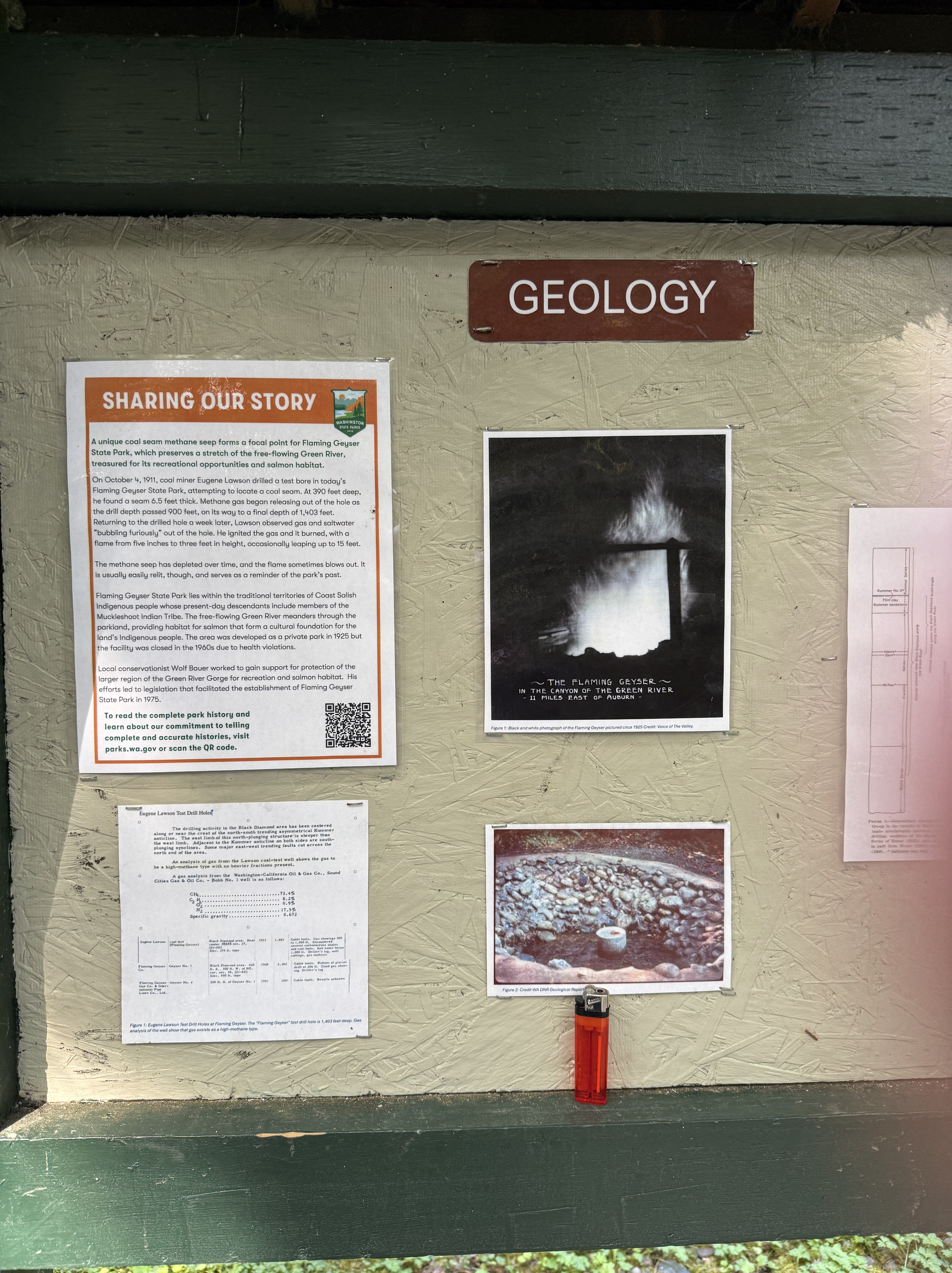
I’ll summarize what you can read if you zoom in on the information presented in this billboard. An exploratory well was drilled here about 100 year ago, looking for coal–they found it, along with methane (natural gas) and other gases produced by decaying vegetation at several hundred feet below the surface. The small well produced a flammable gas that has burned intermittently since it was first lit by a geologist.

Flaming geyser wasn’t very active when we visited, but it was burning. To repeat, this is NOT a natural seep, but the result of a well drilled a century ago. Nevertheless it has become a local tradition, and it is relit whenever it goes out.
Bubbling geyser is a lot more fun. This video shows small bubbles of methane, as well as hydrogen sulfide and other, unnamed, gases. Methane is odorless, but this area smelled strongly of H2S, which is added to natural gas to help detect leaks.
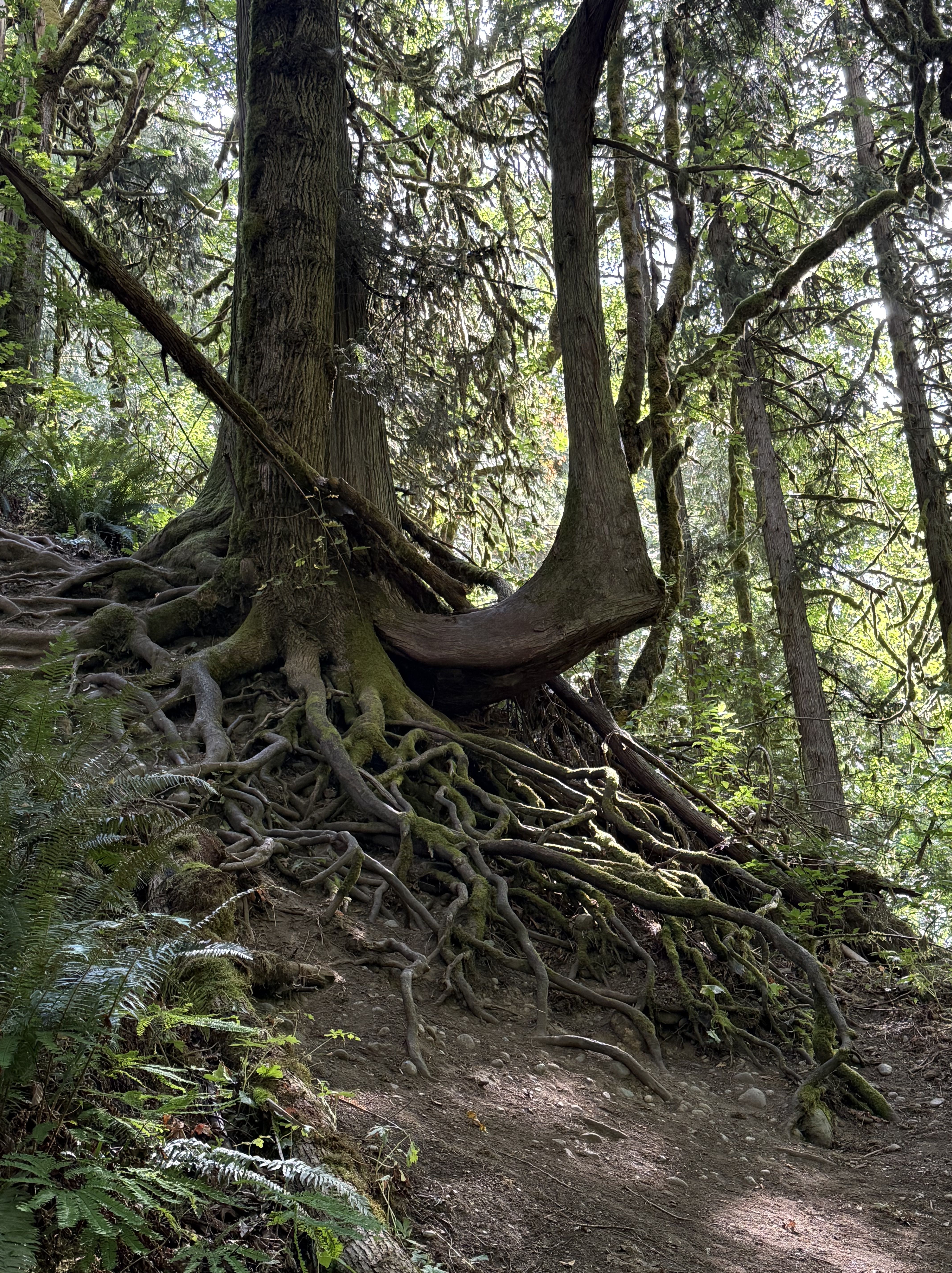
This is a beautiful example of survival. The surface roots have all been exposed by erosion, but the tree is thriving; its roots have turned into separate trunks. I read somewhere that these conifers in the PNW send their roots out for hundreds of feet, far beyond their canopies.
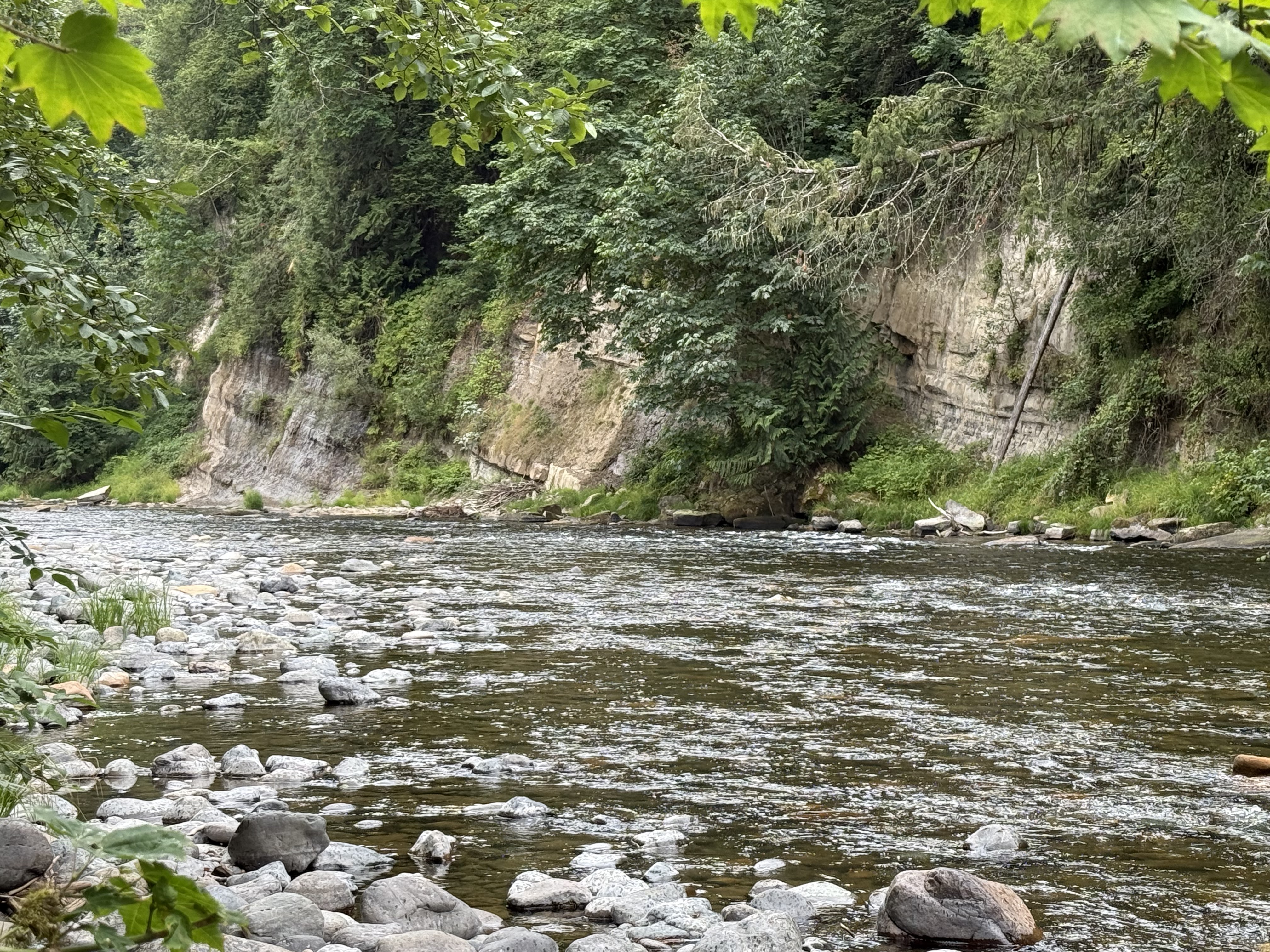
This is where Green River Valley turns into Green River Gorge. The water was perfectly clear, with a slight green tinge, even though there is no algae visible. It reminds me of Commencement Bay, which is also devoid of aquatic plants. And it is all natural, simply a unique ecosystem.
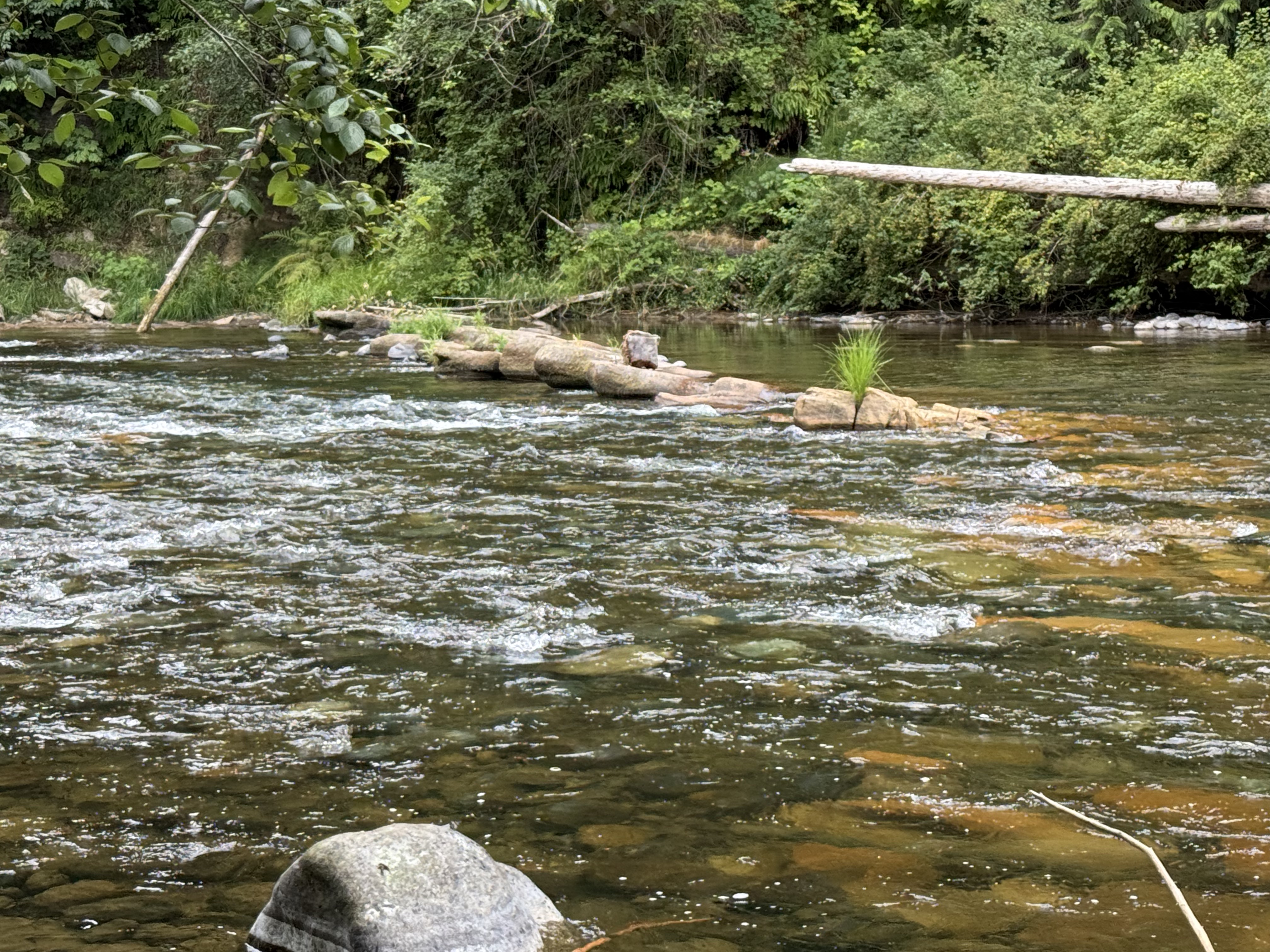
If you wear waders, you can walk on water here.
Final Thoughts
This is a place you have to visit for yourself, especially on such a gorgeous summer day. The temperature was in the mid-seventies, the sky was clear, and people were filling the huge number of picnic areas, carrying their supplies and tubes, ready for a fun day of floating down one of the best rivers I’ve ever seen.
You’ve got to see it for yourself.
A Day Trip to Yakima
We wanted to see what was on the other side of the mountain, so we headed east from Tacoma and crested the Cascades at Chinook Pass. It was snowing at the pass and fog/clouds obscured what were probably majestic views. We pushed on to Yakima and found the Cowiche Canyon recreation and conservancy area.
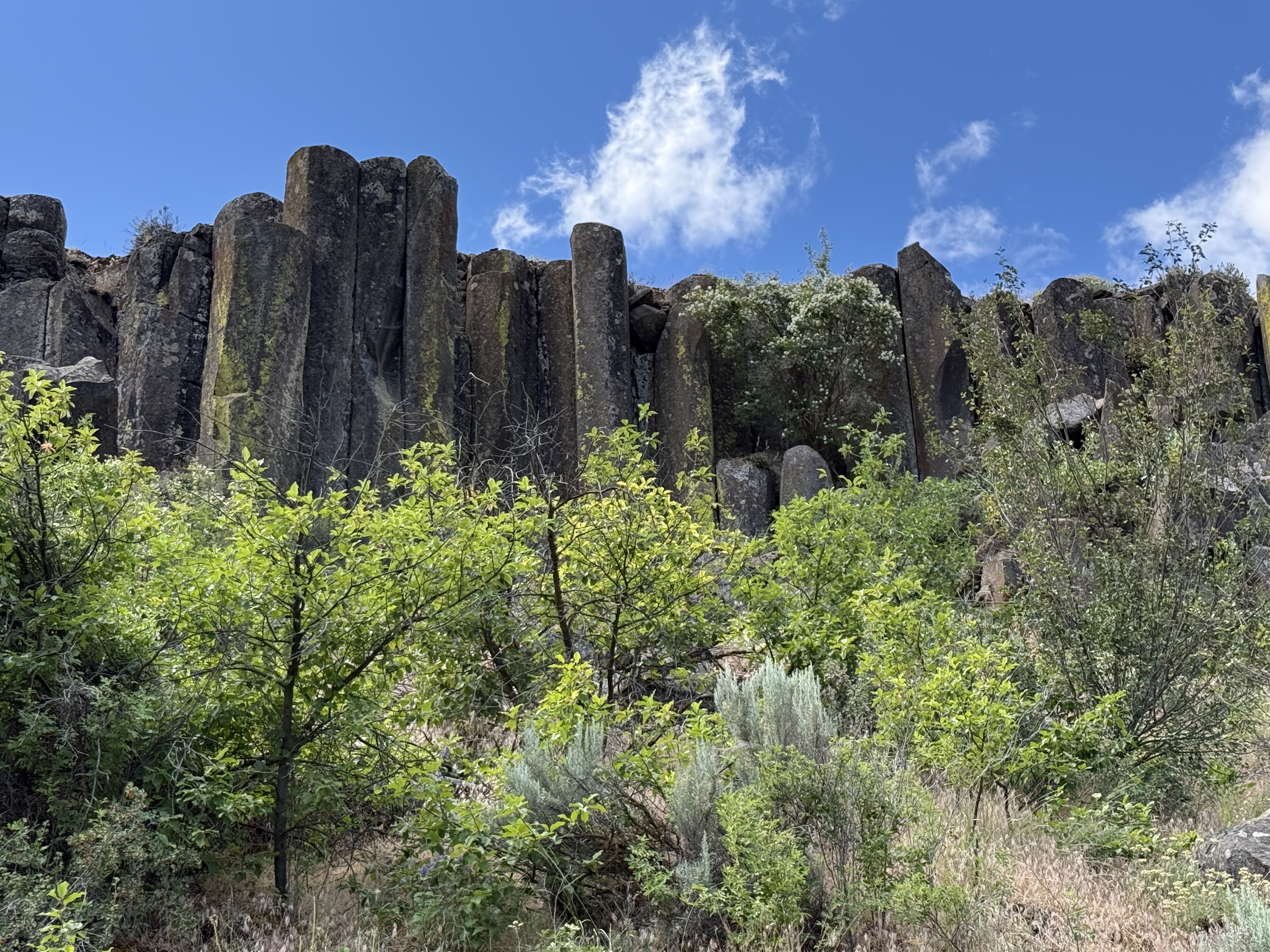
This is a typical view from the trail, which follows an old rail line that was used for seventy years to haul apples out of the area. I have discussed the columnar basalts and vegetation in previous posts. It was late spring and all of the plants were showing their color while water rushed past in the creek at the bottom of the canyon.
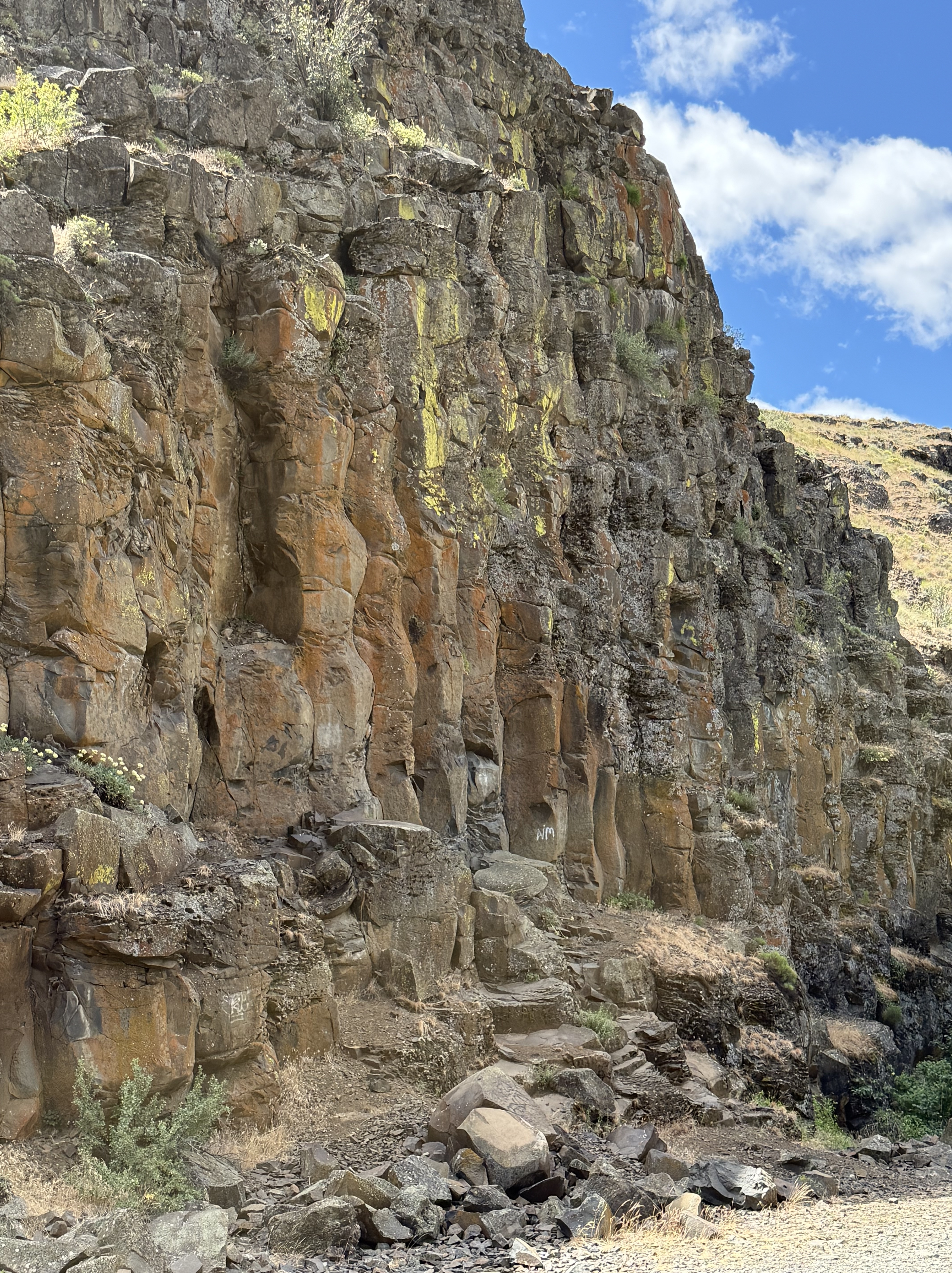
This undulating columnar basalt caught my eye because of the color and its wavy appearance.
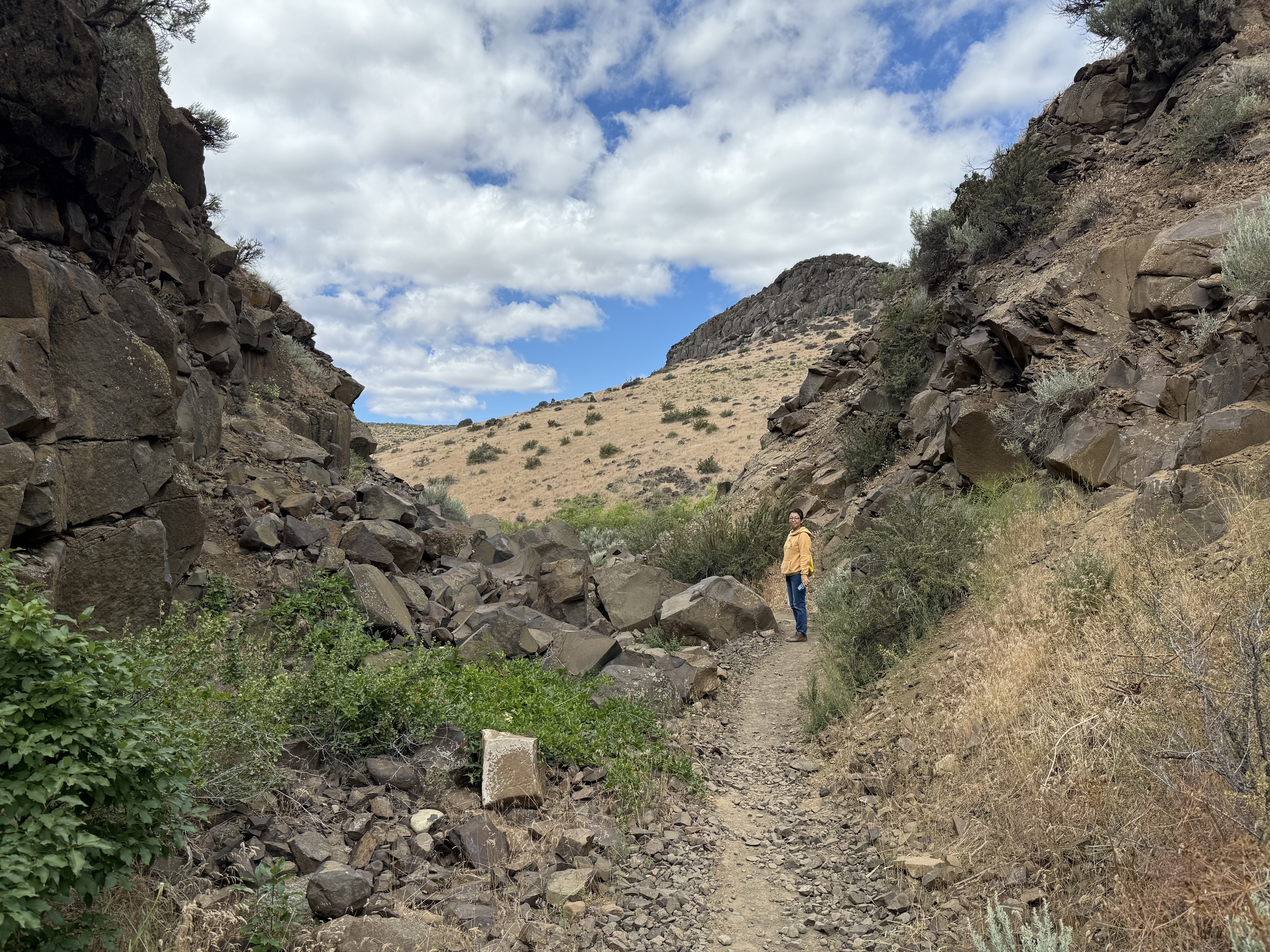
The Burlington Northern railroad wasn’t afraid to use explosives to create a path through what was described at the time as, “A dry, rocky canyon good for nothing except a railroad.” The rails have been removed, but the eleven bridges required to construct a rail line to cover the 3 miles of the trail system are mostly still in place.
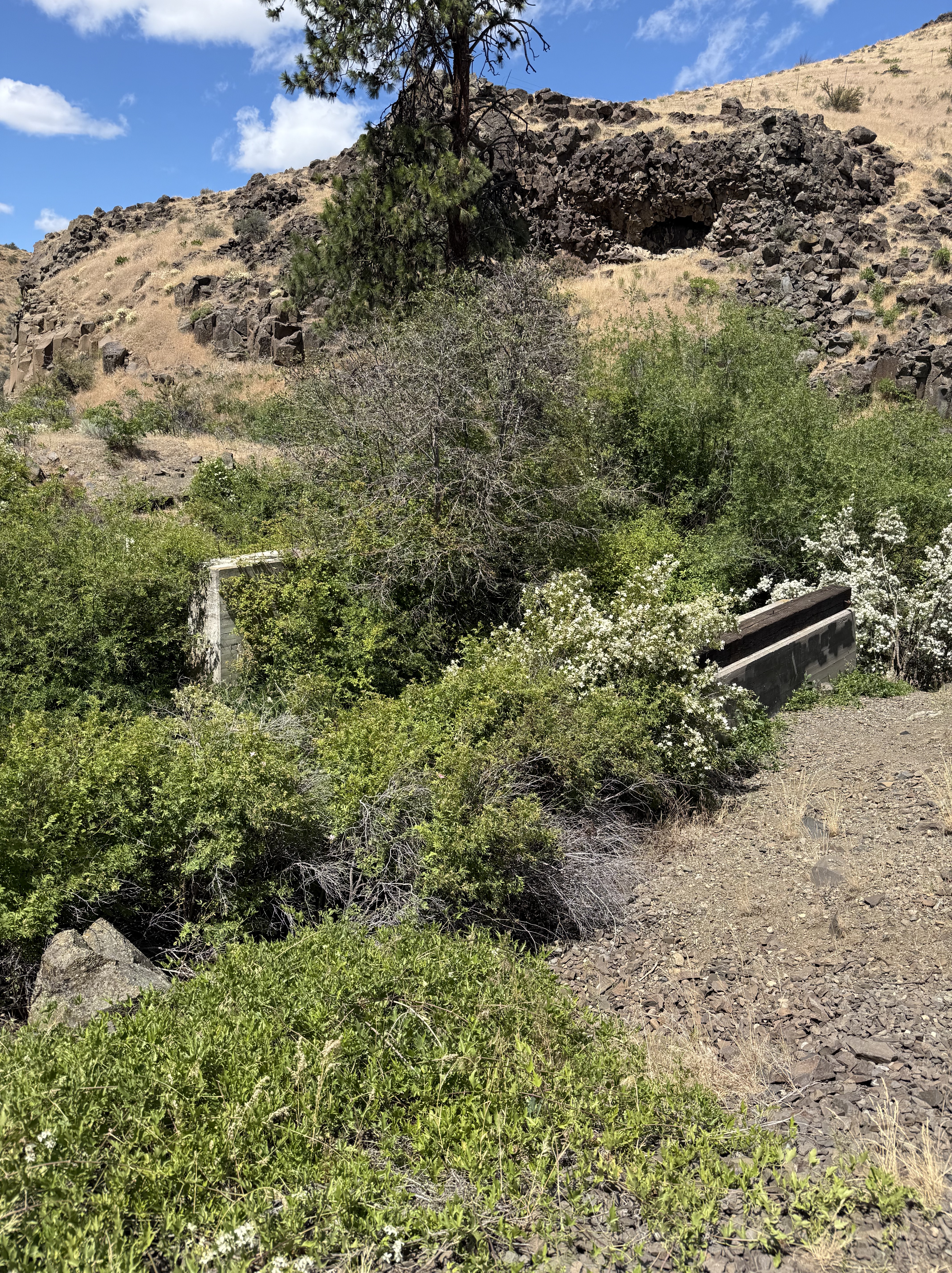
Here’s one that didn’t last. It was replaced by a pedestrian bridge constructed by the Cowiche Canyon Conservancy and the Bureau of Land Management.
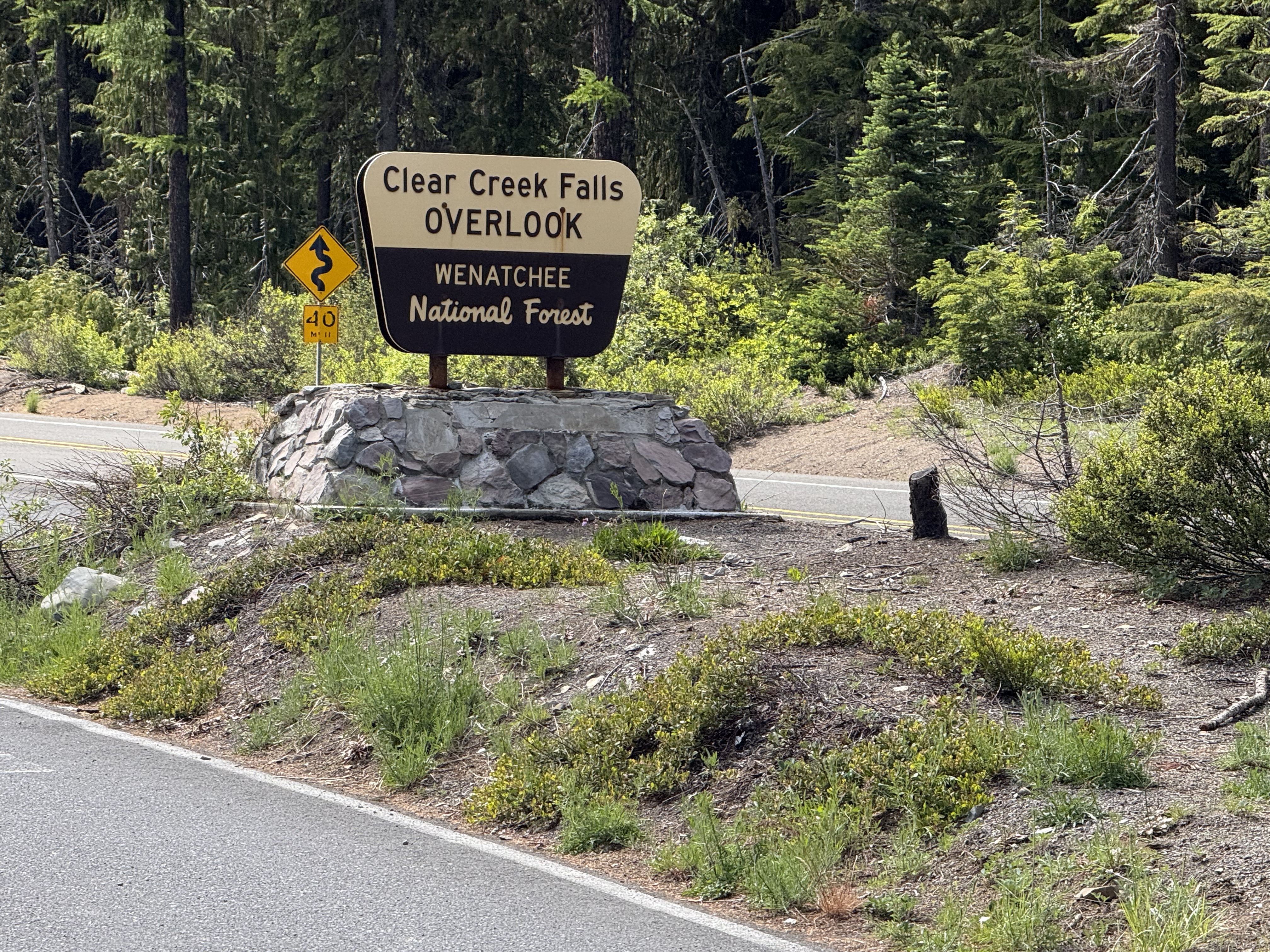
We took a more circuitous route back to Tacoma using US12 through White Pass. It didn’t snow, and we got a look of one of the many water falls in Washington.
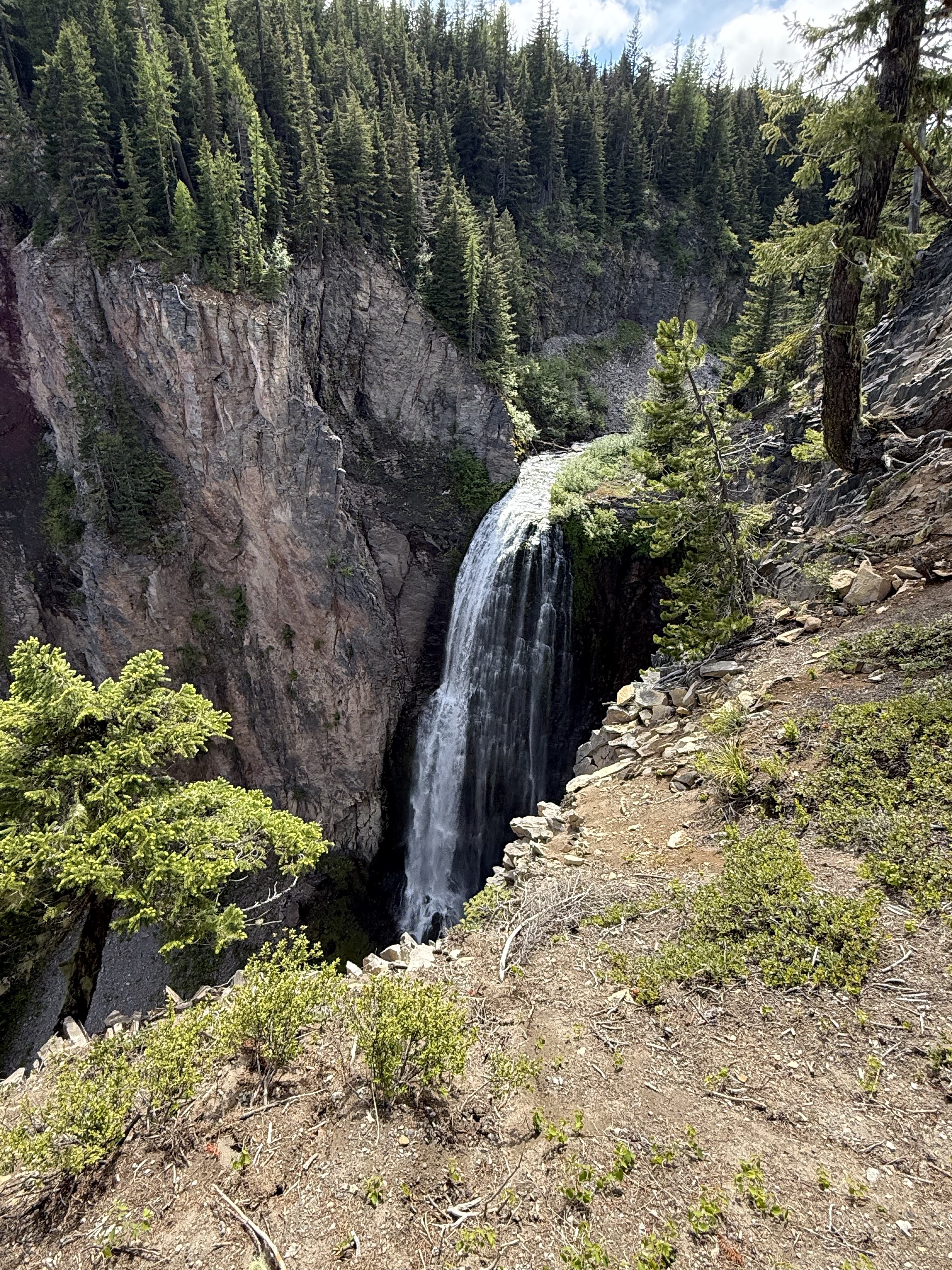
This was the best angle I could get, and I still couldn’t see the bottom! It turns out that Washington has more than 3000 catalogued water falls, more than any other U.S. state. Clear Creek is rather small at only 300 feet, so I guess there is some more air down there.
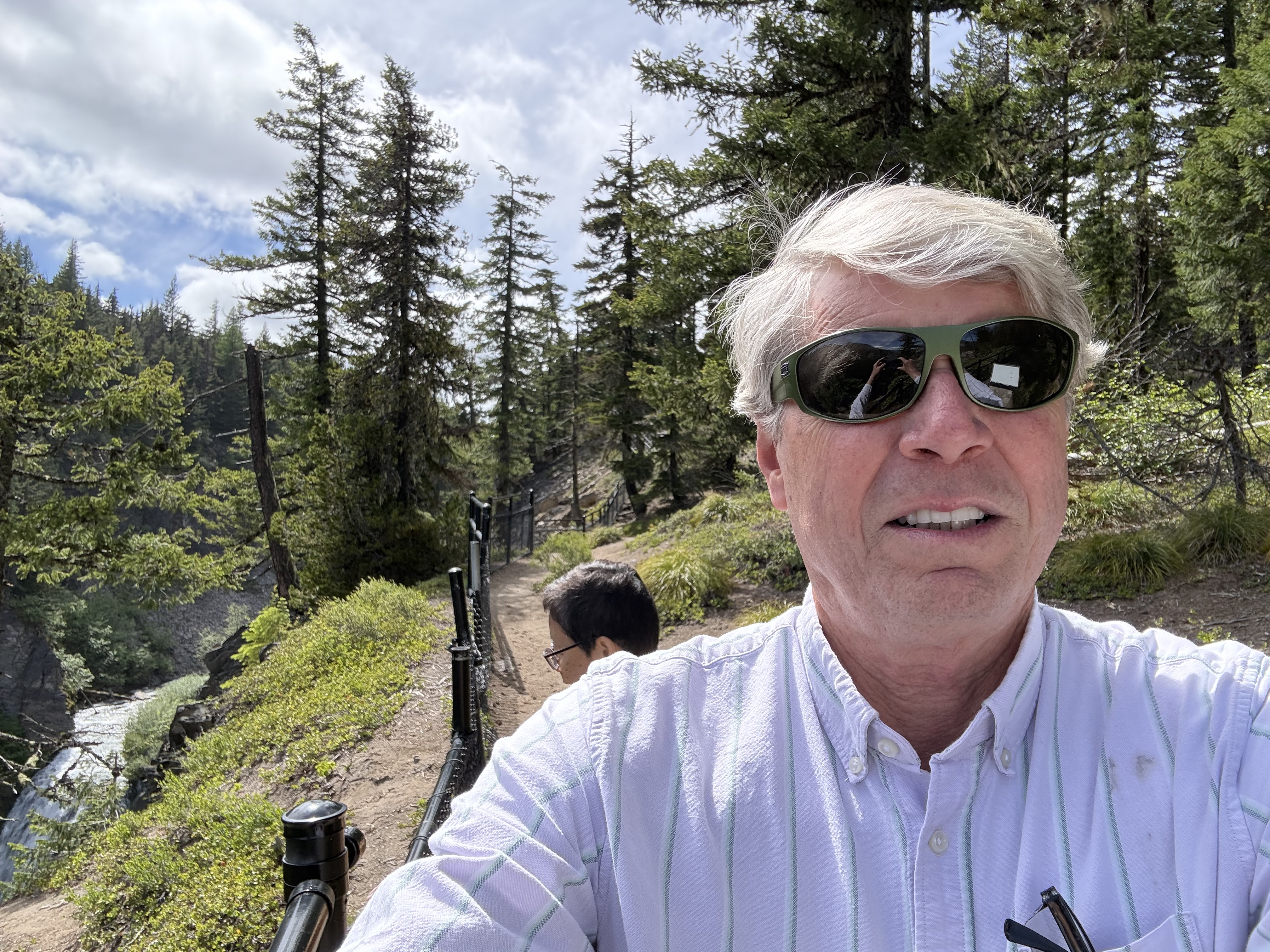
It was a beautiful day in the Pacific Northwest, including the snow flurries. A ten-hour day trip took us from coastal Washington, over a 6000 foot pass, into dry eastern Washington, where we hiked through a canyon filled with native plants and rocks (hahaha), and back over the Cascades past a magnificent water fall in Wenatchee National Forest.
This is undoubtedly the most beautiful place I have ever lived…
Vancouver, British Columbia
I’ve never been to Canada…officially. I canoed into Ontario once and spent a frigid spring evening on an island in the Boundary Waters; and I briefly crossed into Quebec when visiting a friend in Presque Isle, Maine; but this time I crossed at the border station on I-5 north of Seattle.
The drive to Vancouver is about three hours, but there is a wait at the border. It was less than thirty minutes entering Canada…
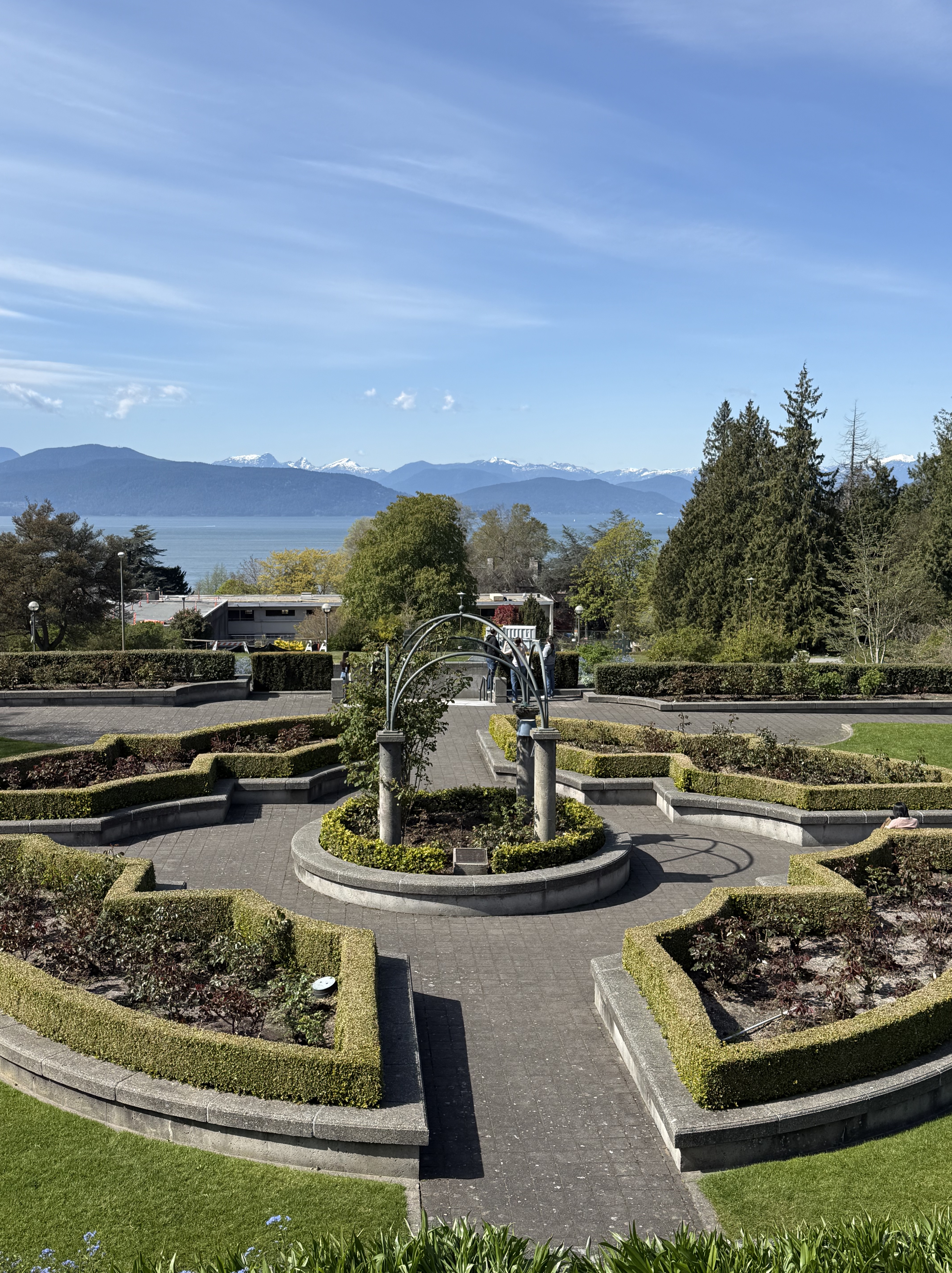
It was beautiful weather, so we did as many outdoor activities as we could in the short time we were there. Our first stop was the University of British Columbia, which has about sixty thousand students. It is a very large campus located on the Strait of Georgia. This photo is looking westward towards Vancouver Island.
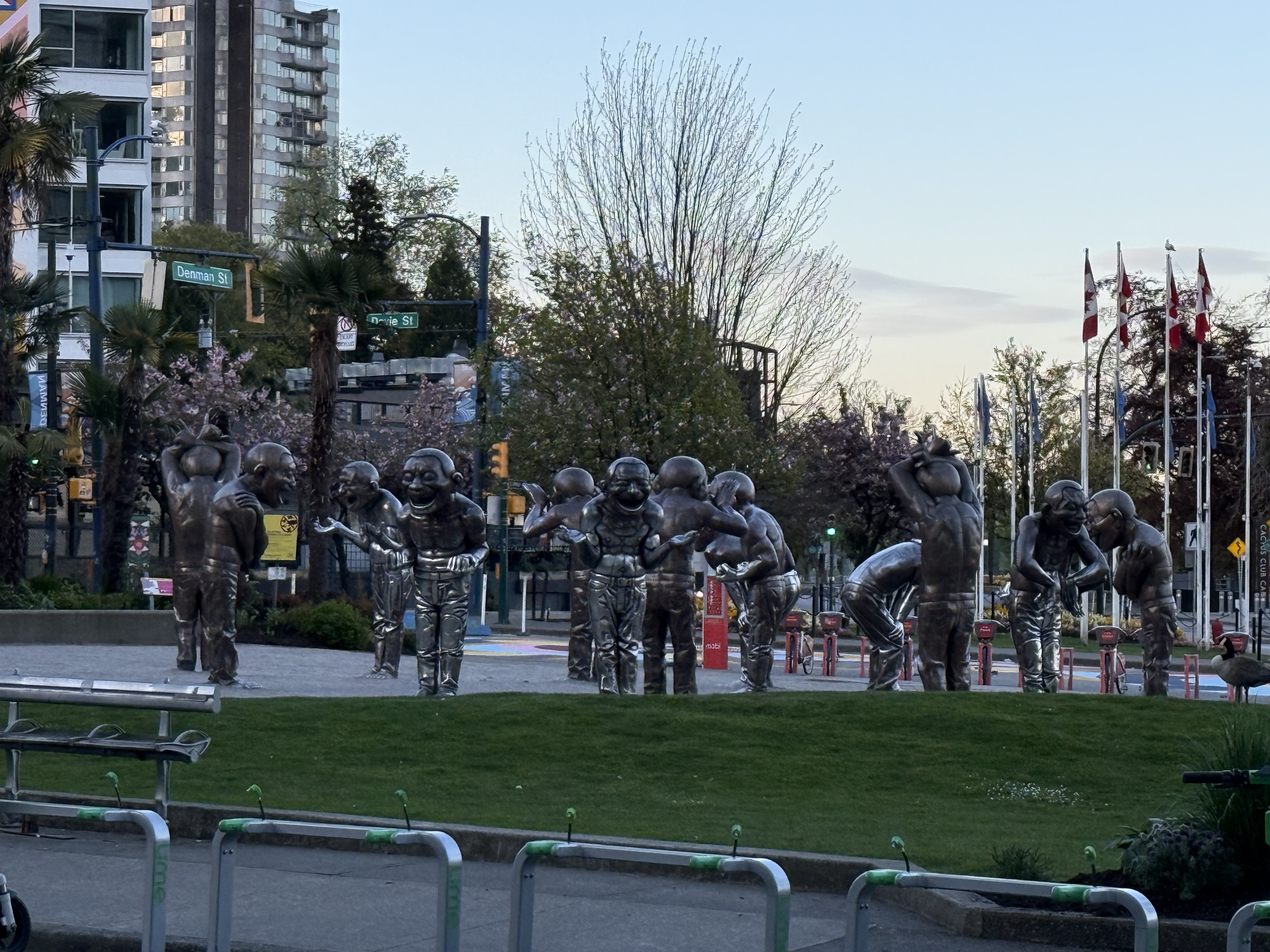
We spent the night near Stanley Park, which was filled with locals enjoying the weather. These metal statues are about eight feet tall, depicting the same shirtless man laughing and gesticulating. He was actually kind of creepy, but humor is in the eye of the beholder.
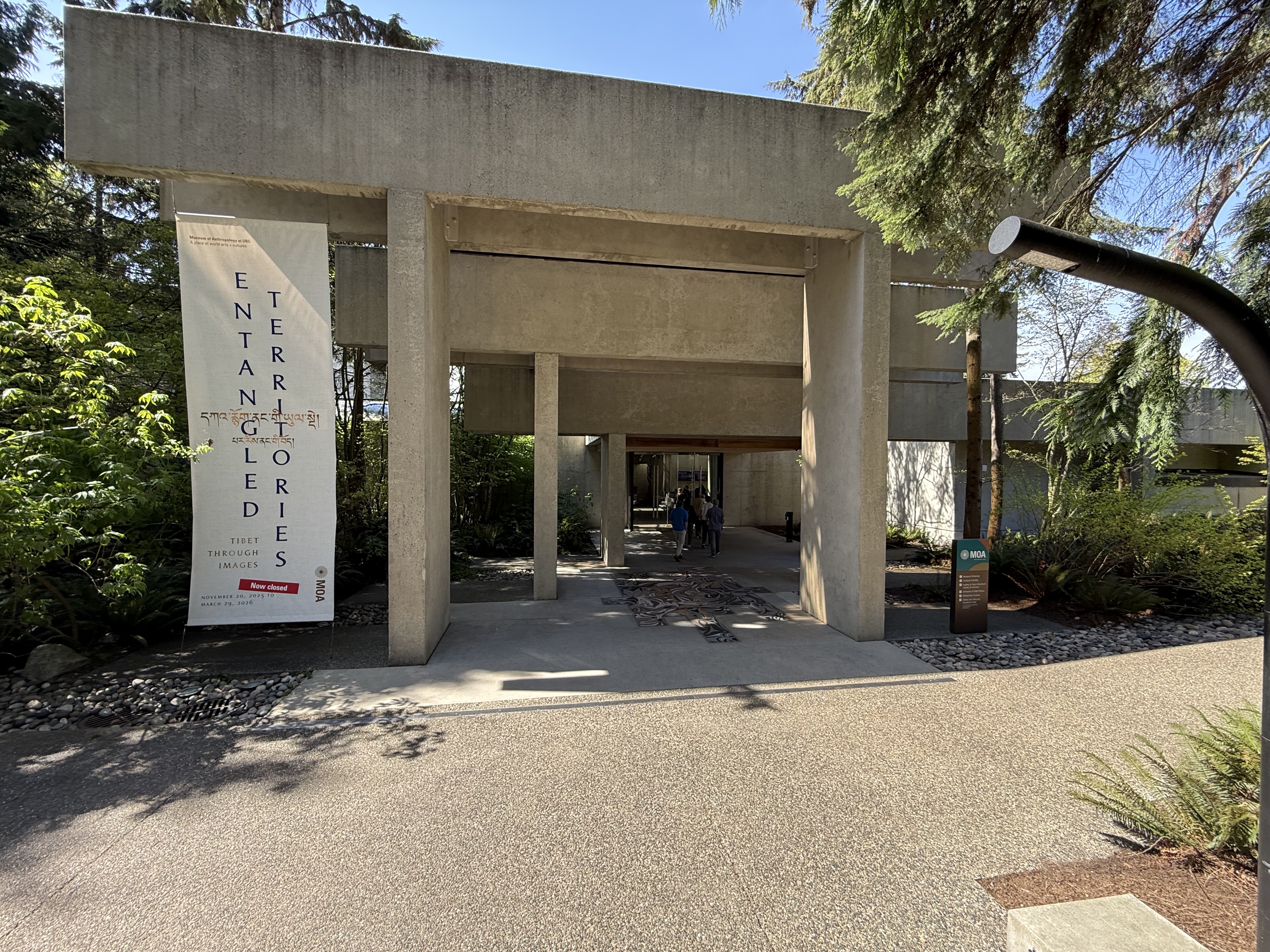
The Museum of Anthropology at UBC has a permanent exhibit of sculptural artwork by several native artists.
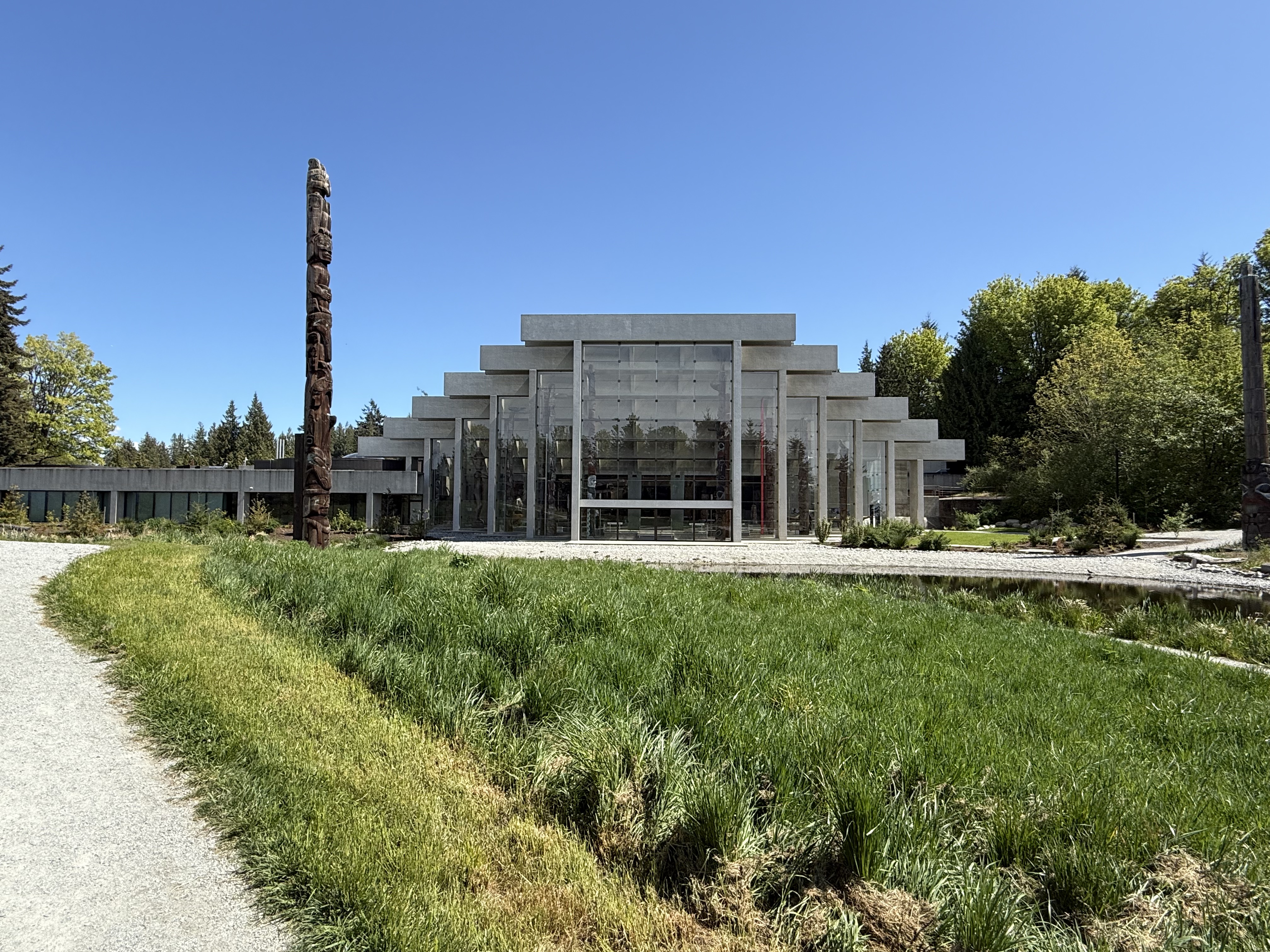
Totem poles are very popular still among the indigenous people. Several originals are on display as well as recent creations.
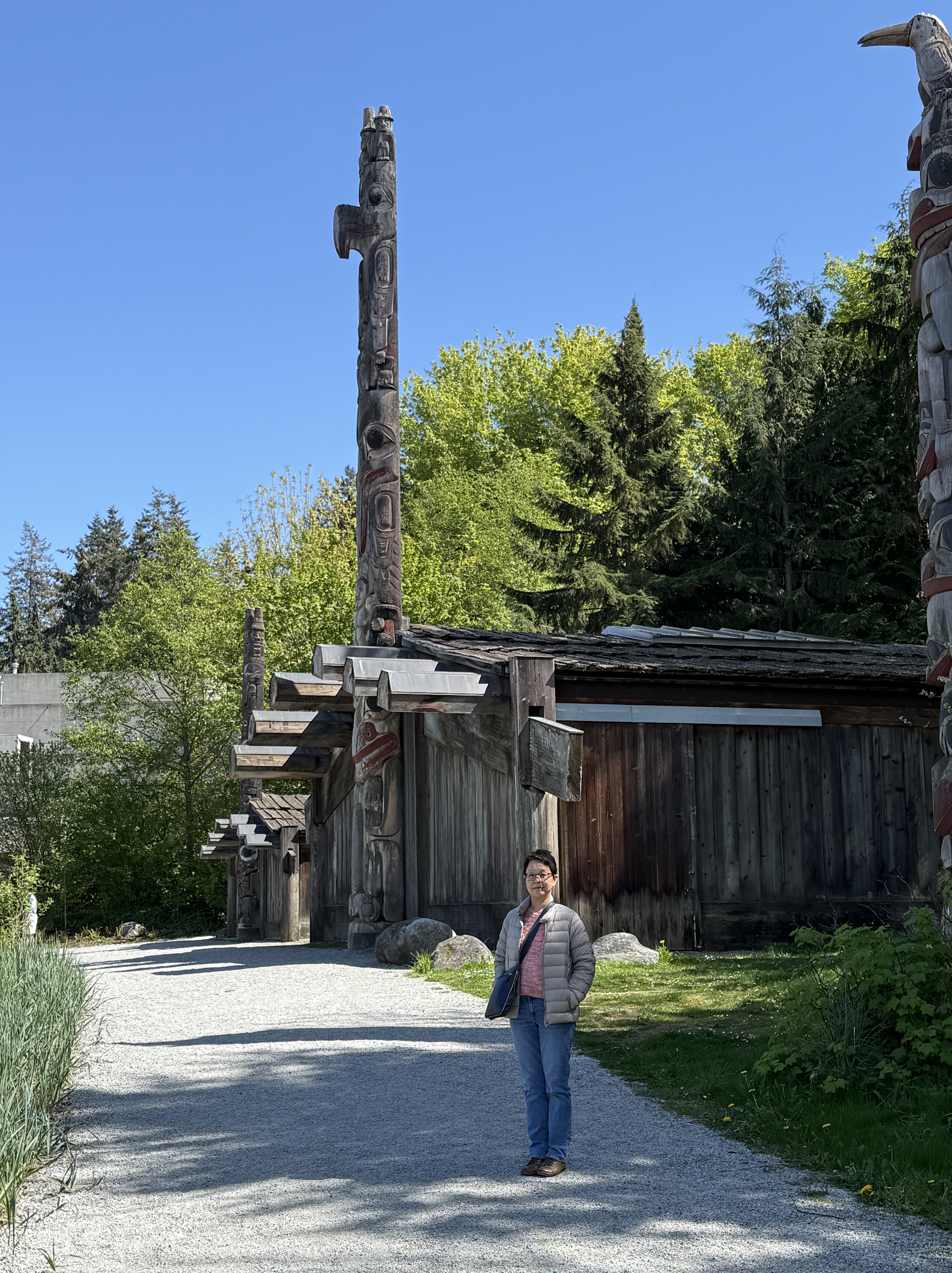
The outdoor display includes mock-ups of a tribal living area, including several poles. Apparently these are updated now and then as the family grows. They aren’t religious, but simply a traditional way of recording major events.
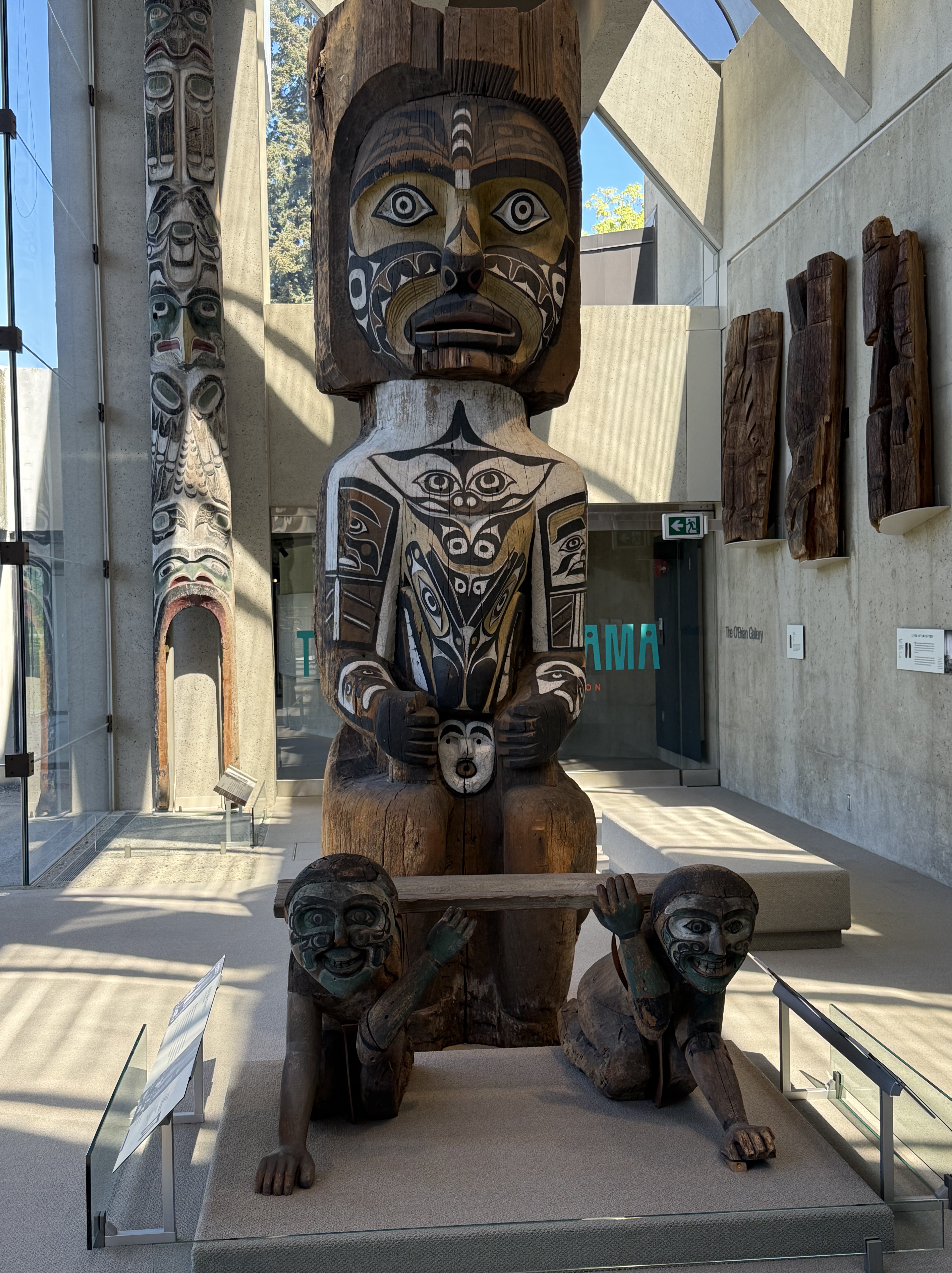
This recent creation represents a successful life, including owning slaves; that’s right, the locals had slaves but not in recent times. This is a historical piece of art rather than reflecting modern times.
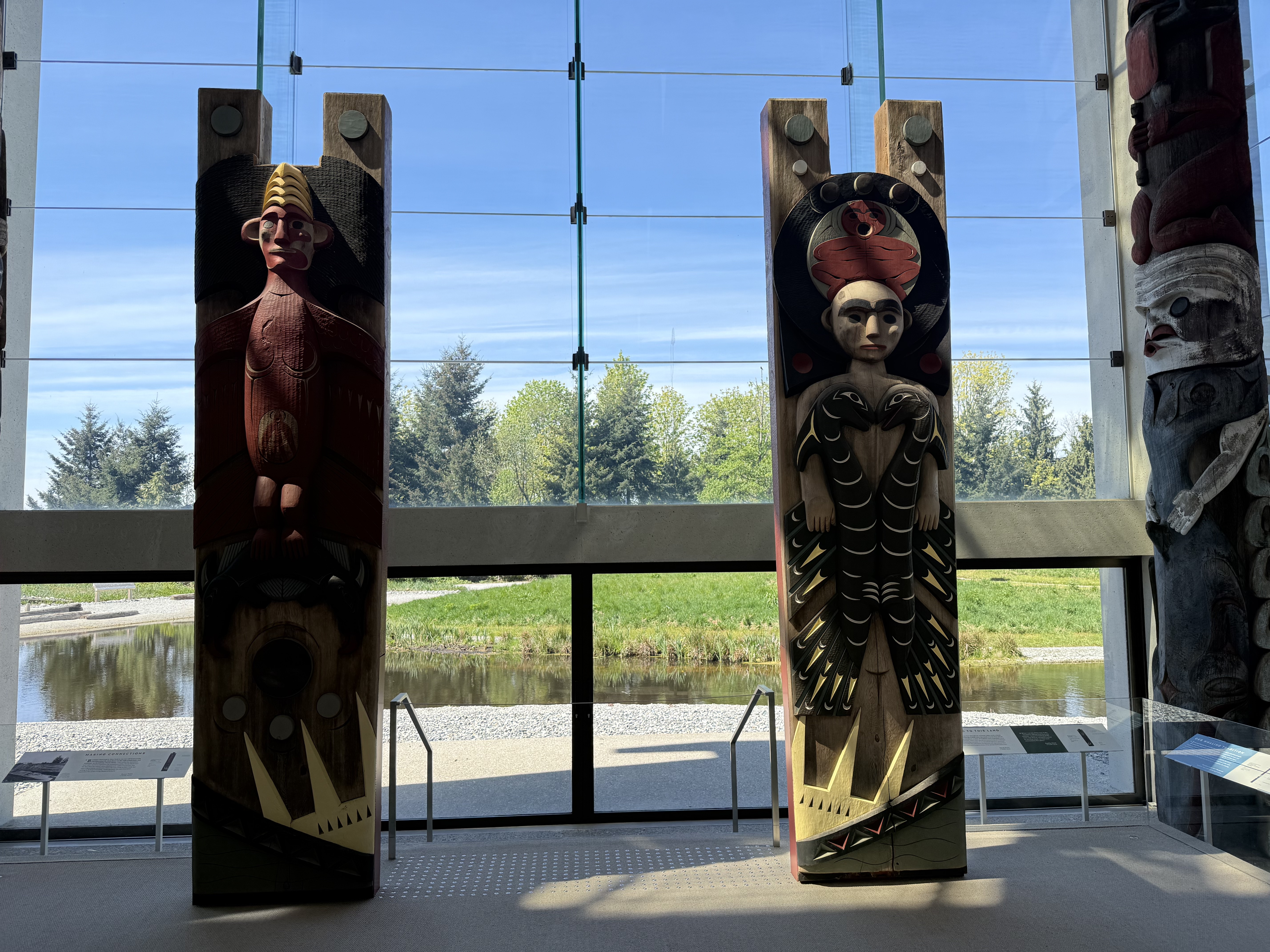
These two pieces represent the east coast, on the left with a rising sun; and the west coast with a setting sun.
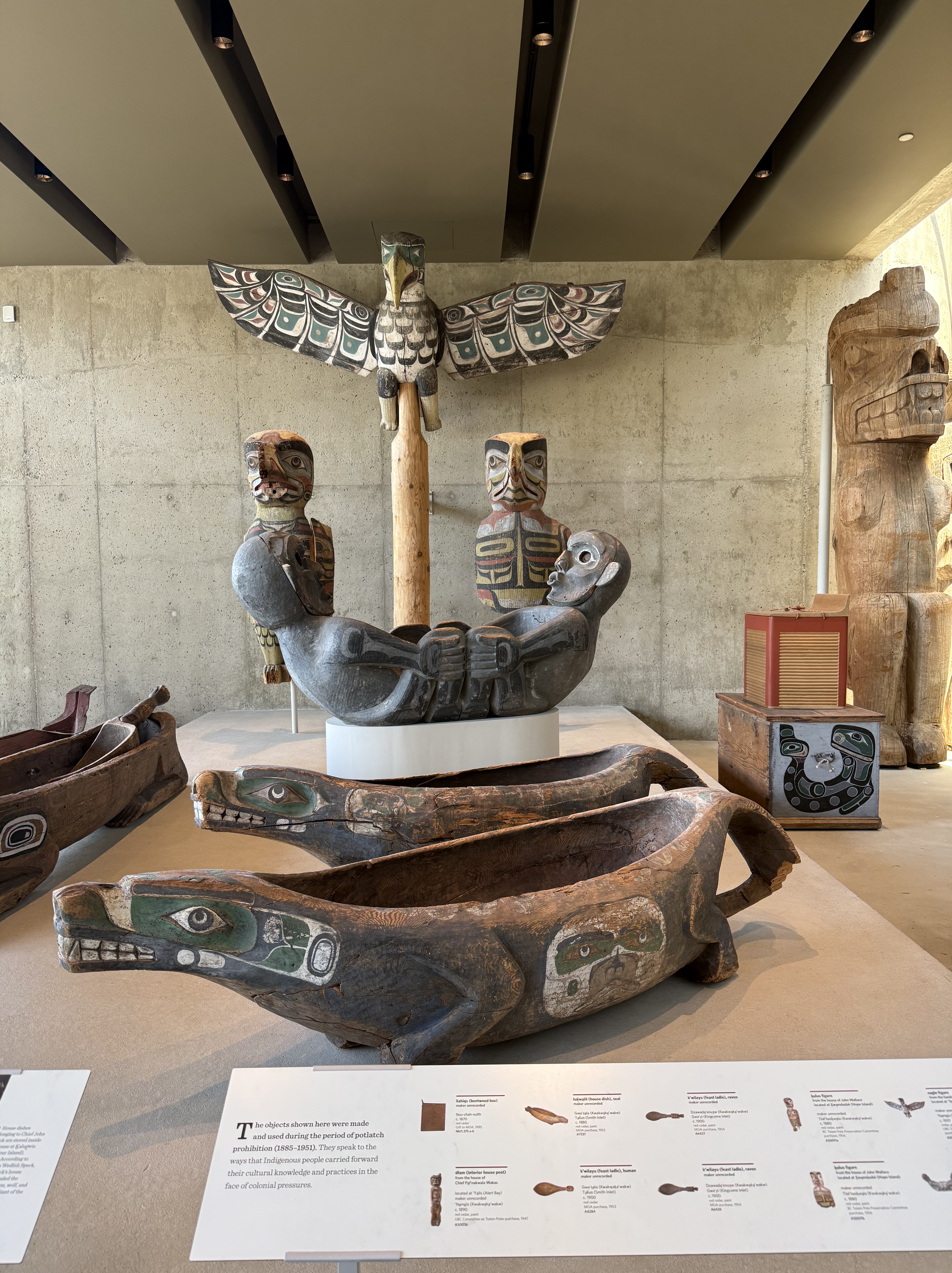
I was surprised at the variety of carved artwork the locals have created. Some of this is old and some is recently created by the active local artisans.
We drove to Shannon Falls, which cascades over 1000 feet.
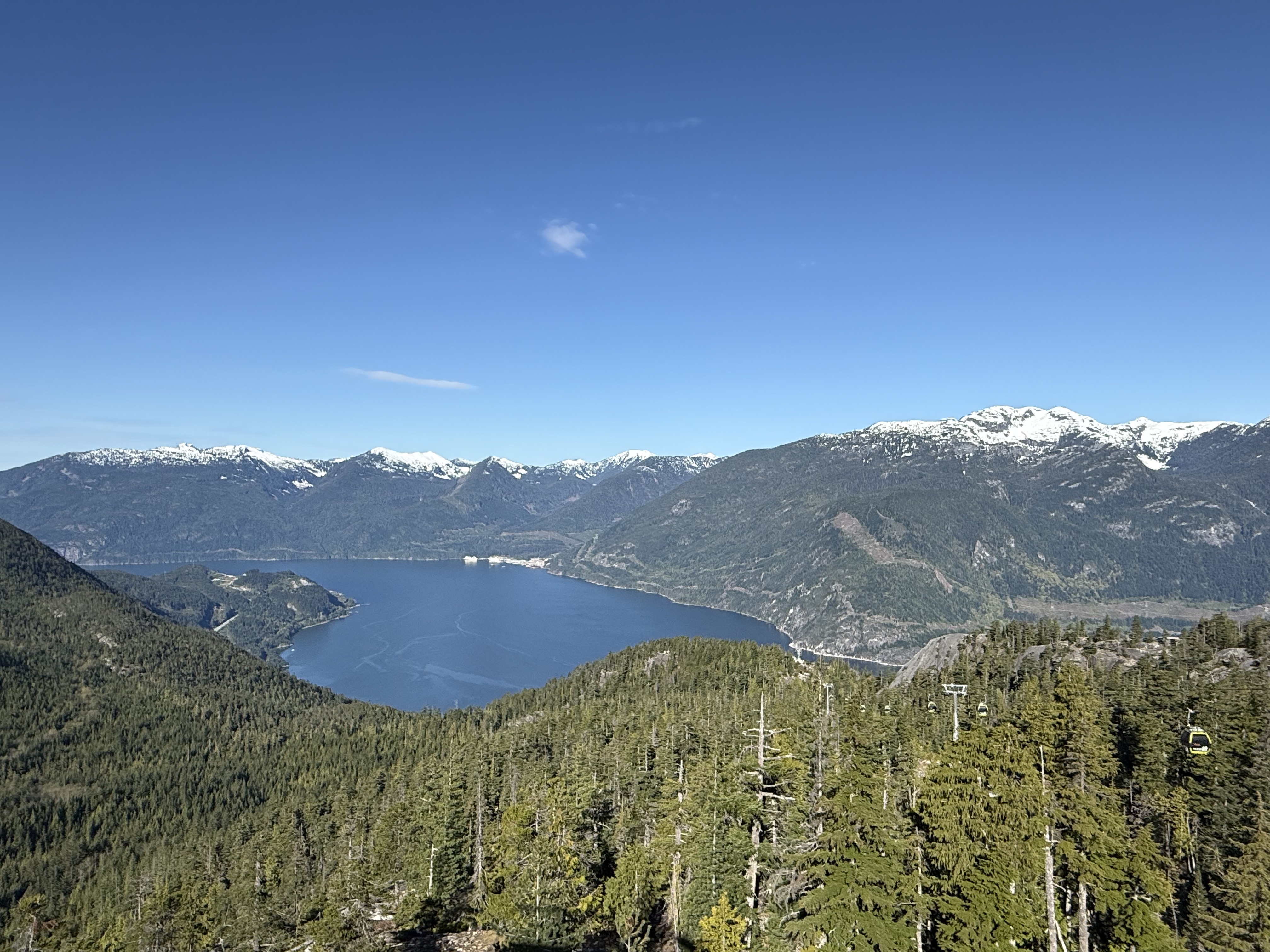
Then we rode a gondola for the 2300 foot climb to the top of Stawamus Chief and followed a good trail around to see the glacial topography from several vantage points. It was impressive, but I declined to use the suspension bridge for a better view. It’s a LONG way to the bottom.
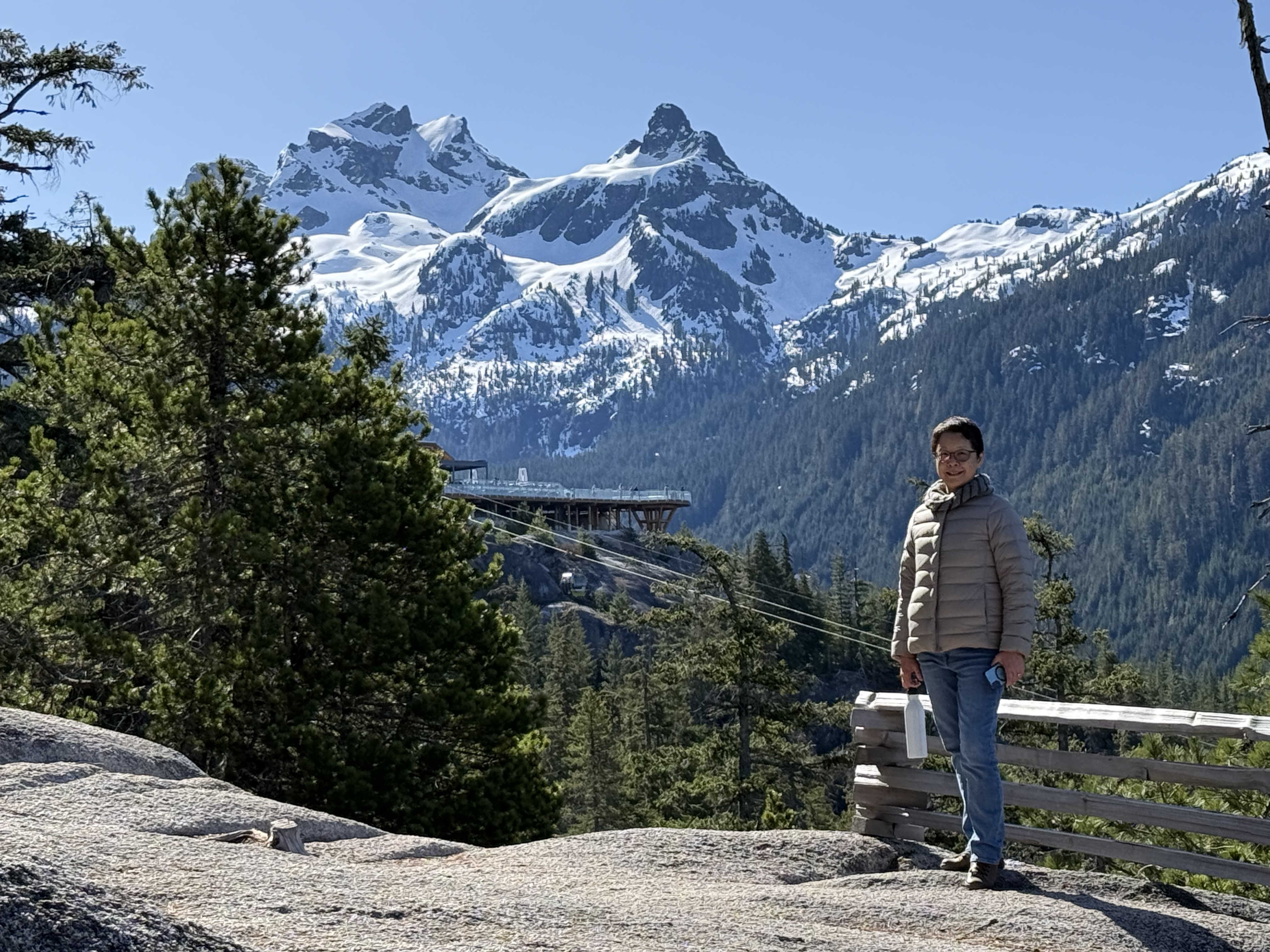
These pointed peaks are the remnants after alpine glaciers carved away at the mountain. Note their similarity to the famous Matterhorn in Switzerland.
We had to say goodbye, but we’ll probably return to Vancouver. It’s a beautiful city filled with friendly people who speak just like Americans in a city that could easily be mistaken for Seattle; perhaps some day Seattle and Vancouver will bridge the international border and merge into a megalopolis. I think we’re halfway there already.
The southbound border crossing wasn’t as pleasant as entering Canada; the American border was understaffed, ill-equipped, confusing and, generally, a clusterfuck. We spent 90 minutes to move three-hundred yards, to find that the passport-reading equipment in our line wasn’t working properly.
We plan to get a Nexus card for future trips…
The Olympic Peninsula: Quinault Rainforest to Cape Flattery
This is the first in what I hope will become a regular series of blogs from my travels around the Pacific Northwest (PNW) as well as trips throughout the world. This series accompanies my main blog, Rocks and (no) Roads, which reports on the geology of various places to which I travel. You could see I’m expanding my horizons; in addition to posting about general sights in this post, I will also be including environmental and ecological observations that are of interest to me. My background is in geology, but I’ve become aware of a lot more since moving to the PNW. So this is a learning experience, thanks in large part to the availability of expert assistance from CoPilot, Microsoft’s version of ChatGPT. I’ll be turning to it to identify plants and evidence of animal activity in future posts.
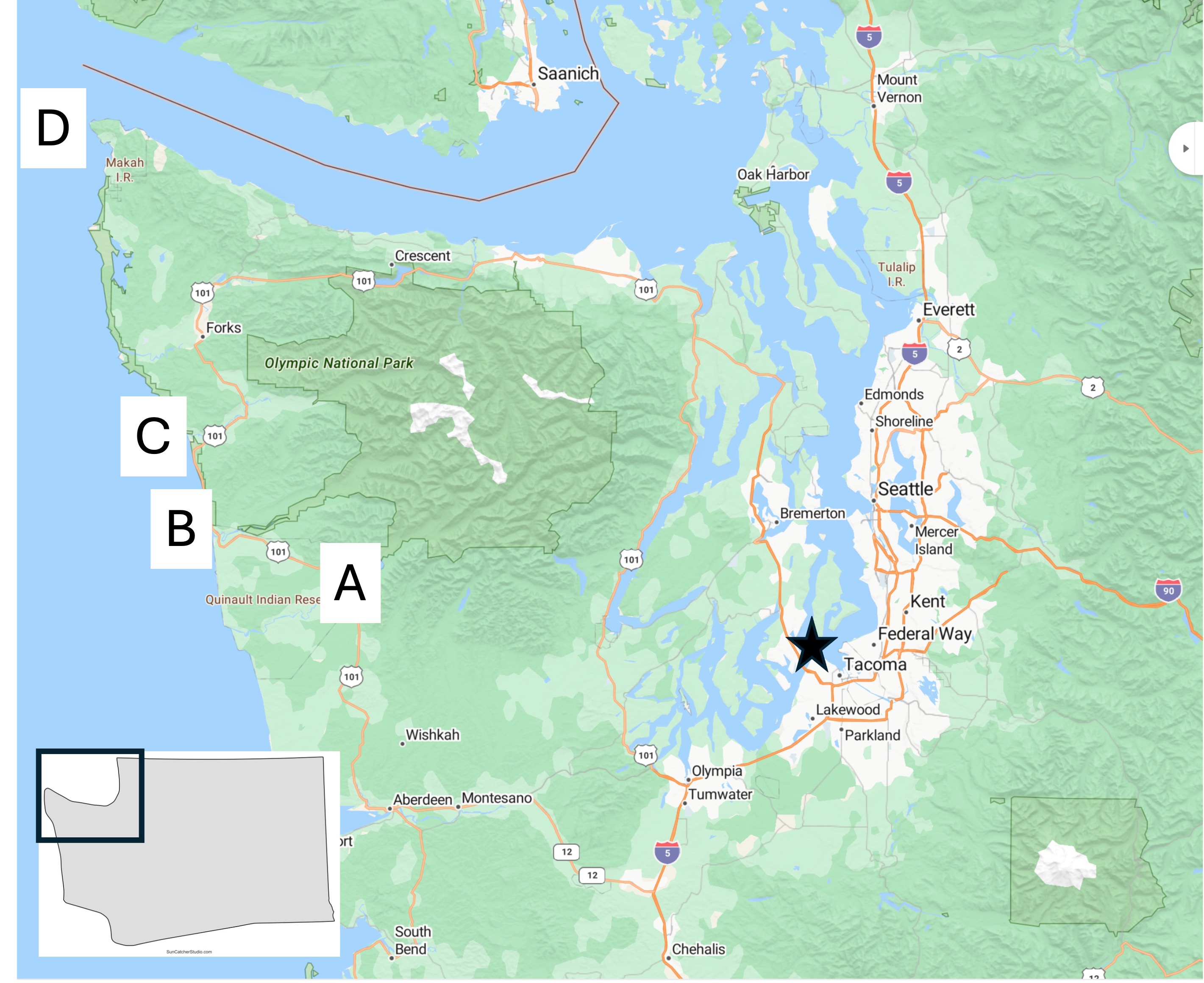
This is the base map I’ll be using in many of my posts from the PNW. The star indicates my base in Tacoma. Today’s post describes a two-day trip to circumnavigate the Olympic Peninsula. Although this area is the wettest in the contiguous United States, with annual rainfall up to twelve-feet, it was clear for the duration of my visit. The labeled areas indicate where the photos described below were taken.
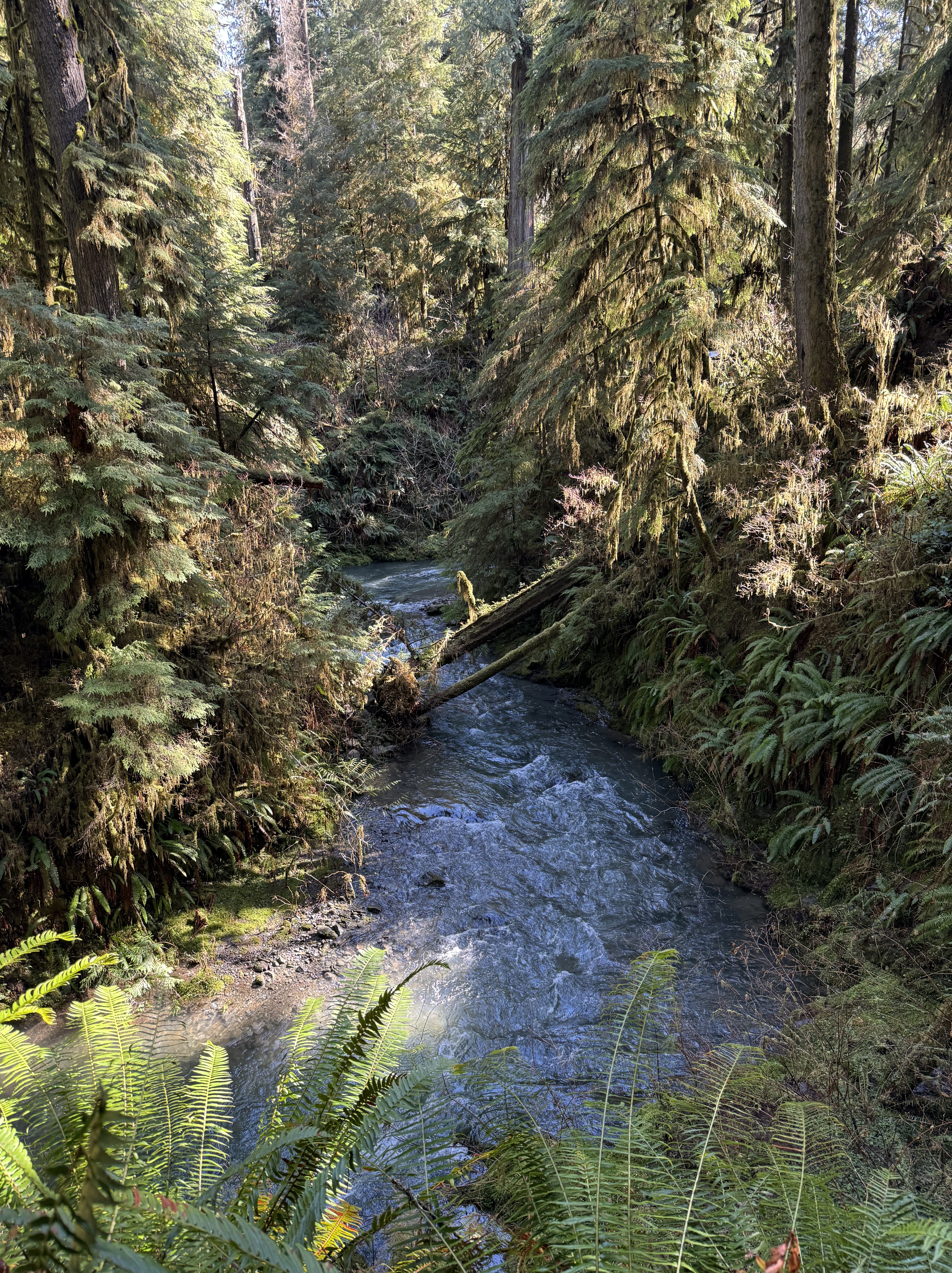
Location A: Quinault Rainforest. Photographs can’t do justice to the experience of being surrounded by a temperate rainforest. There are many trails of different lengths, but I followed a shorter one (about one mile) that followed Willaby Creek for a while before turning into the depths of the forest. This image shows the creek rushing by about 50 feet below the trail as it races to the south shore of Lake Quinault.
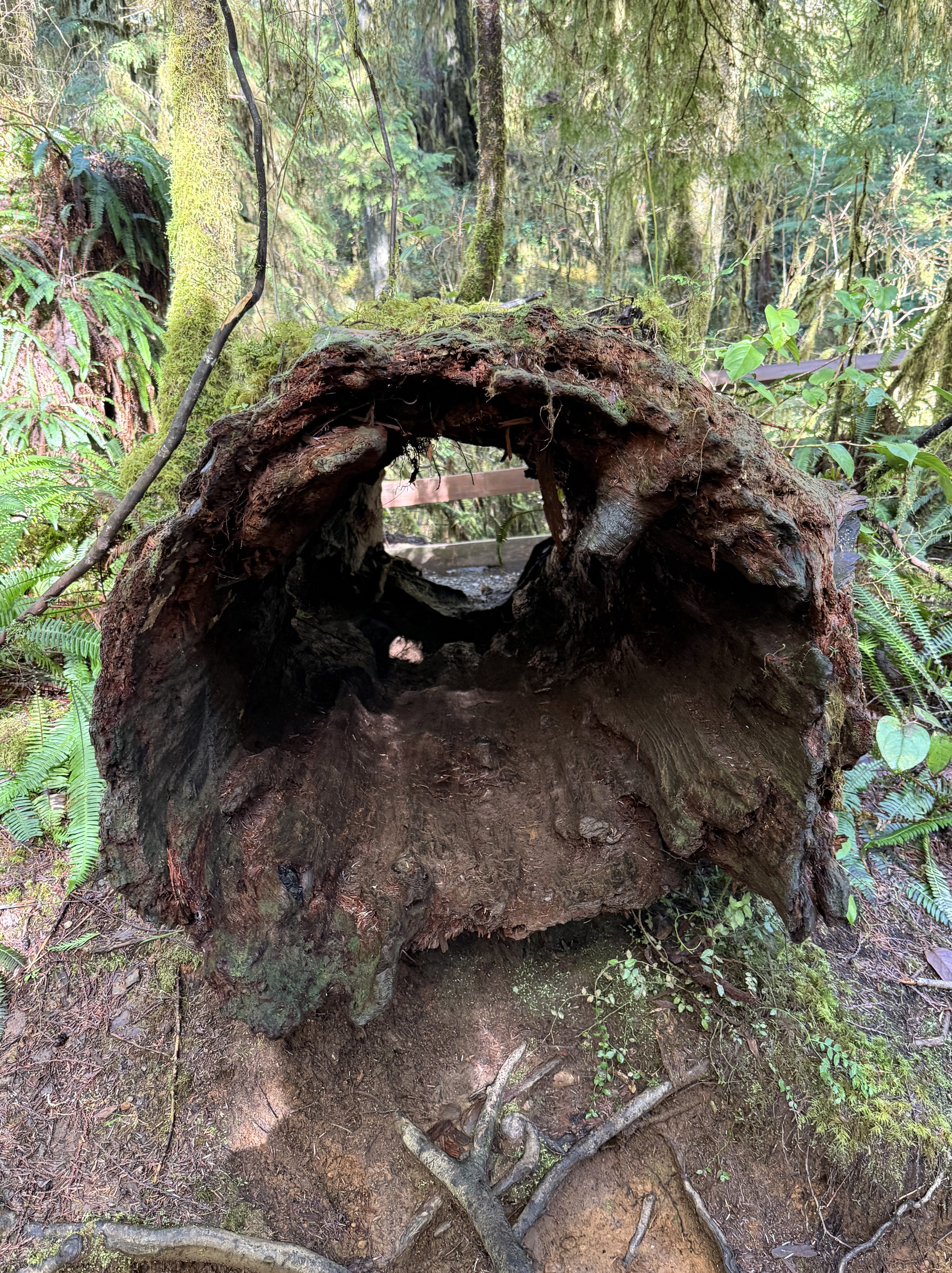
Location A: Quinault Rainforest. This rotted log is about six-feet in diameter. It is representative of the ongoing decay and rebirth of the forest. I’ll talk more about that in another post. Note the ferns growing out of the decaying wood.
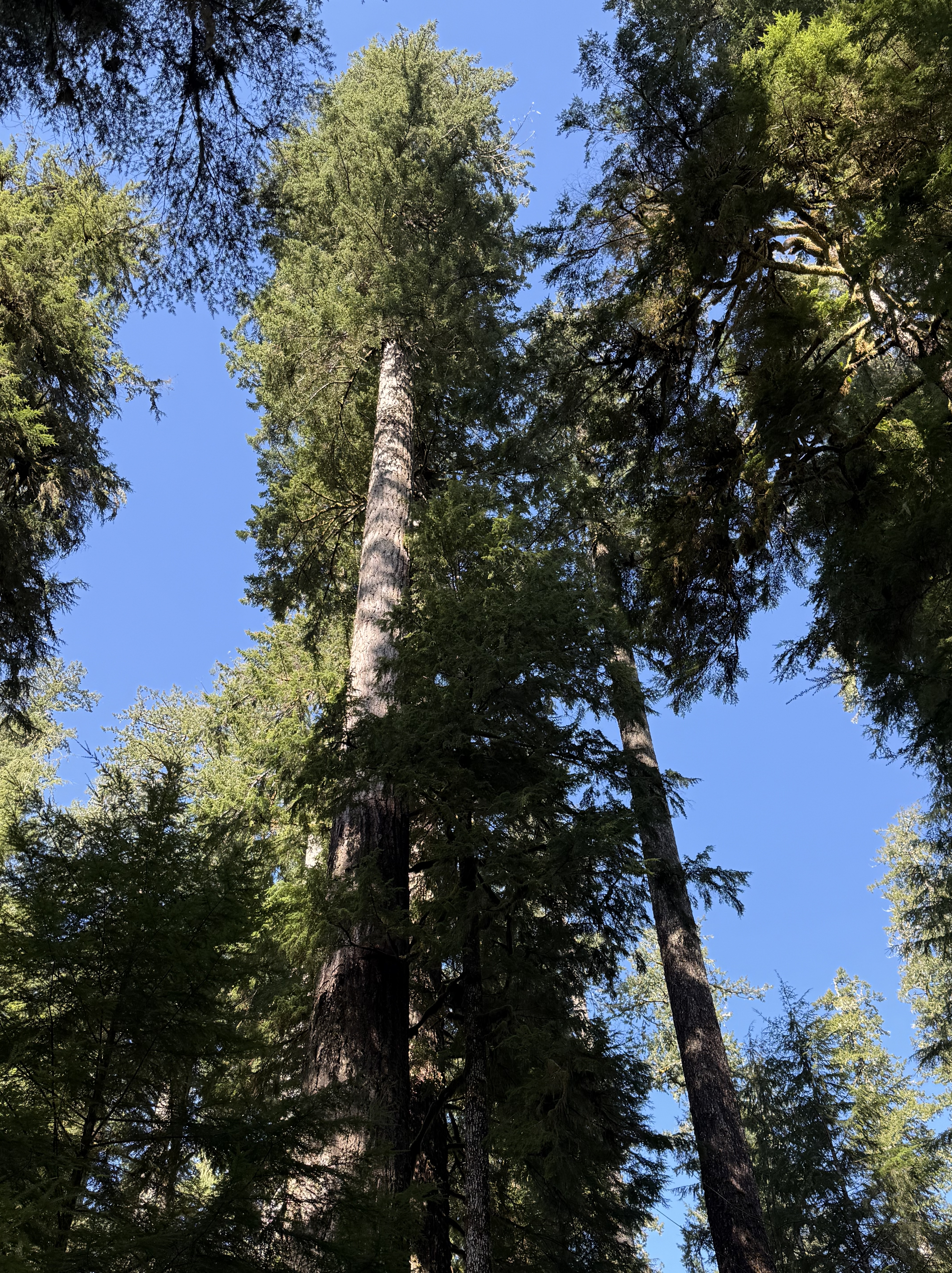
Location A: Quinault Rainforest. There are at least half-a-dozen species of giant evergreen trees in the rainforest, and I can’t identify any of them; but CoPilot suggests it might be a Coast Redwood, part of a local population found in this area. This example is typical in an area known for its “Champion Trees”. We’ll get to that in the next photo.
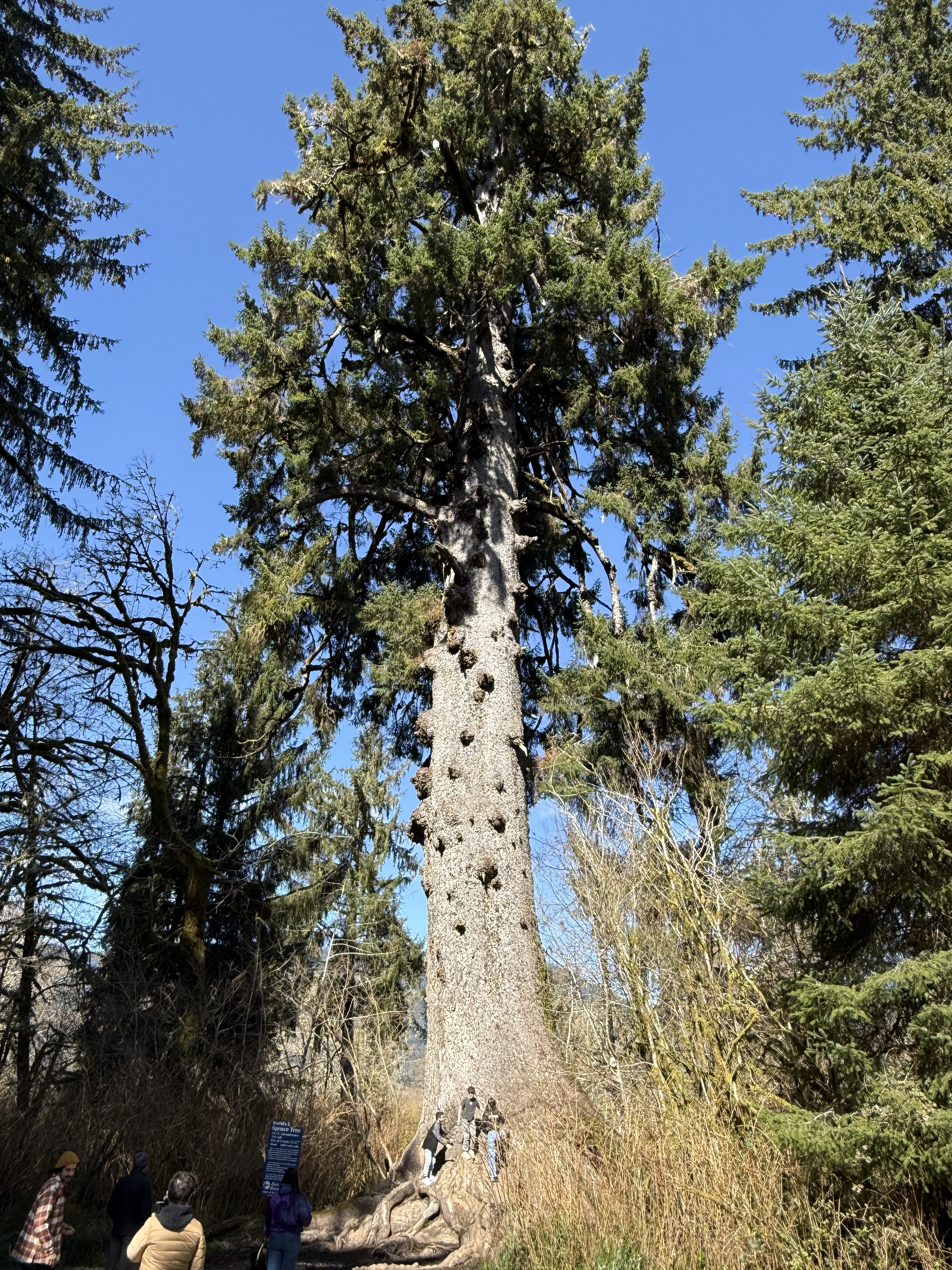
Location A. Quinault Rainforest. This is the world’s largest Spruce tree. It is 191 feet tall and about 1000 years old. It is one of the six champion trees located in Quinault Valley. The other champion trees are: the world’s largest Western Red Cedar, Douglas Fir, and Mountain Hemlock; and the largest Yellow Cedar and Western Hemlock in the U.S. This tree is growing in a wetland area at the NE end of Lake Quinault.
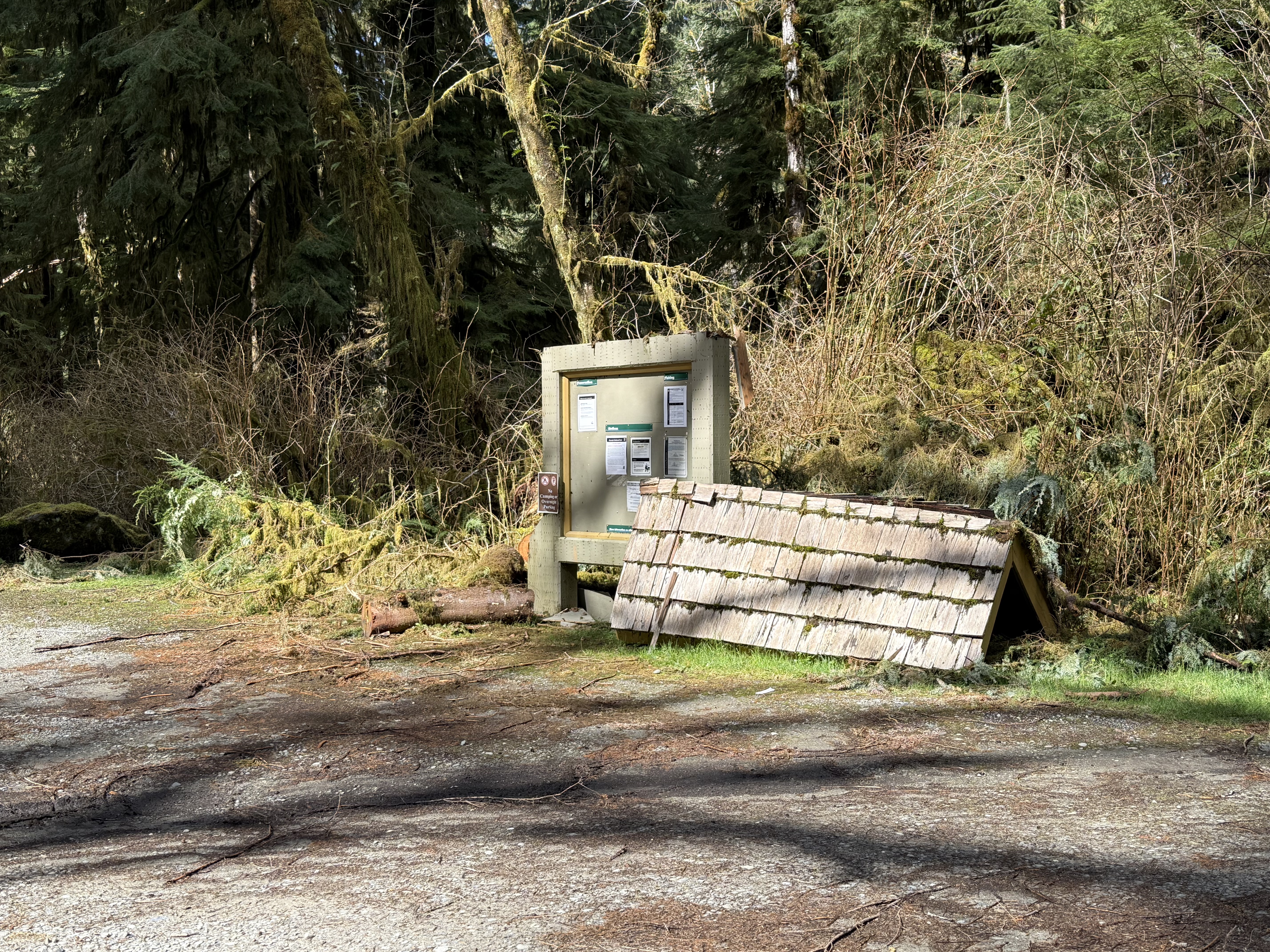
Halfway between Sites A and B. During my day-trips around the area, I’ve noticed a what appears to be a regional interest in post-industrial art, including but not limited to large concrete facilities that have been left to decay in place, as well as small sculptures and other curiosities scattered throughout the cities and forests. I don’t know if this is intentional or not: the roof of the information board collapsed (no doubt because of 12 feet of rain per year) and was set aside, possibly as a monument to nature?–or evidence of the poor funding and mismanagement of the National Park Service.
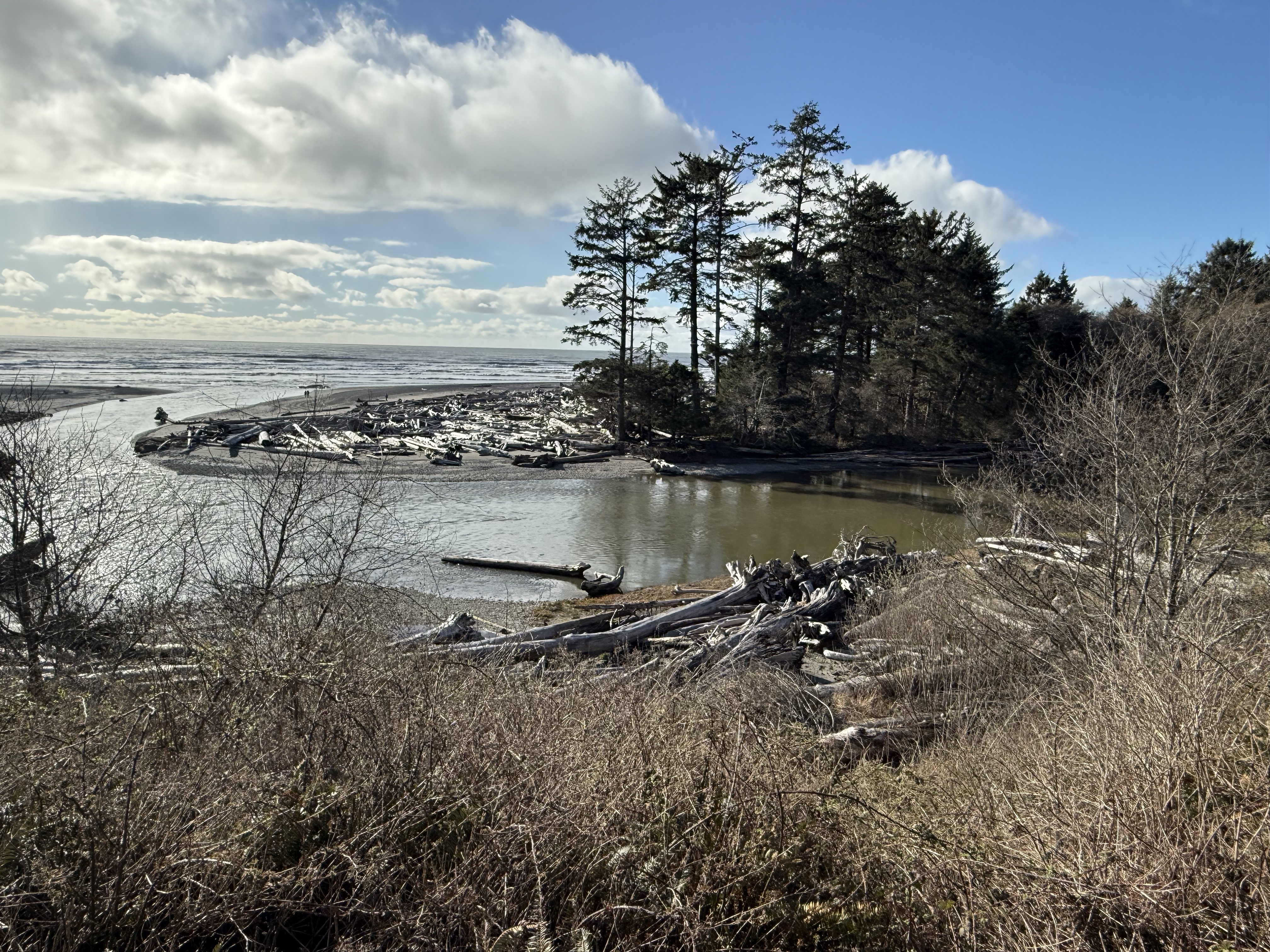
Location B: Kalaloch Lodge. This is the view from the deck of the lodge where I spent the night. Kalaloch Creek meanders as it approaches the coast and enters the Pacific Ocean here. An impenetrable pile of driftwood (actually logs and entire trees) has collected on a sand spit deposited on bedrock.
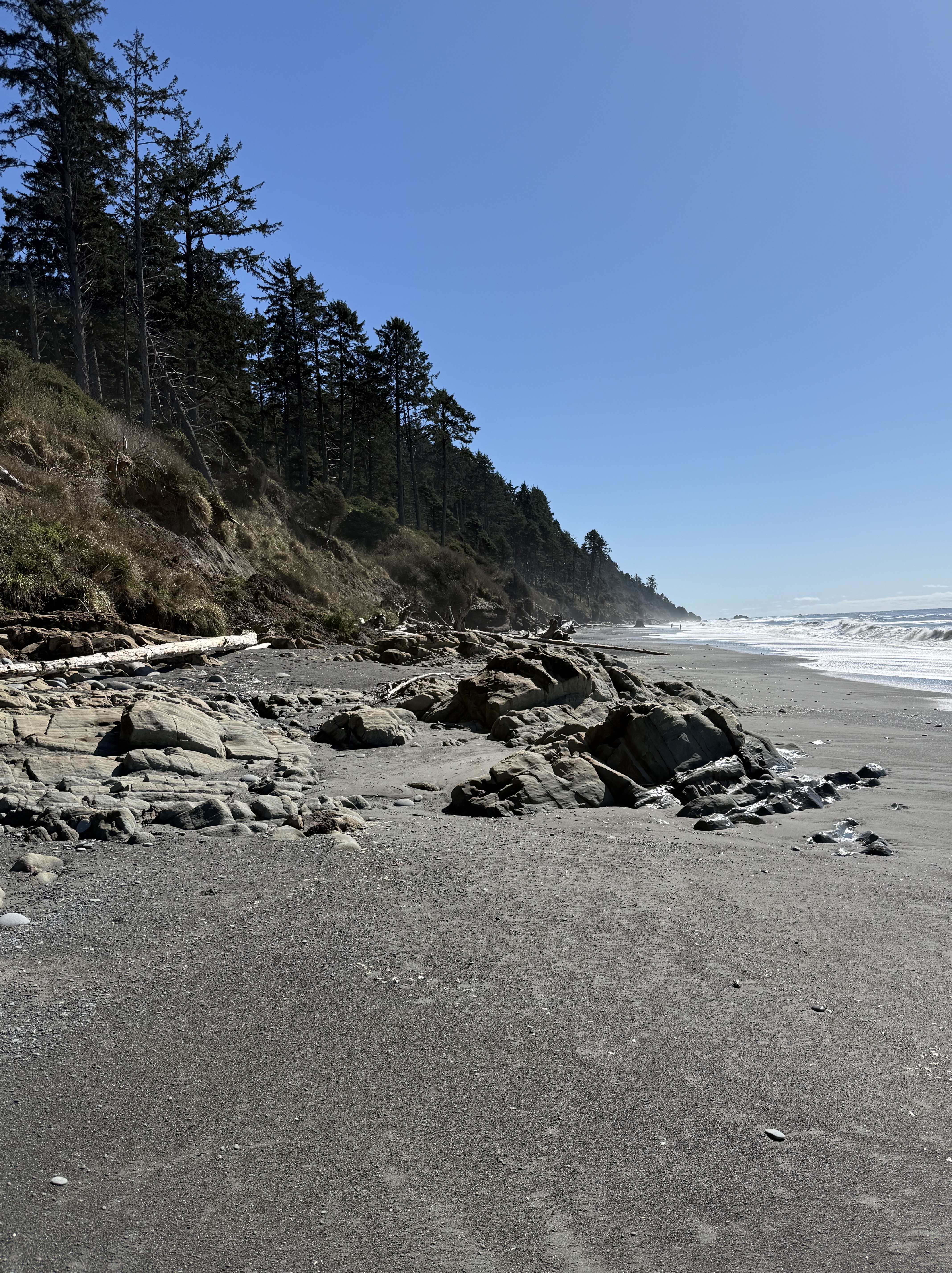
Location B: Beach 4 at Kalaloch. Steep bluffs of glacial till front a wide beach with many exposures of rock, which I’ll discuss in my next post.
Location C: Ruby Beach. This was the last beach before US 101 turned inland for ten miles. I took a video because a series of photos can’t possibly convey the beauty of this location as the sun was rising. Note all the rocks protruding from the water at low tide. The rocks are rising from the earth as we make our way north.
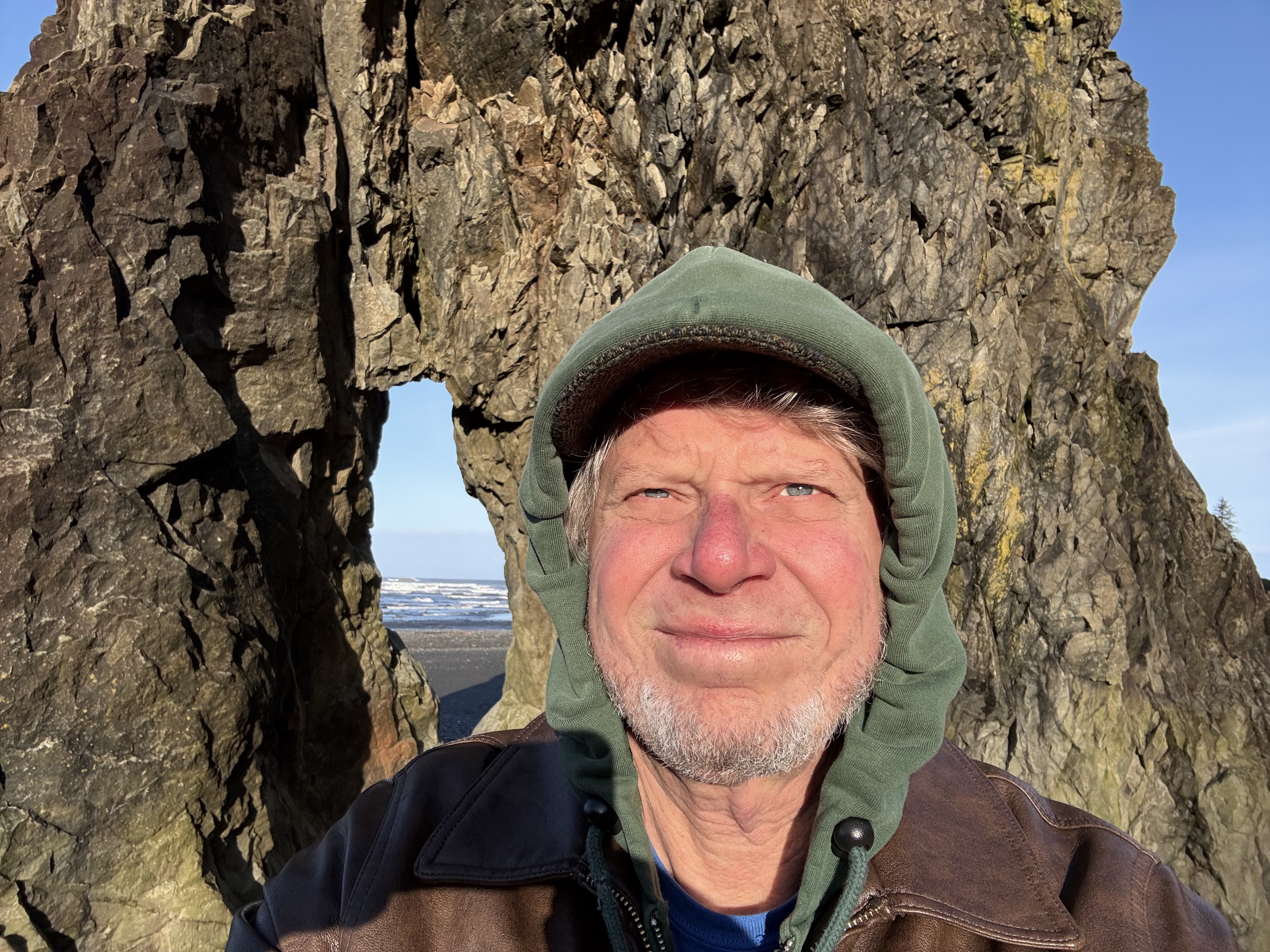
Location C. This selfie demonstrates how chilly it was, with the temperature below 40F. Rock formations like this are called stacks; they are erosional outliers as the coast recedes over millions of years, pounded day and night by rocks carried by waves; and tides that exceed nine feet–twice a day! You have to time your visit accordingly or all you’ll see is water.
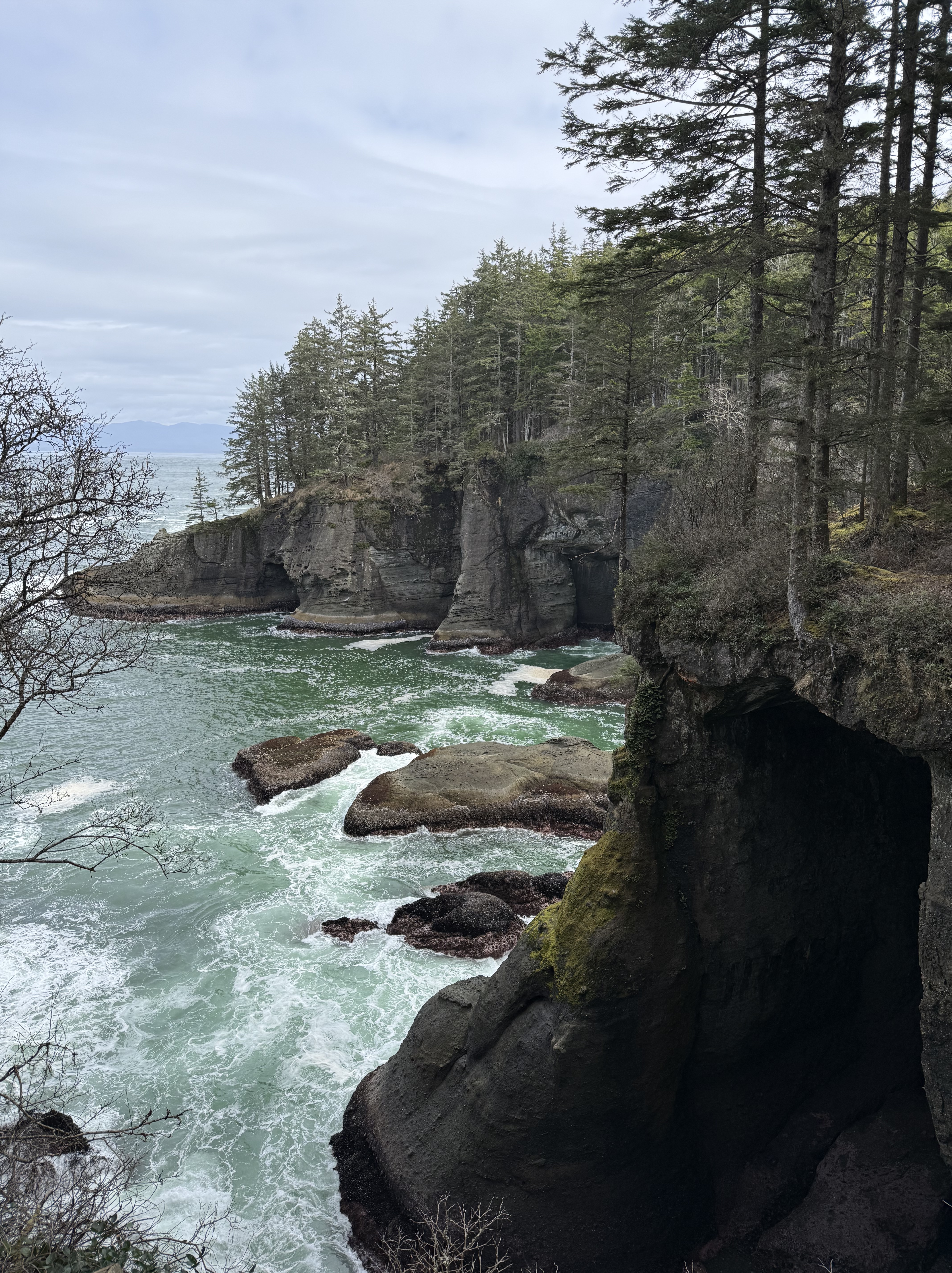
Location D: Point Flattery. This is the extreme tip of the contiguous United States. The bedrock we saw further south, at Ruby Beach, now forms wave-cut cliffs that tower 40-80 feet above the waves. The top of the bluffs is 330 feet above sea level. The view from the catwalks is breathtaking. Vancouver Island, BC, is visible in the background, with peaks around 6000 feet.
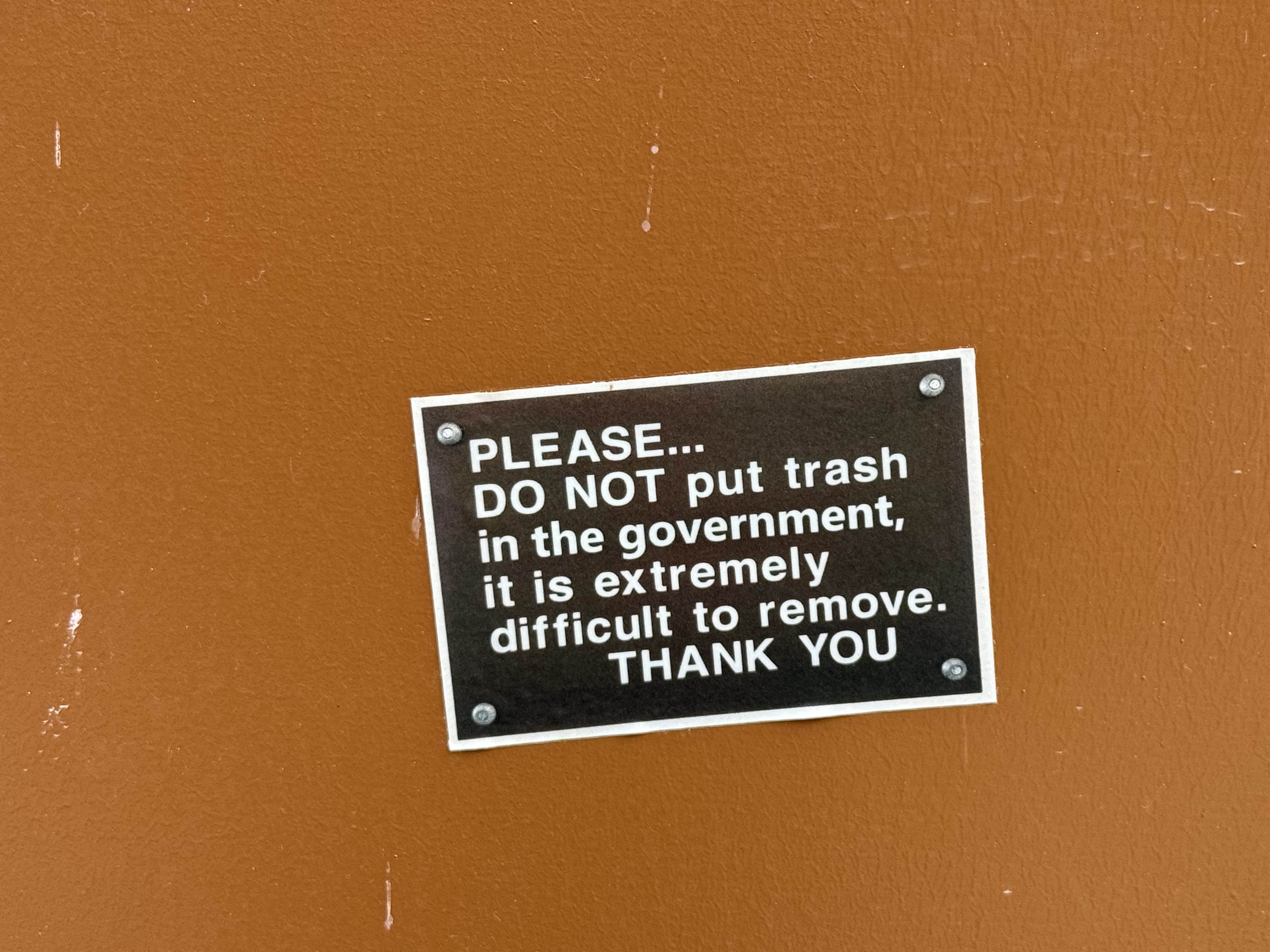
More PNW Humor. All of the toilets we saw along the coast were constructed over septic tanks, with warnings about what to put in them. Someone with a sense of humor modified just one word of the official message…
If you get the chance, I strongly recommend visiting Olympic National Park, but you’re going to want to spend a week unless you live nearby in the PNW.
Gravel Beaches on Vashon Island
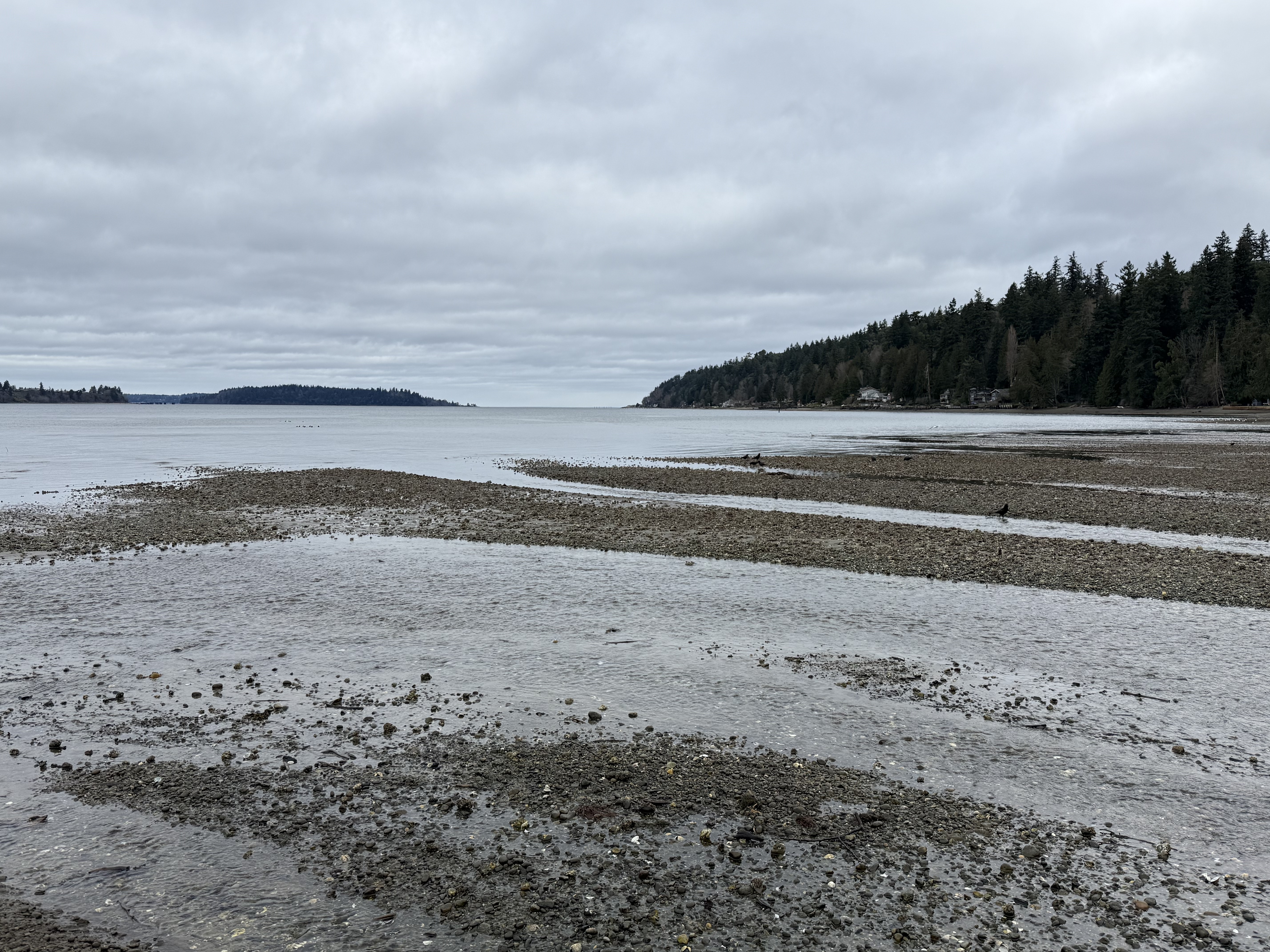
This photo of the gravel/mud beach at Fern Cove Nature Preserve reveals a marine delta, fed by Shinglemill Creek. Unlike the mud/sand delta we saw at Dash Point, the sediment here is dominated by rounded gravel and small boulders. Mud, sand and silt form the matrix. All of this material is available from the glacial till that comprises Vashon Island.
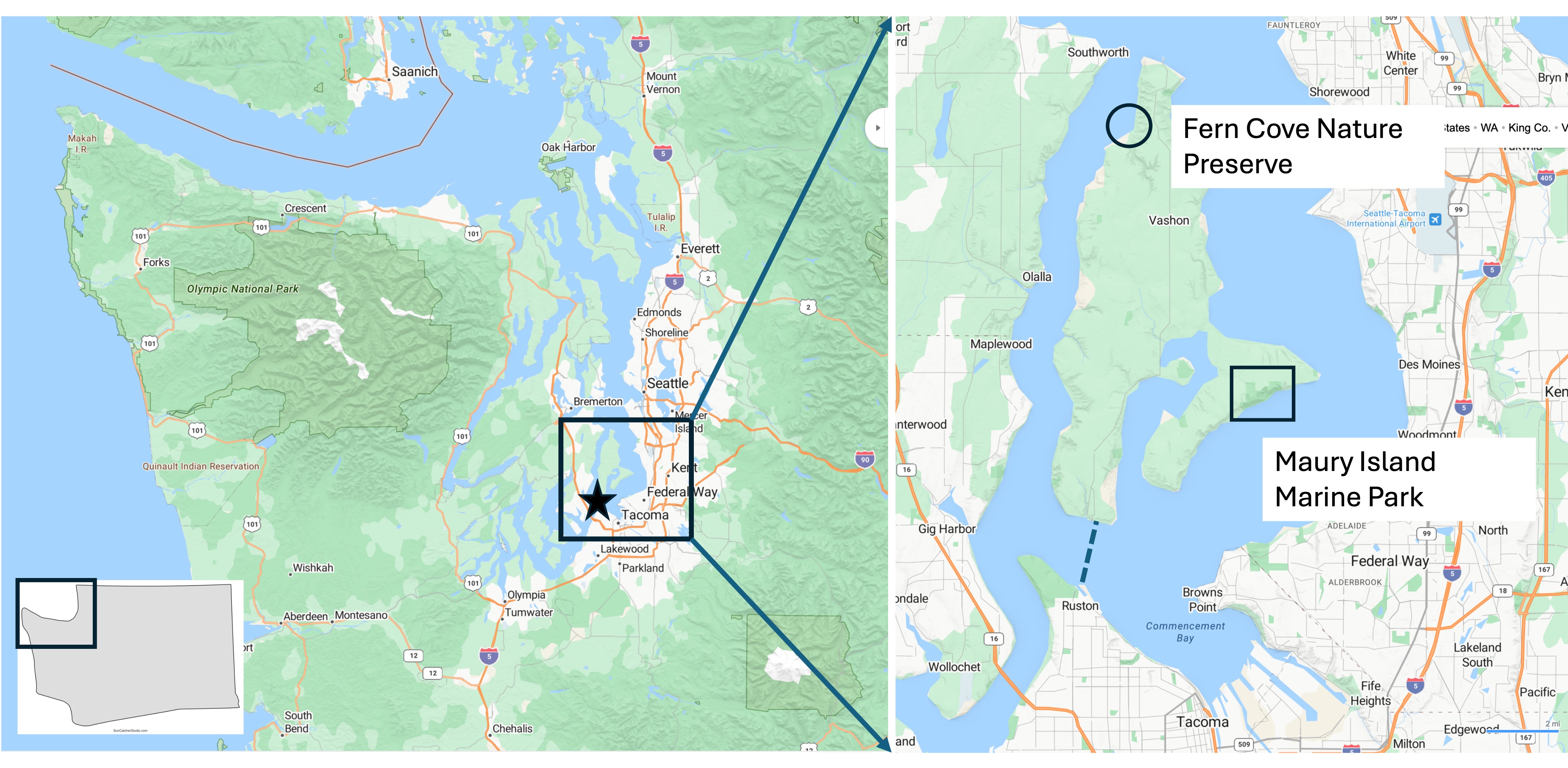
The inset map (right) shows the two sites I visited today. Fern Cove is located near the northern tip of Vashon Island whereas Maury Island Marine Park occupies the SE side of an island that is connected to Vashon by a fill zone about 200 yards across (which is eroding away as I type).
Fern Cove Nature Preserve
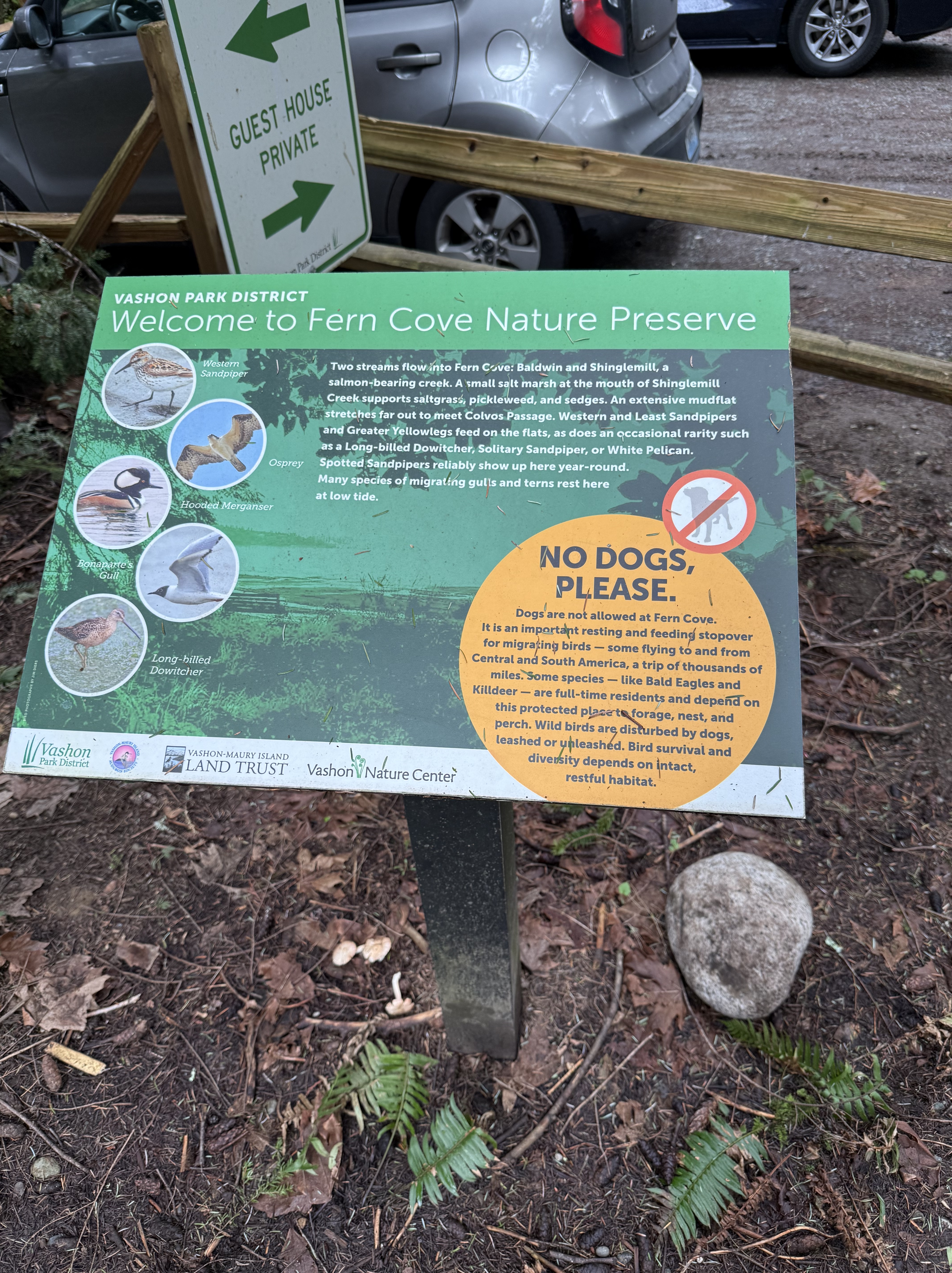
Vashon Island was logged out, so the beautiful evergreen forests that cover most of the island are all second growth. The state is trying to restore the original habitat, and Fern Cove is a good example; they don’t allow dogs!
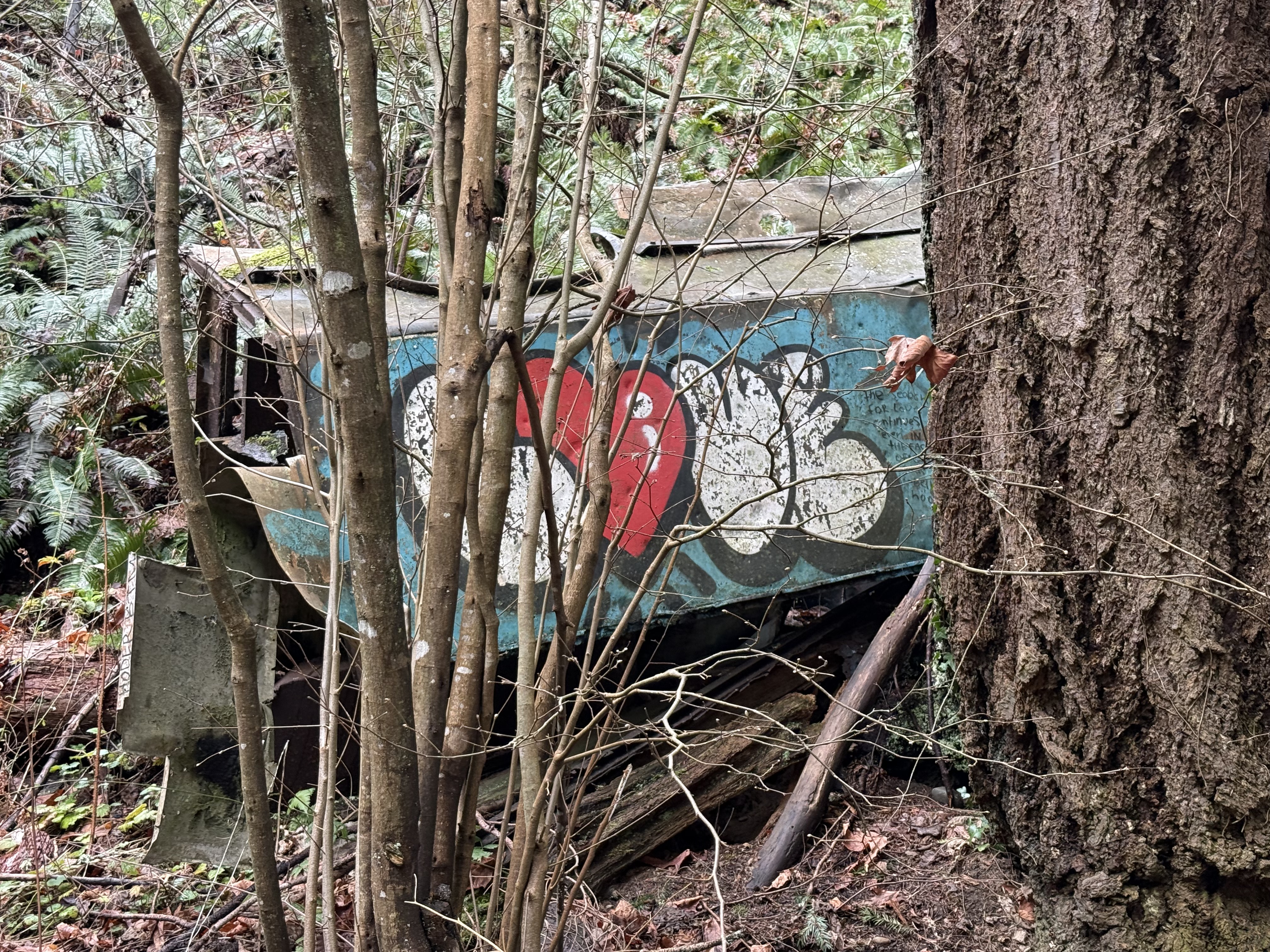
I’ve noticed that people in the Pacific Northwest (PNW) appreciate industrial art of a practical nature. I found an example here, in a threatened habitat that is actively being restored. I guess this old truck body isn’t hurting anything; I’ve also noticed that communities in the PNW don’t waste money on unnecessary actions.
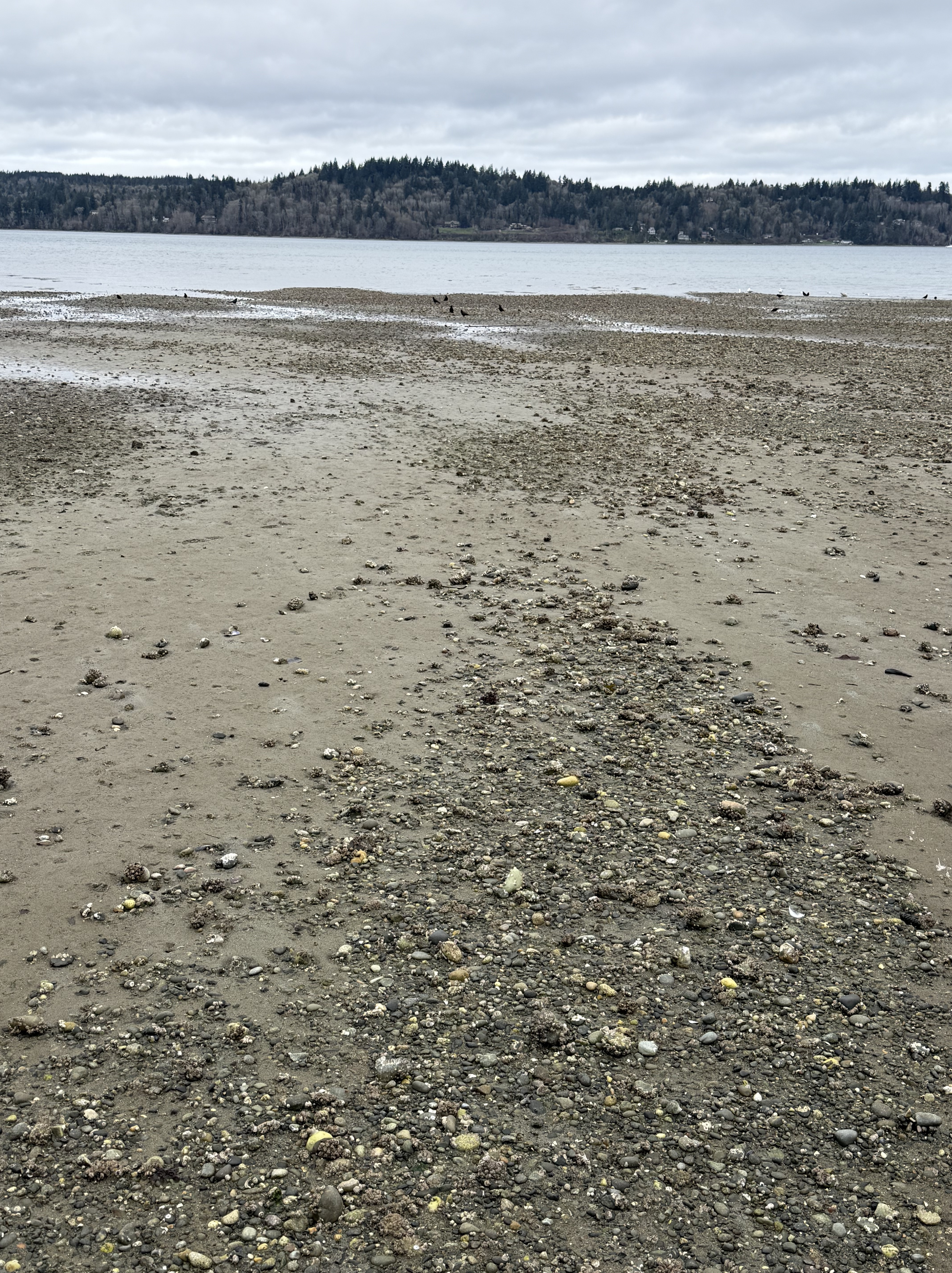
This photo shows how the gravel is localized within the delta, forming low nearshore gravel bars. The intervening areas are muddier than I found at Dash Point.
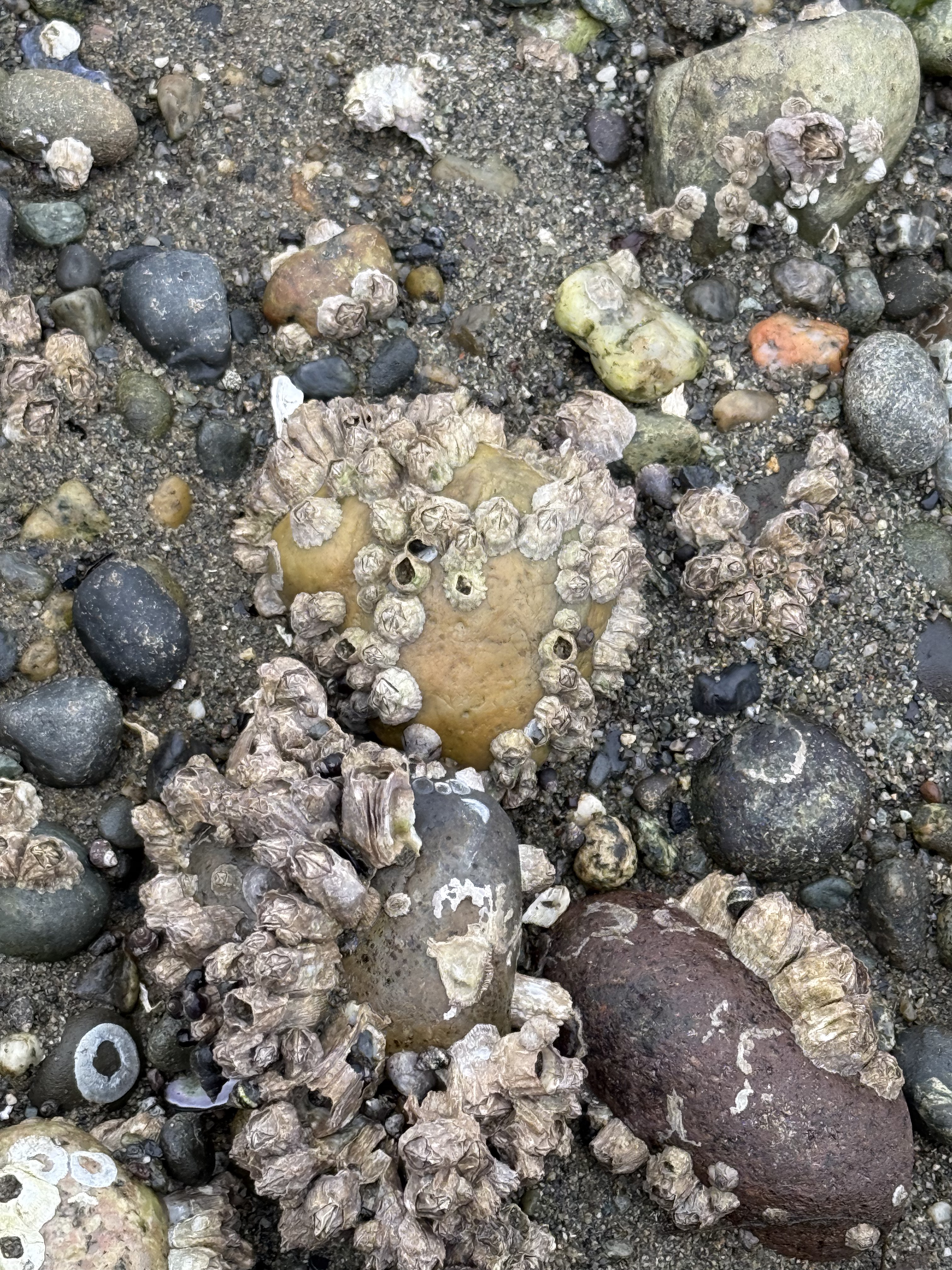
These gravel bars do more than concentrate larger rock fragments. Acorn barnacles encrust the larger ones, which are several inches in diameter. The tidal range is about 7 feet here and the beach is inundated twice daily, so I think these are living. I’ve seen barnacles on large boulders before, but I didn’t know they grew on stones. I guess the wave energy isn’t high enough to disturb them over a life cycle; their larvae must hang around after a storm and find a new rock to inhabit.
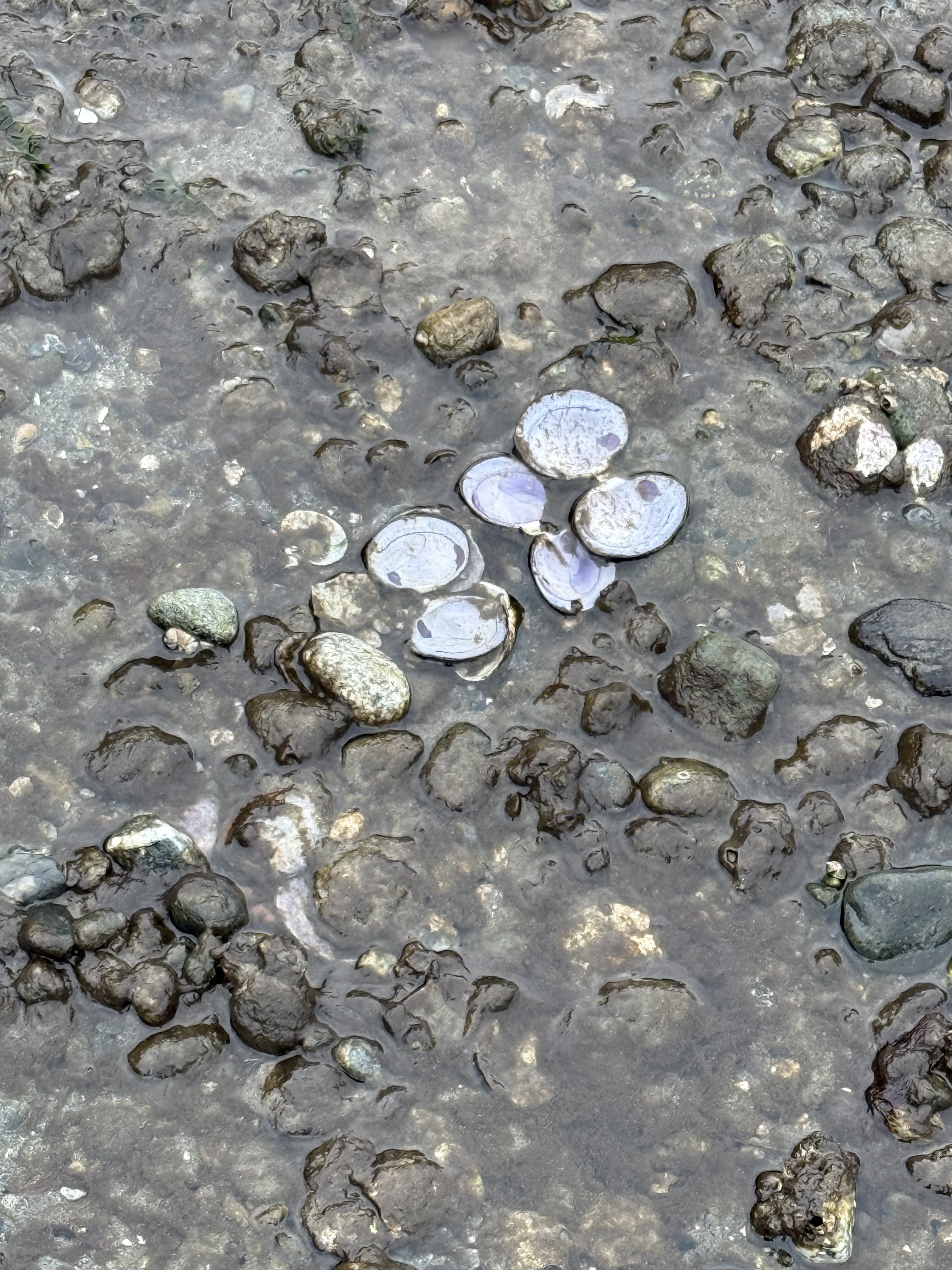
On all the beaches I’ve reported on for Rocks and (no) Roads, I’ve never seen this before. This is an active feeding area for sea birds. These are mussels, which the birds grab from a nearby mussel colony on the shallow delta front and drop on exposed gravel during low tide. The shells break open and the birds feast, leaving their dirty dishes behind.
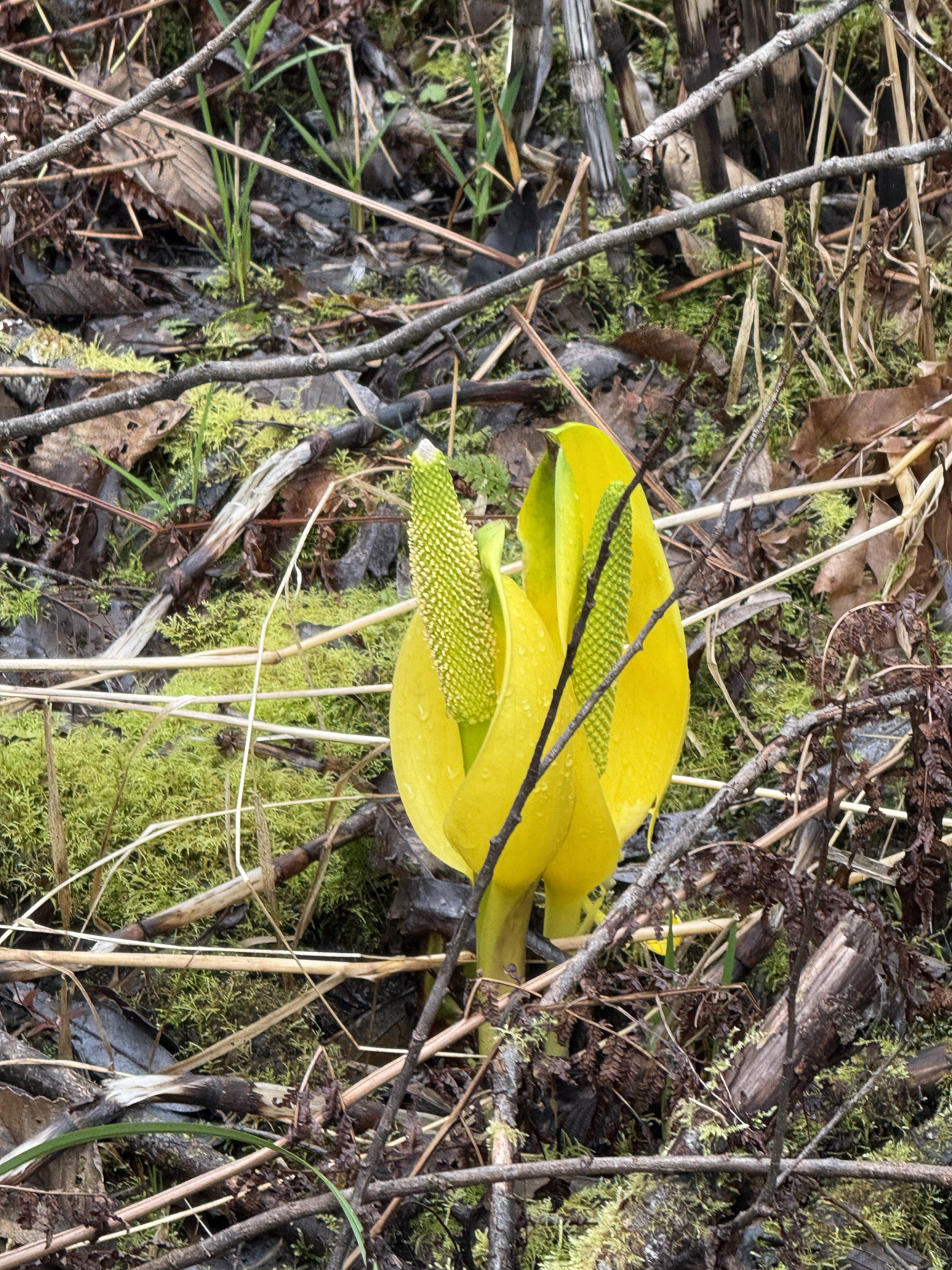
This Western skunk cabbage is just emerging from the wetland surrounding Shinglemill Creek. It will grow leaves up to two feet long, but it makes a beautiful display in the unseasonably warm late winter we’re having in the PNW.
Maury Island Marine Park
On the opposite side of Vashon Island, I visited a gravel quarry that operated for about seventy five years, before being purchased by the state as a park. This is another example of letting nature recover without interference.
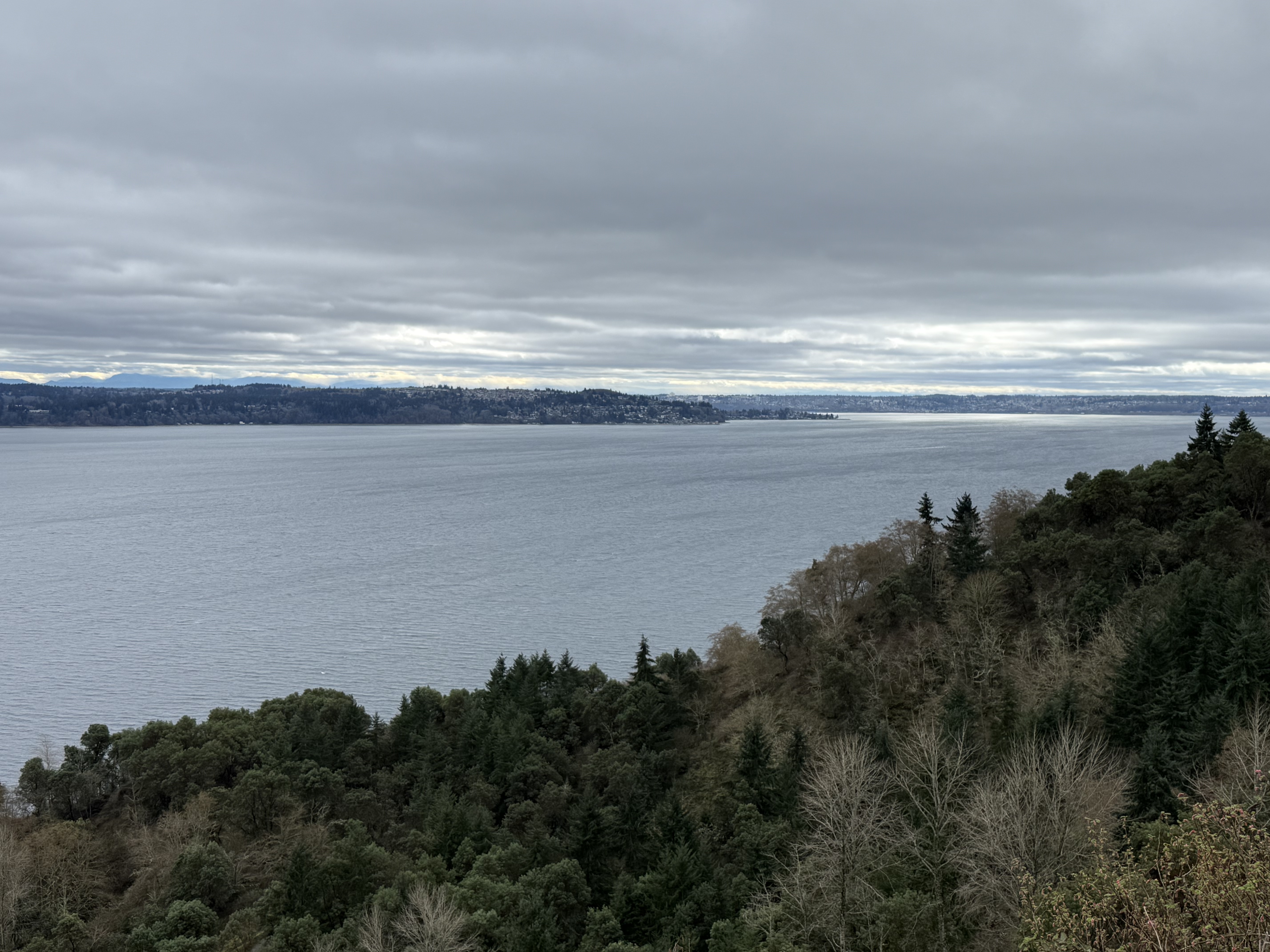
This photo looks SSE towards Dash Point. Commencement Bay and Tacoma are visible in the background; a little sunlight is shining on the bay. The cliff has been quarried for 75 years, so the 400-foot vertical face is now a steep incline with a trail that utilizes many switchbacks to reach the shoreline. Let’s see what I found…
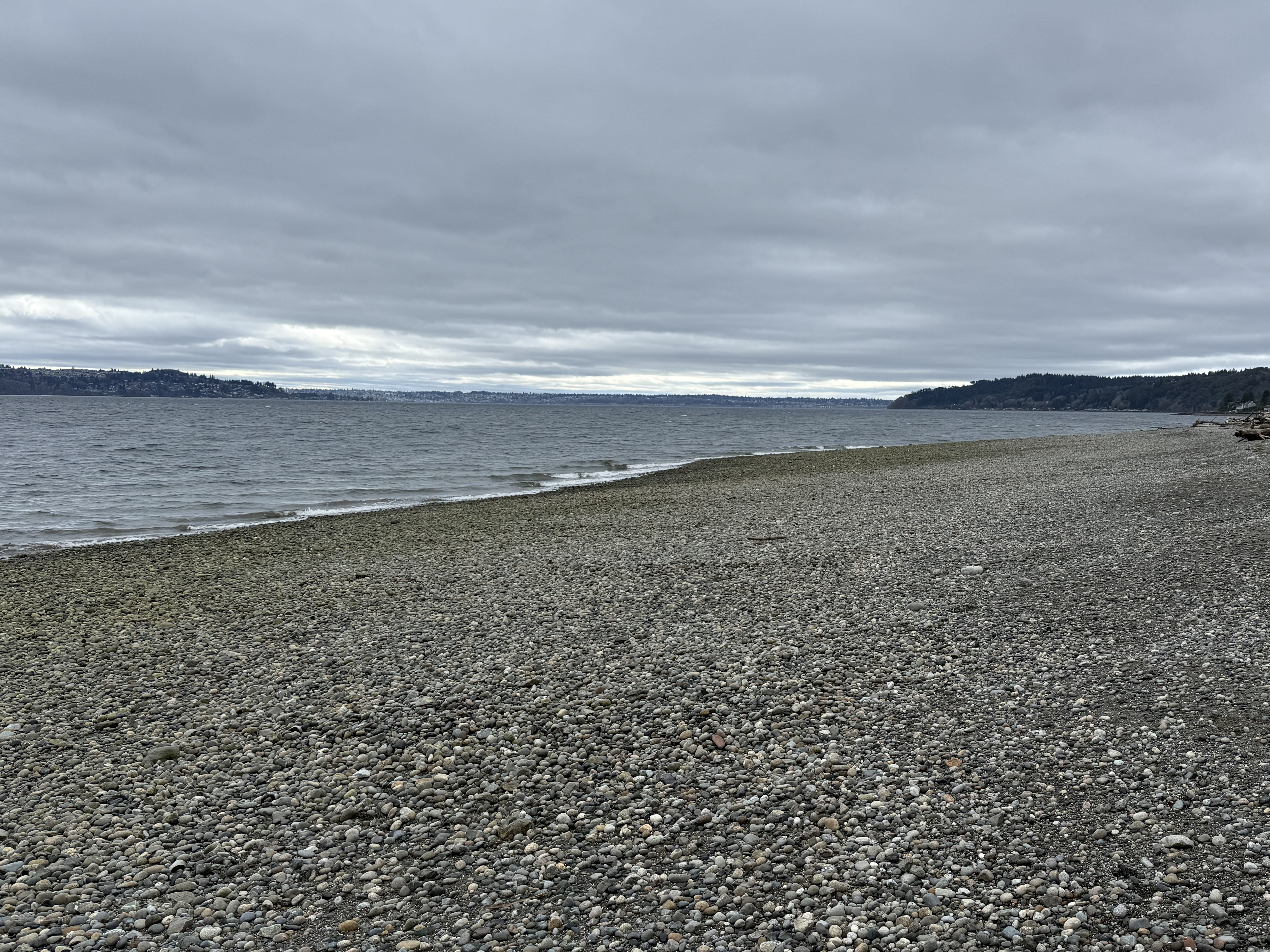
There is no mud or sand visible on this beach. I thought that might be a side-effect of so much gravel quarrying, so I walked beyond the limit of the quarry; the substrate didn’t change, but there must be lingering effects after so many decades of preferential sand removal.
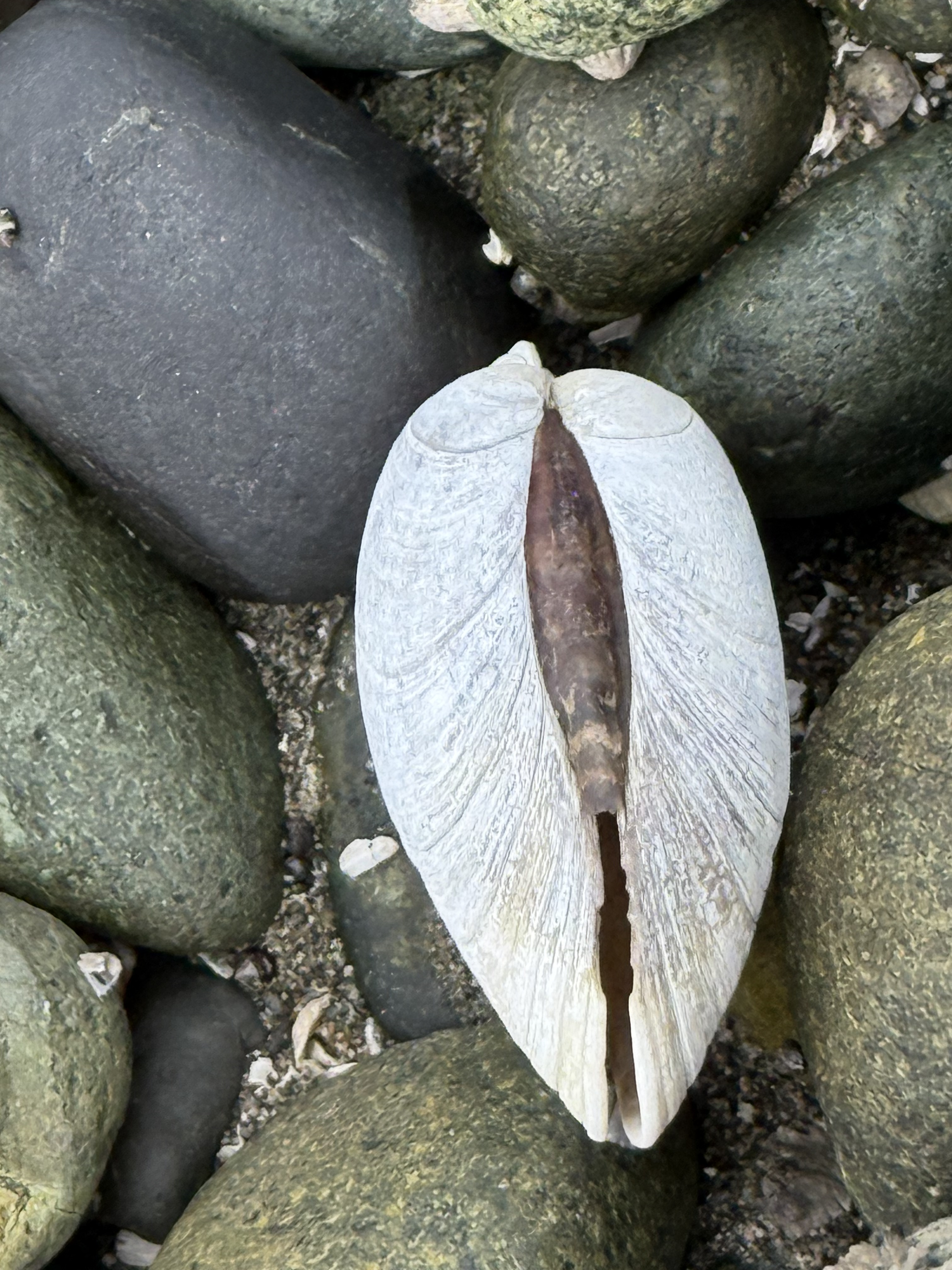
After what I saw at Fern Cove, I thought I was prepared for whatever I might find; but I never expected to see clam shells with the hinge lineament intact; this shell even closed after the bird (e.g. gull or crow) has eaten the soft tissue. The shell actually snapped shut after the animal was eaten. Amazing!
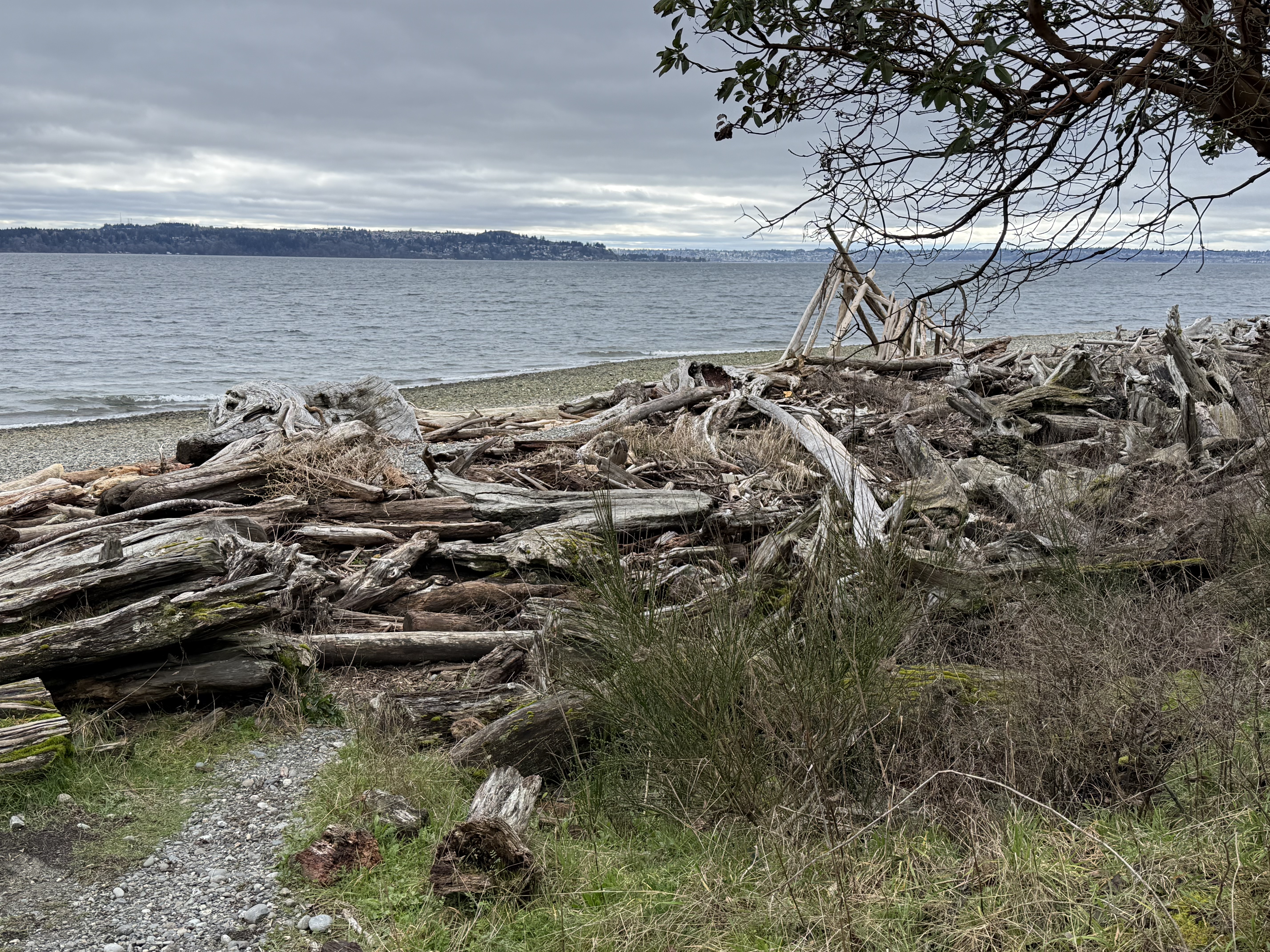
This spectacle gives driftwood a whole new meaning. Someone even built a crude shelter in the background from the logs that have collected over the years. There are a lot of trees in the PNW and many of them fall into Puget Sound, ending up all over the place. This looks like what coastal geologists might call a “hot spot”, a location where waves converge during storms.
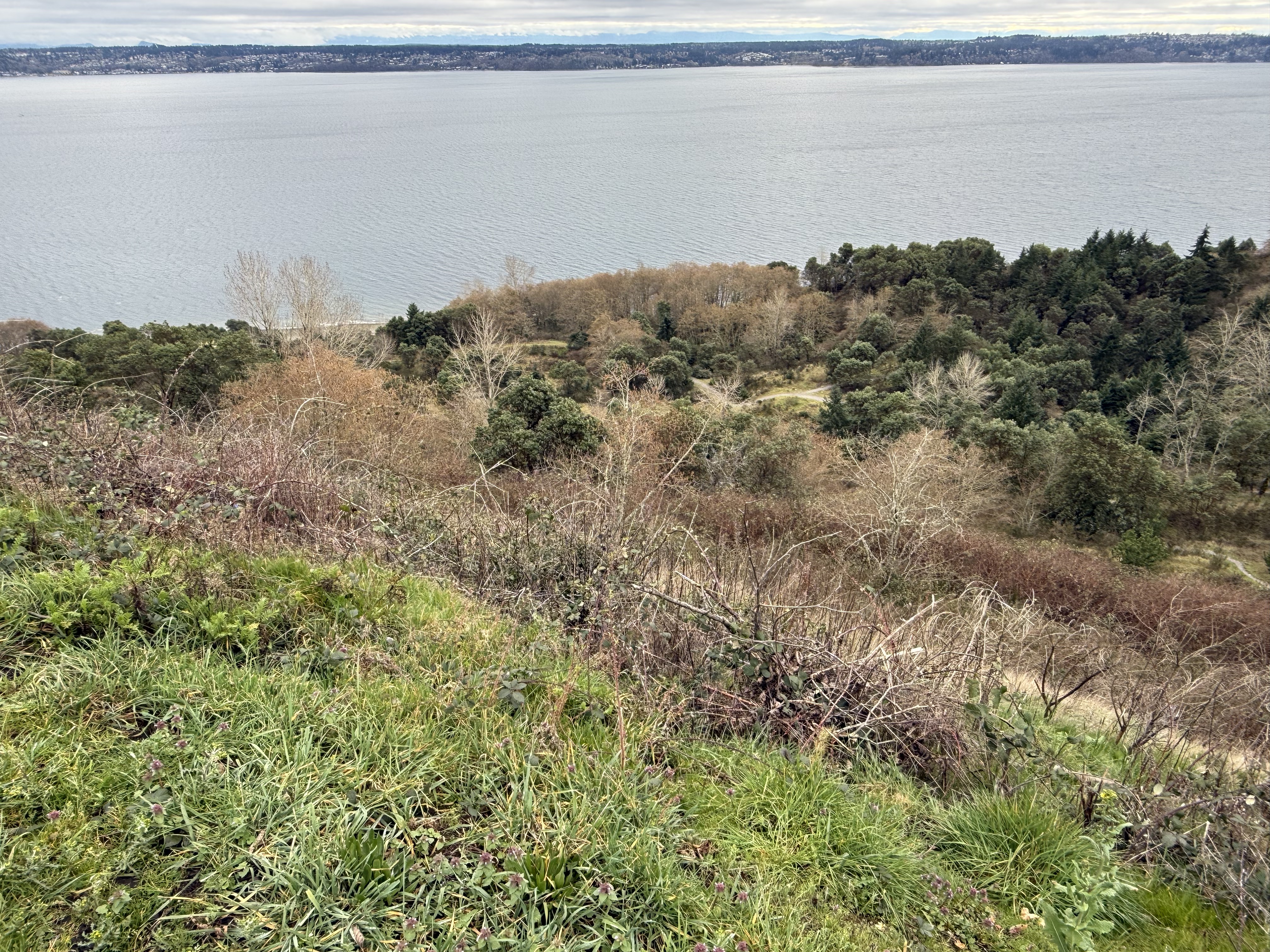
After a hot climb, even in 45F temperatures, I made it back to the top of the cliff. This area was a barren wasteland in 1975, when the state took over; park authorities and volunteers have worked tirelessly to not only allow recovery, but to keep out invasive species. I think they’re doing a pretty good job.
Summary and Acknowledgments
I learned more biology on this day trip than in my entire life. For example, sea birds eat mussels on muddy beaches and clams on cobblestone ones. They carry the hard shells in the air and drop them on rocks, breaking them open to reveal the animal hiding within. Apparently I arrived at these two beaches just after lunch, when the tide hadn’t cleaned up the dishes yet.
I’m going to pay more attention to fauna and flora in my future posts.
I don’t know anything about biology, so all plants and animals identified in this post came from CoPilot (AKA ChatGPT). I didn’t check their identifications because it wasn’t worth the hours that would have required. This is not a research paper. I’m just going out into the world and observing through my dirty, discolored glasses.
But now I can see living things…
Quaternary Geology on Mt. Rainier

Figure 1. View of Mt Rainier from the west. At 14410 feet, it is the most prominent peak in the contiguous United States. It has 28 glaciers, with the largest total surface area in the lower states–35 square miles. Mt Rainier is a stratovolcano, composed of andesitic lava (rather than basalt), material ejected from the summit, and ash layers. This type of volcano is commonly found in subduction zones; they tend to have explosive eruptions (e.g. Mt Saint Helens). The oldest rocks on Mt Rainier are about 500,000 years old. It is active and listed as a decadal volcano–one of the most dangerous volcanoes in the world. Its last major eruption, accompanied by caldera collapse, was 5000 years ago, but minor activity was noted during the nineteenth century.
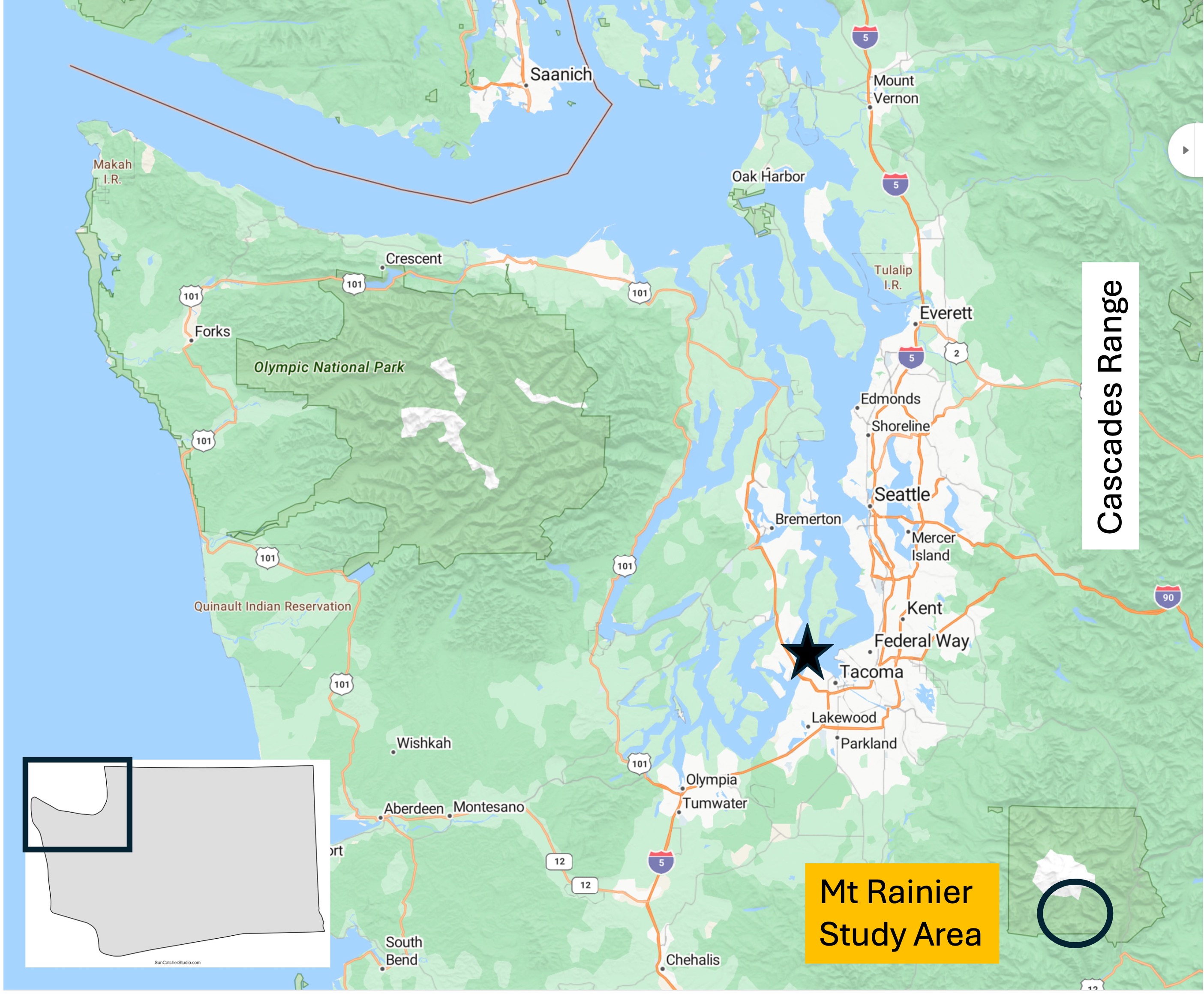
Figure 2. From my home in Tacoma (star) it’s a two-hour drive to Mt Rainier National Park. It is part of the Cascades Range, which comprises many well-known volcanoes like Mt Baker, Mt St. Helens, and Mt Hood.

Figure 3. This photo was taken on the south flank at an elevation of about 5400 feet, near the visitor’s center. It was a beautiful day and there were a lot of people preparing for some cross-country skiing on a couple of feet of snow. From this elevation it takes 2-3 days to reach the summit, almost 9000 feet higher. It’s hard to imagine it being so high and taking so long to reach.

Figure 4. These southern volcanic mountains are part of the Tatoosh Range, with peaks of about 6600 feet. Most of the volcanic rocks comprising these mountains are andesite, intermediate in composition between basalt and rhyolite. It is also very viscous, behaving like peanut butter and thus not flowing well. Andesite is commonly found at convergent plate boundaries where it is thought to result from mixing of basalt (from the oceanic crust), continental crust, and sediments accumulated in the accretionary prism.

Figure 5. Map of the 28 glaciers on Mt. Rainier. The glaciers fill canyons and valleys that were partly cut by ice. Figure 3 shows a smooth mountain, but in reality most of the smooth areas are the surfaces of glaciers. We’ll look at one below. The ellipse indicates the area discussed in this post.

Figure 6. (A) Narada Falls interrupts the descent of Paradise River, fed by Paradise Glacier (see Fig. 5 for location), making it drop a couple hundred feet over a thick layer of andesite. Andesite tends to form blocky flows, as shown in the right side of the photo, where the water seems to be climbing down steps. (B) Possible contact between younger volcanic and older intrusive rocks. Igneous activity within the area has been continuous for at least 50 my, during which time erosion has exposed older intrusive rocks like this granodiorite, which is part of a pluton intruded between 23 and 5 Ma. It is important to keep in mind that the volcanic rocks originated in plutons (magma chambers) emplaced miles beneath the surface. As they are exposed, new volcanoes form as more magma is injected into the shallow crust in a continuous process. (C) Differential weathering has accentuated layering in this volcanic rock, which was probably created by a series of ash layers deposited in quick succession–geologically speaking.
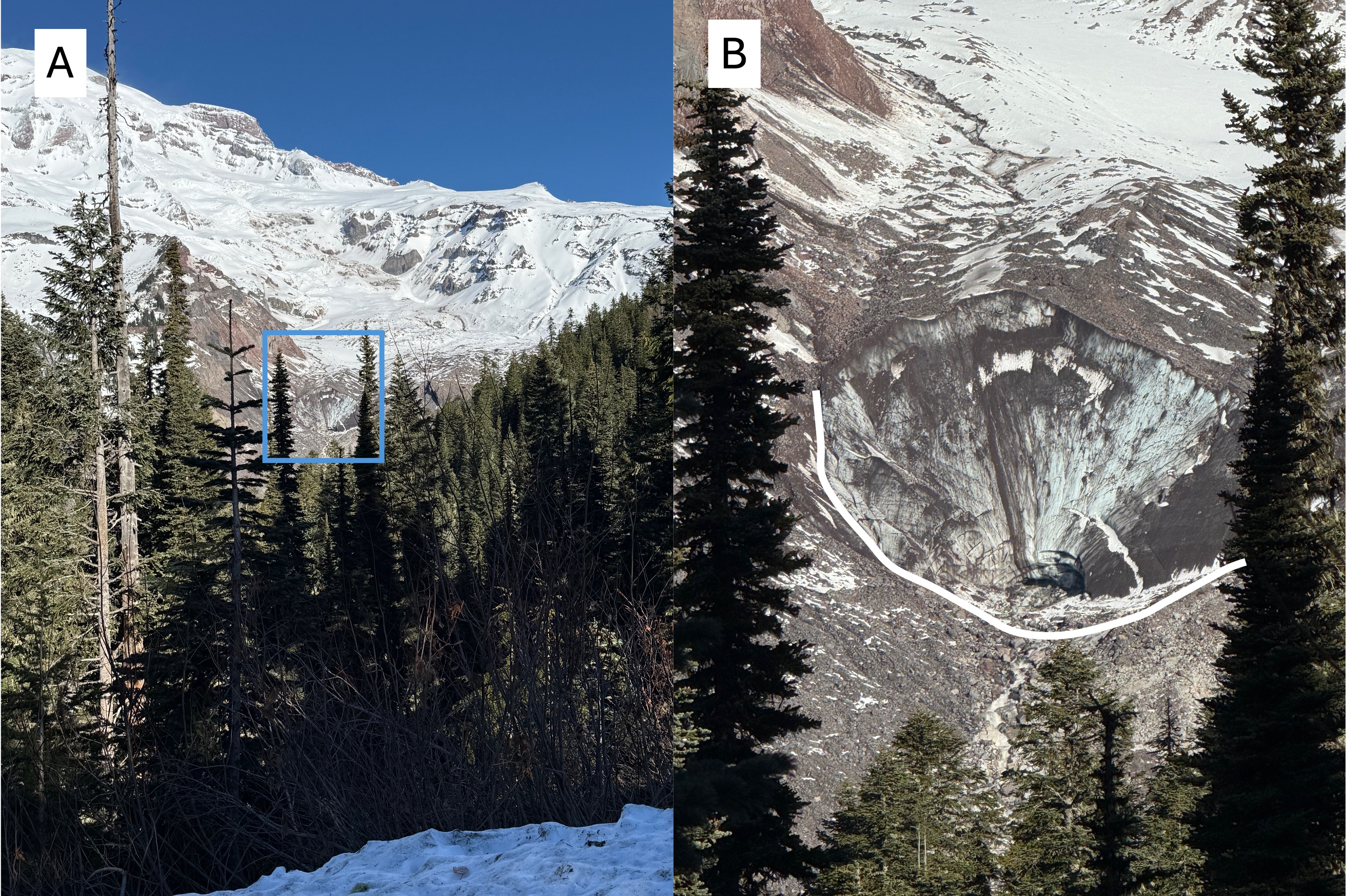
Figure 7. (A) View looking north towards the source of Nisqually Glacier (see Fig. 5 for location), which originates near the peak of Mt Rainier. The area delineated by the blue rectangle is the face of the glacier. (B) Closeup of the face of Nisqually Glacier. The characteristic U-shaped valley carved by glaciers is highlighted in white. Note the dark material within the glacier, probably wind-blown fine sediment. It looks like the face is a couple hundred feet high. I’ve never seen a retreating glacier before, so this is pretty spectacular to me. The Nisqually River originates right here…
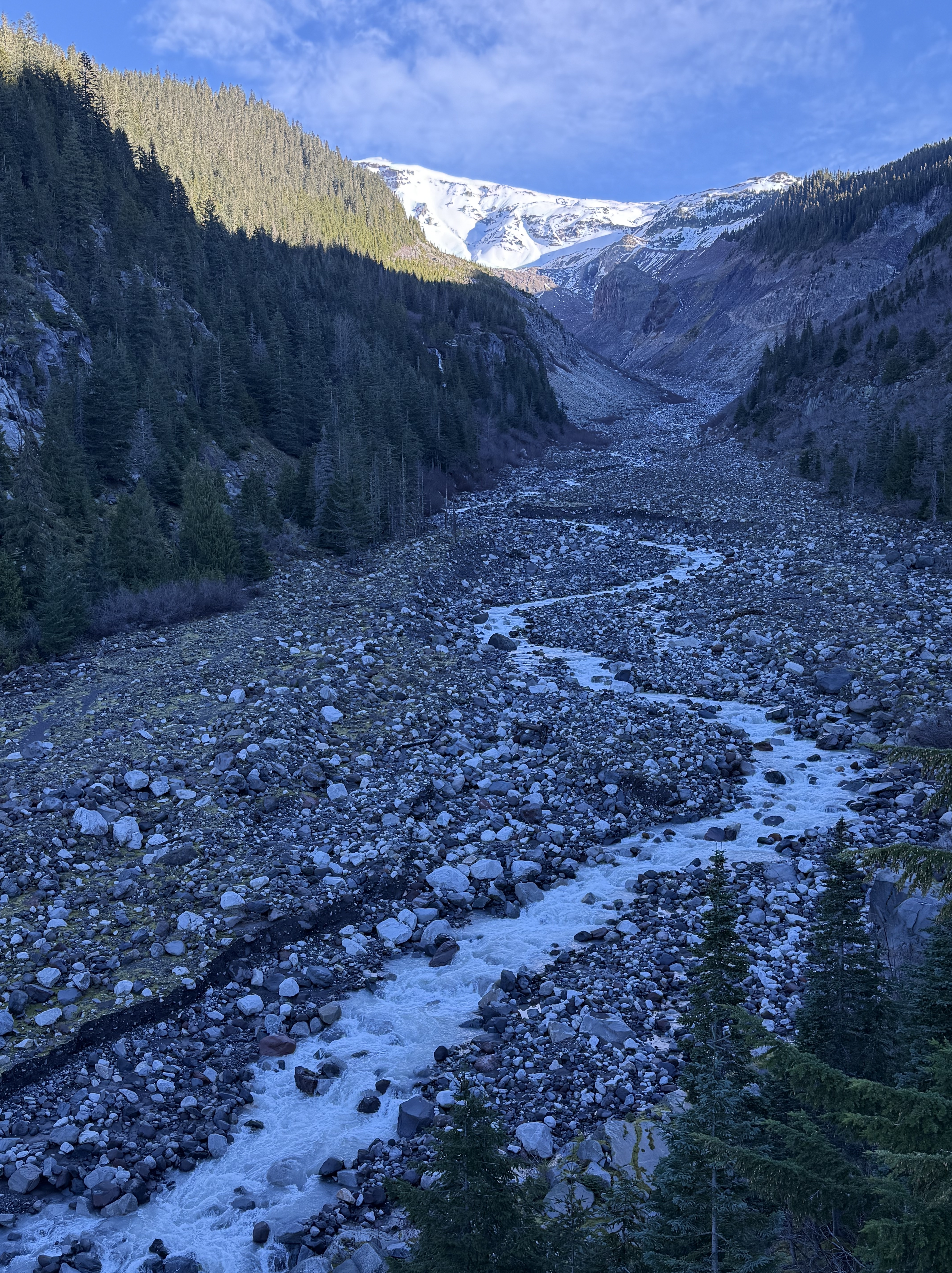
Figure 8. View looking upstream along Nisqually River a mile downstream from Fig. 7. This is one of the most stunning photos I’ve ever taken because it reveals geological continuity, from the origin of a glacier 10000 feet higher, to the outwash being transported by a river. Amazing! Note the perfect U-shape where the shadow ends upriver. This area would have been covered by the glacier as recently as 10000 years ago.

Figure 9. Another mile downstream from Fig. 8 the walls of the valley have lowered, and are now rimmed by volcanic flows half-buried by detritus. Evidence of a glacier filling the valley has been erased by collapse of the valley walls. Rounded boulders fill the riverbed. The Nisqually River is overwhelmed by the huge sediment load and opens up new channels to continue flowing.

Figure 10. View looking upstream at the confluence of Nisqually River and Van Trump Creek. There are a couple of interesting features visible in this braided stream bed, less than two miles from the glaciers feeding each branch. The valley is very wide and flat-bottomed because it was carved by glaciers more than 10000 years ago. The large boulders (as large as three feet) covering the entire valley floor were transported by a glacier and became relict after its retreat because the stream flow, even during floods, is too weak to transport and erode them. The Nisqually River is cutting a channel through these relict sediments; the scarp is about eight feet in height. The white line delineates large, surface boulders from subjacent sand and silt with few boulders. Note that the surface boulders stop upstream where the white line curves sharply upward.

Figure 11. Image from 200 feet downstream of Fig. 10, showing a break eroded in the boulder-bar that crosses the stream bed at an angle. During recent heavy rain Nisqually River broke out of its current channel and created a myriad of flow structures such as the longitudinal bars seen in the lower-right of the photo. I think this bedform is actually a terminal moraine marking the maximum advance of a previous glacier–not necessarily the maximum glacial extent during the last two-million years.

Figure 12. (A) Andesite boulder (2 feet across) wet by recent rain shows fine-scale structure. The irregularity of the laminae, and phenocryst distribution, suggest to me that this sample represents ash fall rather than a flow. Magma with the viscosity of peanut butter tends to form smooth lines because it is difficult to penetrate, which would be necessary to create the mixed-up appearance between the lighter and darker shades in the center of the image. (B) Large block (~10 feet long) of intrusive rock similar to that seen at Narada Falls (Fig. 6B), but this is two-miles downstream. This relic was pushed/dragged by a glacier to this location. The white circle indicates where a close-up photo was taken. (C) Close-up (5x) image of the heavy block. It contains quartz (Q), plagioclase/albite feldspar (no orthoclase) (F), and amphibole (Am). My estimate of the composition is: 50% feldspar; 30% quartz; and 20% amphibole. Based on my estimated mineral composition, this would be granodiorite; however, I didn’t differentiate plagioclase and albite feldspar. (The former is darker than the latter.)
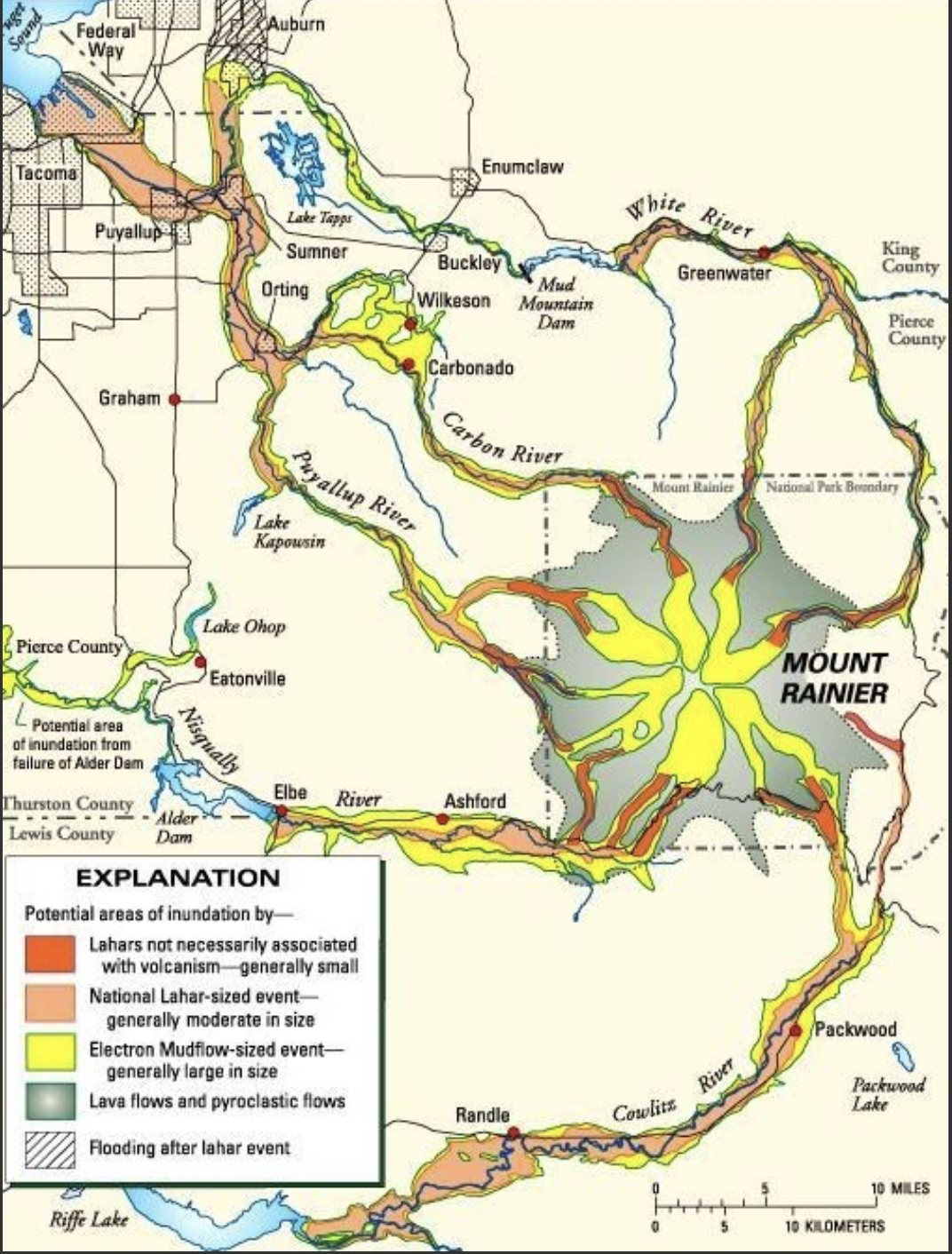
Figure 13. Map of potential volcanic risks associated with Mt Rainier–besides an explosion (e.g. Mt St Helens) and the eruption of ash which would cover a large area, depending on wind direction. Lahars (mud flows fed by all those glaciers) pose the greatest risk because andesite is too viscous to flow more than a few miles from its source.
Summary. I have seen evidence of continental glaciers in the Great Plains, the German Plain, and Ireland, but I never had the opportunity to observe glaciers up close. Alpine glaciers were nothing more than an abstract idea to me, something viewed from a distance.
I’ve looked out over the clouds from the summit of Haleakala crater on Maui, gazed into the cauldron of Kilauea, witnessed the boiling water rising from beneath Yellowstone’s seething caldera. I’ve seen videos of volcanic eruptions in Iceland, but I never imagined putting the glaciers and volcanoes together–right next door!
Usually, geology is observed as a series of images frozen in time, but at Mt Rainier it can be glimpsed as a real-time process that reshapes the earth’s surface–from top to bottom.
What a wild geological ride!


Recent Comments