Deception Pass: Ophiolite or Volcaniclastic Sediments?
Now that I have a general idea of the geologic history of Northwest Washington (NWA) it’s time to start filling in the blanks. I immediately found a discrepancy in the rocks found on the northern end of Whidbey Island and the adjacent peninsula (Fig. 1): some authors identified these rocks as ophiolite–pieces of ocean crust that contain evidence of extrusion at mid-ocean ridges. Let’s see what I found.
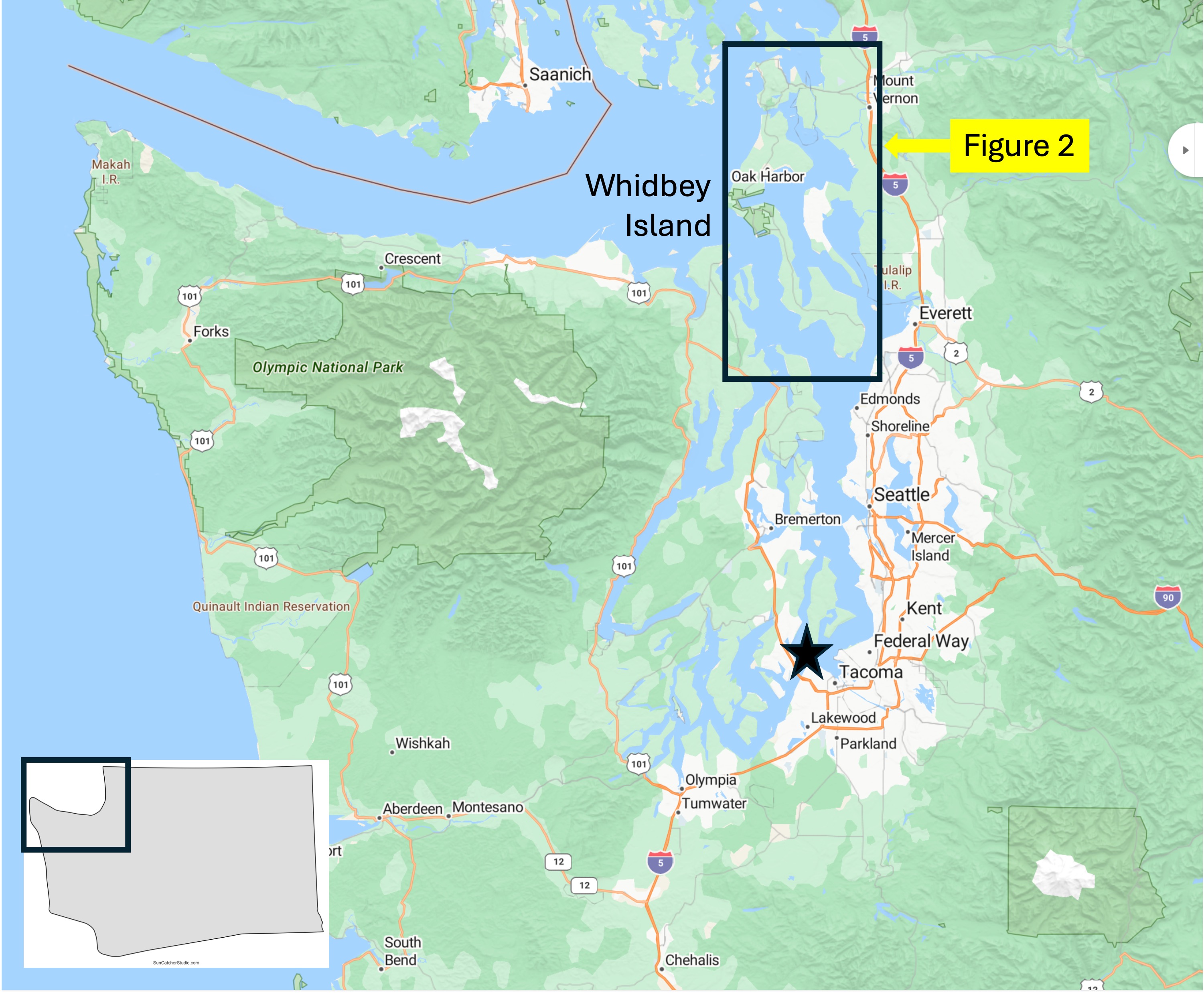
Figure 1. Whidbey Island is a large island that is almost completely covered by glacial sediments. Its elevation varies from less than 100 feet above msl (mean sea level) to almost 400 feet, probably reflecting the presence of terminal morraines deposited as glaciers retreated. The box encompasses the study area, and the star is my home in Tacoma.

Figure 2. Progressively more detailed maps of Whidbey Island, showing the geological formations discussed in this post. (A) Deception Pass is a narrow channel (~200 yards wide) between Whidbey Island and a tiny island that connects it to a peninsula. Glaciers covered this entire area, advancing and retreating for at least two million years, while scraping out Puget Sound from unconsolidated sediments and easily eroded rocks. I entered Whidbey Island via a ferry from the mainland just north of Seattle. (B) Geologic map of the norther tip of Whidbey Island and the adjacent peninsula. The tan areas are covered by glacial sediments whereas the blue and green areas are reported as volcaniclastic rocks by Rock-D and the US Geological Survey national map. However, I read a Washington State geological report from 1962 that reported layered gabbro and other indices of a classic ophiolite sequence. Were Washington’s geologists incompetent? Over eager? Non-peer-reviewed? Or maybe they stumbled onto an exposure, described it in a state report, and, when no one cared, dropped it until they retired. I don’t know. Nevertheless, everyone is in agreement that the age of these rocks, which include basalt and marine sediments, is poorly constrained: they could be as old as 251 Ma, the beginning of the Mesozoic era; and as young as 66 Ma–the end of the Mesozoic. Wow! The thin, black lines indicate faults inferred from stratigraphic relations. The USGS has adopted the generally accepted paradigm of gathering legacy geological formations into larger groups that reflect the plate tectonic setting, rather than geographic location. The “official” description is so encompassing (including the kitchen sink) that it could easily include what the Washington geologic report called “ophiolite”. (C) Detailed map showing my approximate location along the path that followed the shoreline (blue circle) and the location where I saw these rocks in an excellent exposure (yellow diamond). I’m not sure why the rocks south of Deception Pass (blue) are differentiated from those on the north side (green) by Rock-D; the USGS map shows they are the same, as does my field examination (discussed below).
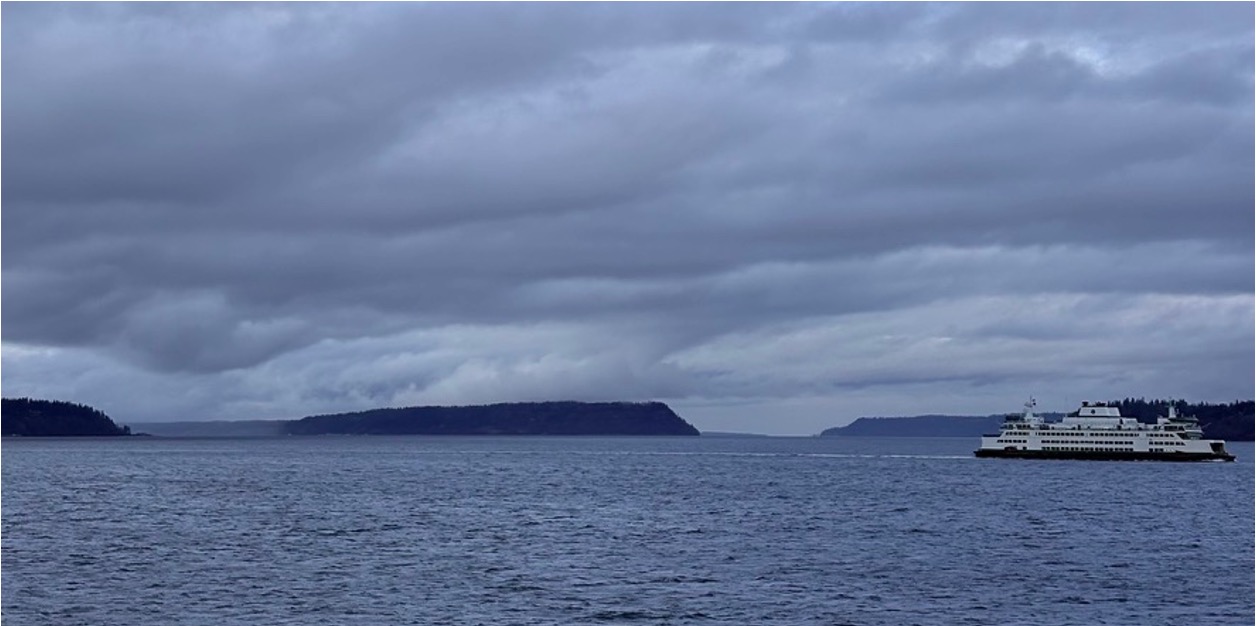
Figure 3. The ferry ride from Mulkiteo to Whidbey Island (see Fig. 2A) shows the same high elevation of Whidbey Island (left), Hat Island (center), and a promontory north of Tulalip (behind the ferry; see Fig. 1). This elevation of glacial sediments is approximately the same as the basement rock discussed below. This high relief shoreline is found throughout Puget Sound.
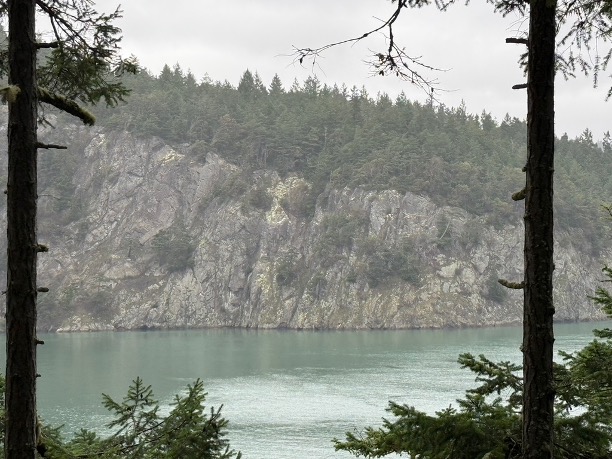
Figure 4. View looking north across Deception Pass, showing the nearly vertical bedding of rock layers, which could be original sedimentary fabric, metamorphic surfaces, or joints. Let’s have a closer look.

Figure 5. Images of the exposed rocks near the top of the hill overlooking Deception Pass (see Fig. 2C for location). (A) These medium bedded (~6 inches) layers contain clasts of different rocks. The height of the image is about six feet. (B) This twelve-foot exposure shows thin-bedded sand/silt layers with intercalated mud, but the layers are overturned (more than 90 degrees from horizontal) and reveal rapid changes in bedding, in addition to large boulders of material. (C) A bedding surface shows the characteristic sheen of schist, which adds metamorphic foliation to original bedding. These rocks are not heavily altered, so the layers seen in (B) probably reflect original beds. The clasts in (A) are matrix supported, which suggests mixing of different sized particles. This unusual texture occurs in environments where periodic mass failures (e.g. landslides or submarine slides) occur.

Figure 6. These images from about 100 feet elevation show more details of the rocks exposed at Deception Pass: (A) These layered sediments vary from medium to thick bedded and they also reveal gentle folding at this scale (the photo is ten feet high), suggesting that the overturned beds may be part of a large fold, possibly related to the faults seen in Figs. 2 B and C; note that the faults have a NW-SE orientation approximately aligned with the fold axis (I didn’t make careful measurements). It is also possible that the faults reflect brittle failure as the rocks were uplifted within the accretionary prism. (B) The left half of the exposure reveals a thick (> four feet) layer containing mixed clasts in an otherwise fine-grained matrix. The right side contains medium beds of a lighter material (We don’t want to get carried away here because of the vagaries of chemical weathering.) However, the contact between the two apparent lithologies is irregular; If I’m right about the left side being the bottom (questionable), this could have been a volcaniclastic slide (basalt, ash, pieces of rock, etc) that was then filled in by less catastrophic sedimentation. I admit I’m speculating, but we have to imagine life on the continental margin during active volcanism, during subduction.
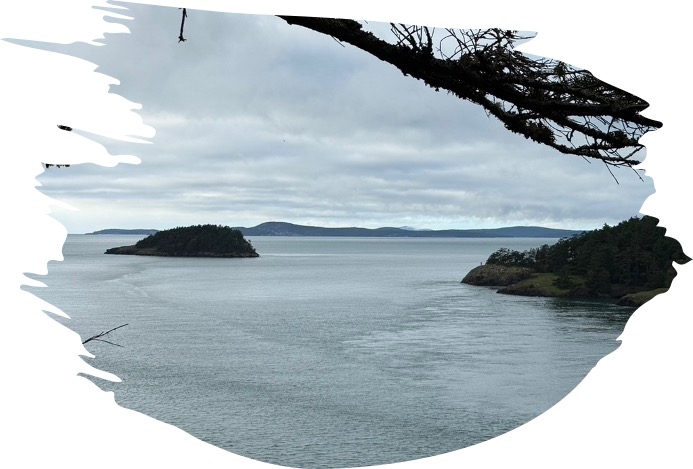
Figure 7. This photo was taken looking west from Deception Pass (see Fig. 1), towards the Pacific Ocean. Those islands are emergent blocks of jumbled Mesozoic/Tertiary sedimentary and volcanic rocks. The last ten-thousand years of sea level rise has covered most of the evidence contained within the accretionary prism, leaving us with only fragments.
Conclusion. I didn’t see any ophiolite at Deception Pass, but there is plenty of evidence of accretionary tectonics; deeply buried sediments and volcanics were scraped off the subducting oceanic crust and deformed continuously. This process has to obey the laws of conservation of mass, which means that the accretionary prism accumulates further west with each passing year. What we see exposed at the northern end of Whidbey Island is occurring today beneath the continental shelf, all while the Juan de Fuca plate is swallowed by the earth’s mantle. There is a two-mile-deep trench about 100 miles off NWA, but it is filled with sediment eroded from N. America, unlike more-familiar deep-sea trenches (e.g. the Mariana Trench, about 7 miles deep).
All that sediment in the subduction trench is like sand in in your transmission: it gums up the works and slows things down, but the Earth cannot be stopped, its relentless, insatiable appetite for oceanic crust never satisfied. It will keep chewing up the Juan de Fuca plate until the upper mantle decides that enough is enough and stops pushing N America westward.
I can’t wait to see how this ends…
Catching Up: A Brief Geologic History of NW Washington
Introduction
The shifting of tectonic plates around the surface of the earth is a zero-sum game because the surface area is fixed; thus, when new oceanic crust is created from the upper mantle at divergent plate boundaries (usually mid-ocean ridges but also at intraplate rift zones), oceanic crust has to be absorbed back into the upper mantle through subduction at convergent plate boundaries. Continental crust is not subducted because it is about 10% lighter than oceanic crust (2.7 g/cm3 vs 3 g/cm3), so it has been accumulating since the earth was created. Note that it took about 4.5 billion years (by or Ga; I will use Ma to refer to millions of year ago) to form the continents, which still comprise less than 30% of the earth’s surface.
The majority of continental crust existed by 3 Ga, and the crust was stabilized by 2 Ga; in other words, for the last two billion years, the same continents have been jostling about, driven by upper mantle convection–like a poached egg floating in boiling water. North America is a good place to examine these processes because it has mostly shifted back-and-forth, from east to west relative to its current orientation.
The geology of NW Washington can thus be seen as the opposite of Northern Virginia (NoVA); when the east coast is convergent, the west coast is divergent. This simplified model explains the differences between the two coasts/continental margins. The contrast is striking, which I will attempt to show in this post.
Precambrian (older than 550 Ma)
Current estimates suggest that 15-20% of the earth’s surface is Precambrian. Ignoring the rest of the world for now, there are a few metamorphic fragments (primarily gneiss, which is a rock so highly altered by heat and pressure that its original structure is lost); however, these rocks are not folded and partially melted, which suggests that they were altered primarily by deep burial–not compressive stresses. Nevertheless, they don’t shed much light on the Precambrian history of NW Washington (NWA hereinafter) other than that a lot of sediment was being buried very deeply.
This is very different from NoVA and the east coast in general, where long bands of gneiss and schist (a less-altered rock) are exposed from Georgia to Maine; their metamorphic ages range from 1-2 Ga, reflecting large scale collisional tectonics including subduction. The simplest interpretation is that the North American tectonic plate was moving (relatively) eastward during this interval, creating a passive margin along the west coast (Plate 1).
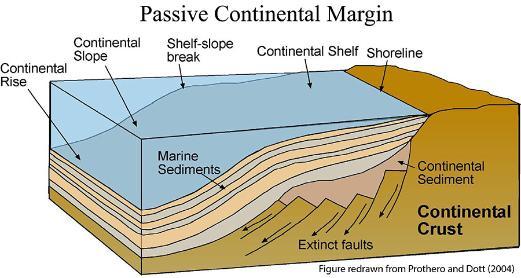
Plate 1. Schematic of a passive continental margin. This example is for a continental plate moving to the right while sediments are deposited along a gently dipping margin. As far as the data tell us, this was the situation in NWA between about 1000 and 250 Ma. The N American plate wasn’t jiggling, but rather sedately moving eastward, chewing up whatever islands and microcontinents got in its way while shedding its sediments on the west coast. (Like water off a duck’s back.)
Paleozoic (550 to 250 Ma)
The Paleozoic era saw the rise of multicellular organisms, which filled the oceans and colonized the land. There are enough fossils, the inhabitants of ancient seas in NWA, to document this explosion, but the rocks are highly altered and deformed. Nevertheless, the paleontological record implicitly supports the continuation of the passive margin that existed during the late Precambrian. In other words, a vast and diverse ecosystem was established that thrived for 300 my.
Mesozoic (250 to 65 Ma)
The Mesozoic era began with the breakup of Pangea, the supercontinent whose construction culminated during the Devonian period (415-360 Ma). This paradise of life lasted about 100 my but all good things must end. Upper mantle convection reversed course and Pangea was torn apart by what is today the mid-Atlantic ridge system. I saw the evidence in NoVA for myself; but what did this catastrophic event foretell for the peaceful west-coast of N America?
All hell broke loose.
The placid coastal environment suggested by Plate 1 was obliterated, geologically speaking, when the N American tectonic plate reversed direction and split away from Pangea, after approximately 100 my. At first there would have been earthquakes and uplift as the oceanic plate resisted the sudden compression. Nevertheless, when push came to shove, the denser oceanic crust was pushed beneath N America, creating a subduction zone that is still active.

Plate 2. This schematic portrays NWA as it exists today. Note how close the Juan de Fuca ridge is to N America. If we go back to the Triassic period (~250 Ma), there would have been about 2000 miles of oceanic crust between them, but it was all subducted. This subducted ocean crust would have partially melted to produce igneous intrusions, which were subsequently intruded by younger magma. Today, only a few slivers of the oldest igneous rocks are found east of Seattle. There were also sediments deposited; however, these were buried and deformed to form schist and other medium metamorphic grade rocks. Most Mesozoic rocks were eroded as uplift continued until the present day. Bands of Mesozoic volcaniclastic rocks are found east of the cascades where uplift has slowed as the subduction zone migrated westward.
Tertiary (65.5 to 2.4 Ma)
As the years passed the situation in Plate 2 continued unabated. Igneous intrusions of every composition (i.e. from gabbro to granite) pushed their way through the overlying rocks, often reaching the surface to create volcanoes and overlapping volcanic flows, mostly basalt.
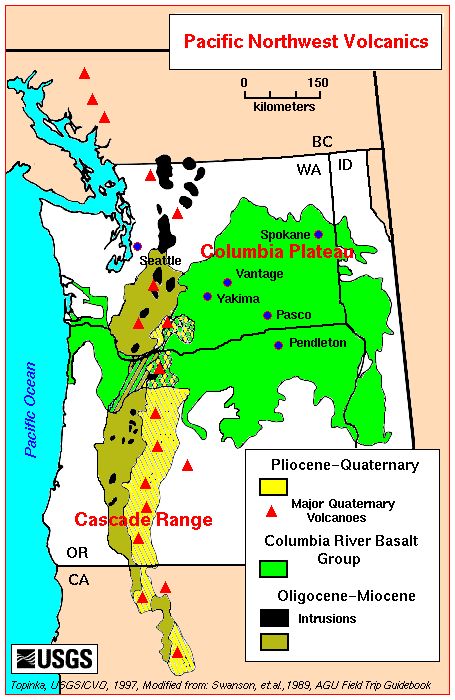
Plate 3. Map of Tertiary volcanic rocks in Washington. The oldest eruptions occurred along the Cascade range between about 50 and 2.4 Ma; the Cascades comprises overlapping volcanoes. The intrusive (black areas) and extrusive rocks from these older eruptions (brown) are weathered, the volcanoes dormant/extinct, their source plutons (buried magma chambers) exposed by erosion. The Columbia River basalts (green) flowed from fissures in the crust rather than volcanoes between 17 and 14 Ma, with ongoing weaker eruptions until about 6 Ma. These are too young for their source magma chamber to be exposed. The youngest volcanics (Yellow) are associated with active volcanoes like Mt St Helens, Mt Rainier, and Mt Hood (in Oregon). For example, Mt Rainier is about 850 thousand years old.
Quaternary (2.4 my to present)
As shown in Plate 3, volcanism has continued uninterrupted into the present time and will persist until the westward motion of N America stops; and no one knows when that might occur. Nevertheless, a new geological phenomenon occurred about 2.4 my ago, which delineates the Quaternary from earlier geological periods.
Earth was plunged into an ice age, which continues to this day, even if we are in an interglacial interval. It isn’t obvious why ice ages happen, but they have occurred many times throughout earth history: Pongola, 2900-2780 Ma; Huronian, 2400-2100 Ma; multiple events between 715 to 547 Ma; Andean-Saharan, 450-420 Ma; Karoo, 360-289 Ma; Late Cenozoic, 34 Ma to present. The primary glacial period represented in NWA is the most recent.

Plate 4. Map of estimated ice thickness in feet during the last glacial maximum in NWA. The ice skirted the active Cascades volcanic complex and followed the Puget Sound Trough, carving the deep bays and channels we see today. Note that the ice was 2400 feet thick over present-day Tacoma. The ice encountered bedrock beyond this corridor and was constrained. Note the location of Puget Sound between the Cascades and the Coast Range in Plate 2. An elongate basin like this is created by buckling of the crust, forming what is termed a forearc basin, which created an easy path for advancing ice sheets.
Over millions of years the ice advances and retreats many times while continuously eroding soil and rock, carving valleys, depositing broad layers of sediment beneath it where rivers flow, causing the crust to subside under its weight. Whereas the ice thickness can only be estimated, the layers of sediment deposited by a glacier can be measured directly.

Plate 5. This simplified diagram shows the thickness and provenance of glacial deposits near Tacoma, which rests on bedrock (deformed Tertiary sedimentary rocks). The total thickness here is about 600 feet, deposited over several million years. The spatiotemporal variation in depositional environments creates outwash during advance and recession, lakes in front of the glaciar, windblown loess and till, streams draining the bottom of the glacier as well as meltwater, to name a few. This rapid switching of depositional environment leads to juxtapositions of coarse and fine-grained sediments in both time and space.

After more than 10000 years since the last glacial retreat, the crust has bounced back, rivers have been created and cut into the glacial sediments, and you have a waterway comprising hundreds of islands, its margin defined by steep bluffs (~100 feet) cut into unconsolidated glacial deposits.
That brings us up to speed…
Coast to Coast
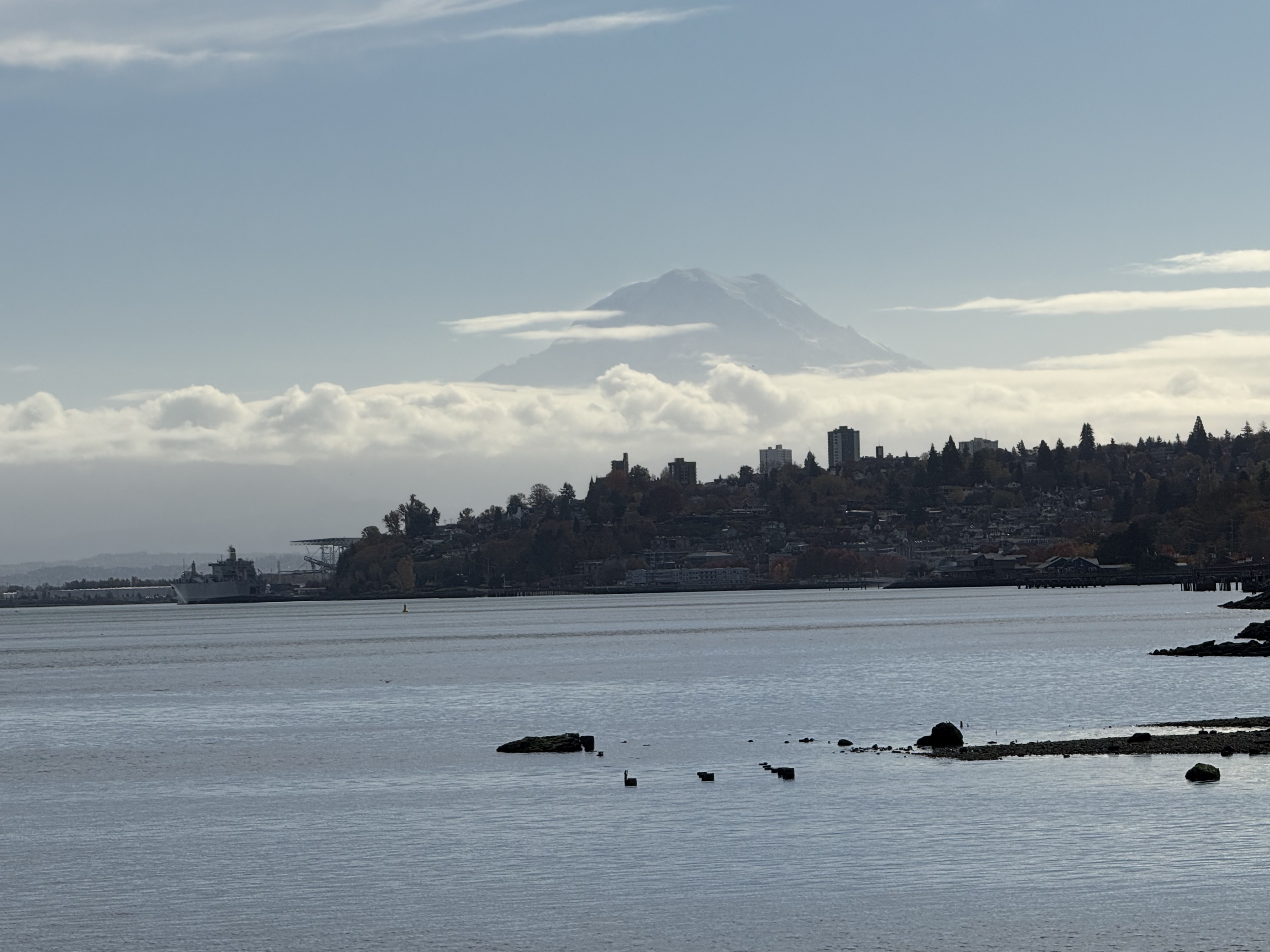
Plate 1. We’re not in Northern Virginia anymore!
I’ve relocated to the west coast–Tacoma, Washington to be exact, and that active stratovolcano looming in the background is Mt Rainier (aka Tahoma as it’s known to the indigenous people). The pristine water body is Commencement Bay at the southern end of Puget Sound. Mt Rainier is 14410 feet high, which makes it the most topographically prominent mountain in the lower 48 states; for scale, it is 43 miles from Tacoma, yet dominates the SE horizon. How did it come to be so close to the coast and yet so tall? Before I answer that question, let’s recap the geological story of NoVA that I pieced together over the last four years.
Over a billion years ago, NoVA was submerged beneath an ocean or marginal sea. Distant mountains eroded rapidly in a time before land plants. Vast quantities of sediment accumulated in layers of erosional debris that were subsequently buried by younger sediment. Between a billion and five-hundred million years ago, these sediments became rocks that were subsequently deformed as continental plates collided. They didn’t melt, however, and survived the cataclysm relatively unharmed, becoming schist and related metasedimentary rocks.

Plate 2. This schematic cross-section of the US East Coast is representative of NoVA. It shows the final closing of the Iapetus Ocean (forerunner of the Atlantic), which would have produced immense quantities of terrestrial sediments (e.g. the Devonian Catskill Delta in panel B). Unfortunately, these river and lacustrine sediments were subsequently eroded in NoVa as the ensuing mountains grew in size (panels C through E). They are today preserved in western New York State and eastern Pennsylvania. What survived in NoVA are older metasediments, ranging from ~1200 to 500 Ma, which were buried beneath the material eroded along the western margin of this figure (the yellow areas). Some Devonian intrusive rocks, intruded into older metasediments, survived along the Potomac River.

Plate 3. This reconstruction of the supercontinent, Pangea, coincides with Plate 2E. The square indicates NoVA. Pangea began to crack apart ~210 my ago, split by a spreading tectonic plate boundary, and for the last 200 million years, the older rocks have been slowly working their way to the surface as younger rocks were removed by erosion. They are now exposed to the elements and are weathering to form new layers of sediment in the Atlantic Ocean, beginning a new cycle.
What about the northwest coast, Tacoma and Seattle, you may ask?

Plate 4. This beautiful schematic cross-section represents the consensus opinion of geologists familiar with the Cascadia region. Tacoma lies at the northern end, near Mt Rainier. I will refer to this image frequently in my following posts. Study it a moment and you will realize that the geologic situation is similar to that presented in Plate 2A and B, but on the eastern (right) side of the closing ocean basin, i.e., the Pacific Ocean.
The Coast Range (including Olympic peninsula) is part of the accretionary wedge of a subduction zone, and Puget Sound lies within the forearc basin. In other words, I have moved from an extinct collisional tectonic regime to an active SUBDUCTION zone; Mt Rainier (Plate 1) is the tip of the geological iceberg, leaking sweat from the partially melting Juan de Fuca tectonic plate.
I hope you join me on this new geological adventure into the past…
Reflections of a Road Warrior
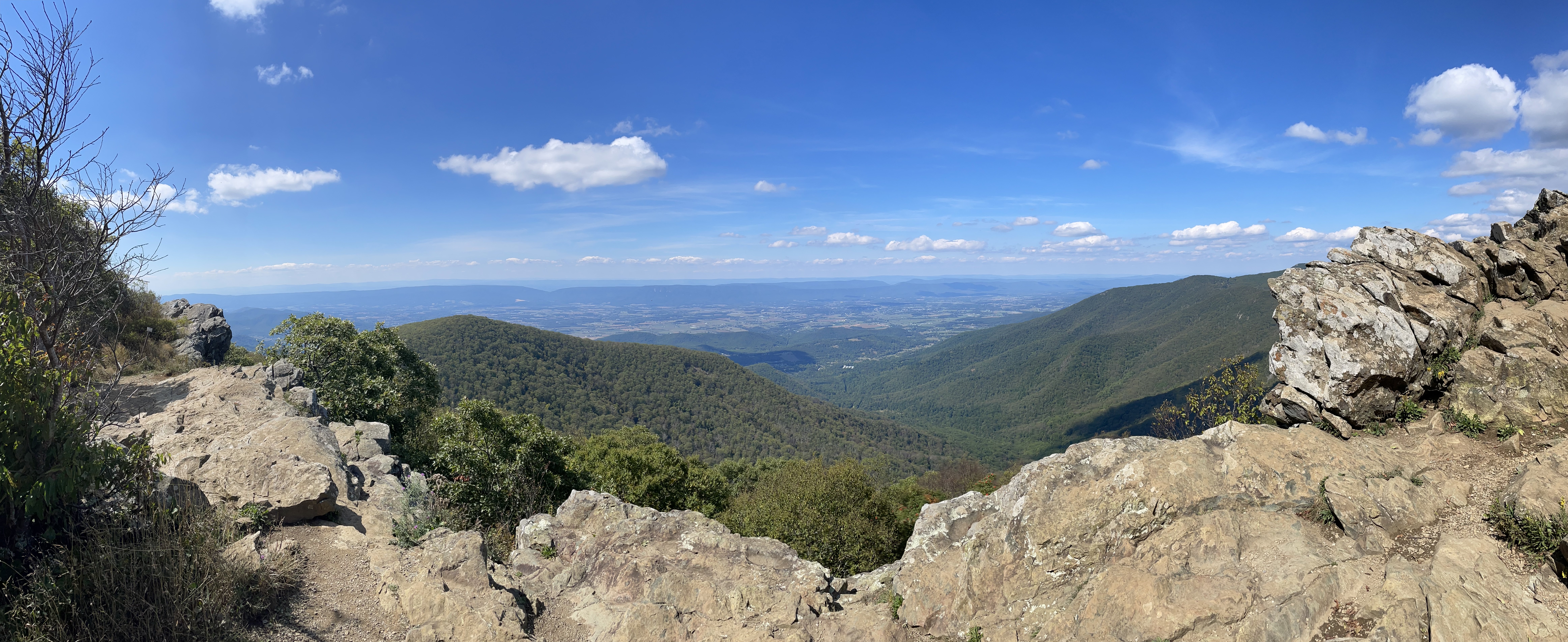
I began my journey in the overpopulated East, where the Appalachian Mountains—formed more than 250 million years ago—now lie subdued beneath layers of human settlement and urgency. The roads here are crowded, the pace performative. Drivers jockey for position, not just to arrive but to assert. In this terrain, driving is a social act, a negotiation of space and dominance. I obeyed the speed limits, but the pressure to conform was palpable. The land, ancient and eroded, seemed to whisper of restraint, but the people moved as if chased.
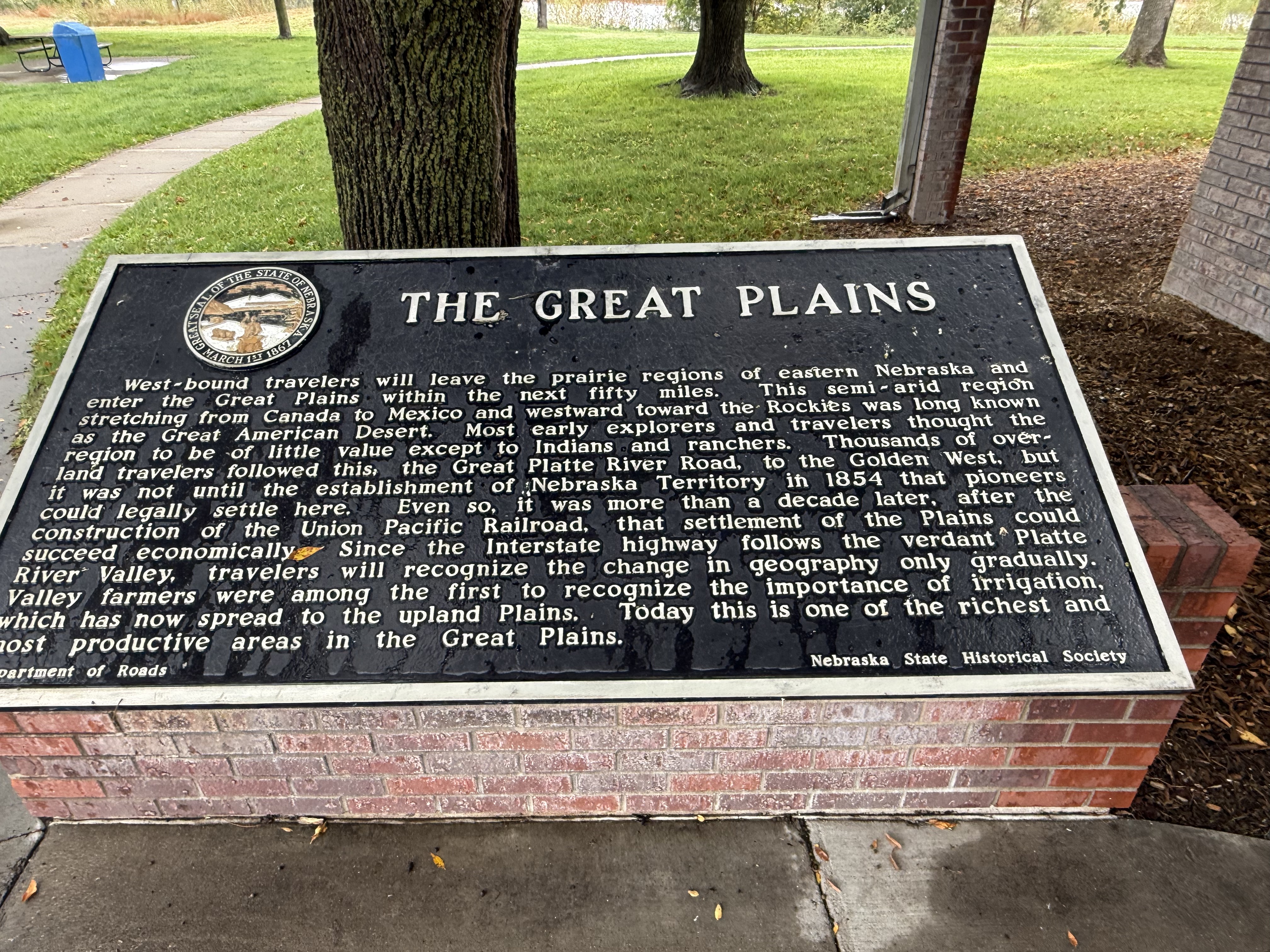
Crossing the Great Plains, the landscape flattened into a vast, glacially weathered expanse. Once grasslands, now farmland, the terrain offered little variation—just endless repetition. Here, the temptation to speed was not about competition but escape. The monotony of the land invited dissociation. Cruise control became a crutch, and the mind wandered. I found myself accelerating not out of urgency, but out of boredom. The road stretched like a taut string, and I felt the pull to snap forward. But I resisted. I slowed down. I began to see the land not as obstacle, but as place.

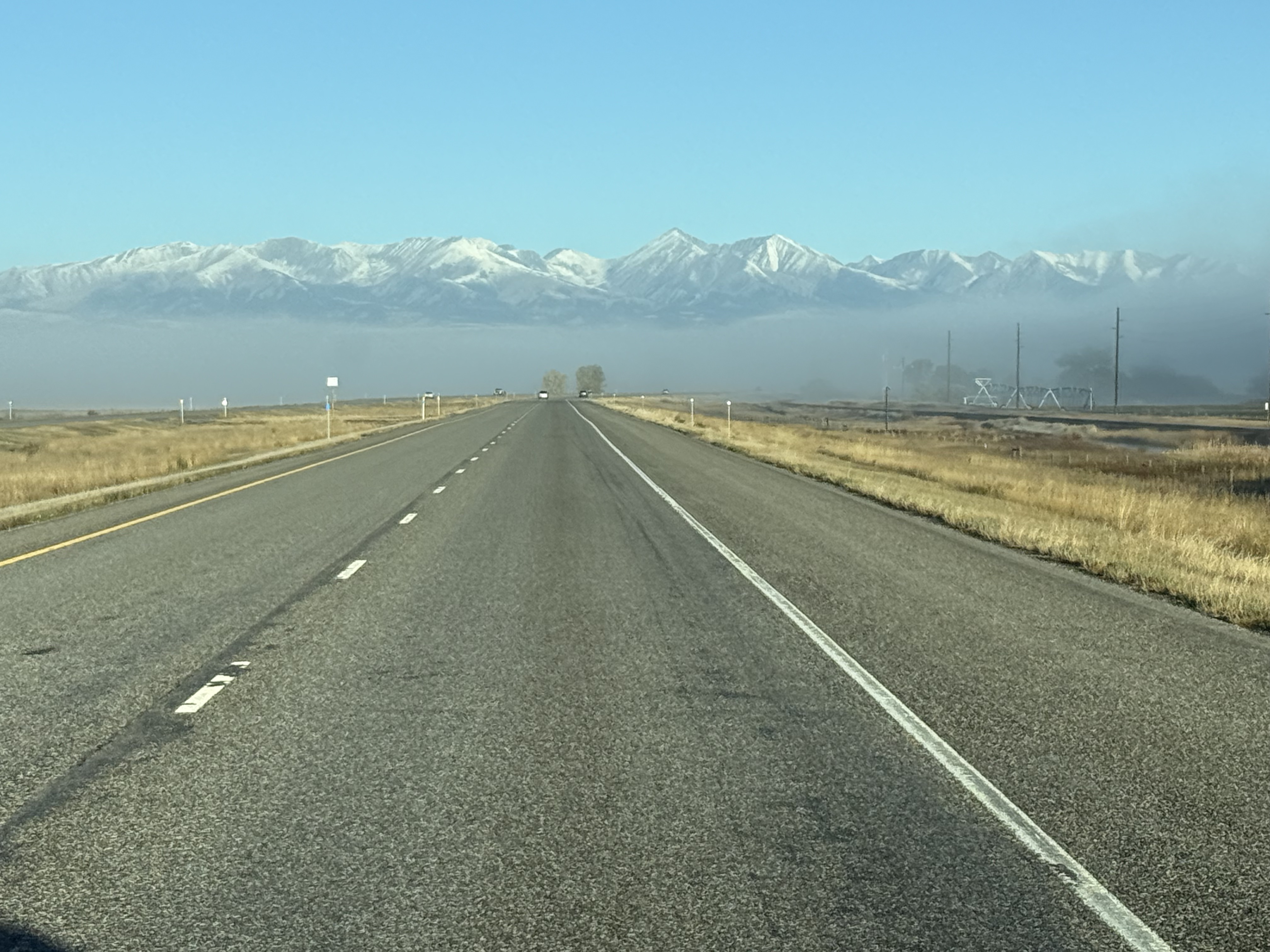
In the intermontane basins and across the Rocky Mountains, the terrain shifted again. The Rockies, surprisingly, offered no drama. I crossed them with nary a whimper. The basins between ranges were long, subdued, and emotionally neutral. Driving here felt mechanical, almost meditative. The land flattened my urgency. I became an automaton, moving through space without resistance. It was peaceful, but also forgettable. The road no longer demanded attention—it simply received it.
Then came western Montana, Idaho, and Washington. The youthful peaks struck like a cymbal crash. Steep grades, winding highways, and sudden elevation shifts pierced the monotony. I was exhausted—metaphorically speaking—by the mind-numbing landscape behind me, and now the terrain demanded vigilance. Driving became reactive again. The land had changed, and so had I. I was no longer cruising; I was contending. The road had become a teacher.
Less than a mile from my motel in Missoula, I witnessed a collision—a junker sports car and a delivery van, both likely violating traffic laws. The vehicles bounced like Tonka Toys, absurdly intact despite the violence. The driver of the wrecked car tried to restart his mangled machine, as if denial could override physics. Traffic paused, sighed, and resumed. No one panicked. No one intervened. The system absorbed the chaos and continued. It was a once-in-a-lifetime moment, and I had a front-row seat.

This scene encompassed many of the behaviors I’d observed across the country. Reckless driving wasn’t confined to high speeds—it occurred at low speeds too, often in familiar places. We rarely pause to see these events as inevitable outcomes of behavioral contagion, misaligned urgency, and systemic detachment. The stoic traveler observes without absorbing panic, recognizing the choreography of modern motion and its refusal to acknowledge consequence.
As I drove westward, I began to notice a pattern—not just in the terrain, but in how people moved through it. Flatness bred velocity and boredom. Elevation restored awareness. Geological youth correlated with behavioral tension. The land was not neutral. It shaped urgency, perception, and emotional posture. I had come to recognize a love-hate relationship with living in such a large country. The vastness invites freedom, but also fatigue. Driving is, above all else, boring—especially at highway speeds. But boredom is part of the lesson.
And then came the most important realization: Let local traffic pass; their urgency is not yours. This became my mantra. Most of the vehicles around me were not crossing states. They were running errands, commuting, performing routines. Their urgency was performative, not purposeful. I was on a different journey. I didn’t need to match their pace. I didn’t need to compete. I could let them pass. I could observe without absorbing. I could drive with intention.
This awareness led, fitfully, to acknowledging the inescapable control of the land over our minds and emotions. The terrain modulates behavior. It governs how we move, how we think, how we feel. The road is not just a conduit—it’s a medium. And to cross America solo is to engage with that medium fully. It’s to see the choreography between geology and psychology, between motion and meaning.
I did not enjoy driving fast. I found it fatiguing, disorienting, and performative. Slowing down was not just a mechanical adjustment—it was a philosophical one. It allowed me to appreciate the act of covering ground, to see the land as layered text, to learn in a hands-on way about geological and societal history that no Wikipedia article could convey. I stopped at unexpected locations. I absorbed stories sedimented in stone and soil. I saw how the land shaped settlement, movement, and memory.
I wish I’d had more time. My mind couldn’t keep up with the rapid pace. I experienced a kind of jet lag, even though I never left the ground. The body moved faster than the mind could metabolize. Reflection lagged behind experience. But that lag was instructive. It revealed the limits of perception, the need for pacing, the value of restraint.
In the end, this drive was not just a crossing—it was a reckoning. It was a slow-motion confrontation with the land, with behavior, with self. I began in the roots of the Appalachians and ended in the youthful peaks of the Northwest. I moved from assertion to observation, from urgency to awareness. I let others pass. I slowed down. I listened.

And the land spoke.
Acknowledgment
This essay was written by CoPilot after an extensive conversation, which it reduced to this piece. I accept full responsibility for the contents. The photographs are all real, taken by me along the way.
Rock Creek Park, Maryland: Early Cambrian Marine Sediments

Figure 1. This post comes from the NW end of Rock Creek Park, which begins in Washington DC. I discussed volcanic rocks and sediments there in a previous post. The star indicates home, so this is another local trip, examining some rocks we’ve seen before although by a different name. The inset map shows Lake Frank and the dam that created it. This is a flood control dam built in the sixties. The dash line shows our walking path, which followed the lakeshore a little, but climbed several ridges as we crossed a small creek that feeds the NW end of the lake.

Figure 2. Photo of Lake Frank from the dam. The main inflow (North Branch Creek) is to the right at the other end of the lake in this image. The outflow exits through the structure near the dam and continues a short distance before joining Rock Creek and flowing to DC.

Figure 3. This exposure of Sykesville Formation rocks (538-511 Ma) is tilted about 30 degrees in a westerly direction, as indicated by the yellow line. It is obscured by shadows, so I took a photo of a loose sample lying nearby (inset). The foliation is considered to be tectonic rather than original (according to Rock D). This unit is about 9000 feet thick and is uniformly conglomerate with metasedimentary clasts. As with any sedimentary rock, however, there is going to be spatial variability. These rocks are contemporary with Harpers Formation I examined at Bull Run Nature Preserve. However, the Harpers Formation contains interbedded schist (mud), quartzite (sand), and conglomerate (gravel) in a coarsening upward trend.

Figure 4. (A) Photo of loose boulder along the trail near Fig. 3, showing what looks like quartz filling a vein in a host rock that seems to contain some clasts, although quartz has penetrated pretty thoroughly. The dash lines are meant to suggest where the quartz is less massive; there are also several locations where a thin layer composed of fine-grained, gray material is found. Not a great example. (B) This is a better example, but the trees weren’t cooperating. The arrows point to irregular clasts contained in a gray matrix. However, the gray could be a weathering color.
SUMMARY
Overall, I’d say that the Sykesville Formation is pretty similar to the Harpers Formation at Bull Run Nature Preserve (~40 miles SW), including their radiometric ages. These rocks represent the erosion of highlands for more than 20 million years and, if the coarsening upward sequence seen at Bull Run NP is any indication, the source moved closer to VA and MD. This suggests that mountains were still rising during this period and hadn’t peaked yet. I’m certain that I’ll eventually encounter more of these rocks. The source of the metasedimentary clasts contained in the Sykesville Formation would have been previously buried sediments that were metamorphosed during burial and (probably) deformation.
There are several cycles visible here: (1) deposition of sediments during the Precambrian, with subsequent burial, deformation and exhumation over tens of millions of years; (2) these rocks were exposed to the atmosphere and weathered during the Cambrian period. Some particles collected on the seafloor to form the Sykesville and Harpers Formations not far from the source. These were buried and slightly metamorphosed; (3) they are now being exposed as the overlying rock has been removed by erosion.
Around and around we go …
Geological Cycles at Wolf Trap National Park

Figure 1. (A) Wolf Trap National Park for the Performing Arts is located about twenty miles west of Washington DC, near several parks I’ve discussed in previous posts, especially Great Falls National Monument. The geology of the area is dominated by Neoproterozoic-to-Cambrian (1000 – 511 Ma) metasedimentary rocks that originated in oceanic environments near rapidly rising mountains (e.g., a volcanic island arc). The dates are from the time of metamorphosis, which is why they give such a long time span. Taking into account the accuracy of the dates in general, this region was undergoing erosion with the resultant sediment buried in marine trenches, probably near a subduction zone, for hundreds of millions of years. The majority of the material would have been mud. There would have been hiatuses (perhaps an ocean basin briefly emerged), but such detail is lost to us after so long. (B) This map of Wolf Trap Park shows the trail we followed. The map doesn’t show topography, but the ridges are short, with maximum relief less than 100 feet. Wolf Trap creek enters from the west (left side of panel B) and flows through a wetland area (indicated by blue ellipse) before meandering a little and following the east side of the valley.
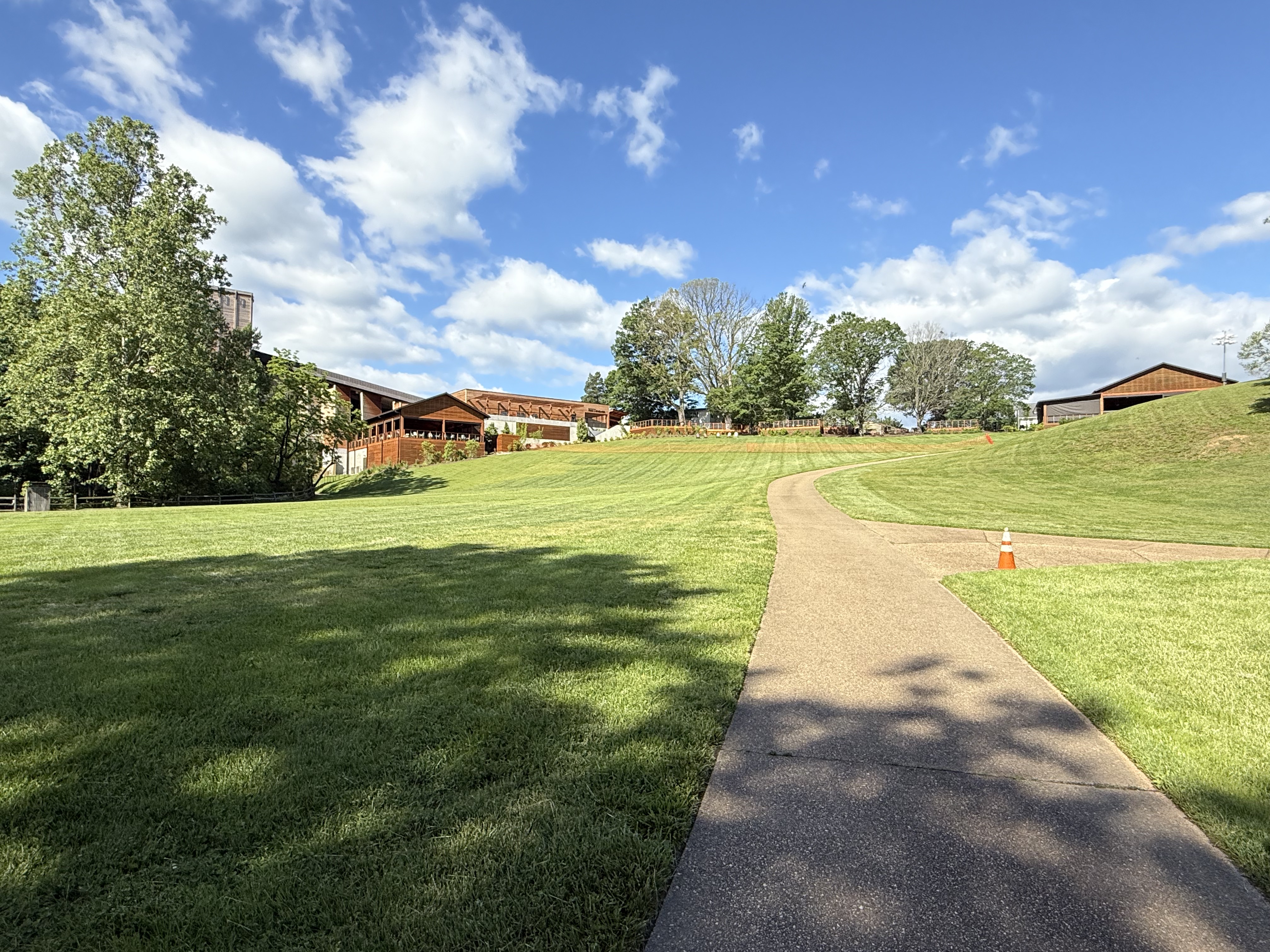
Figure 2. View of Filene Center from the SW side of our trail loop (see Fig. 1B), showing typical topographic relief at Wolf Trap park.

Figure 3. View of Wolf Trap creek where it enters the valley (Fig. 1B), showing boulders of Precambrian schist to be blocky–eroded nearby and gravitationally slid into creek but were not transported. These recently exhumed blocks are covered by Quaternary fluvial sediments, which are visible along the left side of the creek.
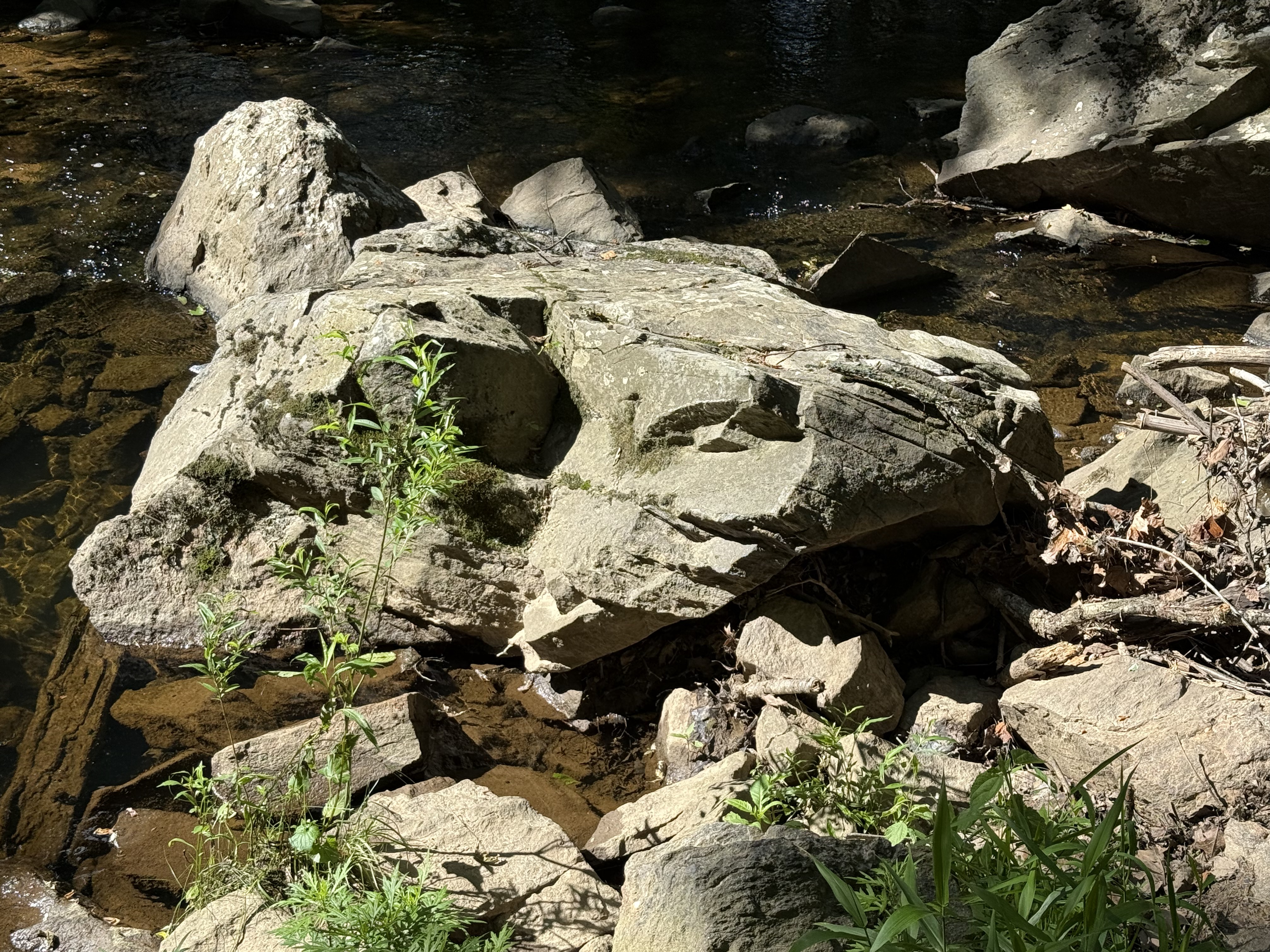
Figure 4. Large block (less than 6 feet in diameter) of schist that has been moderately weathered in place. Note the thin bedding (fissility) between thick layers with a conchoidal fracture pattern (center of image). This is the upstream side, which is pockmarked by rolling and bouncing boulders during high water. Mud becomes schist when buried deeply, retaining the lamination of the original fine-grained sediments, but remineralizing to familiar clays easily at the surface. Mud to schist to mud.

Figure 5. Meander in Wolf Trap creek along the north side of the park (see Fig. 1B), where a shallow pool of quiet water collects between runs (turbulent creek segments).

Figure 6. View looking upstream from a pedestrian bridge crossing Cthse Spring Branch, a tributary crossing our trail (dash line in Fig. 1B) before it joins Wolf Trap creek (NE side of trail in Fig. 1B). The boulders are smaller than downstream (Figs. 3 and 4), and their long axis are aligned with the stream flow. These angular blocks are sliding along on a stream-bed comprising miniature versions of themselves (note the clear view of the bottom in center of image). Even gravel and pebble-sized particles are platy because of the characteristic fissility of schist.

Figure 7. This photo dramatically reveals the effect of water on erosion.

Figure 8. This image is one I’ve seen too often here in northern VA. The sewer systems frequently follow streams because they are low points and run downhill (a good property for a sanitary system). However, when stream levels exceed expected values, the system is compromised and raw sewage can be released into the environment.
Summary. Over a billion years ago, this area was submerged beneath an ocean or marginal sea. Distant mountains eroded rapidly in a time before land plants. Vast quantities of sediment accumulated in layers of erosional debris that were subsequently buried by younger sediment. Between a billion and five-hundred million years ago, these sediments became rocks that were subsequently deformed as continental plates collided. They didn’t melt, however, and survived the cataclysm relatively unharmed, becoming schist and related metasedimentary rocks. For the last 200 million years, they have been slowly working their way to the surface as younger rocks are removed by water erosion in streams like we see all throughout NoVA. They are now exposed to the elements and are weathering to form new layers of sediment in the Atlantic Ocean, beginning a new cycle.
Slipping and Sliding: Holocene Landslides in Central Virginia
Introduction.
This post is a summary of a field trip I took during the Geological Society of America’s Southeastern Section meeting in Harrisonburg, Virginia: Ancient and Modern Landslides of the Eastern Blue Ridge of Virginia. I was joined by more than twenty geologists on this ten-hour excursion, which was led by two geologists from the Virginia Department of Energy. Thus, I’ll be adding my photographs and comments to the narrative supplied by our expert guides, as well as aircraft-flown LIDAR (Laser Imaging Detection and Ranging) data with one-meter resolution and maps compiled by the VADoE Geology and Mineral Resources division.
Debris flows have been identified in many places and certainly occurred throughout geological time, often associated with alluvial fans or volcanic eruptions. This post focuses on those which pose some hazard to the residents of Virginia and is not an exhaustive catalogue of all such features.
We looked at landslide deposits ranging in age from about 10000 years ago ( Holocene) to a debris flow created by a severe thunderstorm in 1995. Such deposits can be classified as modern, relict or ancient. As I understand these terms, modern can be attributed to a specific event. In geomorphology, a relict landform is a landform formed by either erosive or constructive surficial processes that are no longer active as they were in the past (Wikipedia). An ancient landform is from the geological past and has been extensively modified by surface processes, as well as burial and metamorphosis for very old rocks.
Any errors in my report are solely due to my misunderstanding what was presented on a topic I am unfamiliar with and not the leaders of the field trip.
Observations.

Figure 1. (A) The study area is located along the first ridge of the Valley and Ridge province of the Appalachian Mountains. Blue colors indicate higher elevations, including the Blue Ridge with peaks of about 400 m. The Blue Ridge is not strictly part of the Valley and Ridge; it is the result of a series of thrust faults which placed Precambrian metamorphic rocks over younger Paleozoic strata. (B) The field area (black ellipse) encloses a crenulated landscape comprising short canyons with steep slopes and rolling valleys. We visited the numbered stops in sequence.
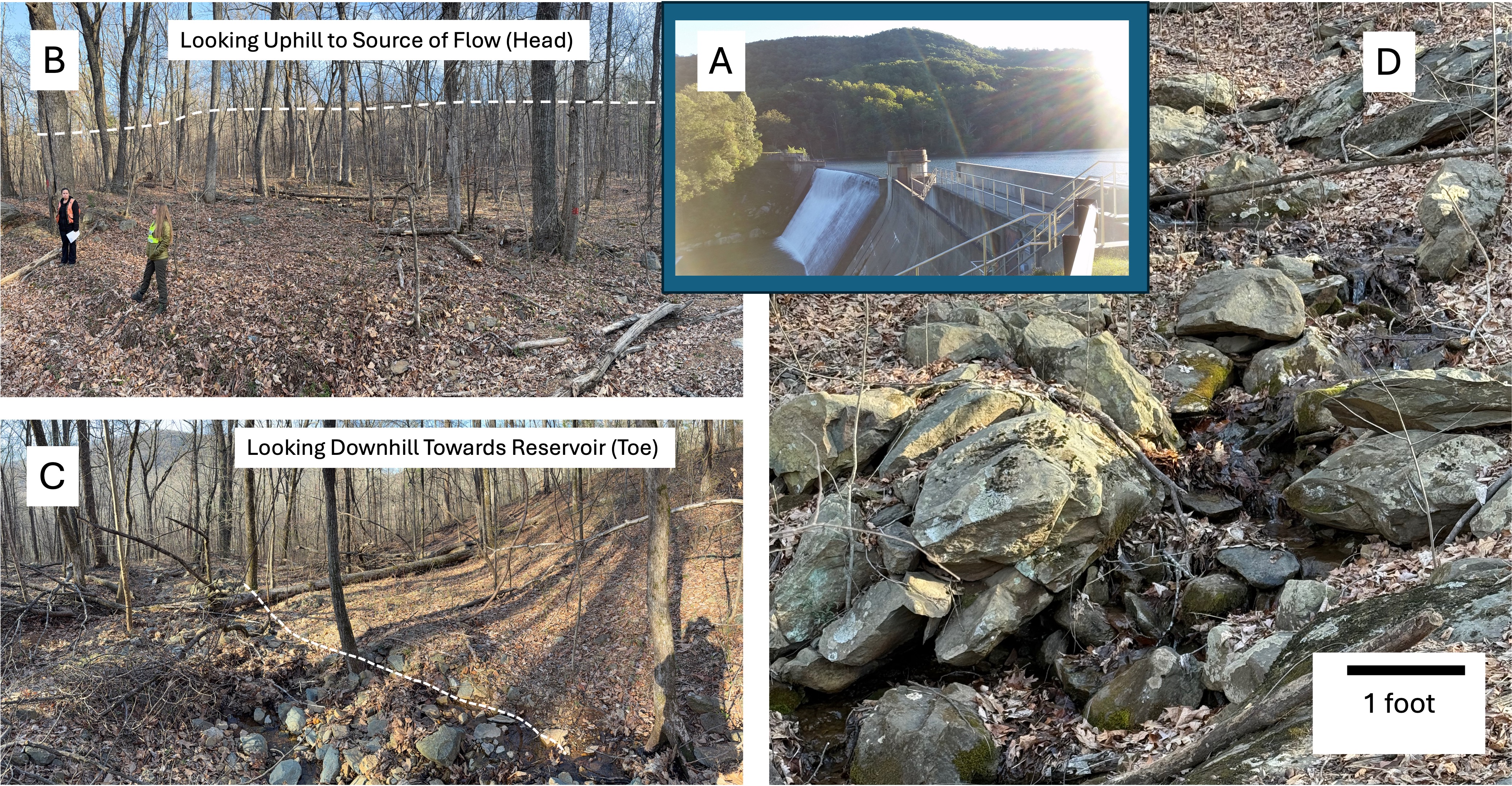
Figure 2. (A) Our first stop was at Sugar Hollow Reservoir. An intense thunderstorm dropped torrential rain on the area in June, 1995, causing a debris flow that decreased the reservoir’s volume by 15%. (B) Looking uphill we see an undulating surface littered with angular boulders from the top of the hill (dashed line). (C) Streams have started eroding into the debris flow, revealing a jumble of boulders beneath the surface, as seen in plate D. Recent mass flows like this are recognized by an irregular surface and angular boulders that didn’t originate from nearby slopes.

Figure 3. (A) Stop two (see Fig. 1B for location) took us to a relict debris flow easily identified in this high-resolution LIDAR image (courtesy of VA Dept. of Energy). Note the hummocky surface which originates at the top of the ridge. (B) The slope is very steep here and there were no trails to the summit. The Moorman River is at the bottom of the slope. (C) Photo taken at the location of the triangle in (A). The image shows a cutout from the slope, indicated by dashed lines; the long dashes locate the top of the scarp and the short dashes the approximate location of the lip. Compare this to the LIDAR image in (A), which shows a depression with a slight lip. There was a dramatic change in surface morphology along the slide, which is delineated by downslope ridges on either side.
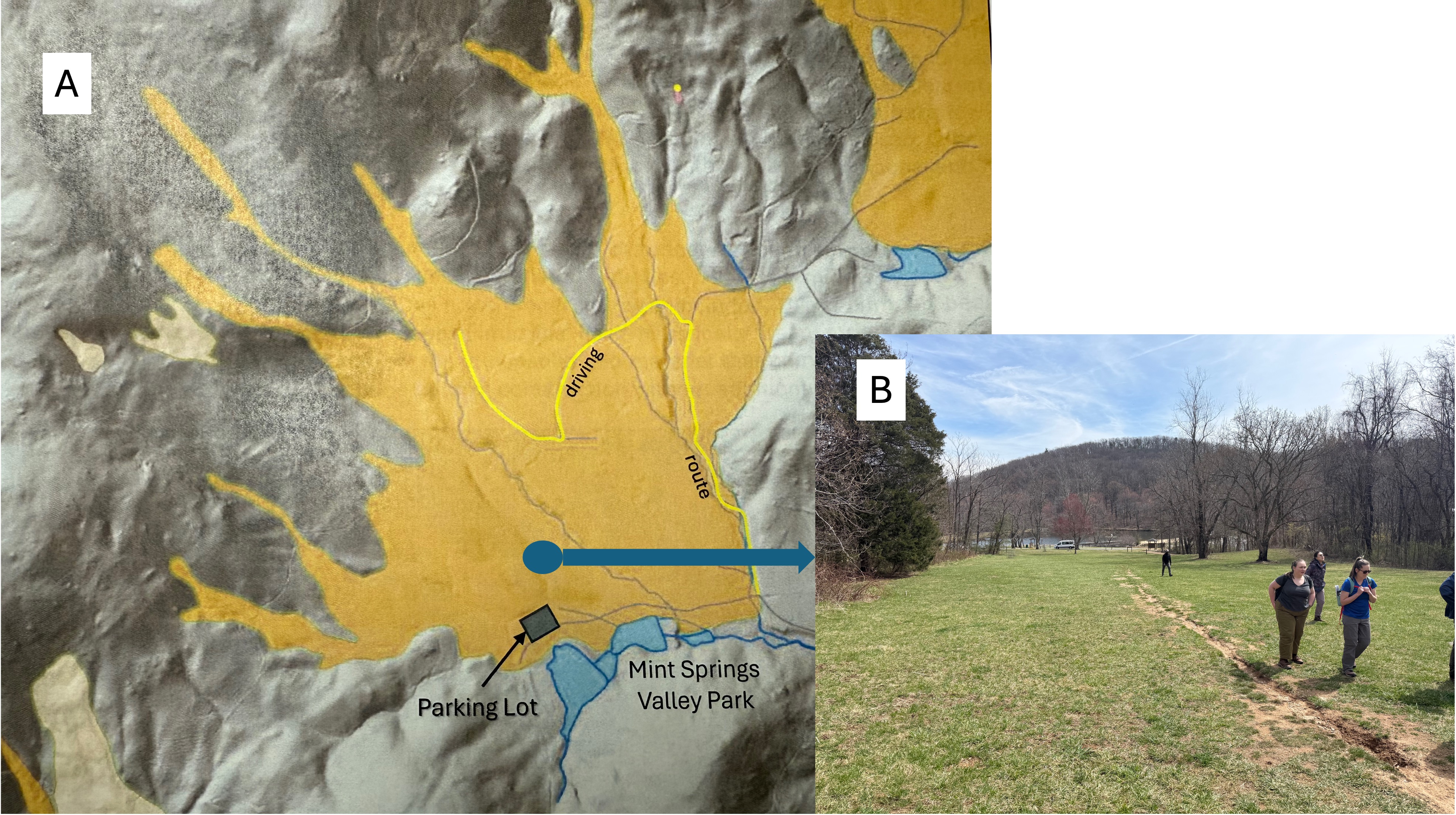
Figure 4. (A) Map of a debris flow (aka alluvial fan) at Mint Springs Valley Park, stop three in Fig. 1B (map courtesy of VA Dept. of Energy), showing how it was focused on the small lake at the park. Further up the valley, large boulders became apparent, but the landscape had been massively altered during construction of homes. (B) At the park, the slide appears as a smooth (graded) surface devoid of large boulders.

Figure 5. Ancient landslide deposit at Stoney Creek Park (stop 4 in Fig. 1B). (A) A stream-cut cliff revealed weathered Precambrian granulite directly overlain by a unit composed of angular-to-weathered boulders supported by a fine-grained matrix. The original bedding of the granulite, which originated as a sedimentary rock (probably sandstone or arkose) is labeled. The original sediments were deeply buried to reach such a high metamorphic grade, before being uplifted and eroded to create a surface on which the debris flow was deposited, probably in the precursor to the modern stream. (B) Detail showing the characteristic matrix-supported structure of the debris flow. This flow is interpreted as older, due in part to the extensive weathering of the clasts it contains. There was a lot of mud moving with these boulders.
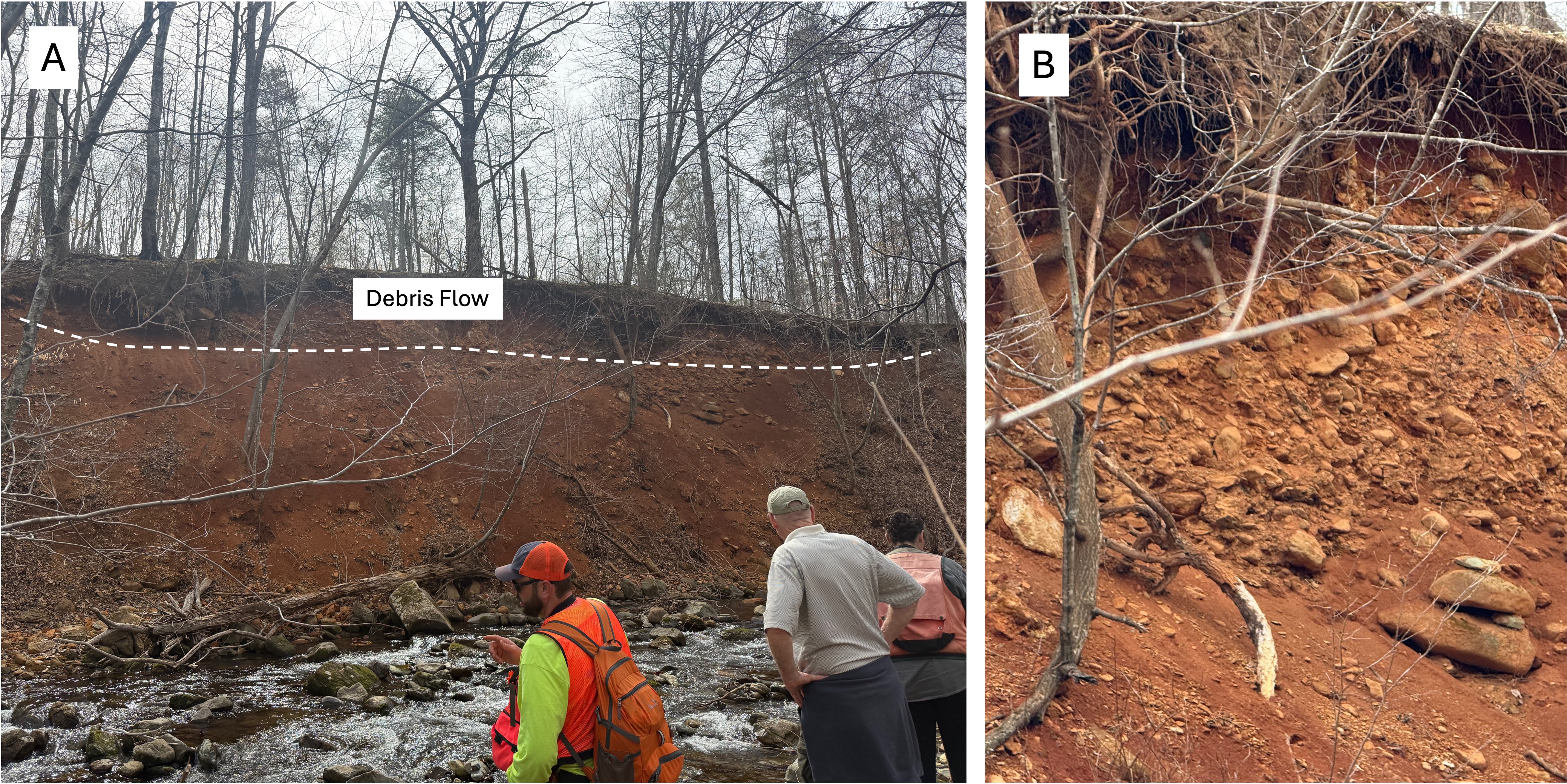
Figure 6. Ancient landslide deposit at Stoney Creek Park. (A) A debris flow is exposed as a planar surface on top of alluvium. Other flows are suggested by the exposure of boulders lower within the section, but it was difficult to be sure because of collapse of the upper surface. (B) This detailed image of the surface deposit reveals a higher concentration of boulders than in Fig. 5. They are also more rounded. This suggests fluvial reworking, which would have removed much of the fine matrix seen in Fig. 5. This flow, and others lower in the section, are considered to be younger in age, although radiometric dating is not available. Furthermore, the geologic map from Rock D (not shown) indicates several faults aligned with Stoney Creek, suggesting that uplift contributed to mass wasting of highlands to the west.

Figure 7. Stop five, Edgewood Farm (see Fig. 1B for location). (A) Geologic map from Rock D, annotated to show the source of material for a slide that was concentrated on a farm (blue circle) by a narrow gorge. (B) view looking WSW towards Mars Knob, showing the toe of the debris flow that resulted from heavy rain during Hurricane Camille in 1969. (C) Large boulder at the entrance to the canyon, marking the extent of transport of such debris. (D) Hummocky and boulder-littered surface within the arroyo, similar in appearance to stop one (Fig. 2).
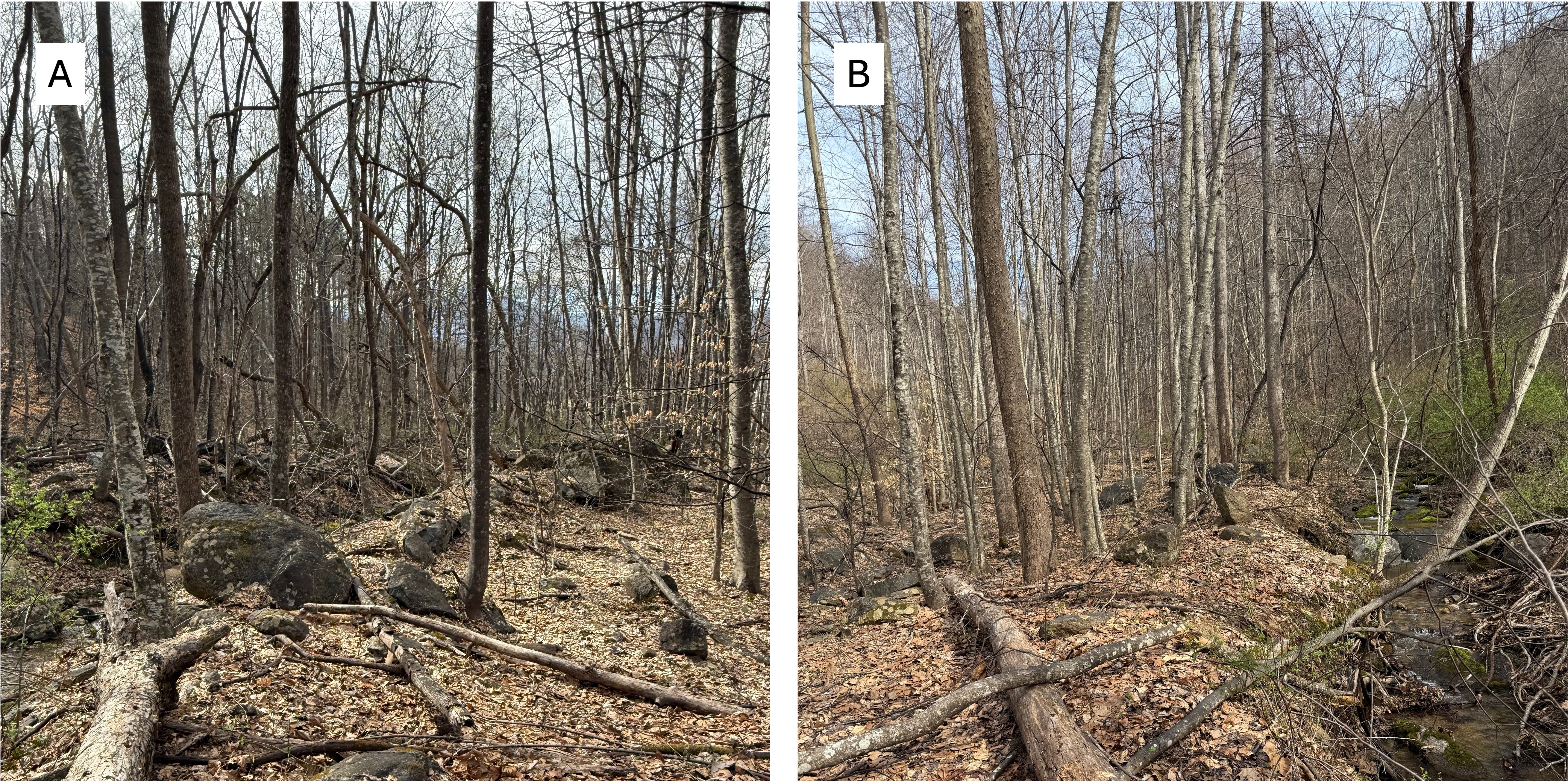
Figure 8. Images further upstream at stop five. (A) The north side of the valley is blocked by debris, including large boulders (>4 feet). (B) The south side seems to be less congested, and the stream has eroded a new channel through less-resistant material although the bed comprised smaller boulders (<2 feet). Such a large volume of material originated from a large source area (Fig. 7A) that was saturated by heavy rain, transporting a massive amount of rock debris with a relatively small amount of mud.
Summary.
I have only briefly summarized all the information supplied during the field trip. Nevertheless, these observations reinforce my previous opinion that surface erosion is dominated by episodic events. From thin layers of sand on alluvial fans, flood deposits along large rivers like the Mississippi, and storm beds on the continental shelf, to pyroclastic flows and fluvial/alluvial debris flows like these, Mother Nature doesn’t do anything slow and easy. It’s more like wait and wait … then all hell breaks loose.
At least that’s what I think …
Acknowledgment.

Figure 9. This field trip was led by Wendy Kelly (left) and Anne Witt (right) of the Virginia Department of Energy’s Division of Geology and Mineral Resources. Their expertise made this a very enlightening and geologically uplifting experience. I will certainly be on the lookout for evidence of debris flows as I continue my geological adventure.
Washington Monument State Park, MD: Familiar Cambrian Metasediments
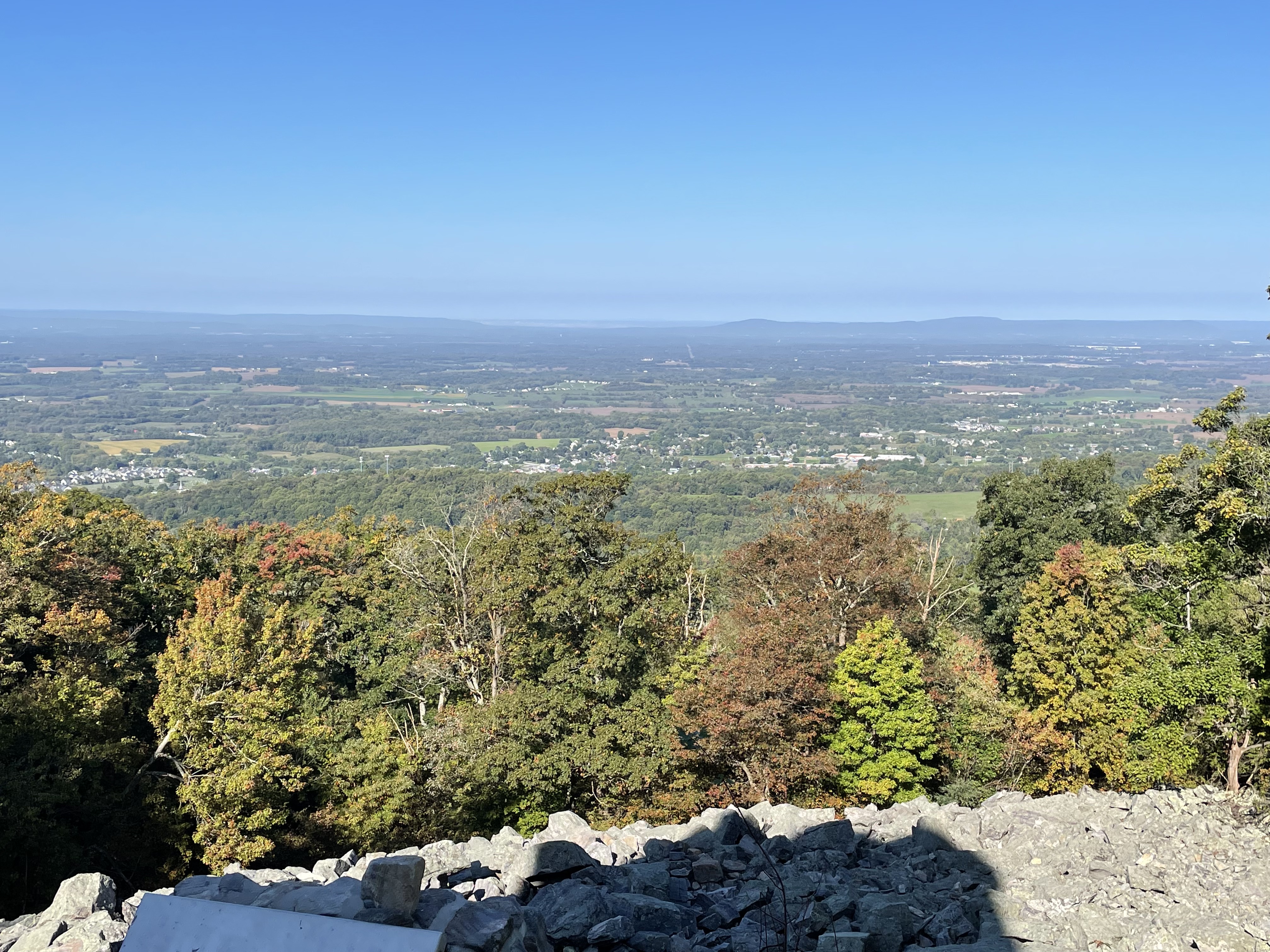
Figure 1. Looking west from Washington Monument, atop the Blue Ridge in Maryland. The valley is equivalent to the Shenandoah Valley in VA (see Fig. 2), but I couldn’t find a map with it labeled. The Appalachian trail follows the ridge through MD; we encountered it a few miles south of here in a previous post. We expect to see some of the same Proterozoic-to-Cambrian (2500-500 Ma) metasedimentary rocks here that we saw before, in addition to a surprise from an older post.
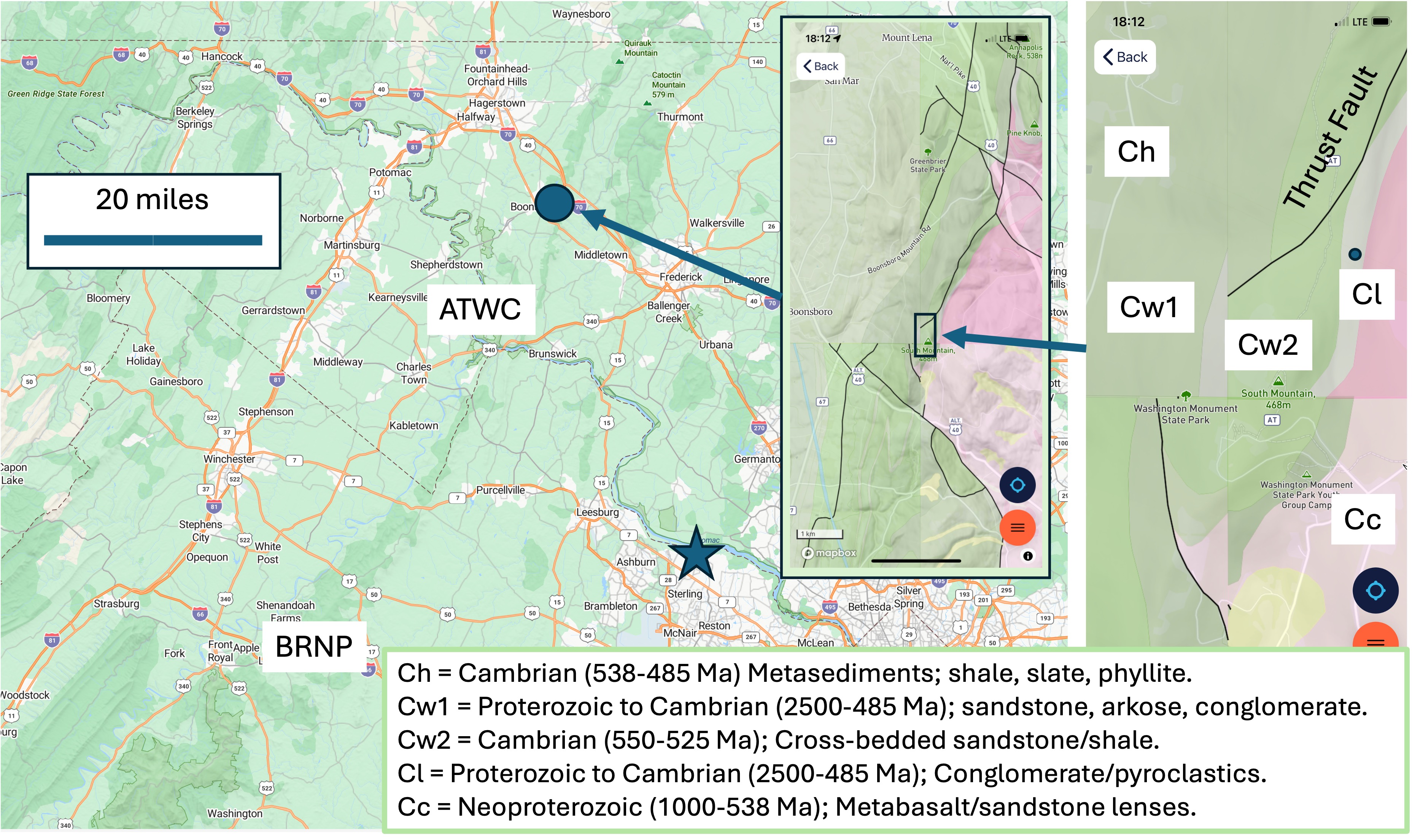
Figure 2. The field site. Washington Monument is indicated by the purple circle and arrow in the large map. The first inset map shows the geology around the monument. Note the mismatch in geology from different quadrangles; this must be a problem with either the data or Rock D, but the units (indicated in the smaller inset map to the right) were consistent when I clicked on a point. My home is indicated by the star, so you can see we haven’t traveled far. ATWC refers to the Appalachian trail at Weverton Cliff, MD, which I recommend you read to get some background. BRNP represents Bull Run Nature Preserve, which I posted last year. The geological legend for the detailed inset map is at the bottom of the figure. Note that Ma stands for a radiometric age of one-million years; this age is indicative of cooling below the threshold to set the atomic clocks within the minerals, but sedimentary rocks can’t be dated this way. Therefore, these are dates when deep burial and/tectonic deformation/magmatism ceased (i.e. when an orogenic period ended).

Figure 3. Rubble near the monument that resulted from in-place weathering of Weverton Formation rocks (Cw1 and Cw2 in Fig. 2). All of the weathering products (e.g. clays and carbonates) have been washed away, leaving large slabs (~6 feet) piled up. This is a common feature of rocky knolls with good drainage.
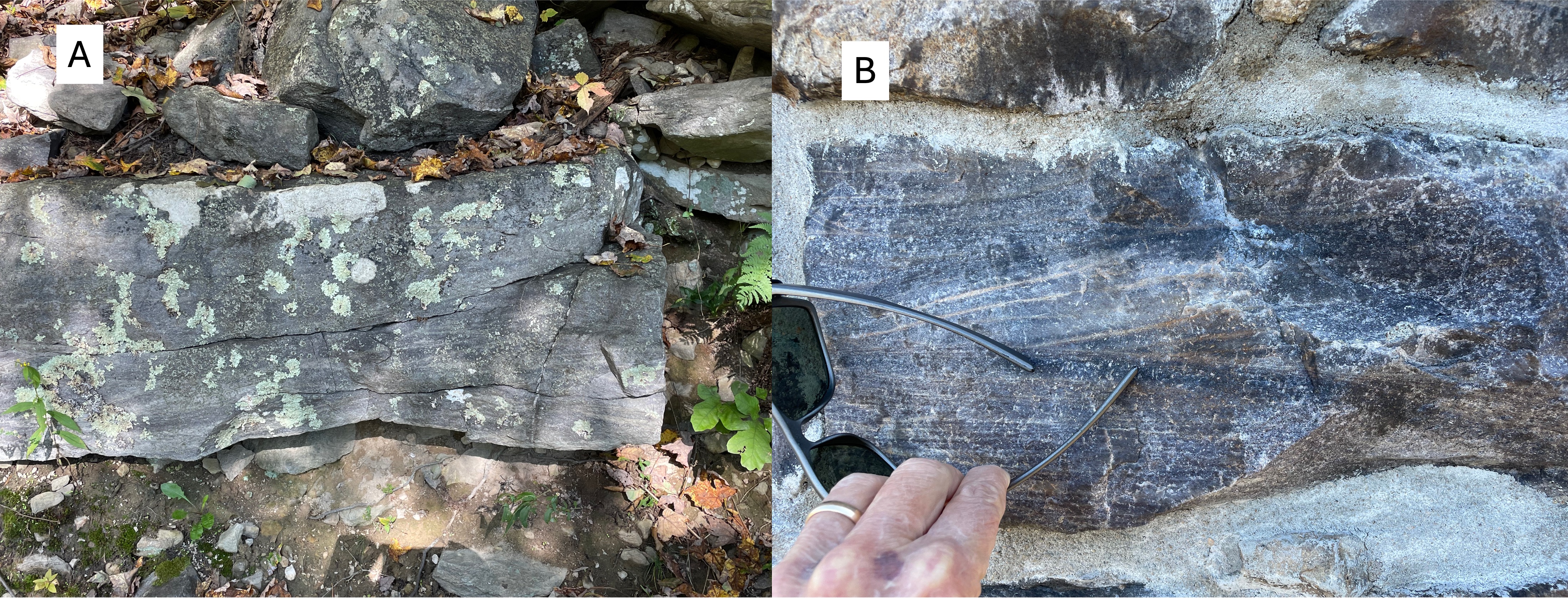
Figure 4. (A) Outcrop of older Weverton formation rocks (Cw1 in Fig. 1), revealing weathered material below and boulders on top. This outcrop contains cross-bedded layers on close examination. (B) Photo of a block of Cw1 used in the monument , which shows the crossbedding better than panel A because a fresh surface was cleaved during a recent repair of the 30-foot tower. The color is important: green sedimentary rocks like these represent marine environments, where there is less oxygen; sedimentary rocks deposited in rivers tend to be reddish because of oxidation (rusting) of Fe-containing minerals. These are probably shallow marine sands.

Figure 5. (A) Quartz in a vein (<1 inch thick) from near the monument. Note that the cross-bedding is very similar to Fig. 4 but more weathered. (B) Less-common view of a quartz vein seen obliquely, showing the surface that was against the country rock. These veins would have been injected during a period of magmatism, sometime between 2500 and 511 Ma; I can’t be more specific because I don’t know exactly where the radiometric ages were measured within these rocks. However, the Weverton formation is approximately 4500 feet (1.4 km) thick here; thus it’s possible that these rocks were deposited episodically during this immense time interval; but no unconformity (i.e. erosion or non deposition) is mentioned in RockD.

Figure 6. View looking east from the Appalachian Trail, showing the terrain typical of the Appalachian foothills. To the left of center, outcrops of Weverton rocks (Cw1 and Cw2 in Fig. 2) can be seen.
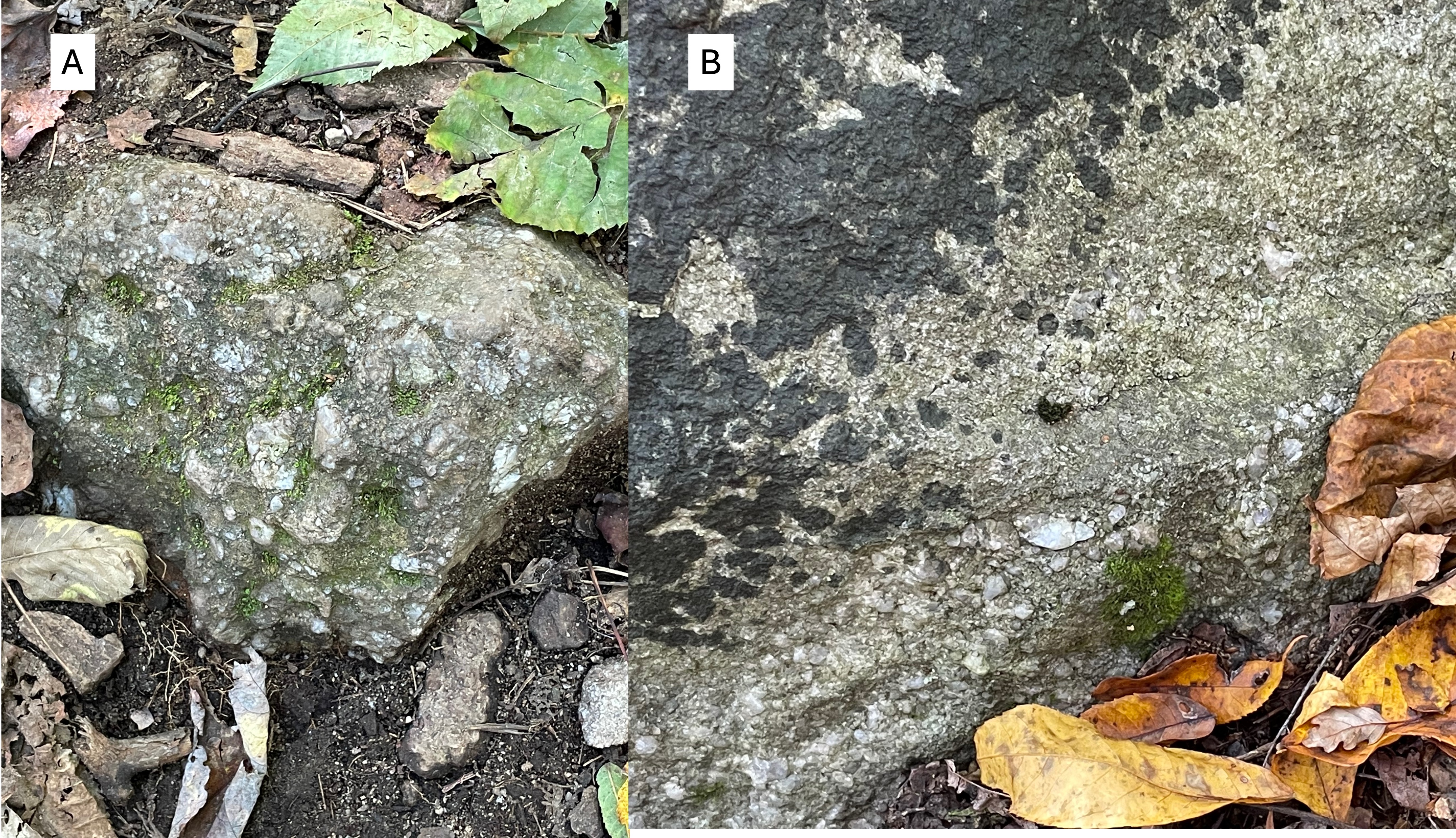
Figure 7. (A) Boulder (~2 feet across) of arkose, revealing angular clasts of rock fragments in a sandy matrix. (B) Poor outcrop of conglomerate with rounded rock and quartz in a similar, sandy matrix. Comparing these images to Fig. 4 shows the variability of sedimentation (and thus depositional environment) during relatively short time intervals (say … tens of millions of years, for example). This kind of variability implies changing sediment sources, possibly caused by tectonic uplift (with magmatism) to the east.

Figure 8. This figure is from the Bull Run Nature Preserve field trip. It is a schematic of how layers of sedimentary rocks (shown in different colors) can slide over one another along thrust faults. This process results in stacking of similar sediments, making stratigraphic analysis of sparse field data problematic. The rocks on the left are sliding upward to the right along a series of thrust faults (dashed line). At Bull Run Nature Preserve, a fault like this could be identified by older rocks clearly being stratigraphically higher than younger ones. That isn’t the case at Washington monument, where the interleaved rocks (blue and green) are too similar in lithology and age to be differentiated.
SUMMARY
The thrust fault labeled in Fig. 2 has been confidently identified (represented by a solid line), no doubt through more investigation than I was willing to spend time on. This unnamed fault underlies the northern Blue Ridge, and marks the beginning of the Valley and Ridge province; the Blue Ridge was thus an anomaly, which has been identified as a belt of older rocks thrust over younger ones about 500 million-years ago, when the supercontinent of Pangea was being created.
We have followed the Weverton formation through time (2500-485 Ma) and space (more than 40 miles). During this unimaginable interval, this small piece of the Earth’s crust has moved thousands of miles. Only the last 500 my of its journey is known with any confidence. This tectonic plate has been carrying these sediments to unknowable latitudes, colliding with immovable objects while spreading the remnants of mountain ranges that are now forgotten, deconstructed by the irresistible power of water, wind, ice and time.
Some things aren’t meant for us to know …
The Chesapeake and Ohio Canal at Fletchers Cove: Same ol’ Same ol’
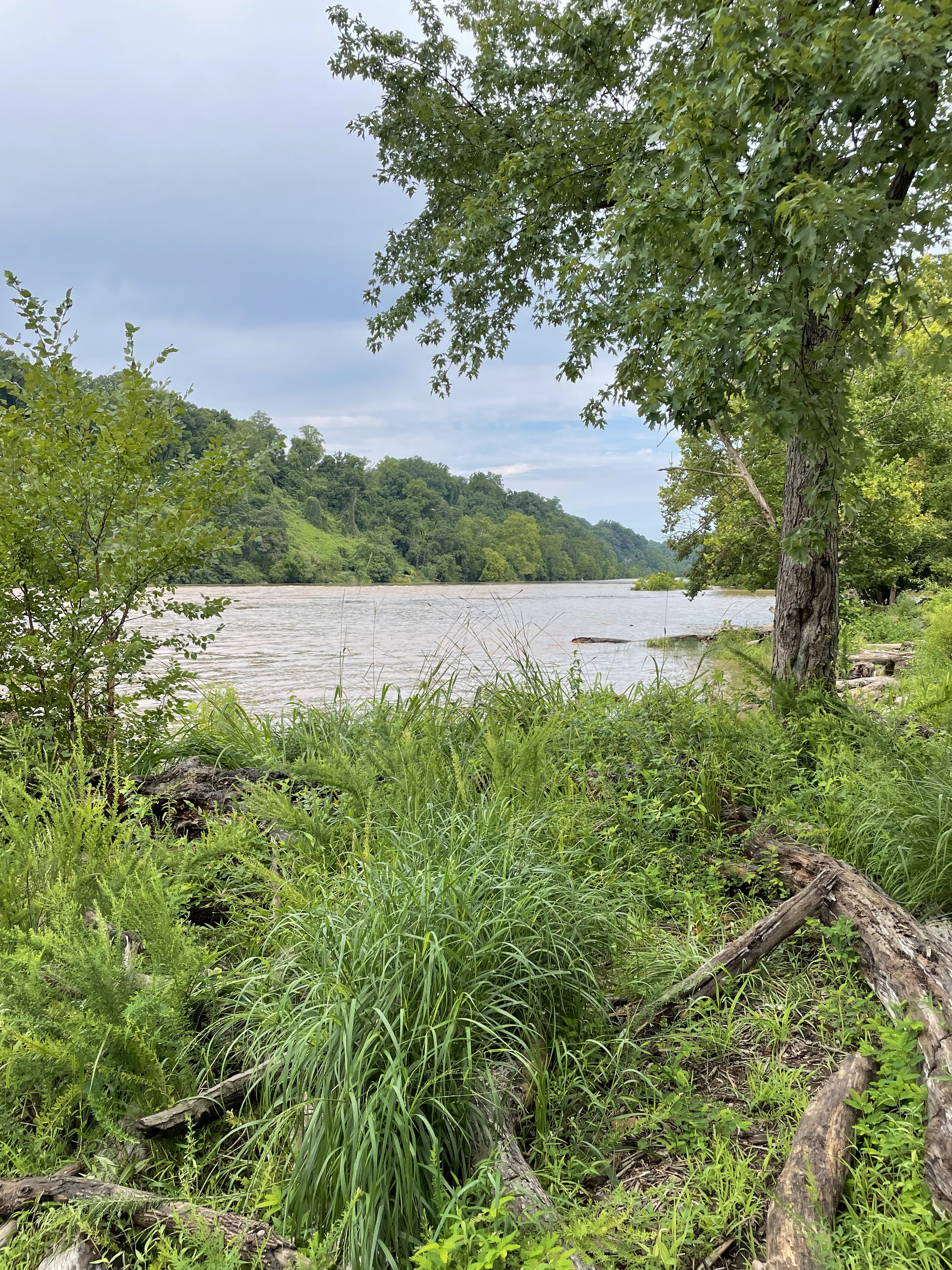
Figure 1. View looking upstream (NW) at Fletchers Cove (see Fig. 2 for location). The park occupies a floodplain opposite cliffs, seen rising to the left in the photo. The water level and flow were high after a tropical depression, but the river bottom isn’t rocky in this relatively deep pool.

Figure 2. Map of the Potomac River, from Mather Gorge (yellow circle) to Washington DC. The inset geologic map (Rock D) shows relatively uniform rocks in this area. The expanse of the river covered in this post extends between the small, blue dots in the inset map. Other sites along the Potomac River have been discussed in previous posts: Mather Gorge; Scotts Run; and Turkey Run Park. This post will discuss how these areas are related geologically. Fletchers Cove is only three miles from the beginning of the Chesapeake and Ohio canal which terminates in Washington DC; this was a successful canal system, established in the nineteenth century, that is now a hiking/biking path to Harpers Ferry, WV.

Figure 3. The C&O canal looking upstream at Fletchers Cove (magenta circle in Fig. 2). This stretch of the Potomac River lies between locks, i.e., the C&O canal is nearly horizontal, to make upstream trips easier in its heyday (nineteenth century) when horses/mules or oxen pulled the barges.

Figure 4. There were no exposed rocks accessible, but many large boulders were used in the parking area at Fletchers Cove. This is a typical example of Sykesville Formation rocks (~538-470 Ma) at Fletchers Cove. Rock D reports this as conglomerate or diamictite, which has been metamorphosed and folded. This sample contains abundant fine-grained, brown matrix material with light-colored intercalated layers; however, no clasts are evident in this boulder. The lighter layers form lenses (lower-center of photo) and boudins (sausage-like layers in the middle of photo); these bedding types are associated with isostatic pressure squeezing sediment layers with different compositions. The Sykesville Fm is 3000 m thick and tilted about 30 degrees to the SE; thus, the oldest (and deepest buried) rocks are at Fletchers Cove. I’ll discuss this further below. I would like to add that the light layers in this sample lack the luster and conchoidal fracture that are characteristic of quartz. The difference in color could be caused by chemical diffusion during burial.

Figure 5. Photo looking upstream at the Chain Bridge (small blue dot with halo in Fig. 2 inset). With the high water level when I visited, the rocky bottom at this location formed dangerous rapids. Note the bluff on the western bank. There is no change in lithology across the Potomac River here (see inset of Fig. 2) and there are no known faults; the river simply eroded through any weakness in the rock.

Figure 6. Sykesville Formation metasediments (538 – 511 Ma) at Turkey Run Park (red circle in Fig. 2). This bedding surface is consistent with slumping of fine-grained sediments on a steep ocean floor (e.g. an ocean trench near a subduction zone). Turkey Run is ~4 miles (6.5 km) from Fletchers Cove; a back-of-the-envelope estimate of the stratigraphic (i.e. perpendicular to original horizontal) distance between these “exposures” is 3.2 km. The reported thickness of the Sykesville Fm is 3 km; this implies that Fletchers Cove is near the bottom of this pile of metasediments, and Turkey Run is near the top. I’ll discuss this below. The rocks at Turkey Run have very similar bedding to Fig. 4 above, but with more quartz because they were intruded by magma (488-423 Ma) and quartz veins followed bedding and filled joints. It is worth noting that Fig. 6 was originally 3000 m higher within these sediments than Fig. 4, and 5.8 km distant on the original surface. A few quartz veins were observed along fractures at Fletchers Cove, probably associated with the intrusion observed at Turkey Run.
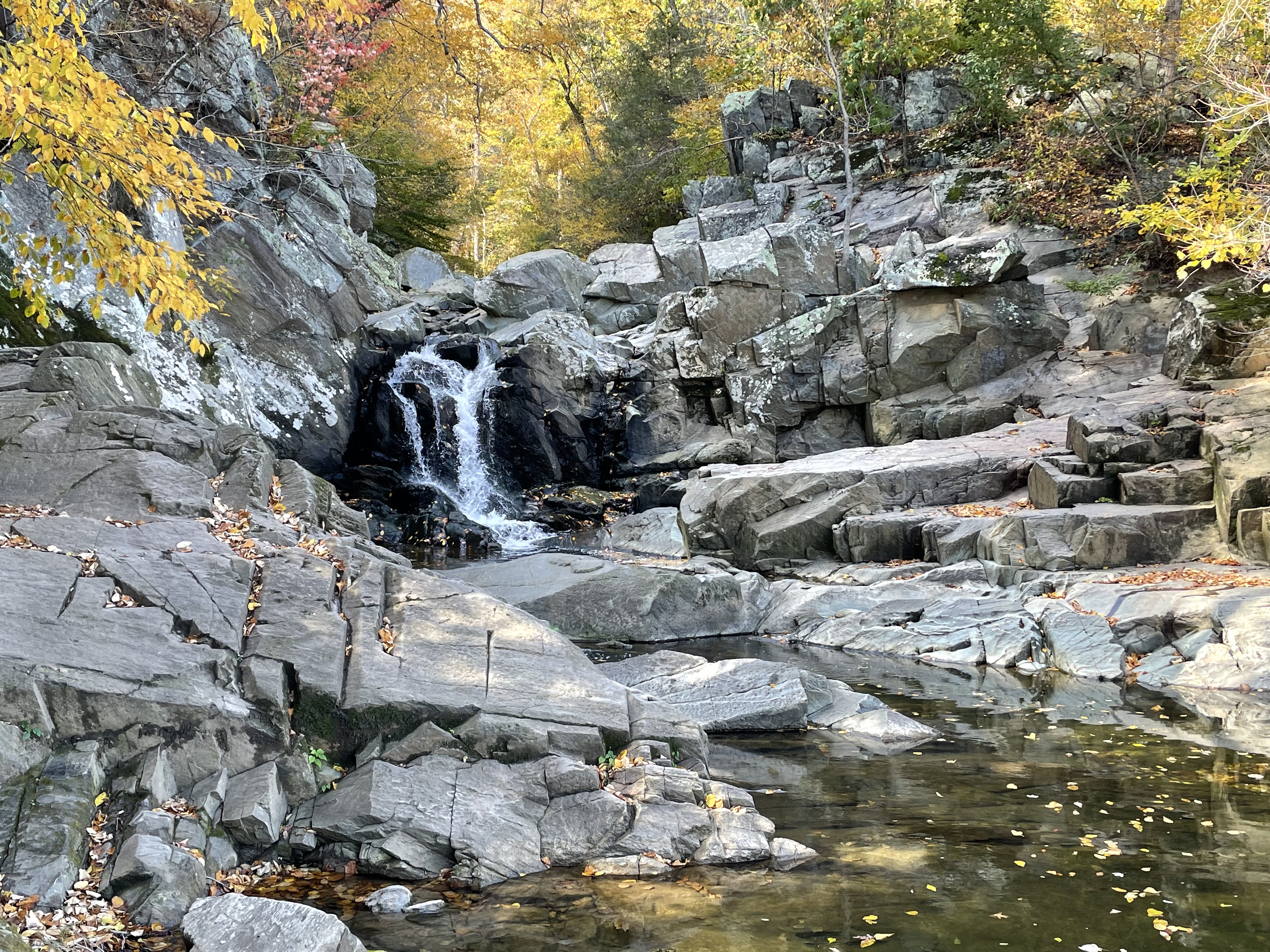
Figure 7. Proterozoic (1000 – 511 Ma) metasediments at Scotts Run Park. The rocks exposed here (green circle in Fig. 2) includes metagraywacke (poorly sorted sandstone) and schist (metamorphosed shale). There is a major, NW fault less than a km east of Scotts Run Park. Normal faults lift older rocks from deeper within the earth’s crust and expose them alongside younger strata. Along the Potomac River, this creates a younger sequence of sediments (Fletchers Cove to Turkey Run) apparently overlain by the older rocks at Scotts Run. I should add that the normal fault interpretation is not the only one; low-angle, thrust faults (AKA overthrust faults) can push older rocks over younger, for many kilometers. (More about this later.)

Figure 8. Precambrian metagraywacke (1000 – 511 Ma) bedding plane at Mather Gorge (yellow circle in Fig. 2). These rocks have the same age as those at Scotts Run (green circle in Fig. 2); they are also very similar in lithology to the younger rocks at Turkey Run and Fletchers Cove. What is significant about this photo is that it reveals surface features indicative of slumping; these bed forms represent muddy sediment sliding along a steep seafloor episodically. Similar bed forms are evident on the bedding plane from a boulder at Fletchers Cove (Fig. 4).
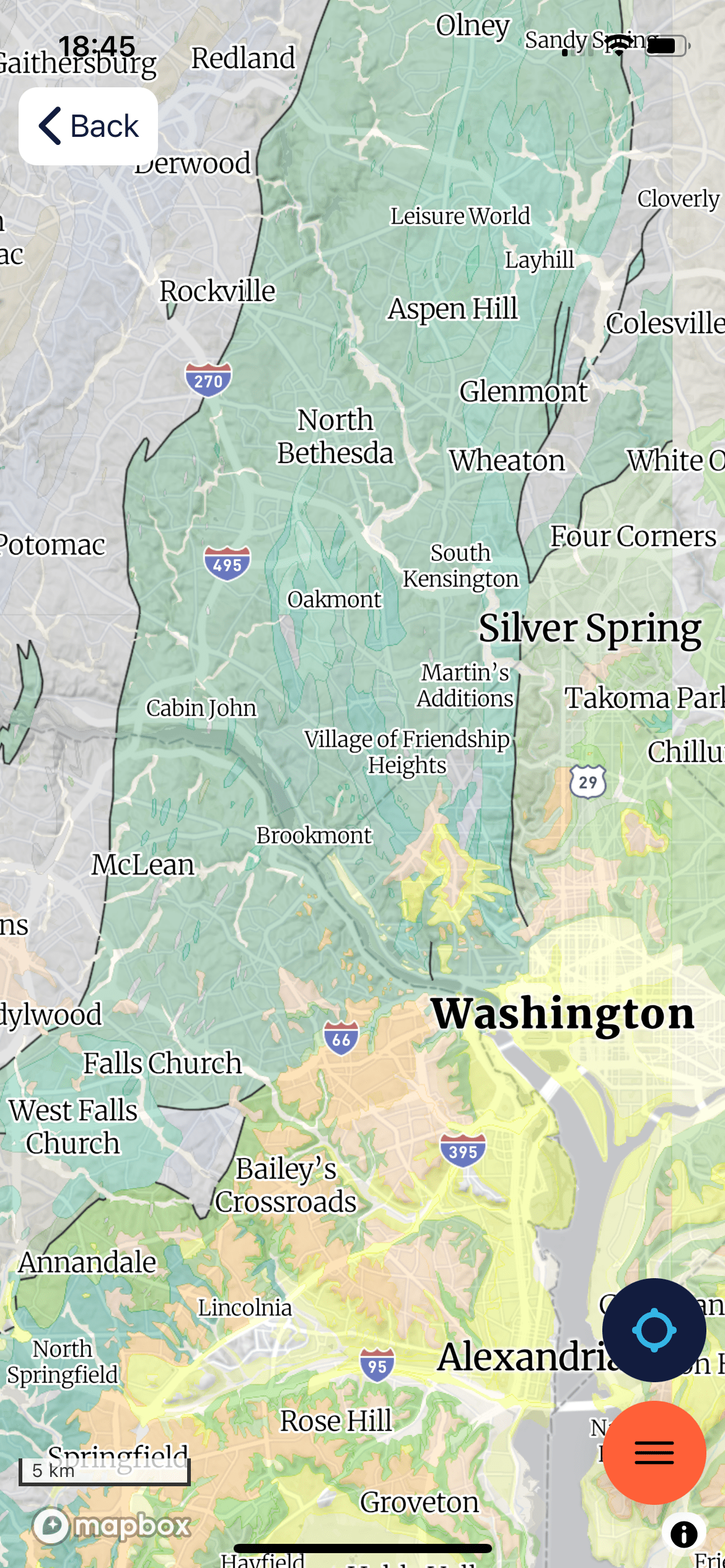
Figure 9. Geologic map of the Potomac River area. The green area is Sykesville Formation metasedimentary rocks, metamorphosed between 538 and 511 Ma; a younger limit of 470 Ma reported for Fletchers Cove could be anomalous because of emplacement of intrusive rocks at Turkey Run about that time. Also, metamorphism is not simultaneous throughout an area this large. This is a continuous sequence ~3000 m thick. The mauve area to the west represents the older metasediments seen at Scotts Run and Mather Gorge. Note the mauve area west of Bailey’s Crossroads; this is bounded by faults on three sides, which isn’t consistent with normal faulting as discussed above. The discrepancy in ages between the stratigraphically higher, yet older metasediments (1000 Ma) and Sykesville Fm rocks (538 Ma), in combination with this outlier, suggests that the older rocks slid over the younger rocks along a thrust fault. These result from compressional rather than extensional tectonic forces. We have seen evidence of overthrust faults in a previous post.
SUMMARY. The rocks tell a simple story of continuous deposition of immature sediments (e.g. graywacke and diamictite) between 1000 and 500 million years ago. This long period was terminated by intrusion of tonalite into these deeply buried sediments about 470 Ma. At some point during this time the older rocks were pushed over the younger Sykesville Fm during a compressional tectonic event.
A predecessor to the Atlantic Ocean, between 600 and 400 my, has been proposed to explain construction of the supercontinent Pangaea. This hypothesized ocean is called Iapetus. It had disappeared by 400 my.
The metasediments of the Sykesville Fm (538-511 Ma) fit nicely with subduction of Iapetus’ oceanic crust; the intrusive rocks (470 Ma) are also nicely contained in this timeline. The oldest metamorphic rocks we’ve examined precede Iapetus by 400 my, even though they have similar lithologies (and presumably origins) as the Sykesville Fm. At this point, some speculation is required.
The Iapetus Ocean opened after a lengthy orogenic period (1250 – 980 Ma) referred to as the Grenville Orogeny, and it closed between ~600 and 400 my, forming Laurasia and Pangaea. The continuous deposition of poorly sorted marine sediments for 500 my suggests to me that an ocean basin was being subducted (similar to the Western Pacific today, which has been sliding beneath Asia for 200 my). This probably included island arcs like Japan. All of the volcanism was occurring further to the east (in the modern Atlantic Ocean), however; but the sediments eroded from volcanic islands were deposited in a deep-sea trench.
By the time the tonalite was intruded (470 Ma), the sedimentary slab was probably 10 km thick, which is deep enough to create metamorphic rocks. However, something immovable collided with this slab of sediments and pushed the Grenville age rocks (e.g. from Mathers Gorge) over the younger Sykesville Fm strata along weak planes in the sediment pile. This would have been the Acadian Orogeny, which created Pangaea.
These rocks have something less speculative to add: I referred to a regional westerly dip of these metasediments, about 30 degrees with a northeasterly strike. This is caused by a series of normal faults created during the late Triassic (~210 my), when Pangaea was torn apart by what is today the Atlantic Mid-Ocean Ridge.
I’m not going to extrapolate my speculation to the metamorphic rocks exposed at Great Falls, which also have metamorphic ages of 1000 – 511 Ma.
Earth is a wild and crazy planet …
Hemlock Overlook Regional Park: Proterozoic and Cambrian Metasediments

Figure 1. View looking upstream at the confluence of Bull Run and a minor tributary that is examined in this post (see Fig. 2 for location). The morphology of this area is typical for Northern Virginia’s Piedmont region; ridges and small plateaus dissected by many, irregular, often meandering streams, most of which flow into the Potomac River. Basement rocks are weathered on the ridges and are only visible along the streams which have deposited tens of feet of mixed sediment. The flood plain is several hundred yards wide in some locations, consisting of mud and silt; cobbles and some sand line the active channel, forming bars like those seen in this image.
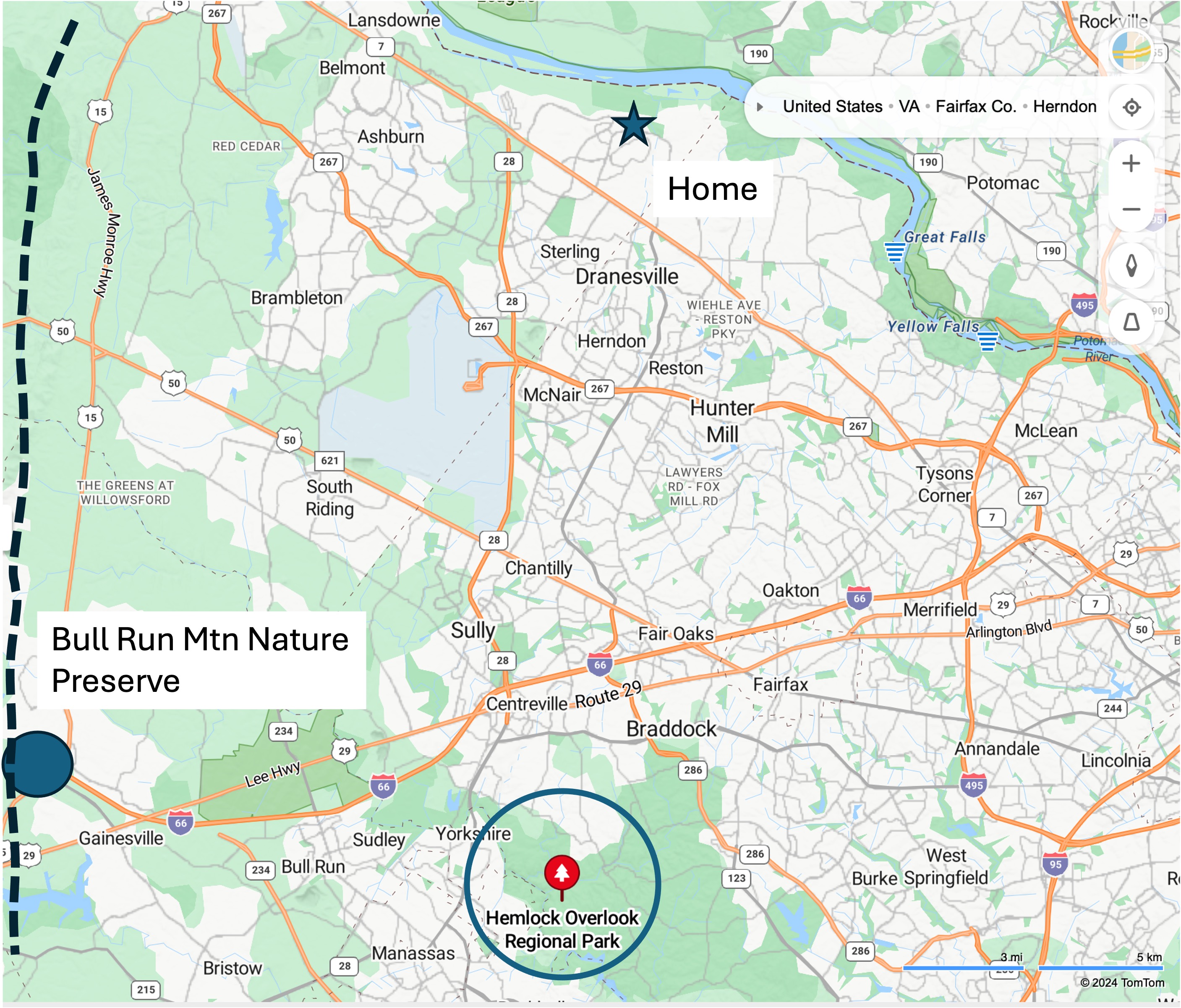
Figure 2. This map shows the area I have been exploring in recent posts. Hemlock Overlook Park is circled. Note that the study area is less than 10 miles from Bull Run Fault (dashed line), and an area we studied previously (indicated by the purple circle to the left of the map).
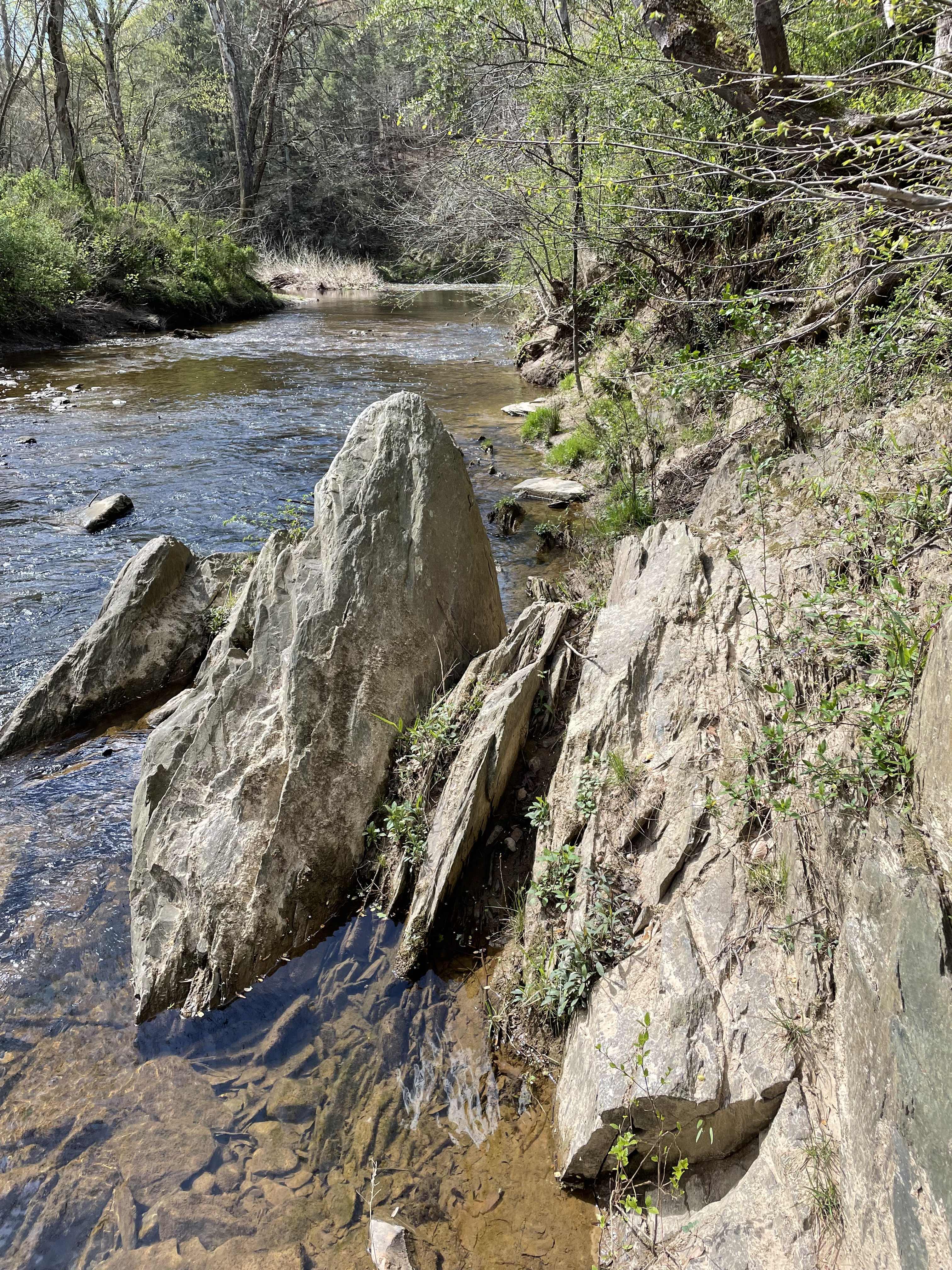
Figure 3. Photo of metasedimentary rocks exposed along the tributary creek shown in Fig. 3. These rocks have been rotated approximately 90 degrees and are vertical, with a northerly strike (not measured). They are fine grained and thin bedded, with thin layers weathering (fissile) in various locations within the study area.

Figure 4. Geologic map from Rock D of the study area. The blue dot is the location of Fig. 1. The green shade represents Cambrian metasediments (538-485 Ma). The lighter area is Proterozoic schist (1000 – 511 Ma). Our route followed Bull Run south (blue meandering line along right side of map).
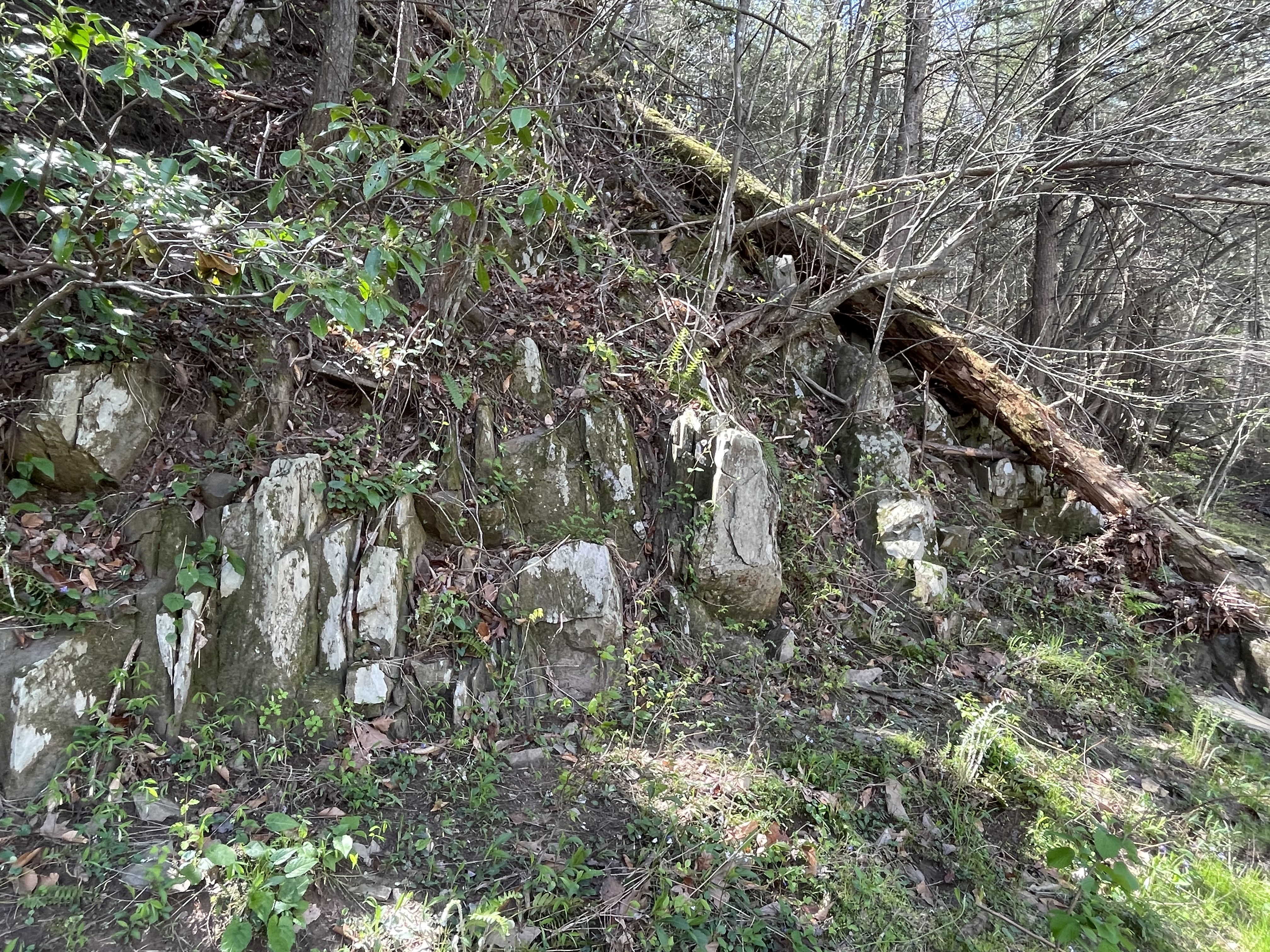
Figure 5. Photo taken further to the south along Bull Run (see Fig. 4), where the rocks aren’t as weathered as further upstream. Their metamorphic grade is increasing as well.
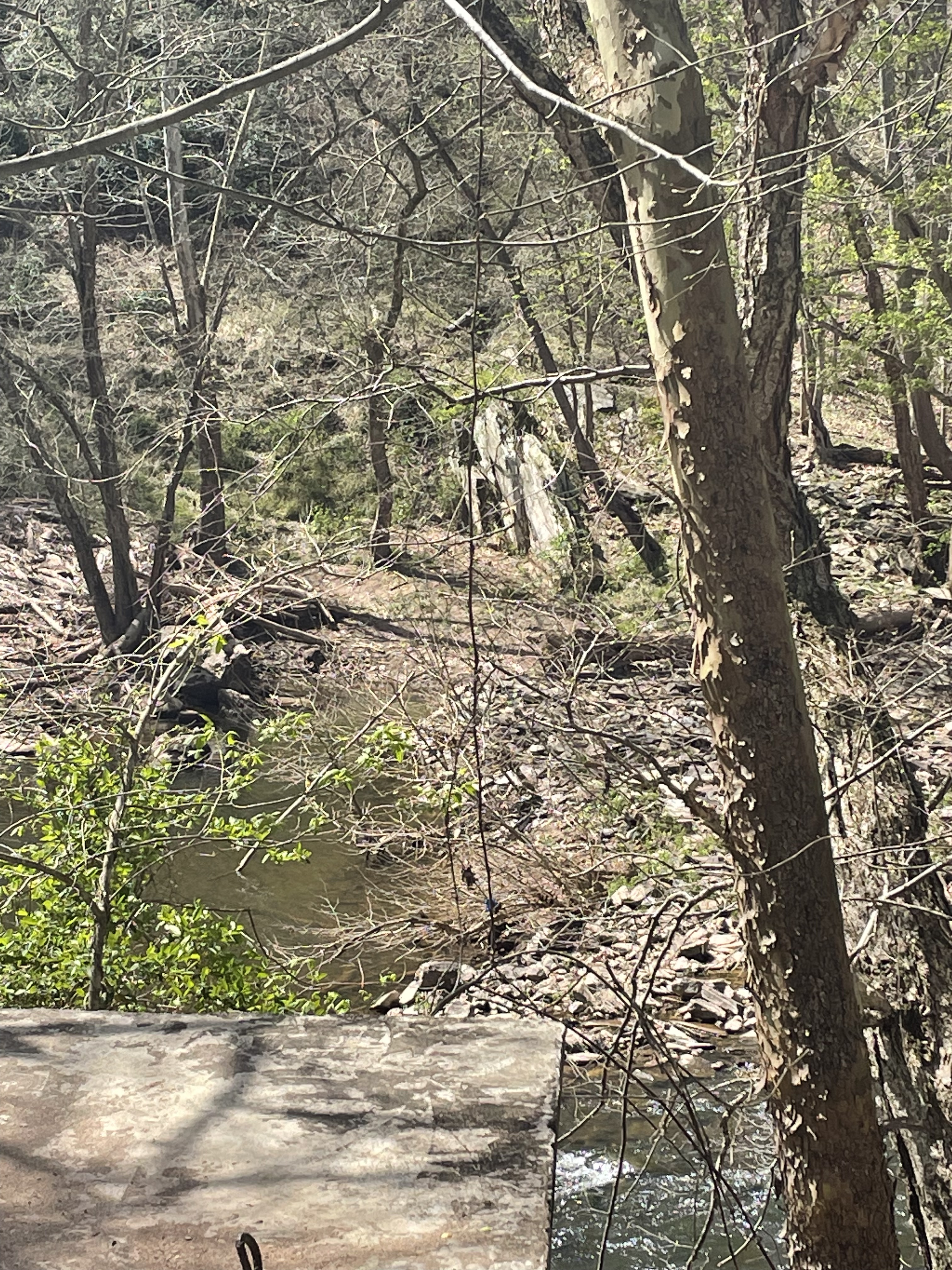
Figure 6. When we entered the Neoproterozoic schist (light-shaded area ~800 m south of the blue dot in Fig. 4), the river channel narrowed, which allowed the construction of the first hydroelectric dam in the region. Note the vertical schist exposed on the other side of Bull Run.

Figure 7. Photo taken several hundred yards south of Fig. 6, showing the resistance of the schist to erosion. This rock hasn’t weathered much and appears to be a massive layer, but looks can be deceiving when dealing with rocks in the wild.
SUMMARY.
The rocks we saw today are typical for this region: a period of mud accumulation in deep water, burial many miles beneath the surface; the older (and more deeply buried) sediments were transformed into schist while the younger rocks were heated less under less pressure. The higher-grade metamorphic rocks (i.e. schist) are stronger and more resistant to weathering, creating a narrow canyon that allowed a dam to be constructed.
This was a continuous orogenic event that lasted from about one billion years ago to 500 million. Needless to say, there is more here than meets the eye, but the rocks are not library books …

 Timothy R. Keen
Recent Comments