A Quick Visit to the Lemay Family Collection
I visited the Lemay Family Collection of automobiles. It is affiliated with the Lemay America’s Auto Museum, but it more low key. Nevertheless, it contains a lot more than antique cars; this post is sharing some of the more mundane aspects of the development of automobiles as a major form of transportation.

The lower shelf of motor oil contains many familiar products; but the upper shelf will probably get your attention. How about putting some skunk oil in your motor? I wonder about their marketing campaign. Note that there are no plastic bottles here; every container is 100% recyclable, heavy cardboard (not corrugated) and metal rings.

I discovered the motometer recently. These devices are thermometers mounted to the radiator cap, which was exposed until the late 1920s. This is an assortment of these important gauges but, unfortunately, they aren’t labeled.

The major oil companies started adding tetraethyl lead to gasoline to prevent premature detonation in the 1920s, but they knew lead was dangerous, so they formed a new company called the Ethyl Gasoline Corporation; the word “lead” never appeared in advertising, but people loved the new gas, even though they had no idea what was in it. They thought it was high octane. You gotta love mass marketing in the twentieth century.

They don’t make BMWs like this anymore. Note the door on the front.

This is a horse-drawn road grader. Th operator stood on a missing platform and turned the wheels to adjust the blade. Some of them were adapted to be pulled by tractors. Not a very satisfactory solution …

This is a motorized road grader from 1925-1930. The gasoline engine is beneath the large tank in front of the cab. It was basically a tractor with an extra axle behind, and a long frame in front. This was before hydraulics were available, so the controls are all manual.

This is a Fordson road roller circa 1930-38. Note the smooth engine, reflecting the art-deco design craze sweeping the country.

ChatGPT and I agree that this is probably a road oiler (for asphalt surfaces) from the 1930-50s. We’ve all seen trucks with large tanks spraying oil on asphalt roads.

I recently posted about hood ornaments over the decades after a visit to the Lemay auto museum. This one, from a 1937 Packard 120 Coupe, caught my eye because the winged, female figure seems to be holding a wheel and tire assembly or maybe a disk. This is one of two optional ornaments, the Goddess of Speed; the other was a cormorant. Optional hood ornaments! Who would have believed it.
Final Thoughts
I always enjoy looking at old automobiles because they reflect the non-military development of a new technology, unlike aircraft. Part of this evolution was progress in road machinery — cars need good roads, unlike horses and buggies.
Disarray Along Commencement Bay
This morning we went for a walk along the western shoreline of Commencement Bay, which was home to many sawmills, even a smelter, between the 19th and late 20th centuries. Rather than removing all of the industrial debris, the city has left the remaining infrastructure as a kind of museum. There are signs explaining a lot of the history and even a piece of sculpture integrated with an original saw.
The shoreline is a dynamic environment where plants struggle to keep up with the sea and weather. Thus, pioneer plants dominate the flora.
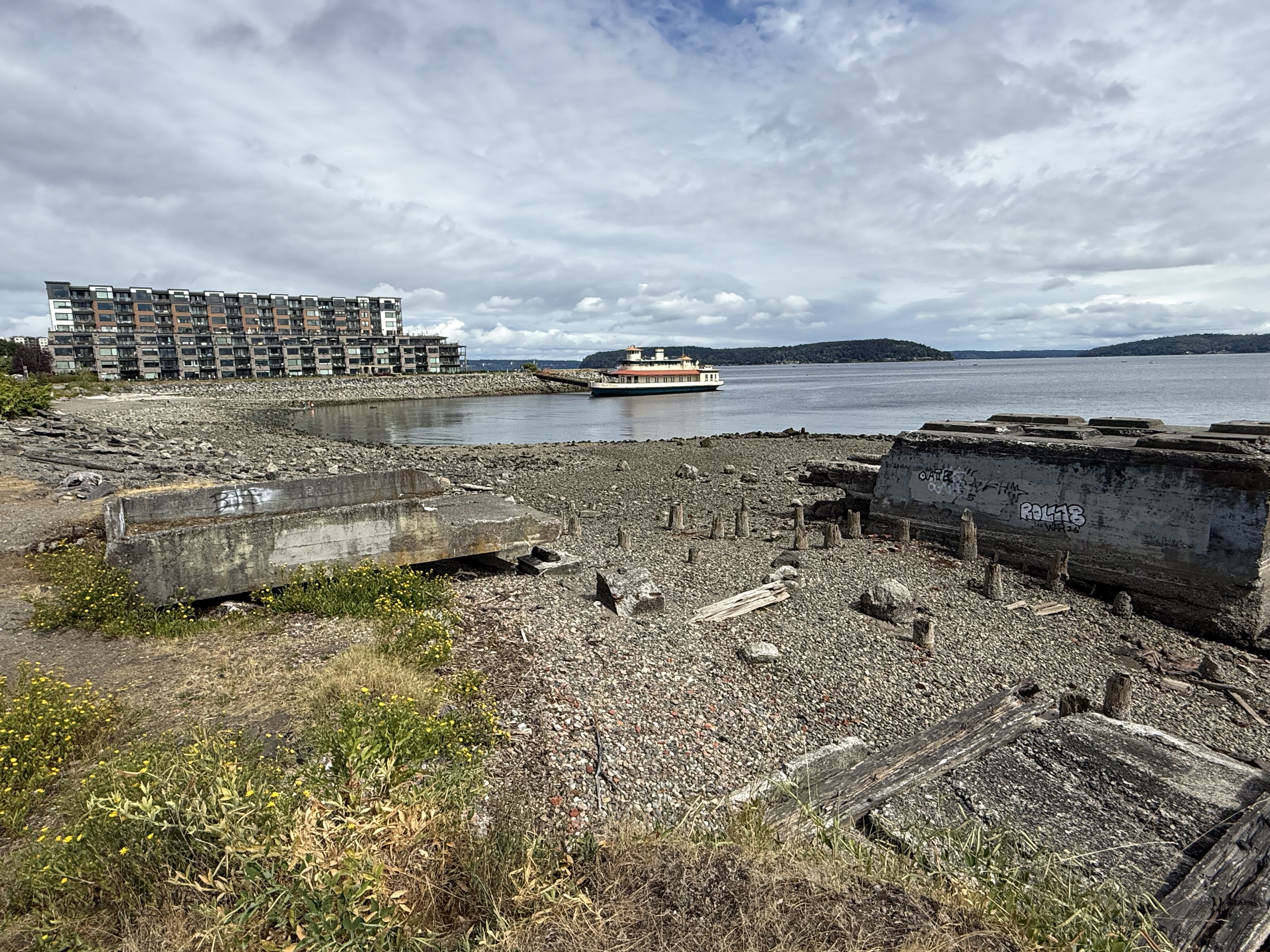
This view is looking to the NE. This is the last sawmill site along the bay, but it doesn’t have any signage explaining its history. Nevertheless, this image, taken at low tide, says a lot: The large concrete structure was the foundation for a piece of heavy equipment like a saw or winch; the piling stubs reveal where it was connected to land, where a receiving platform (left of image) was constructed. The remnants of a dock are in the lower right. There are a line of pilings further seaward that demarcate a dock that would have served as a wharf for ships.
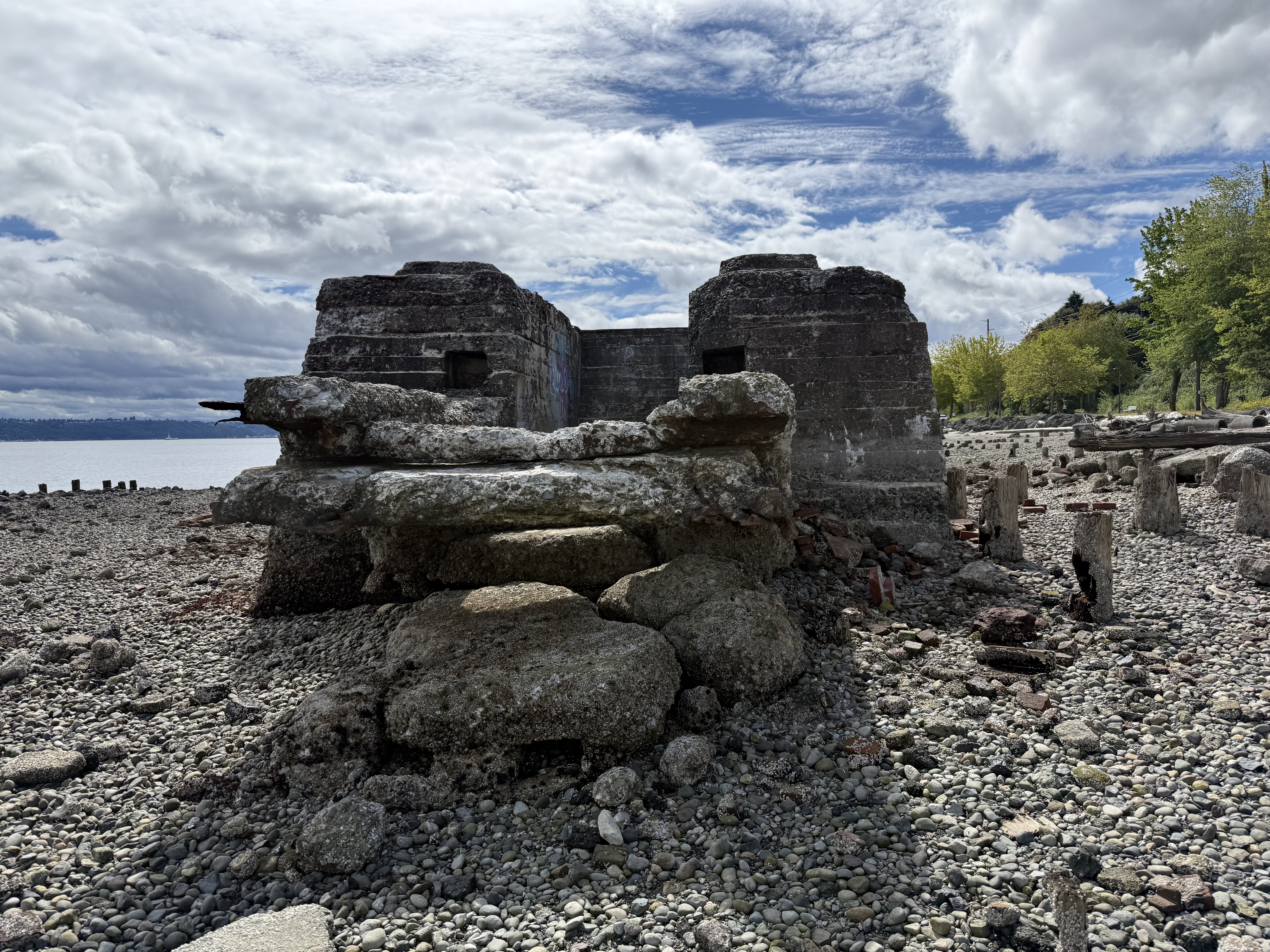
Most of this structure would have been submerged at high tide (7-10 feet, twice a day). This reinforced concrete structure probably was the base for the saw, the channel likely designed for pulleys, chains, etc, that ran the saw or pulled trees (up to 14 feet in diameter) into it. The sawmills often located their saw heads offshore to make processing logs, which arrived by raft, easier.
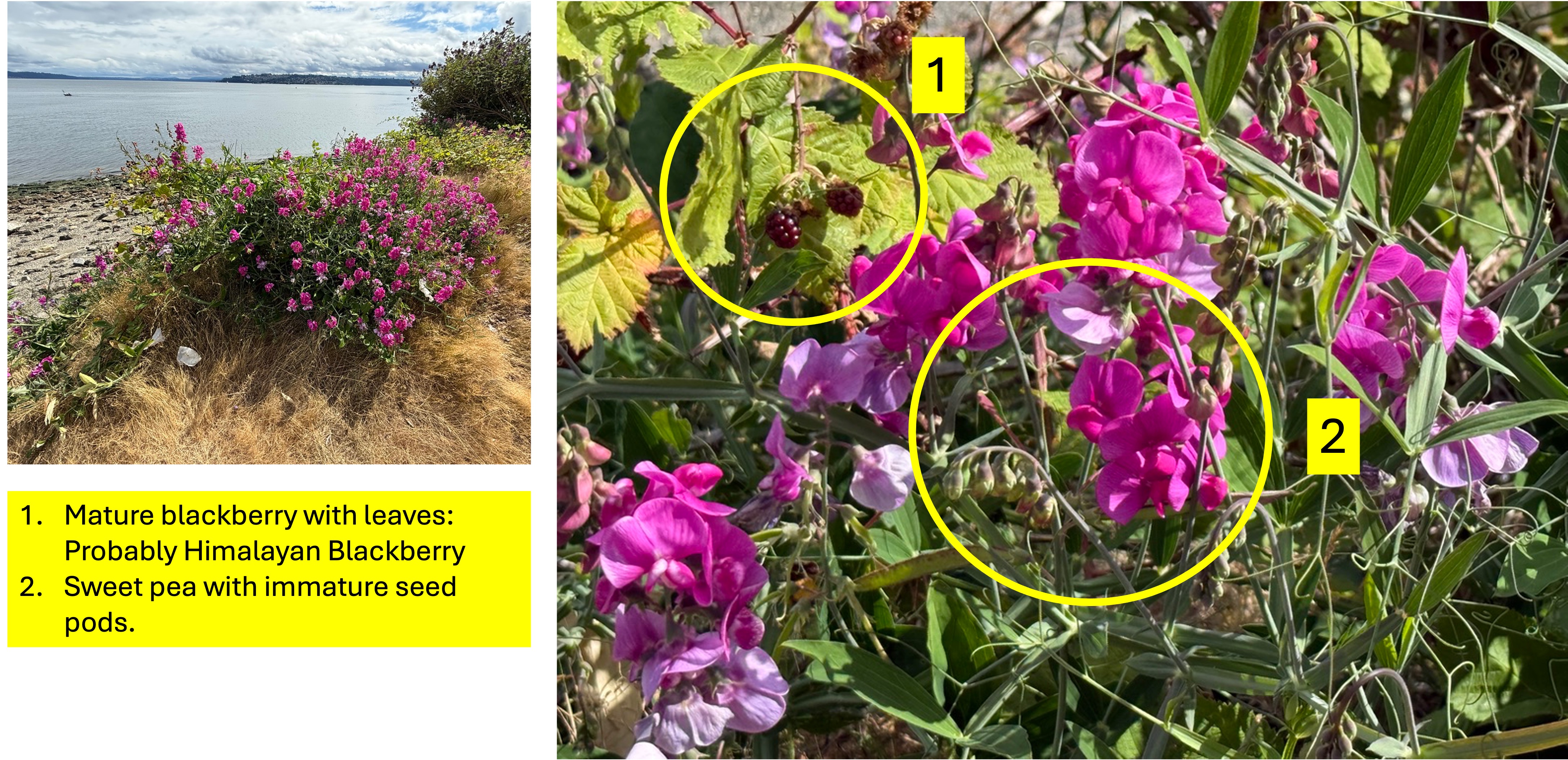
This bramble caught my eye, so I took a closer look. It is a mixture of two pioneer plants. Sweet peas of different species are native to the PNW (I don’t know which exactly this is), but Himalayan blackberry is invasive and threatens ecosystems across the region. They are fighting it out, so I’m cheering for the sweet pea — to fend off the foreign invader.
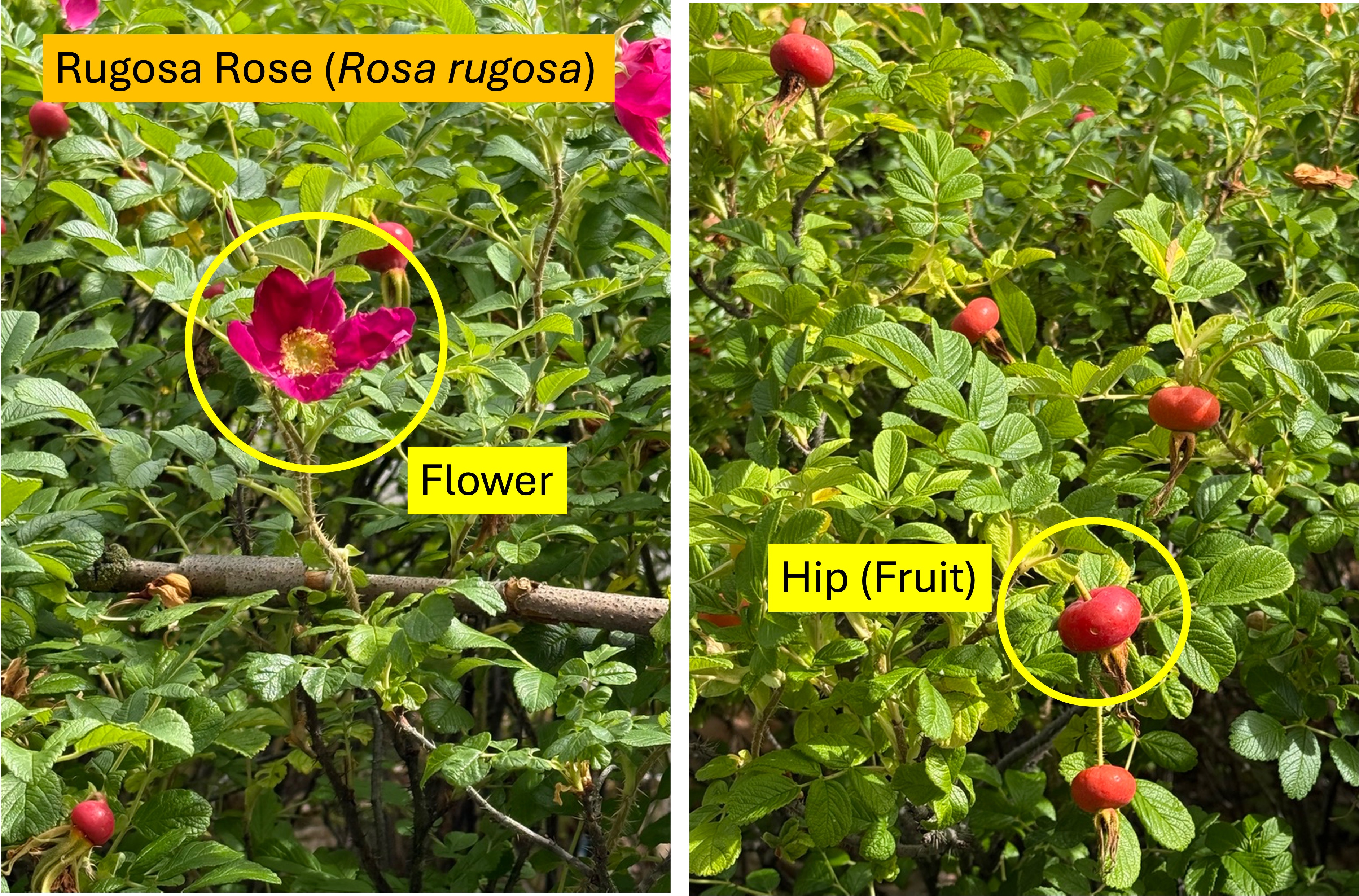
This wild rose species caught my eye because of the huge fruit (golfball sized), which is apparently edible. Just put enough gravy on it and it’ll taste fine.
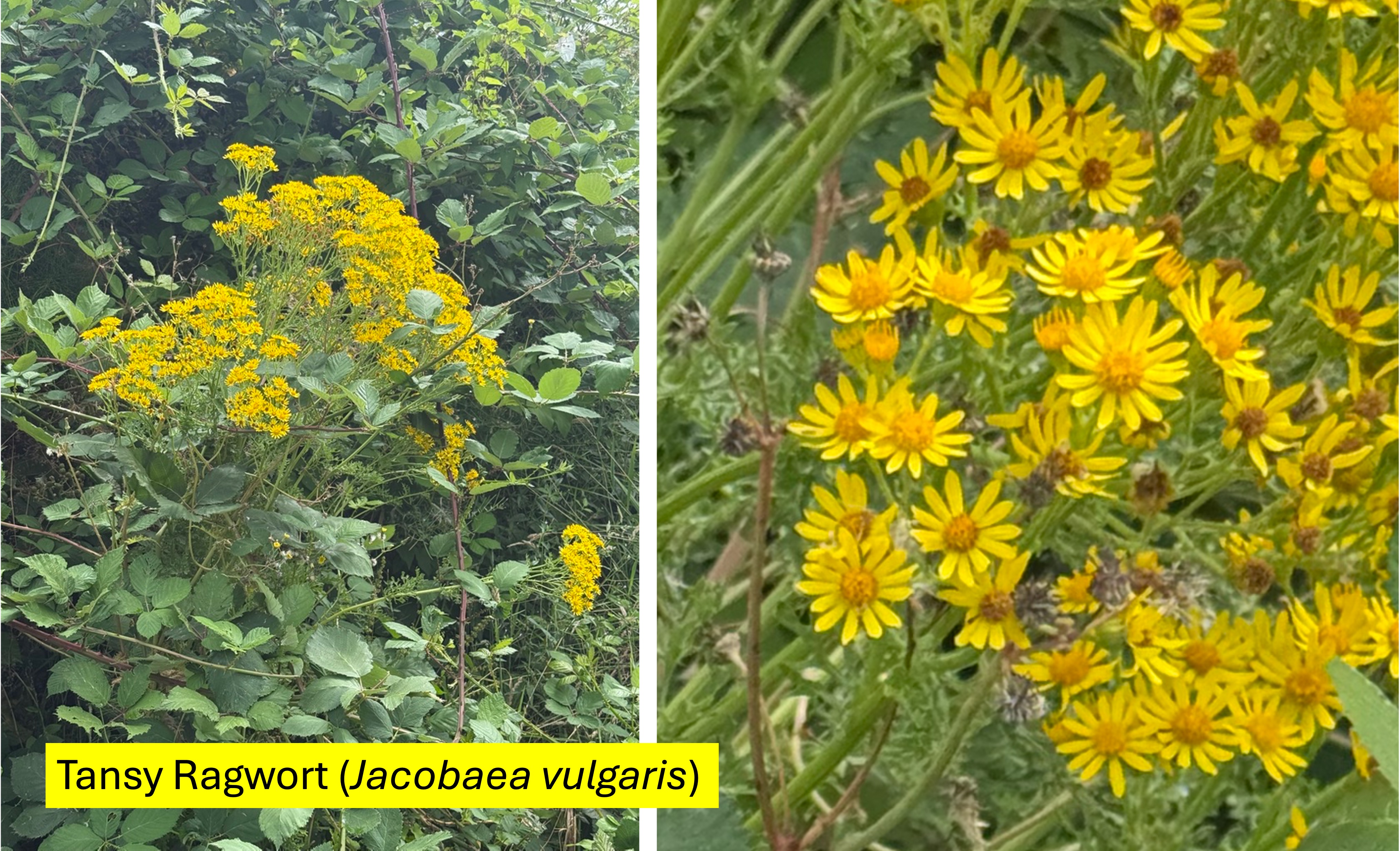
I thought these bright, yellow flowers looked familiar. I checked a previous post to discover that the flowers are not common tansy. The flowers are curved upward and the centers are large, orange domes. It is invasive and toxic to animals (and people), so it is actively monitored. This example is growing in a thicket along with Rugosa Rose, which is also invasive; and yes, there are native plants that thrive in a coastal environment but they have natural controls that are lacking for these alien species.
Final Thoughts
I didn’t mean to photograph anything today, but the flowers are so eye-catching. And I love old industrial sites.
The Northwest Native Garden
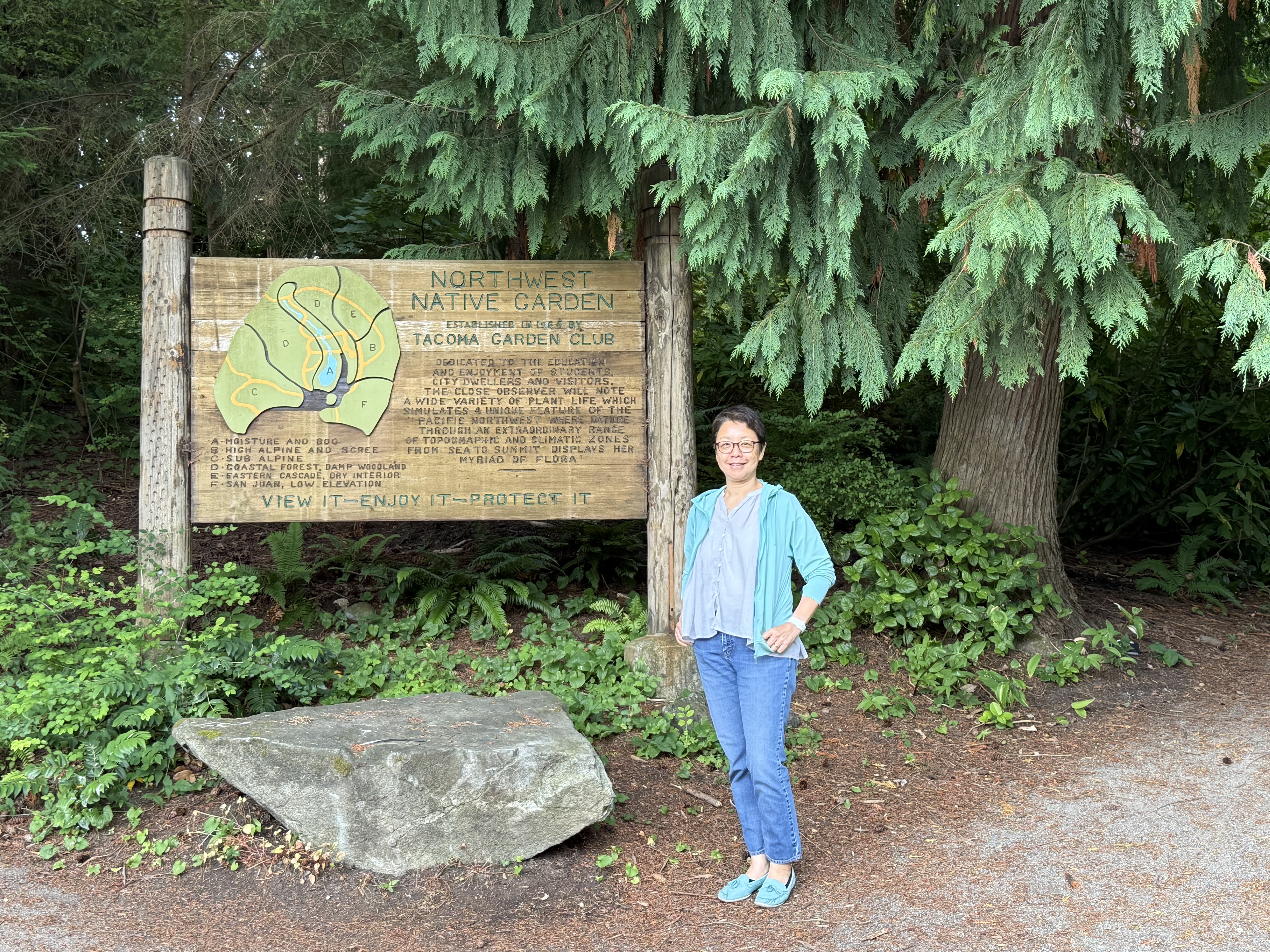
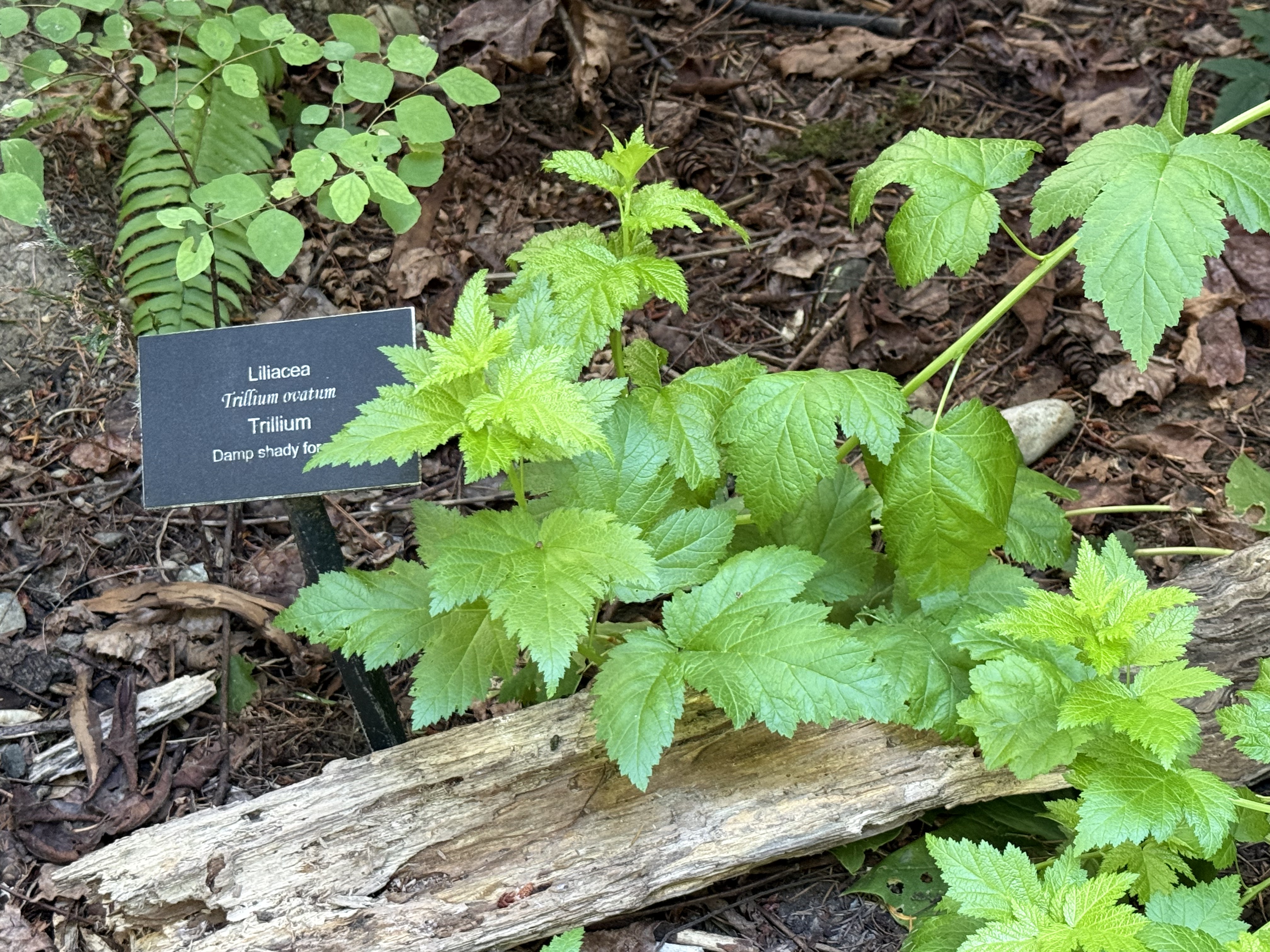
Like the (rare) sign says: Trillium likes moist coastal forests.
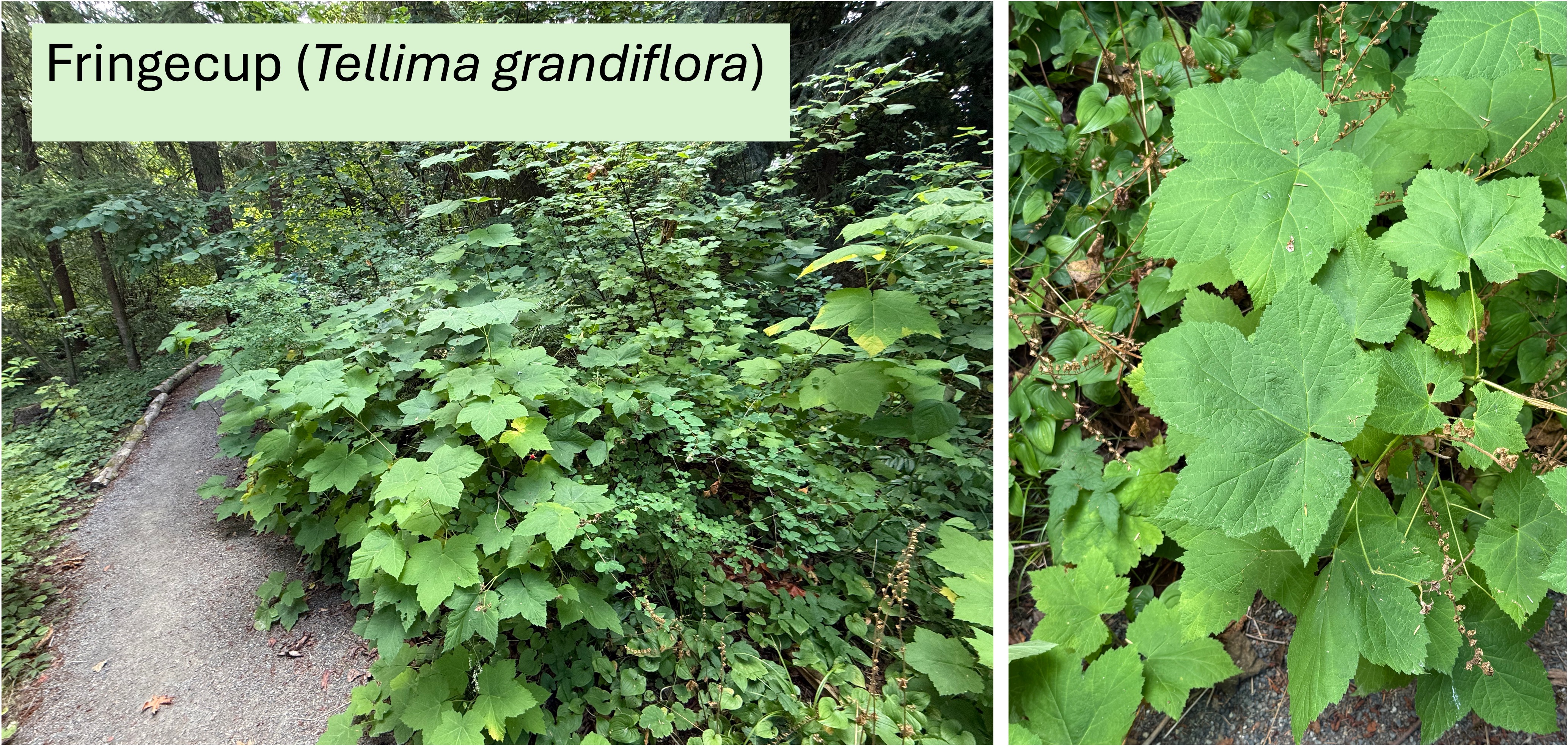
This common PNW shrub thrives in moist coastal forest environments.
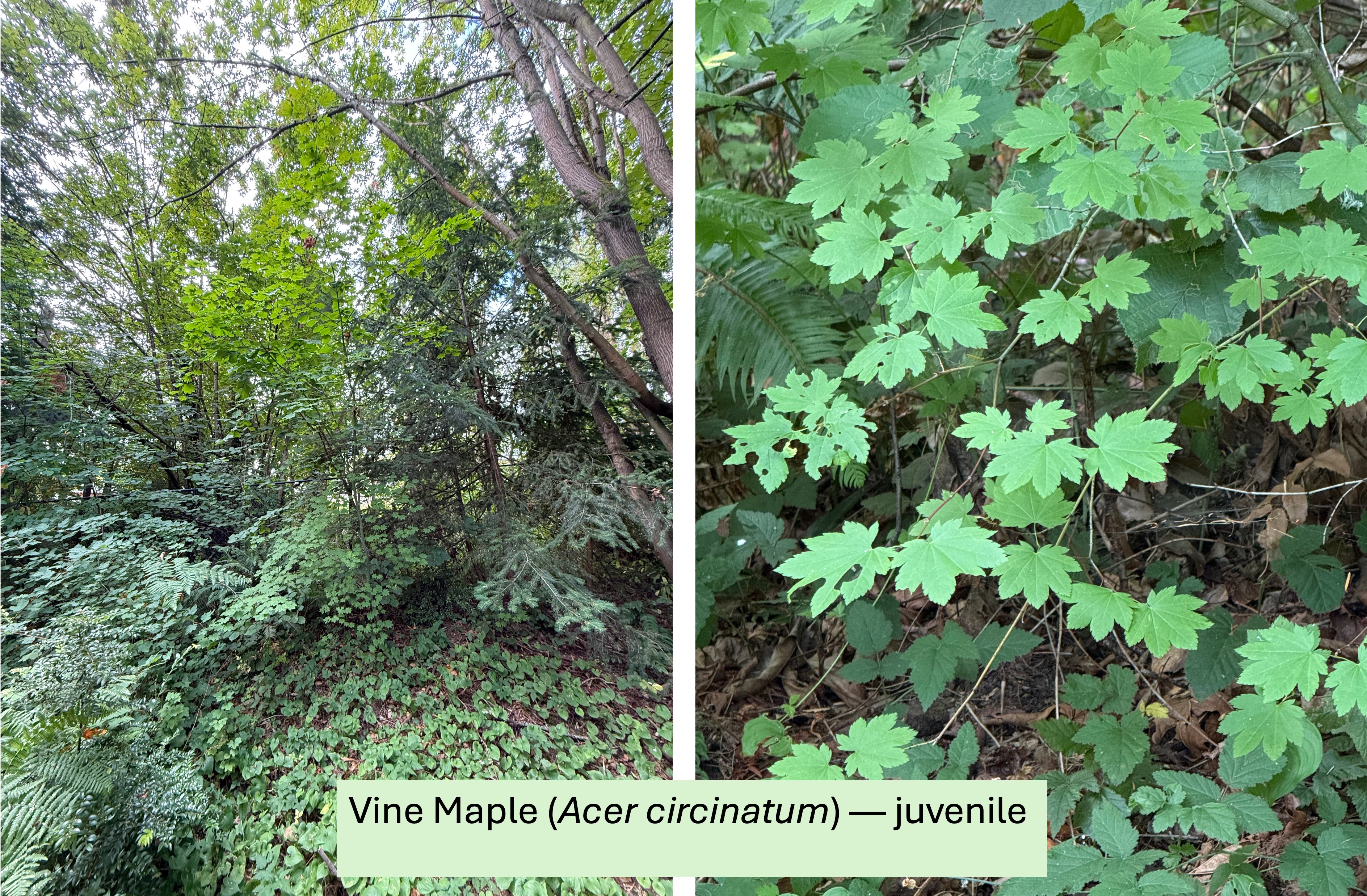
Vine Maple is an understory tree, which doesn’t grow high enough to compete for full sun; instead, it grows beneath the conifers and gives even more shade to the shrubs. This sapling is just starting to get some height. Moist coastal forest.
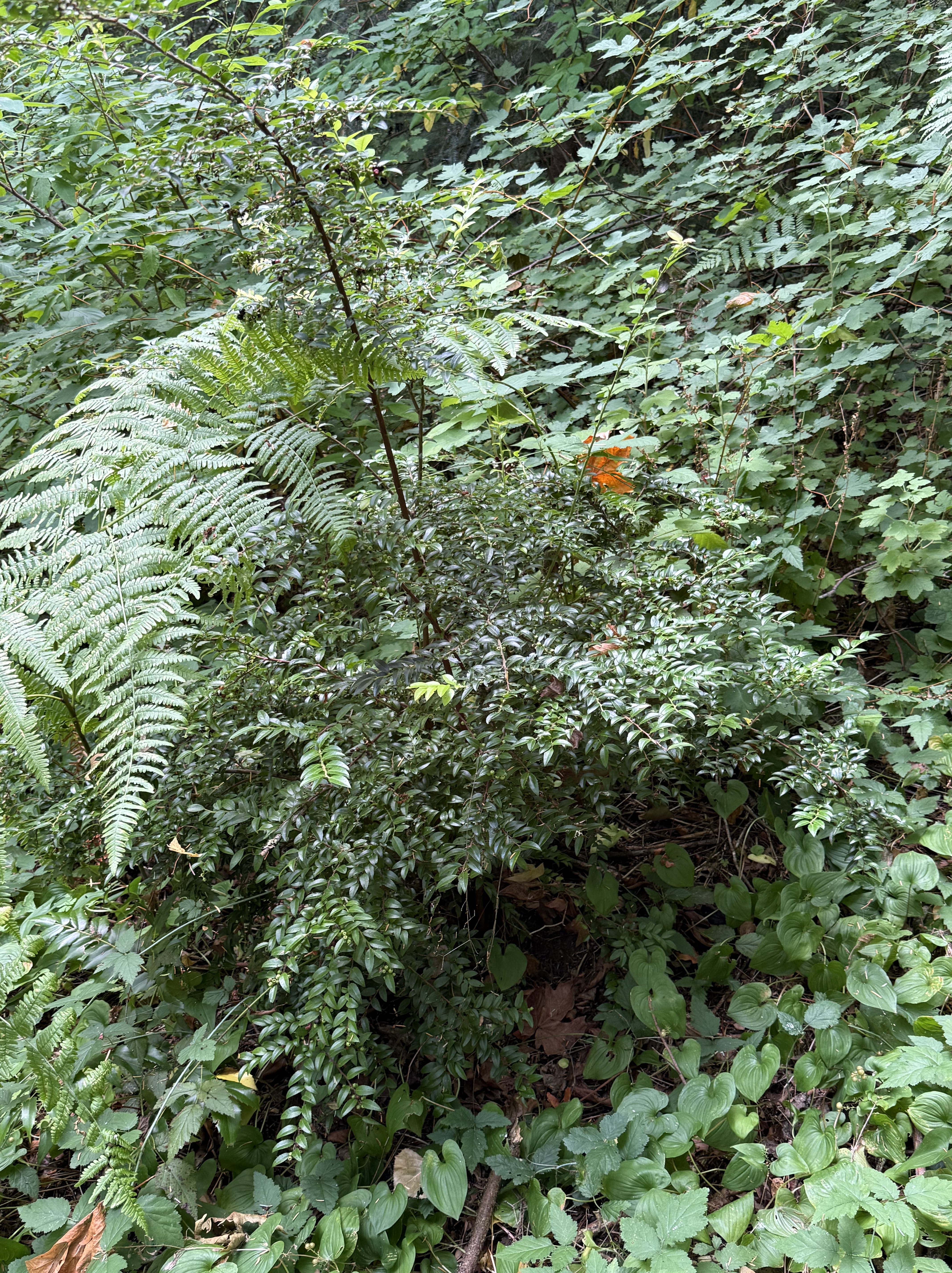
This is Salal (Gaultheria shallon). It grows in an environment similar to Vine Maple, in nutrient-rich, well-drained soils, often near water. Moist coastal forest.
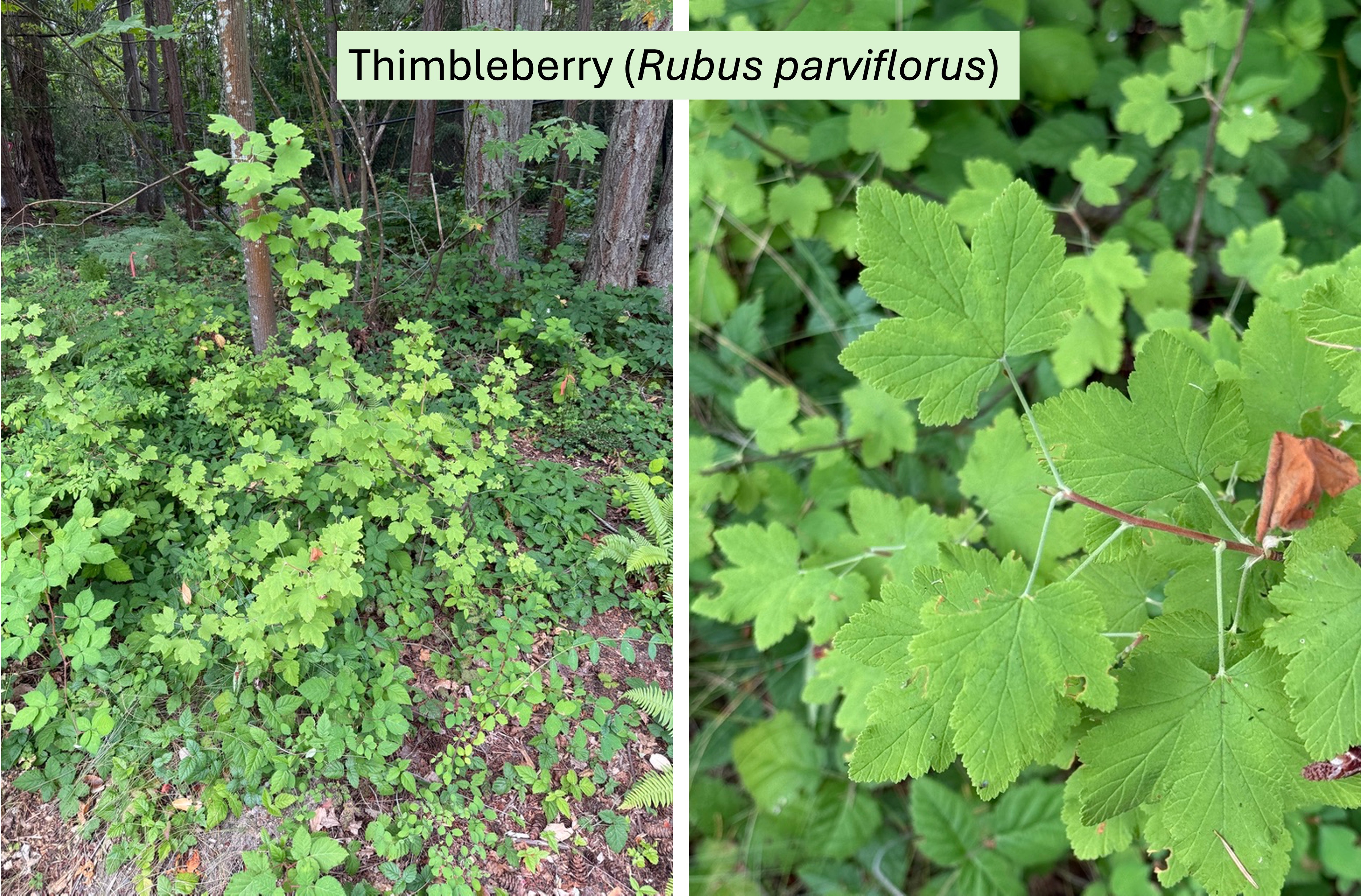
This shrub forms colonies in mesic forest patches, where partial sun is available although it is shade tolerant. The identification is difficult because of so many plants with similar leaf shapes, but I agree with CoPilot. A denizen of moist coastal forests.
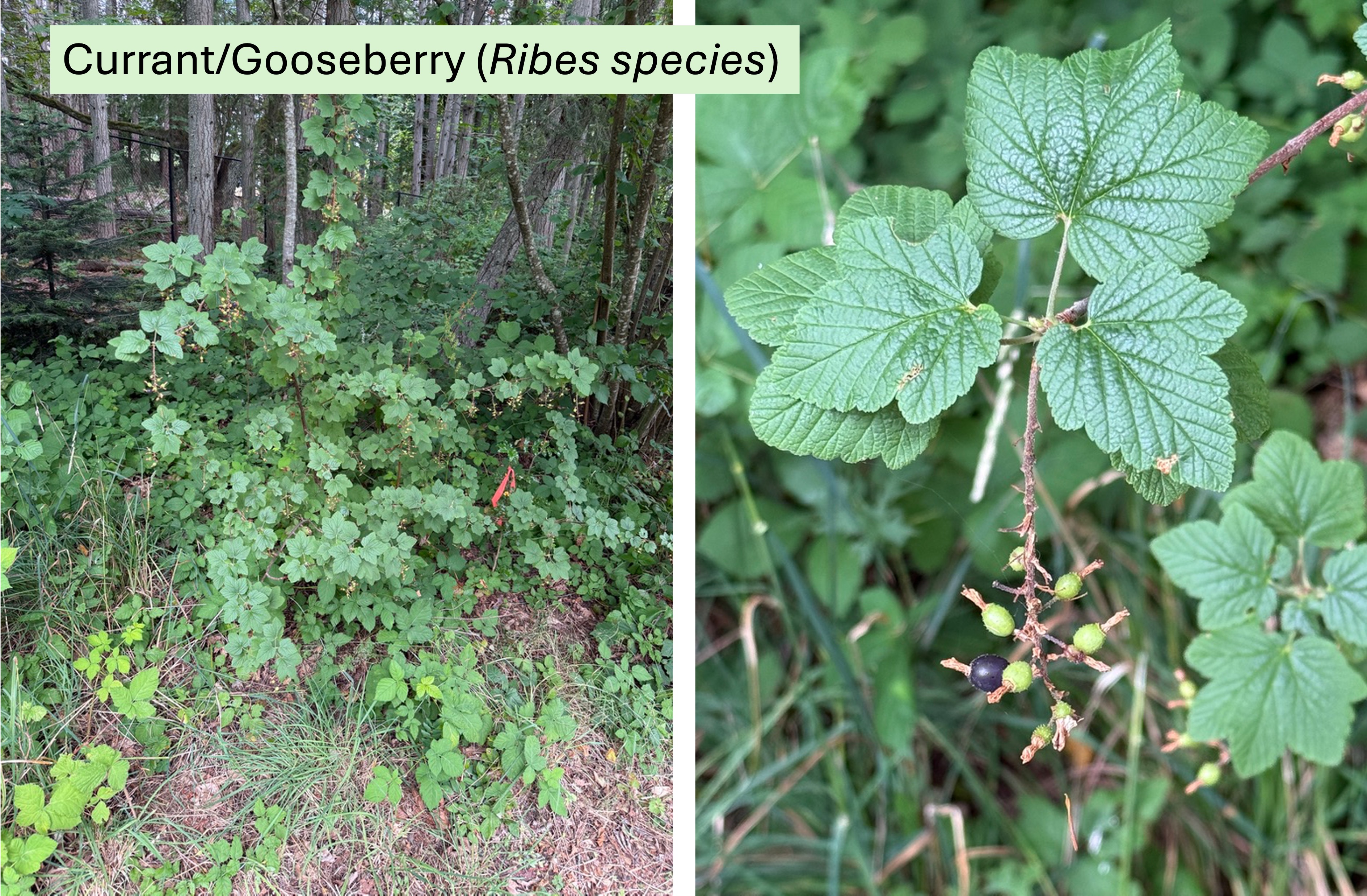
This plant is common to shrub thickets and riparian edge habitats.
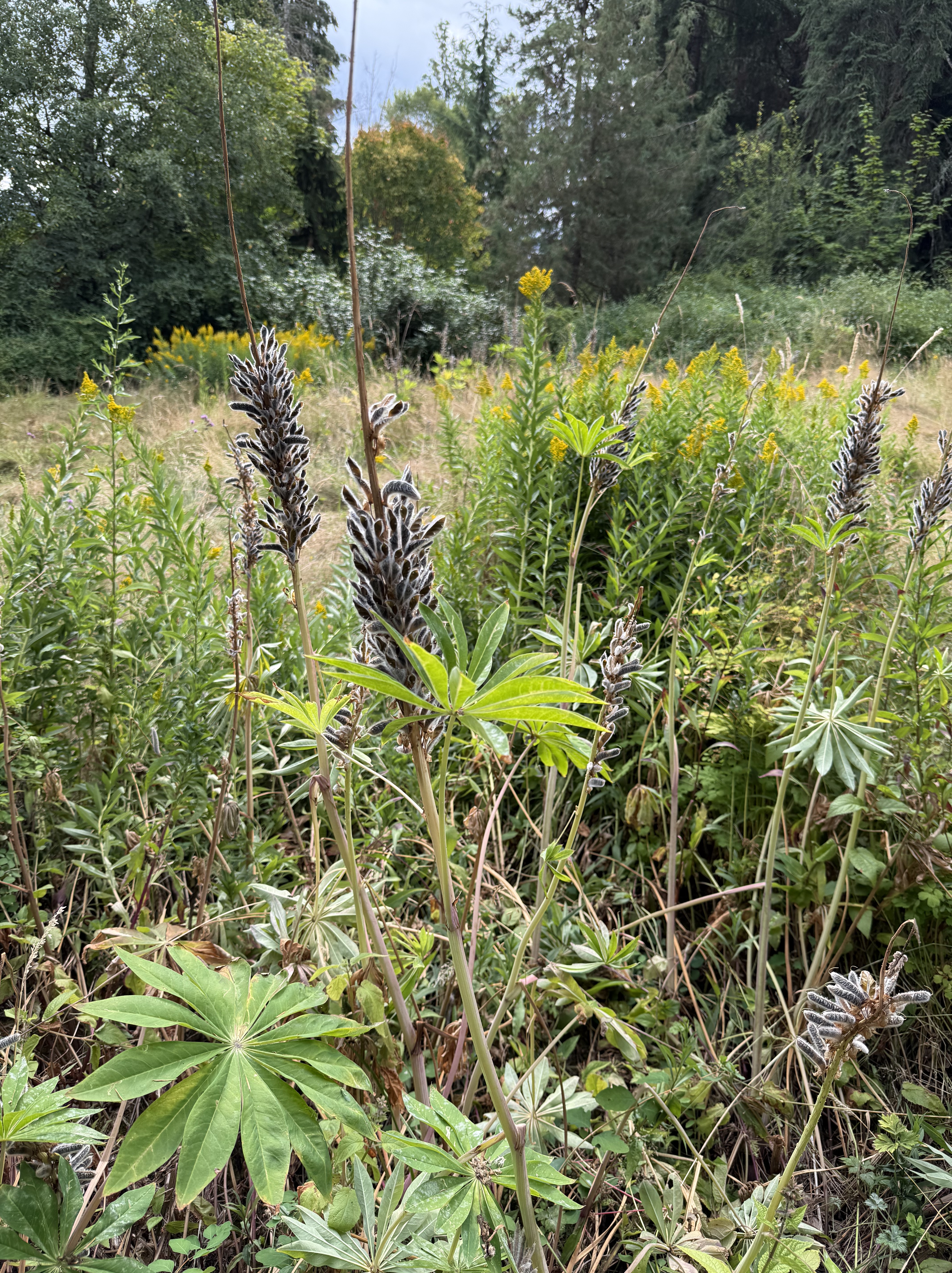
This distinctive plant is Bigleaf Lupine (Lupinus polphyllus). It thrives at the edges of meadows in a full-sun environment with moist to dry soil. Those lovely appendages are seed pods, so I don’t know what the flowers look like. This plant thrives in prairie/oak woodland habitats.
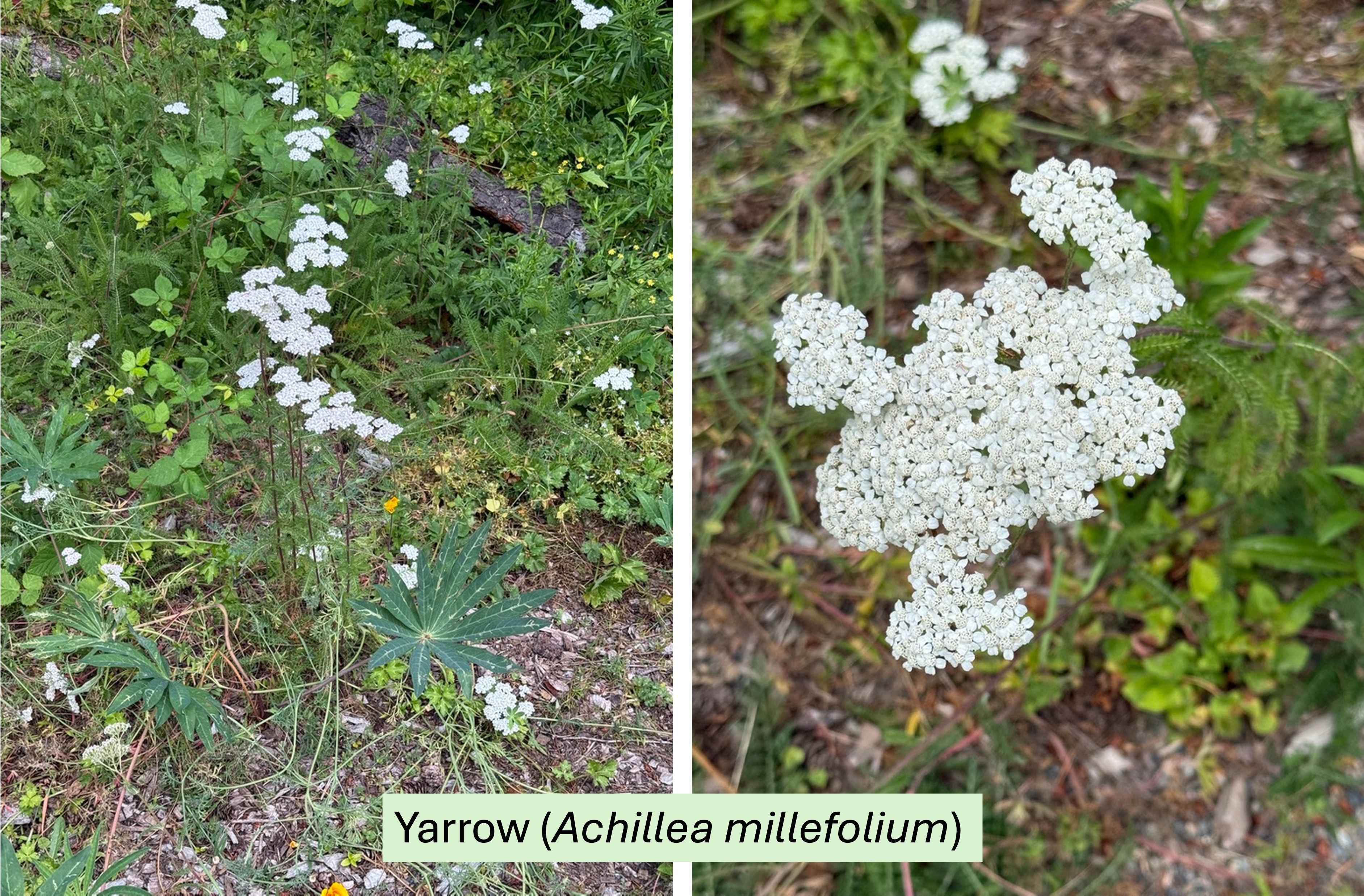
This slender, flowering plant is thriving in the prairie section of the garden. Prairie/oak woodland environments.
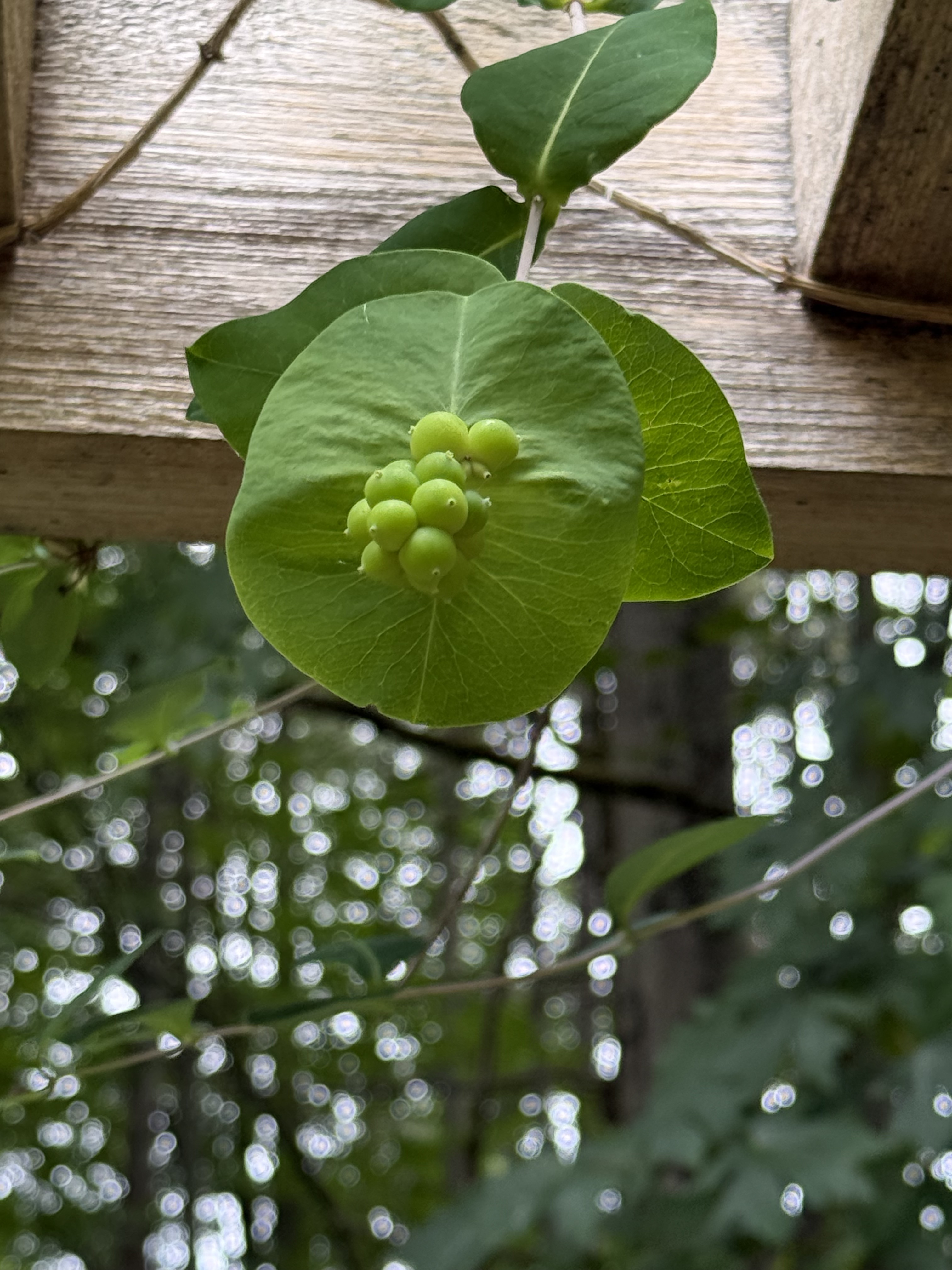
This vine is Perfoliate Honeysuckle (Lonicera caprifolium). It is a non-native variety that is commonly planted on trellises and fences. This one was hard to identify; CoPilot failed completely but, with help from Claude (Anthropic’s AI), we finally figured it out. We could still be wrong, however.
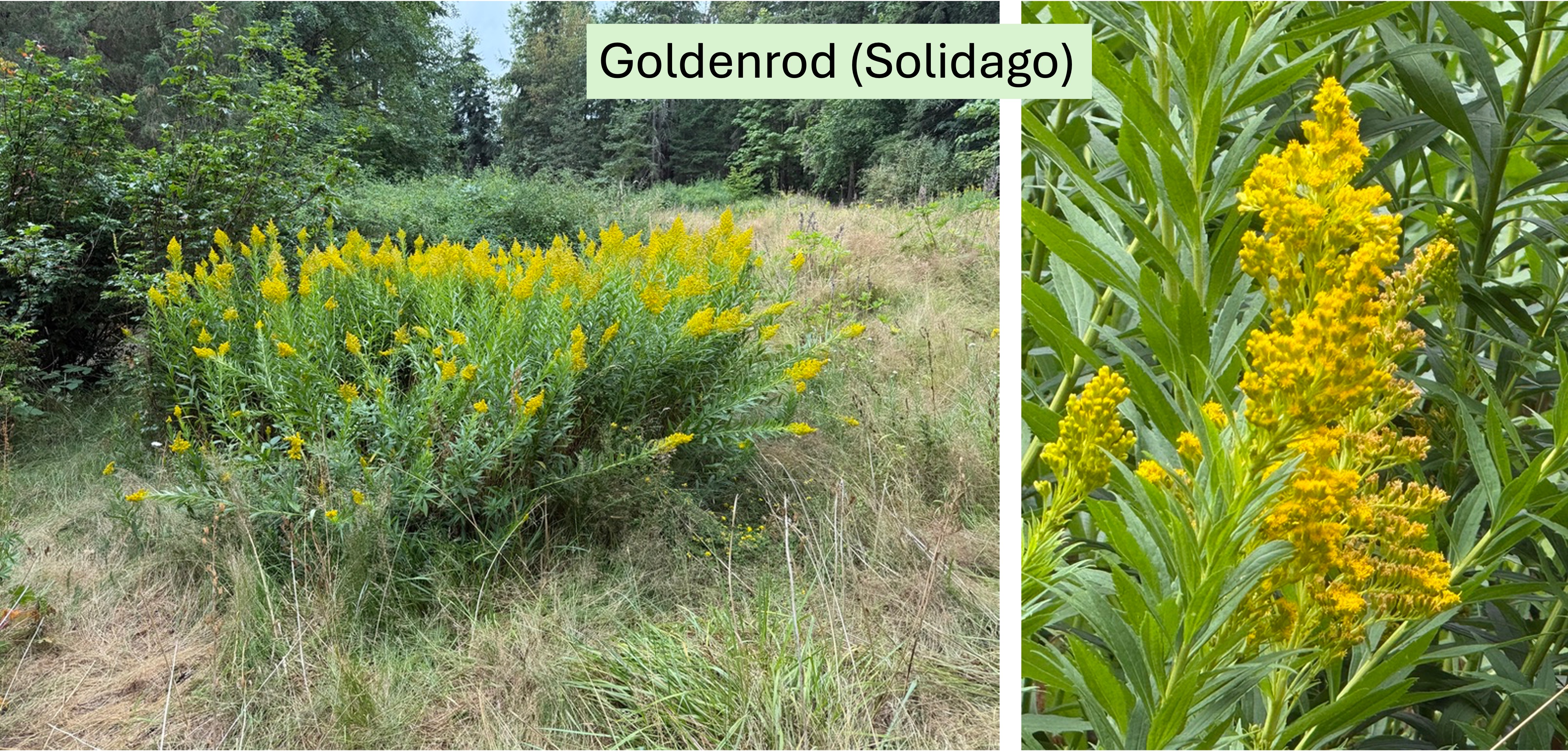
This flowery shrub grows in meadows like the micro-environment at the Northwest Native Garden. Prairie/oak woodland habitats.

These non-native (to Tacoma) columns of volcanic rock show up everywhere in the PNW. They originate within the Cascades Range, near volcanic vents and volcanoes.
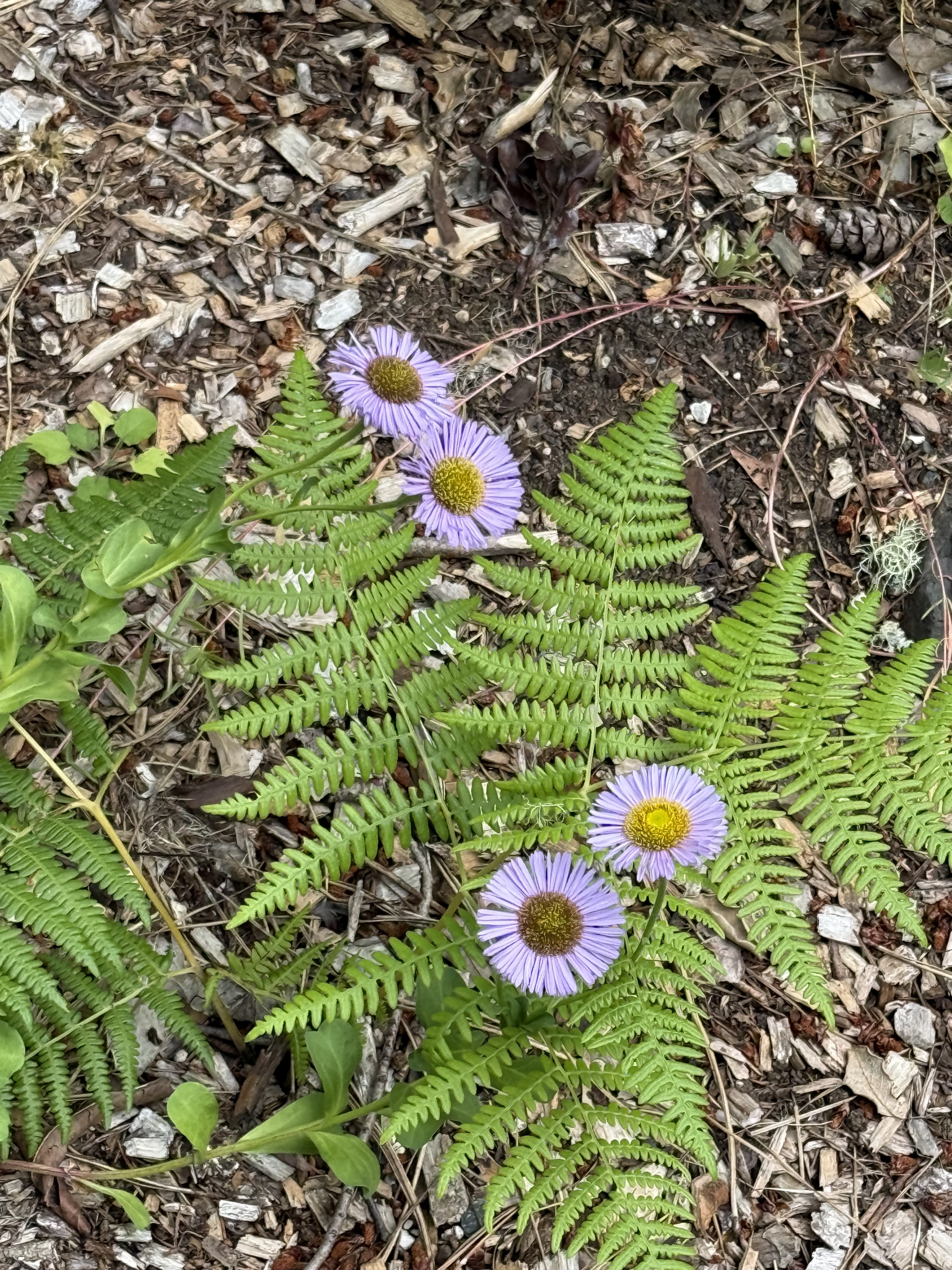
This lovely flower, growing through some ferns, is Douglas Aster (Symphyotrichum subspicatum). It is common in moist meadows and forest edges. I verified the identification from CoPilot. Common in moist woodland/forest edge habitats.
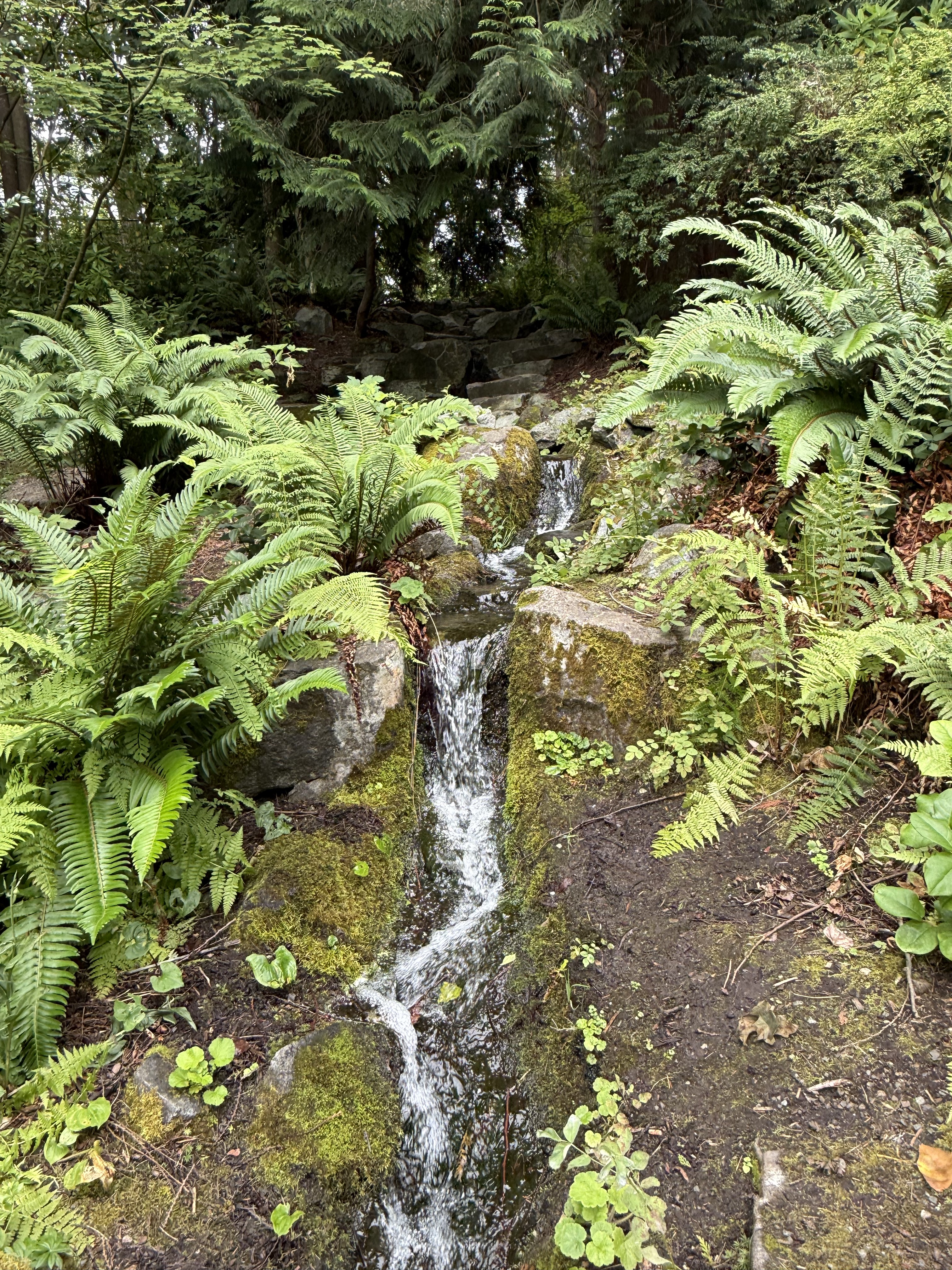
There is a small, articficial stream flowing through the garden and feeding a small pond. I don’t know where the water comes from … is it natural or recycled? No idea.
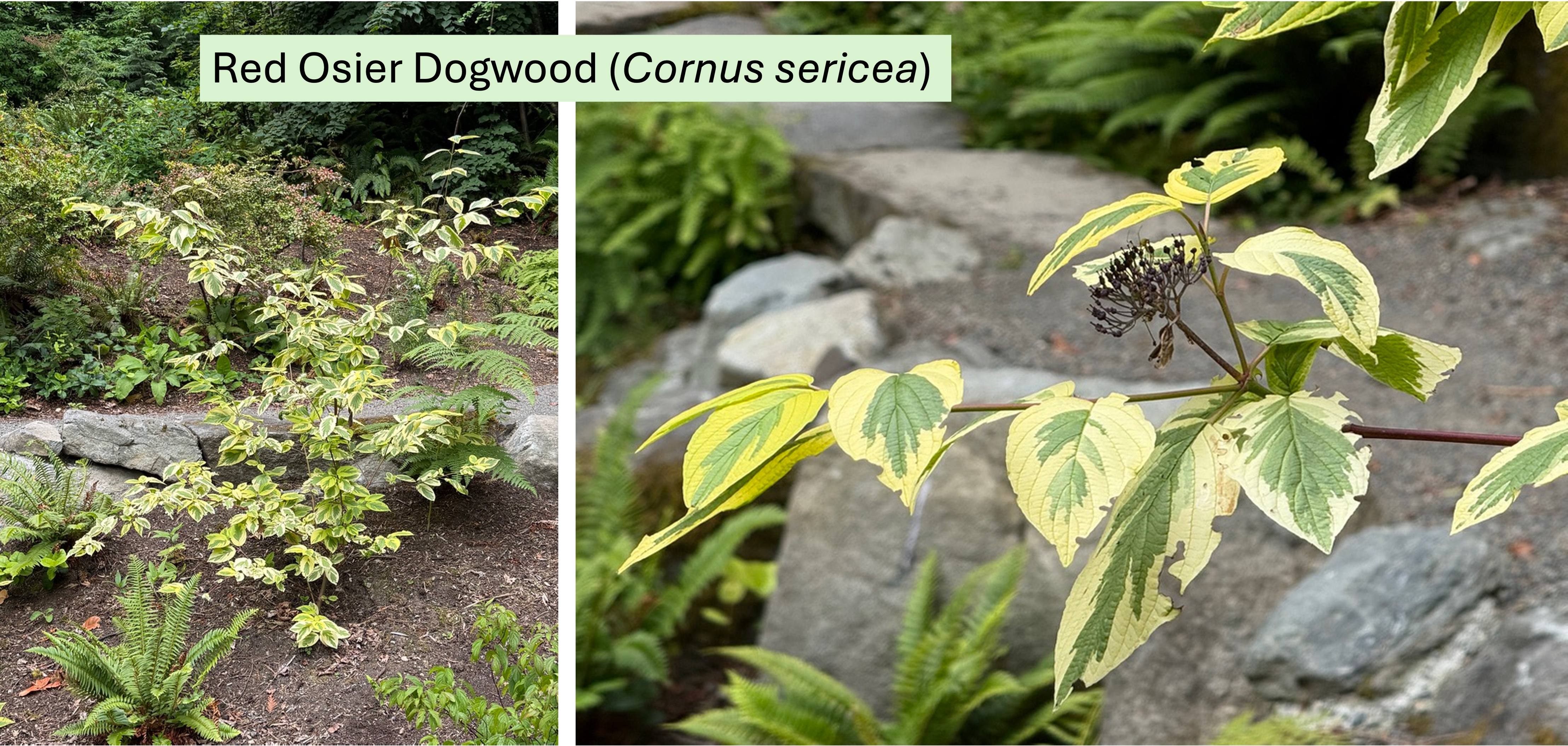
This is a rare non-native species planted in the garden for contrast. I checked this myself, and this variety is variegated.
Final Thoughts
The Northwest Native Garden is a great place to see many of the ecosystems in the PNW in one place. However, the lack of identification is a problem, which I addressed using CoPilot. But I had to check it a lot because it is a Large Language Model, not a specific plant-identification model. Nevertheless, it always got me into the ballpark; and it is easy to work with, like collaborating with a human who knows a lot but tends to jump the gun sometimes.
We spent about an hour strolling through four PNW environments, which was a lot easier than driving around. It reminded me of a Japanese garden, like the one in Portland. Very peaceful and colorful.
I hope that anyone who got this far enjoyed my trip through the Northwest Native Garden as much as I did. I plan to revisit it and learn about some more native PNW flora.
The Foothills Trail along Carbon River, Pierce County, Washington
This post is a humorous (I hope) addendum to my posts on the geology and flora of Carbon River. I have noticed a lot of quirky, regional trends, both in decoration and signage, here in the Pacific Northwest (PNW) during our nature walks. The Foothills Trail was no exception.
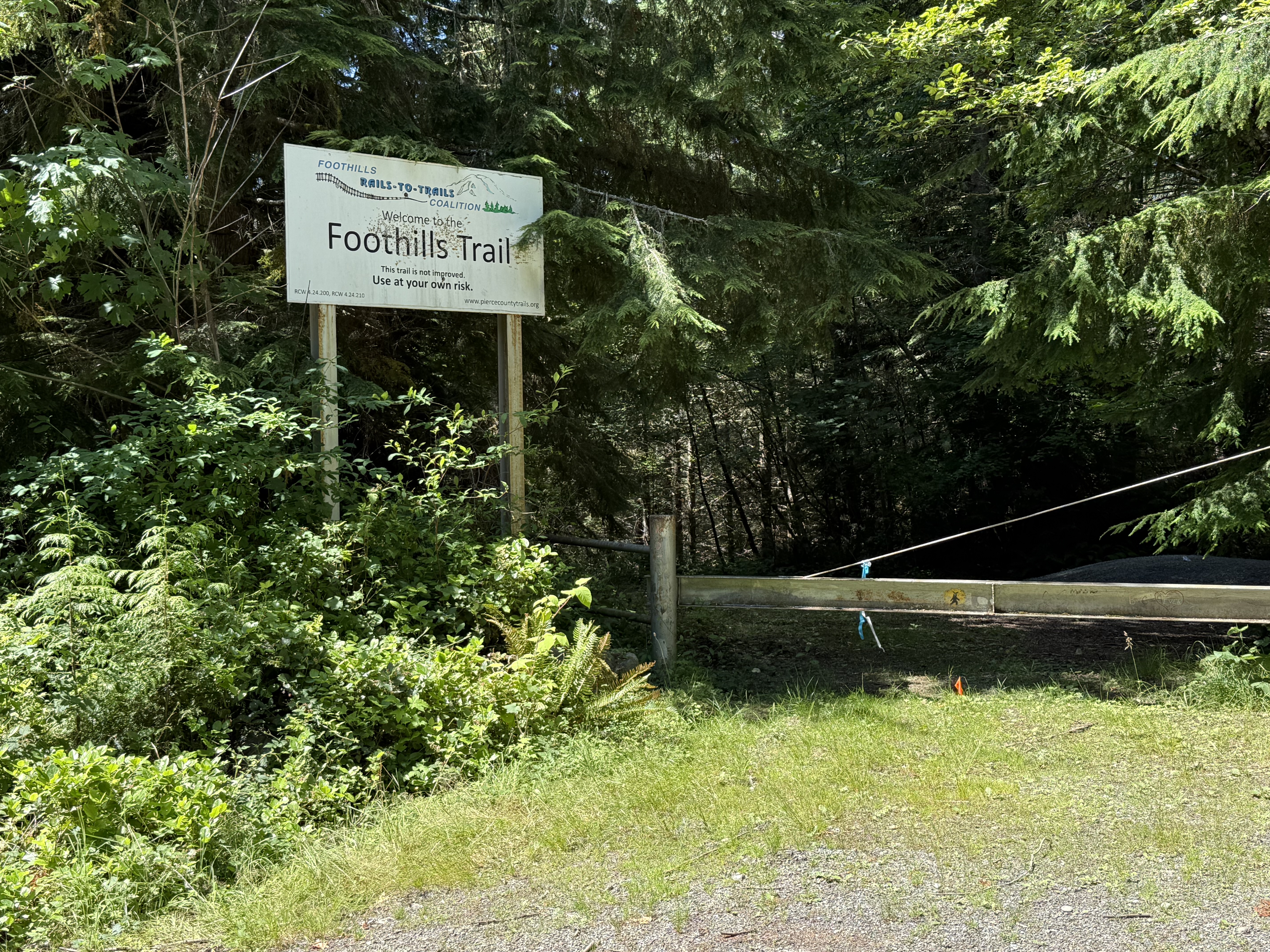
There are several access points to the trail, but this was the only sign. It ends with a serious warning: Use at your own risk. What lies ahead in that darkness?
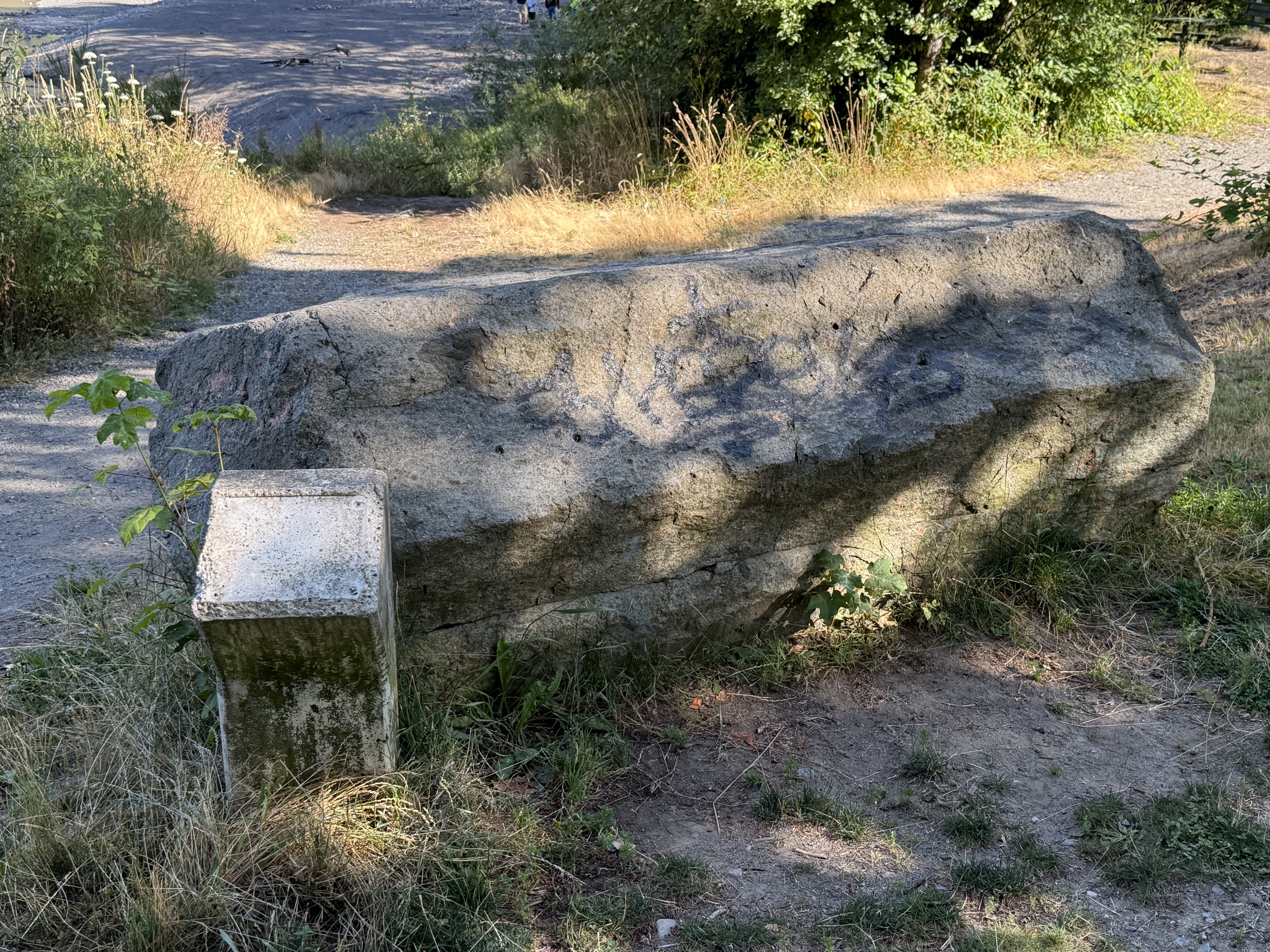
A couple miles downstream from the “official” trailhead, we stopped along the Carbon River. This is a piece of ubiquitous columnar andesite that was apparently placed here as a decorative piece. Unfortunately the sign is long gone.
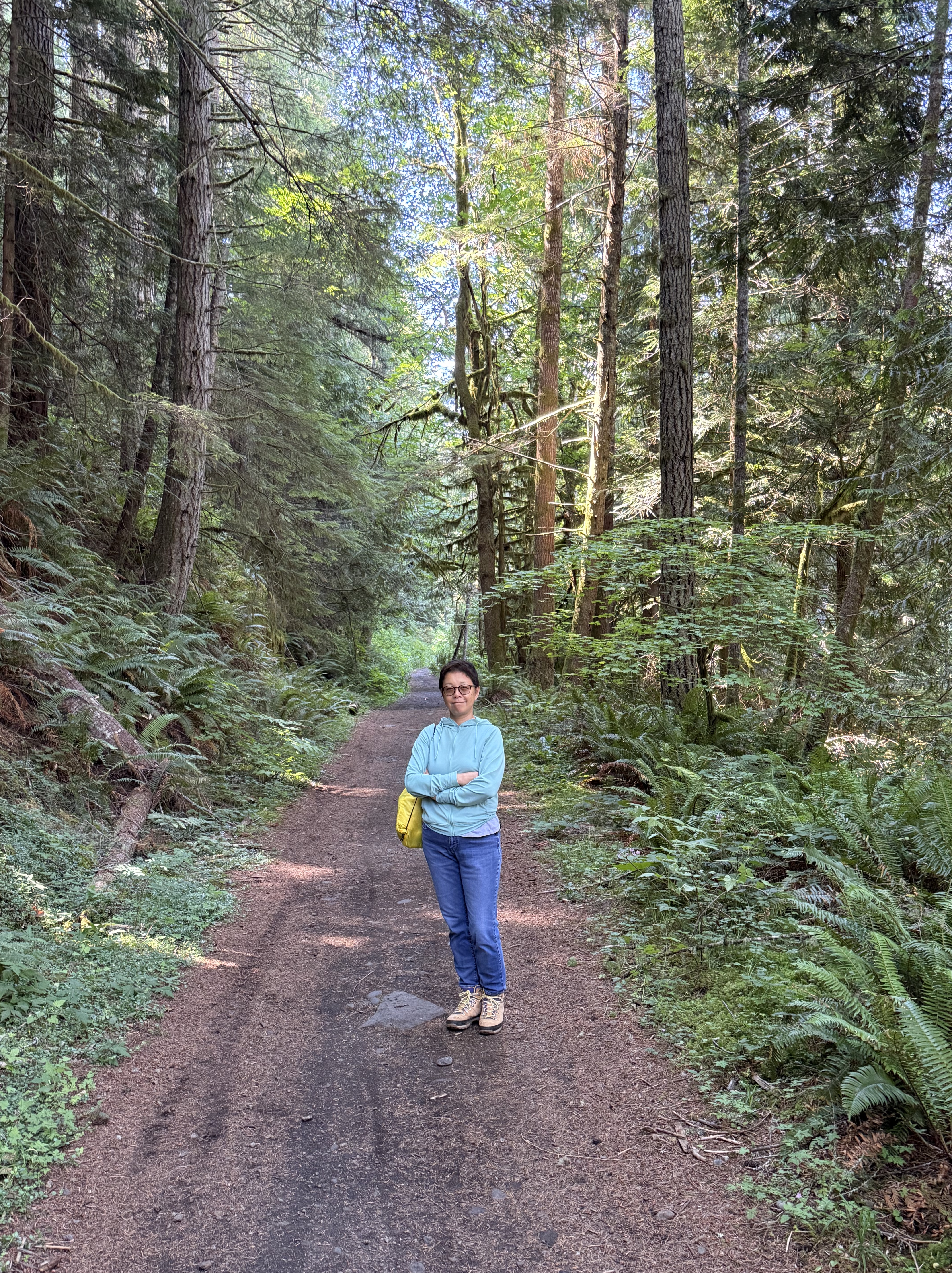
The trail is wide and easy to access on foot. I don’t know about a wheel chair although it is flat all the way.
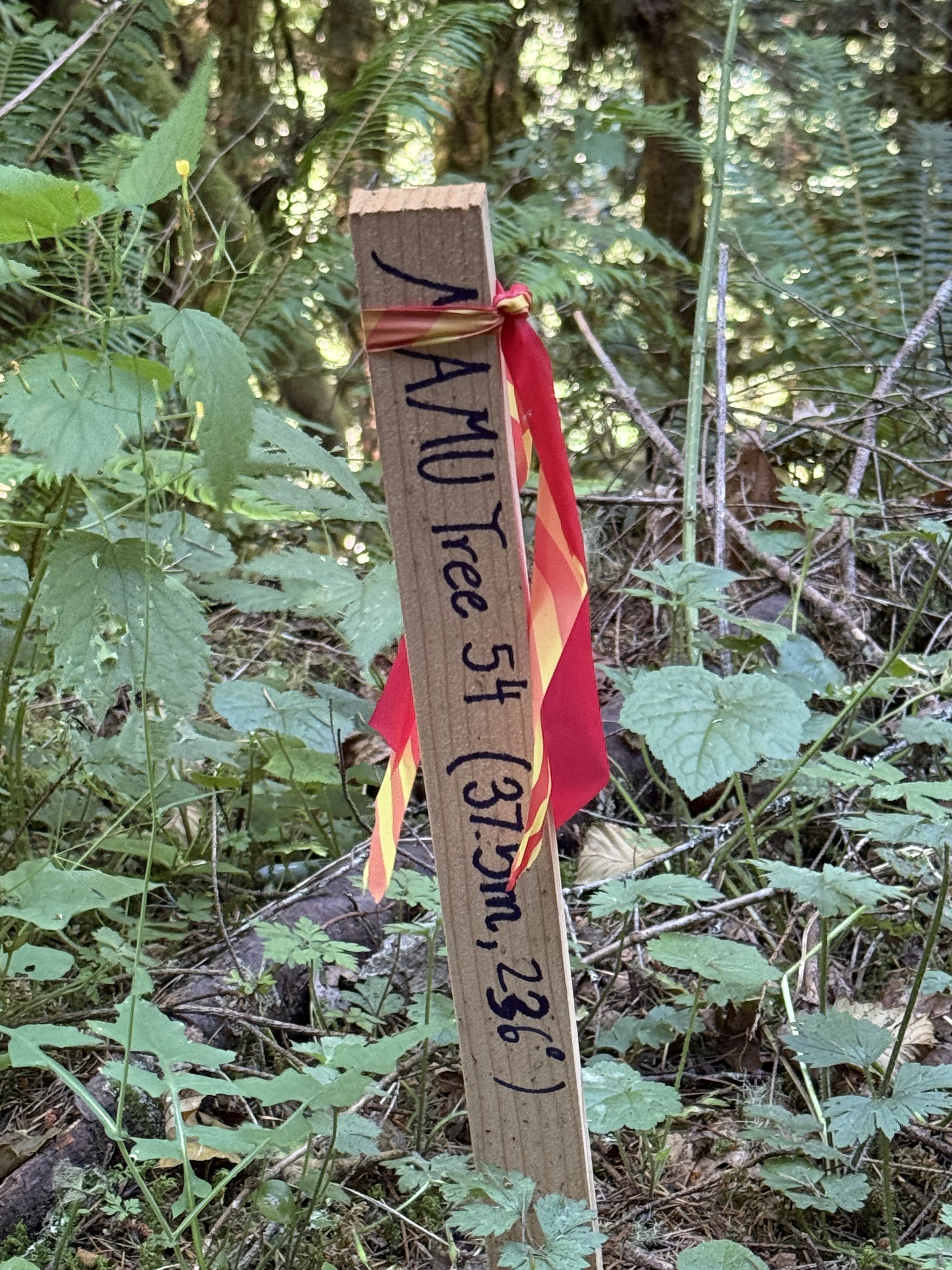
We saw several of these marker stakes along the trail. I looked it up and, to the best of my knowledge, this is indicating a tree where a pair of Marbled Murrelets are nesting. They are an endangered species and extremely difficult to locate, but there is an ongoing survey program. That sounds reasonable to me; the sign gives both a distance and compass heading to the tree.
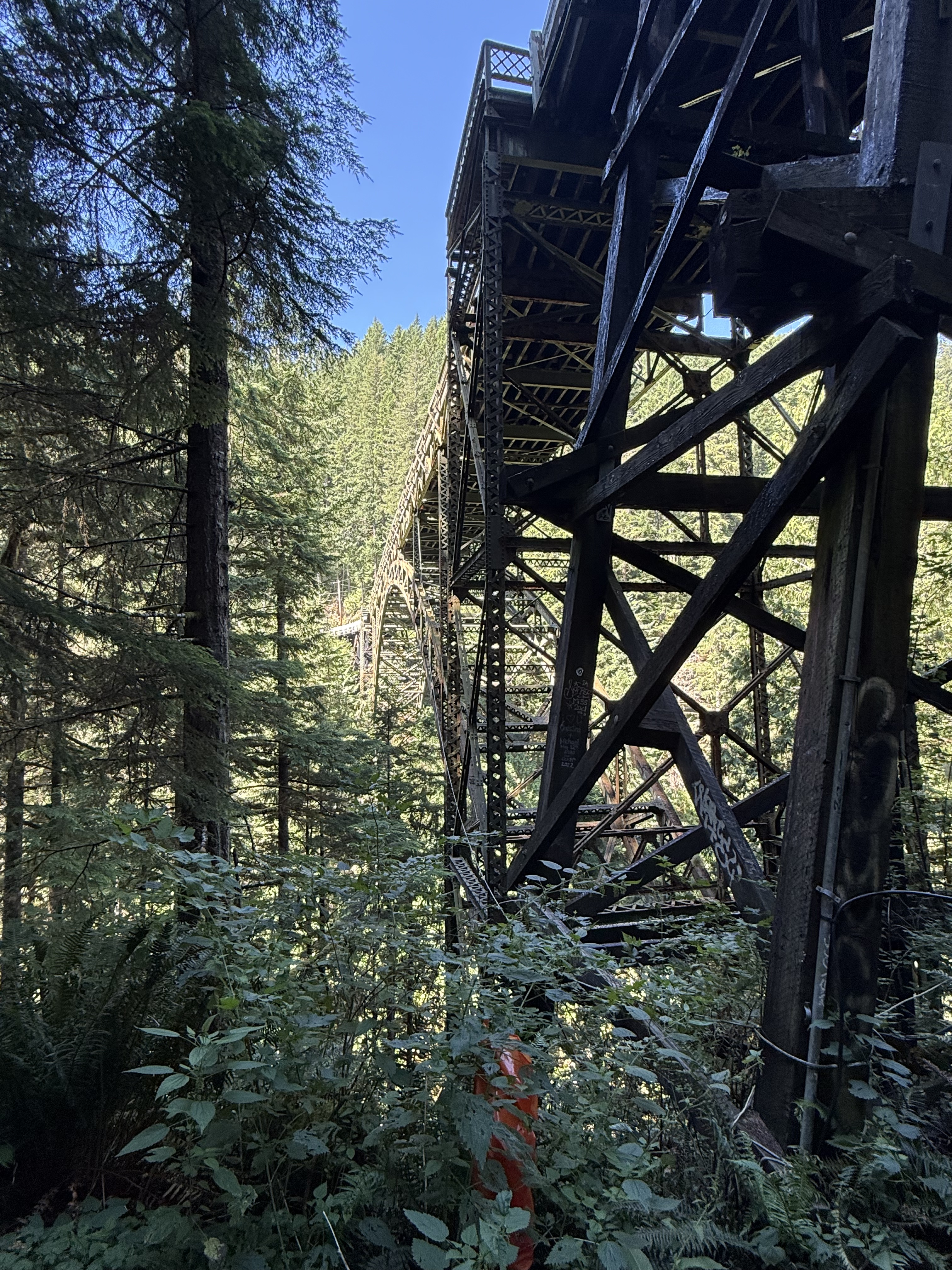
The trail intersected the Franklin Bridge, which is indefinitely closed to traffic.
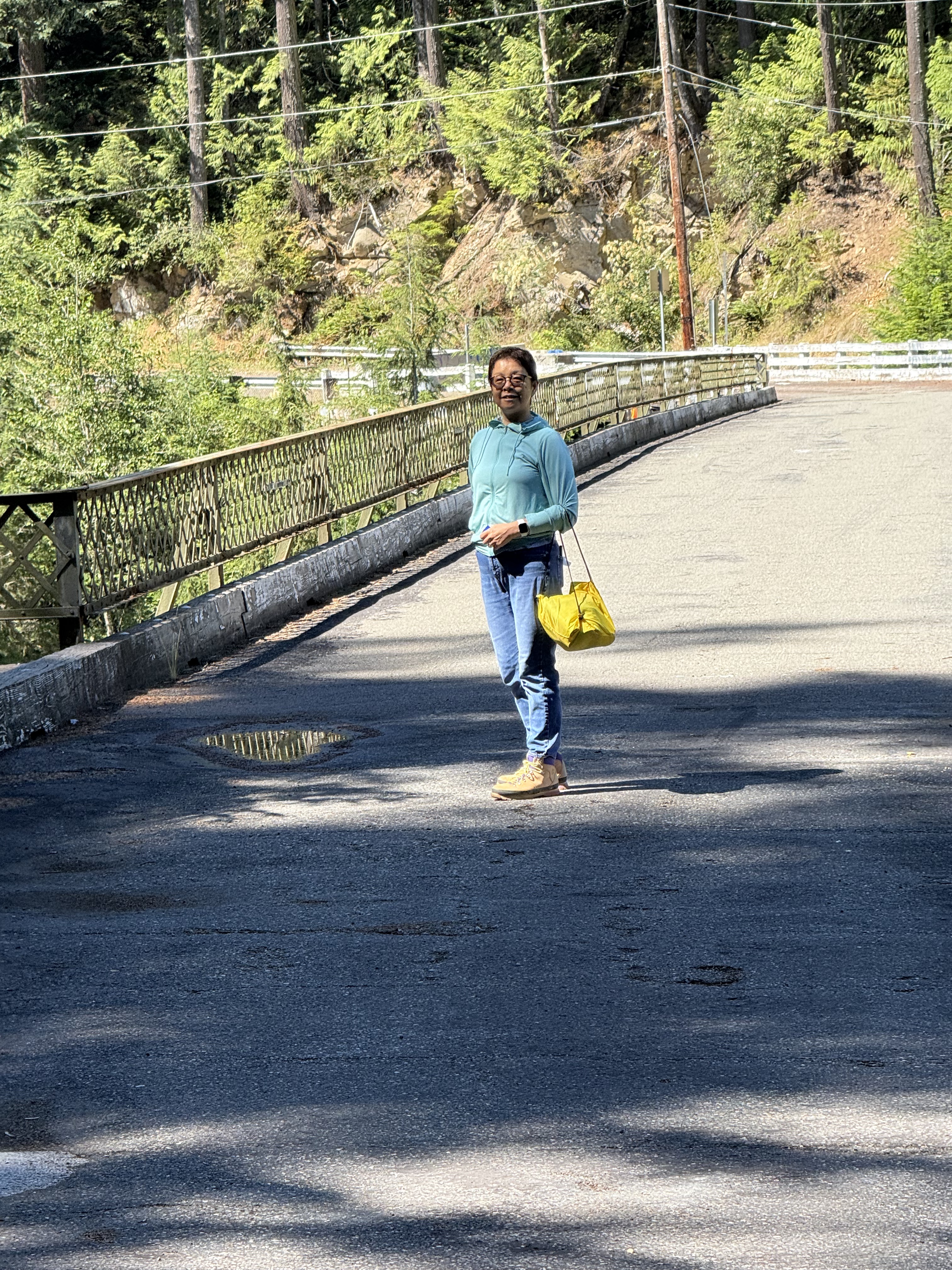
We climbed a steep slope, with the help of sturdy handles attached to wire rope, and took some photos on the bridge.

After we finished on the bridge, we passed the concrete blocks obstructing the road. Several signs made it clear that the bridge is closed to cars, bicycles, and pedestrians. Apparently someone disagreed with the DOT restrictions, and modified the sign. Don’t ask me why the figure is carrying a gas can that says, “Oh ya fuck ya.” I guess they’re thumbing their nose at anyone who would dare condemn what looks like a perfectly useful bridge — at least for people and wild animals.
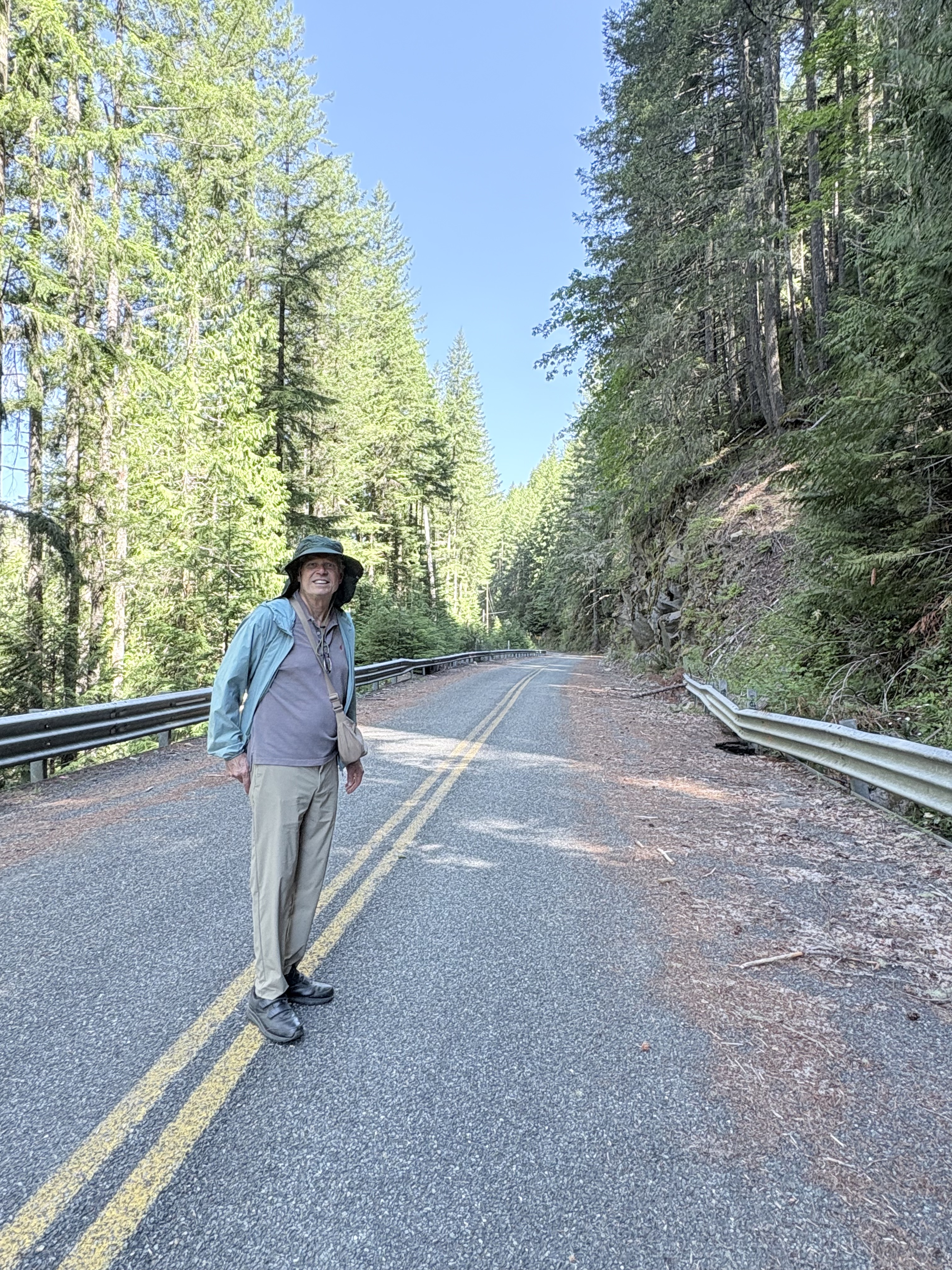
We walked the three miles back to our car along the abandoned road. There were several rock falls and damage to the guardrails. In this image, a large boulder smashed through the eroded roadbed. It was like a post-apocalypse movie. Pretty cool … and quiet.
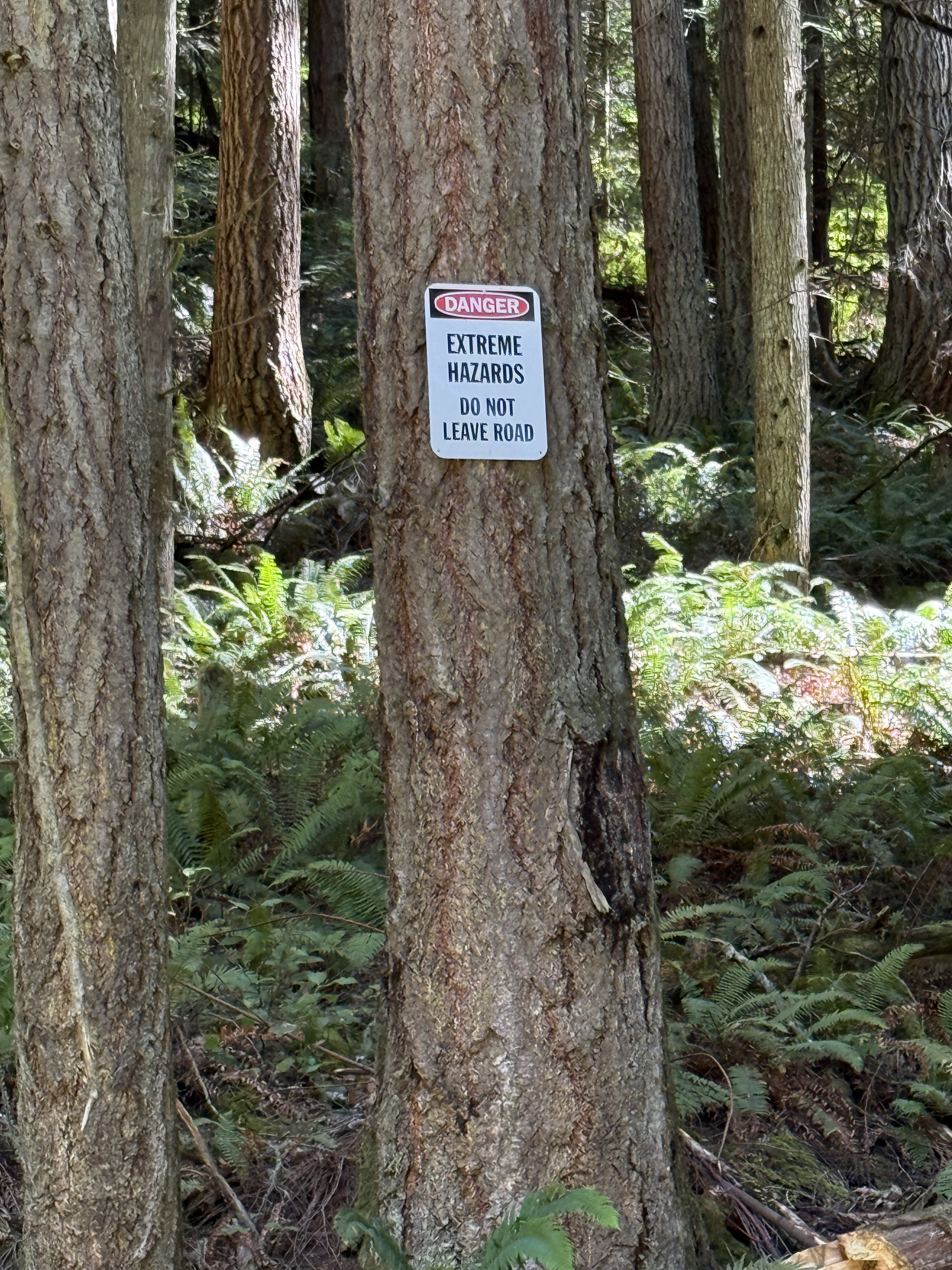
These relatively new signs were posted randomly on trees on the hill of the road. Hazards. Not hazard. Maybe Western Rattlesnakes, poison ivy or … dare I say it? Bigfoot. Stay out of the woods. But we just walked three miles through the woods. Damn!
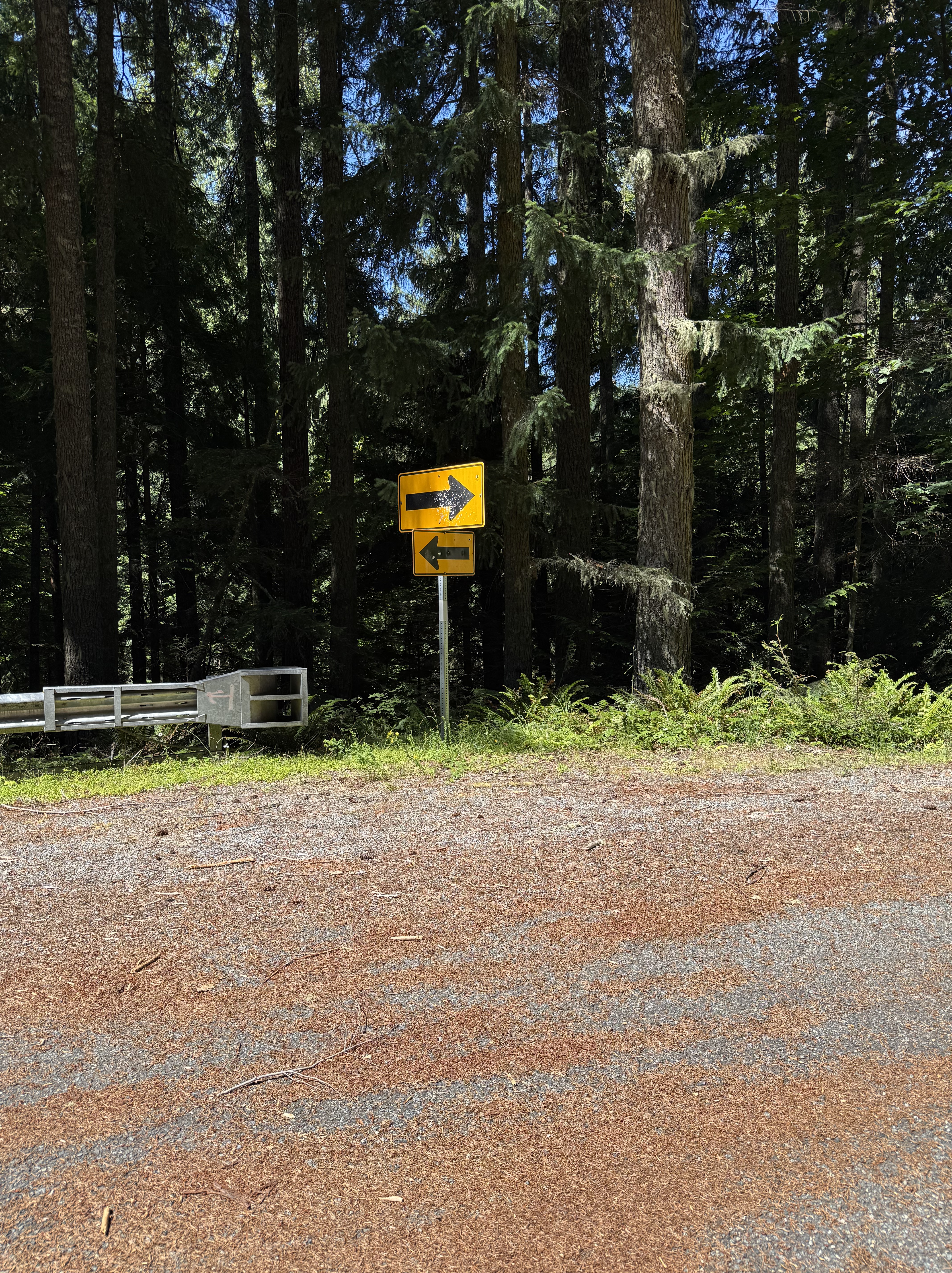
These opposite-pointing signs were on a curve. Nevertheless, I have to wonder why the guardrail stops in the middle of the curve, but reflective signs were felt necessary. Short sightedness? Budget constraints? Stupidity?
The Flora of Carbon River, Pierce County, Washington
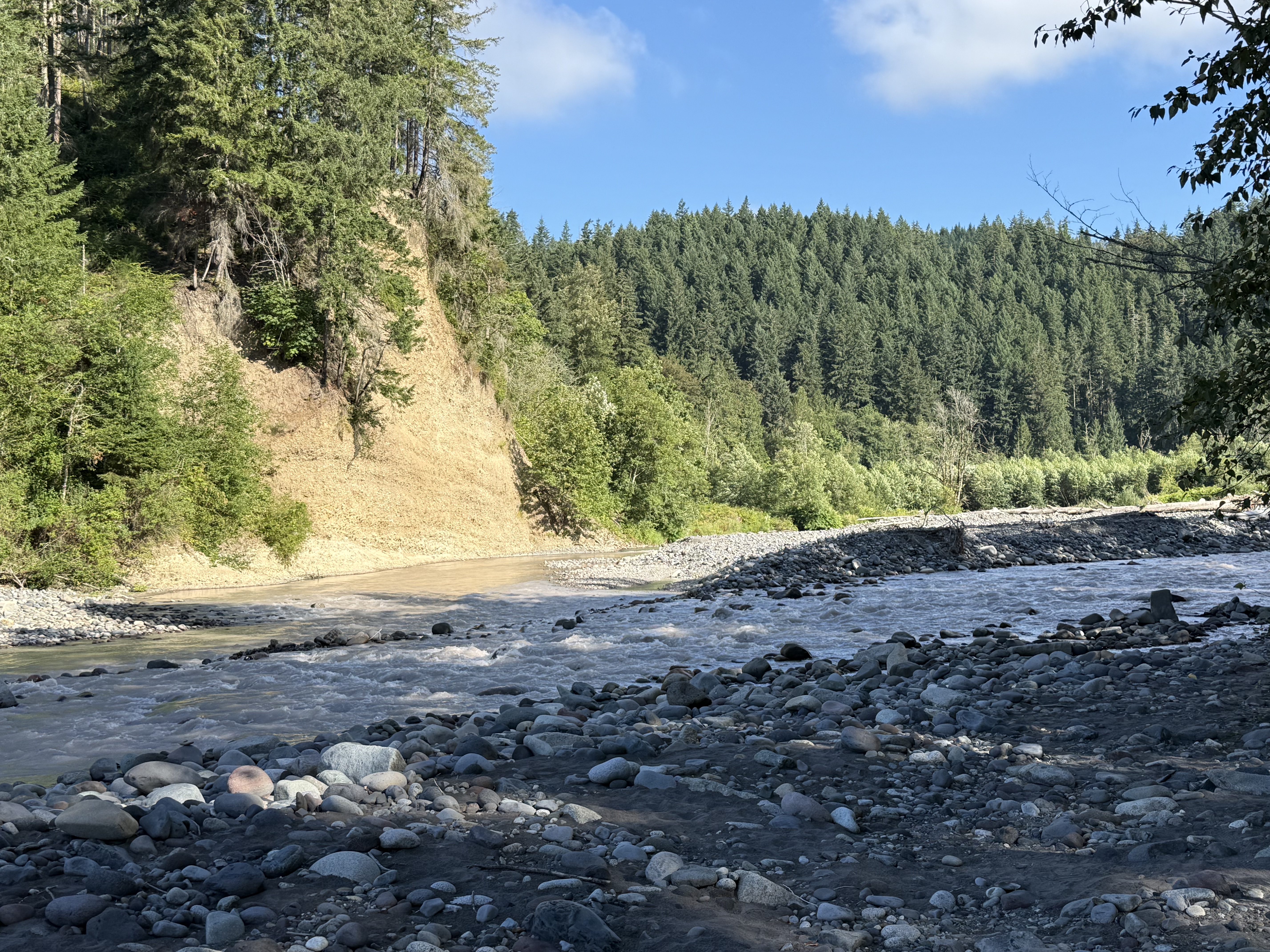
Plate 1. Our first stop was at Carbonado, where the Carbon River exits the canyon that has constrained it from its origin on Mt. Rainier. It immediately forms multiple channels as it cuts through glacial till on its circuitous path to Commencement Bay.
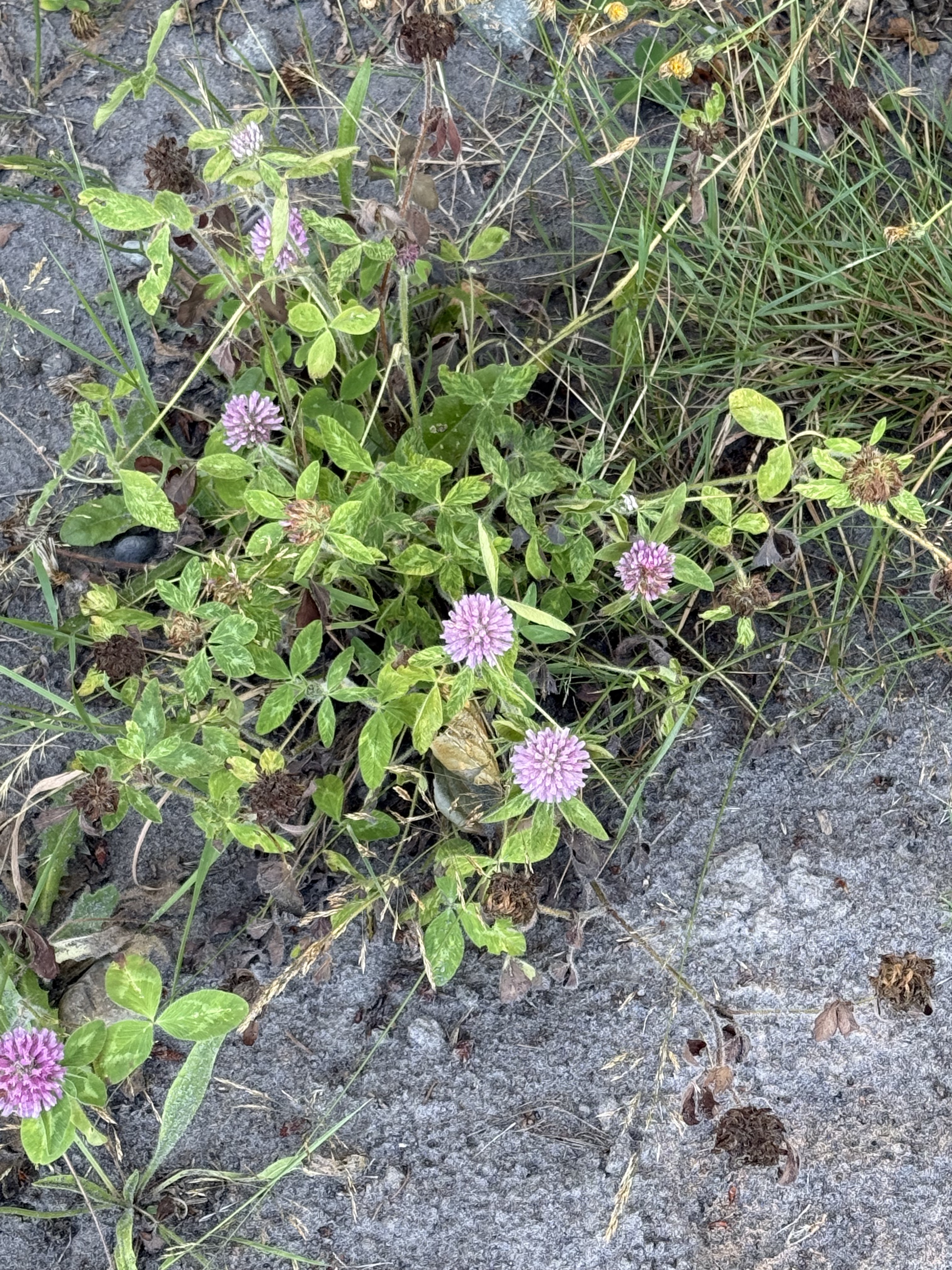
Plate 2. This lovely flower is red clover (Trifolium pratense), a common wildflower along rivers.
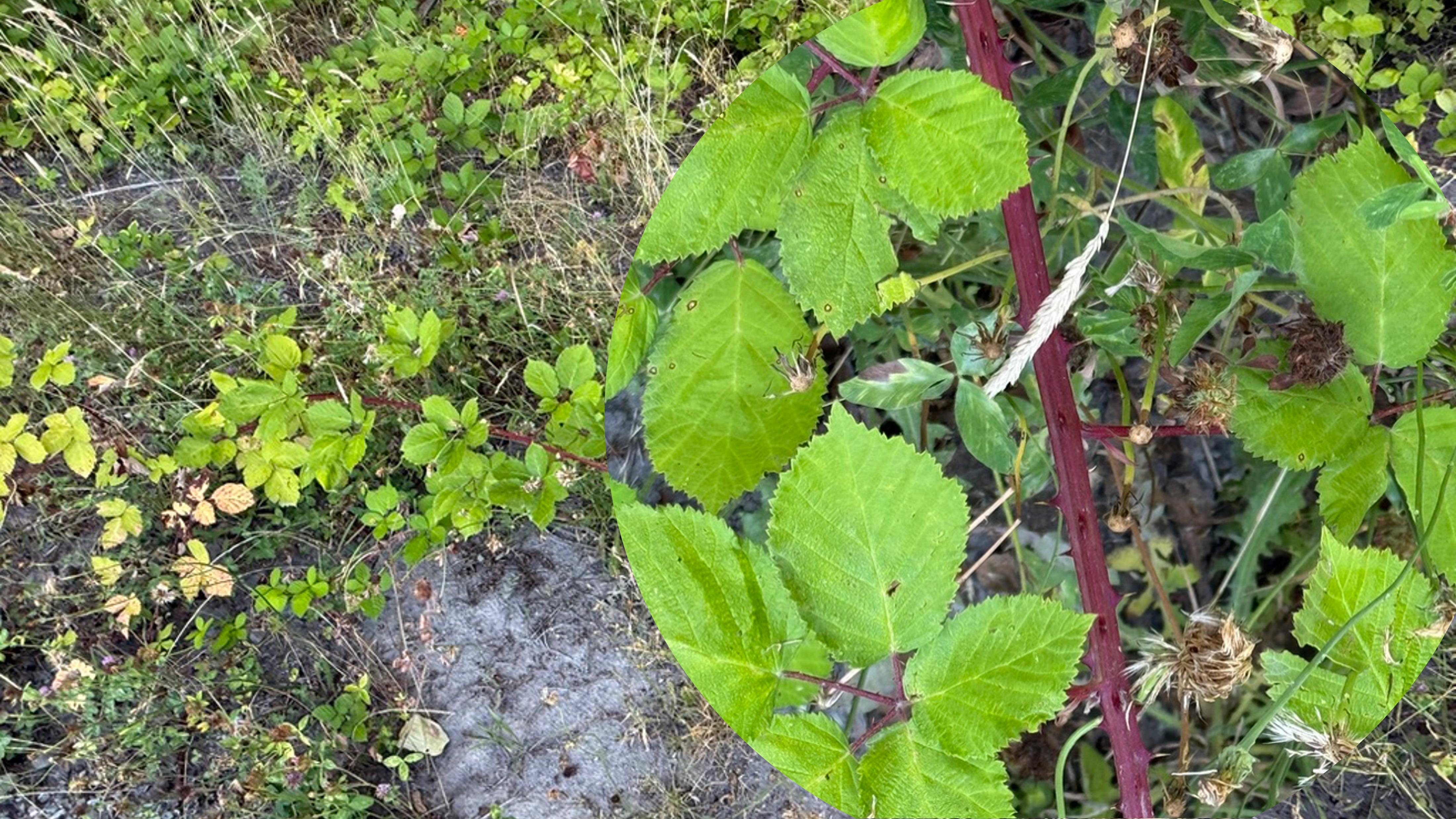
Plate 3. CoPilot and I argued too long about this one, but, after some back and forth, I decided it might be a genus of Spiraea. They are another common shrub in this ecosystem, but they aren’t in flower in July. Note the shriveled flowers in the right image. Too late to be sure. That’s why I’ve always ignored these bushes.
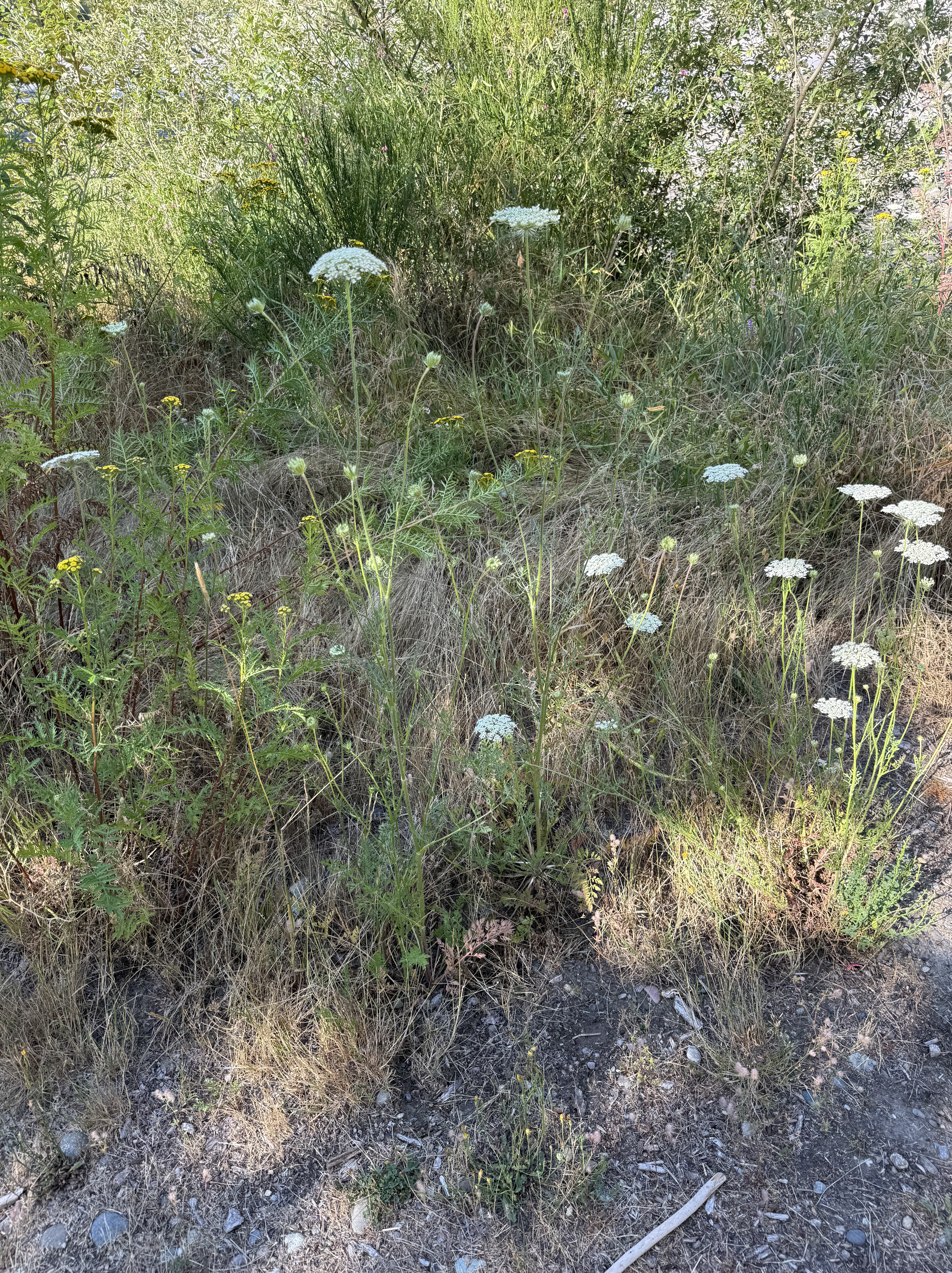
Plate 4. Cow parsnip (Heracleum maximus) is a common wildflower in meadows and roadsides in Washington.
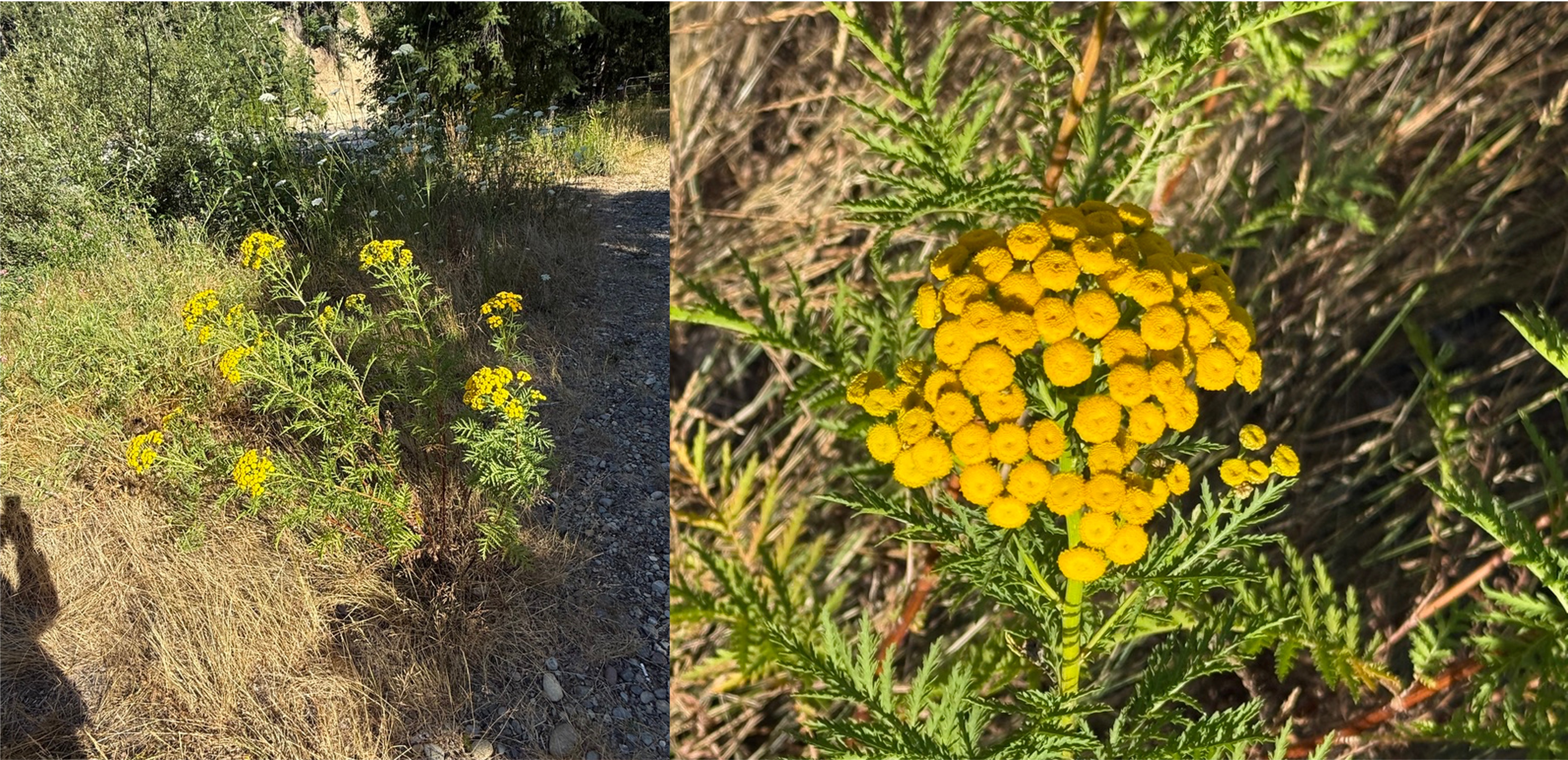
Plate 5. Tansy (Tanacetum vulgare) is a common wildflower along the Carbon River corridor.
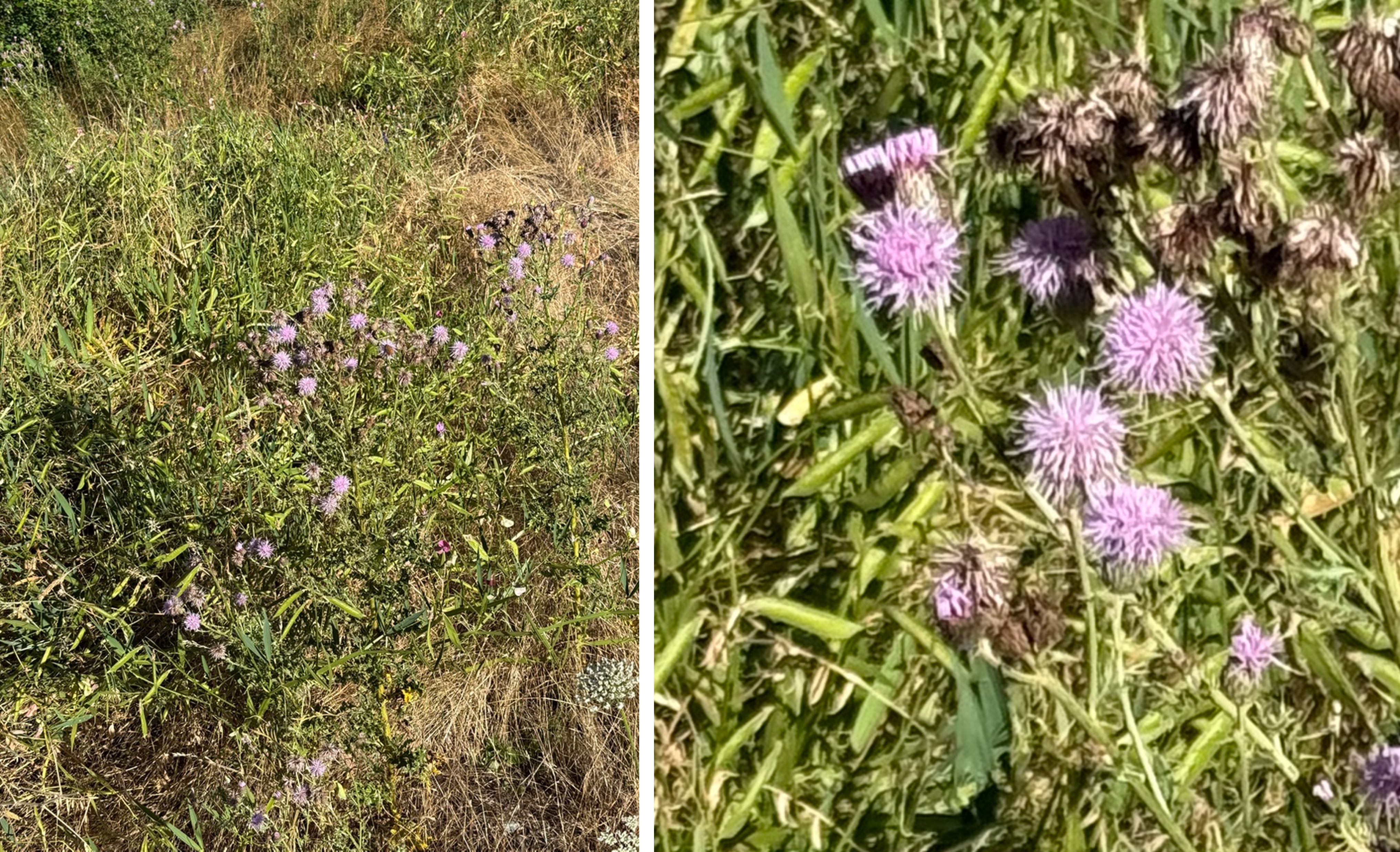
Plate 6. I thought, when putting this post together, that this was red clover (Plate 2), but CoPilot identified it as Canada thistle (Cirsium arvense). It loves disturbed areas like river edges. I did detect some spines when I zoomed in on the second photo. Why am I not surprised? If it’s pretty it will have spikes ready to draw blood from any inquisitive passers by.
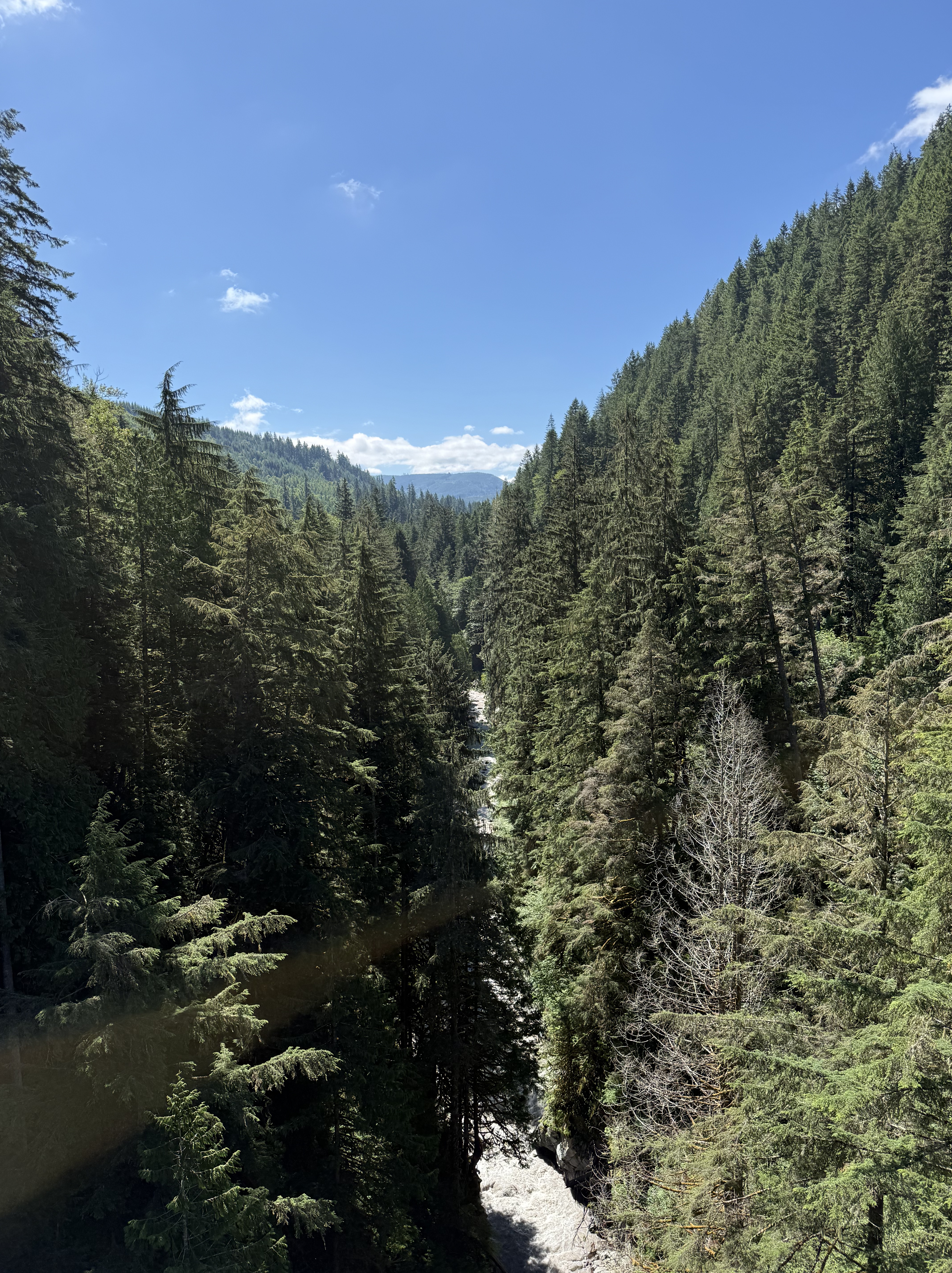
Plate 7. This view is looking downriver from Franklin bridge, which is permanently closed. I’ll now describe some of the flora we encountered as we followed the river along a steep slope.
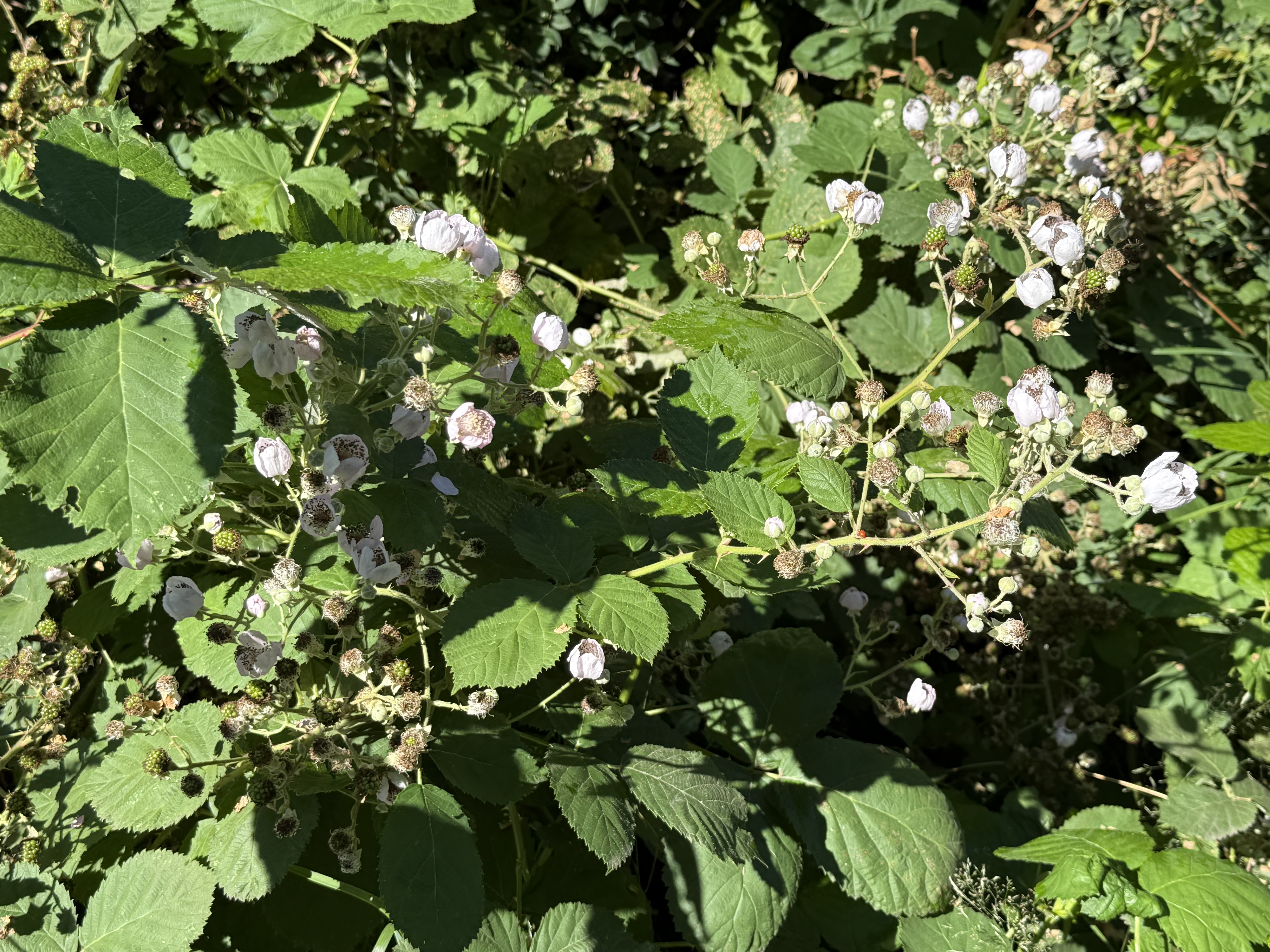
Plate 8. I (kinda) got this one right. This is a wild rose, Nootka rose (Rosa nutkana). This is another plant that waits for an opening in the forest canopy to grow, and then it colonizes like crazy — until the forest canopy catches up with it. Moist but well-drained soil pretty much sums up Carbon River canyon.
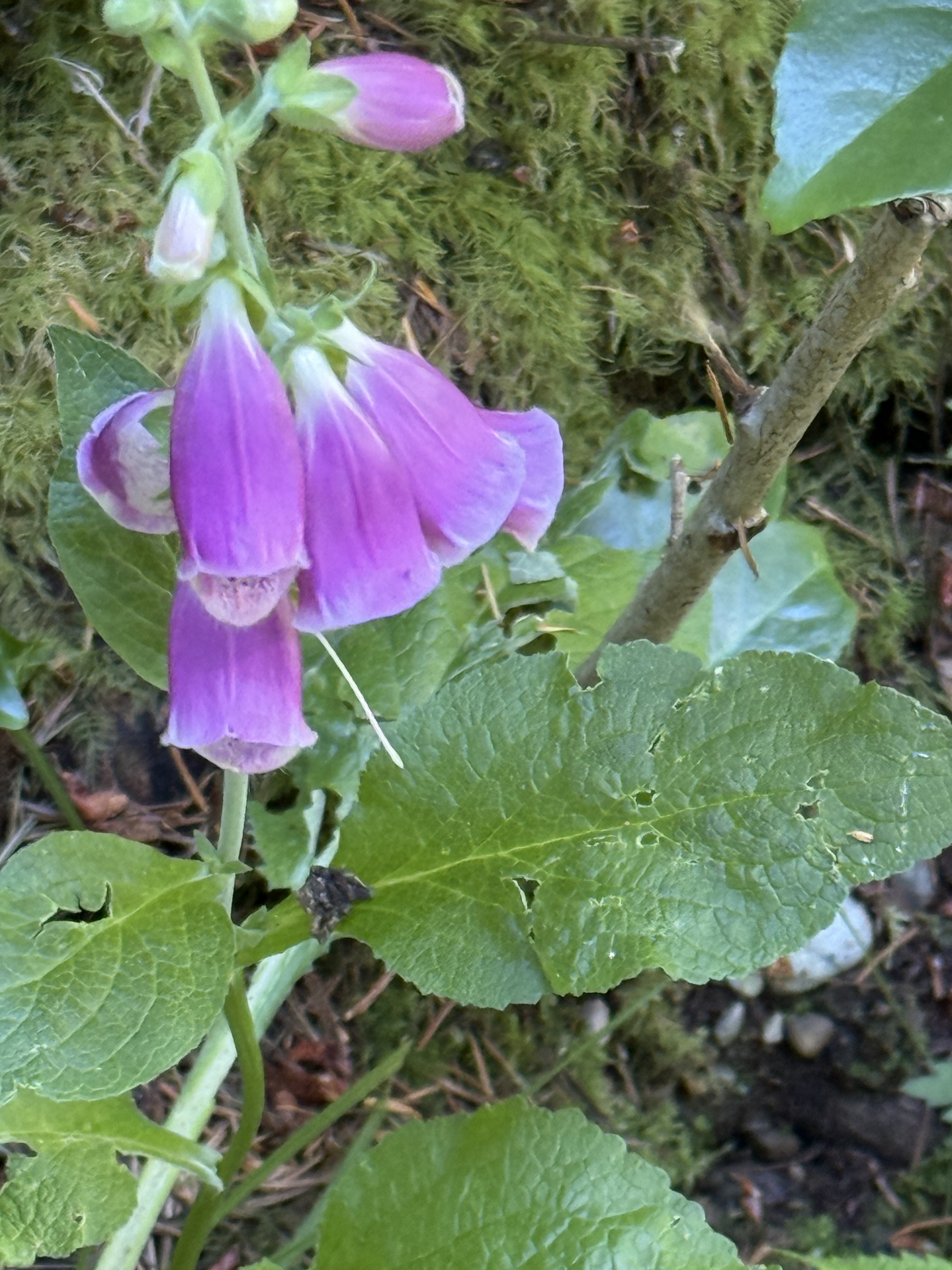
Plate 9. This familiar flower is foxglove (Digitalis purpurea), introduced from Europe; but it is so naturalized that it behaves like a native plant, similar to Cascade penstemon (see Plate 11), thriving in disturbed ground at the edge of conifer forests and in temporarily sunny areas.
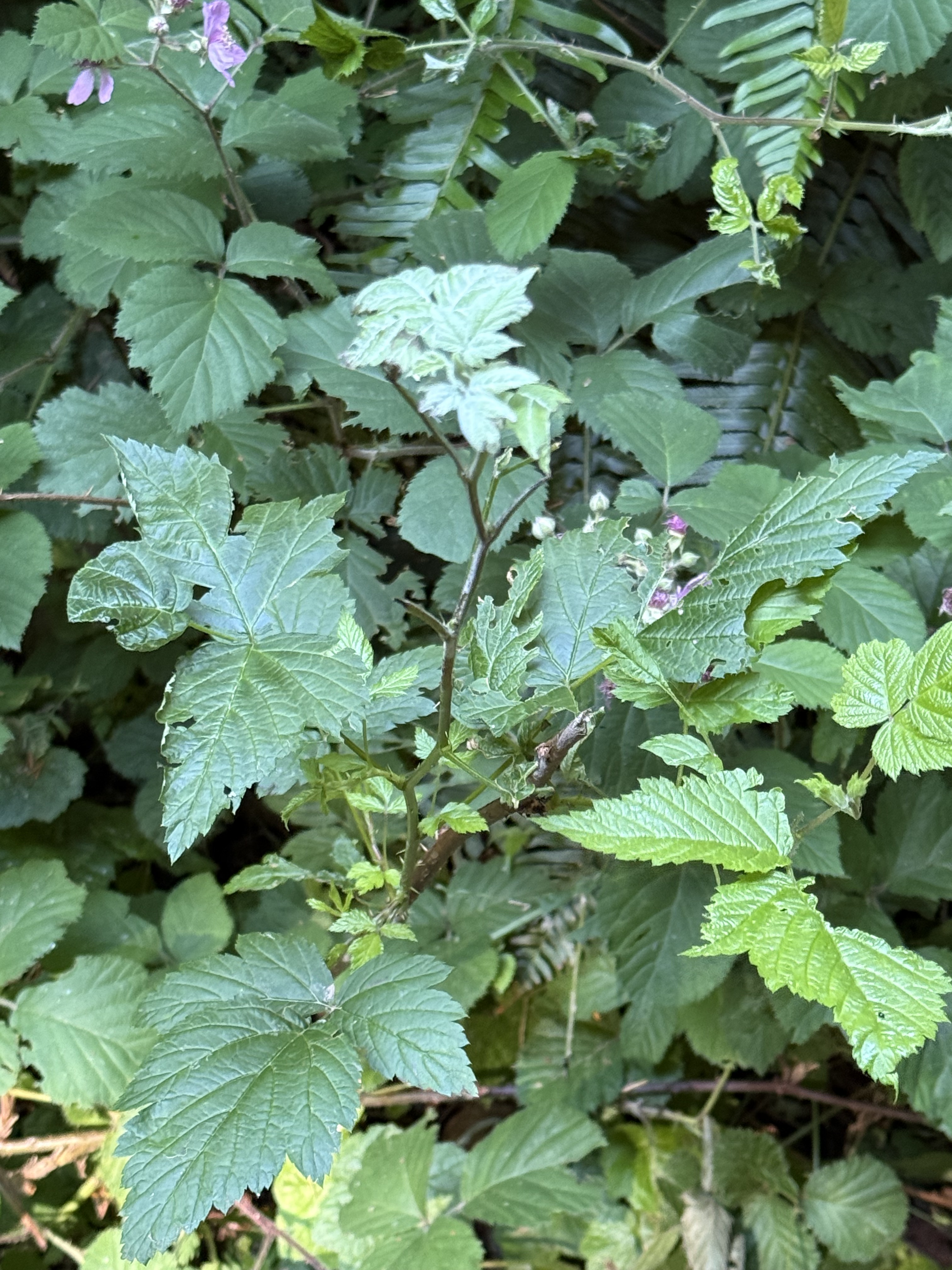
Plate 10. Besides white flowers, I am also fixated on thorns; however, I don’t know anything about thorns except that roses have them, as well as many of the shrubs I’ve encountered on my nature walks. This is probably Himalayan blackberry (Rubus armeniacus), an invasive species to Pierce County. I guess that’s why it isn’t called Washington blackberry, or some such. I checked a previous post from Point Defiance, and there it was! Invasion of the forest snatchers.
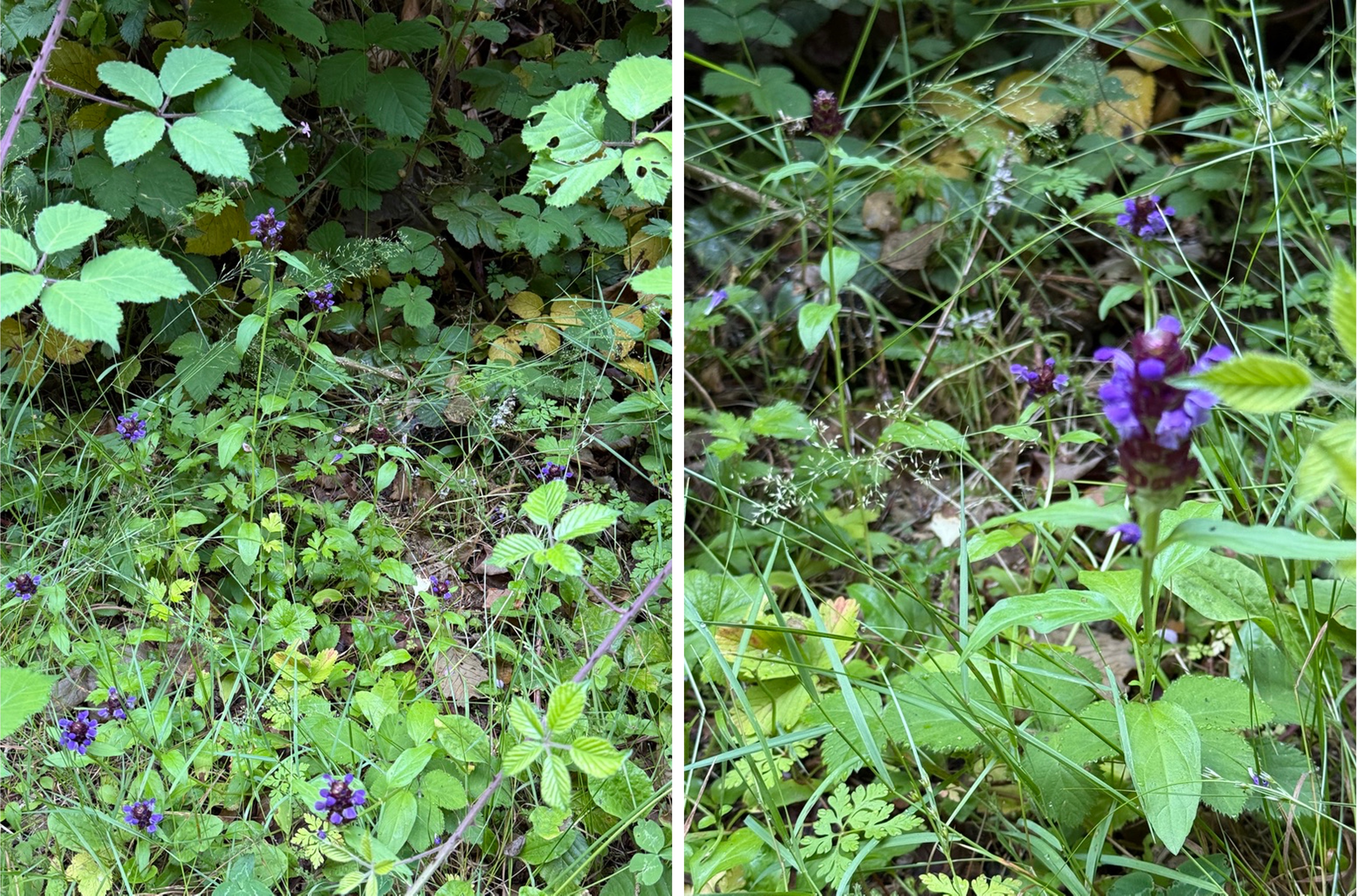
Plate 11. This purple wildflower is probably Cascade penstemon (Penstemon serrulatus), a native to the PNW. It is what CoPilot calls an ecotone plant — one that thrives where a conifer forest is encroaching on a prairie environment. We encountered it where the conifers hadn’t yet blocked out the sun along the trail.
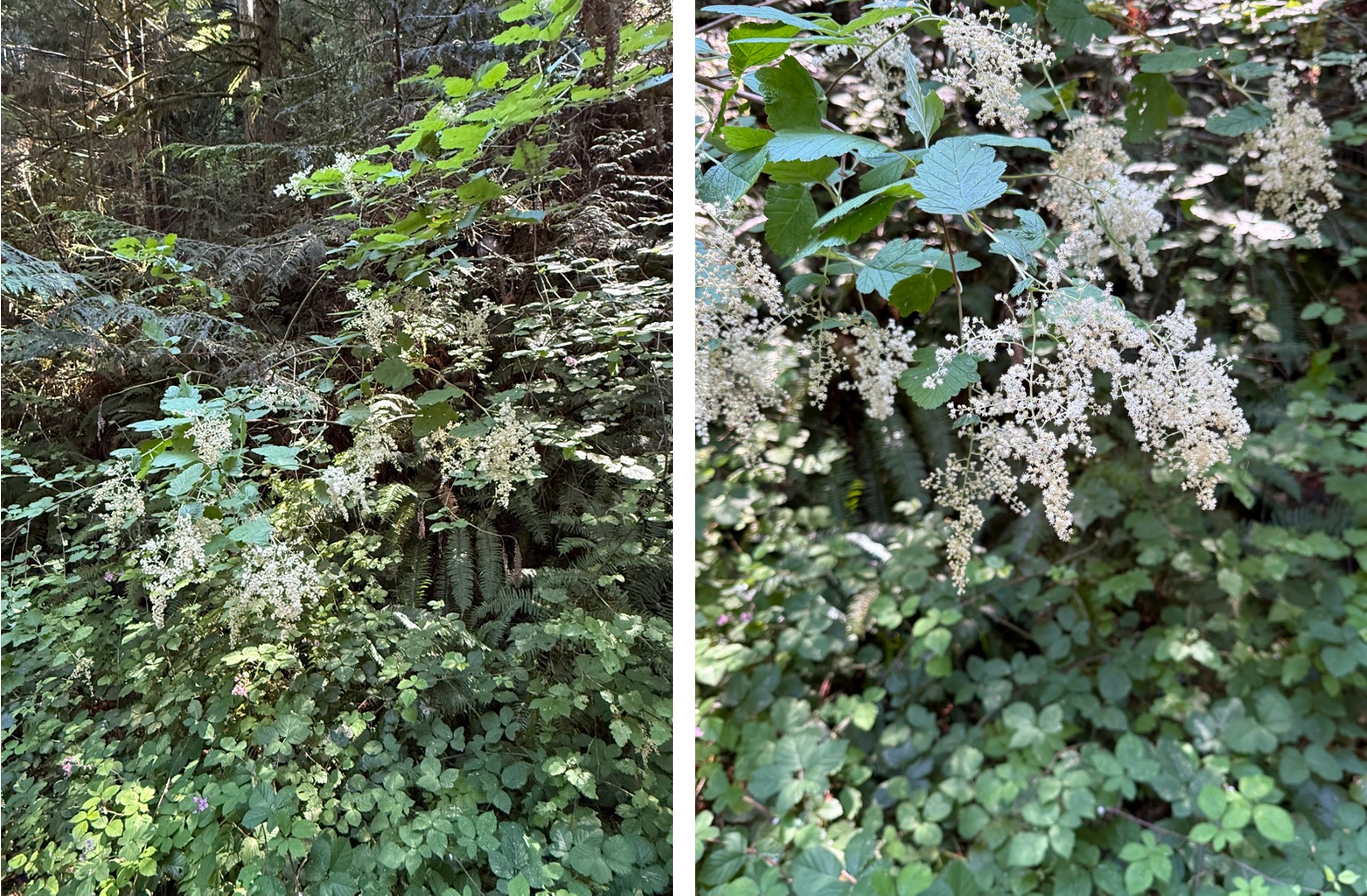
Plate 12. I’m easily fooled by white flowers. This non-woody shrub is False Solomon’s seal (Maianthemum racemosum). It grows in the understory of a conifer forest, which is a good description of Carbon River canyon.
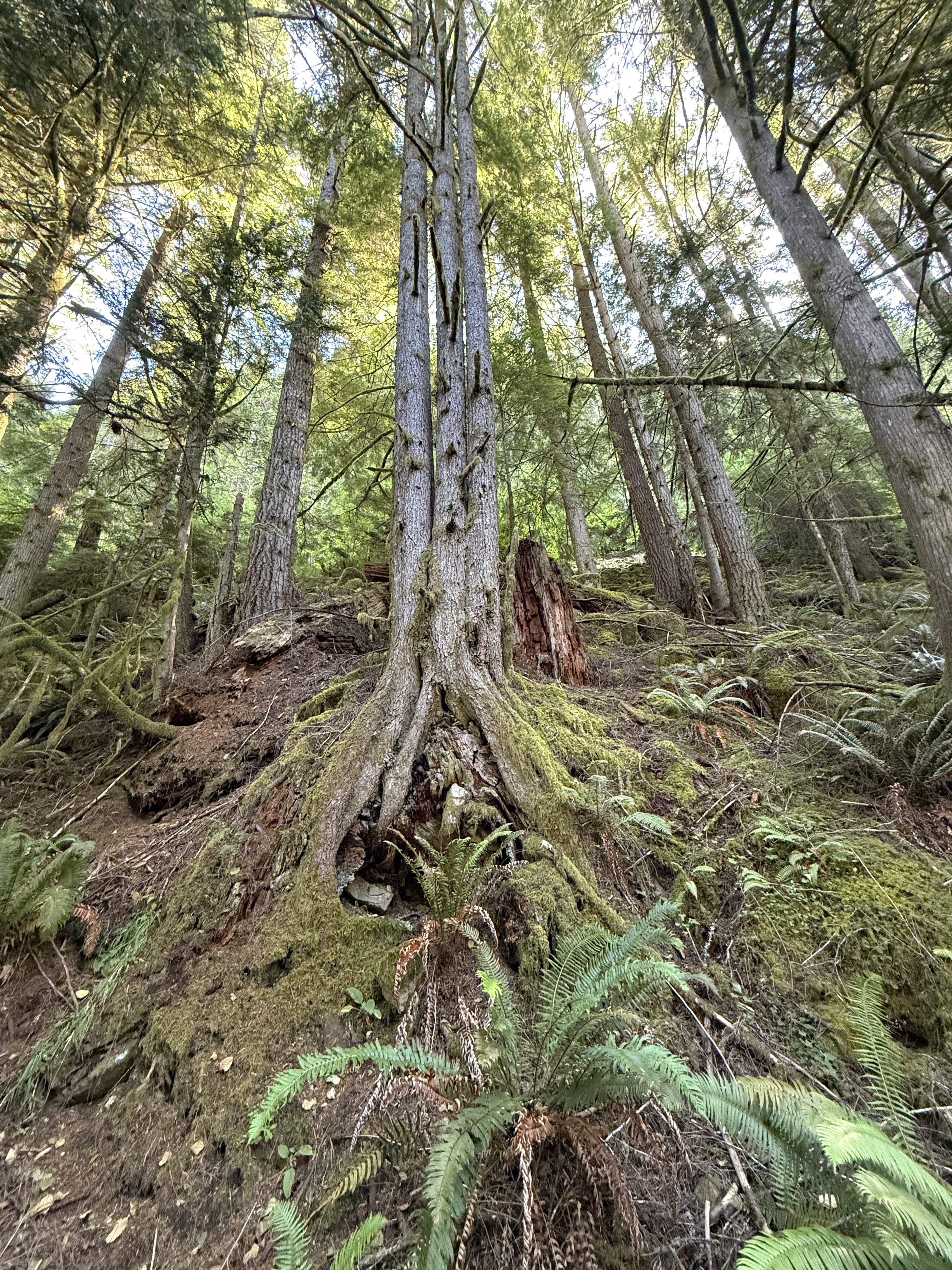
Plate 13. This is the first triplet I’ve seen from a nurse log. These young hemlocks will certainly compete for sun and nutrients. There can be only one survivor.
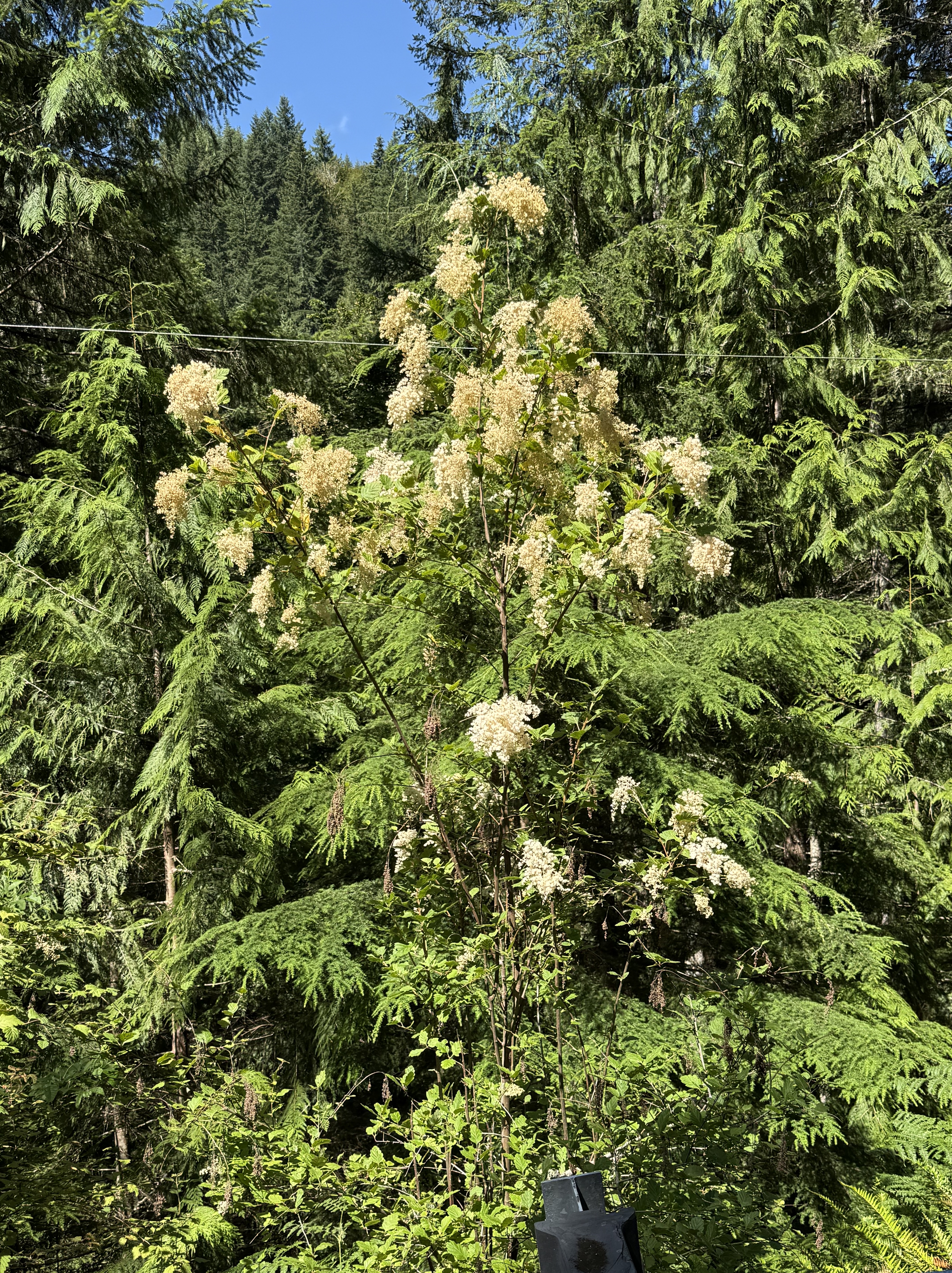
Plate 14. I thought this was cow parsnip, but CoPilot identified it as ocean spray (Holodiscus discolor). The white flowers were all I needed to see, but this tall, woody shrub (6-12 feet) is completely different from the weed in Plate 4.
Final Thoughts
The only thing I can add to the photos is that Carbon River is part of a transitional ecosystem, not unlike Mima Mounds. I Imagine this borderland environment is also alternating between a lowland/prairie and an upland/conifer forest, depending on conditions. However, much to my disappointment, the plants here were different from those we saw before. Furthermore, there were far more species along the Carbon River corridor. We were fortunate to visit when many of the flowers were in bloom.
I enjoy taking pictures of flora and learning about the ecosystem, but this is too complex for me. I’m only a simple geologist.
The Flora of Point Defiance Park
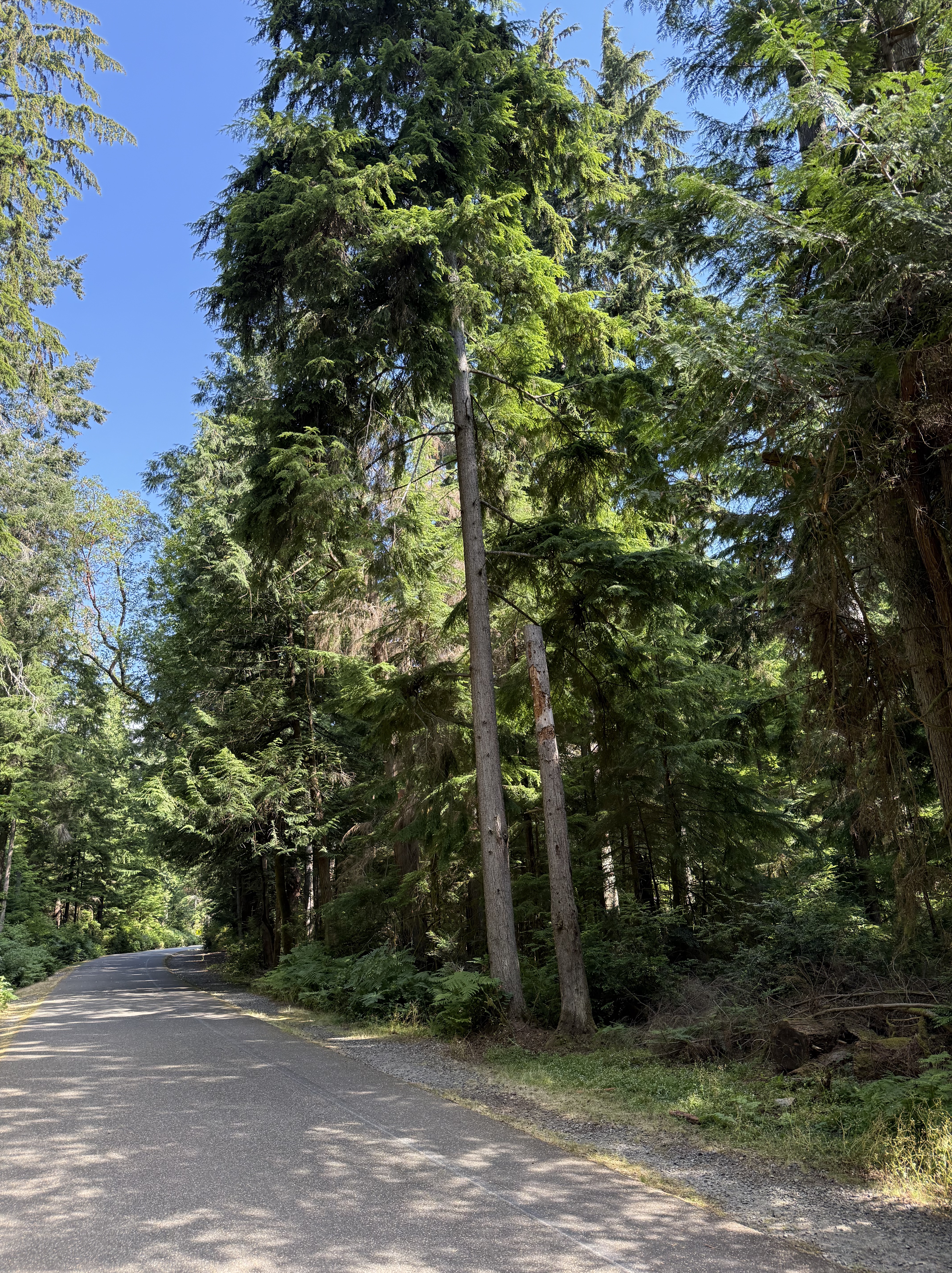
This beautiful, mature second‑growth coastal temperate rainforest is only ten minutes from my house. I should get there more often, and perhaps I will after taking an interest in ecosystems in addition to geology. Today’s outing was an opportunity to begin acquainting myself with the ecosystem I inhabit, so I made an effort to identify several plants along Five Mile Drive, a road that circumnavigates the forest and is permanently closed to auto traffic. When I started walking along this path, this forest was nothing but a lot of green trees and stuff. My perspective changed over an hour or so, and about 2.5 miles.
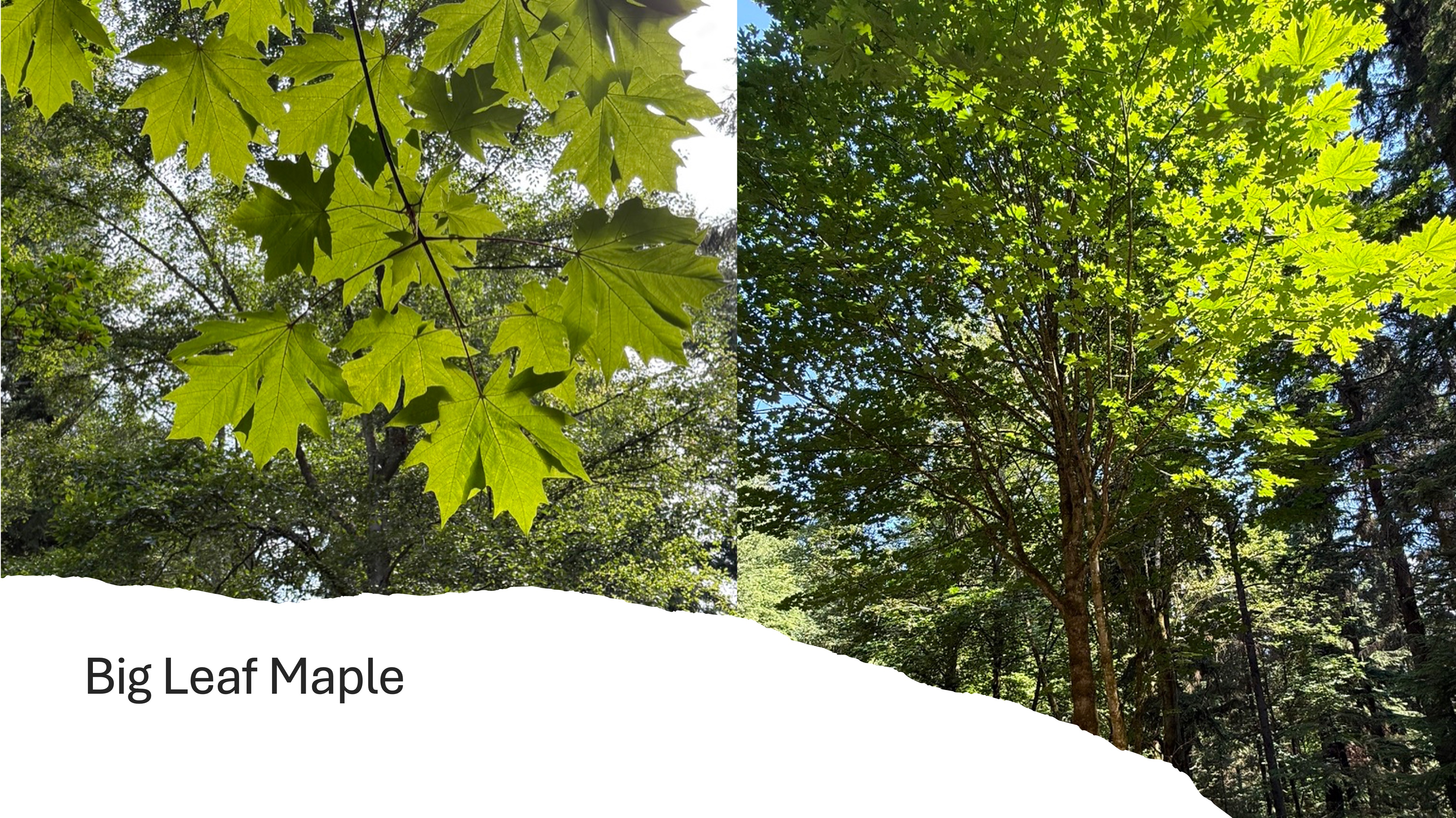
This colorful maple tree is a native to Puget Sound. It earns its name because those deeply lobed leaves are up to a foot across. But what are its roles in this forest? CoPilot had a lot to say about that. The Big Leaf Maple is fundamental to this ecosystem because it creates a huge amount of leaf litter that contributes to the forest floor and thus supports a vast microbiome, as well as a nurturing environment for conifer seedlings. This large tree (50-150 feet) fills in gaps in the forest canopy, supplying shade and catching rainwater, as well as dew. Its dappled shade creates a diverse understory for new growth. It is important in the success of birds, insects, bats, squirrels, and deer. They all hang around it and depend on its large mass for homes and meals. Its large root system contributes to hydrologic stability by stabilizing slopes, slowing runoff (and erosion), retaining moisture, improving soil infiltration.
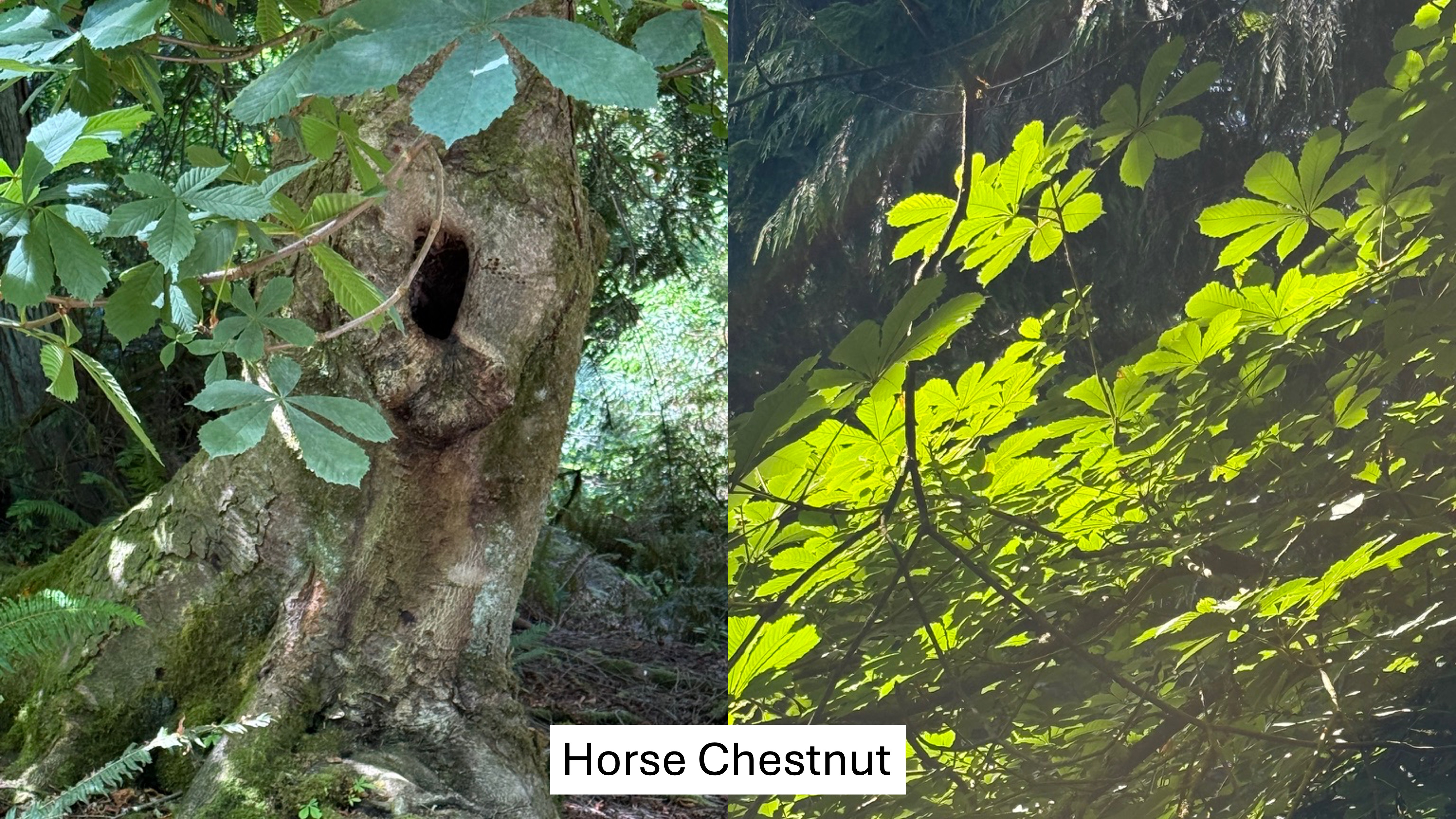
This large tree is native to SE Europe and they were introduced after the logging boom led to immigration. However, it is not an aggressive invader; this lovely tree does not form thickets, outcompete conifers, spread wildly, alter soil chemistry, suppress understory diversity, or create monocultures. In CoPilot’s words, “It’s a polite non-native.”
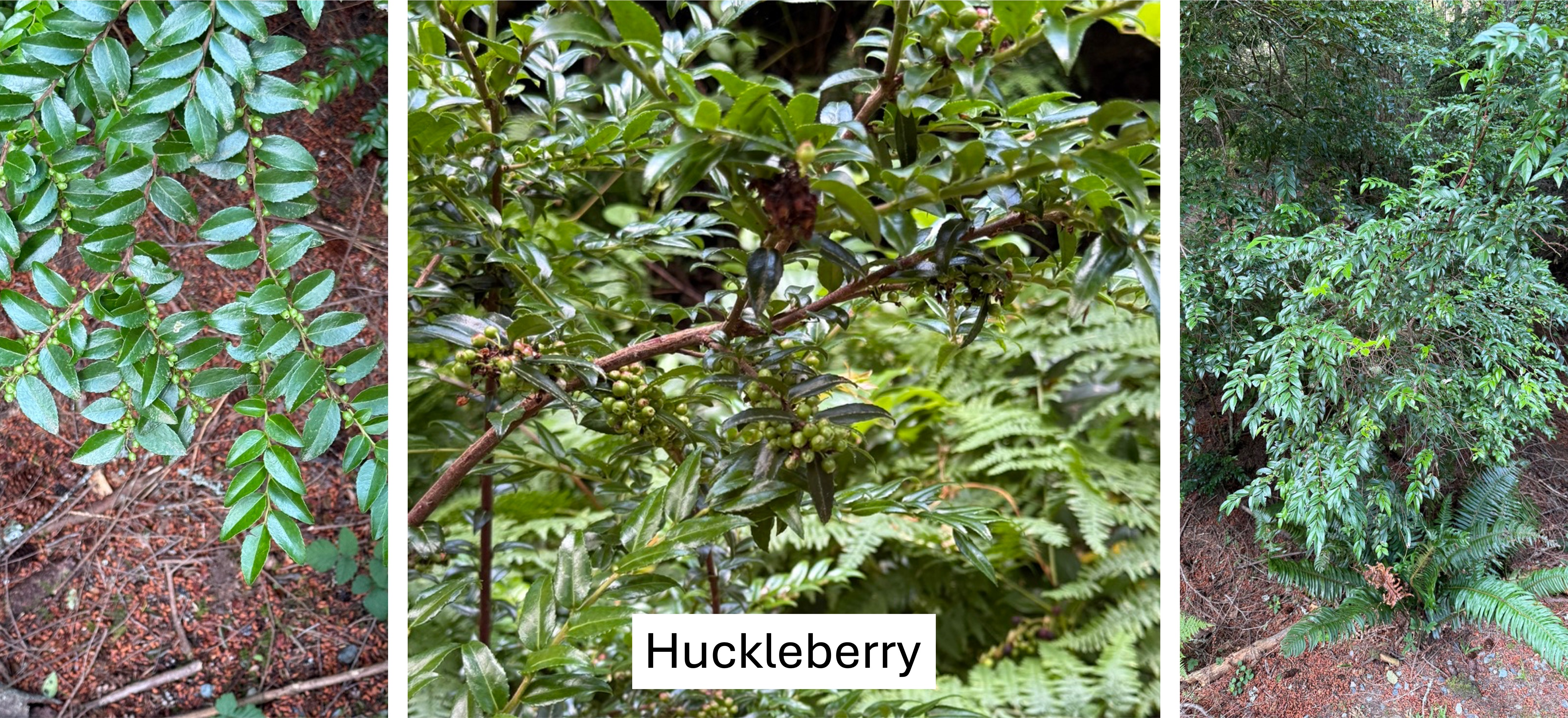
This nondescript shrub gives the forest its lush, evergreen understory identity. It is one of the top berry producers in the Puget Sound lowland forest but, more importantly, its berries ripen later in the season, extending the berry window into early fall. It also thrives in the acidic soils Douglas fir and hemlock create, in turn moderating soil conditions. It bridges the gap between ecological disturbance (i.e. logging) and late-successional forest. One could say that it serves as a node in the forest’s ecological web. This is an unrecognized keystone species in the understory.
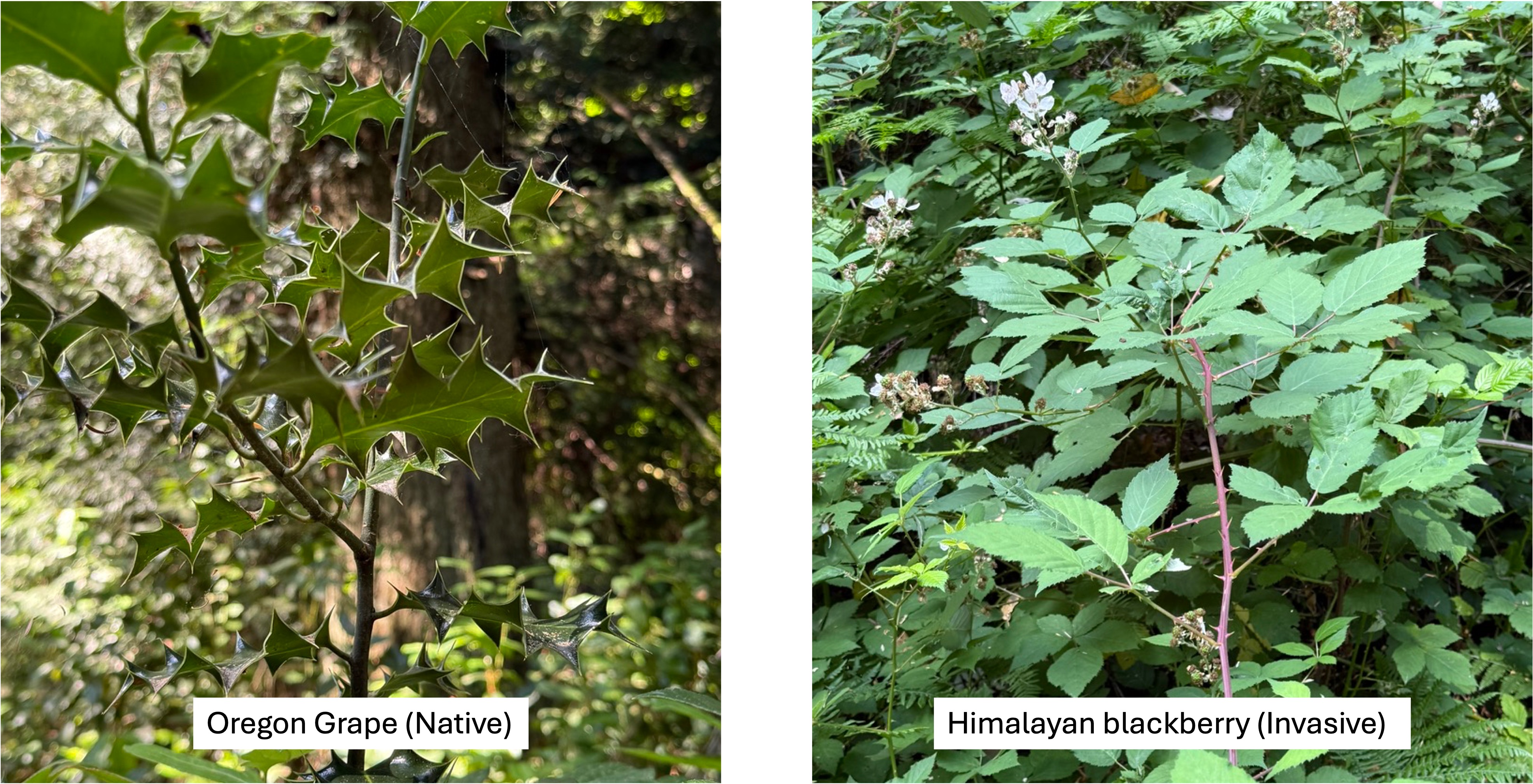
Oregon grape is the huckleberry’s silent partner in keeping the understory secure because it is also an evergreen shrub. In addition, it supplements the food web by blooming in March-April, providing nectar when few other shrubs are in bloom. Its berries ripen by mid-summer, bridging the gap between early berry producers like salad and late huckleberries. It precedes huckleberry in forest succession but persists as the canopy creates a shadier understory.
Himalayan blackberry is less like the fruit-bearing huckleberry and Oregon grape, and more like the Trojan Horse. The fruit are abundant and sweet, produced for a long season, and loved by all the denizens of the forest; thus, they are spread like wildfire, colonizing the entire forest–without predators in Pt. Defiance. The result of this invasion includes impenetrable thickets, root masses that choke other species, spreading by long, arching canes, and monocultures. It kills all the other stabilizing shrubs and creates a single mass of Himalayan blackberry. If left unchecked it can destroy an entire ecosystem, including the conifers. Holy shit!
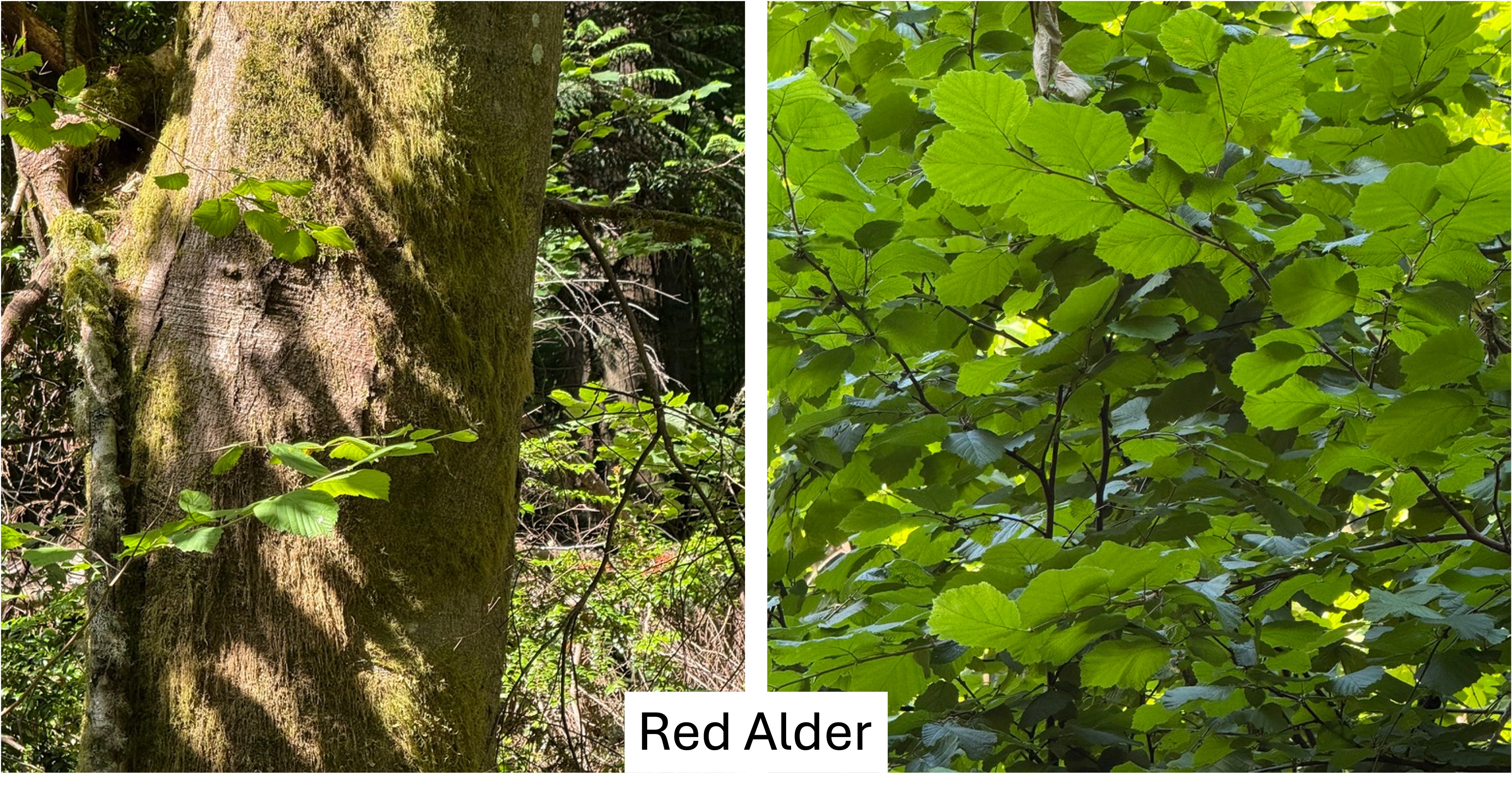
This nitrogen-fixing tree is the first responder when the forest is disturbed. As such it enriches soil, accelerates forest recovery, feeds the next generation of conifers, increases understory diversity, boosts fungal activity, and generally improves growth rates of proximal plants. Alder is the first tree to reoccupy damaged land, preparing the site for the conifers that will come later. Wherever alder stands exist, the biodiversity of the forest is increased. Because it gives so much to the forest, alders only live 40-60 years, thus acting as a continuous healing agent as a forest recovers from an environmental shock. This is the pioneer tree of the lowland forest. I hope it can defeat the Himalayan blackberry.
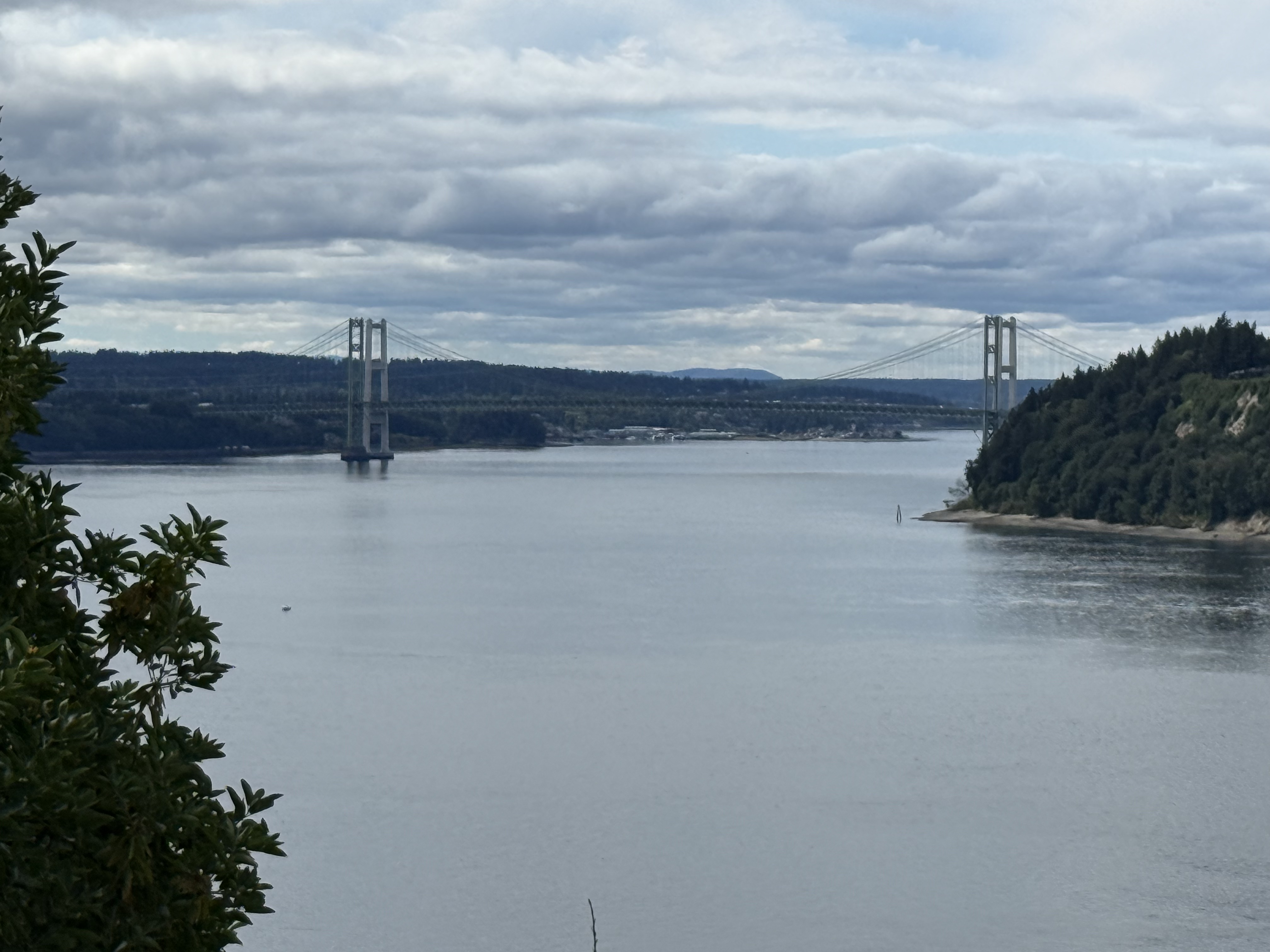
This view of the Tacoma Narrows bridge through the thick forest reveals a green landscape perched atop high bluffs overlooking Puget Sound. As far as the eye can see, from this vantage point, the forests were clear-cut to make profits and fuel the economic development of the Pacific Northwest.
But at what cost?
Mima Mounds Natural Area Preserve
It was unbelievably gorgeous weather here in the Pacific Northwest (PNW), with a high of 74 F, so we took a look at a couple of nearby natural areas.
Mima Mounds
This exceptional area isn’t unique but it is an unsolved geological problem. It is also peculiar in being a transition zone between active prairie and forest ecosystems. I’ll try to explain this with photos, and some help from CoPilot, Microsoft’s version of ChatGPT. However, I won’t solve the geological conundrum, which may never be fully explained.
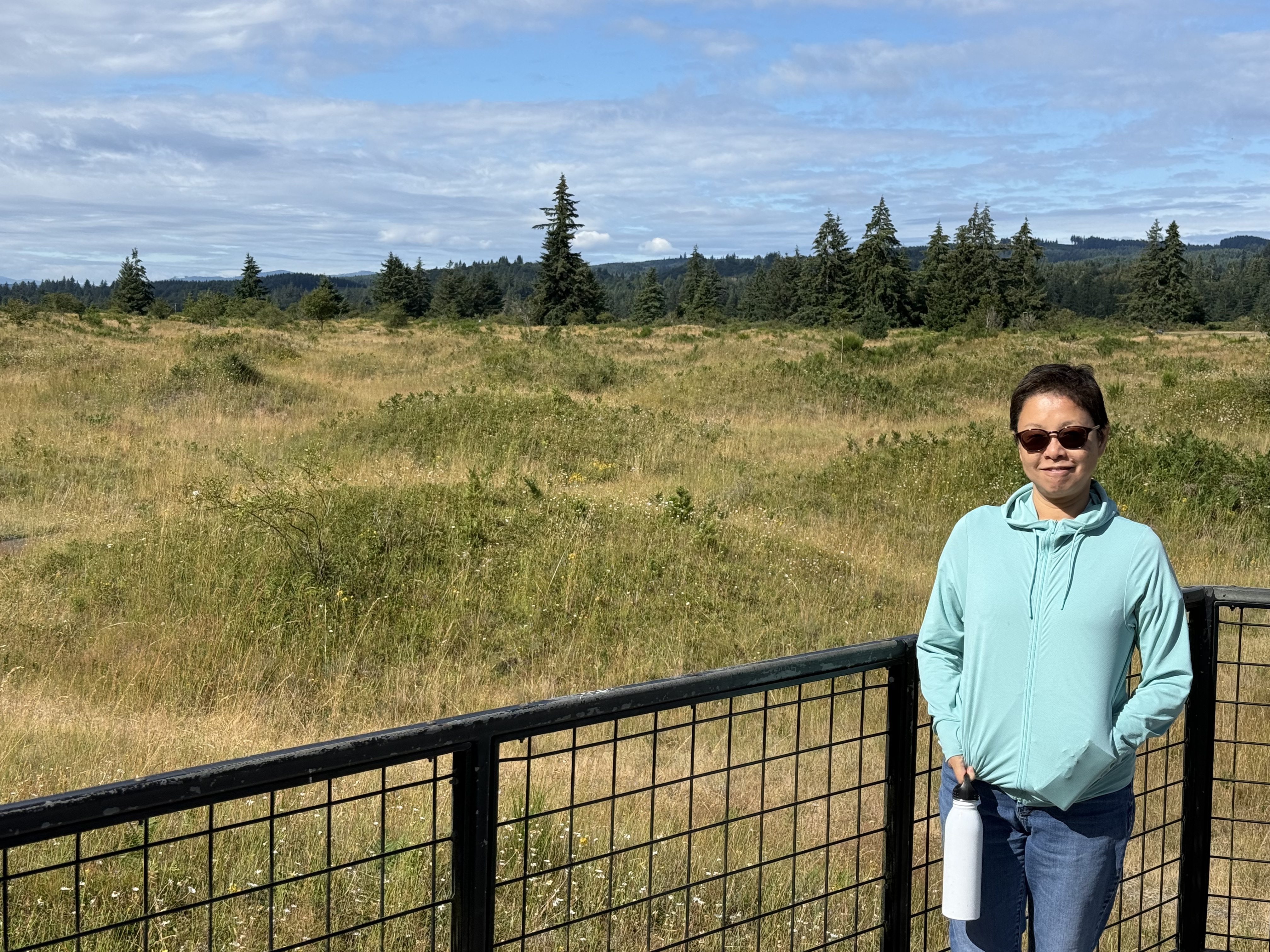
The Mima Mounds are about 16500 years old. They formed as the last continental ice sheet retreated from Washington. The mounds you see in this photo sit atop a gravel surface created at the southern extremity of this glacier. People, including the native Americans who have lived here for tens of thousands of years, have been perplexed by this bizarre topography.

There is a 1.9 mile trail that goes through the area; however, when European Americans first came here, this topography extended for more than twenty miles. Most of it has been demolished.
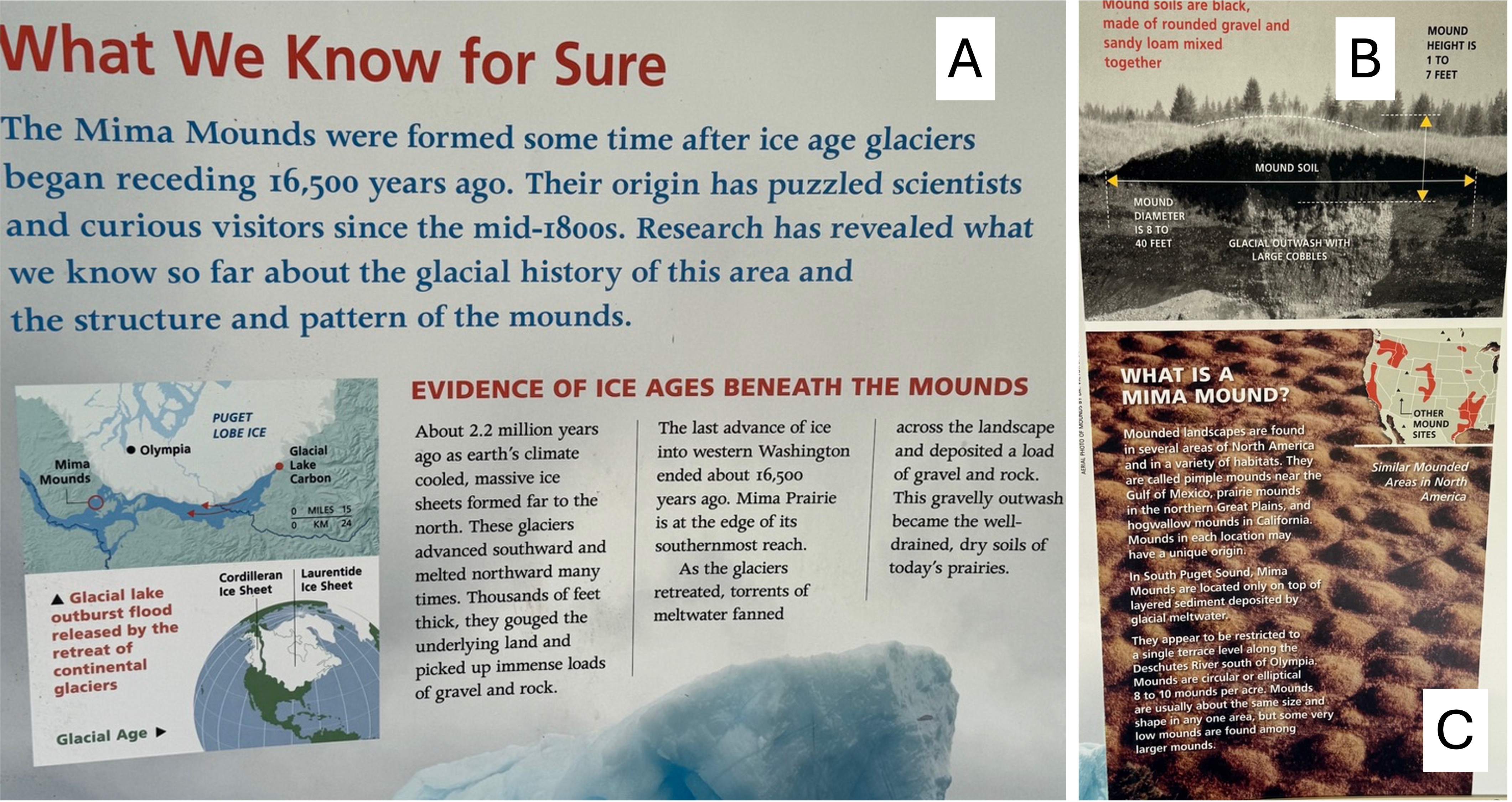
This is a portion of the information board at the interpretive center. (A) The Mima Mounds were constructed after the ice sheets began to retreat for the last time. The inset map shows the location of the NAP relative to the glacier and modern cities. This was the absolute furthest south of thick ice, but that doesn’t mean it was warm. (B) This is a rare photo of a cross-section through a mound. The dark soil is organic-rich and excellent potting soil. The subjacent glacial outwash is gravel. (C) This is a photo from the air, which shows their regular spacing. This is the geological problem. How could they have formed over about 400 square miles?
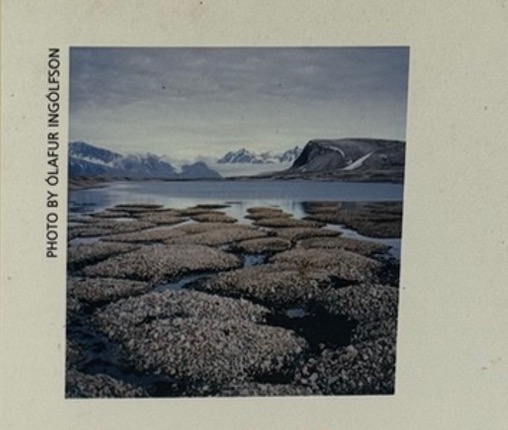
There are many theories for the origin of the Mima Mounds, and other mounds found in N. America and elsewhere. These are summarized on the Wikipedia page. I included this photo because it was on the poster; and the size/shape of these blocks of permafrost from Scandinavia are a good match to the mounds we saw. And they are in a similar, post-glacial environment.
Prairie Ecosystem
I’m discussing both the geology and ecology of Mima Mounds together in this post because they are inextricably connected. There are two ecosystems competing for space in this lumpy prairie environment. The result is there for anyone to see, if they ask the right questions.
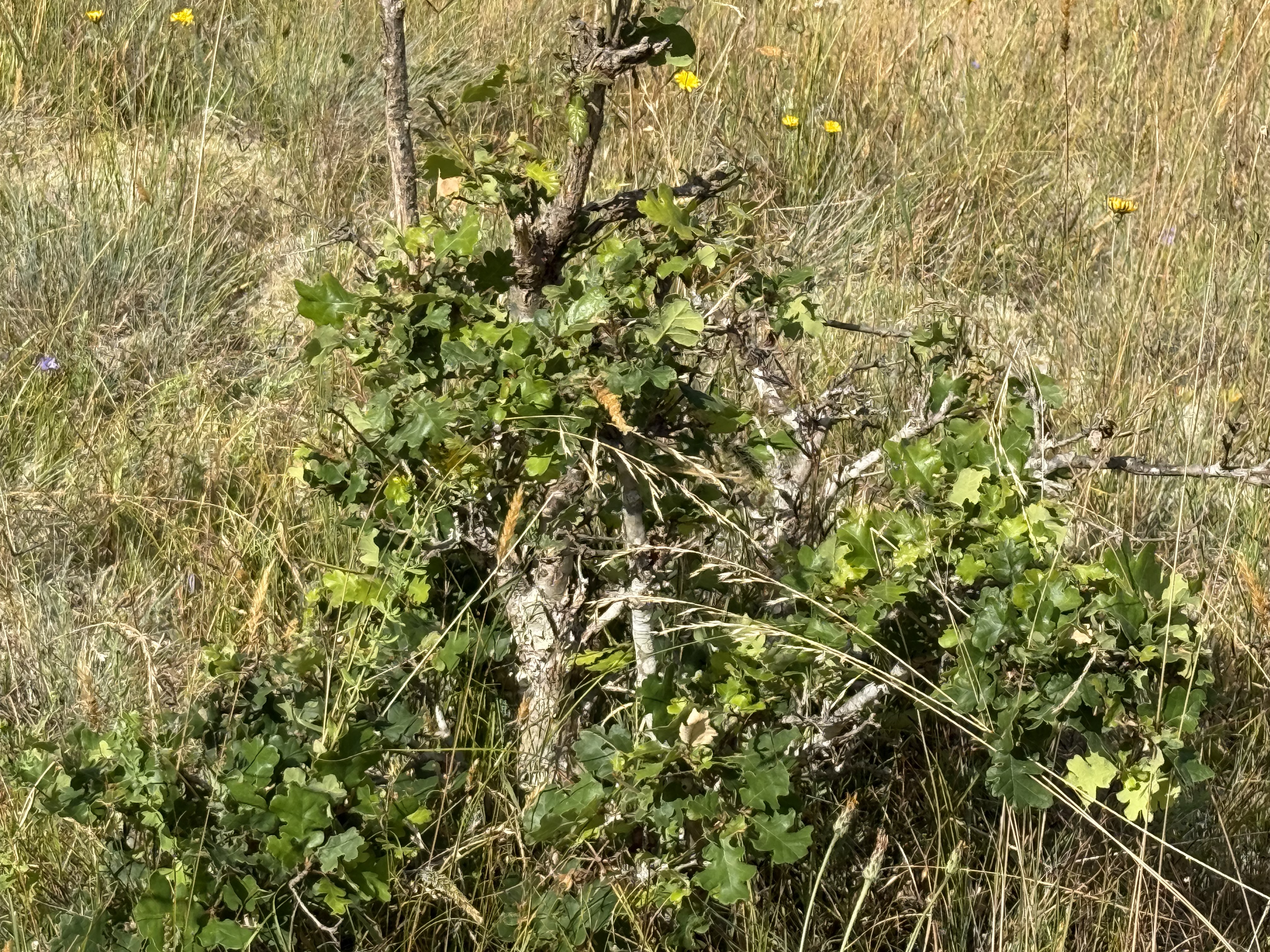
This low shrub was identified by CoPilot as snowberry, which is a staple of the prairie. I only saw them on the mounds, their roots in good soil, but apparently they also do well in the sandy glacial soil. From my perusal of the internet, I can’t disagree.
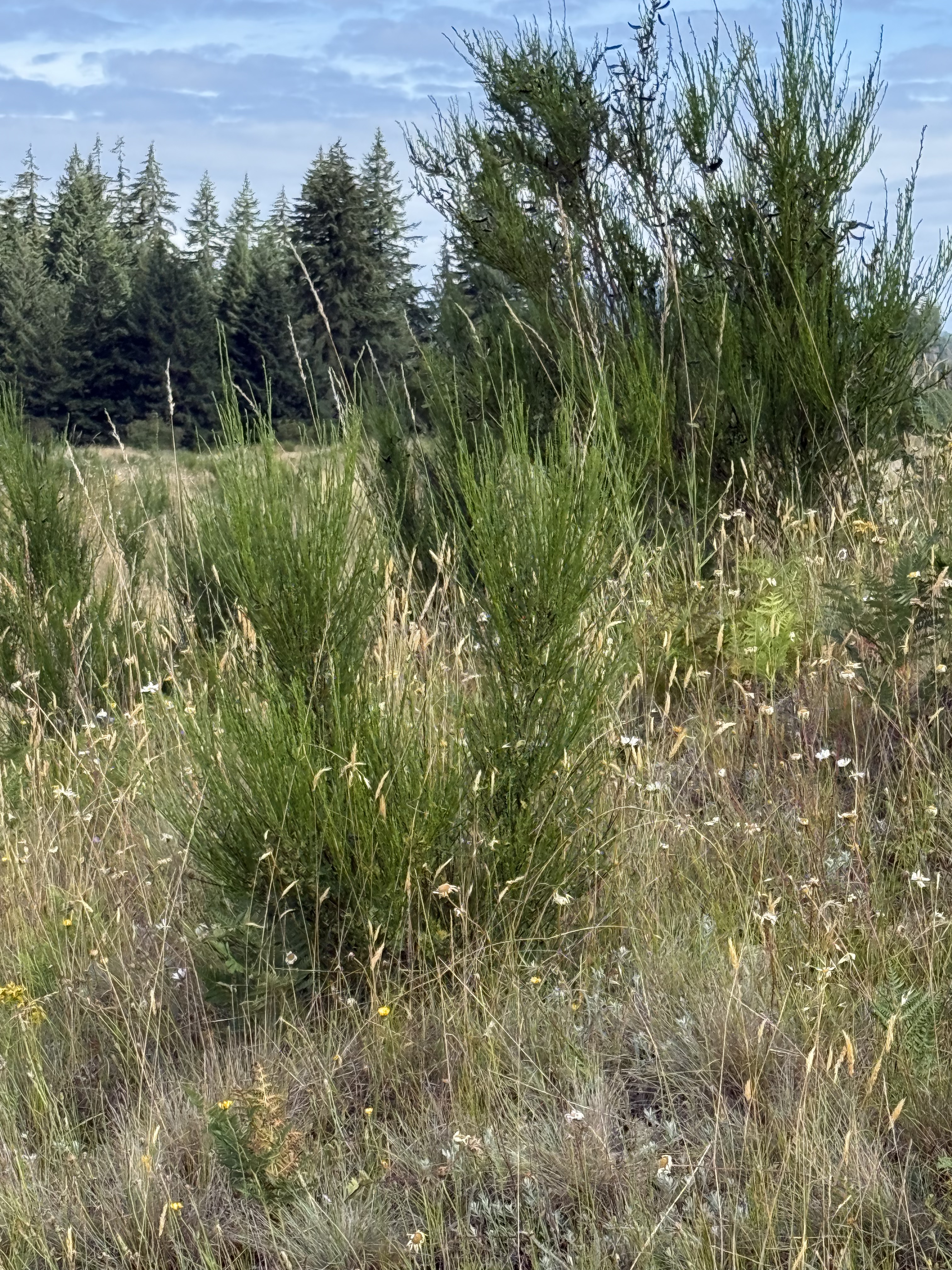
My ignorance is hilarious. I thought this was some kind of wildflower … but CoPilot identified it as a Douglas fir seedling. They were growing only on the mounds, sometimes in clusters. This is evidence (to me and CoPilot) that this is a dynamic transitional environment where forest species coexist with prairie flora.
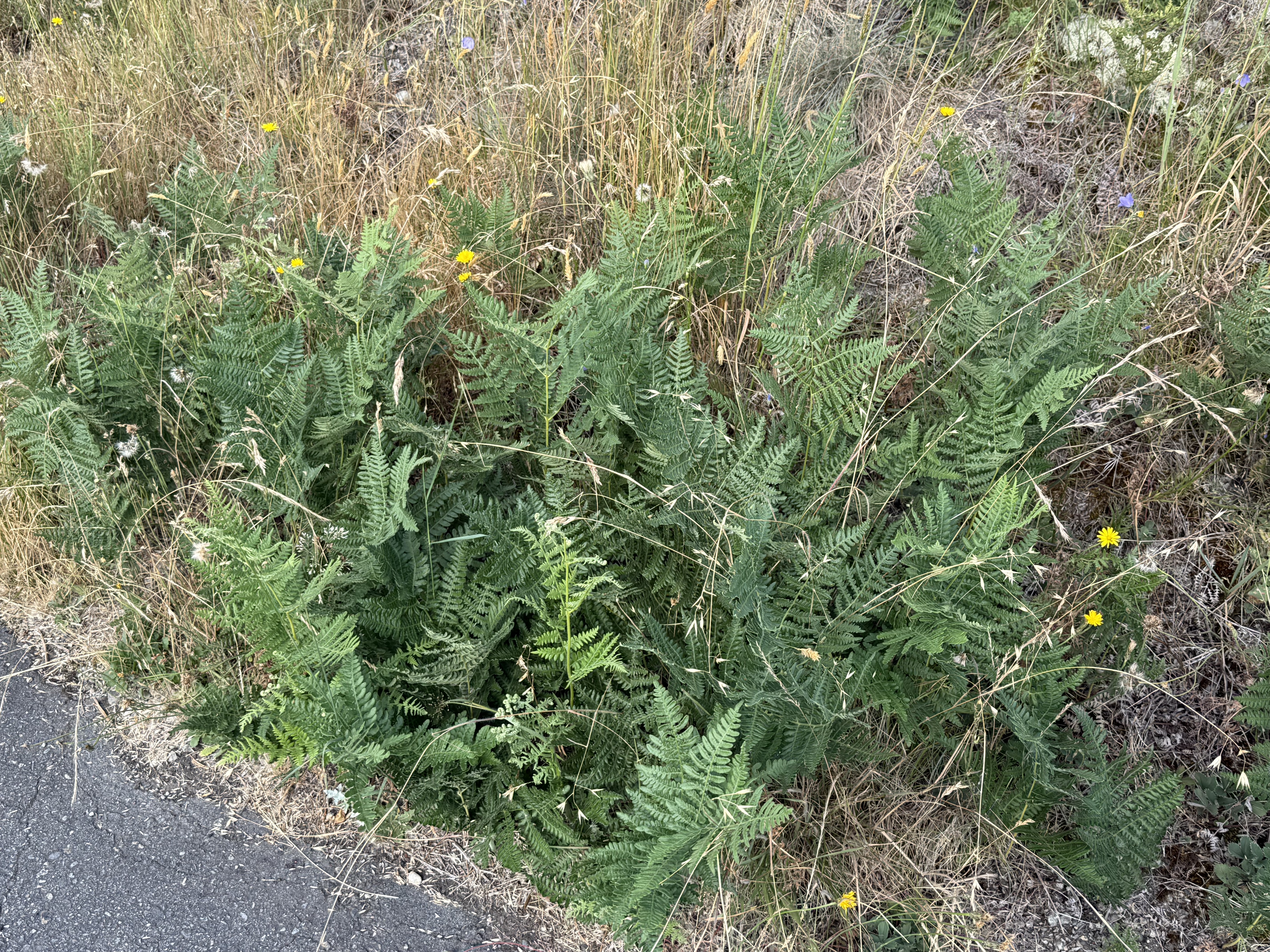
This fern caught my eye because it is not a natural inhabitant of a prairie ecosystem. However, the mounds are near a forest, so … CoPilot thinks it is a bracken fern, which is native to the area but not a prairie environment. It often behaves as an aggressive colonizer in disturbed edge habitats. That last phrase gets my attention because this preserve is at the edge of a mature forest.
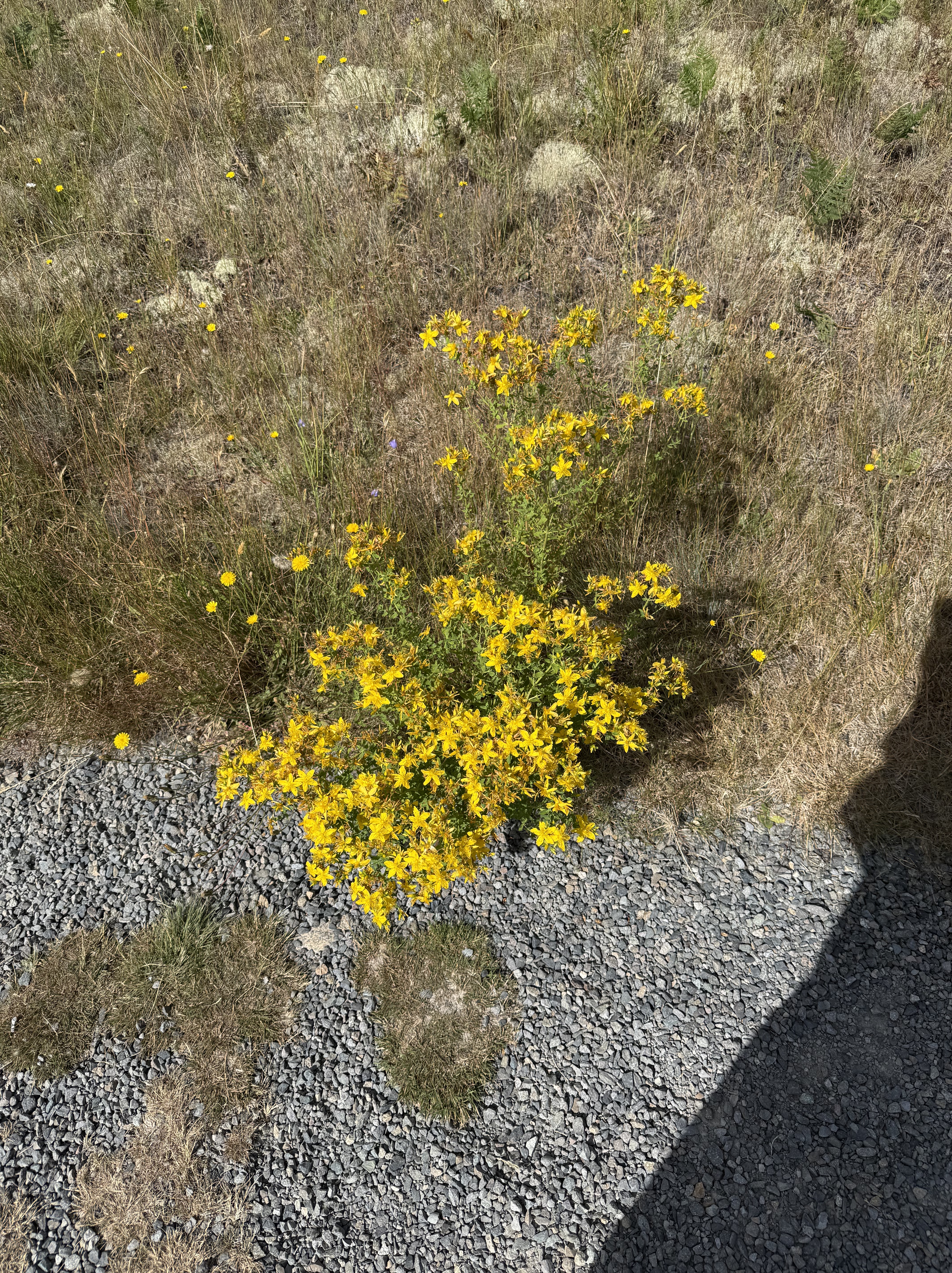
This lovely flowering shrub was identified by CoPilot as a species of Lotus, commonly called Spanish Clover, deervetch, or trefoil. It grew in the sandy areas between the mounds. My quick check can neither confirm nor deny this identification, but this common variety of clover is native to the PNW.
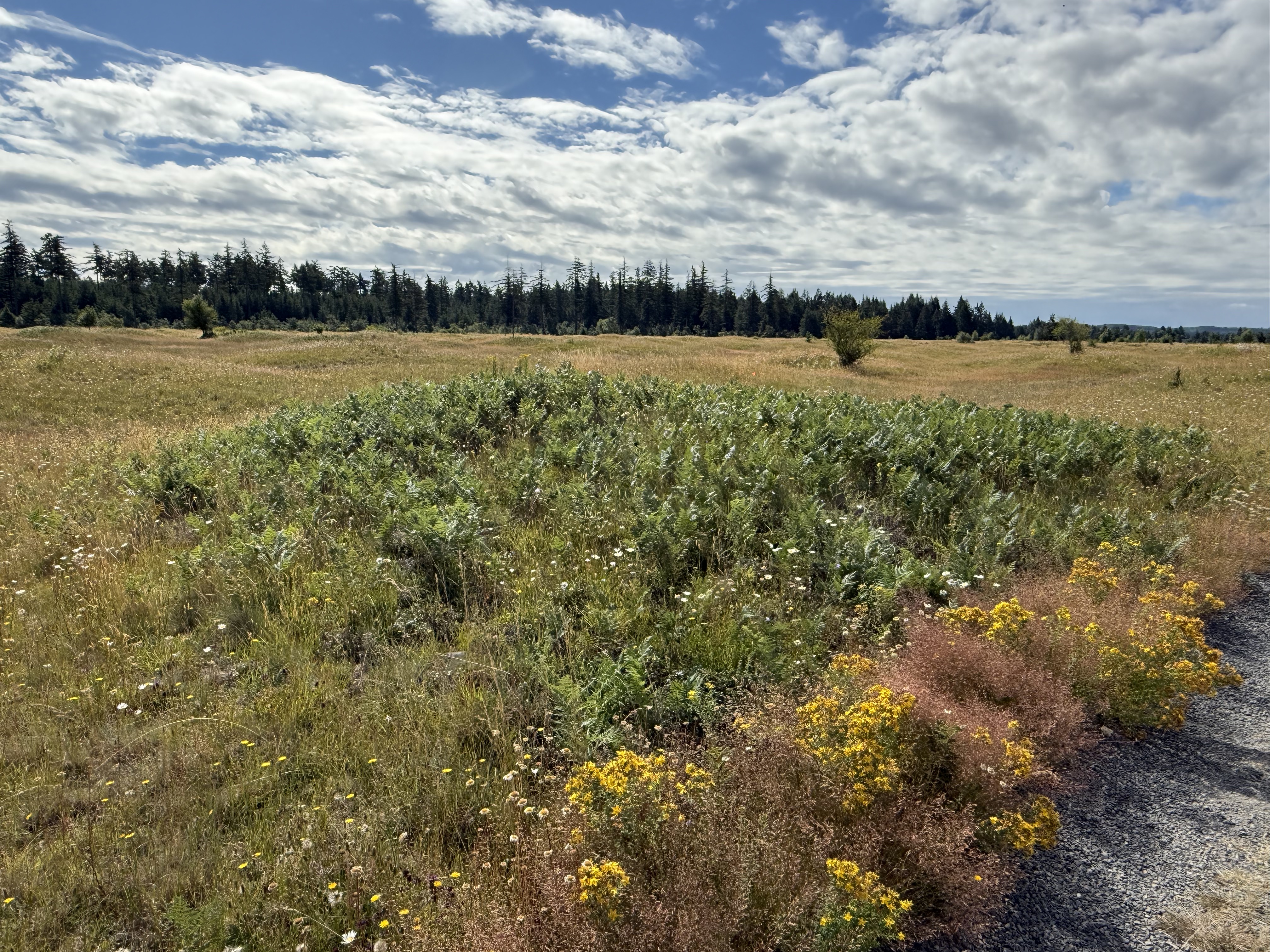
This mound is populated by bracken ferns, crowding onto the area with good soil.
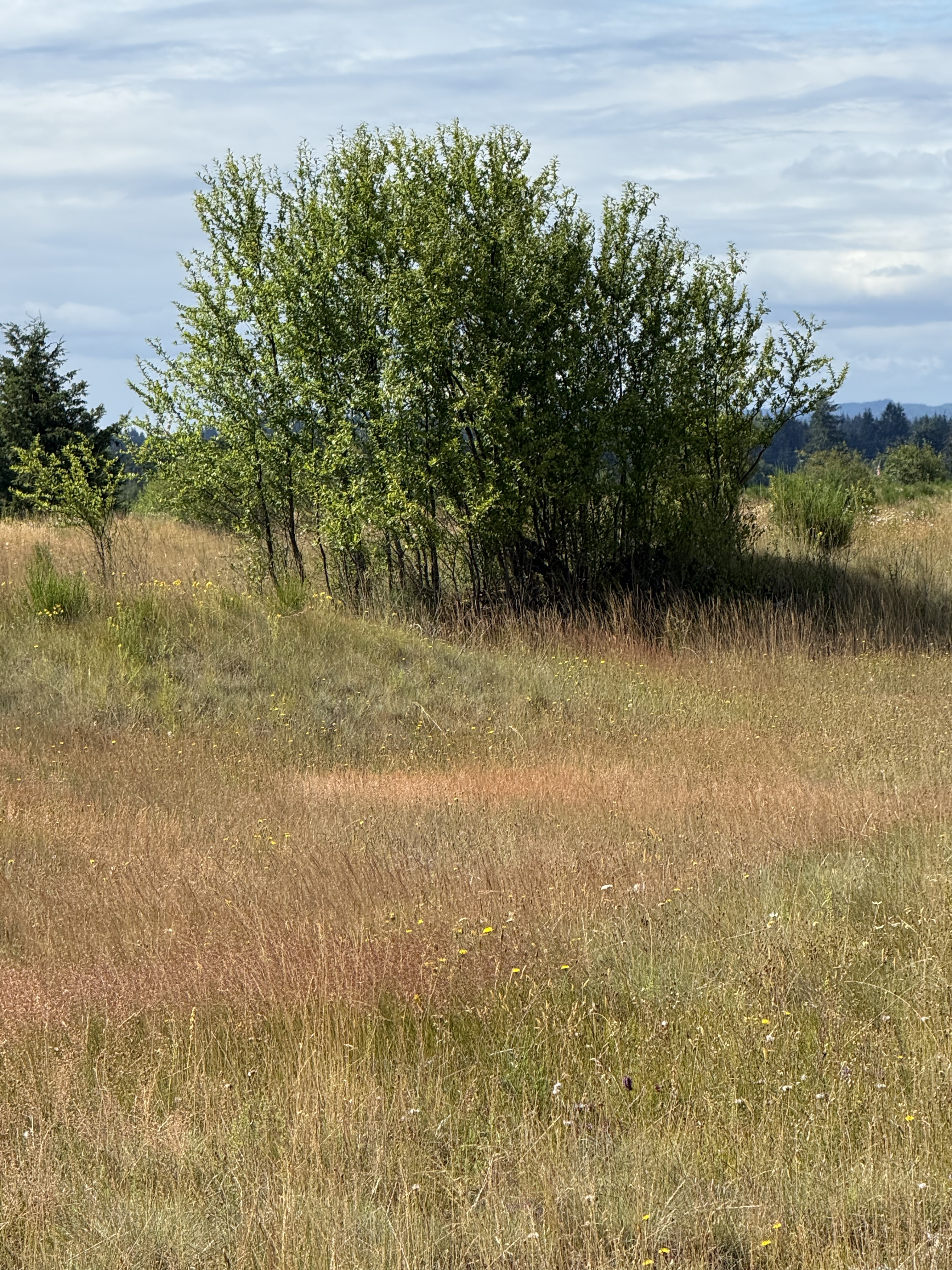
I don’t know what species this copse of young trees is, but it is obviously encroaching on the prairie ecosystem.
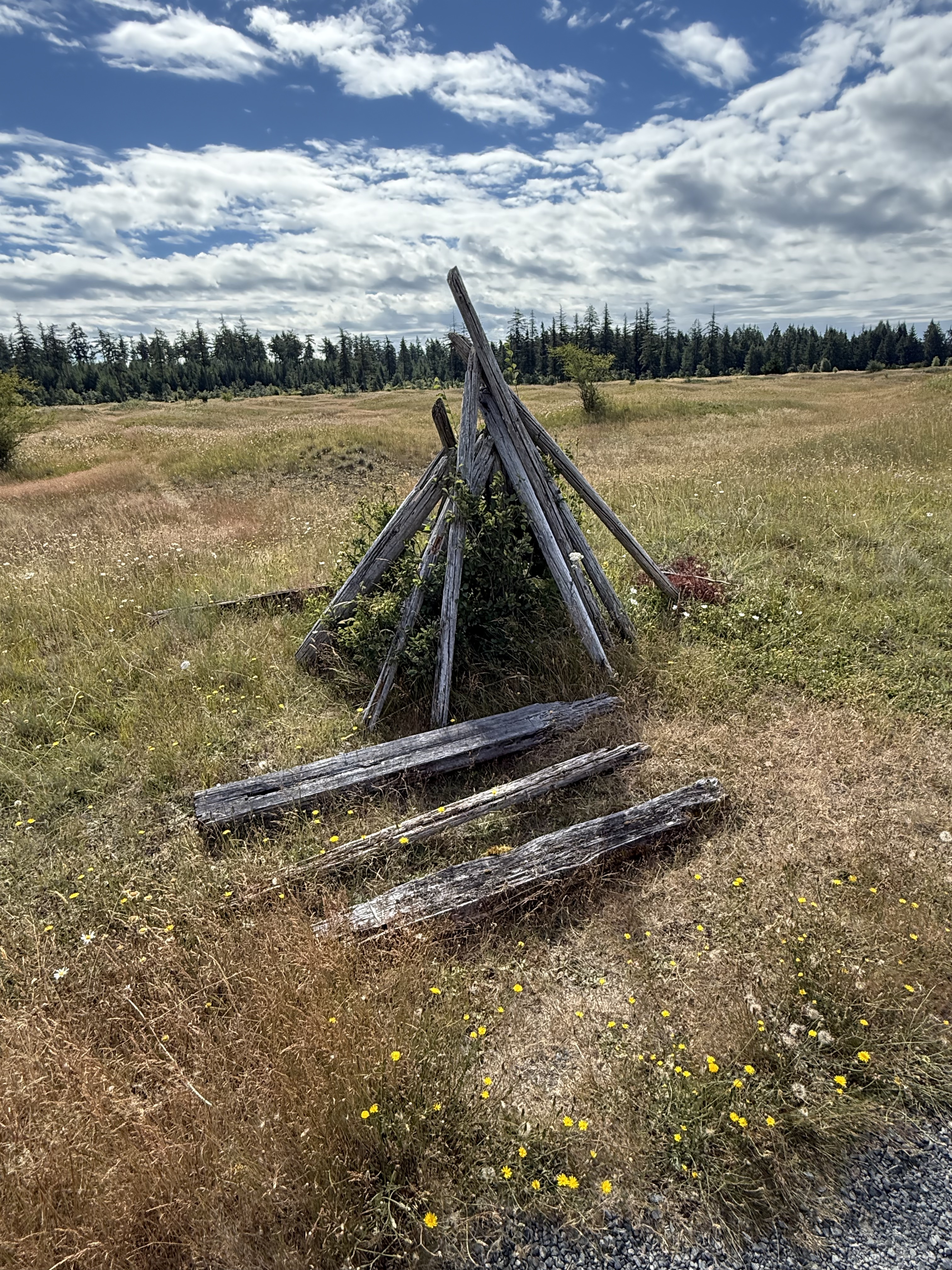
You never know what you’re going to find when you go outdoors. According to CoPilot, this is probably the result of NAP’s policy of not removing human artifacts that don’t interfere with the environment. Manpower shortages, policy priorities, etc. Mima Mounds was established in 1976, so it’s fair to say that this structure is at least that old. I guess NAP hasn’t gotten around to it yet, which fits my nascent sense of priorities in the PNW.
Bill Frank Jr. Nisqually National Wildlife Refuge

We stopped for a quick visit, which turned into a one-mile death march (for me, after walking 4 miles on uneven ground), to see where the Nisqually River empties into Puget Sound. It originates from the face of an alpine glacier above 6000 feet on Mt. Rainier. This is a tributary stream that forms a series of algae-covered ponds.
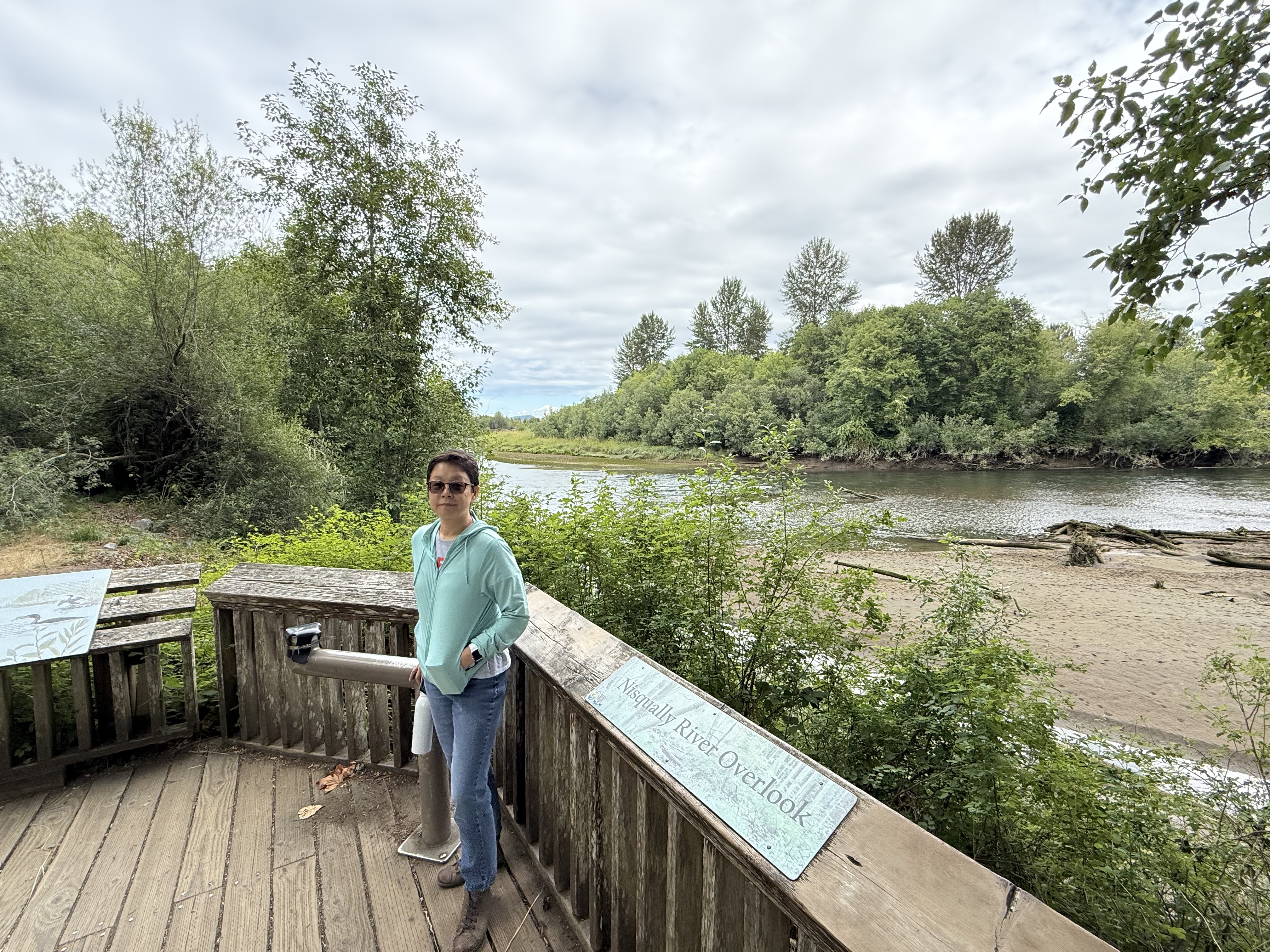
Here we are, less than a mile from the Nisqually River’s delta in Puget Sound. There is a lot of downcutting and the creation of sand bars, but no boulders or even cobbles. This glacial river has been tamed by nature over a distance of about eighty miles, but it is still flowing pretty fast. We didn’t make it to the delta … maybe next time.
Summary
This was a great day trip to a fascinating and beautiful area, where the prairie and the forest compete for space on the top of mounds of top soil whose origin is a mystery. This back-and-forth movement of plants on timescales of years to decades suggests that the PNW is alive and well, the flora responding to minute changes in soil and air temperature/moisture, precipitation, wind, etc. Let’s hope these two thriving ecosystems can continue their dance without further human interference.
I have my own hypothesis about the formation of the Mima Mounds, which is consistent with the facts. 1) As the glacier melted and retreated, over thousands of years, shallow lakes developed in local depressions. These lakes were shallow, perhaps twenty feet deep, and limited in extent. 2) Fine-grained sediment (i.e. mud) and organic debris settled in them to depths of no more than ten feet. They were ice covered for part of the year. 3) As the glacier retreated further, streams began to superimpose their beds onto this landscape, but they weren’t like a glacial river (e.g. Nisqually River). These were weak streams flowing over a post-glacial landscape, meandering and not cutting new channels. 4) This mild erosion was superimposed on a landscape dominated (in this area) by an antecedent pattern like that seen in the Arctic (see above photo). Fine-grained sediment was removed, following a suture pattern until only irregular bumps remained. 5) This process of sheet-flow erosion continued to the present day, leaving us with these paradoxical mounds.
I am a sedimentologist, so I think in terms of turbulence and flow as interconnected processes that alter a landscape slowly, one grain of sand at a time. There wasn’t enough turbulence to strip away the veneer of clay over this basin in the time allowed, so it chipped away at the weak edges of lumps of soil that were probably held together by the roots of plants.
In other words, the thawing of permafrost created the pattern, and turbulent flow polished it to what we see today.
Prove me wrong…
Hood ornaments through the ages: A visit to Lemay–America’s Car Museum
This wasn’t my usual visit to the local automobile museum. Instead of glimpsing the big picture, as seen through the evolution of car bodies from wagons to sleek, steel superstructures sitting on rapidly changing chassis, I am going to take a rather myopic view of automobile development in the twentieth century. Cars and airplanes co-evolved once lightweight, powerful motors were developed; but, unlike aircraft, autos weren’t substantially influenced by wars. In fact, the redirection of civilian manufacturing to wartime needs was an impediment to progress in land transport. Nevertheless, similar lofty ideas influenced automotive design, especially their adornment with signs of the modern, technological age.

Inspiration for this post came from my son, whose attention to detail constantly reminded me to focus on the details. Thus, this post begins with a ~1903 Studebaker electric buggy, which has no adornment despite being painted an eye-catching red.

By 1913, International Harvester designed a logo for the radiator of this cargo wagon.

Pierce Arrow added a bit of flair to the insignia. A good part of this post will focus on the development of radiator caps, from fancy adornment of the cap, which was required to add water for the internal combustion engine, to …. let’s see what happened.


Graceful designs appeared early, as in this 1920s Cadillac. I think the flowing pattern behind this woman’s head represents water as she burst from the surface of the sea, as suggested by the fluted base. She is taking flight.

Lincoln turned to the graceful greyhound on the radiator cap to imply beauty and speed. Note the lean ribcage, coincidentally similar to the louvers used for cooling in early models.

The Nash corporation created the Metropolitan car to compete in European markets during the 1950s. Small, economical, but stylish, it nevertheless had an ornate hood ornament that was no longer attached to the radiator cap.

No long hair streaming in the wind here. This idealized female figure wears her hair in a bun and is … I don’t know what she’s lying on, but it looks like some kind of jet pack.

Chevrolet caught my attention because of the evolution of their logo. This 1940s grill looks like an idealized shield, i.e., coat of

By the 1950s the Chevrolet “coat of arms” had become wider to fit the full-body designs made possible by improvements in metal working, but they still added meaningless details like the crown icons on this design. Accompanied by a V that filled that gap in the wider hood.

By the 1960s the emblem was surrounded by an ellipse, which made it easier to attach it to the larger grill required for more powerful engines.

This 1950s Ford integrates several elements from different eras: The name of the model, the stylized coat of arms, and an icon representing the jet age–the hood ornament is reminiscent of the iconic F86 Sabre, the hero of air combat during the Korean conflict (it was never officially declared as a war).


This 1950s Oldsmobile integrates similar emblems: It adds a map of the Western Hemisphere, and updates the fighter jet to a bomber.

Mercury takes another twist by updating the old “coat of arms” to a minimalist Mercury icon (the head wearing wings on his hat), combined with a stylized M to fill that wide hood.

This 1930s Plymouth attempts to represent a mythical past by including a Valkyrie taking flight with what looks like a Mayflower ship–probably homage to the name, “Plymouth”.

This 1950s Ford looks like it has a pistol attached to the hood.

The color scheme on this 1930s Ford may not be original, but it is obvious that Ford wanted to advertise that this car was powered by an eight-cylinder motor, probably the famous flathead V-8 which they introduced to the working class.

Ford purchased Lincoln and claimed their greyhound, added a V8 emblem to make it clear this was NOT a straight eight, which was a powerful but problematic motor, and glommed their still-in-use emblem onto the grill of this late 1930s/early 1940s era car.

This early 1930s Ford dropped the decorative, exposed radiator cap but included a support bar to get the message out that this was a V-8 automobile.

When pressurized cooling systems were introduced in the early decades of the twentieth century, it was necessary to monitor water temperature, but in-dash gauges hadn’t been invented yet. This radiator cap incorporates a thermometer. This photo shows the side that the driver didn’t see: in a time before owner’s manuals, it tells the operator what the proper temperature range is. The other side, which faces the driver, shows hot water filling a bulb.

This temperature gauge is the only example I saw of a biplane, and it’s supplied by the instrument manufacturer.


According to ChatGPT, this youth is drawing a bowstring on the radiator cap of a Pierce Arrow (circa 1930). Note the bow he’s sitting on. I don’t quite understand the position, but I’m not an archer. It makes more sense than a child about to ride a slide, and it explains the curved, cylindrical object he’s sitting on. Who would’ve thunk…

The Buick Riviera, introduced in about 1962, had this unimpressive R set in a groove in the hood.

A couple of stylistic changes to Lincoln in the 1940s: The greyhound was swapped for what looks like a ball and bat; and the coat of arms became a body-sized shield.

The driver has to read this temperature gauge from behind the steering wheel. The strange symbols around the edge look like fish bones or trilobites …

Bentley wanted to be certain that people next to you at the traffic light knew how wealthy you were.

This 1950s car mixed a jet aircraft symbol with knight holding a shield.

This 1940a hood ornament pre-dated jet aircraft, but that androgynous figure is going pretty fast…


The proud owner of this 1920s Buick receives a crown (of thorns?) from an angel.


I wonder what this wading bird is looking for? According to ChatGPT, it is the Packard “Goddess of Speed”, an art deco representation of coiled power about to explode. I guess people looked at things differently in the 1930s…


International Harvester incorporated only their iconic IH symbol on the Scout’s hood in the 1960s, but culture doesn’t wait for corporations to add their own “art deco”. I don’t know how much more of this I saw at the museum, including all those Motometer temperature gauges…

This 1950s Pontiac Bonneville sports a jet on each fender instead of only one.


What the hell? CoPilot (aka ChatGPT) thinks that the weird arrowhead on top was just that–meant to imply as fast as an arrow. That’s a long way from an airplane or valkyrie. This bizarre hood ornamentation might explain why Hudson went out of business in the 1950s.

Since Earth doesn’t have any rings, this 3D circle must represent a satellite’s orbit. Pretty advanced for the mid-1950s. Too bad Oldsmobile didn’t make the cut when it was time to downsize GMC in 2004. Bummer.


They barely had room for the coat of arms between the jet intake and the aircraft on the hood on this 1950/51 Studebaker Champion. Despite the optimistic ornamentation, this car had a six-cylinder with about 100 hp. Bummer.


Mercedes added a badge for those who weren’t familiar with its iconic star.


There’s a lot going on here: a pair of “8”s for, presumably, the straight-eight engine that was a real powerhouse in the 30s; wings; an explicit acknowledgement of both Dodge boys; a Star of David; and a set of pipes, maybe for an organ, on the radiator cap.
Final Thoughts
If you made it through this long post, I hope you enjoyed the journey as much as I did. I have never examined one aspect of the evolution of automobiles in such detail before. It was worth it, even if hood bling isn’t as exciting as engines, brakes, body styles, and all the other mechanical components.
Two concepts seem to have been central during the twentieth century: having a coat of arms was probably an extension of custom-made coaches to horseless carriages; and associating cars with flight, either through birds, mythic creatures, or airplanes. The combination was often ludicrous but always entertaining. The phrase, “They don’t make them like they used to,” is nowhere more applicable than to stylistic choices in bodies and the chrome trim they sport.
A Quick Visit to the Tacoma Art Museum
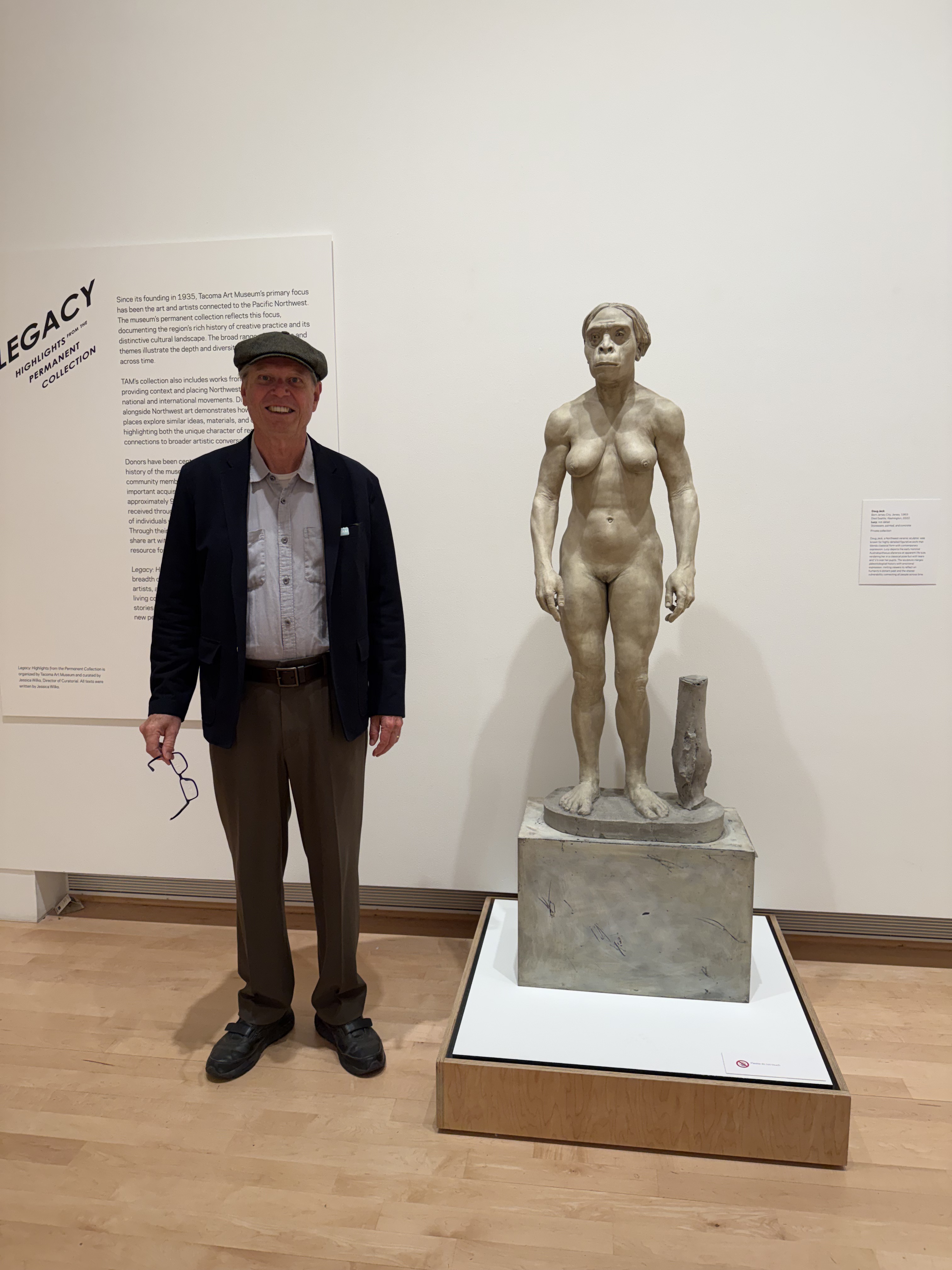
Ever since a 40% complete skeleton of a female Australopithecus afarensis was discovered in 1974, in Ethiopia, she’s been put on a pedestal both figuratively and literally. A PNW artist created this life-size sculpture of her, giving her a strong upper body and legs in accordance with current theories that she walked a lot, but also climbed trees.

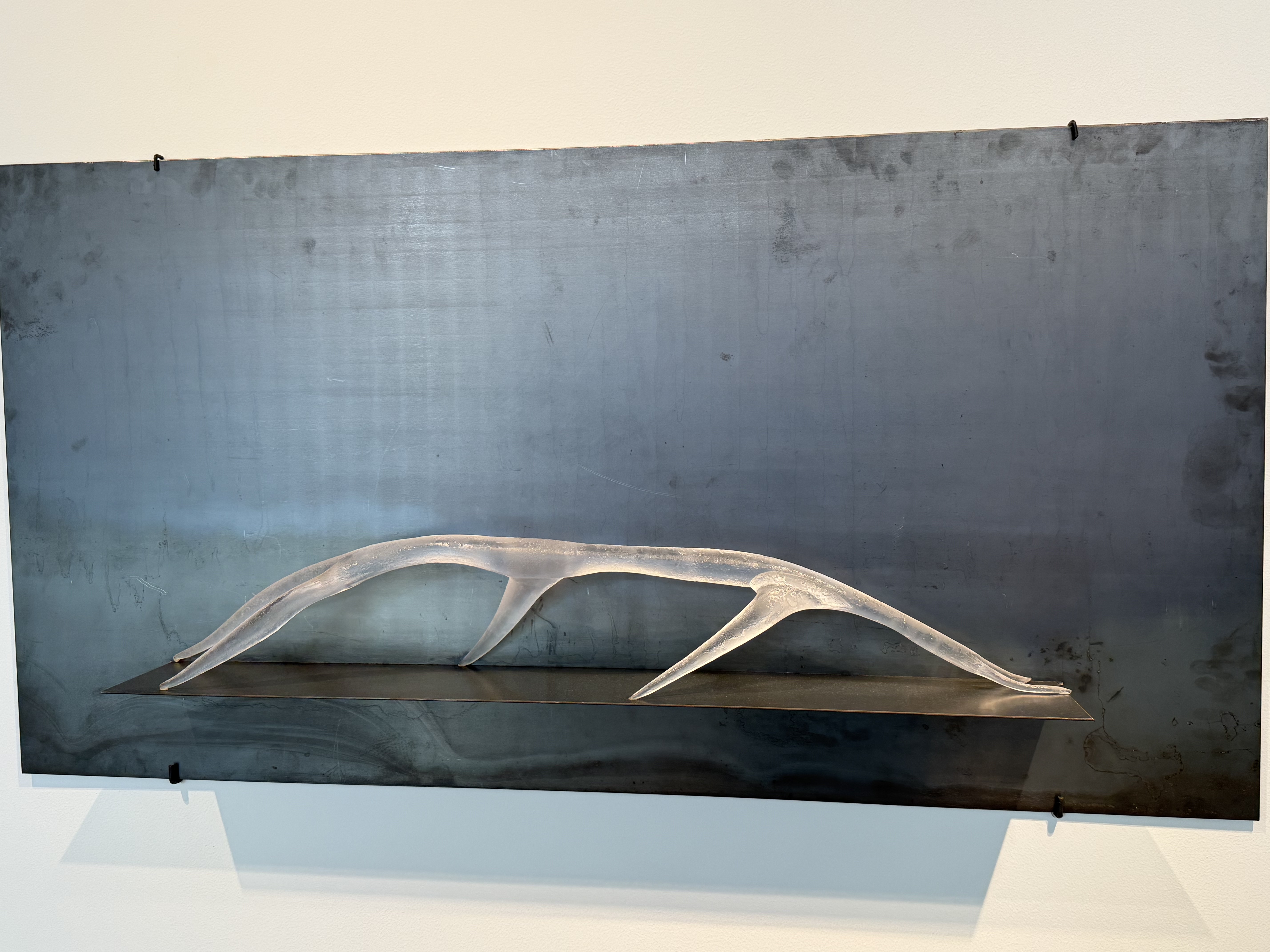
There are a lot of glass exhibits because Tacoma also hosts a famous glass museum and working foundry.

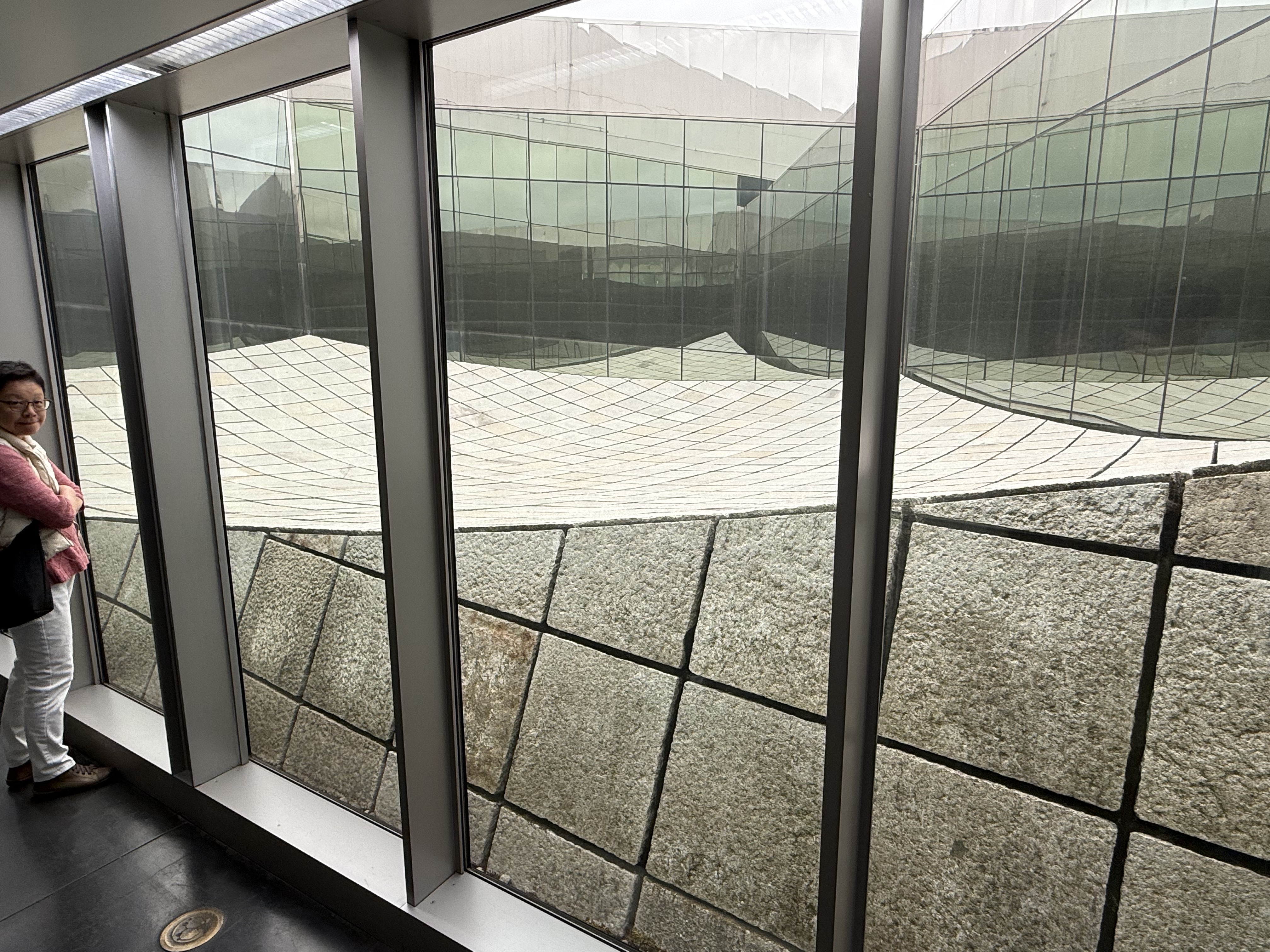
This curious display fills an inaccessible plaza within the building. The stones were acquired from a village in China, where they served as a roadway constructed 500 years ago. The exhibit is designed to represent a wave on the surface of Commencement Bay.
The Oregon Zoo in Portland
We drove a couple of hours to visit The Oregon Zoo. I don’t like zoos much, lately, because they house imprisoned animals, but I am aware that they do a lot of good work towards saving endangered animals from extinction. So I was ambivalent about this trip; nevertheless, I was pleasantly surprised at the quality of this particular zoo.
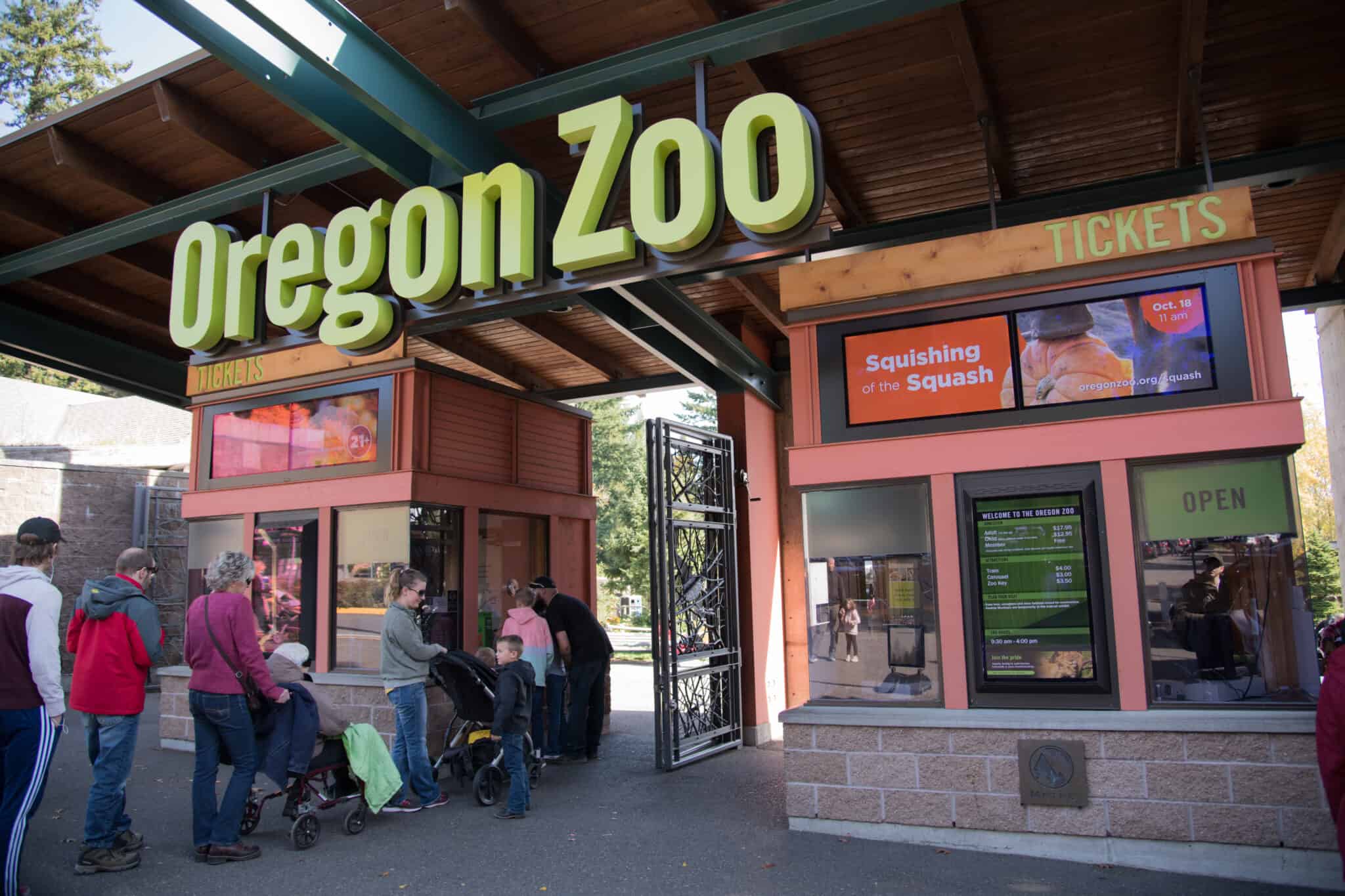
I bought a ticket for the 11:00 a.m. window from a kiosk, which printed my bar code–all without a hitch and no line.
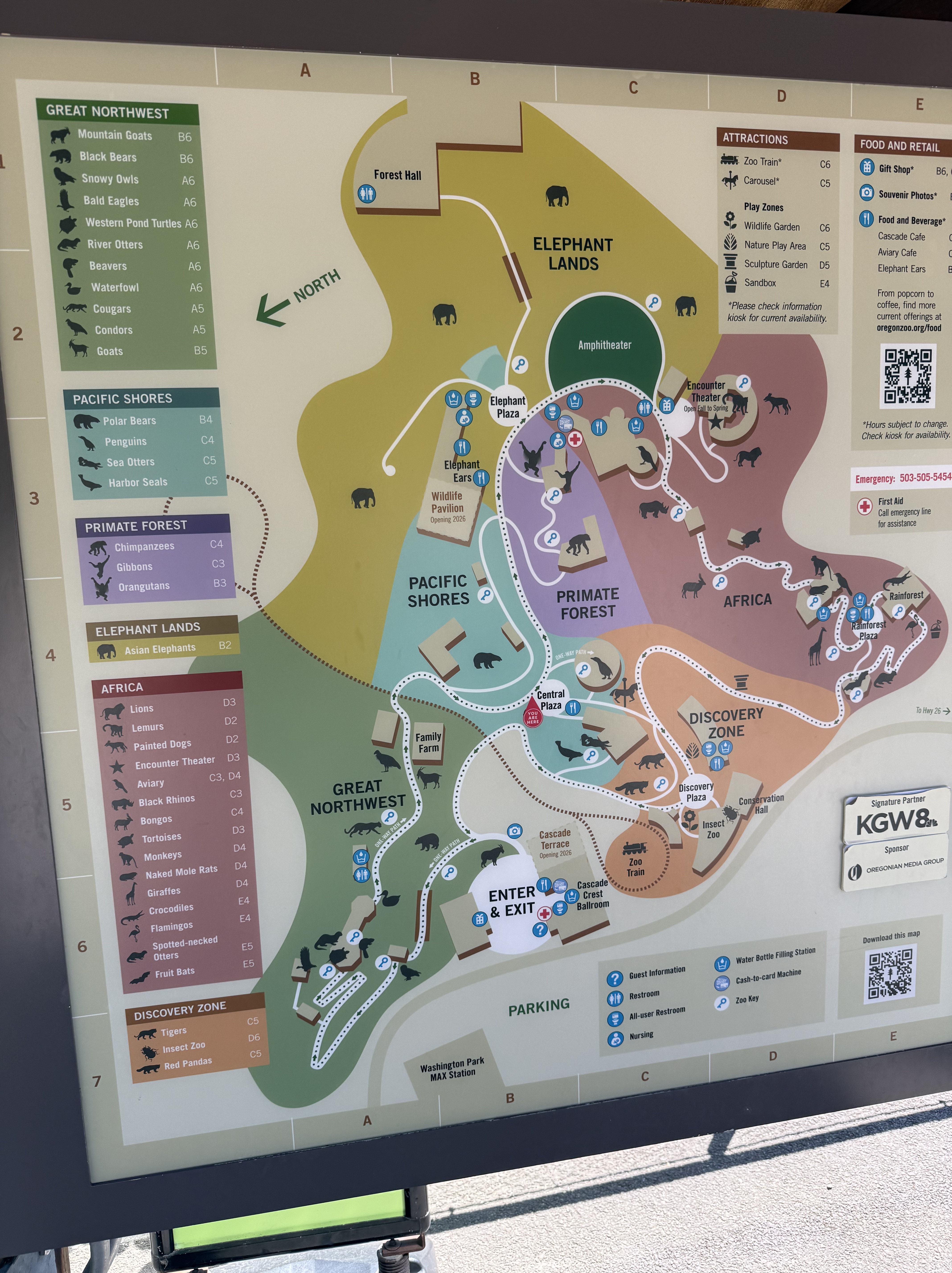
It was a beautiful day, so the parking lot was full; but we parked at the overflow parking lot and rode a free school bus for a quick trip to the entrance. It was better than parking in the regular lots. The arrows show the one-directional flow of people that is encouraged by the layout. It’s about two miles and takes 2-3 hours.
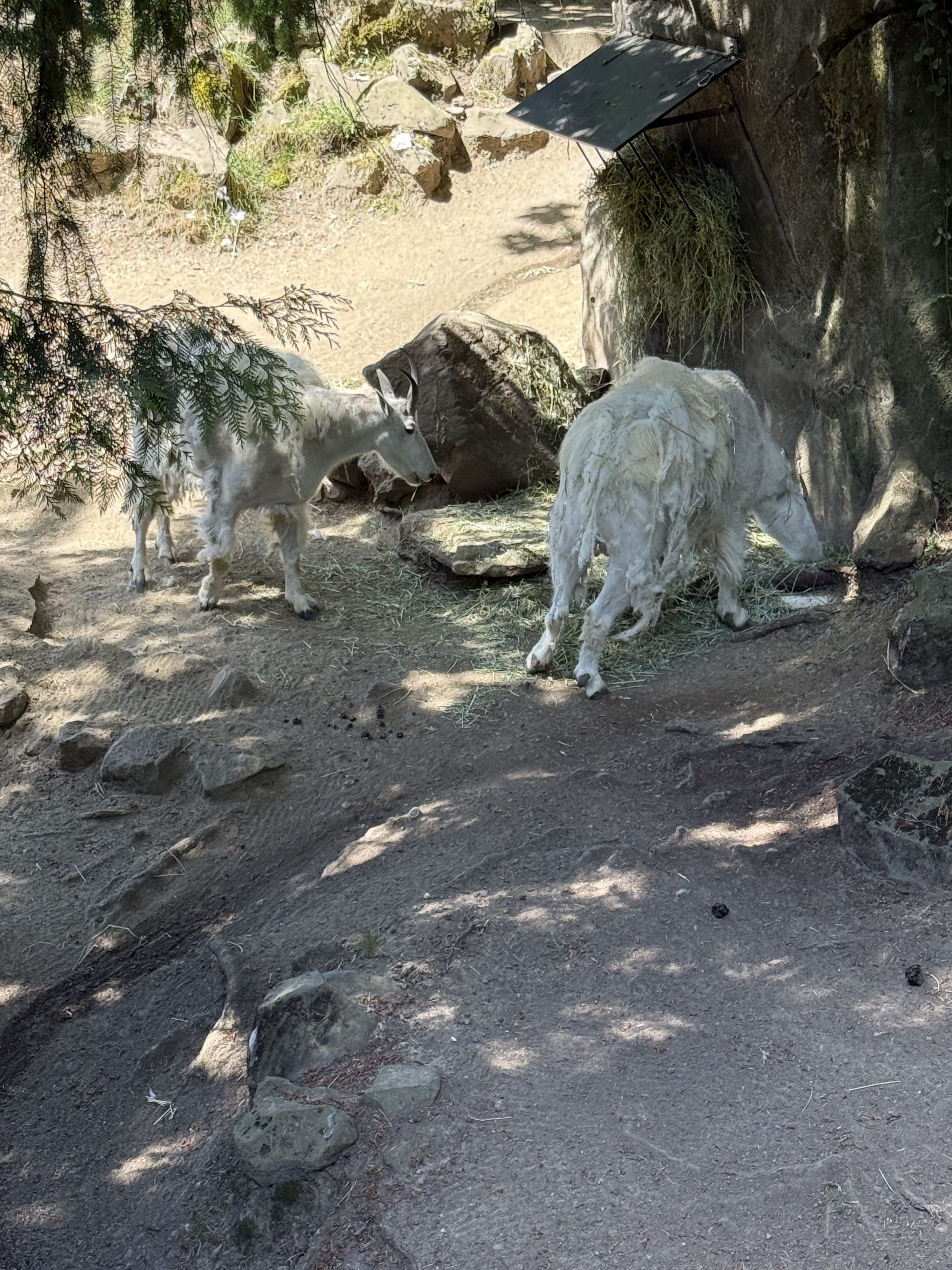
There is a mountain goat exhibit at the entrance with artificial rock piles, but its inhabitants were having lunch. They look pretty ragged, I guess because they’re losing their winter hair (or is it fur?).
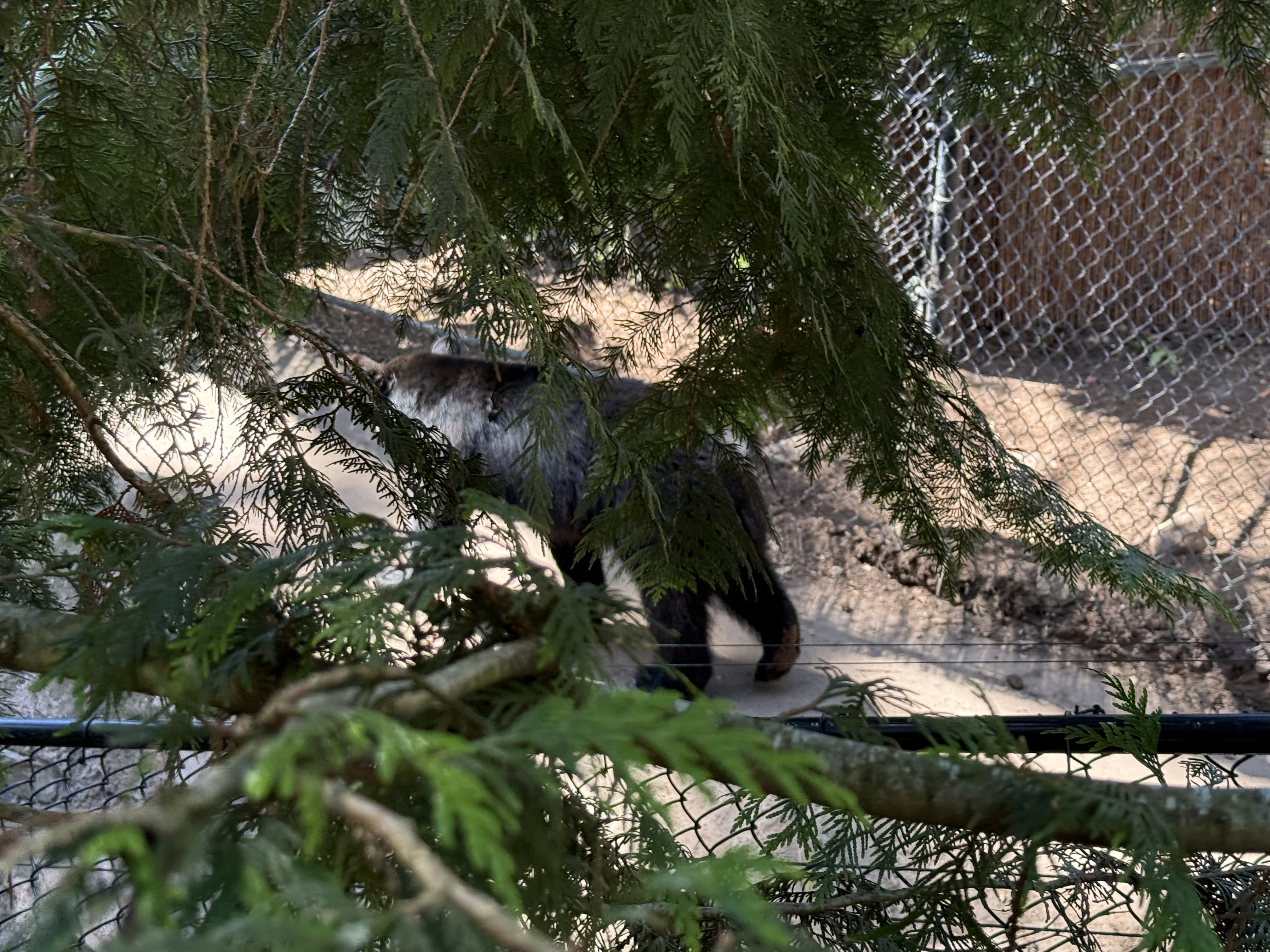
The Pacific Northwest was a grouping of regional species, including three black bears. I missed a lot of opportunities to photograph them interacting because I was confused by their enclosure, which was very large. It covers the side of a hill and includes several personal areas in addition to available shared “dens” where they could get some privacy from prying eyes.
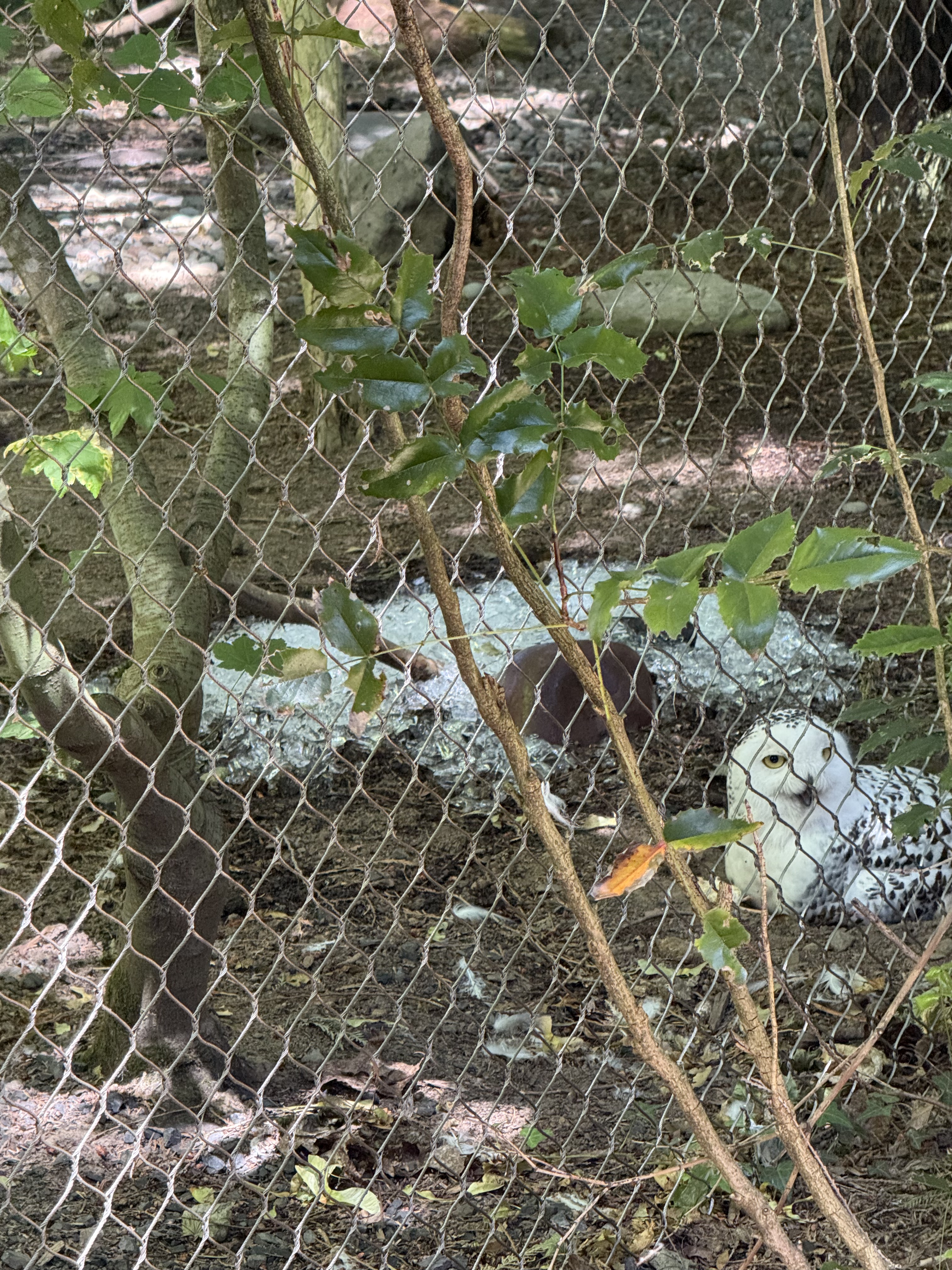
The owls seemed to enjoy sitting on the ground, even on a pile of ice, even though they had plenty of branches to hang out on.
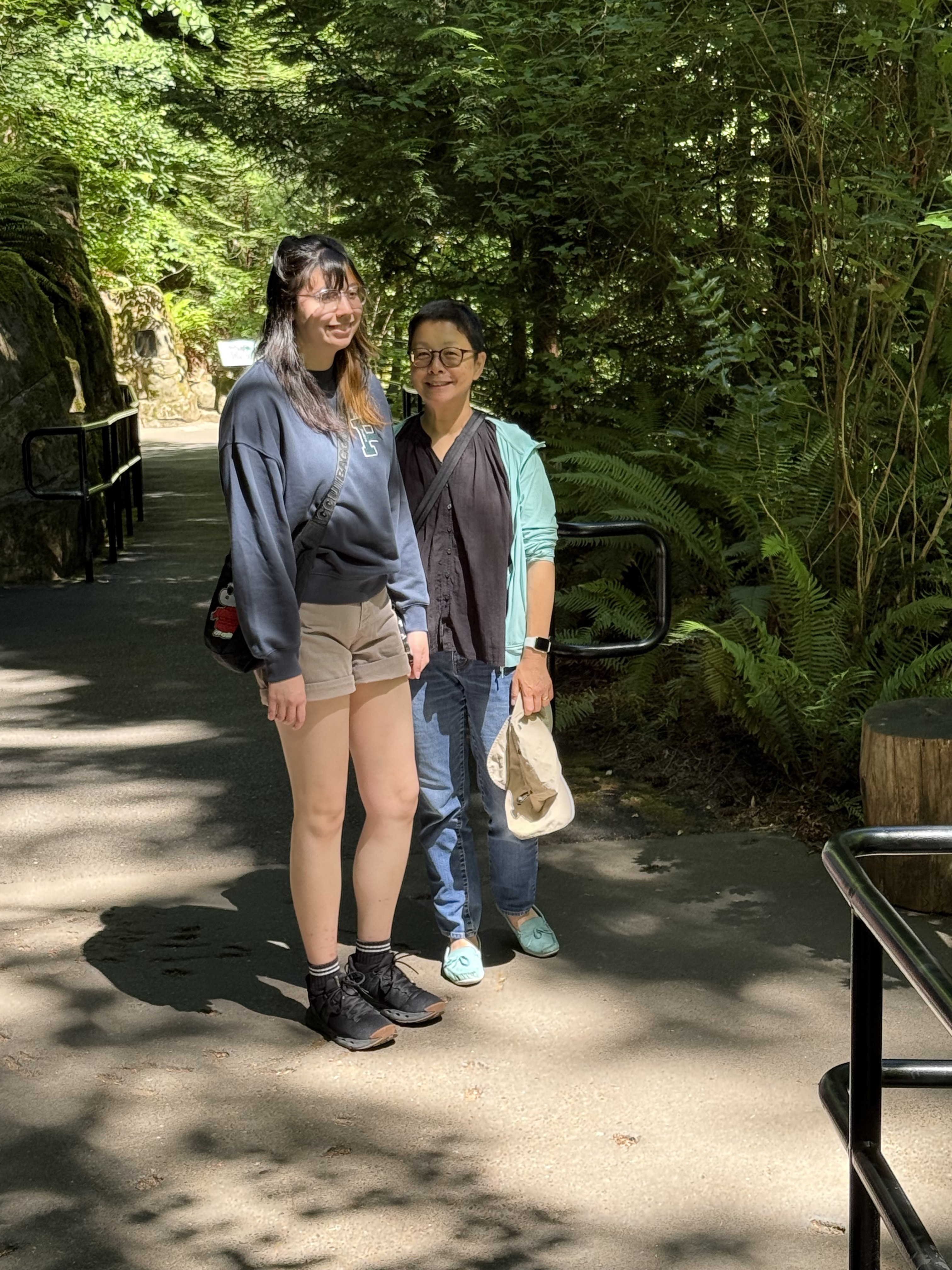
There was plenty of shade available for the inhabitants as well as the visitors.
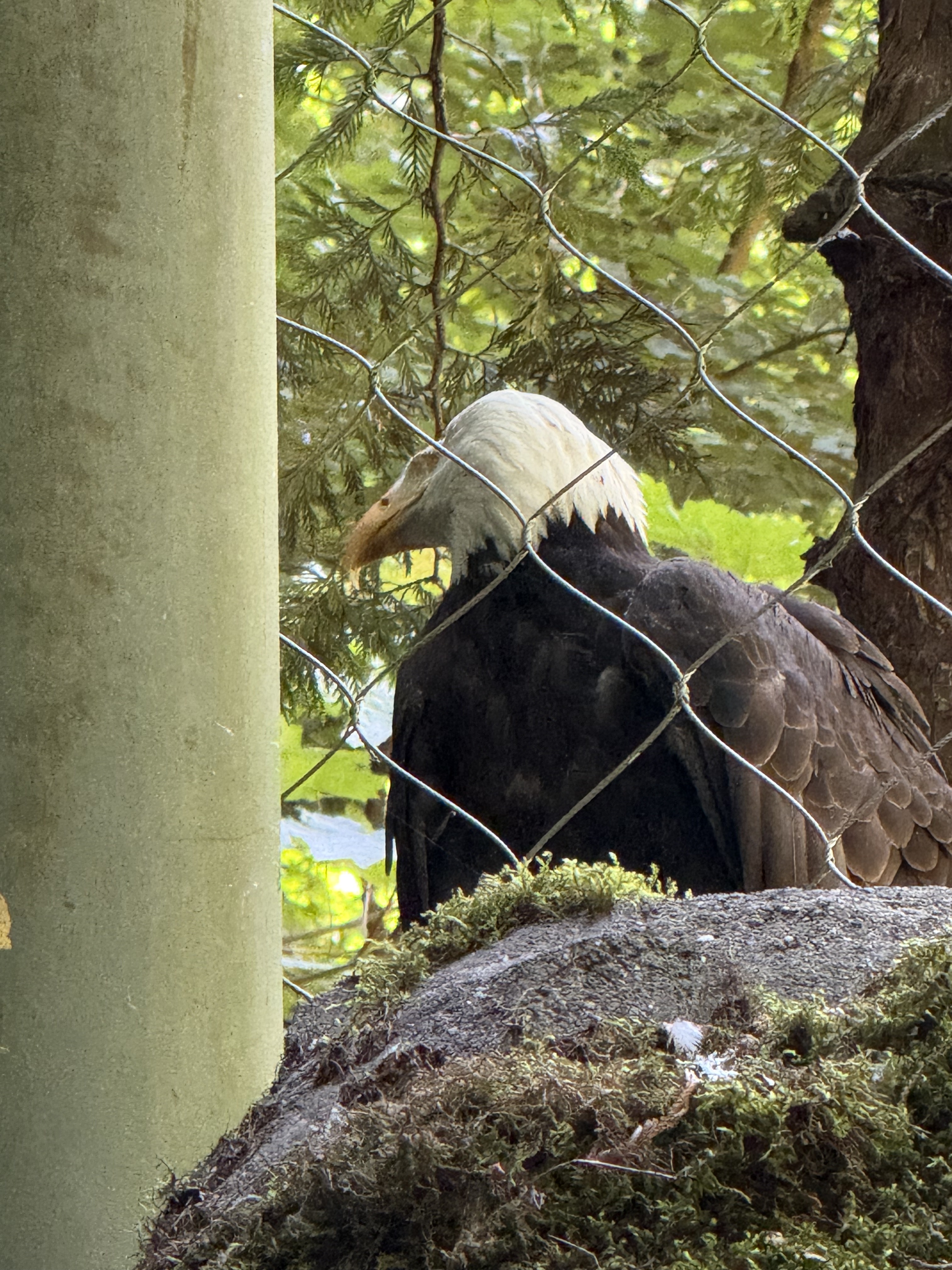
The bald eagles were rescued and are unable to fly properly, so I guess this is an “assisted living” facility.
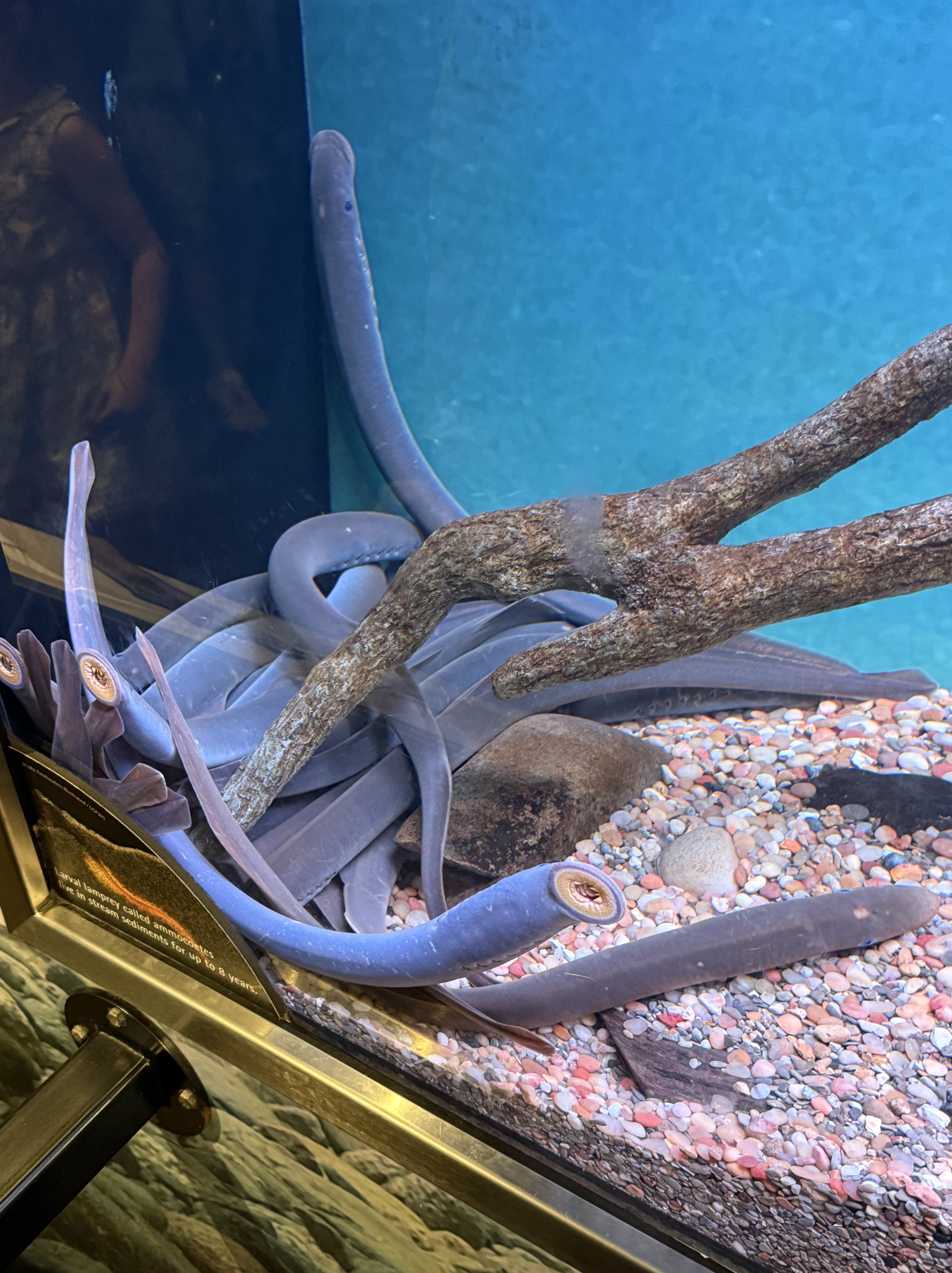
The lampreys were lying together in one end of a smallish tank. I guess it’s difficult to know whether they care about their surrounding or not. This is one strange fish.
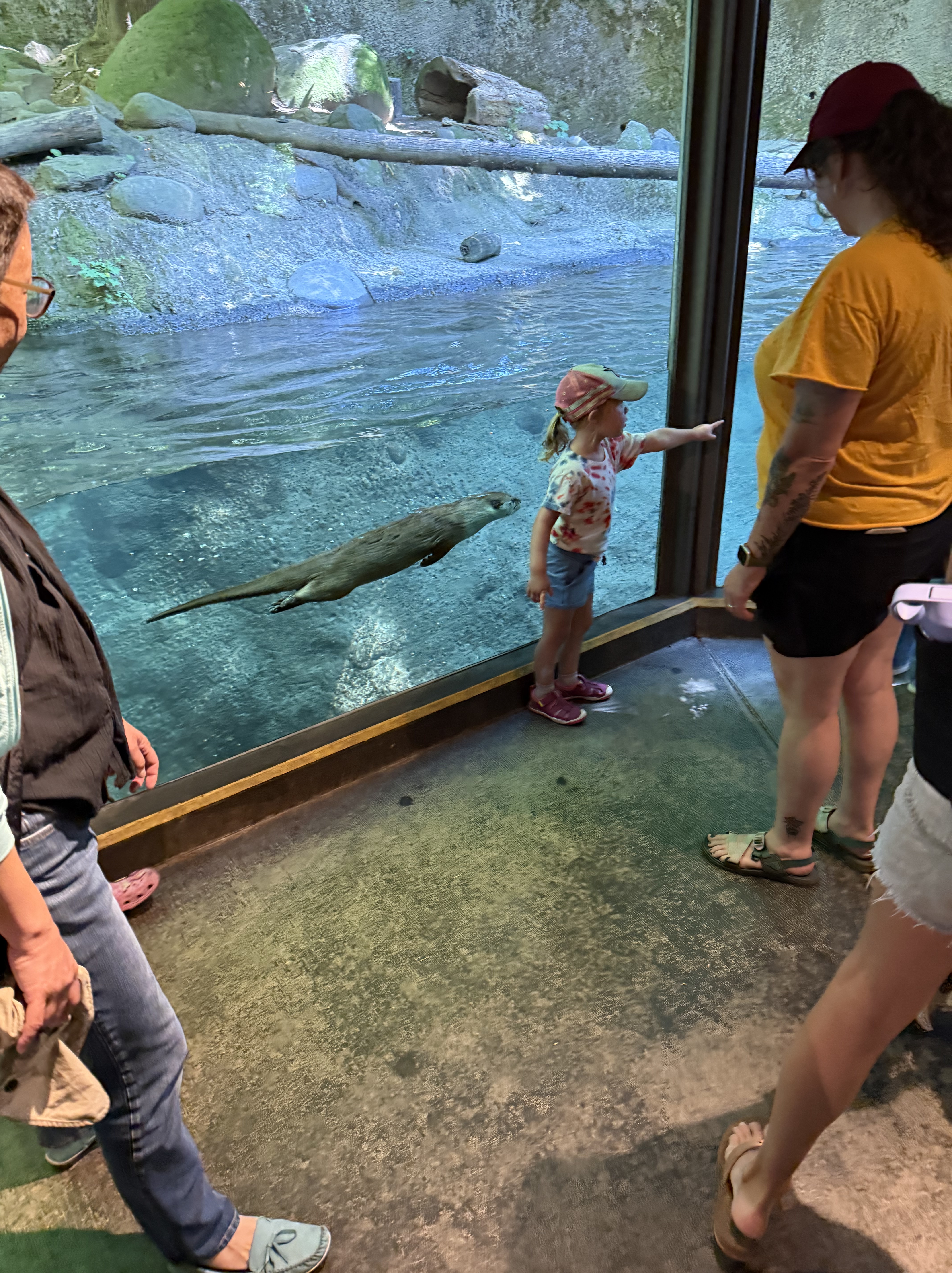
I never like to see free-wheeling animals like otters in captivity, even if they have cooled water to swim in. And I didn’t see any fish swimming around for them to catch. The phrase “feeding time” really bothers me, but I suppose we primates need to see the animals we share the world with in person to recognize them as being living beings. No one knows what an otter thinks…
This video shows a couple of otters cavorting in a viewing room. They had private places available, so I guess they don’t care if we reading monkeys watch them; but I wish that woman hadn’t kept her fat head so close to the window.
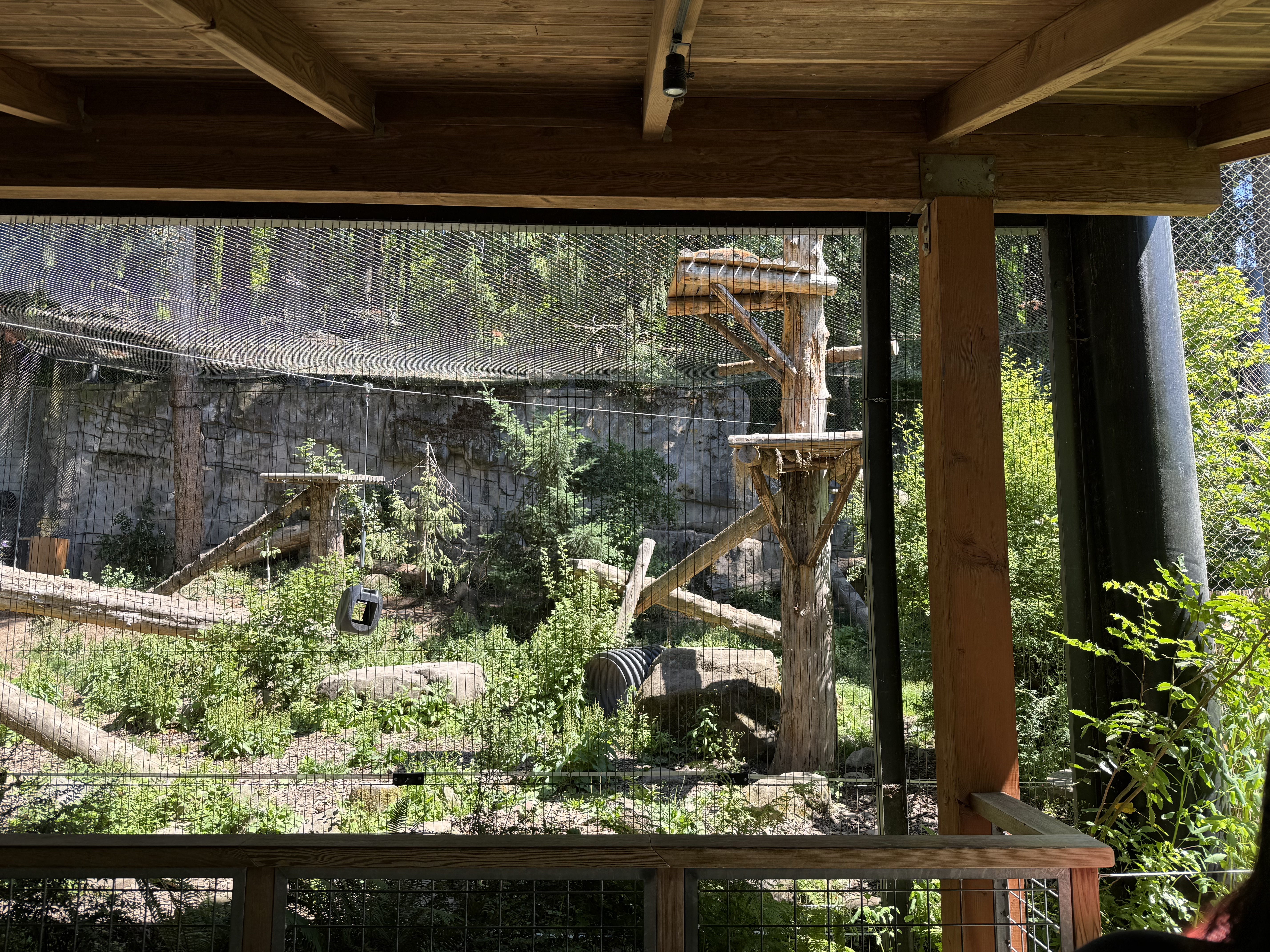
The mountain lion/cougar/etc is on the highest platform taking a nap, so I guess they’ve gotten used to life in a cage with a net ceiling. These big cats, native to all of N. America, aren’t endangered, but, obviously, we can’t see them this close. They are pretty dangerous.
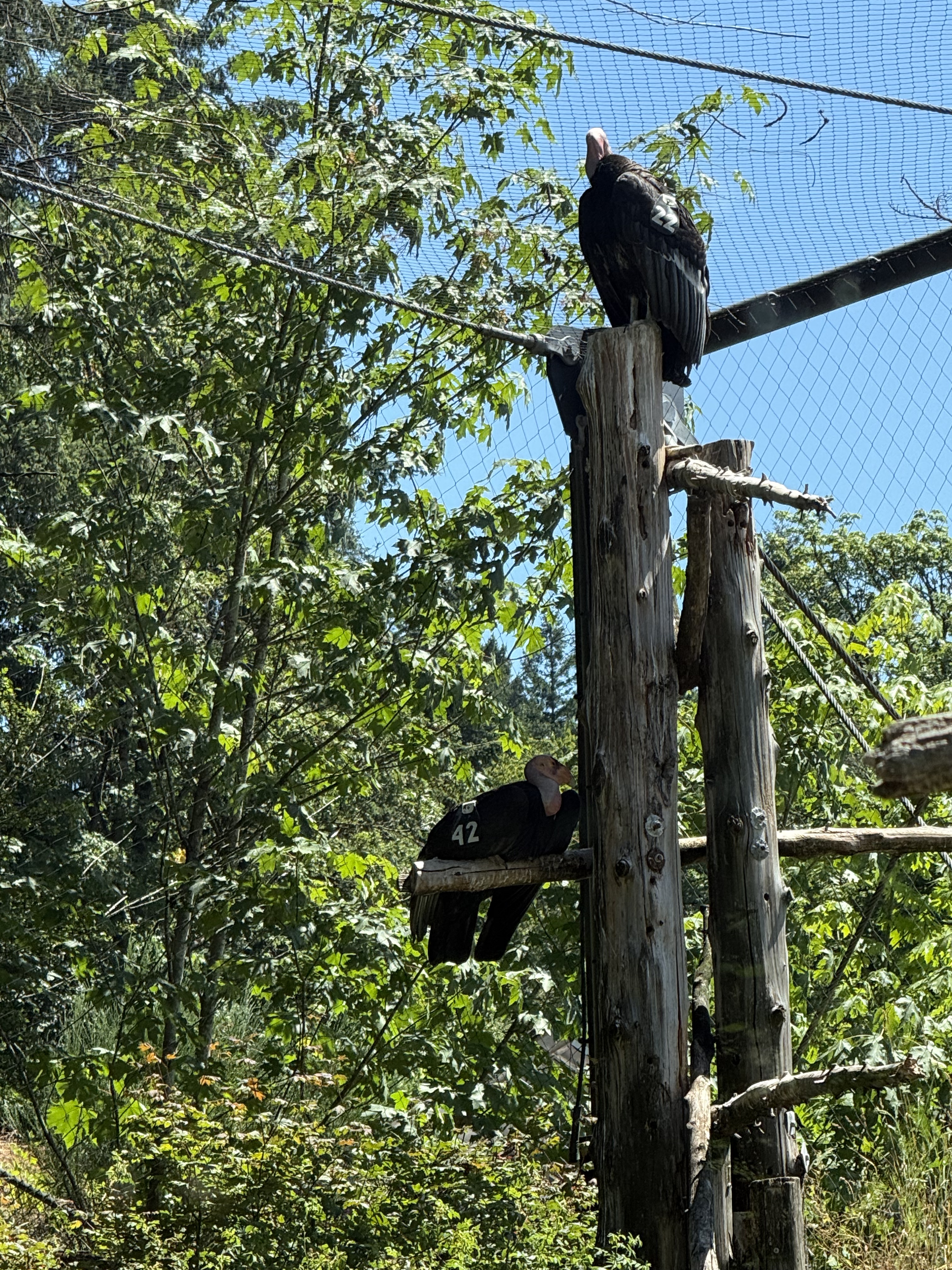
I was feeling pretty bleak about the whole zoo concept until I saw the condors. They were actually EXTINCT in the wild until the efforts of zoos reintroduced them; now they are coming back, each one wearing a team number and a radio transmitter. I guess this is their “halfway house” before winning their freedom.
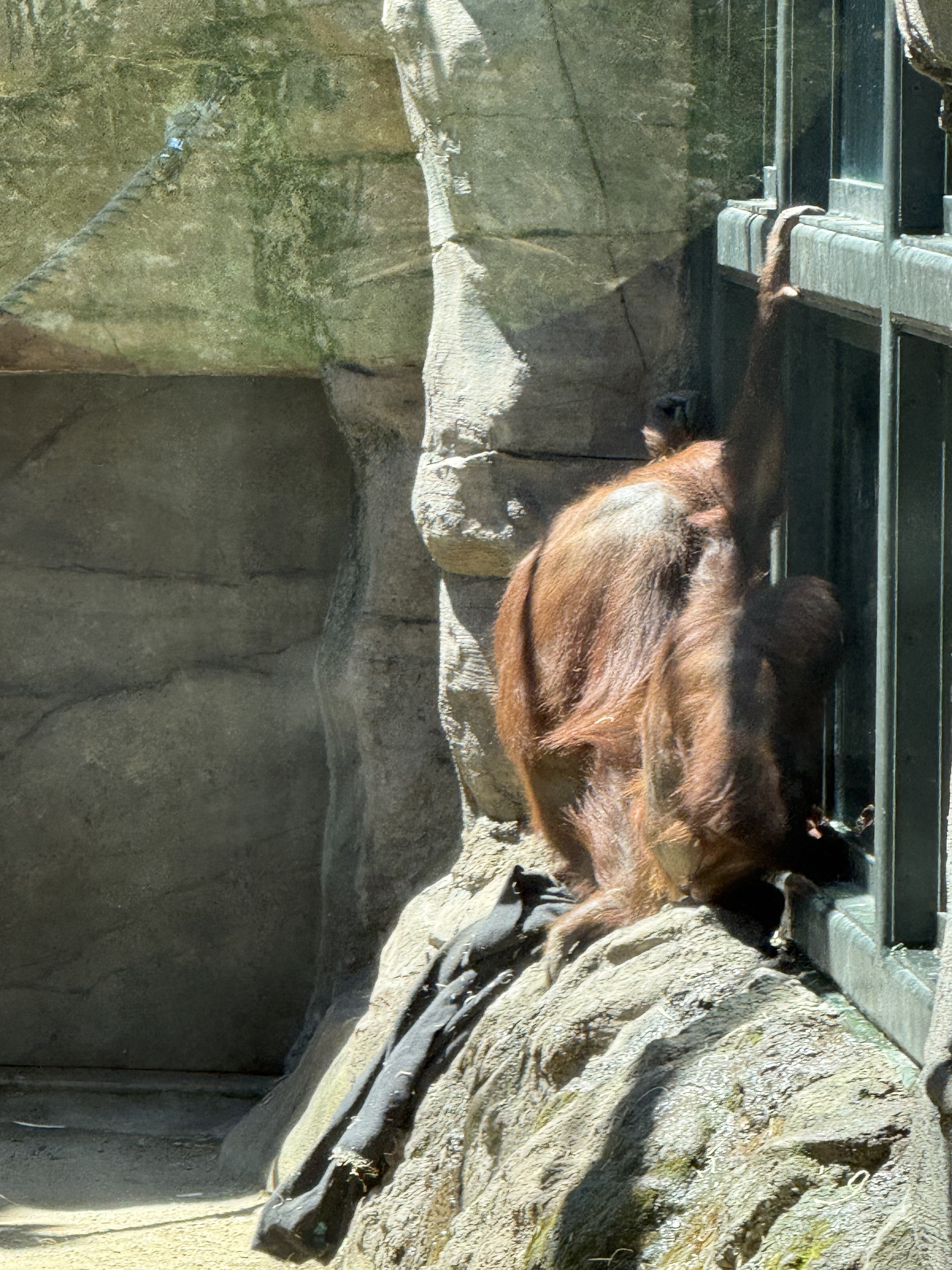
The primates have a series of habitats. Unlike some of the other prisoners, they take an interest in their captors’ antics; these orangutans are watching their human helper clean their bedding (airing and replacing straw). The looking glass works both ways…
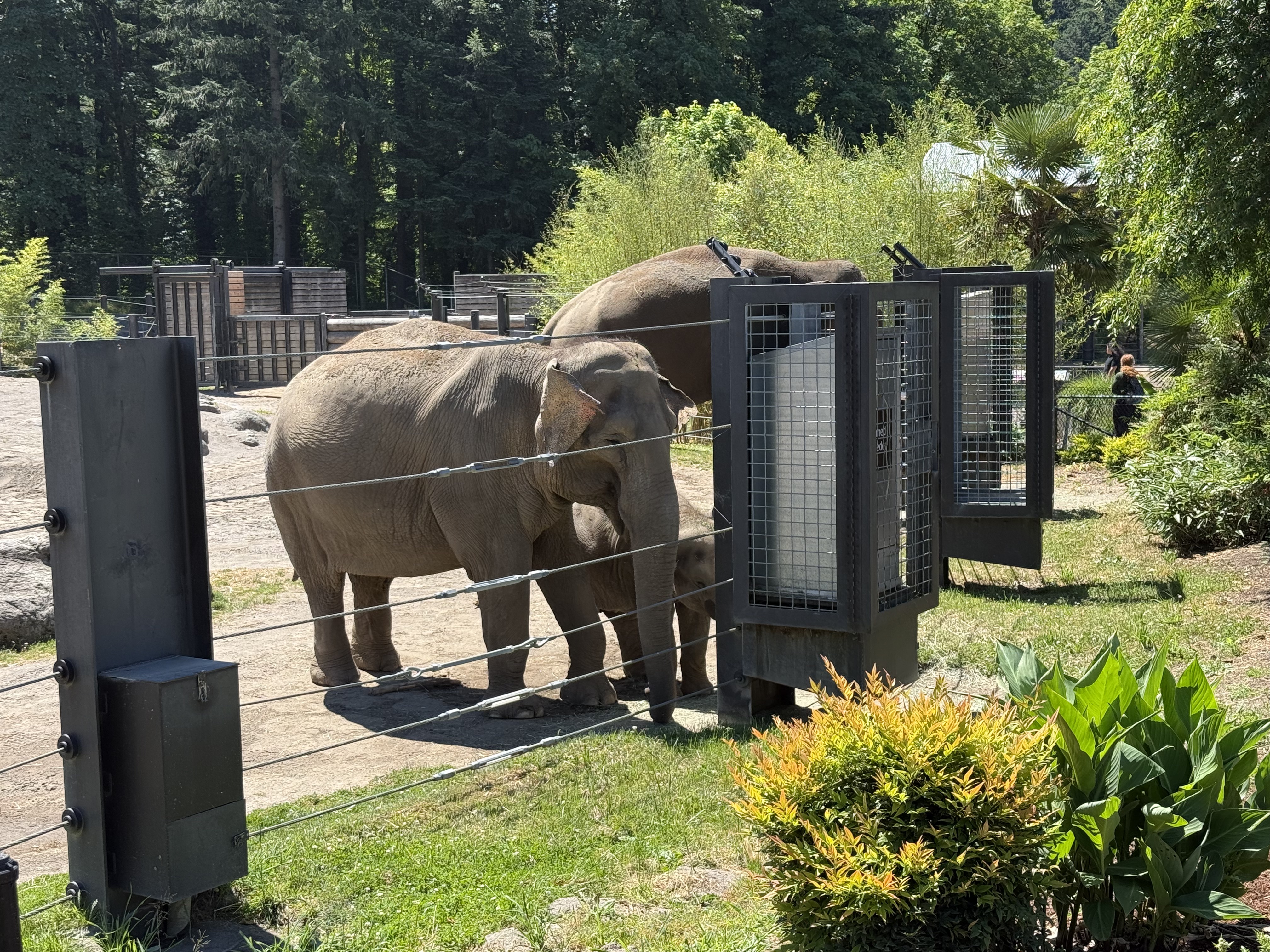
The zoo has named their “guests” because they are trying to support social systems like these elephants would have in the wild. Thus they have family groups (even in animals that don’t have “nuclear” families). For example, one of the males was in a sexually provocative state and isolated in the enclosure seen in the background so that he couldn’t fight with the other males, or injure the young one; but another who was considered “safe” was mixing with the “herd” while feeding in a separate “males only” trough until…
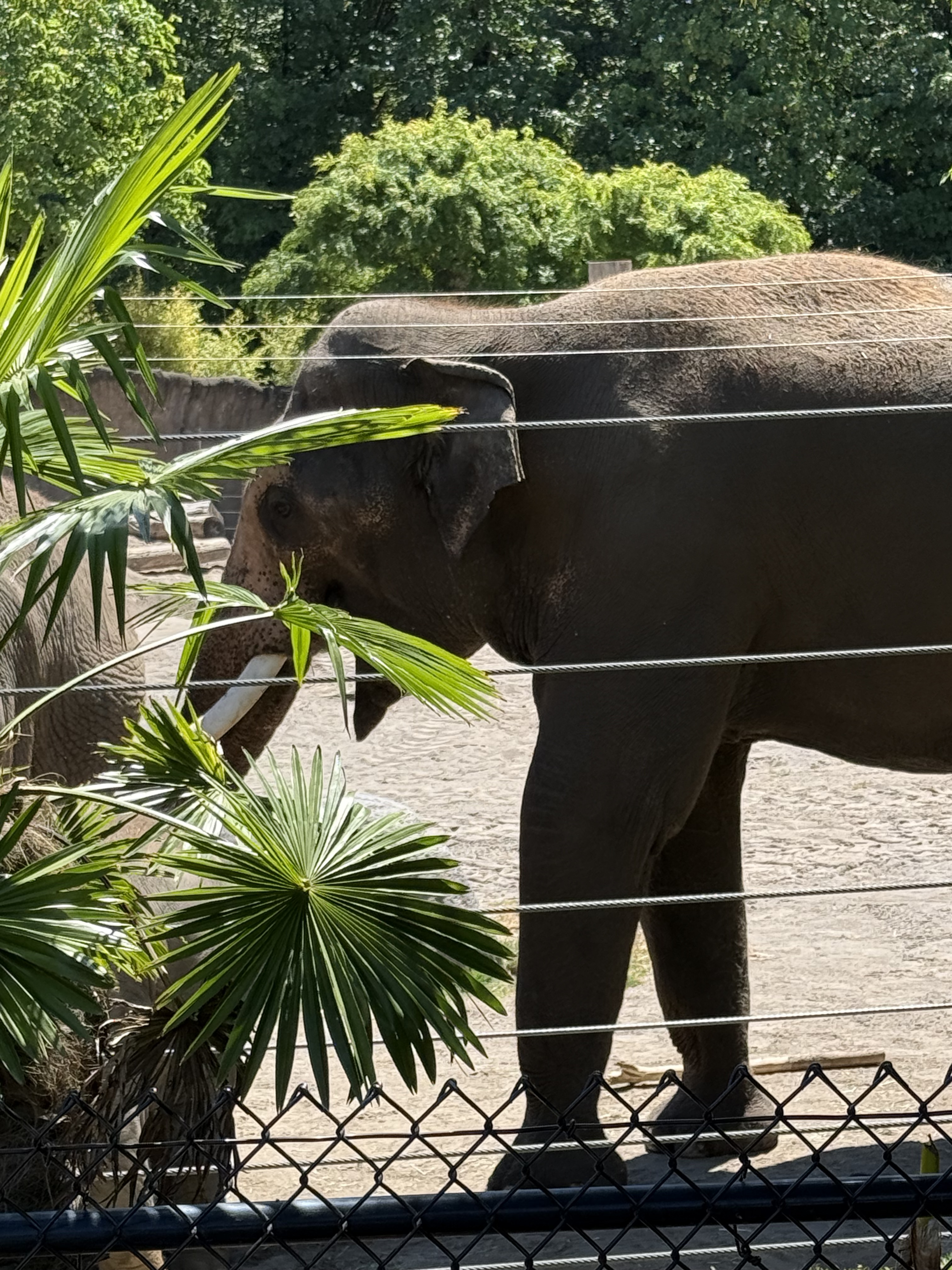
He finished his plate and pushed the others, including the young one, aside to eat their food. These large animals really need many square miles to live. This situation is like having your entire family living in a studio apartment, which people do in some parts of the world; nevertheless, elephants are at the top of my list for animals that will be eradicated by humans because they simply require so much SPACE to live, and they consume massive amounts of resources. I hope they don’t follow the path of the condors, and I applaud efforts like these–hope for the best but prepare for the worst-case scenario…
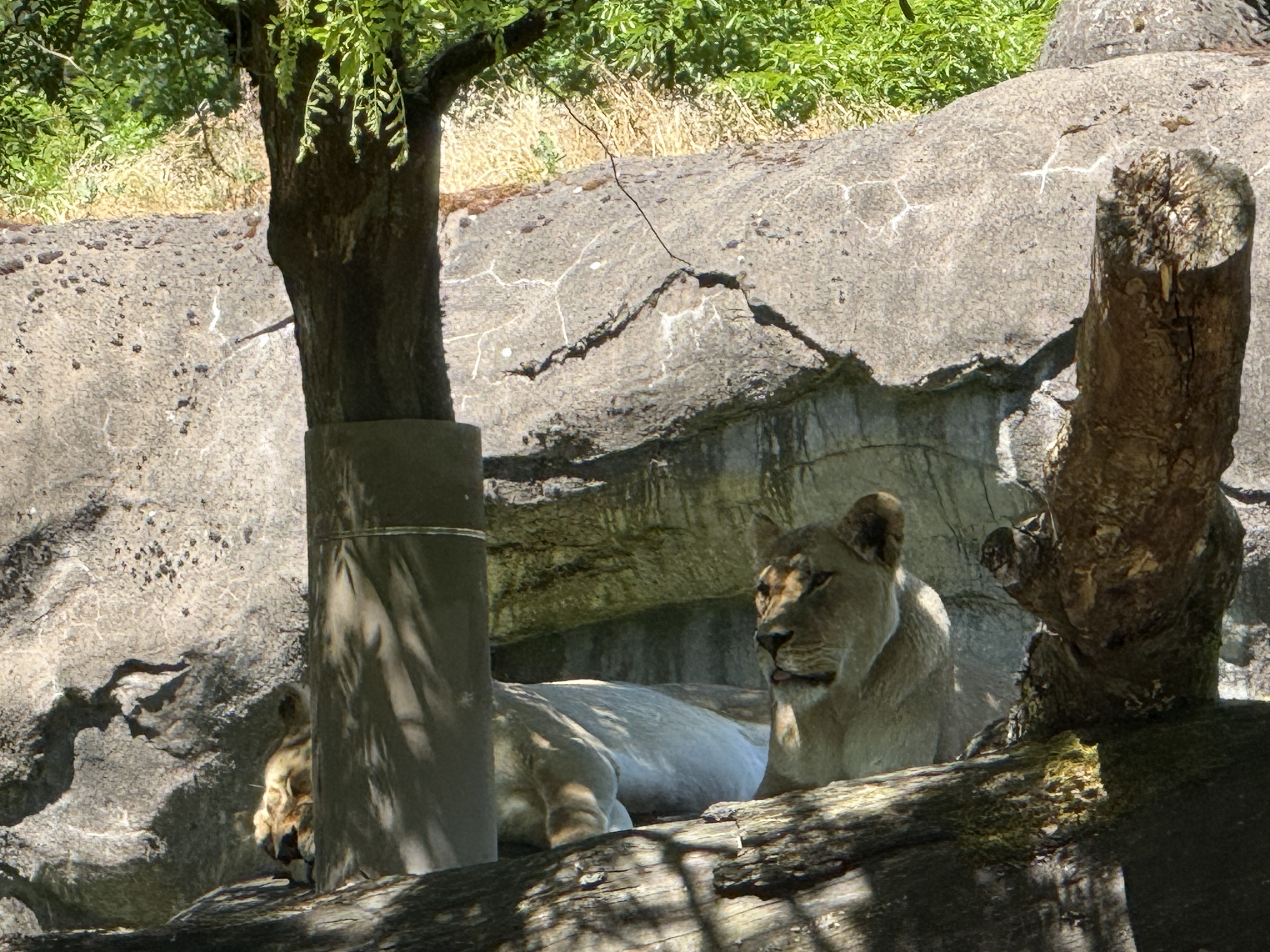
I could barely see these lions, but my phone’s camera caught this image. Words fail me to describe what might be going through this loin’s mind…
These lemurs don’t seem to care that a bunch of primates are watching them as they wake from a nap…
This monitor’s tail is half as long as its enclosure. A photo can’t convey its situation as well as a video, even thought it isn’t doing anything dramatic, but–what is it thinking? I have no idea; maybe it is perfectly happy–well fed, as cool or warm as it desires…
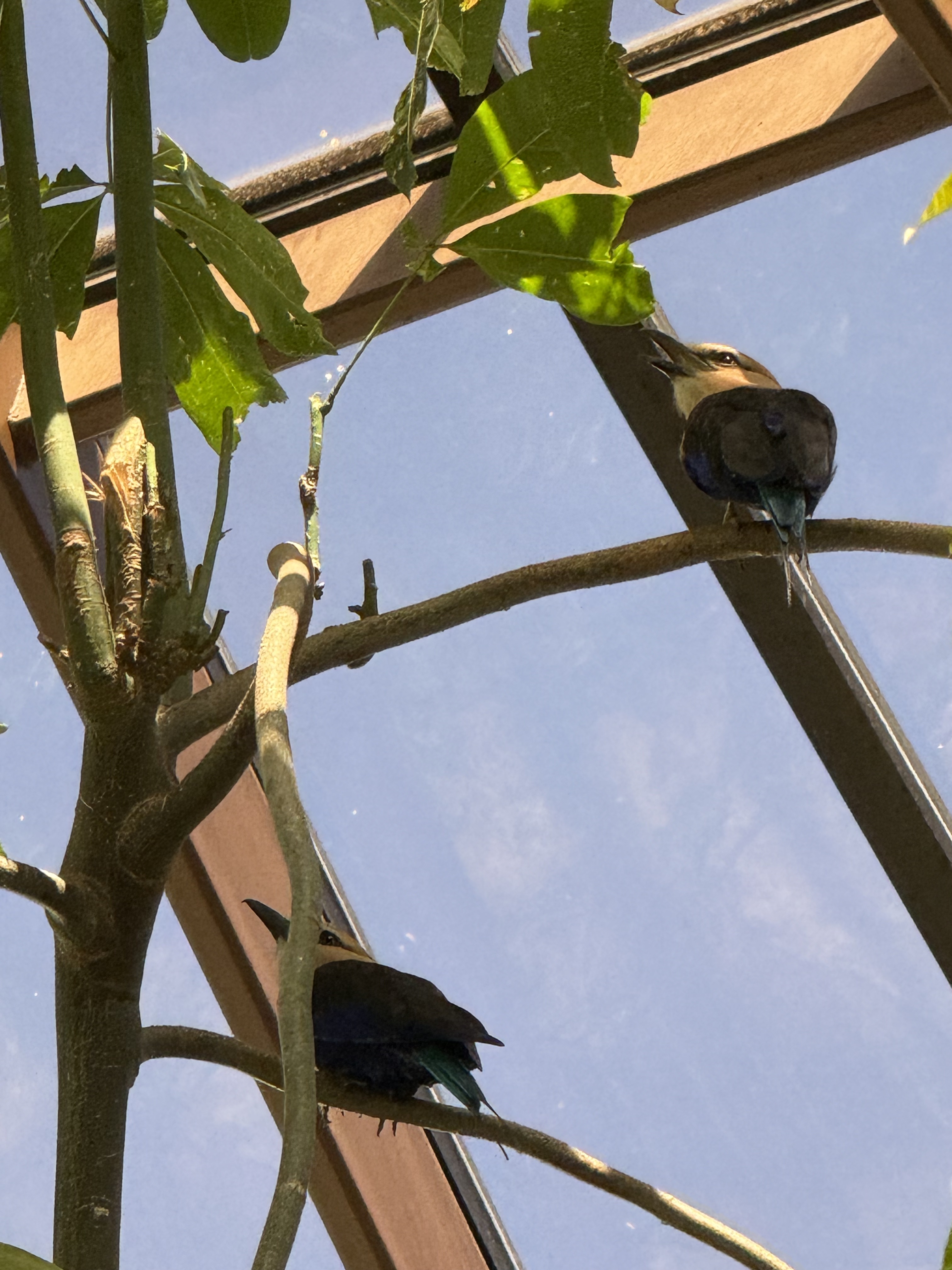
There were a lot of birds in the bird enclosure–small ones that could fly around, larger, flightless ones that hung around the door as if waiting for a chance to escape.
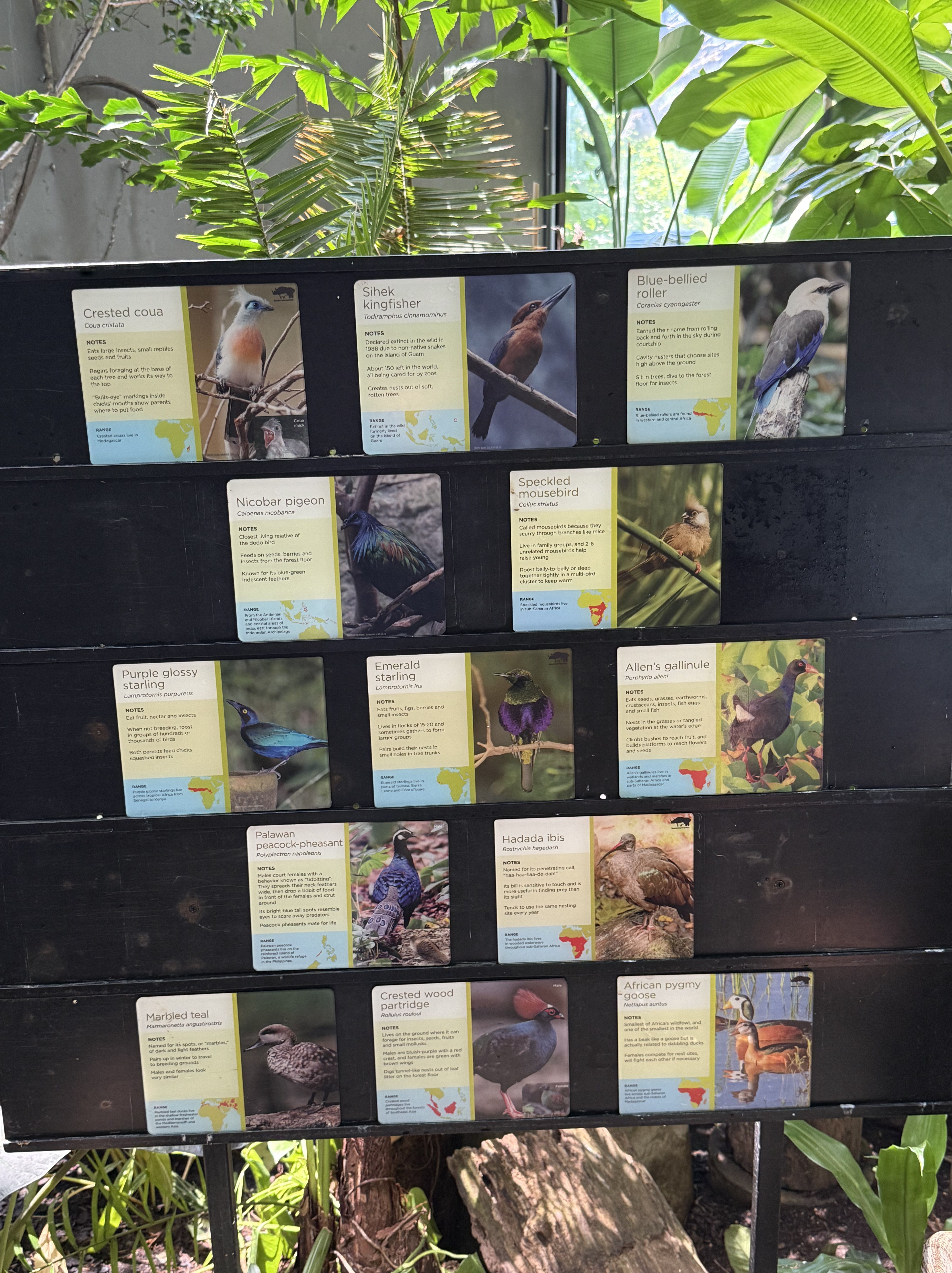
I saw several of these, but they didn’t pose for photos. None of them looks like the birds from the previous photo, but I don’t know anything about birds. Maybe the listing is out of date…or maybe I’m a typical modern Homo sapiens, who is so unaware of the physical world that…
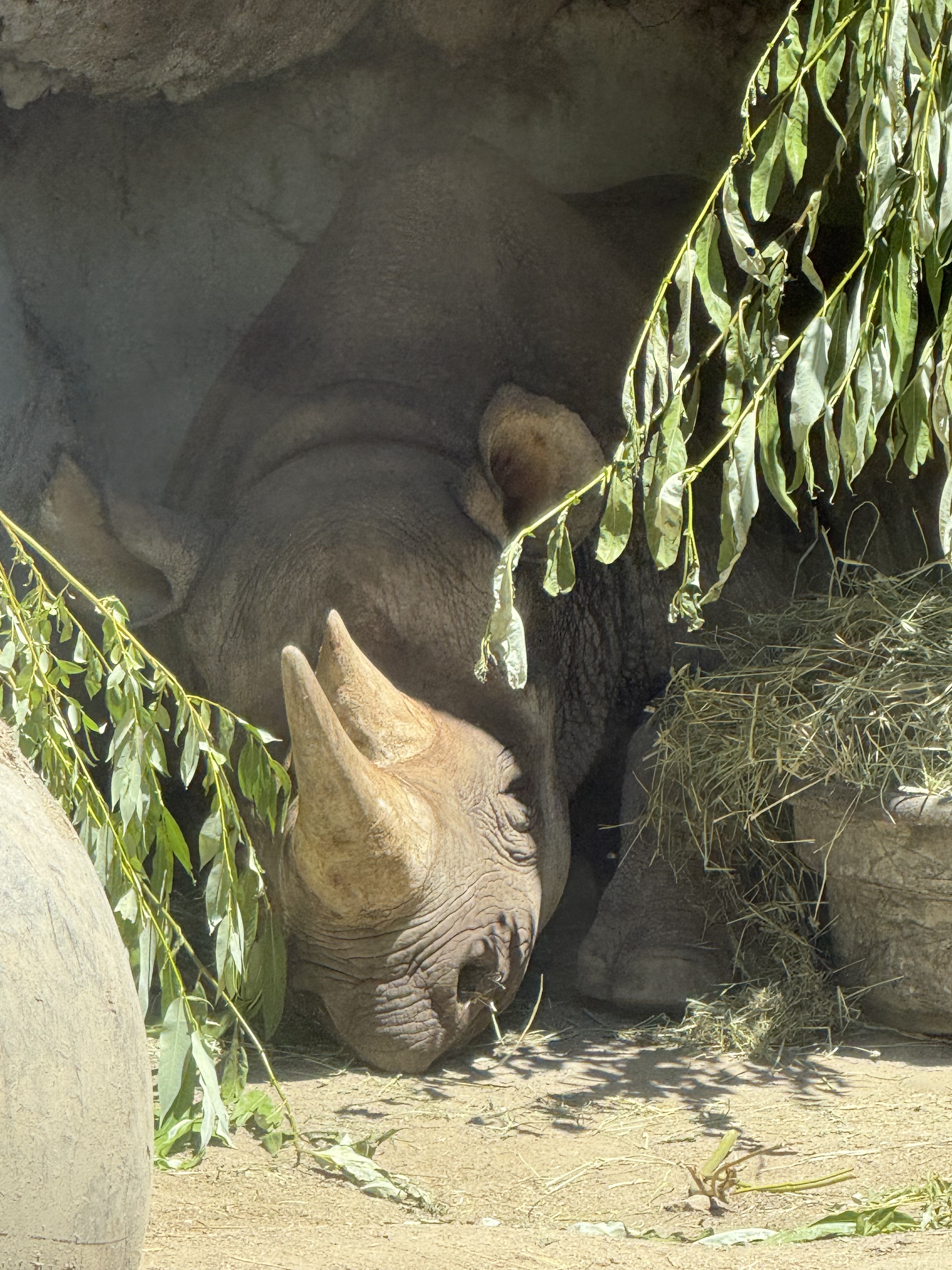
Thank god my phone could see in extreme contrast. I never saw this rhinoceros lying in the shade, apparently listening to every word we primates were saying. This is another example of an animal that requires a lot of SPACE to live; the Oregon Zoo did its best with what was available, even creating a “family” environment with several animals living together.
This tiger doesn’t say much, but their stately demeanor says more than words…

I got this image without seeing what I was photographing. With the light/shade contrast, I was blind but my camera wasn’t. What is this magnificent creature’s expression conveying?
I try not to anthropomorphize because none of the animals held captive in the Oregon Zoo are human. They aren’t stupid, intelligent, emotional, sociopathic, or anything else we sapiens self-classify ourselves as. They are simply not in a position to influence the physical world as dramatically as we. Lions and tigers don’t create cages to hold their prey before they become a meal. They hunt when they are hungry and eat what they can catch.
I don’t think my feelings about zoos have changed after my visit to this excellent repository of the animal world. Nevertheless I understand the conflict between humanity’s claim to dominance, as the top global predator, and the responsibility that comes with this natural order; what I mean is that we are the children of Earth, just as is the tiger and the bacteria. However, with great power comes great responsibility, and it is incumbent on us to accept the difficult challenge of preserving life to the extent of our abilities.
Every animal I saw in the Oregon Zoo is, or will soon be, threatened by humans. Maybe we are the cause of the next great extinction–if so, such an ominous responsibility should be treated with great circumspection. This is no light matter.
Whether we like it or not, we are responsible for the fate of life on Earth…


Recent Comments