Review of “The Folded Sky” by Elizabeth Bear

I’ll start with the easy part. The author has created an entire galaxy of worlds, which I assume define the “White Space Novel” series. There are even pirates, humans who want nothing to do with the modern world or aliens, which there are plenty of in this story. The action scenes aboard various spacecraft are well written and exciting.
The story is a mix of banal family drama and high-energy action scenes, all set to the backdrop of an imminent stellar explosion. The combination doesn’t work for me. I’ve been trying to figure out why, and I finally decided that there are too many antagonists. The story gets convoluted and it is hard to know who or what is an actual threat. The family scenes took up most of the first third of the book; I think the author realized they had lost track of the plot and jammed all the action they could into the last third.
At least twenty percent of the book is wisecracks by the first-person narrator. They used every simile and metaphor in the TWENTIETH CENTURY books. Maybe this is because the central character studies ancient civilizations, but her family had left earth only a few generations before the story takes place. It was very difficult to remember that they are a serious scientist with all the supercilious comments. Overall, this unnecessary self-reflection seriously detracts from the story, and adds a lot of pages.
There’s too much going on…but nothing. Once it became obvious that the pirates were just background noise, the book reduced to a whodunnit about a couple of attempted murders. Every seemingly hopeless situation is miraculously overcome with more fantastical alien powers. In other words, the story is contrived to fit the author’s predetermined ending. All authors do that to some degree, but it was a little too obvious in this book.
If you like space operas you’ll probably enjoy this book.
Quaternary Geology on Mt. Rainier

Figure 1. View of Mt Rainier from the west. At 14410 feet, it is the most prominent peak in the contiguous United States. It has 28 glaciers, with the largest total surface area in the lower states–35 square miles. Mt Rainier is a stratovolcano, composed of andesitic lava (rather than basalt), material ejected from the summit, and ash layers. This type of volcano is commonly found in subduction zones; they tend to have explosive eruptions (e.g. Mt Saint Helens). The oldest rocks on Mt Rainier are about 500,000 years old. It is active and listed as a decadal volcano–one of the most dangerous volcanoes in the world. Its last major eruption, accompanied by caldera collapse, was 5000 years ago, but minor activity was noted during the nineteenth century.
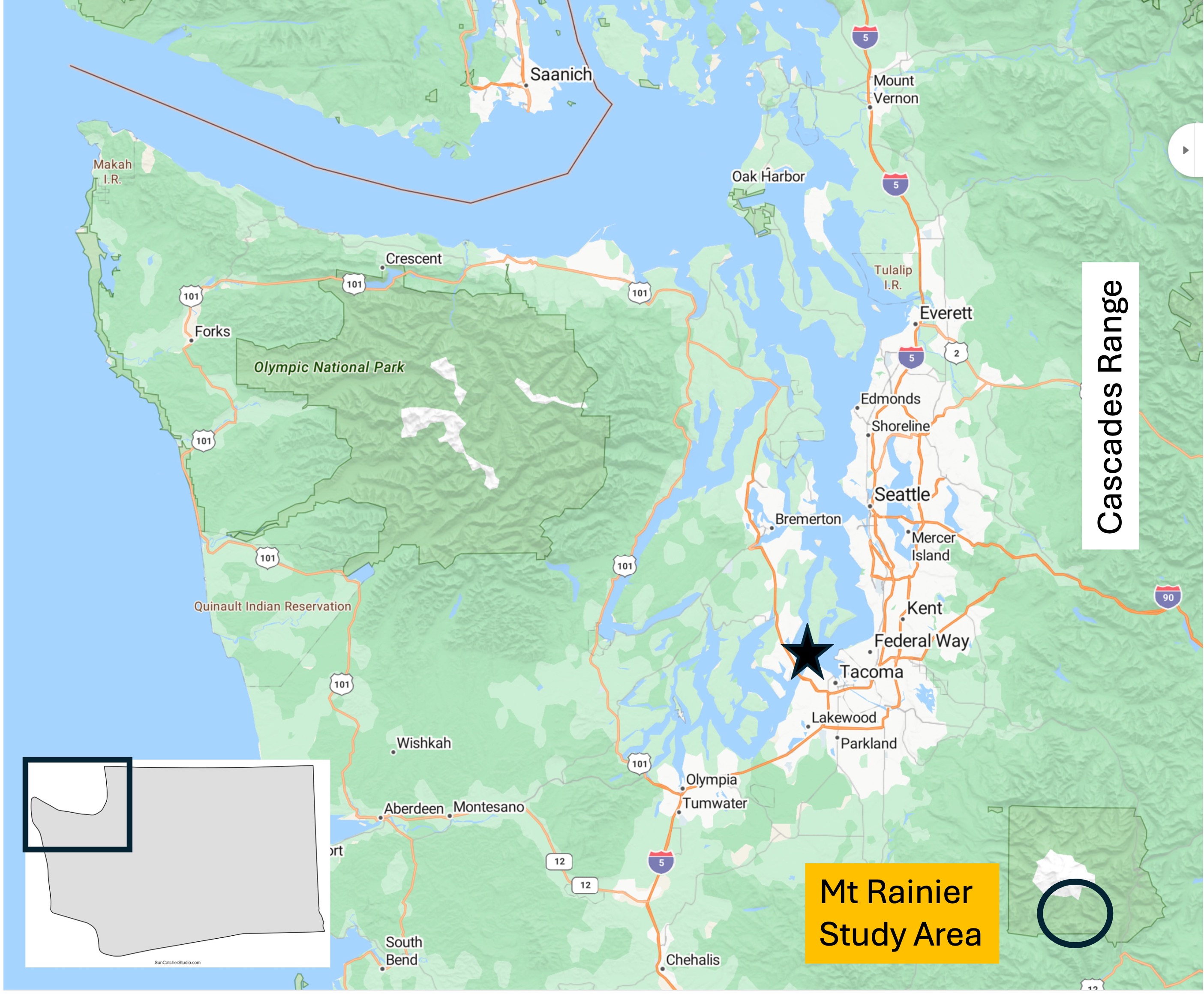
Figure 2. From my home in Tacoma (star) it’s a two-hour drive to Mt Rainier National Park. It is part of the Cascades Range, which comprises many well-known volcanoes like Mt Baker, Mt St. Helens, and Mt Hood.

Figure 3. This photo was taken on the south flank at an elevation of about 5400 feet, near the visitor’s center. It was a beautiful day and there were a lot of people preparing for some cross-country skiing on a couple of feet of snow. From this elevation it takes 2-3 days to reach the summit, almost 9000 feet higher. It’s hard to imagine it being so high and taking so long to reach.

Figure 4. These southern volcanic mountains are part of the Tatoosh Range, with peaks of about 6600 feet. Most of the volcanic rocks comprising these mountains are andesite, intermediate in composition between basalt and rhyolite. It is also very viscous, behaving like peanut butter and thus not flowing well. Andesite is commonly found at convergent plate boundaries where it is thought to result from mixing of basalt (from the oceanic crust), continental crust, and sediments accumulated in the accretionary prism.

Figure 5. Map of the 28 glaciers on Mt. Rainier. The glaciers fill canyons and valleys that were partly cut by ice. Figure 3 shows a smooth mountain, but in reality most of the smooth areas are the surfaces of glaciers. We’ll look at one below. The ellipse indicates the area discussed in this post.

Figure 6. (A) Narada Falls interrupts the descent of Paradise River, fed by Paradise Glacier (see Fig. 5 for location), making it drop a couple hundred feet over a thick layer of andesite. Andesite tends to form blocky flows, as shown in the right side of the photo, where the water seems to be climbing down steps. (B) Possible contact between younger volcanic and older intrusive rocks. Igneous activity within the area has been continuous for at least 50 my, during which time erosion has exposed older intrusive rocks like this granodiorite, which is part of a pluton intruded between 23 and 5 Ma. It is important to keep in mind that the volcanic rocks originated in plutons (magma chambers) emplaced miles beneath the surface. As they are exposed, new volcanoes form as more magma is injected into the shallow crust in a continuous process. (C) Differential weathering has accentuated layering in this volcanic rock, which was probably created by a series of ash layers deposited in quick succession–geologically speaking.
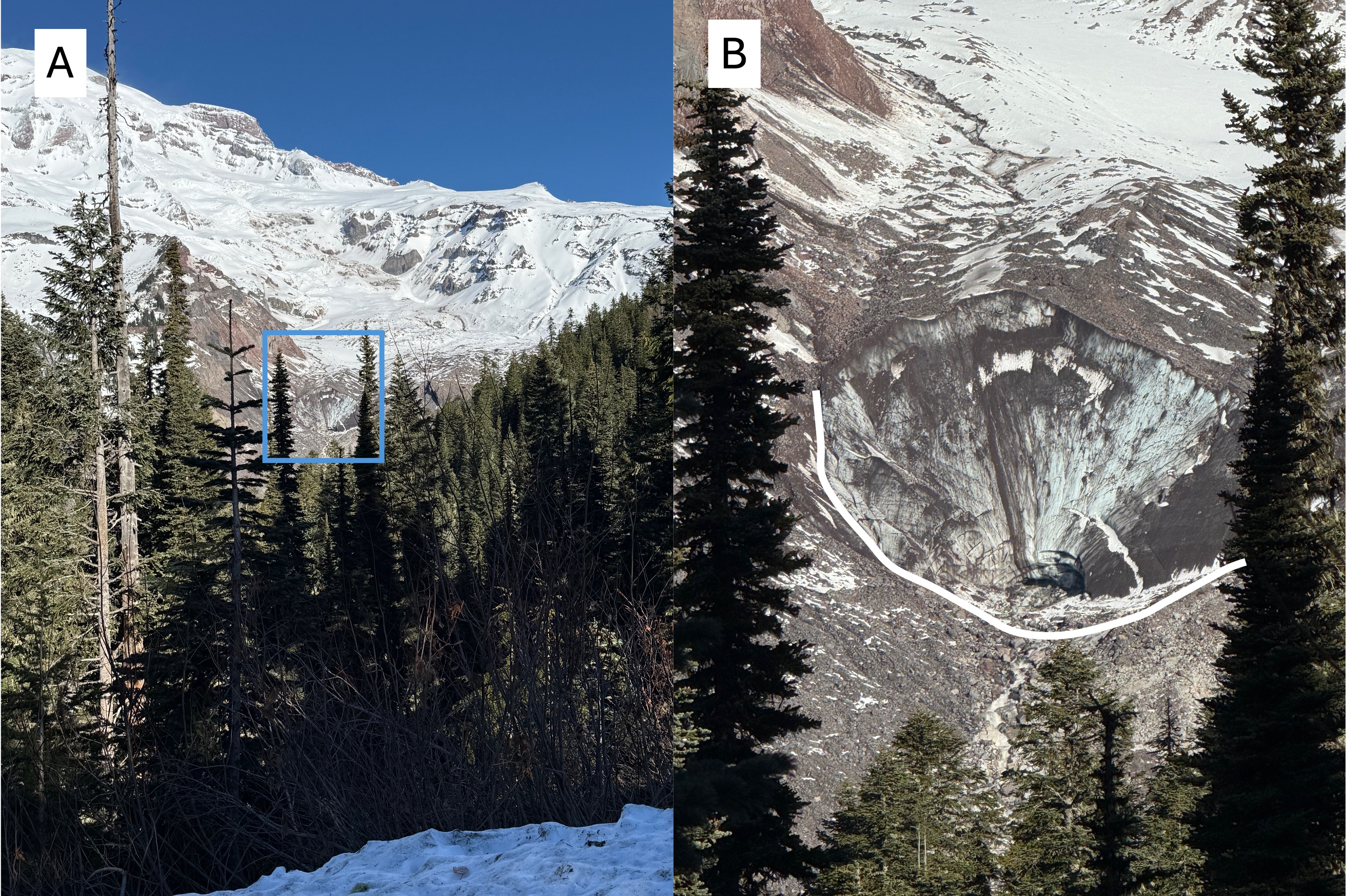
Figure 7. (A) View looking north towards the source of Nisqually Glacier (see Fig. 5 for location), which originates near the peak of Mt Rainier. The area delineated by the blue rectangle is the face of the glacier. (B) Closeup of the face of Nisqually Glacier. The characteristic U-shaped valley carved by glaciers is highlighted in white. Note the dark material within the glacier, probably wind-blown fine sediment. It looks like the face is a couple hundred feet high. I’ve never seen a retreating glacier before, so this is pretty spectacular to me. The Nisqually River originates right here…
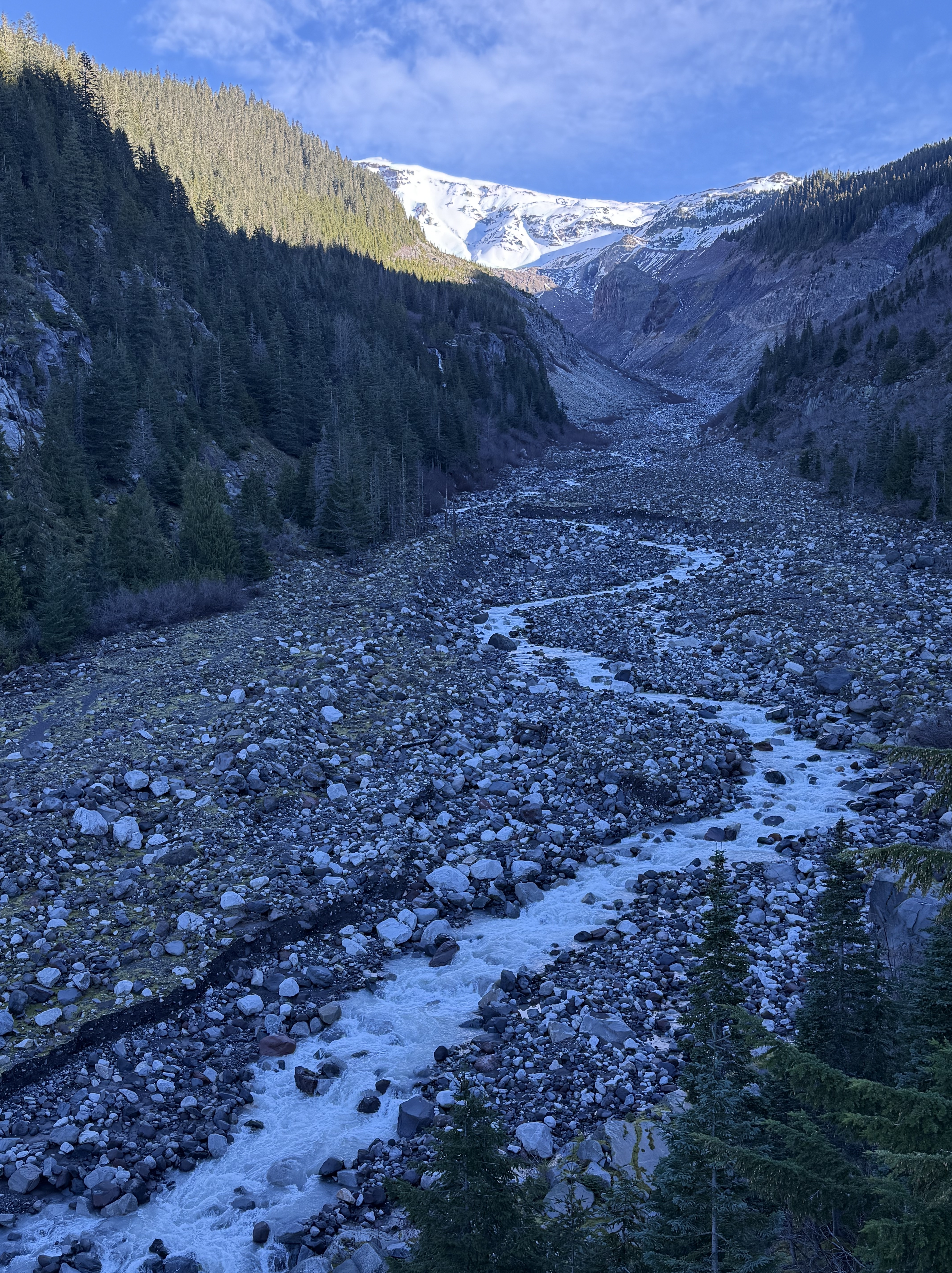
Figure 8. View looking upstream along Nisqually River a mile downstream from Fig. 7. This is one of the most stunning photos I’ve ever taken because it reveals geological continuity, from the origin of a glacier 10000 feet higher, to the outwash being transported by a river. Amazing! Note the perfect U-shape where the shadow ends upriver. This area would have been covered by the glacier as recently as 10000 years ago.

Figure 9. Another mile downstream from Fig. 8 the walls of the valley have lowered, and are now rimmed by volcanic flows half-buried by detritus. Evidence of a glacier filling the valley has been erased by collapse of the valley walls. Rounded boulders fill the riverbed. The Nisqually River is overwhelmed by the huge sediment load and opens up new channels to continue flowing.

Figure 10. View looking upstream at the confluence of Nisqually River and Van Trump Creek. There are a couple of interesting features visible in this braided stream bed, less than two miles from the glaciers feeding each branch. The valley is very wide and flat-bottomed because it was carved by glaciers more than 10000 years ago. The large boulders (as large as three feet) covering the entire valley floor were transported by a glacier and became relict after its retreat because the stream flow, even during floods, is too weak to transport and erode them. The Nisqually River is cutting a channel through these relict sediments; the scarp is about eight feet in height. The white line delineates large, surface boulders from subjacent sand and silt with few boulders. Note that the surface boulders stop upstream where the white line curves sharply upward.

Figure 11. Image from 200 feet downstream of Fig. 10, showing a break eroded in the boulder-bar that crosses the stream bed at an angle. During recent heavy rain Nisqually River broke out of its current channel and created a myriad of flow structures such as the longitudinal bars seen in the lower-right of the photo. I think this bedform is actually a terminal moraine marking the maximum advance of a previous glacier–not necessarily the maximum glacial extent during the last two-million years.

Figure 12. (A) Andesite boulder (2 feet across) wet by recent rain shows fine-scale structure. The irregularity of the laminae, and phenocryst distribution, suggest to me that this sample represents ash fall rather than a flow. Magma with the viscosity of peanut butter tends to form smooth lines because it is difficult to penetrate, which would be necessary to create the mixed-up appearance between the lighter and darker shades in the center of the image. (B) Large block (~10 feet long) of intrusive rock similar to that seen at Narada Falls (Fig. 6B), but this is two-miles downstream. This relic was pushed/dragged by a glacier to this location. The white circle indicates where a close-up photo was taken. (C) Close-up (5x) image of the heavy block. It contains quartz (Q), plagioclase/albite feldspar (no orthoclase) (F), and amphibole (Am). My estimate of the composition is: 50% feldspar; 30% quartz; and 20% amphibole. Based on my estimated mineral composition, this would be granodiorite; however, I didn’t differentiate plagioclase and albite feldspar. (The former is darker than the latter.)
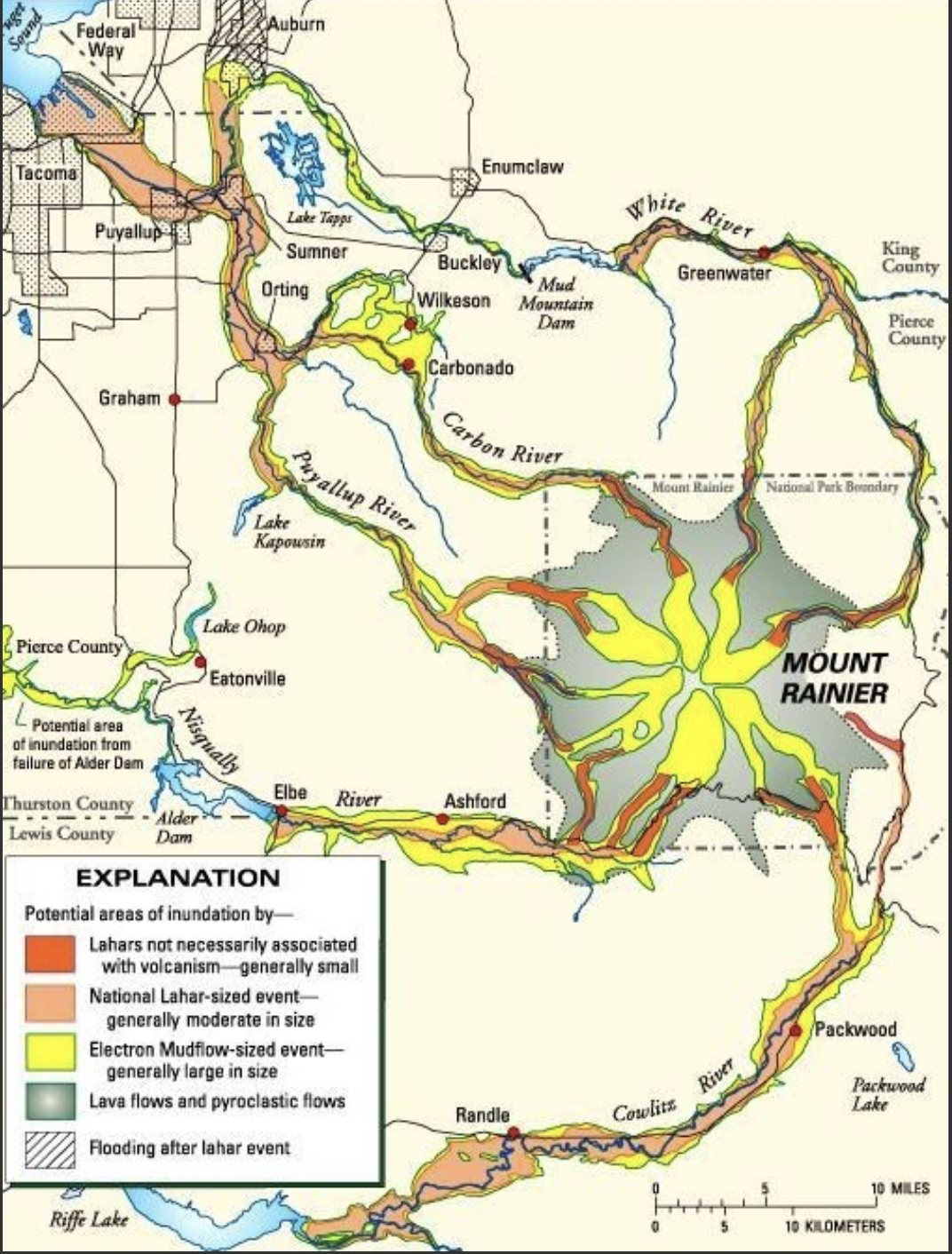
Figure 13. Map of potential volcanic risks associated with Mt Rainier–besides an explosion (e.g. Mt St Helens) and the eruption of ash which would cover a large area, depending on wind direction. Lahars (mud flows fed by all those glaciers) pose the greatest risk because andesite is too viscous to flow more than a few miles from its source.
Summary. I have seen evidence of continental glaciers in the Great Plains, the German Plain, and Ireland, but I never had the opportunity to observe glaciers up close. Alpine glaciers were nothing more than an abstract idea to me, something viewed from a distance.
I’ve looked out over the clouds from the summit of Haleakala crater on Maui, gazed into the cauldron of Kilauea, witnessed the boiling water rising from beneath Yellowstone’s seething caldera. I’ve seen videos of volcanic eruptions in Iceland, but I never imagined putting the glaciers and volcanoes together–right next door!
Usually, geology is observed as a series of images frozen in time, but at Mt Rainier it can be glimpsed as a real-time process that reshapes the earth’s surface–from top to bottom.
What a wild geological ride!
Deception Pass: Ophiolite or Volcaniclastic Sediments?
Now that I have a general idea of the geologic history of Northwest Washington (NWA) it’s time to start filling in the blanks. I immediately found a discrepancy in the rocks found on the northern end of Whidbey Island and the adjacent peninsula (Fig. 1): some authors identified these rocks as ophiolite–pieces of ocean crust that contain evidence of extrusion at mid-ocean ridges. Let’s see what I found.
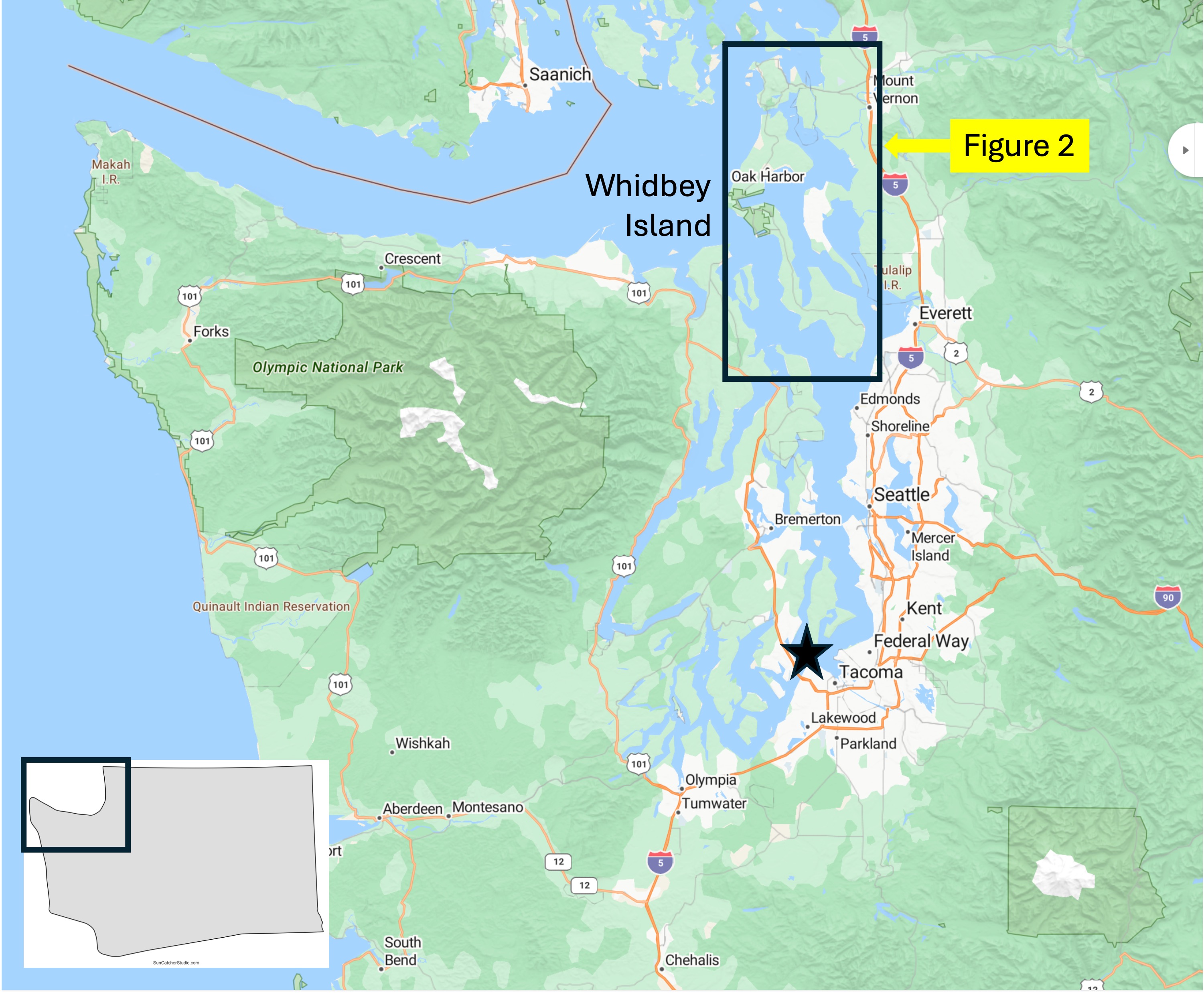
Figure 1. Whidbey Island is a large island that is almost completely covered by glacial sediments. Its elevation varies from less than 100 feet above msl (mean sea level) to almost 400 feet, probably reflecting the presence of terminal morraines deposited as glaciers retreated. The box encompasses the study area, and the star is my home in Tacoma.

Figure 2. Progressively more detailed maps of Whidbey Island, showing the geological formations discussed in this post. (A) Deception Pass is a narrow channel (~200 yards wide) between Whidbey Island and a tiny island that connects it to a peninsula. Glaciers covered this entire area, advancing and retreating for at least two million years, while scraping out Puget Sound from unconsolidated sediments and easily eroded rocks. I entered Whidbey Island via a ferry from the mainland just north of Seattle. (B) Geologic map of the norther tip of Whidbey Island and the adjacent peninsula. The tan areas are covered by glacial sediments whereas the blue and green areas are reported as volcaniclastic rocks by Rock-D and the US Geological Survey national map. However, I read a Washington State geological report from 1962 that reported layered gabbro and other indices of a classic ophiolite sequence. Were Washington’s geologists incompetent? Over eager? Non-peer-reviewed? Or maybe they stumbled onto an exposure, described it in a state report, and, when no one cared, dropped it until they retired. I don’t know. Nevertheless, everyone is in agreement that the age of these rocks, which include basalt and marine sediments, is poorly constrained: they could be as old as 251 Ma, the beginning of the Mesozoic era; and as young as 66 Ma–the end of the Mesozoic. Wow! The thin, black lines indicate faults inferred from stratigraphic relations. The USGS has adopted the generally accepted paradigm of gathering legacy geological formations into larger groups that reflect the plate tectonic setting, rather than geographic location. The “official” description is so encompassing (including the kitchen sink) that it could easily include what the Washington geologic report called “ophiolite”. (C) Detailed map showing my approximate location along the path that followed the shoreline (blue circle) and the location where I saw these rocks in an excellent exposure (yellow diamond). I’m not sure why the rocks south of Deception Pass (blue) are differentiated from those on the north side (green) by Rock-D; the USGS map shows they are the same, as does my field examination (discussed below).
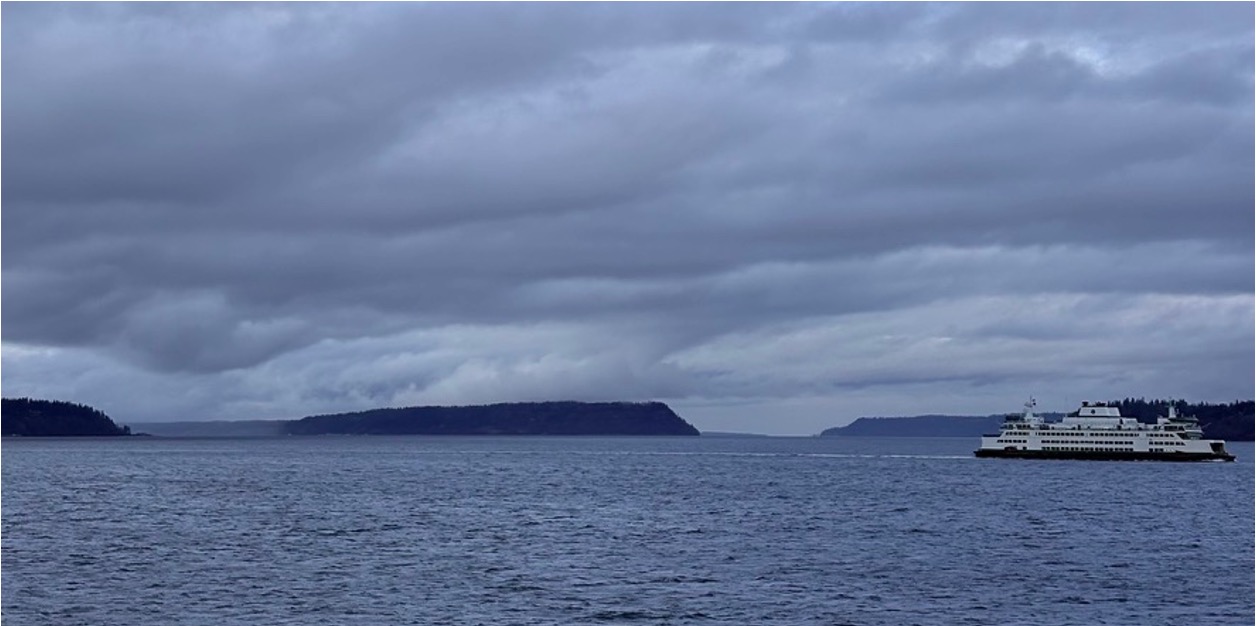
Figure 3. The ferry ride from Mulkiteo to Whidbey Island (see Fig. 2A) shows the same high elevation of Whidbey Island (left), Hat Island (center), and a promontory north of Tulalip (behind the ferry; see Fig. 1). This elevation of glacial sediments is approximately the same as the basement rock discussed below. This high relief shoreline is found throughout Puget Sound.
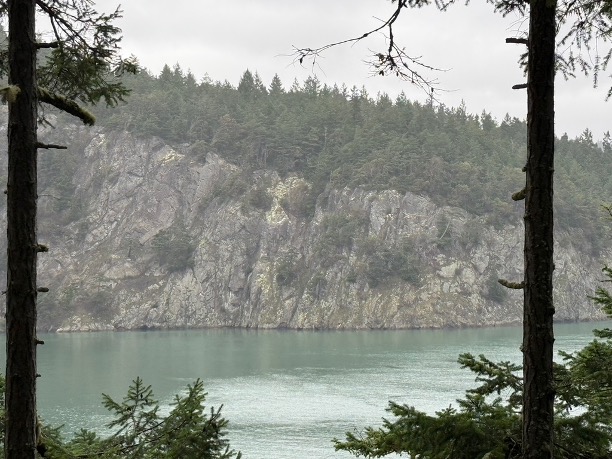
Figure 4. View looking north across Deception Pass, showing the nearly vertical bedding of rock layers, which could be original sedimentary fabric, metamorphic surfaces, or joints. Let’s have a closer look.

Figure 5. Images of the exposed rocks near the top of the hill overlooking Deception Pass (see Fig. 2C for location). (A) These medium bedded (~6 inches) layers contain clasts of different rocks. The height of the image is about six feet. (B) This twelve-foot exposure shows thin-bedded sand/silt layers with intercalated mud, but the layers are overturned (more than 90 degrees from horizontal) and reveal rapid changes in bedding, in addition to large boulders of material. (C) A bedding surface shows the characteristic sheen of schist, which adds metamorphic foliation to original bedding. These rocks are not heavily altered, so the layers seen in (B) probably reflect original beds. The clasts in (A) are matrix supported, which suggests mixing of different sized particles. This unusual texture occurs in environments where periodic mass failures (e.g. landslides or submarine slides) occur.

Figure 6. These images from about 100 feet elevation show more details of the rocks exposed at Deception Pass: (A) These layered sediments vary from medium to thick bedded and they also reveal gentle folding at this scale (the photo is ten feet high), suggesting that the overturned beds may be part of a large fold, possibly related to the faults seen in Figs. 2 B and C; note that the faults have a NW-SE orientation approximately aligned with the fold axis (I didn’t make careful measurements). It is also possible that the faults reflect brittle failure as the rocks were uplifted within the accretionary prism. (B) The left half of the exposure reveals a thick (> four feet) layer containing mixed clasts in an otherwise fine-grained matrix. The right side contains medium beds of a lighter material (We don’t want to get carried away here because of the vagaries of chemical weathering.) However, the contact between the two apparent lithologies is irregular; If I’m right about the left side being the bottom (questionable), this could have been a volcaniclastic slide (basalt, ash, pieces of rock, etc) that was then filled in by less catastrophic sedimentation. I admit I’m speculating, but we have to imagine life on the continental margin during active volcanism, during subduction.
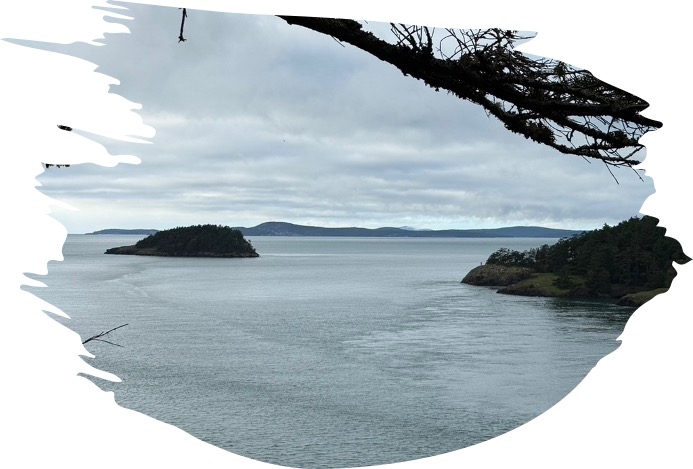
Figure 7. This photo was taken looking west from Deception Pass (see Fig. 1), towards the Pacific Ocean. Those islands are emergent blocks of jumbled Mesozoic/Tertiary sedimentary and volcanic rocks. The last ten-thousand years of sea level rise has covered most of the evidence contained within the accretionary prism, leaving us with only fragments.
Conclusion. I didn’t see any ophiolite at Deception Pass, but there is plenty of evidence of accretionary tectonics; deeply buried sediments and volcanics were scraped off the subducting oceanic crust and deformed continuously. This process has to obey the laws of conservation of mass, which means that the accretionary prism accumulates further west with each passing year. What we see exposed at the northern end of Whidbey Island is occurring today beneath the continental shelf, all while the Juan de Fuca plate is swallowed by the earth’s mantle. There is a two-mile-deep trench about 100 miles off NWA, but it is filled with sediment eroded from N. America, unlike more-familiar deep-sea trenches (e.g. the Mariana Trench, about 7 miles deep).
All that sediment in the subduction trench is like sand in in your transmission: it gums up the works and slows things down, but the Earth cannot be stopped, its relentless, insatiable appetite for oceanic crust never satisfied. It will keep chewing up the Juan de Fuca plate until the upper mantle decides that enough is enough and stops pushing N America westward.
I can’t wait to see how this ends…
Catching Up: A Brief Geologic History of NW Washington
Introduction
The shifting of tectonic plates around the surface of the earth is a zero-sum game because the surface area is fixed; thus, when new oceanic crust is created from the upper mantle at divergent plate boundaries (usually mid-ocean ridges but also at intraplate rift zones), oceanic crust has to be absorbed back into the upper mantle through subduction at convergent plate boundaries. Continental crust is not subducted because it is about 10% lighter than oceanic crust (2.7 g/cm3 vs 3 g/cm3), so it has been accumulating since the earth was created. Note that it took about 4.5 billion years (by or Ga; I will use Ma to refer to millions of year ago) to form the continents, which still comprise less than 30% of the earth’s surface.
The majority of continental crust existed by 3 Ga, and the crust was stabilized by 2 Ga; in other words, for the last two billion years, the same continents have been jostling about, driven by upper mantle convection–like a poached egg floating in boiling water. North America is a good place to examine these processes because it has mostly shifted back-and-forth, from east to west relative to its current orientation.
The geology of NW Washington can thus be seen as the opposite of Northern Virginia (NoVA); when the east coast is convergent, the west coast is divergent. This simplified model explains the differences between the two coasts/continental margins. The contrast is striking, which I will attempt to show in this post.
Precambrian (older than 550 Ma)
Current estimates suggest that 15-20% of the earth’s surface is Precambrian. Ignoring the rest of the world for now, there are a few metamorphic fragments (primarily gneiss, which is a rock so highly altered by heat and pressure that its original structure is lost); however, these rocks are not folded and partially melted, which suggests that they were altered primarily by deep burial–not compressive stresses. Nevertheless, they don’t shed much light on the Precambrian history of NW Washington (NWA hereinafter) other than that a lot of sediment was being buried very deeply.
This is very different from NoVA and the east coast in general, where long bands of gneiss and schist (a less-altered rock) are exposed from Georgia to Maine; their metamorphic ages range from 1-2 Ga, reflecting large scale collisional tectonics including subduction. The simplest interpretation is that the North American tectonic plate was moving (relatively) eastward during this interval, creating a passive margin along the west coast (Plate 1).
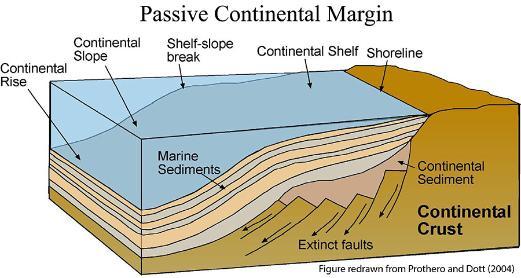
Plate 1. Schematic of a passive continental margin. This example is for a continental plate moving to the right while sediments are deposited along a gently dipping margin. As far as the data tell us, this was the situation in NWA between about 1000 and 250 Ma. The N American plate wasn’t jiggling, but rather sedately moving eastward, chewing up whatever islands and microcontinents got in its way while shedding its sediments on the west coast. (Like water off a duck’s back.)
Paleozoic (550 to 250 Ma)
The Paleozoic era saw the rise of multicellular organisms, which filled the oceans and colonized the land. There are enough fossils, the inhabitants of ancient seas in NWA, to document this explosion, but the rocks are highly altered and deformed. Nevertheless, the paleontological record implicitly supports the continuation of the passive margin that existed during the late Precambrian. In other words, a vast and diverse ecosystem was established that thrived for 300 my.
Mesozoic (250 to 65 Ma)
The Mesozoic era began with the breakup of Pangea, the supercontinent whose construction culminated during the Devonian period (415-360 Ma). This paradise of life lasted about 100 my but all good things must end. Upper mantle convection reversed course and Pangea was torn apart by what is today the mid-Atlantic ridge system. I saw the evidence in NoVA for myself; but what did this catastrophic event foretell for the peaceful west-coast of N America?
All hell broke loose.
The placid coastal environment suggested by Plate 1 was obliterated, geologically speaking, when the N American tectonic plate reversed direction and split away from Pangea, after approximately 100 my. At first there would have been earthquakes and uplift as the oceanic plate resisted the sudden compression. Nevertheless, when push came to shove, the denser oceanic crust was pushed beneath N America, creating a subduction zone that is still active.

Plate 2. This schematic portrays NWA as it exists today. Note how close the Juan de Fuca ridge is to N America. If we go back to the Triassic period (~250 Ma), there would have been about 2000 miles of oceanic crust between them, but it was all subducted. This subducted ocean crust would have partially melted to produce igneous intrusions, which were subsequently intruded by younger magma. Today, only a few slivers of the oldest igneous rocks are found east of Seattle. There were also sediments deposited; however, these were buried and deformed to form schist and other medium metamorphic grade rocks. Most Mesozoic rocks were eroded as uplift continued until the present day. Bands of Mesozoic volcaniclastic rocks are found east of the cascades where uplift has slowed as the subduction zone migrated westward.
Tertiary (65.5 to 2.4 Ma)
As the years passed the situation in Plate 2 continued unabated. Igneous intrusions of every composition (i.e. from gabbro to granite) pushed their way through the overlying rocks, often reaching the surface to create volcanoes and overlapping volcanic flows, mostly basalt.
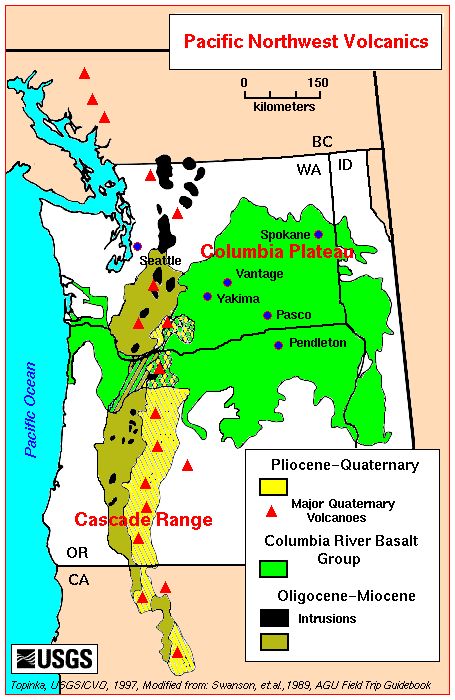
Plate 3. Map of Tertiary volcanic rocks in Washington. The oldest eruptions occurred along the Cascade range between about 50 and 2.4 Ma; the Cascades comprises overlapping volcanoes. The intrusive (black areas) and extrusive rocks from these older eruptions (brown) are weathered, the volcanoes dormant/extinct, their source plutons (buried magma chambers) exposed by erosion. The Columbia River basalts (green) flowed from fissures in the crust rather than volcanoes between 17 and 14 Ma, with ongoing weaker eruptions until about 6 Ma. These are too young for their source magma chamber to be exposed. The youngest volcanics (Yellow) are associated with active volcanoes like Mt St Helens, Mt Rainier, and Mt Hood (in Oregon). For example, Mt Rainier is about 850 thousand years old.
Quaternary (2.4 my to present)
As shown in Plate 3, volcanism has continued uninterrupted into the present time and will persist until the westward motion of N America stops; and no one knows when that might occur. Nevertheless, a new geological phenomenon occurred about 2.4 my ago, which delineates the Quaternary from earlier geological periods.
Earth was plunged into an ice age, which continues to this day, even if we are in an interglacial interval. It isn’t obvious why ice ages happen, but they have occurred many times throughout earth history: Pongola, 2900-2780 Ma; Huronian, 2400-2100 Ma; multiple events between 715 to 547 Ma; Andean-Saharan, 450-420 Ma; Karoo, 360-289 Ma; Late Cenozoic, 34 Ma to present. The primary glacial period represented in NWA is the most recent.

Plate 4. Map of estimated ice thickness in feet during the last glacial maximum in NWA. The ice skirted the active Cascades volcanic complex and followed the Puget Sound Trough, carving the deep bays and channels we see today. Note that the ice was 2400 feet thick over present-day Tacoma. The ice encountered bedrock beyond this corridor and was constrained. Note the location of Puget Sound between the Cascades and the Coast Range in Plate 2. An elongate basin like this is created by buckling of the crust, forming what is termed a forearc basin, which created an easy path for advancing ice sheets.
Over millions of years the ice advances and retreats many times while continuously eroding soil and rock, carving valleys, depositing broad layers of sediment beneath it where rivers flow, causing the crust to subside under its weight. Whereas the ice thickness can only be estimated, the layers of sediment deposited by a glacier can be measured directly.

Plate 5. This simplified diagram shows the thickness and provenance of glacial deposits near Tacoma, which rests on bedrock (deformed Tertiary sedimentary rocks). The total thickness here is about 600 feet, deposited over several million years. The spatiotemporal variation in depositional environments creates outwash during advance and recession, lakes in front of the glaciar, windblown loess and till, streams draining the bottom of the glacier as well as meltwater, to name a few. This rapid switching of depositional environment leads to juxtapositions of coarse and fine-grained sediments in both time and space.

After more than 10000 years since the last glacial retreat, the crust has bounced back, rivers have been created and cut into the glacial sediments, and you have a waterway comprising hundreds of islands, its margin defined by steep bluffs (~100 feet) cut into unconsolidated glacial deposits.
That brings us up to speed…
Coast to Coast
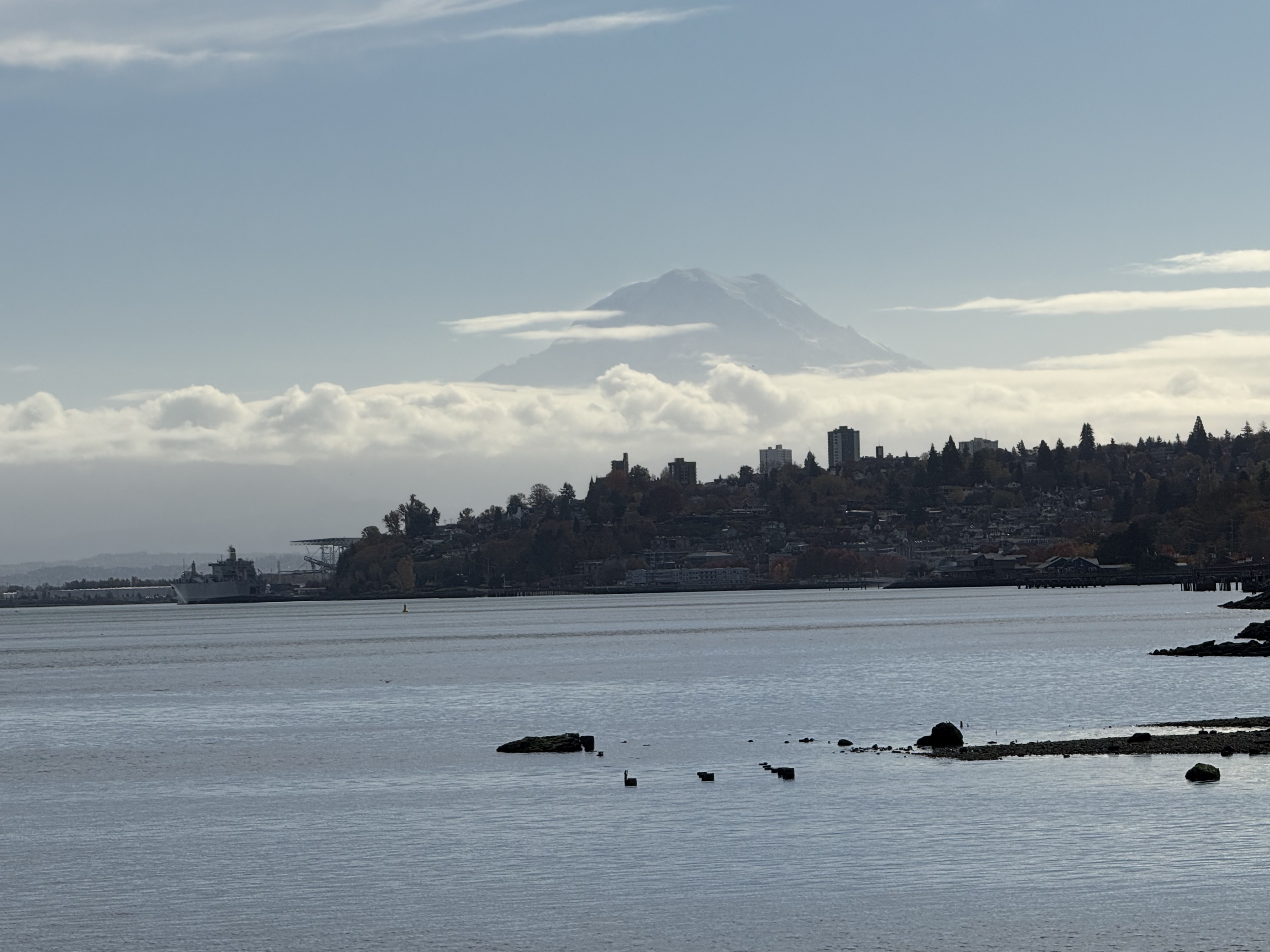
Plate 1. We’re not in Northern Virginia anymore!
I’ve relocated to the west coast–Tacoma, Washington to be exact, and that active stratovolcano looming in the background is Mt Rainier (aka Tahoma as it’s known to the indigenous people). The pristine water body is Commencement Bay at the southern end of Puget Sound. Mt Rainier is 14410 feet high, which makes it the most topographically prominent mountain in the lower 48 states; for scale, it is 43 miles from Tacoma, yet dominates the SE horizon. How did it come to be so close to the coast and yet so tall? Before I answer that question, let’s recap the geological story of NoVA that I pieced together over the last four years.
Over a billion years ago, NoVA was submerged beneath an ocean or marginal sea. Distant mountains eroded rapidly in a time before land plants. Vast quantities of sediment accumulated in layers of erosional debris that were subsequently buried by younger sediment. Between a billion and five-hundred million years ago, these sediments became rocks that were subsequently deformed as continental plates collided. They didn’t melt, however, and survived the cataclysm relatively unharmed, becoming schist and related metasedimentary rocks.

Plate 2. This schematic cross-section of the US East Coast is representative of NoVA. It shows the final closing of the Iapetus Ocean (forerunner of the Atlantic), which would have produced immense quantities of terrestrial sediments (e.g. the Devonian Catskill Delta in panel B). Unfortunately, these river and lacustrine sediments were subsequently eroded in NoVa as the ensuing mountains grew in size (panels C through E). They are today preserved in western New York State and eastern Pennsylvania. What survived in NoVA are older metasediments, ranging from ~1200 to 500 Ma, which were buried beneath the material eroded along the western margin of this figure (the yellow areas). Some Devonian intrusive rocks, intruded into older metasediments, survived along the Potomac River.

Plate 3. This reconstruction of the supercontinent, Pangea, coincides with Plate 2E. The square indicates NoVA. Pangea began to crack apart ~210 my ago, split by a spreading tectonic plate boundary, and for the last 200 million years, the older rocks have been slowly working their way to the surface as younger rocks were removed by erosion. They are now exposed to the elements and are weathering to form new layers of sediment in the Atlantic Ocean, beginning a new cycle.
What about the northwest coast, Tacoma and Seattle, you may ask?

Plate 4. This beautiful schematic cross-section represents the consensus opinion of geologists familiar with the Cascadia region. Tacoma lies at the northern end, near Mt Rainier. I will refer to this image frequently in my following posts. Study it a moment and you will realize that the geologic situation is similar to that presented in Plate 2A and B, but on the eastern (right) side of the closing ocean basin, i.e., the Pacific Ocean.
The Coast Range (including Olympic peninsula) is part of the accretionary wedge of a subduction zone, and Puget Sound lies within the forearc basin. In other words, I have moved from an extinct collisional tectonic regime to an active SUBDUCTION zone; Mt Rainier (Plate 1) is the tip of the geological iceberg, leaking sweat from the partially melting Juan de Fuca tectonic plate.
I hope you join me on this new geological adventure into the past…
Reseña de “Crónica de una muerte anunciada” por Gabriel García Márquez

Este libro fue muy difícil de leer. Un hombre inocente es asesinado por gemelos que creen que él arruinó la reputación de su hermana y destruyó la noche de bodas. La historia relata eventos previos a la muerte. Es un asesinato por venganza en un pueblecito pobre en el que una novia debe ser virgen. Toda la gente sabe sobre el plan de los gemelos pero espera en fascinación. Es una muerte brutal, acto cometido a plena vista. El narrador investiga el crimen y descubre la verdad después de muchas entrevistas con testigos años después.
La novela está escrita en español coloquial y es probablemente demasiado difícil para un estudiante como yo. Yo nunca sospeché que el español tuviera tanto sinónimos para palabras comunes. No pienso que aprendí ninguna palabra nueva. Sin embargo no me gusta narrador omnisciente, especialmente en español porque es imposible para mantener los caracteres cuando sus pensamientos y actos se confunden. La autora usó nombres completos pero esto solo aumenta la confusión. Para complicar las cosas el asesinato se describe varias veces por diferentes perspectivas. Oh, Dios!
Yo elegí este libro porque es corto pero ahora deseo que nunca hubiera leido! Brutal. Triste. Otro ejemplo de Garcías conocimiento sobre cultura latina.

 Timothy R. Keen
Recent Comments