Archive | July 2023

From There to Here: Wyoming
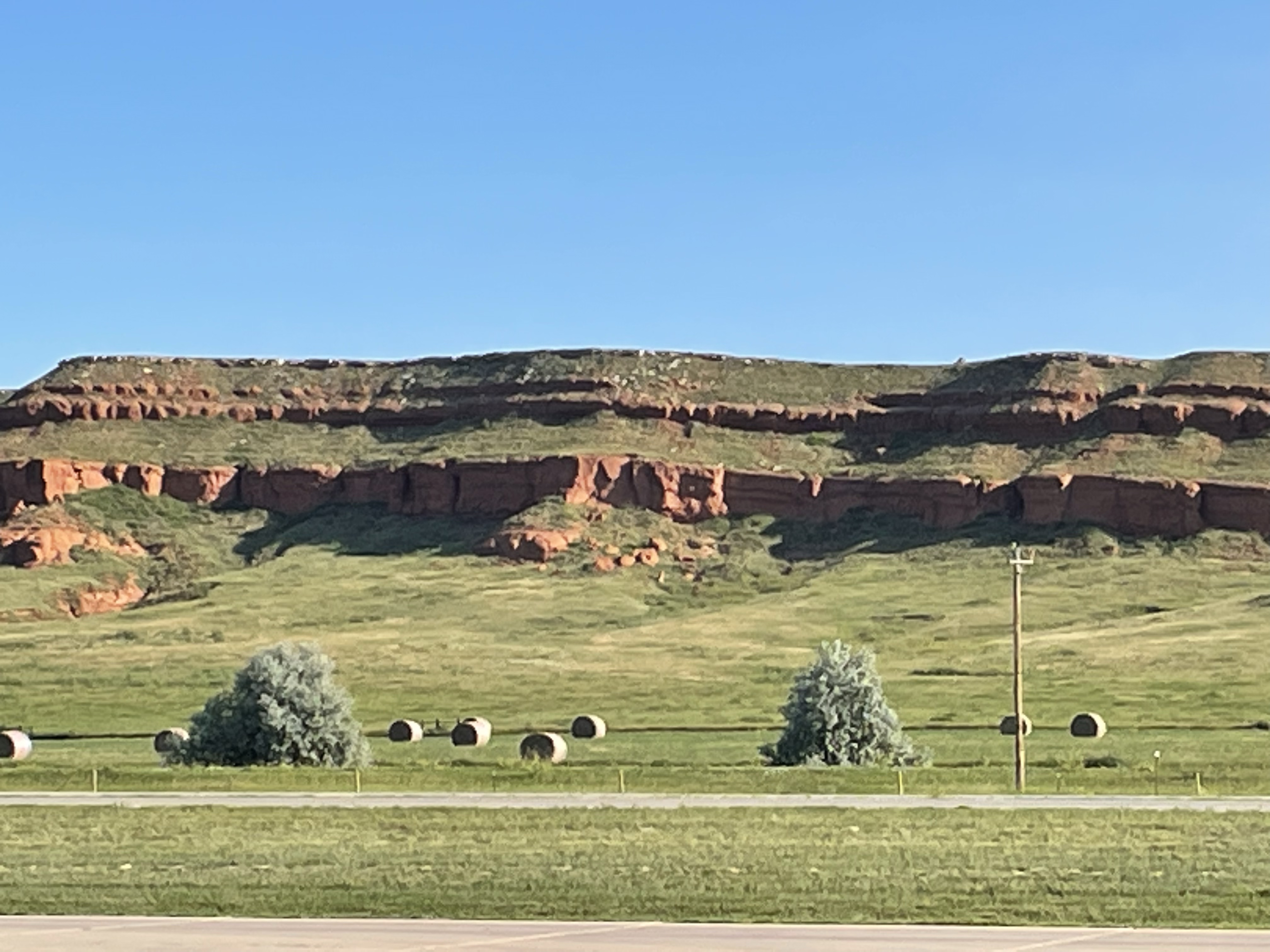
Figure 1. These horizontal mudstones (Spearfish Formation) were deposited in fluvial and lacustrine environments (red color indicates fresh water) about 250 my ago, when Pangea was beginning to split. For comparison, we found coarse sediments in Northern Virginia, forming the western margin of a local basin produced by the breakup of this supercontinent. Despite being a thousand miles west of the ancestral Appalachians, sediments were collecting in modern Wyoming. They somehow escaped the upheaval that was to come, when oceanic crust was subducted by the westward motion of the North American tectonic plate.

We discussed the tumultuous history of Precambrian rocks in Montana in my last post. The story of crustal shortening in western North America continues to this day. The huge, shield volcanoes comprising the Cascades Mountains show that this westward motion has not ceased at the current time.

The story of oceanic subduction and collision with multiple microcontinents is recorded in the rocks I had to drive past, so I have to resort to a geological map again.

Figure 2. Geologic map centered on the Black Hills of South Dakota. Gillette is circled to the left. The purple rocks to the west are Precambrian metasediments. The black hills consist of a Precambrian core of granitic intrusive rocks (light brown ellipse in center of image), surrounded by Paleozoic sediments worn away from the hard, igneous core of the Black Hills. I have written about the Black Hills previously. My point here is that Precambrian rocks, and their Paleozoic cover, were uplifted through Mesozoic strata (Fig. 1) to form one of the geological wonders of the world. Although the precise mechanism for uplift of the Black Hills is unknown and controversial, it is undoubtedly related to the eastward thrusting of Precambrian rocks over younger rocks throughout the Rocky Mountains. The map has the location of the “Badlands” circled; this is an area where younger rocks (reddish brown, less than 60 my) are topographically lower than older rocks (light green, 100 my). The gently undulating topography reflects hidden faults created by the uplift of the Black Hills.

Summary. This was a short post because I was occupied and didn’t have time to explore this fascinating region. Nevertheless, I can confidently say that when Pangea broke up, the North American tectonic plate began to “swallow” the proto-Pacific plate and any microcontinents it harbored.

This 200 my long process created the Rocky Mountains, the overthrust belts of Montana, the Black Hills of South Dakota, the Colorado Plateau, the volcanic Cascade Mountains, the complex system of faults that define California, and so many other geological features of the western North American craton.

It wasn’t as if another gigantic mountain range could form in the aftermath of Pangea’s break-up. The earth can only produce one of them every couple hundred million years, a tectonic pattern called a Wilson Cycle.

Spokane, Washington, to Gillette, Wyoming: Geology in the Rearview Mirror

This post is experimental and not particularly interesting, but it is the best I can do under the circumstances; I followed Interstate 90 through the Rocky Mountains at 70 mph, with no pull-offs, and trying to take photos in the heavy traffic would have been suicidal. Instead of including a map, photos of outcrops, and some close-ups to examine mineralogy, I am relying on geological maps and my memory. The most experimental part is that I’m working on an iPad, which is a blessing and a curse. Let’s see how it worked out.

Figure 1. I got this image from Wikipedia because no one takes photos of road cuts. All I could find were scenic photos like this, which are useless for my purpose. Nevertheless, the steepness of the peaks gives some idea of why I didn’t stop. The road cuts showed sedimentary rock layers tilted every direction. This is the first mountain range east of Spokane, but the next dozen or so were similar in form.
Figure 2. This geologic map from RockD shows the rocks I encountered between Spokane and Gillette, Wyoming (shown by the blue dot in the lower-right). The volcanic rocks I saw in the Spokane area (last post) didn’t cover the Bitterroot Mountains (purple area between the two leftmost circled areas). The purple rocks are fine-grained metamorphic sediments between 1600 and 1000 my old. The second circle roughly outlines the area where Lake Missoula formed, dammed by ice during the Pleistocene. The steep and resistant (to glacial erosion) Precambrian rocks formed channels that were easily blocked by ice. When the glaciers retreated periodically, huge floods escaped through these passes. I drove though some of them without knowing it (I was busy). Riverside Park, where I found anomalous boulders, is one such episodic flow path.
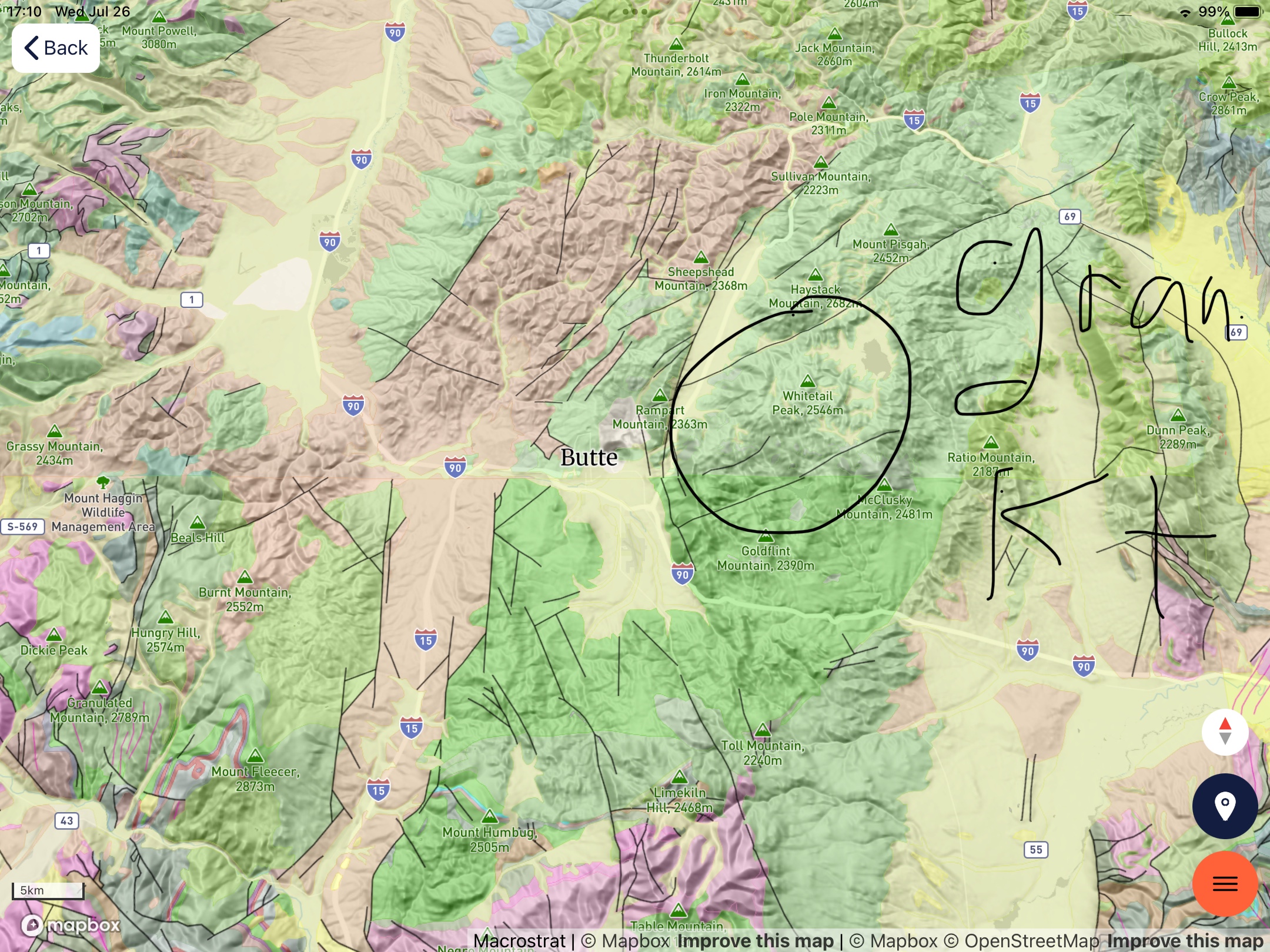
Figure 3. This map segment reveals several Cretaceous batholiths (pink hues) east of the Bitterroot Mountains. I circled one in this map that I drove over when leaving Butte, Montana on I-90 this morning. The litho logo was easy to identify from the truck at 65 mph, even with all the tight turns.
Figure 4. This map segment identifies some of the oldest rocks in North America (marker at lower-left of image), which are as old as four-billion years. For reference, Sheridan is circled (see Fig. 2 for its location within the larger region. The area covered by the inset comprises nearly horizontal Miocene (~50 my) sediments that formed cones resembling small volcanoes. This nascent “badland” was at least 60 miles across.
Figure 5. This geologic map shows my route (black line) along Interstate 90, from Portland, Oregon, to Gillette, Wyoming, with stops in Spokane, Washington, and Butte, Montana.


Summary. The oldest rocks (Precambrian metasediments shown in purple shades) are scattered throughout the Rocky Mountains. These old rocks were pushed and pulled for hundreds of millions of years as microcontinents collided to form what we call western North America.

Paleozoic rocks (500-230 my) that would have been deposited on top of them, or intruded into them, are only found in scraps here and there (I’m speculating, but Paleozoic rocks have a habit of turning up in the unlikeliest places).

During the late Cretaceous (about 80 my), granitoid intrusions forced their way into these older rocks, as I saw at Butte and other small mountain ranges (pink and tan hues). This was a geologically active period in the evolution of western North America.

About fifty-million years ago, volcanoes formed along the western margin of North America (e.g. Mt Hood and other volcanoes produced thousands of feet of volcanic rock, forming the Columbia plateau (yellow shades in Fig. 5). At approximately the same time (50 – 5 my) sediment was collecting in lakes and shallow inland seas leftover from the Cretaceous Interior Seaway. These sediments are undeformed and not very well lithified (i.e. not buried deeply); they appear east of Bozeman MT as green in Fig. 5.

Hidden beneath the Precambrian rocks, which were pushed eastward as much as 150 miles in Canada, and Miocene sediments, lay the oil and coal rich Cretaceous sediments laid down between about 150 and 60 my ago. As proof of this, Billings MT (rightmost circled area in Fig. 2), with a population less than 150 thousand, has three oil refineries; but it is so remote, with so little infrastructure (e.g. pipelines), that trucks deliver refined petroleum products to rail cars. It is a modern western boom town.

We’ll see what tomorrow brings …

A question of scale: Indian Canyon Falls
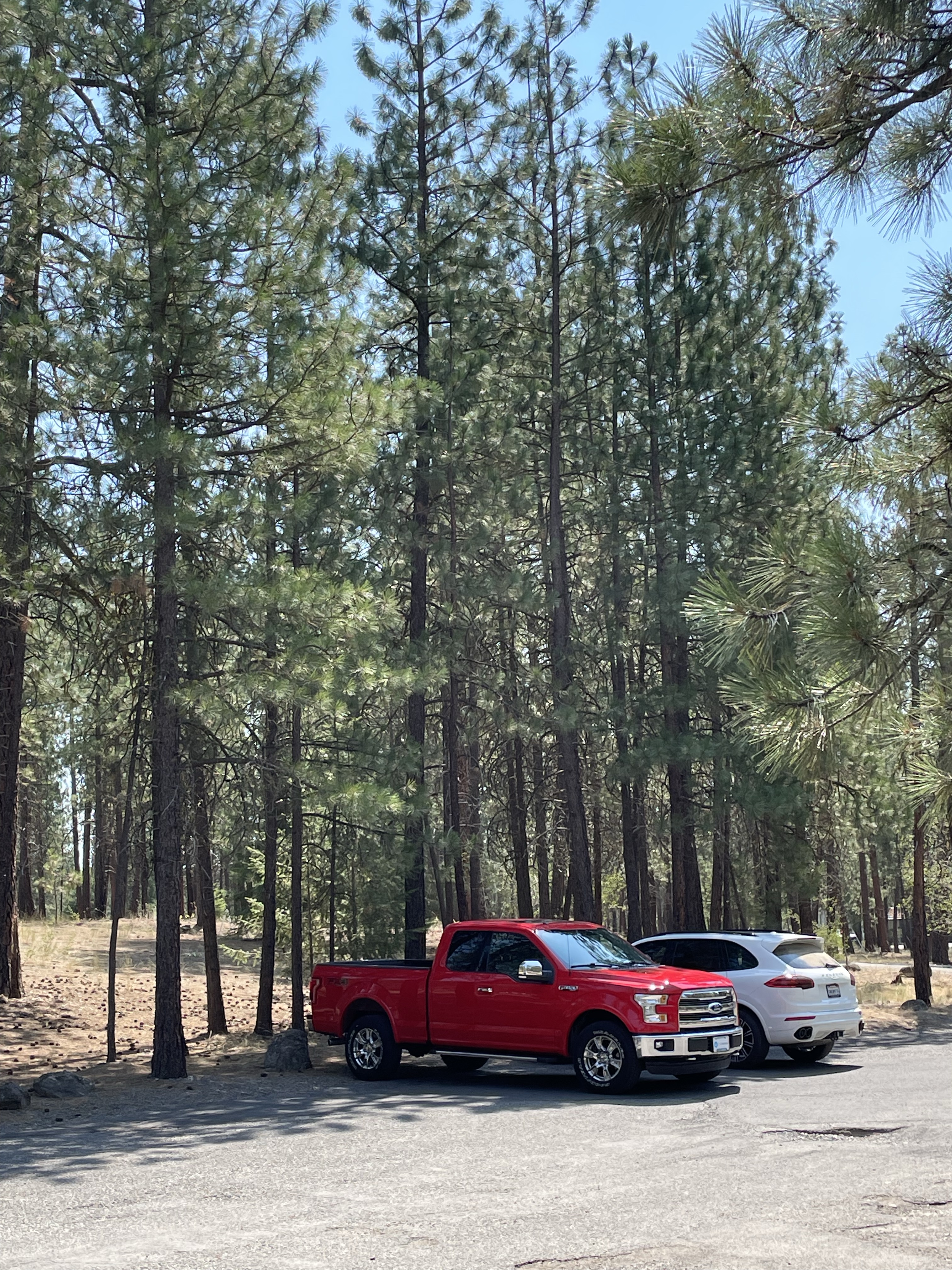
Figure 1. This photo doesn’t have anything to do with this post, but this is where I parked when I explored Riverside park, along the Spokane River. I didn’t have an opportunity to get a big picture of Indian Canyon falls, which is only 15 minutes from the “Bowl and Pitcher” because it is located in an area with heavy undergrowth, hidden between basalt scarps.
Figure 2. Indian Canyon falls should be called “Hidden Falls” because it occupies a narrow crevice in a thick sequence of basalt. In this post, I will try and show how running water slowly but irresistibly forms chasms as big as the Grand Canyon. This photo shows the middle terrace of Indian Canyon; the top is about 20 feet higher and couldn’t be photographed properly to convey the correct sense of scale.
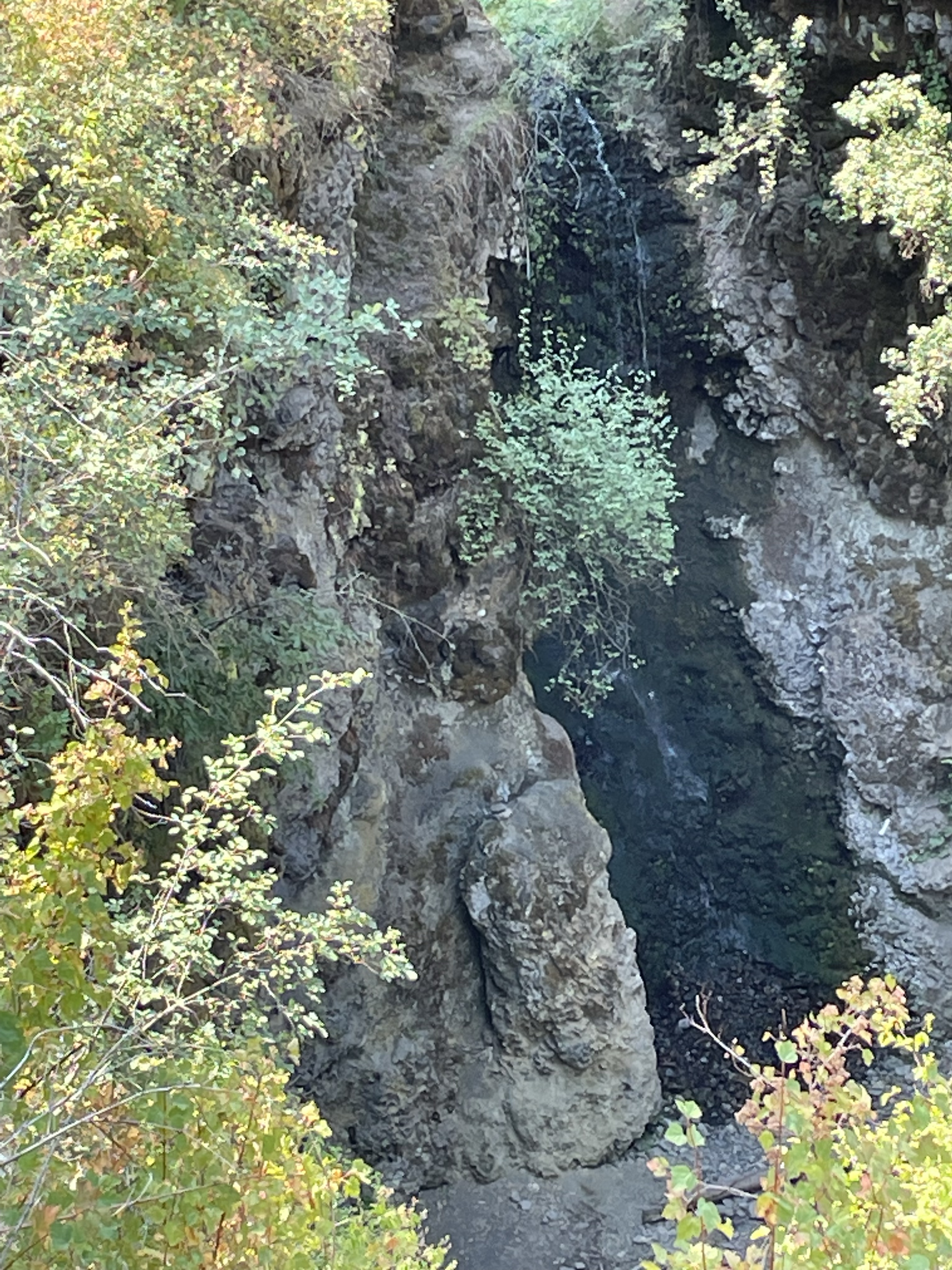
Figure 3. Photo looking into the lower “gorge” of Indian Canyon. A cave can be seen along the far wall and the bottom is somewhere “down there,” about fifty feet below my vantage point.
Video 1. This video is from the same vantage point as Fig. 3, but now you can hear the water trickling over the ledge, see the water moving in a thin flow, and see the surrounding morphology.
Figure 4. Photo from slightly further downstream. A thin, bright line shows the “water fall.”

Video 2. This short film shows the dynamics of the water running over the ledge in the context of the inner canyon. It really brings the experience to life.

Summary. I found Indian Canyon falls by looking for Lake Missoula park, which turned out to be closed to the public. However, the Park Service supplied a link to other geological attractions, with navigation instructions—GoogleMap took me to a nondescript, heavily wooded area, where I found something I hadn’t expected to see.

The rivulet of water flowing over the “fall” during the dry season is an omen of what is to come for this relatively unknown canyon (it was actually covered with biking and hiking trails). At first the trickle carries only mud, then sand, then gravel, then boulders, then …

Indian Canyon falls is how it begins. Where it ends …

Think big …

Bowl and Pitcher: Volcanic Rocks at Riverside Park, Spokane, WA

Figure 1. Photo of a large volcanic boulder that has been named the “Pitcher” by local inhabitants for centuries. The name comes from the columnar rock with a piece protruding from its left side. I don’t seen the resemblance but I don’t see angels and dragons in the stalactites found in caves either.
Figure 2. Photo of the “Bowl” seen from a vantage point at the top of a cliff. The bowl is the dark opening to the left. These two exposures are huge boulders that fell off the surrounding cliffs when the Spokane River undercut the surrounding volcanic rocks.
Figure 3. Geologic map from RockD, showing the Riverside area and the “Bowl and Pitcher” campground. The yellow areas to the left are basaltic flows dated to between 25 and 5 my. The tan area is glacial lake outwash deposits lining the river bed.
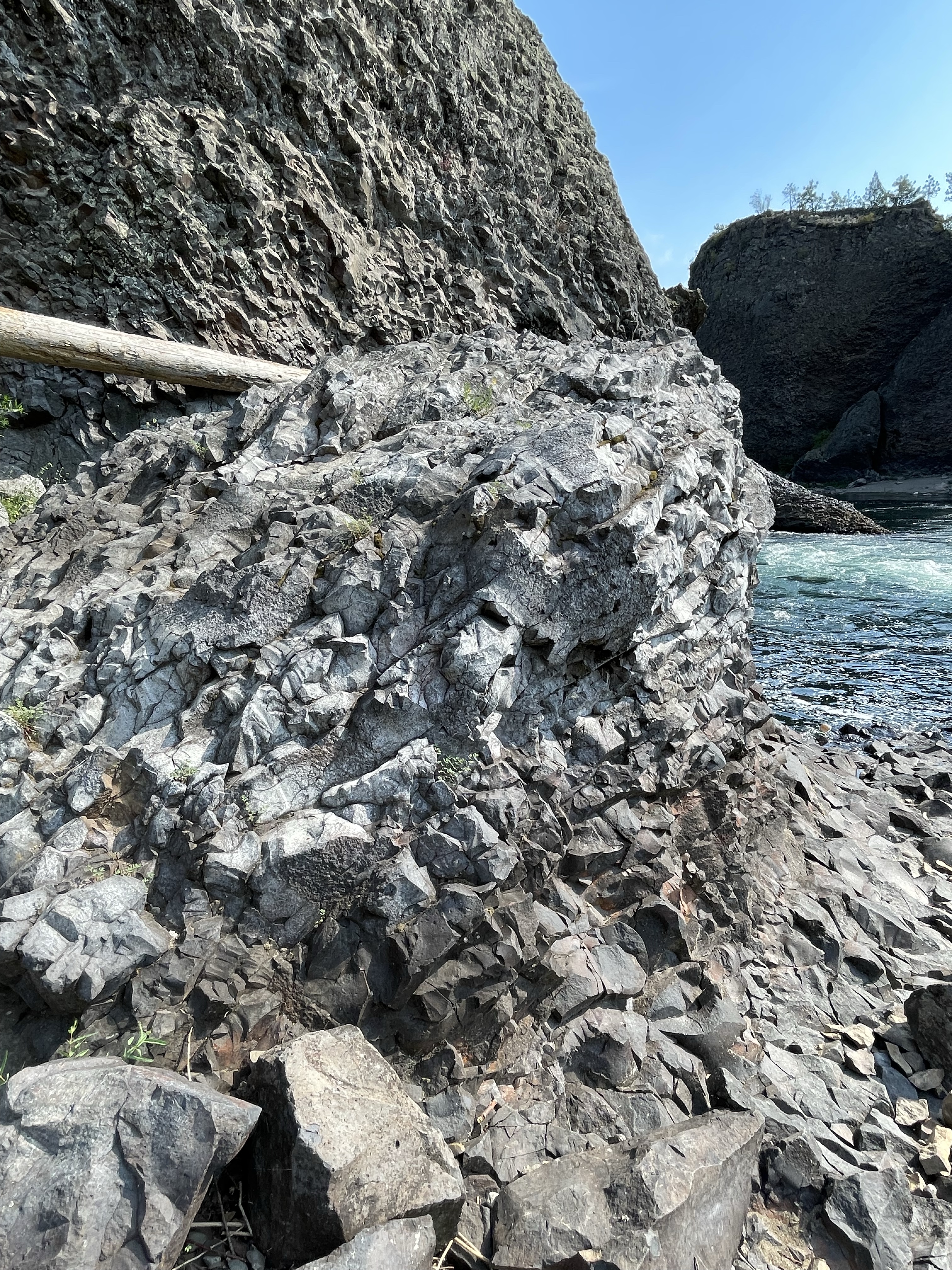
Figure 4. Photo of the cliff where Fig. 2 was taken. Note the irregular surface of the entire cliff face; pieces of this rock are seen in the foreground, revealing strange, curved shapes.
Figure 5. Photo of the “Bowl” rock, showing the curved structure seen in Fig. 4; I have seen this kind of form in limited areas in older basalt but never comprising a cliff. It is reminiscent of ropy lava (pahoehoe), which suggests that it was very viscous and flowed slowly. There was very little sign of weathering (forming soil profiles), so much of it was extruded very quickly. Note the indent on the right side of the image, where rocks carried by the river eroded the lava; a process like this probably led to collapse of these huge boulders into the Spokane River.
Figure 6. Well-worn boulder (~2 feet long) showing lamination that could be volcanic or sedimentary in origin. If volcanic, it looks like a welded tuff (hot ash); either way, there is no rock like that contained within the basalts making up this area.
Figure 7. A recently broken fragment (not by me) of a boulder shows a composition of alkali feldspar (white, high in sodium) with some quartz (pink and gray). I think it is syenite, an intrusive igneous rock dominated by Albite feldspar. Like the sample seen in Fig. 6, it isn’t associated with basalt.
Figure 8. This badly beaten boulder remained intact and more than 2 feet long after millions of years in a river bed. It is similar to the sample in Fig. 6 but lamination isn’t apparent and, besides, I just wanted to share such an amazing specimen with you. Note that it is lying next to similarly colored rocks that haven’t been polished to such a high sheen.

Summary. Today’s excursion brings two questions to mind: 1) What is the meaning of such an immense thickness (hundreds of feet) of basalt with such an unusual form? (I’m going to call it “oyster” lava.); 2) How did rocks that are nowhere to be seen in the area (refer to Fig. 3) end up in Riverside Park?

Basalt flows are known to be highly irregular in outcrop because lava flows in tendrils, sheets, molten chunks blown out of a fissure; however, these flows (and there must be thousands of them exposed in the cliffs along Spokane River) are eerily uniform and individual flows can’t be identified. This is unusual for relatively young volcanic rocks. The problem is exacerbated by the scarcity of soil profiles; there wasn’t time for water to react with the highly reactive minerals in basalt before another layer was deposited. I don’t have an answer.

The second question is easier to answer. During the last two million years, this region was covered by thick ice sheets that periodically melted and then expanded. Dams of ice formed huge lakes like Lake Missoula, the size of some states. There is overwhelming evidence for the catastrophic collapse of such an ice dam between 20 and 10 thousand years ago. The region surrounding Spokane contains many igneous, sedimentary, and metamorphic rocks dating from Precambrian (older than 500 my) to the age of these basalts (about 10 my).

The resistant cliffs surrounding the “bowl and pitcher” channeled such massive floods many times, beating very hard rock (e.g. Fig. 8) to a pulp as the boulders bounced along and hit other equally hard rocks.

I don’t like unanswered questions but that’s how it goes because the rocks keep secrets …

Volcaniclastic Deposits at Motel 6

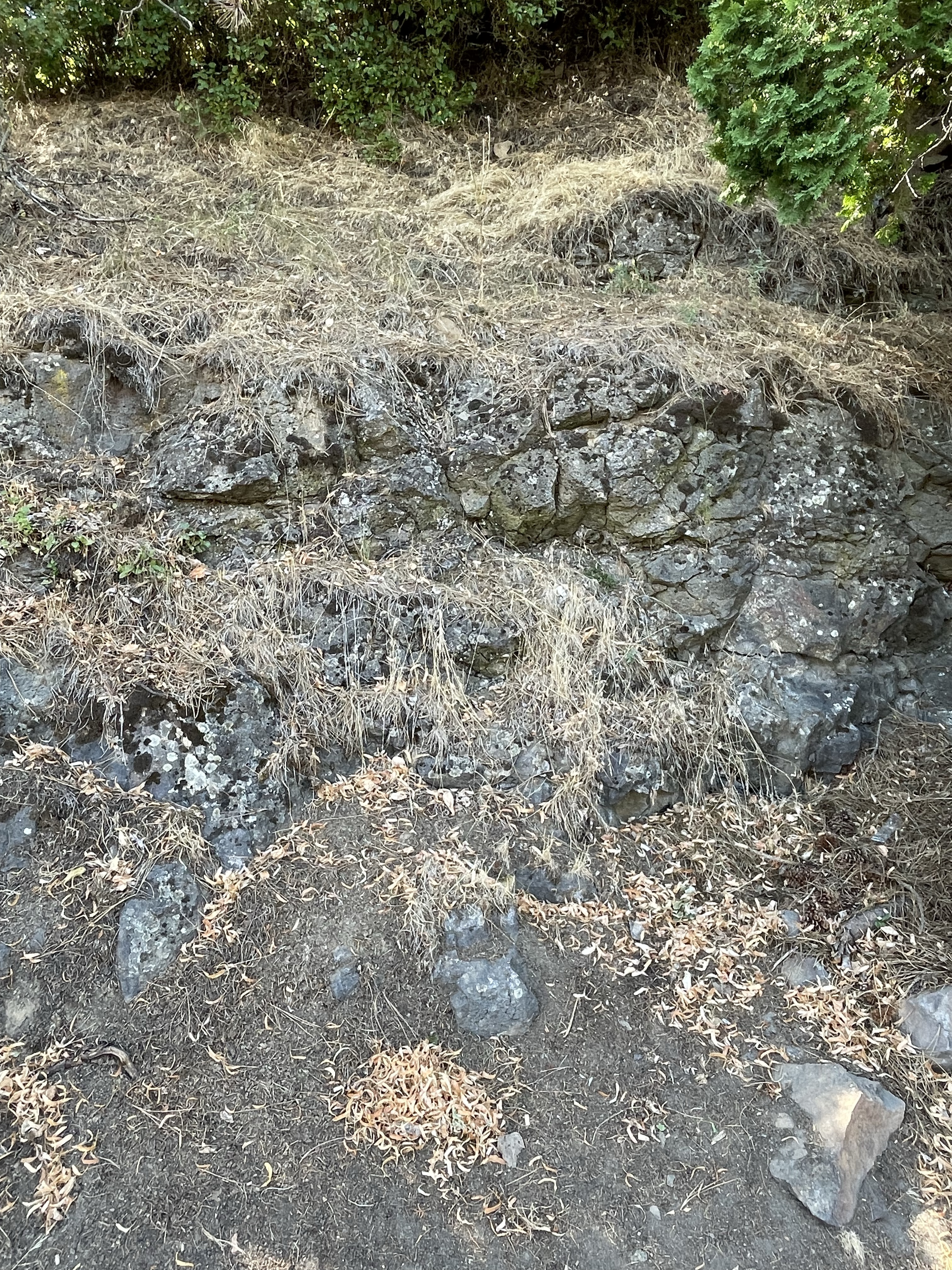
Figure 1. The parking lot at Motel 6 in Spokane exposed twenty feet of volcaniclastic deposits. This photo shows several features that will be discussed in this post. I will refer back to this figure later.
Figure 2. Exposure of vessicular lava to the left Fig. 1. This slope has been cut but not filled. Large cavities left by volcanic gasses are visible in the upper part of the photo.
Figure 3. Large vesicles are visible throughout this part of the section exposed at the Motel 6 parking lot. I didn’t see any phenocrysts. This was a lava flow with low viscosity, filled with gases like carbon dioxide (CO2).
Figure 4. This image shows that the volcanic gases were not uniformly distributed. The thick layer in this photo had much smaller vesicles. The image also shows the complex bedding inherent in volcanic flows. It is important to note that there are no ash layers evident in this exposure. This lava flowed and didn’t sputter and congeal, finally blasting out of a volcano. It was very different from what we saw at Mt. Hood. This magma source contained much less silica (which makes magma sticky and explosive) than what we saw several hundred miles west in Oregon. (This image is about six feet in height.)
Figure 5. The top of this image reveals a different structure than we saw lower in the section. These rocks contain rounded boulders in a fine matrix. Look back at Fig. 1 and focus on the section to the left of the tree. The outcrop is lumpy (for lack of a better phrase), containing rounded boulders in a fine matrix, like we saw in the lahar flows at Mt. Hood. I admit that this is speculative without closer examination, but that’s what this blog is about. I think a thick (maybe ten feet) section of lava flowed from distributed sources (i.e. fractures and not central cones) under high pressure (hence the gas content) in a massive eruption. During hundreds, if not thousands, of years this lava was weathered and channels formed and led to both episodic and continuous erosion and transport in streams running across the volcanic landscape. I am not ignoring the absence of paleosols (ancient soil horizons); these lava flows are only a couple of million years old and climate wasn’t that different than today. During my traverse of the Columbia plateau, I noticed that soil was poorly developed in the current climate regime because the Cascade Mountains block moisture from the Pacific Ocean.

This post is a little weak but I wanted to show that we can find evidence of the earth’s history in our back yard (literally). My interpretation may be completely wrong but it is consistent with my observations and (limited) understanding of volcaniclastic deposits.

I’m going to look at some more curious volcaniclastic deposits tomorrow …

Mount Hood: Volcaniclastic Deposits

Figure 1. This is Mt. Hood seen from the south. The peak is about about 11,240 feet and this photo was taken from an elevation of 6000 feet, at the Timberline lodge. Several eruptions and collapses have occurred in the last few millennia, leaving the summit asymmetric. Note how the left side appears to be missing. Material has been transported/erupted down the slope towards the camera. The near-field shows two ridges constructed of debris transported as fluidized sediment, carrying huge boulders as well as sand and even ash down the slope in a series of tongues. These deposits are called lahars. Note the wide range of sizes of material near the camera, some larger blocks are still angular while others are rounded. The lahar sweeps up everything in its path but is limited in extent.
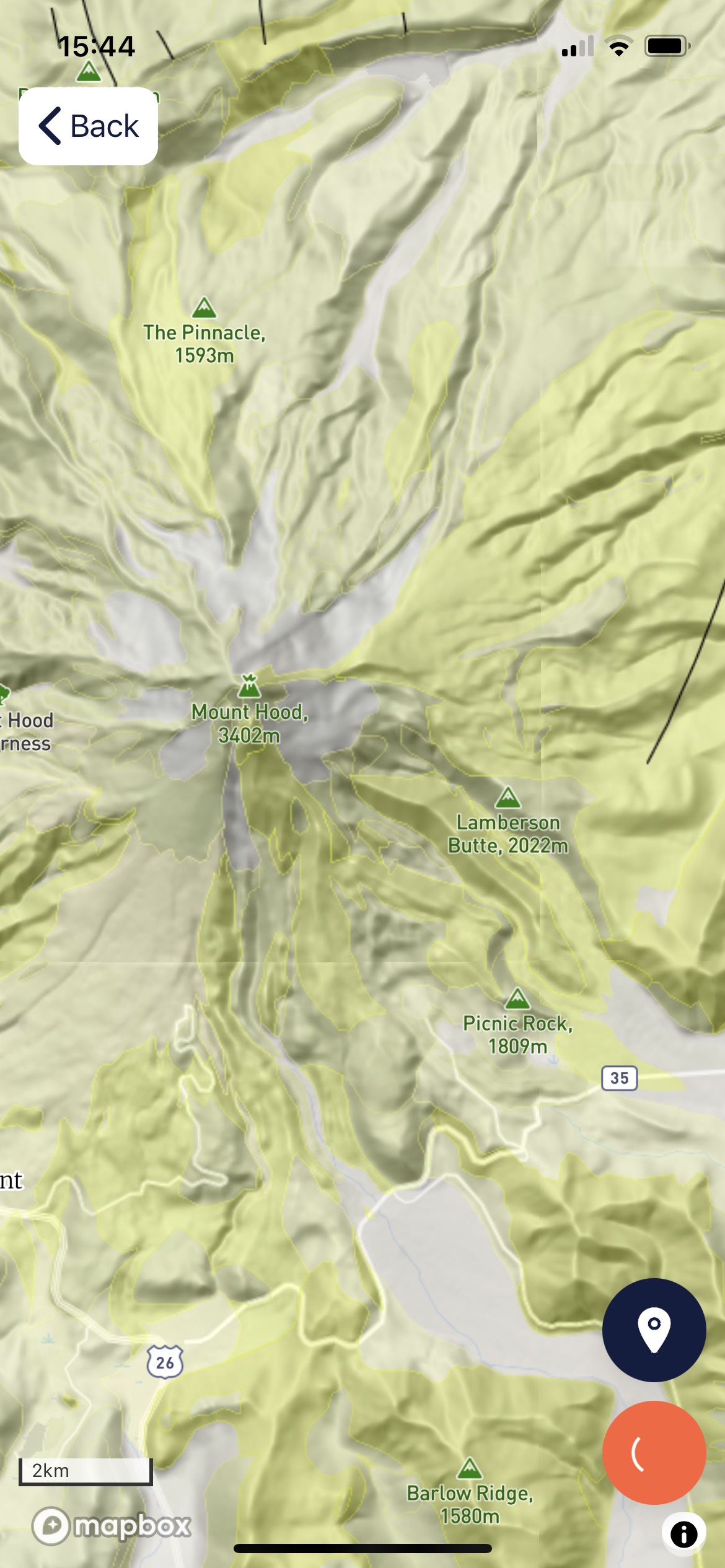
Figure 2. Geologic map of Mt. Hood from RockD. The study area was along the slope near the closed path to the left of center in this map. Note the linear ridges originating at the summit. These are lahar deposits (pyroclastic and debris flows), colored in pale yellow-green. The darker shades are ash and lava with a composition of andesite and Dacite (extrusive igneous rocks low and high in silica, respectively). The underlying magma chamber was long lived (tens of millions of years) and evolved chemically.
Figure 3. This image of a typical boulder is about one inch across. It has a very fine matrix with angular, light-colored crystals that are probably feldspar and quartz. The large one looks like quartz to me, which suggests that this particular sample is Dacite. This was blown out of the volcano and later eroded, rolling down the hill and becoming part of a debris flow. These phenocrysts were probably torn apart during an eruption and trapped in red-hot, fine ash as volcanic bombs near the summit.
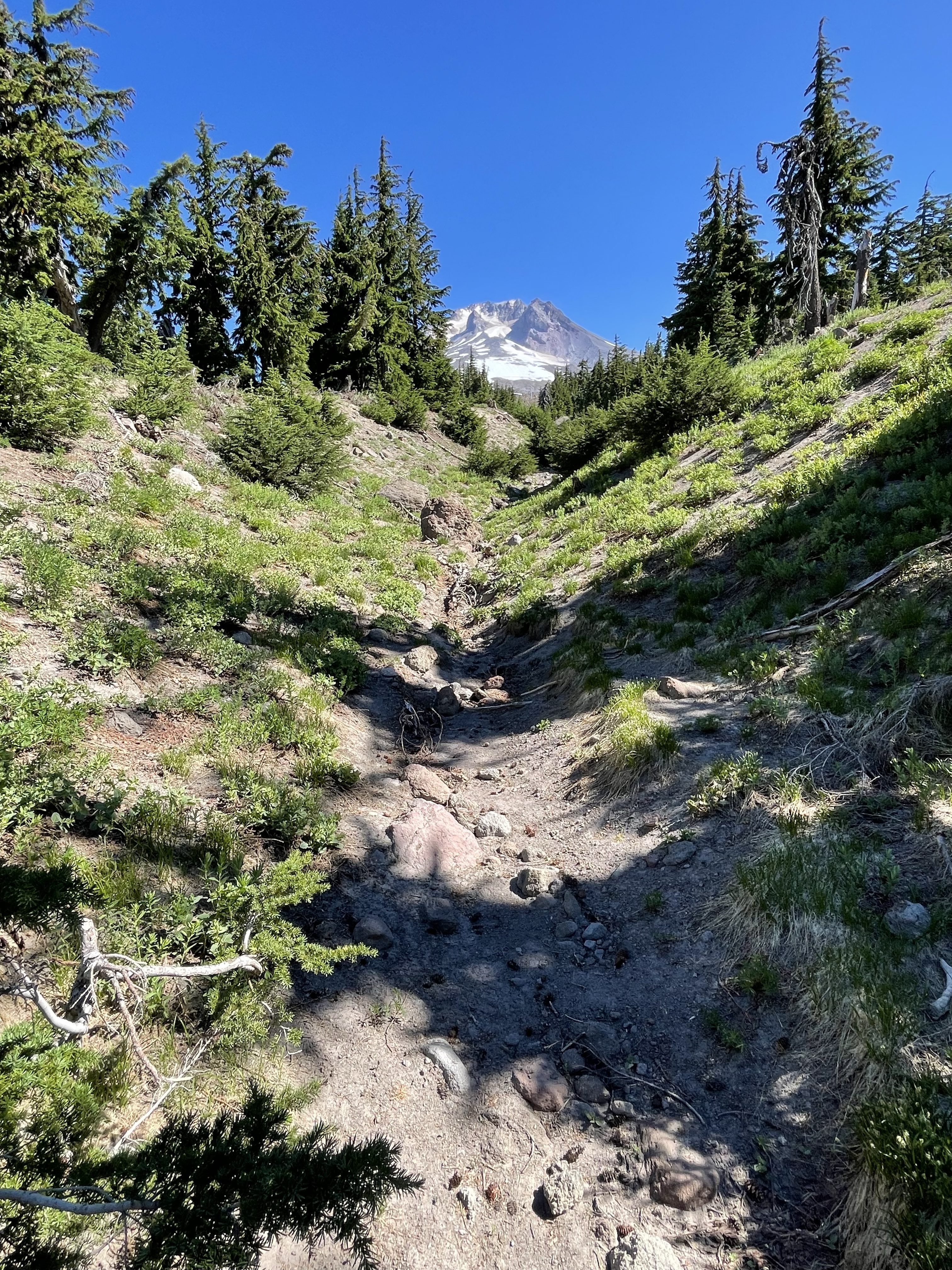
Figure 4. Photo of the linear channel between two debris flow ridges. Note the presence of vegetation on the slope, including trees. It takes a few centuries or longer to form soil for plants to grow in. The scene in Fig. 1 is very different, with sparse vegetation. Look up the channel and you see the summit; it was a straight run downhill for the lahar.
Figure 5. This photo shows the termination of a lahar as well as any other; they run out of momentum and stop without flowing out like water, because of their high viscosity. This has been occurring for millions of years, so the entire region on which Mt. Hood rests consists of subterranean flows like these, one piled on top of another; lava, ash, mud … repeat. A careful examination of Fig. 2 will show that the ridges radiating from Mt. Hood often end in bulbous terminations. Erosion has softened their morphology somewhat.

Summary. Understanding volcanic stratigraphy is easy with a simple exercise. Spread your left hand out on the table, fingers apart. Each finger is a volcaniclastic flow, either pyroclastic, lava, or a lahar, separated by hundreds of thousands of years. Now, lay your right hand over the left but not with the fingers aligned. Imagine doing this hundreds of times, while peeling away the tops of your fingers randomly (i.e. erosion).

Remember the violent eruption of Mt. St. Helens? It was a pyroclastic eruption (mostly red-hot ash) but what made it destructive was the boiling hot mud encasing boulders of older volcanic material. The blast flattened the trees for miles and the lahar cleaned up the debris.

Imagine such an eruption occurring every year … thank god they are separated by centuries or millennia.

There’s only so much energy available, even for the dynamic earth …

Road Trip Across the U.S.A.

This post is being written in Portland, Oregon, 2800 miles from Northern Virginia, where this journey began. I’m working on an iPad, which is new to me, so I’m going to limit this to a summary of previous posts, and briefly discuss some rocks I haven’t discussed before. I’ll go into more detail on the return trip, which will, however, take a different path.
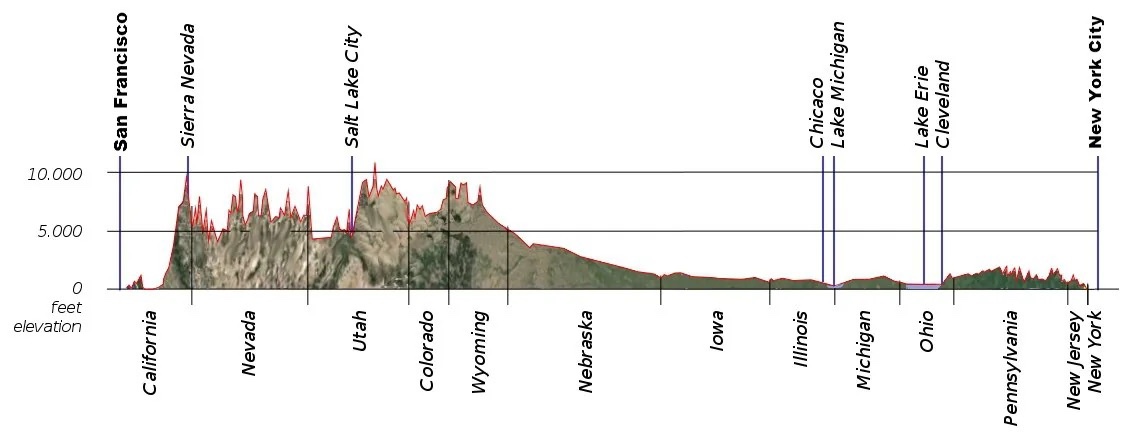
Figure 1. Topographic profile from NYC to San Francisco. This isn’t the route we took but it will serve as a general guide to our journey. We began in Northern Virginia (about 300 miles south of NYC) and finished in Portland, which is more than 600 miles north of San Francisco. The highest elevation we crossed was about 6000 feet.

I have said a lot about the rocks in NOVA (Northern Virginia), so I’ll refer to those posts. The eastern end of Fig. 1 is underlain by rocks more than one billion years old that record a collision on a continental scale.

We also found evidence of deposition in marine and coastal settings throughout the Paleozoic (~500 to 250 my), which I’ve discussed before. This period of erosion was interrupted in the Triassic Period, about 200 my ago, when the east coast began to stretch; coarse sediments filled newly developing basins throughout NOVA.

Our westward journey took us through Maryland and Pennsylvania (see profile above), where we found evidence of broad, shallow seas to the west and rising highlands to the east throughout the Paleozoic.

West of the ancestral Appalachian mountains, from Ohio to Illinois, we saw rolling hills covered with farms that replaced primordial forests. I don’t have any photos of this area, but there isn’t much to see. However, this is where extensive glaciation becomes evident, continuing across the Great Plains to Nebraska. I wrote about the moraines that dominate this region in a previous post.

This post picks up the story in eastern Wyoming (see profile above), where we find sediments deposited in coastal areas during the Late Cretaceous (~100 my) dominating the region.

Figure 2. Geologic map of the area around Rawlins, Wyoming. The majority of the rocks (green hues) are Cretaceous (~145-65 my). Faults (black lines) separate these older nearshore sands and muds from Miocene (~20 my) coarse sediments (yellow colors), Paleozoic marine sediments (aqua tints), and Mesozoic nearshore sediments (blue hues). Note the arch form of the Mesozoic layers; this is an anticline, folded layers of rock, the result of crustal shortening (i.e. compression).
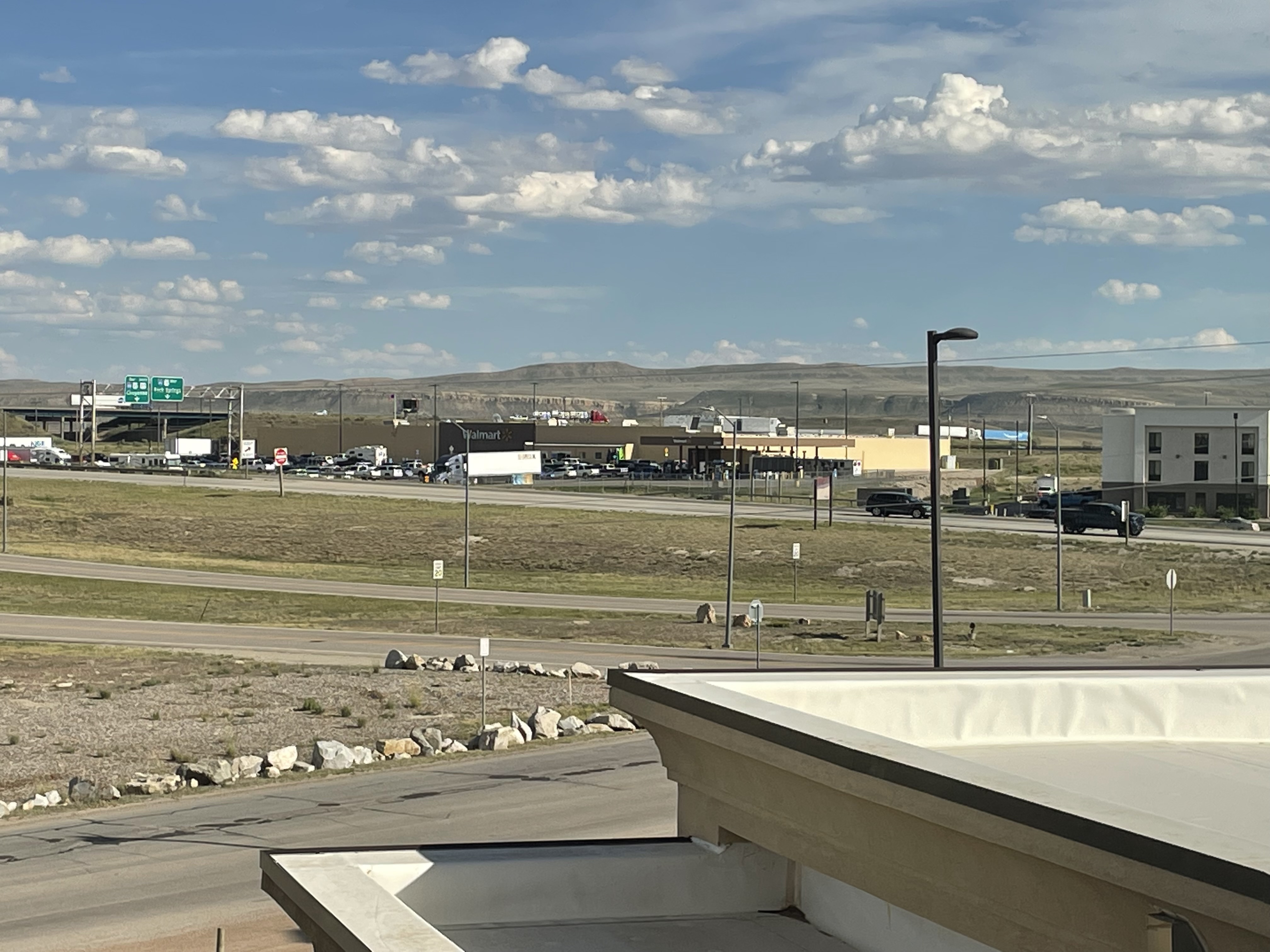
Figure 3. Photograph of mixed Paleozoic marine sediments NE of Rawlins (see Fig. 2). These rocks were uplifted along faults by thousands of feet, removing more than 400 my of younger sediments in some cases. As suggested by the solid lines in Fig. 2, these are fault blocks; the types of faults are not identified in the available data, but they are probably normal faults that formed after the youngest (Miocene) sediments were deposited. The Mesozoic rocks were folded during tectonic compression, probably during the Cretaceous and early Tertiary (~65 my), and later displaced along normal faults about 20 my ago, during a controversial extensional tectonic regime referred to as the Basin and Range.
Figure 4. Typical exposure of Green River Formation (Eocene, 56-48 my), lake deposits consisting of shale, siltstone, limestone and evaporite sediments. These layers of rock are nearly horizontal everywhere I’ve seen them.
Figure 5. Uinta Mountains to the SSW of I-80, where Precambrian metasedimentary rocks form peaks over 13000 feet.
Figure 6. Cretaceous conglomerates (~100 my) exposed within Echo Canyon in NE Utah along I-80. This view is looking east.
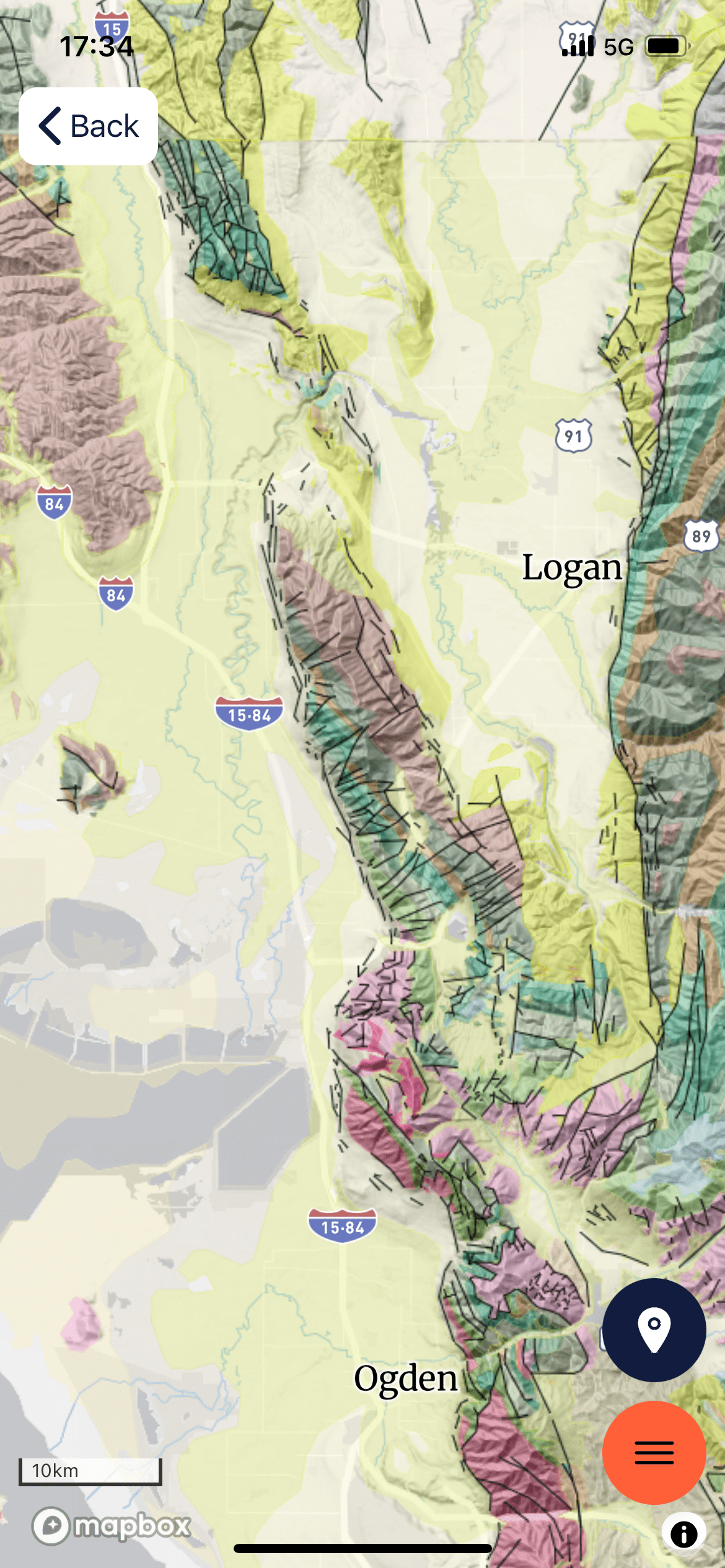
Figure 7. Geologic map of the route we took north from Ogden, Utah, on Interstate 84. The dark colored rocks east of I-84 are Precambrian and Paleozoic metamorphic rocks that have been faulted and folded during the Mesozoic era (200-65 my). They are thus jumbled up in a pile after millions of years of crustal compression followed by extension.
Figure 8. Late Cretaceous granitic intrusion exposed near Boise, Idaho.
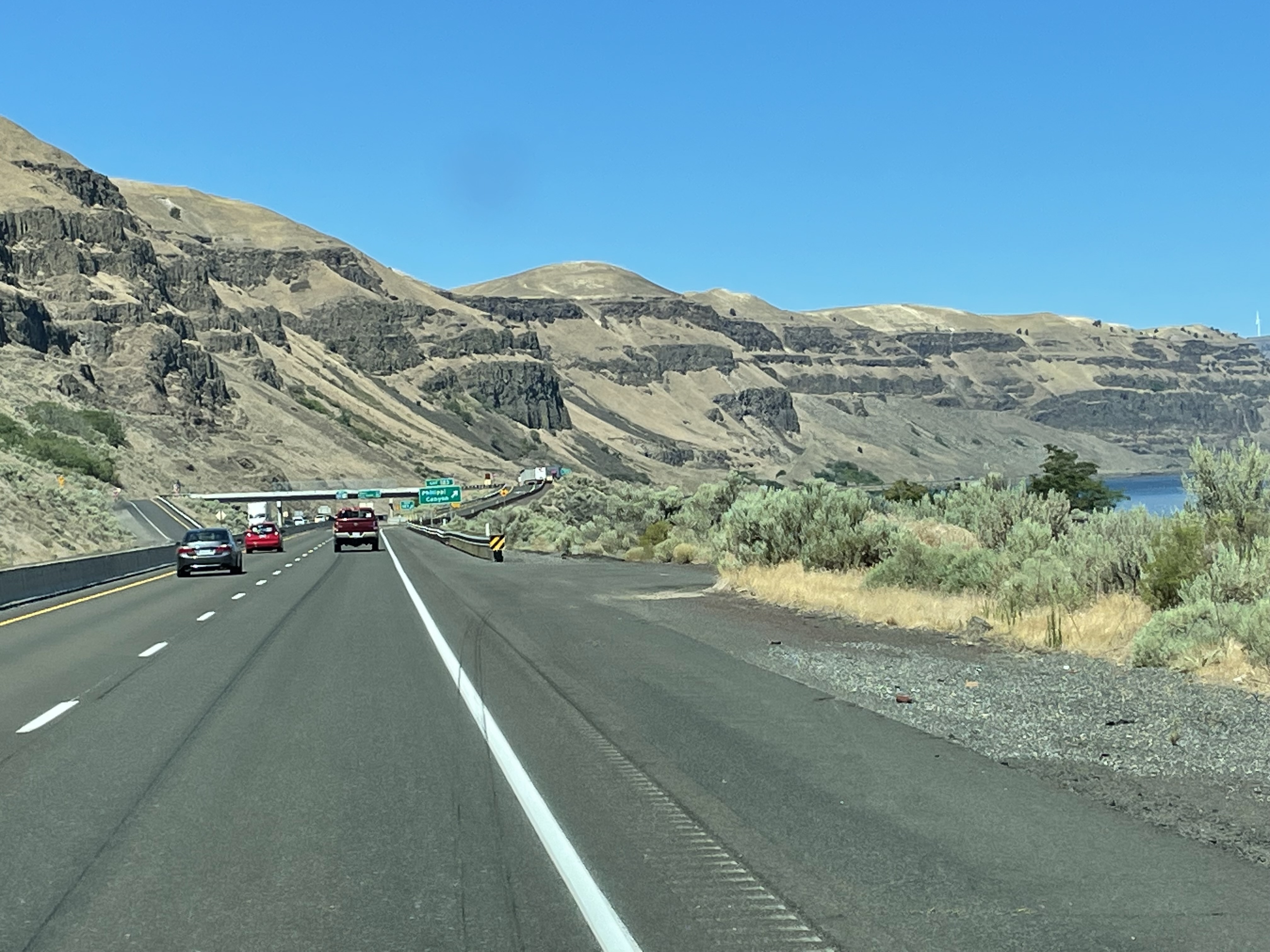
Figure 9. Exposure of Miocene volcanic rocks, typical of those covering most of Oregon. This photo was taken in Columbia River Gorge about 100 miles east of Portland. Referring to Fig. 1, this would be near the western end of the profile, but north of California and the Sierra Nevada mountains; thus at much lower elevations.
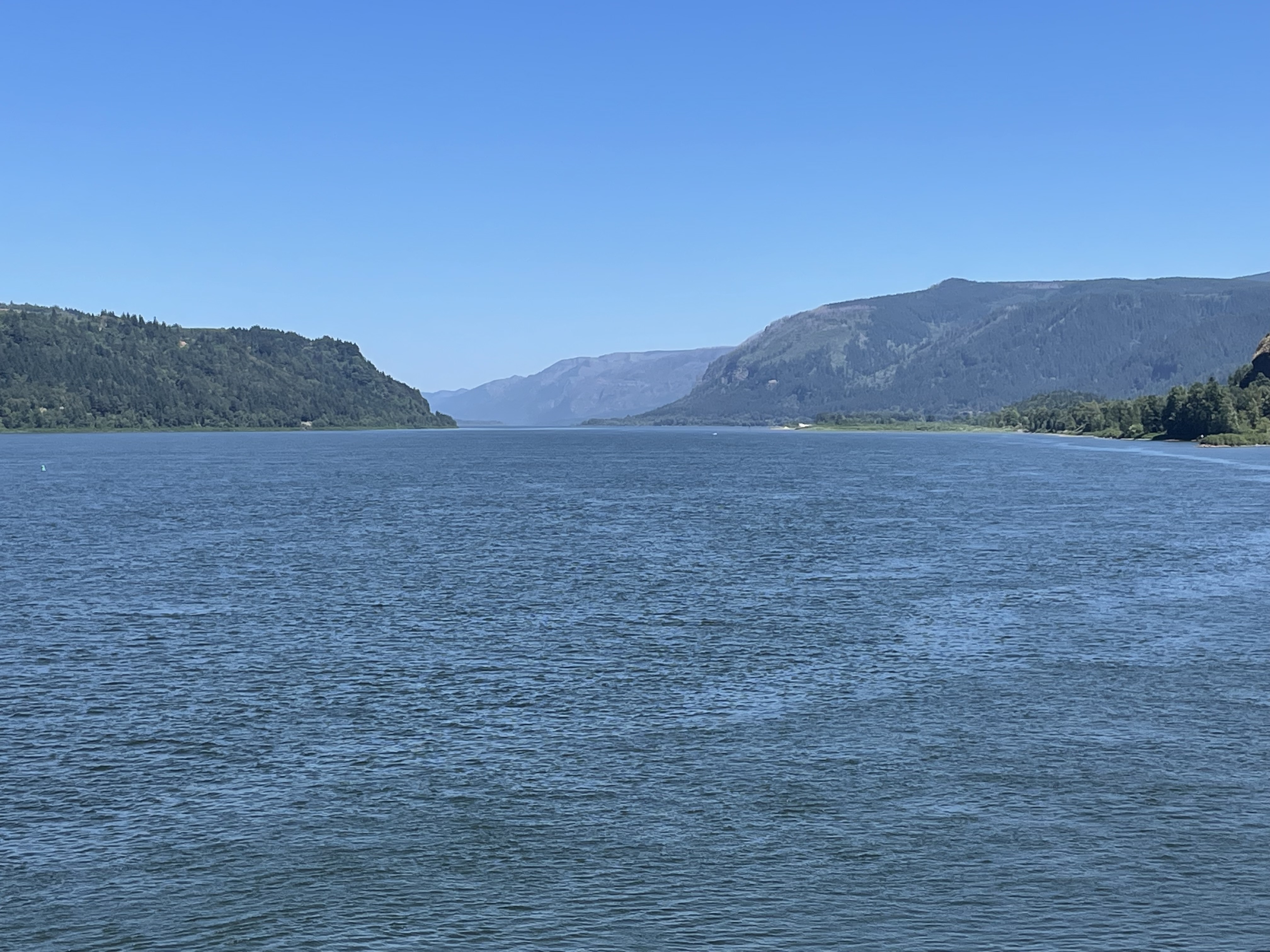
Figure 10. View looking east along the Columbia River gorge,showing the curved sides of the valley filled by the river. This entire region was glaciated until recently and valleys were carved out of the volcanic rocks during the last 2 million years.
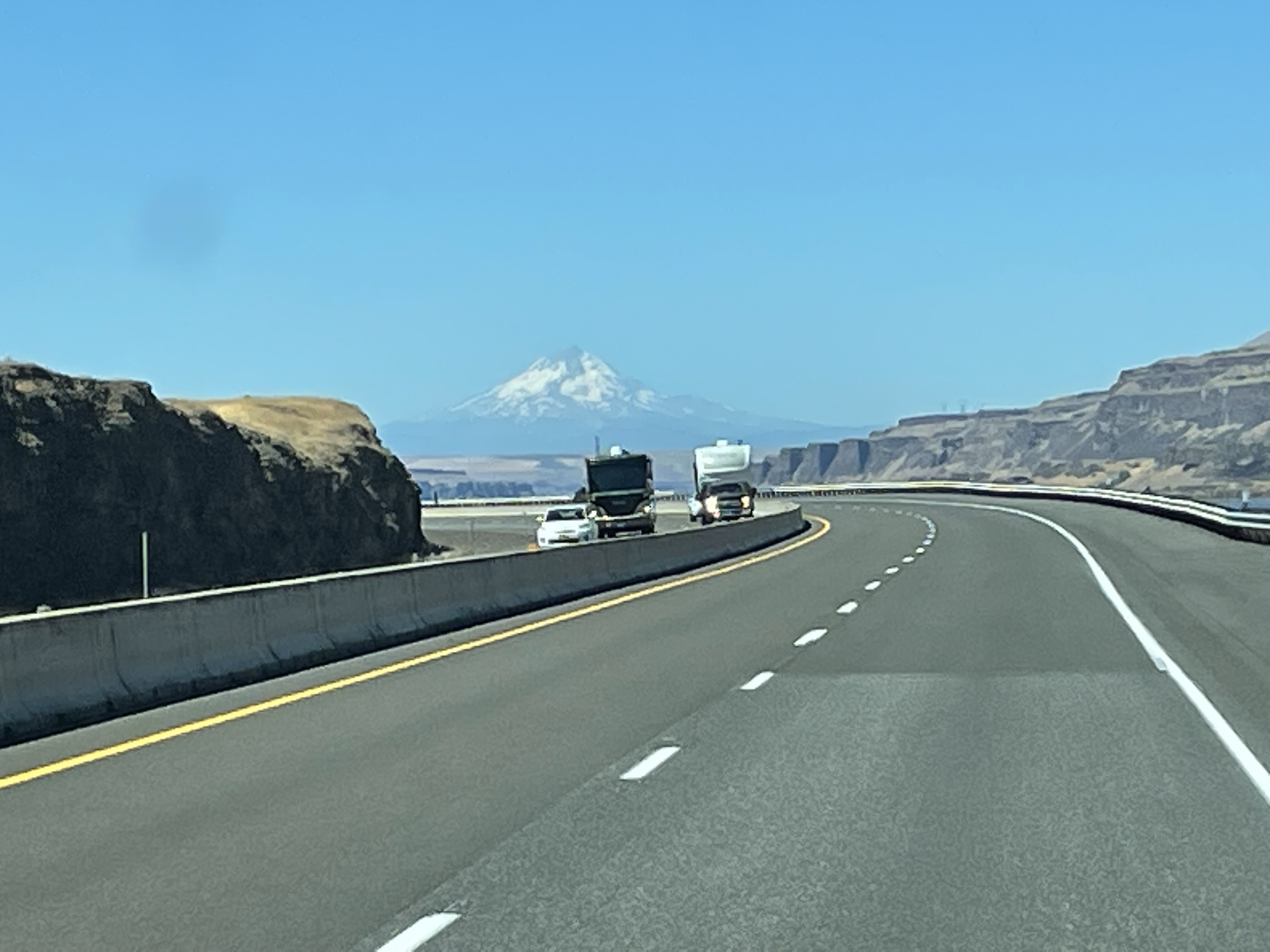
Figure 11. Looking SW from the Columbia River gorge (see Fig. 9), towards Mt. Hood. This volcano was the primary source, along with fissures and minor cones, of the vast basalt and ash layers covering Oregon.

SUMMARY. We started out in NOVA, where a titanic collision occurred more than 500 million years ago. We saw evidence of a similar orogeny in the Precambrian rocks exposed in Utah, Wyoming, and Idaho, long before they were deformed and pushed eastward.

During the Paleozoic era (500 – 230 my), thick layers of sediments were deposited in Pennsylvania (see Fig. 1) as the ancestral Appalachian Mountains rose, then eroded over hundreds of millions of years. The proto-Atlantic Ocean (Iapetus) opened and closed during this immense span of time.

We saw similar Paleozoic sedimentary rocks in Utah and Idaho (no photos available) but the big picture of continuous deposition along huge swaths of what is today western North America is recorded elsewhere (e.g. the Grand Canyon and Colorado Plateau).

The Mesozoic era is mostly recorded in sediments associated with the break-up of Pangea in NOVA, where stretching of the crust produced ridges and intervening grabens filled with coarse sediment. The Mesozoic and Cenozoic eras were spent eroding the ancestral Appalachian mountains as Eurasia and North America went their separate ways.

Vast expanses of shallow marine and lacustrine sediments were deposited in the (modern) central and western United States during the Mesozoic, accompanied by the eastward push of older rocks by episodic collisions; this was not a continental collision but probably a series of micro continents and island arcs being absorbed as oceanic crust was subducted. A vast interior seaway reached from the Gulf of Mexico to the Arctic Circle at this time.

The Cenozoic saw the eruption of vast quantities of volcanic material in Oregon and Idaho as Mt. Hood (and other volcanic centers) reached its peak of activity. The Cretaceous seaway dried up and terrestrial sediments replaced marine deposits, as the Colorado Plateau rose more than 5000 feet, shedding sediments everywhere. Finally, great ice sheets carved the earth’s surface into a new landscape defined by moraines and glacial valleys.

The Cenozoic is mostly under represented in NOVA because sediment collected on the continental shelf of North America, which was (and still is) a passive margin. Everything that was carried westward by the Mississippi River system was deposited ultimately in the Gulf of Mexico, where huge oil and gas fields developed from organic material transported by an ancestral Mississippi River drainage system. There was no room for sediment as the Appalachian mountains rose, in response to the removal of miles of overlying rock.

This has been a brief and probably inaccurate comparison and contrast of eastern and western geology of the United States, but it is only what I’ve seen with my own eyes, enhanced by the vast knowledge accumulated by generations of geologists tying the story together.

We’ll see what I learn on the return journey …