
Review of “Ulysses” by James Joyce

My God!
This was the most difficult book I’ve ever read, or even imagined. I thought it would be some kind of Horatio Alger story with a lot of eccentric characters. I was right about the second part. This long book (783 pp.) covers one day in the life of a man in his late thirties, and it isn’t an especially interesting day. Leopold Bloom is simply the instrument whereby the author introduced several writing techniques that collectively are called Post Modern. He invented this genre and, rather than introducing these techniques (e.g., stream-of-consciousness, allegorical writing, extreme third-person point of view, omniscient narration, flashbacks) in several works, he packed them all into this monstrous tome.
I can’t possibly write a review of this book, which is unnecessary anyway because it has become part of the literature curriculum in most colleges and universities. It has been analyzed, read between the lines, parodied, practically treated like a sacred scripture by literary analysts since it was written.
I’ll stick to what little I know, that is, what I read myself and what I thought about it. There is no plot, no protagonist, antagonist, conflict, nothing that belongs in a novel. There is no character development. Everyone is fixed, although they are an eccentric group. No epiphany. No denouement. Leopold Bloom, in addition to his primary function of letting James Joyce experiment with prose, is a tool for presenting the many woes of the Irish in the early twentieth century, mostly associated with the English presence on their island. These stories are presented through the eyes of working class people in Dublin.
Each of the eighteen chapters introduces another literary technique. Most of them are bad and have not been pursued by later writers I have come across. However, the author’s representation of stream of consciousness is breathtaking in detail. I’ve heard that the typical human has an attention span (when they’re not focusing) of about ten seconds; that’s about how long these characters (mostly Bloom) thoughts remain coherent. Joyce does this so realistically that I saw my own thoughts in his characters’ reflections. He also foretold what psychological research demonstrated fifty years later; men think about sex all the time.
I checked my comprehension by reading the chapter-by-chapter plot synopsis on Wikipedia after I finished a chapter. I didn’t miss much but I did reread a couple of sections where the metaphorical run-on prose lost me completely. Of course the writer of the Wikipedia page probably spent a semester studying this book.
This would have been an interesting novel if it had been two-hundred pages or so, but Joyce didn’t just go a bridge too far. He just kept going and going and going and going and going …
I have commented in previous review that I notice writer fatigue in most novels. There was no way to know if Joyce was burned out or not (he spent eight years writing Ulysses) because of the changing style. He probably was, which would explain the bizarre chapter where a visit to a birthing center becomes a medieval castle filled with knights and kings, ghosts … see what I mean?
Bowl and Pitcher: Volcanic Rocks at Riverside Park, Spokane, WA





Summary. Today’s excursion brings two questions to mind: 1) What is the meaning of such an immense thickness (hundreds of feet) of basalt with such an unusual form? (I’m going to call it “oyster” lava.); 2) How did rocks that are nowhere to be seen in the area (refer to Fig. 3) end up in Riverside Park?
Basalt flows are known to be highly irregular in outcrop because lava flows in tendrils, sheets, molten chunks blown out of a fissure; however, these flows (and there must be thousands of them exposed in the cliffs along Spokane River) are eerily uniform and individual flows can’t be identified. This is unusual for relatively young volcanic rocks. The problem is exacerbated by the scarcity of soil profiles; there wasn’t time for water to react with the highly reactive minerals in basalt before another layer was deposited. I don’t have an answer.
The second question is easier to answer. During the last two million years, this region was covered by thick ice sheets that periodically melted and then expanded. Dams of ice formed huge lakes like Lake Missoula, the size of some states. There is overwhelming evidence for the catastrophic collapse of such an ice dam between 20 and 10 thousand years ago. The region surrounding Spokane contains many igneous, sedimentary, and metamorphic rocks dating from Precambrian (older than 500 my) to the age of these basalts (about 10 my).
The resistant cliffs surrounding the “bowl and pitcher” channeled such massive floods many times, beating very hard rock (e.g. Fig. 8) to a pulp as the boulders bounced along and hit other equally hard rocks.
I don’t like unanswered questions but that’s how it goes because the rocks keep secrets …
Review of “Cosmopolis” by Don DeLillo

I reviewed the first book written by Don DeLillo, White Noise, and the author’s style of exploring the thoughts of the main character intrigued me, so I read this book. Rather than unfolding over months, this story takes place in less than twenty-four hours, much of it in the back of a limousine. The narrative is third-person but focuses on the main character so there’s no confusion — no head hopping. However, the central character, a young (28 years) financial wizard, is as very different from the main character in White Noise, as you can imagine — in every way except one.
Several aspects of this novel bothered me: 1) I found the dialogue confusing, with what should be questions presented as statements, and incomplete sentences; 2) the actions of the central character (Eric) are inconsistent and make no sense, not even within the context of the personal and professional crises he is facing; 3) unlike the college professor in White Noise, the character’s own thoughts don’t explain his actions; 4) the journey across Manhattan is fraught with interruptions, as one would expect, but some of them are so wild that they appear to be tossed in to create (artificial) situations for Eric to repeat his previous behavior.
As for the grammar and punctuation, it’s difficult to comment on; however, the narrator speaks clearly, even if none of the characters (professionals with advanced degrees and working folk) seem capable of finishing a sentence. I also noticed the same general trend I have reported in other novels: there is a subtle shift after the halfway point, at which the erratic dialogue begins to straighten out, but only randomly. The only thing that made sense was the ending, but even that was flawed by Eric’s unexplained deteriorating cognitive function and wildly self-destructive behavior.
This story should have been told by Eric rather than a third-person narrator, who doesn’t appear to know his subject as well as the reader might have hoped. After all, it is a story about overlapping emotional crises and their manifestation in the actions of an apparently normal person.
Finally, I found this story depressing, even though it doesn’t portray anything like the misery explored by Russian or Chinese authors. Perhaps that was all the author wanted to communicate …
Review of “The Satanic Verses” by Salman Rushdie
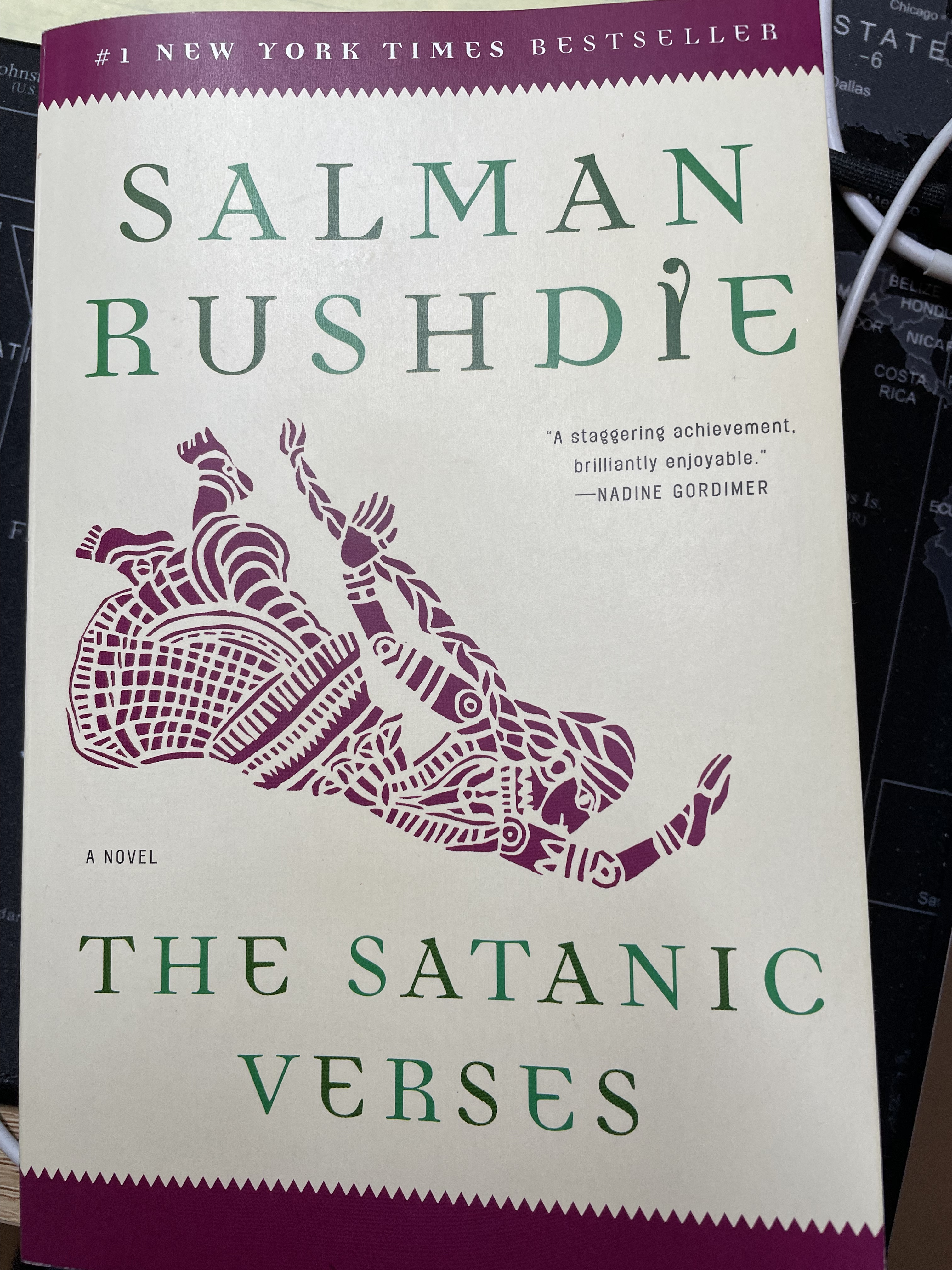
I recently heard the author talking on the radio and it piqued my curiosity, so I wanted to find out what he wrote that has people still trying to kill him after thirty years (he was recently stabbed in London). I figured it must be incredibly derogatory of Islam. I was disappointed.
This is a rather long novel (591 pages) that falls squarely in the literary fiction genre. It reads more like poetry than prose at times, and the author uses every literary trick to make it interesting to read — as a stimulating activity rather than a story with a plot and all that nonsense. His descriptions of even characters conveys who they are without them saying a word. You could call it hyper-metaphorical.
There is a core story here, about two men with similar backgrounds (Indian actors) who meet accidentally and become entwined (to say the least!) as they reconcile their pasts with the present. This story is less than half the book. Rushdie livened the story up with a fantasy twist that hides multiple levels of allegory (east-west, young-old, good-evil, life-death, etc), adding several separate threads that are more like independent stories; all of these pieces are tied together by one of the protagonists (or is he the antagonist?). The author leaves that question unanswered.
There is no attempt made to reconcile any of the fantasy with reality, so the reader can write their own backstory; I’m certain that has been done many times by literary critics, perhaps even Rushdie himself. Personally, I think he just wrote it and let the chips fall.
It’s difficult to critique the grammar and punctuation because the characters often speak in Indian/English slang (I had to look up so many words that it became like translating from Spanish). Also, to keep the pace going, dialogue is mostly within paragraphs and sometimes not even using quotation marks. Thoughts and words are intermixed in an assault of ideas and actions that conveys more than simple conversation. Truly masterful.
I don’t read novels like this in general because they don’t make any sense to me. There is no cause-and-effect, not even speculation about what’s going on — never mind the appearance of the narrator as some kind of deity who doesn’t reappear. Pieces of literary construction are thrown together haphazardly and the result is a mess; however, it is a rather pleasant morass of words and ideas if the reader doesn’t try to read between the lines.
To address my original reason for reading this novel, I think the people who want to kill Rushdie read between the lines and saw something that shocked them so badly that he became one of the protagonists (or are they both antagonists?) to them. To those who believe in magic and superstition, this book can mean almost anything.
I’ve tried not to fall into that wormhole in this review because …
I’m just a reading monkey.
Review of “Antes de ser libres” by Julia Alvarez

This book review is going to be a little different. I have read several books in Spanish but I’ve always written my review in English because my Spanish is very poor. This time, however, I am writing the review in English and appending the Spanish translation. Anyone who reads this with some Spanish language skills will probably get a laugh out of it.
English.
This is a children’s story about an eleven-year old girl whose family escapes from the Dominican Republic during Trujillo’s reign of terror. It isn’t a biography but a condensation of many stories she heard from others.
The central character is enigmatic because I don’t know if her personality is intended or the result of the book being written by an adult. Anita is very mature and has quite a large vocabulary, but she also acts very naive about simple things. This could be character development as the story unfolds. Maybe she’s showing off her vocabulary. Still, it was disconcerting.
The story is straightforward so the appeal must come from Anita’s thoughts, which she doesn’t write in her diary until near the end, which leads to my only real complaint: the narrative is written in first-person, present tense, with past tense used for previous events; however, when Anita writes in her diary, she uses past tense. If she’s telling the story years later, with assistance from her diary, why would she use present tense? That works best for continuous action, not retelling a story. I’m probably just too picky, but it bothered me.
I was also confused about her relationship with several boys she had crushes on during the story. They seemed a lot younger when they were playing together than later in the story, when the boys acted mature. Since when do eleven-year-old boys act more mature than girls? Some of my confusion probably comes from my stumbling Spanish, but boys and girls are boys and girls, not men and women.
It is an old story (it occurs in 1961) that the author enlivens with a young narrator. The story focuses on Anita’s thoughts and feelings rather than historical events and this should make it appealing to young readers.
However, the mention of menstruation could get it banned in some states.
Traducción en español.
Esto es un cuento infantil sobre una niña de once años de quien familia se escapan de la República Dominicana durante el reinado de terror de Trujillo. No es autobiográfica pero compilación de historias de que la autora oída de muchas personas.
El carácter centro es enigmático porque no sé si su personalidad es deliberado o el resulto de que el libro estaba escrito por adulto. Anita es muy matura y use vocabulario grande pero actúa inocente sobre cosas simples. Esto podría la desarrollo carácter por la historia. Tal vez la autora o Anita esta mostrar su vocabulario. Sin embargo es desconcertante.
La historia es claro y sencillo, por lo tanto su atractivo tiene que origina de los conocimientos de Anita que ella no escriba en su diario hasta casi al final de que naturalmente lleva en mi solo reclamo real: la narración está escribir en el primera persona presente con el pasado usado para eventos anteriores; sin embargo, siempre que Anita escribe en su diario ella usa el pasado. Si ella está contando la historia después de muchos años, con ayuda de su diario, por qué usaría ella el presente? El presente funciona bien para acción continuado, pero no recuenta los eventos pasados. Yo estoy probablemente justo demasiado criticón pero eso me molestaba.
Yo estuve confundido también sobre su relaciones con varios niños con quien ella se estaba enamorando durante la historia. Ellos aparecerían mucho más joven cuando jugando con Anita que más tarde en la historia, cuando los niños están actuando matures. Desde cuando los niños de once años se comportan más maduro que niñas? Alguno de mi confusión probablemente se surge de mi español peor pero niños y niñas eran niños y niñas, no hombres y mujeres.
Este es una vieja historia (ocurre en 1961) que la autora le anima con una joven narrador. La historia se foca en los conocimientos de Anita y su sentimientos en vez de acontecimientos históricos y por lo tanto se debería estar a jóvenes lectores.
Sin embargo la mención de la menstruación podría prohibirlo en algunos estados.
Review of “White Noise” by Don Delillo

I heard about this book on NPR. They were saying a movie was made of it, that it is about a toxic spill from a railroad. That’s been in the news lately so I read it. I watched the movie too on Netflix, but I’ll get to that.
The book won several literary awards, which usually means it is literary fiction, rather than action or drama. And it is. The narrator is first-person and all of their crazy thoughts about just about everything are portrayed and explored in numbing detail. That’s what made it interesting. Did you ever wonder if anyone else occasionally sees curious metaphors or analogues in everyday objects and events? Apparent the author does.
From his (the narrator) marriage to the evacuation because of the toxic cloud, and everything in between, nothing is spared close scrutiny, and not necessarily rational or even reasonable. For example, the return of students in the fall to the “College on the Hill” requires several pages to describe, and it is referred to later in the book.
As far as plot goes, there isn’t really one, although I got the impression that the author realized this and shoved an ending in, which was as incomplete as every other thought by the narrator. It would have been better without what was a very unsatisfactory finale. That isn’t important, however; what kept my attention was the narrative, exploration of Jack Gladney’s mind through his attempts to understand the world. He fails and I think this is where the title comes from.
Everything is white noise, in our minds, the outside world, movement through this world. Everything. And that’s probably why the book won awards, and why I recommend it as a fascinating examination of “what if’s” even if there are no satisfactory answers.
As for the movie, I don’t know why anyone would have tried to make a movie from this book. I watched the film and it bore little relation to what I read, except that I saw the movie first; the actor who plays Jack Gladney was perfect, in appearance, speech, mannerisms. Just excellent. Everything else about the film was a major disappointment.
Read it but don’t watch it!
Review of “Hello Summer” by Mary Kay Andrews
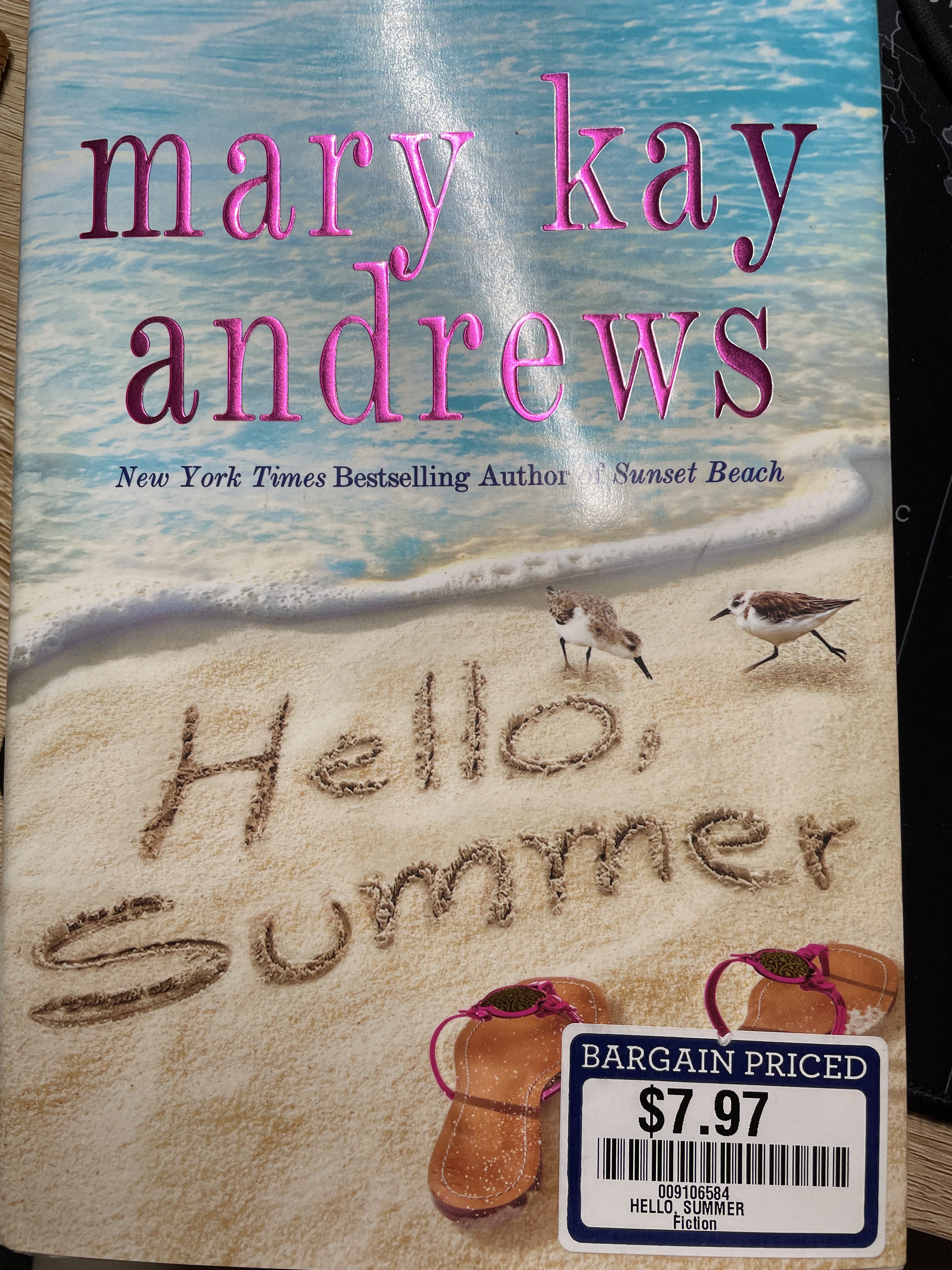
As the front cover image shows, I picked this gem up from the bargain table at Barnes and Noble. It was published in 2020 by an author with a reputation of writing books for summer reading, which I assume means mindless entertainment. The mindless part is certainly true …
First, the writing is a little wordy and, like most of the books I’ve reviewed, it weakens after the halfway point. Typos and clumsy sentences increase but never become a problem for the reader. I just notice those kinds of things. But one thing that was noticeable was the author’s apparent recognition that she had rambled too long and had to wrap it up, as if it were Labor Day and she was only half finished.
I don’t think there is a plot per se, but rather a series of inconveniences, culminating in a convenient story worthy of national headlines. (The central character is a newspaper journalist between jobs.) The character meanders along like the hot summer weather in the Florida panhandle where the story takes place, doing all the things you might expect for a breezy summer read: finding romance, facing past relationships gone off the rails, working hard on the big story, solving a mysterious death through tenacity and brilliant insight.
The author must have recognized that the story was going nowhere, so a bogeyman and a hero were tossed in to create a sense of anxiety and welcome relief, even a tragic ending for the hero. It sounds great but it doesn’t work. Maybe no one notices when they’re reading a book on the porch on beach in Florida on a sultry summer day.
There was a lot of descriptions of flowers using names I didn’t recognize. That would probably appeal to the right crowd, like reading nineteenth century English novels (e.g. Pride and Prejudice). There certainly was a homey feeling to the story but it didn’t quite fit, and maybe that was the intent of the author — big city girl doesn’t fit into her small town roots.
But this girl decides that she can make her life just as challenging in NW Florida as in Atlanta or New York.
I can’t really recommend this book but, like the characters, neither is it egregious …
Review of “Outfox” by Sandra Brown

Another random read, picked up at the discount table at a chain bookstore.
First, my comments on readability. The grammar and punctuation were good, but as with every novel I’ve read, the overall structure deteriorated at the halfway point. Sentences became wordier and context was sometimes lost, so that I had to reread previous paragraphs to catch up. Maybe I’m just a poor reader.
The antagonist is identified early, so this is indeed a story about being outfoxed, a cat-and-mouse game with someone’s life at risk, whose life was the first surprise. The protagonist thinks he is smarter but he’s shown up repeatedly by his adversary. This was well done, especially because the villain is introduced through one thread. This is a bold method that could have been exploited more, but it nevertheless works. Unfortunately, if the hero is always losing, there has to be a big scene where they get lucky. That is how this ends, predictably but surprisingly unexpected.
I had the impression from the outset that the story was going to end in an explicit romantic scene. That was okay, but the intimacy was overdone in my opinion, pushed beyond the inevitable romantic conclusion that was apparently the real plot. I don’t know anything about the author, but this reads like it was written for a specific audience that likes romance mixed with mystery, although there wasn’t much mystery in the perpetrator of heinous crimes. The red herrings weren’t very convincing.
I was totally surprised by the ending, which says a lot about the skill the author used to disguise what was in plain site, if I had been looking for it. However, this cool surprise was irrelevant to the story, and at times made some of the scenes implausible (in retrospect). At the time, I was totally fooled.
This novel smoothly integrates several themes into a sometimes-compelling story that isn’t really a mystery or a romantic drama. Overall, it was okay for casual reading, but don’t expect to stay up late reading…
Review of “The World of Lore: Dreadful Places” by Aaron Mahnke

This was another random read, this time picked up at a local bookstore’s bargain table. I didn’t even read the back cover, so I had no idea this was a collection of mystical stories. The author has a podcast and seems to be a diligent researcher, and he presents a balanced picture of what can be explained and what cannot. I’m not a fan of this genre, but I found the stories well written and fun, with lots of background information on the places where the stories originated. Some of the tales made my hair stand up. Some were boring, most were informative and well presented.
It is an easy book to read, but for some reason it seemed to take a long time to finish. I mean, if you’ve heard one ghost story, you’ve heard them all; nevertheless, the depth of research and skeptical storytelling kept me interested. There really are unexplained incidents. That is a repeated message in this collection.
There isn’t much else to say. The book’s premise is clear and it is informative, rather than just retold stories. If you enjoy the lore behind the scenes, in many different locations, then I recommend this book.
I can’t help but wonder why such stories don’t occur today, despite the widespread use of smart-phone cameras and social media…
Review of “The Man Who Died Twice” by Richard Osman

I didn’t know this was part of a series when I bought it at Copenhagen International Airport. It wasn’t a problem, however, because the references to previous exploits are vague and don’t directly impact this story. The personalities and relationships of the characters are presented in sufficient depth that a fan of the series would probably find the detail redundant.
One thing I found disconcerting is the use of the present tense with a third-person narrator for most of the chapters. This approach is so awkward and inappropriate that the author kept resorting to the past and present perfect to present past events, and they made a lot of grammatically clumsy (if not erroneous) constructions doing it. It just made no sense. There is a first-person narrator who shares her view periodically, and that works fine in present tense. Some people talk like that.
As you can imagine, there are a lot of cliches (English not American) and stereotypes for the characters, but they kind of seemed the same to me most of the time. Now and then, one of them would suddenly behave differently than they had before; that is a risk with an ensemble cast of characters, and I only mention it to be as complete as memory will allow. The central character (not the narrator) seemed to have a rush of inspiration at the end, realizing her fallibility; it made me wonder if she does it in every book?
The plot was obvious because there really was only one person with the resources required to pull off the crime; thus, a variety of red herrings were introduced to keep the reader from figuring it out, and show the weakness of egotism (I still don’t understand the title).
Overall, a fun romp with some elderly people, filled with anecdotal observations of aging and nonsense. I didn’t finish it on the flight, but I remembered to read a few chapters (they’re short) every day.
A final comment: One crime solved by the “Thursday Murder Club” is enough for me…


 Timothy R. Keen
Recent Comments