Catching Up: A Brief Geologic History of NW Washington
Introduction
The shifting of tectonic plates around the surface of the earth is a zero-sum game because the surface area is fixed; thus, when new oceanic crust is created from the upper mantle at divergent plate boundaries (usually mid-ocean ridges but also at intraplate rift zones), oceanic crust has to be absorbed back into the upper mantle through subduction at convergent plate boundaries. Continental crust is not subducted because it is about 10% lighter than oceanic crust (2.7 g/cm3 vs 3 g/cm3), so it has been accumulating since the earth was created. Note that it took about 4.5 billion years (by or Ga; I will use Ma to refer to millions of year ago) to form the continents, which still comprise less than 30% of the earth’s surface.
The majority of continental crust existed by 3 Ga, and the crust was stabilized by 2 Ga; in other words, for the last two billion years, the same continents have been jostling about, driven by upper mantle convection–like a poached egg floating in boiling water. North America is a good place to examine these processes because it has mostly shifted back-and-forth, from east to west relative to its current orientation.
The geology of NW Washington can thus be seen as the opposite of Northern Virginia (NoVA); when the east coast is convergent, the west coast is divergent. This simplified model explains the differences between the two coasts/continental margins. The contrast is striking, which I will attempt to show in this post.
Precambrian (older than 550 Ma)
Current estimates suggest that 15-20% of the earth’s surface is Precambrian. Ignoring the rest of the world for now, there are a few metamorphic fragments (primarily gneiss, which is a rock so highly altered by heat and pressure that its original structure is lost); however, these rocks are not folded and partially melted, which suggests that they were altered primarily by deep burial–not compressive stresses. Nevertheless, they don’t shed much light on the Precambrian history of NW Washington (NWA hereinafter) other than that a lot of sediment was being buried very deeply.
This is very different from NoVA and the east coast in general, where long bands of gneiss and schist (a less-altered rock) are exposed from Georgia to Maine; their metamorphic ages range from 1-2 Ga, reflecting large scale collisional tectonics including subduction. The simplest interpretation is that the North American tectonic plate was moving (relatively) eastward during this interval, creating a passive margin along the west coast (Plate 1).
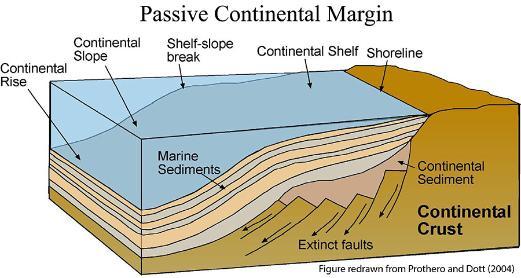
Plate 1. Schematic of a passive continental margin. This example is for a continental plate moving to the right while sediments are deposited along a gently dipping margin. As far as the data tell us, this was the situation in NWA between about 1000 and 250 Ma. The N American plate wasn’t jiggling, but rather sedately moving eastward, chewing up whatever islands and microcontinents got in its way while shedding its sediments on the west coast. (Like water off a duck’s back.)
Paleozoic (550 to 250 Ma)
The Paleozoic era saw the rise of multicellular organisms, which filled the oceans and colonized the land. There are enough fossils, the inhabitants of ancient seas in NWA, to document this explosion, but the rocks are highly altered and deformed. Nevertheless, the paleontological record implicitly supports the continuation of the passive margin that existed during the late Precambrian. In other words, a vast and diverse ecosystem was established that thrived for 300 my.
Mesozoic (250 to 65 Ma)
The Mesozoic era began with the breakup of Pangea, the supercontinent whose construction culminated during the Devonian period (415-360 Ma). This paradise of life lasted about 100 my but all good things must end. Upper mantle convection reversed course and Pangea was torn apart by what is today the mid-Atlantic ridge system. I saw the evidence in NoVA for myself; but what did this catastrophic event foretell for the peaceful west-coast of N America?
All hell broke loose.
The placid coastal environment suggested by Plate 1 was obliterated, geologically speaking, when the N American tectonic plate reversed direction and split away from Pangea, after approximately 100 my. At first there would have been earthquakes and uplift as the oceanic plate resisted the sudden compression. Nevertheless, when push came to shove, the denser oceanic crust was pushed beneath N America, creating a subduction zone that is still active.

Plate 2. This schematic portrays NWA as it exists today. Note how close the Juan de Fuca ridge is to N America. If we go back to the Triassic period (~250 Ma), there would have been about 2000 miles of oceanic crust between them, but it was all subducted. This subducted ocean crust would have partially melted to produce igneous intrusions, which were subsequently intruded by younger magma. Today, only a few slivers of the oldest igneous rocks are found east of Seattle. There were also sediments deposited; however, these were buried and deformed to form schist and other medium metamorphic grade rocks. Most Mesozoic rocks were eroded as uplift continued until the present day. Bands of Mesozoic volcaniclastic rocks are found east of the cascades where uplift has slowed as the subduction zone migrated westward.
Tertiary (65.5 to 2.4 Ma)
As the years passed the situation in Plate 2 continued unabated. Igneous intrusions of every composition (i.e. from gabbro to granite) pushed their way through the overlying rocks, often reaching the surface to create volcanoes and overlapping volcanic flows, mostly basalt.
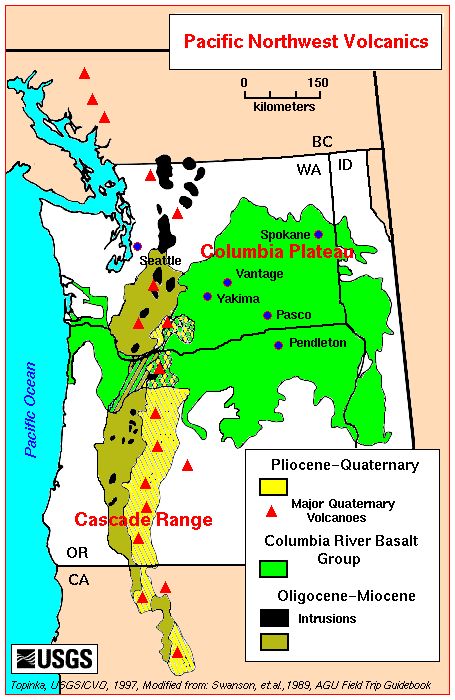
Plate 3. Map of Tertiary volcanic rocks in Washington. The oldest eruptions occurred along the Cascade range between about 50 and 2.4 Ma; the Cascades comprises overlapping volcanoes. The intrusive (black areas) and extrusive rocks from these older eruptions (brown) are weathered, the volcanoes dormant/extinct, their source plutons (buried magma chambers) exposed by erosion. The Columbia River basalts (green) flowed from fissures in the crust rather than volcanoes between 17 and 14 Ma, with ongoing weaker eruptions until about 6 Ma. These are too young for their source magma chamber to be exposed. The youngest volcanics (Yellow) are associated with active volcanoes like Mt St Helens, Mt Rainier, and Mt Hood (in Oregon). For example, Mt Rainier is about 850 thousand years old.
Quaternary (2.4 my to present)
As shown in Plate 3, volcanism has continued uninterrupted into the present time and will persist until the westward motion of N America stops; and no one knows when that might occur. Nevertheless, a new geological phenomenon occurred about 2.4 my ago, which delineates the Quaternary from earlier geological periods.
Earth was plunged into an ice age, which continues to this day, even if we are in an interglacial interval. It isn’t obvious why ice ages happen, but they have occurred many times throughout earth history: Pongola, 2900-2780 Ma; Huronian, 2400-2100 Ma; multiple events between 715 to 547 Ma; Andean-Saharan, 450-420 Ma; Karoo, 360-289 Ma; Late Cenozoic, 34 Ma to present. The primary glacial period represented in NWA is the most recent.

Plate 4. Map of estimated ice thickness in feet during the last glacial maximum in NWA. The ice skirted the active Cascades volcanic complex and followed the Puget Sound Trough, carving the deep bays and channels we see today. Note that the ice was 2400 feet thick over present-day Tacoma. The ice encountered bedrock beyond this corridor and was constrained. Note the location of Puget Sound between the Cascades and the Coast Range in Plate 2. An elongate basin like this is created by buckling of the crust, forming what is termed a forearc basin, which created an easy path for advancing ice sheets.
Over millions of years the ice advances and retreats many times while continuously eroding soil and rock, carving valleys, depositing broad layers of sediment beneath it where rivers flow, causing the crust to subside under its weight. Whereas the ice thickness can only be estimated, the layers of sediment deposited by a glacier can be measured directly.

Plate 5. This simplified diagram shows the thickness and provenance of glacial deposits near Tacoma, which rests on bedrock (deformed Tertiary sedimentary rocks). The total thickness here is about 600 feet, deposited over several million years. The spatiotemporal variation in depositional environments creates outwash during advance and recession, lakes in front of the glaciar, windblown loess and till, streams draining the bottom of the glacier as well as meltwater, to name a few. This rapid switching of depositional environment leads to juxtapositions of coarse and fine-grained sediments in both time and space.

After more than 10000 years since the last glacial retreat, the crust has bounced back, rivers have been created and cut into the glacial sediments, and you have a waterway comprising hundreds of islands, its margin defined by steep bluffs (~100 feet) cut into unconsolidated glacial deposits.
That brings us up to speed…

 Timothy R. Keen
Recent Comments