
Review of “Dreams in the Eternal Machine” by Deni Ellis Béchard
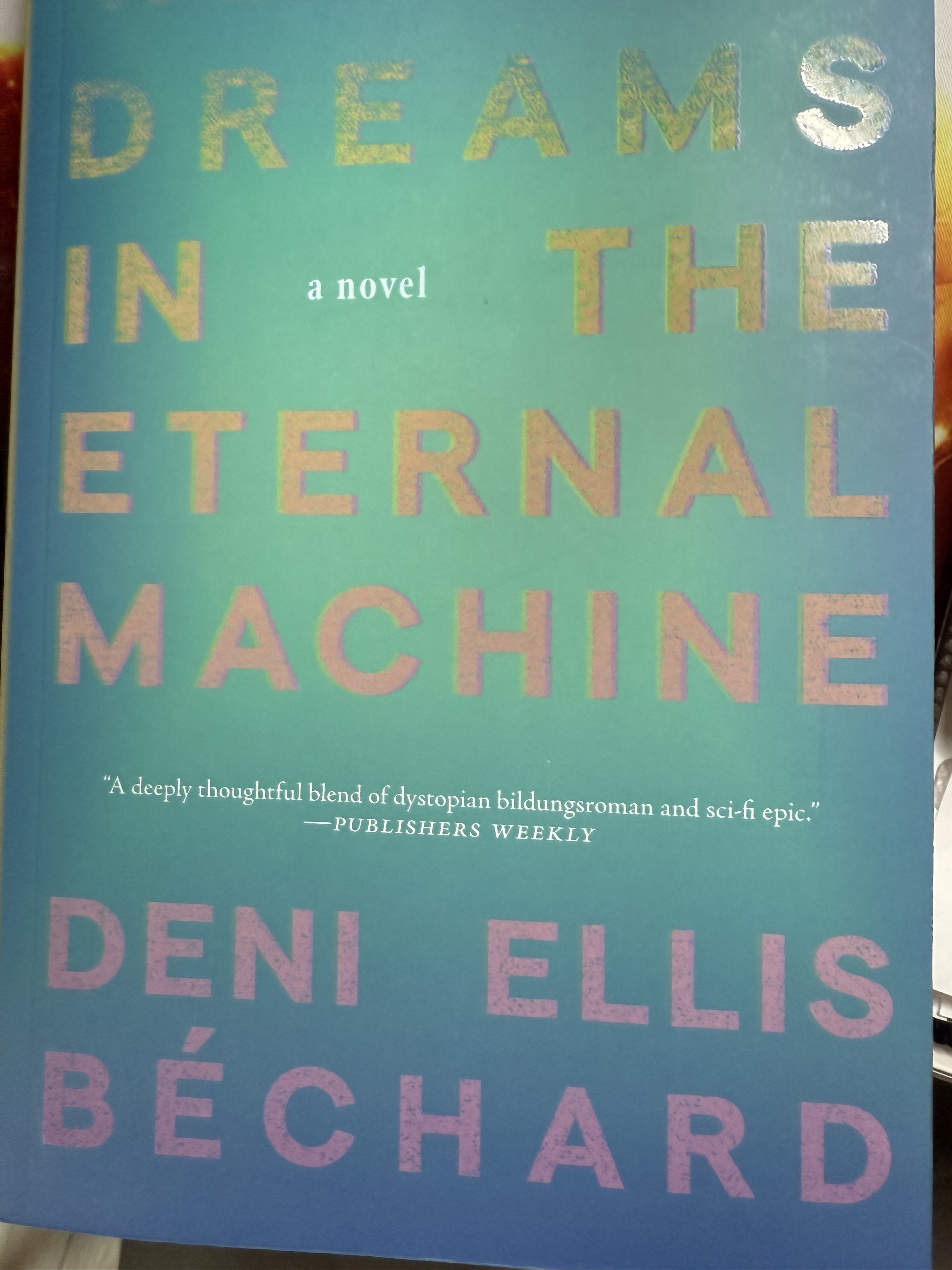
There is no surprise ending to this speculative science-fiction novel. The secret is in the title and explicitly introduced in the first few pages. Everyone on earth, including the planet itself, has been assimilated by an artificial super intelligence whose rapid development far surpassed its creator’s imagination. So what is the plot?
Wrapped in a science fiction cover is a Shakespearean story of betrayal between young people who accidentally meet in an American divided by civil war. Their story is integrated with their separate experiences after assimilation into the machine, and it remains unresolved. The only other evidence of a plot is the general decline in cognitive and emotional wellbeing of the majority of people. This process is explored through several characters whose importance to the plot is never clear. In fact, no one really stood out as being the central character, other than the two young people mentioned above. Having a plot doesn’t require the central character to succeed; failure is the stuff of tragedy and perfectly okay, but no one really struggled against the antagonist (obviously the eternal machine). Their situation is hopeless and there is no chance of escape — not even the slightest. Hopeless.
Given the lack of a coherent plot or even a central character, this story is fundamentally about the response of people to a hopeless situation in which there are no threats of any kind. The machine not only feeds and cares for its dependents, it creates any world they want to see and experience. Spoiler alert: Heaven gets old after a few centuries.
The writing is very good, and the author doesn’t miss a trick to get an agent’s attention and produce a popular book. It seems to me that agents probably don’t think very hard about the books they represent. And, of course, the reader doesn’t find out until it’s too late, the money spent. That’s how I felt. As far as the reviews, I never cease to be amazed at the glowing reviews written about this novel; I guess critics don’t read books either.

 Timothy R. Keen
Recent Comments