
Review of “Rabbit, Run” by John Updike
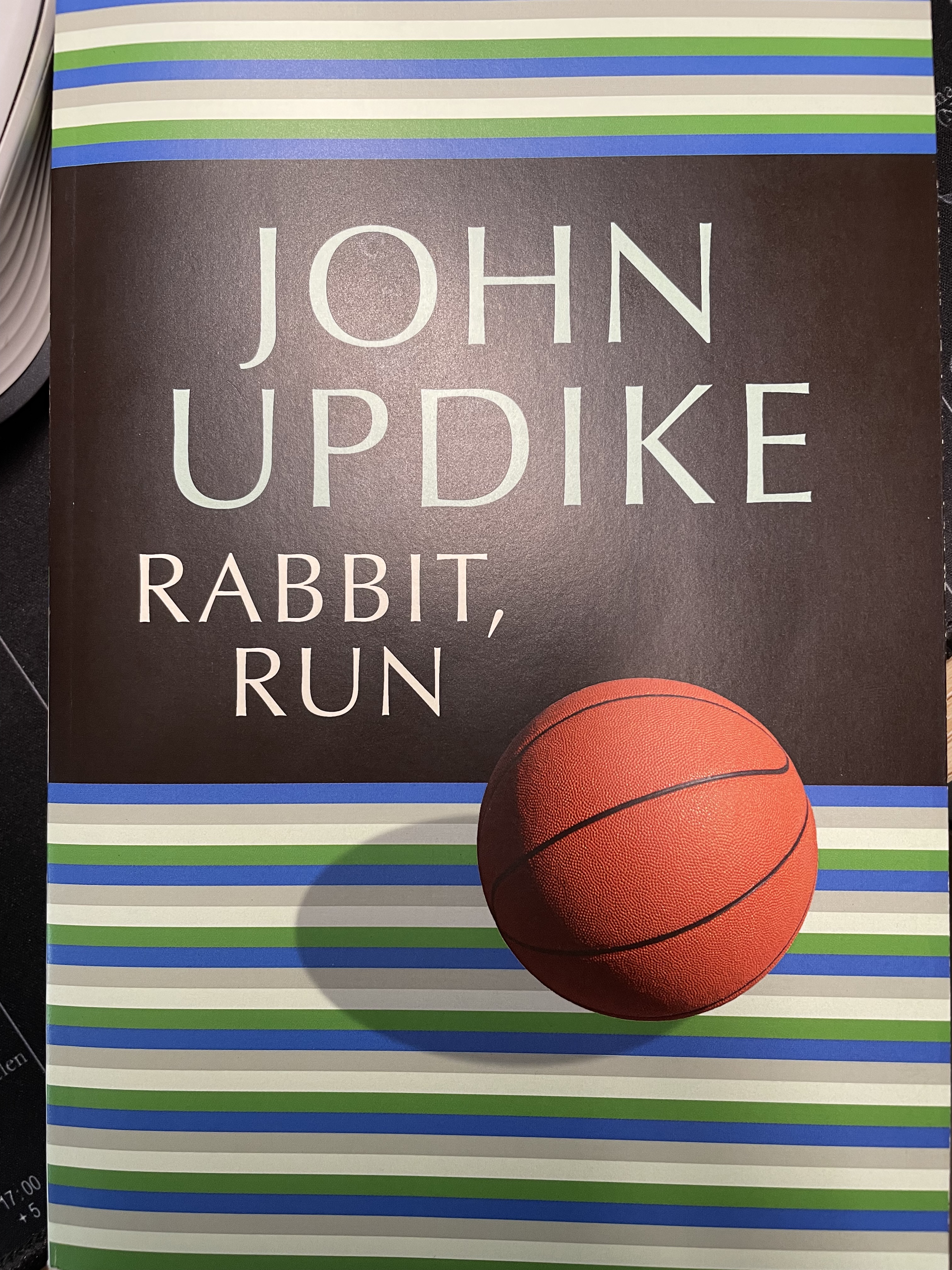
The author of this literary fiction must have been a student of James Joyce (Ulysses) because it is primarily a stream-of-consciousness portrayal of several months in the life of a young man who is trying to escape his pregnant wife and young boy. The plot is secondary to the writing style, which really placed me in the mind of a character I despised throughout, although several of the other characters found him charming and wanted to be around him. I thought about writing this review the way the book is written but decided that would be too much work. I can’t imagine keeping this up for 325 pages and, apparently, it was difficult for this iconic American writer too; like most of the books I’ve reviewed, it starts unravelling about halfway through.
The plot is as much based on the thoughts of the characters as their actions. This is a tragic story about a young man (Harry Angstrom) who dwells on the good old days, when he was a basketball star in a small Pennsylvania town, while selling vegetable peelers at a department store. After abandoning his family, he ignores the advice of everyone around him, even his beloved coach, who turns out to be mortal when viewed through Harry’s cynical eyes. Indecision and feelings of duty lead Harry to reversing course several times, ultimately leading to personal tragedy and humiliation.
Part of the book (there are no chapters) applies the close point-of-view method to several characters and this is where Updike’s skill as a writer shines. While maintaining the stream-of-consciousness style, he eloquently presents several characters’ perspectives on Harry’s predicament.
No detail in any scene is too small to warrant description, but this is where the story gets a little sketchy, especially towards the end. I think the author was running out of metaphors. Nevertheless, I was impressed with how he brought inanimate objects like streets to life, making them characters rather than backdrops. His detailed descriptions of the town where Harry lived are probably excessive, except that some of these paths were followed more than once, each time from a different spatiotemporal perspective, as Harry’s mental gymnastics evolved.
I don’t like tragedies personally because I hear them all the time in the news, but this book was published in 1960. I enjoyed reading about anachronistic devices, e.g. rotary phones with handheld receivers, from a time when I was a young child. Like I said, nothing is overlooked, not even a meal eaten with chopsticks in a Chinese restaurant in a small Pennsylvania town.
I am currently writing a science fiction novel, and I can already see Updike’s influence on my writing; however, I won’t be describing dappled shade as “…a darkness in defiance of the broad daylight whose sky leaps in jagged patches from treetop to treetop above him like a silent monkey.”
That is damn good writing, but maybe it’s meant for writers rather than the average reader.
This is excellent literary fiction.


 Timothy R. Keen
Recent Comments