Review of “Empire of Illusion” by Chris Hedges

As you can see from the book cover, the title is longer than my post title. I think the author could have omitted the subtitle, which almost acts as a table of contents. There weren’t very many chapters and the book isn’t long, but it seemed longer than it was because the author ranted on the subjects he covered. I was especially tired of hearing details from porn stars about what goes into a modern shock-porn movie. I don’t think the author had much to say on the other topics (e.g. higher education, politics, finance) either because they were repetitive and filled with vague references to a conspiracy by the “elite.”
Most of the examples of collusion he discusses are public knowledge and not conspiracies, but Hedges frames them for emotional impact; I suppose that is what investigative reporters do to make a living. I prefer facts to be presented in a logical order so that I can come to my own conclusions, rather than being told on every page that it’s a conspiracy.
If you remove about half the text, the part telling the reader what they already know, this book does present evidence for what the title claims. However, it is incomplete and only focuses on a few topics of interest to the author. Anyone could have written this by reading several newspapers and a few books, skimming social media, and taking the time to connect the dots. That introduces the problem of how the dots are connected and not everyone is going to see a conspiracy behind every social and economic trend.
That leads to my final point about this book: Hedges never connects the dots to complete the picture, not even speculatively. Each category he examines is presented in a standalone chapter and the only big picture he paints is ambiguous, more references to vague conspiracies. Who is conspiring and why is this something I don’t already know? How are the pornography and educational sectors connected? He doesn’t say.
Failing to justify the grandiose title, and possibly with a publisher’s deadline looming, Hedges throws in a couple of pages of optimistic encouragement for us idiots who are completely deceived by the web of conspiracies he’s woven. I do feel deceived — by Hedges, not the porn industry, educators, politicians, or any of the other groups he derides. I know they’re full of shit …
Proterozoic Metasediments at Scott’s Run
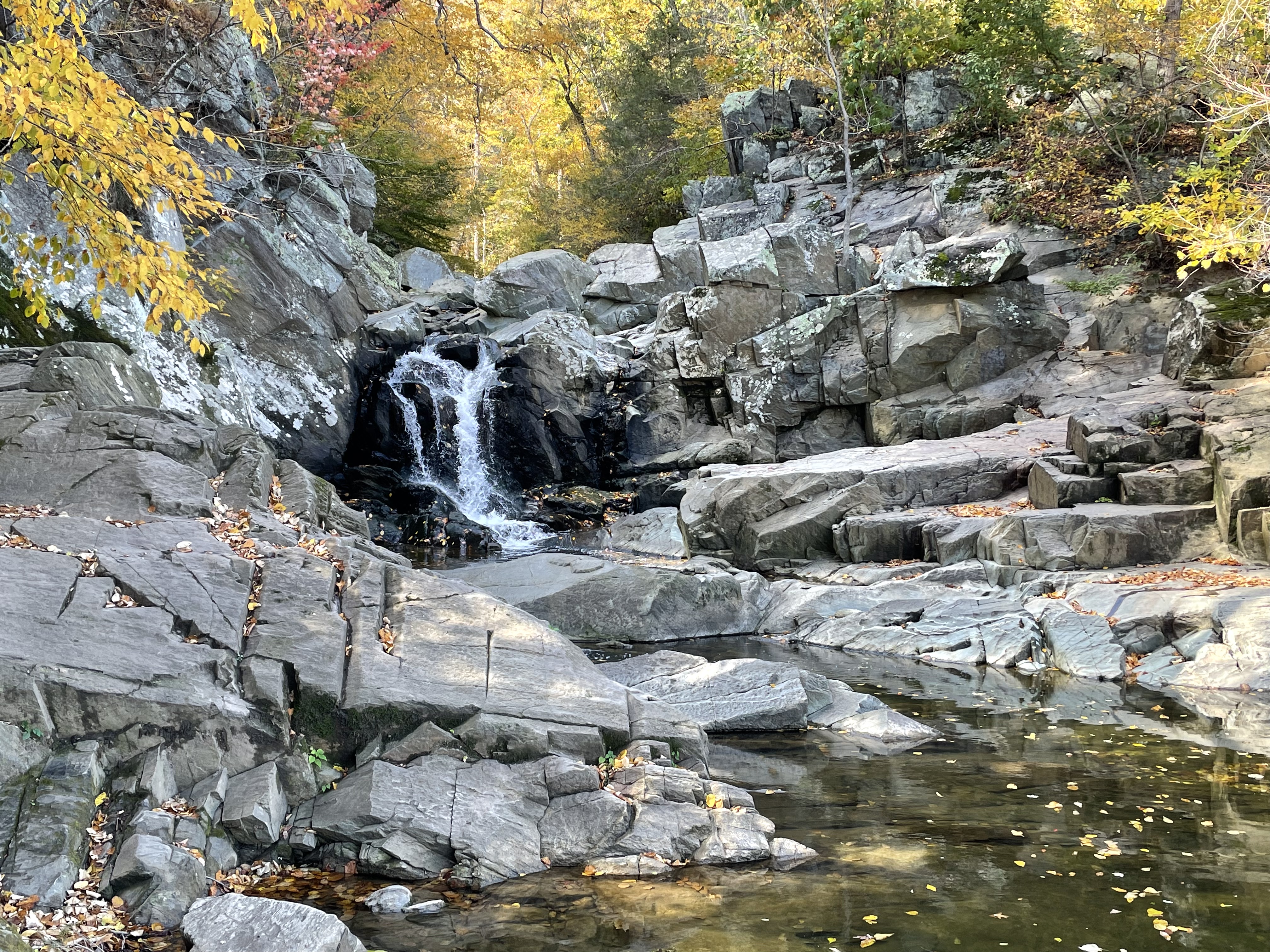
Figure 1. This post explored some of the Precambrian (1000 – 511 Ma) metamorphic rocks we’ve seen before along the Potomac River in Northern Virginia (NOVA). We followed Scott’s run to the waterfall (see Fig. 2 for location), where the creek dropped about ten feet at the current level of the Potomac. This photo shows a massive metasedimentary rock with no foliation. According to RockD this is a metagraywacke, which is a poorly sorted sand-silt sediment deposited on submarine fans (e.g. at the mouth of rivers), with distinctive structures that indicate slumping. The dates are indicative of the age of metamorphism rather than deposition. This is a thick formation but I couldn’t find a measured thickness but, based on its exposure along the Potomac, it must be thousands of feet thick; the large range in ages supports a model of continuous deposition/burial/low-grade metamorphism for hundreds of millions of years. Like a conveyor belt. There is no evidence of magmatism in this area, although a thick sequence of greenstone (metamorphosed basalt and associate volcaniclastic sediments) of this age is exposed in Shenandoah National Park.

Figure 2. Geologic map of Scott’s Run Nature Preserve. The waterfall (Fig. 1) is labeled in the inset map; the geologic map (right panel) indicates the exposure of metagraywacke (Pc Metaseds) in the area with thin lines. Our path followed Scott’s run to the left of the inset map, then the Potomac, before turning south at the Ridge, which will be discussed below.
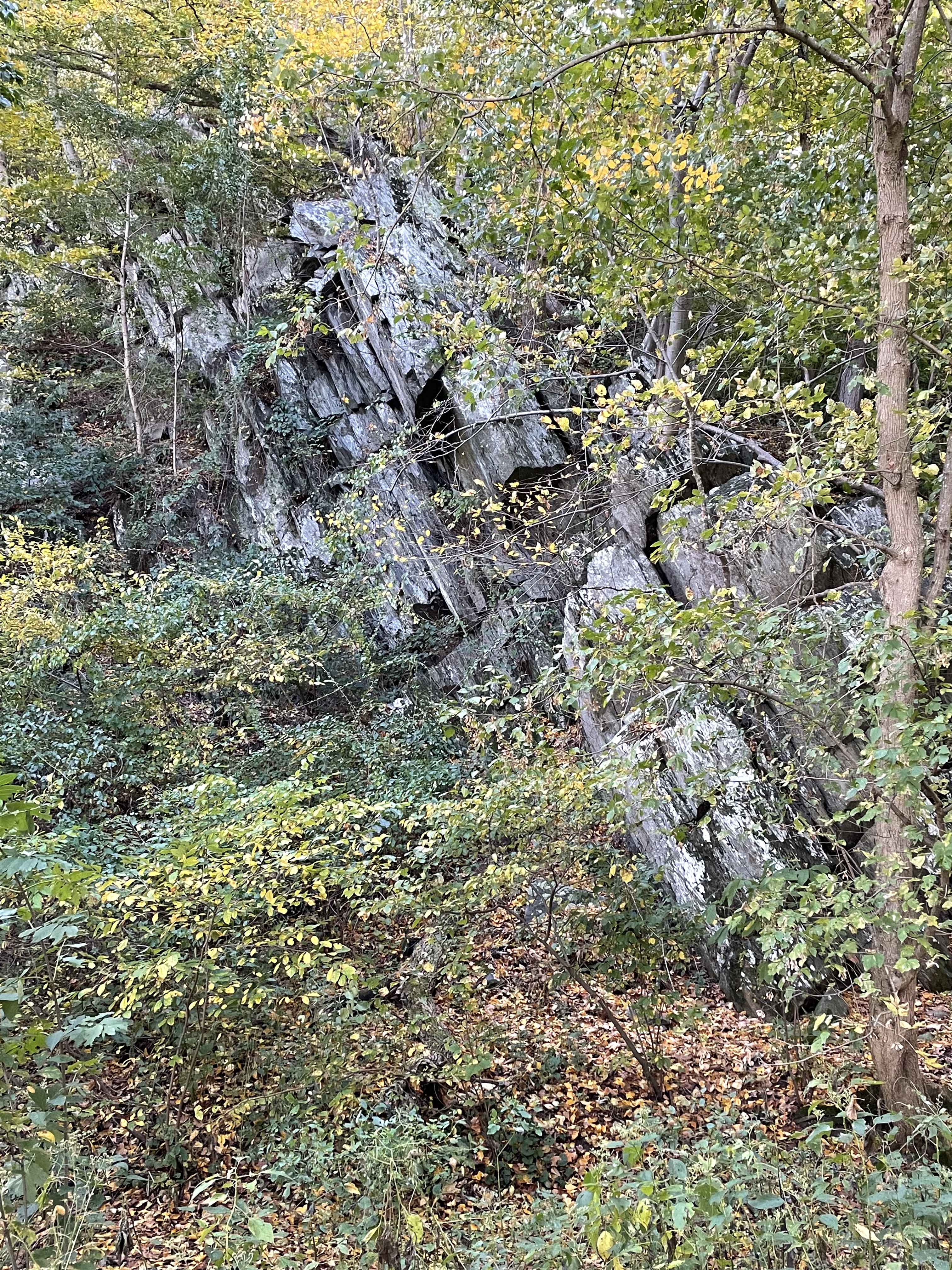
Figure 3. Photo of a ridge of schist (see Fig. 2 for location) the same age as the metagraywacke seen in Fig. 1. Schist is the result of burial and heating of mud at great pressure. Notice the distinct foliation of this outcrop, which is tilted about 70 degrees from horizontal to the west, the same trend we have seen throughout NOVA. The tilting is partly due to normal faulting during the rifting of Pangea about 200 million-years ago. I don’t know how these rocks’ original bedding (i.e. foliation) was deformed when they were buried and metamorphosed into schist. We’ll probably never know. The graywacke we saw in Fig. 1 has a large sand component, which tends to form thicker beds than mud; these schists were originally mud, with minor sand. The origin of foliation is complex; I conjecture that the high water content of mud (clay minerals have lots of bound water) leads to an excess of water that has no where to go when they are heated under pressure for long periods of time (i.e. millions of years). As new minerals crystallize, this water is forced into irregular layers (i.e. surfaces) within the sediments during diagenesis; I’ll go further and say (with significant justification)that sediments that slump into the deep-sea trenches that delineate subduction margins contain excess water and are rapidly buried. The result — schist is my answer.
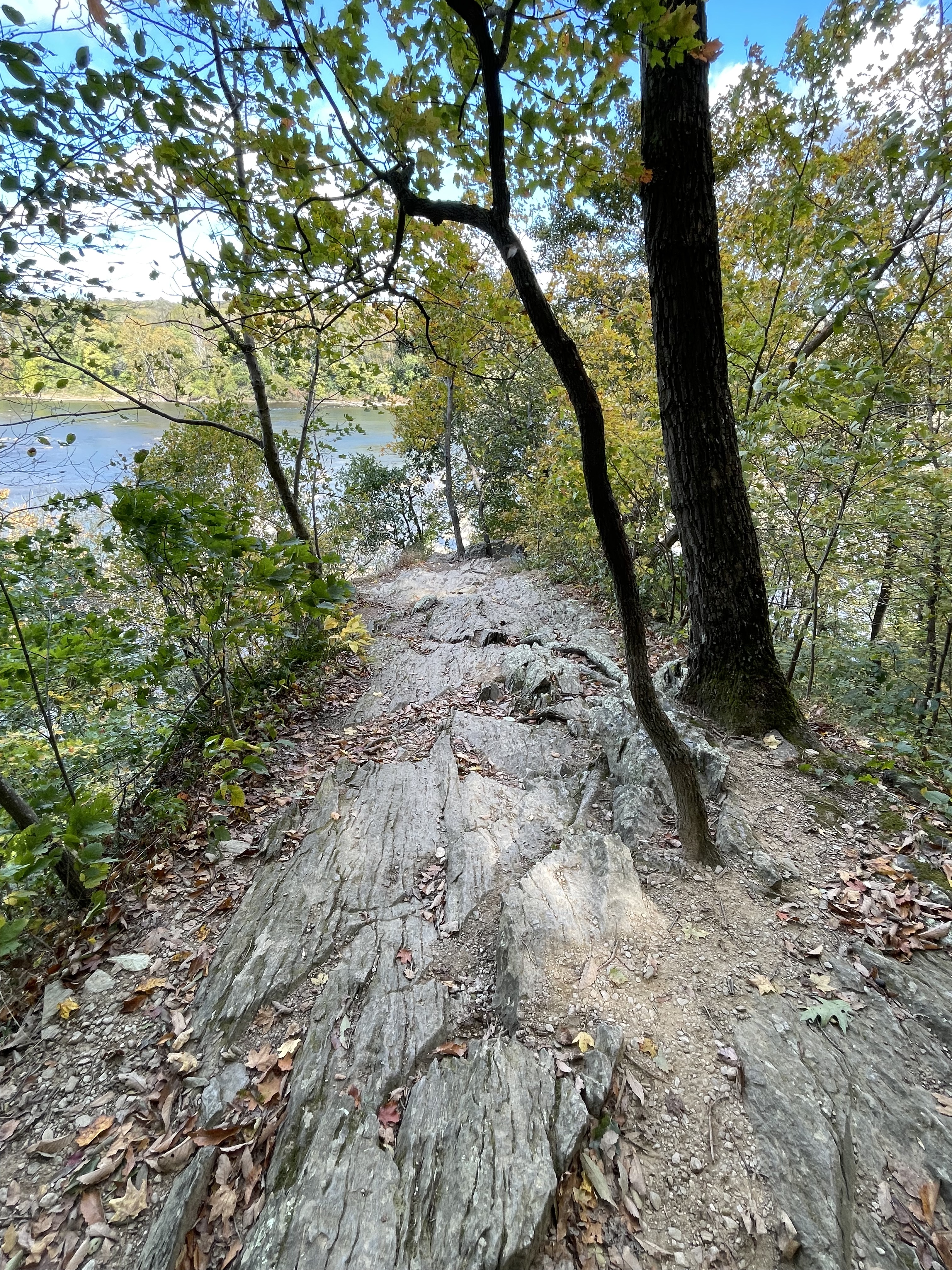
Figure 4. Photo from the top of the cliff seen in Fig. 3, showing the foliation I was talking about. This ridge (see Fig. 2 for location) is demarcated by short streams with steep slopes on both sides. Here, about 60 feet above the Potomac, it narrows to less than 10 feet along its spine.

Figure 5. This image reflects the incredible power of water on a metamorphic rock filled with excess water. Mud doesn’t form quartz or feldspar (chemically resistant minerals) during low-to-medium-grade metamorphism because there isn’t enough silicon in these minerals; they consist of layers of aluminum, iron, calcium, etc, bound with silicon and sandwiched between what are basically water molecules. The result is a fissile rock like this, where the slivers of resistant minerals are getting worn away.
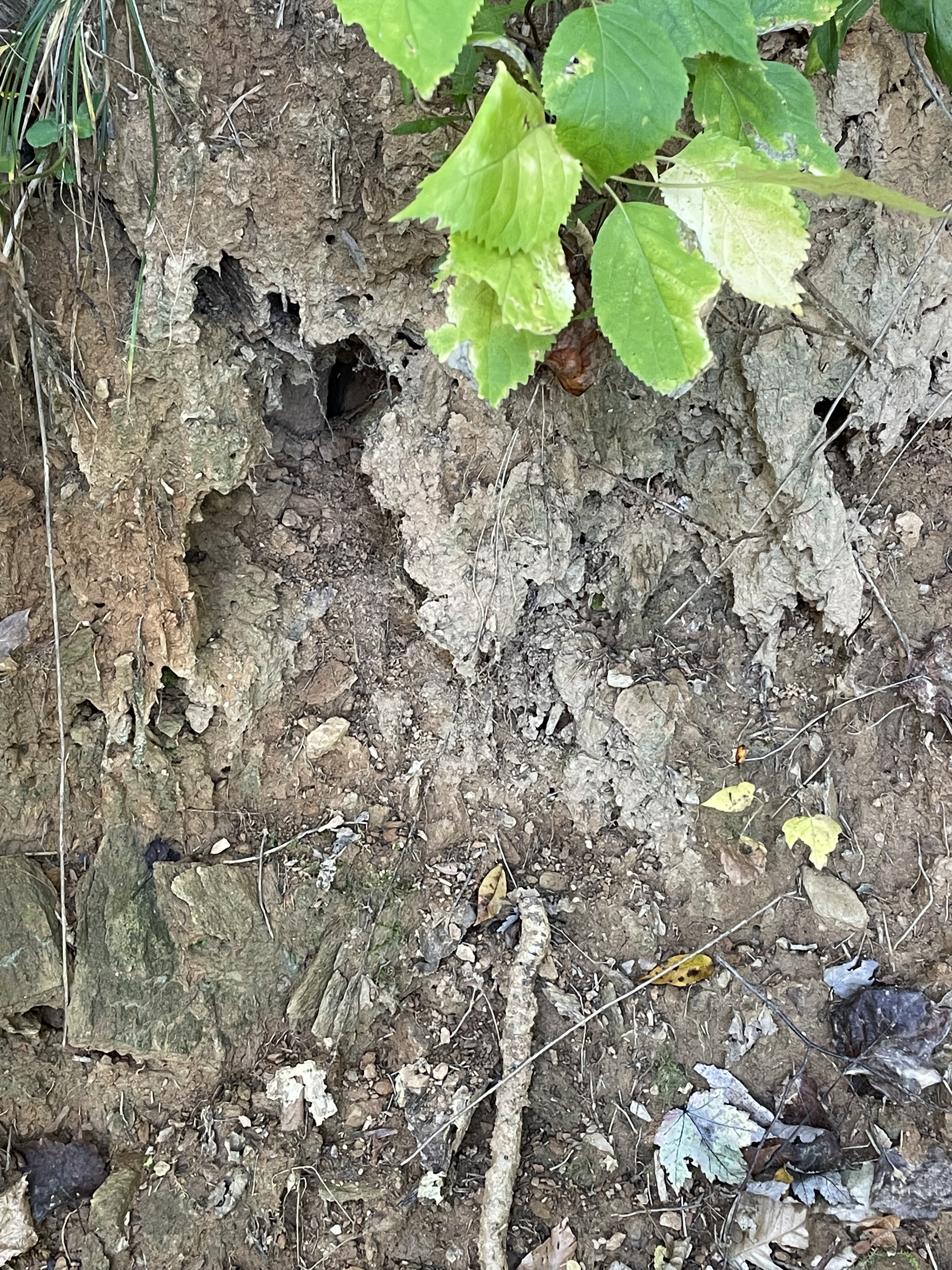
Figure 6. This photo, taken less than 20 feet from Fig. 5, shows the end result of the microscopic weathering of schist. It is turning into mud as the trapped water is released and the aluminosilicates (clays) break down into smaller and smaller grains. This soil is rich in aluminum and is mined for that element in tropical areas where plentiful rainfall maintains the conveyer belt that recycles mud into mud.
Summary. Between one-billion and five-hundred-million years ago, NOVA was a deep sea trench, probably associate with subduction of oceanic lithosphere beneath another tectonic plate. There were, doubtless, interludes in this process, but the geologic evidence suggests that subduction was the game plan. Muddy sediments eroded from what were probably volcanic islands (i.e. the Catoctin Formation) and slid down deep slopes into trenches like we see today in the western Pacific.
This process was heterogenous just as in the modern world. Volcanic activity was dominant in Shenandoah National Park, less than a hundred miles west of Scott’s Run Nature Preserve. The best image I can conjure up is the Philippine Islands, which the irresistible force of mantle convection is crushing against the immovable object of the Eurasian tectonic plate.
I am in awe of the planet we inhabit …
First Contact

The unmanned spacecraft plunged further into the unknown, the Sun no brighter than the stars towards which it had been hurled by gravity at more than thirty-four-thousand mph. It reached the edge of the solar system thirty-six years into its mission, when its instruments – designed to measure planetary magnetic fields, the flux of ions and electrons, and the strength of cosmic rays – encountered the heliopause. Physicists had predicted the existence of such a dynamic surface, an envelope as it were, surrounding the solar system where the interstellar wind would be as strong as the flow of particles emanating from the Sun.
The scientific instruments on Voyager One recorded this momentous event for the scientists of Earth, the third planet from the Sun, to ponder acrimoniously, which was their manner of communicating amongst themselves. Oblivious of their confusion and determination to explain its ambiguous measurements, the interstellar traveler continued on its journey toward the unknown reaches of the galaxy, its instruments powered by a nuclear reactor that would sustain it until 2030 or later. Had it been sentient, Voyager One would have been proud of its accomplishment.
Given the profusion of conflicting data gathered by Voyager One, scientists developed a new model of the heliopause that integrated turbulence into the interaction of the heliosphere with interstellar space, and decided that the lonely spacecraft had just encountered a pothole as it departed the solar system. The intrepid interstellar voyager continued along its trajectory nonplussed, until it encountered something its creators hadn’t anticipated.
Mixed Messages

Another backstory from “The Edge of Space,” a science fiction novel I’m starting. This story introduces three supporting characters and how they interact.
The Science Director’s words were still ringing in Michael Snedden’s ears as he stared at the fake analog clock on the wall of his office. NASA had a reputation for facing up to its failures and moving on. The Viking One mission was a failure. It had been launched fifty-years earlier to travel beyond the solar system but, once entering interstellar space, its instruments began reporting anomalous data. It didn’t even know where it was, even though it was hurtling through the cosmos at more than thirty-four-thousand miles per hour. He was to inform the principal investigators for its science missions of its status and not release any of the faulty data. That last part bothered him. Wouldn’t the PIs want to examine the data so they could improve future instruments? He had raised that point but Director Richardson had been clear that the data were useless for scientific purposes, which raised another flag for Michael. If the instruments had reported scientifically useless data, what else could it be used for? He would to the JPL contractors who’d discovered the problem when he informed them that their services were no longer required.
His computer notified him of the call he’d been expecting, from the White House. Michael knew Assistant Undersecretary of Science and Technology Djimon Walker by reputation only; he was a relentless young man who should not be underestimated. Michael accepted the video call and prepared for the worst, but he was going to insist on knowing why the science leads were not to see the data. He would need a plausible answer when their complaints became public.
Djimon Walker couldn’t have been more than thirty-five, his black face topped by short-cropped hair, a thin mustache separating a broad nose from thick lips, but his symmetrical eyes were focused like laser beams on Michael before he spoke.
“We’ll keep this brief because you are going to get a lot of blowback from your scientists. They are going to demand to see the data that we’re telling them is corrupted but their accessing it is out of the question. You will need to have a good cover story. I suggest that you speak to Malcolm Goodson at NSA. I’ll send you his contact info, He’ll be expecting your call. Meanwhile, I’d like to know more about the contractors at JPL who discovered the anomaly.”
Michael was taken aback by Walker’s verbal assault and had to think a minute, consulting several reports lying on his desk, before responding. “The Viking program’s science mission is being handled by a subcontractor. The lead is …” He dug through the papers and found the contract before continuing, “Madison Long has a B.S. in physics. She’s been working on the project for two years, flawless performance, not a single complaint from the mission scientists, and she was recently joined by Devon Chambers …” He leafed through some more papers adding, “He has a B.S. in physics from Texas A&M, had a scholarship. I don’t know much about him because he’s only been on the program for a couple of weeks. Despite the exemplary job Madison was doing, the contract called for two analysts.”
Walker’s eyes narrowed briefly before he said, “Can you add anything that I don’t already know?”
“I met Madison Long a couple of times in formal situations. She’s a strange girl but … she’s brilliant, that’s how everyone describes her. She could have gotten a PhD from MIT but dismissed it as a lot of academic bullshit – those are her words as I was told. During one brief conversation, she informed me that the constellations were nothing more than paintings put there for our entertainment. She’s a big believer in astrology. During another brief encounter she told me my horoscope and explained it in detail, ignoring the complaints of the scientists around us. Very determined and … she is the most intellectually persistent person I’ve ever met. All I can say about Devon Chambers is what Madison reported in what she calls his initial performance report; he’s a fast learner and doesn’t follow typical scientific thinking. He spotted the anomaly after only thirty minutes on the job, with no introduction to the mission — a failure she admits was her own. He’s a pretty sharp young man. Probably would be a good PhD candidate.”
Walker’s focused expression was unchanged as he said, “Inform Ms. Long that she is on a leave of absence and doesn’t need to monitor the Viking mission any further, but leave the contract in place so that we don’t garner unwanted attention. I will deal with her myself. Thank you for your time, Dr. Snedden.”
The video call ended just like that but, before Michael could reflect on the conversation, his computer informed him of a video call from the President’s undersecretary of science and technology. He had never met Sylvia Dubicki but he’d read about her in newspapers and magazines. She had held temporary positions in the White House for both political parties and was considered to be an honest, pragmatic scientist who was above the political fray. He accepted the call.
“Good afternoon, Dr. Snedden.”
Michael glanced at the clock and did some quick mental math. “Good evening, Dr. Dubicki. What a coincidence. I just got off the line with Dr. Walker, who informed me of the official status of the Voyager program.” He smiled at the aging face on his monitor, a white woman who could have been a grandmother in a children’s story, with short, dyed blond hair showing gray, and twinkling eyes.
“It is getting late,” she replied. “Thank god I don’t have to worry about putting the children to bed. They’re probably going to be up for hours. That’s their problem. My problem is how to deal with the current crisis confronting humanity …” She paused to let her words sink in.
Michael made the connection to Dr. Walker’s ambiguous reference to scientific uses for Voyager One but hedged his response. “Yes. The failure of Voyager One will be a problem with Congress, the competence of NASA once again called into question.”
Dr. Dubicki smiled knowingly. “Good equivocal answer, but this is a … I don’t know how to put it. This isn’t a question of national defense because the spacecraft is far beyond our ability to investigate what happened but there may have been interference by an unknown entity, by which I mean that there is something hidden … the anomalous data seem to conatain a communication of some kind, but NSA’s algorithms haven’t gotten further than that.”
Michael’s mind was reeling. “What kind of message?”
“We don’t know but the only reasonable interpretation at this early stage is contact with an extraterrestrial species. The data reveal patterns that make no sense to our analysts or our supercomputers. By the way, this call was a spur of the moment. I’m sure that Dr. Walker explained the White House’s position very well, but then I thought … maybe we need an outsider’s perspective because, after all, our best effort produced nothing more than a pattern with a fifty-one percent confidence of it being anything more than noise.”
“What would you like me to do, Dr. Dubicki?”
Blue eyes filled with uncertainty presaged what her words made clear. “Madison and Devon are more familiar with the data than the NSA so, even though you are to terminate their involvement in the Voyager program, I would appreciate it if you could continue to allow them access. I’m not asking you to break any law or NASA regulation, but only give them a leave of absence … so they can look at the anomalous data from another perspective.”
“So, officially their contract is terminated but they aren’t told to turn in their badges and they continue to have access to the data. Is that what you’re saying?”
“Yes. Can you do that?”
“That’s a lot easier than telling the mission scientists that they can’t see the data. Why don’t we get their assistance too?”
Dr. Dubicki sighed and frowned. “That would be violating a direct instruction from the President. We are walking a fine line here, Dr. Snedden. Are we in agreement?”
“Yes, ma’am. I will speak to them myself.”
“Thank you, Dr. Snedden.”
Save the Cat
This is some more backstory for a novel I’m working on, The Edge of Space. There isn’t room in the novel for this conversation but I want to get to know the characters better, understand their relationships, find important points that will reveal or at least hint at their stories. The title is a reference to a suggestion I read in a book on screenwriting; if you have a character who isn’t very compassionate or social, have them do something nice as soon as they are introduced, like saving a cat that’s stuck in a tree.
No good deed goes unpunished. On the other hand, if you can take the pain you might find the end of the rainbow. I used to be like the leprechaun looking for the pot of gold. That didn’t work out so I settled for getting by and preparing for the worst. It was only a matter of time.
This story begins like so many, without a beginning. One thing after another took me from who I was three months ago to who I am today – that’s not right because I changed my life three years ago when I became Leo Flores. I used to be Raphael Gomez but that’s another story. I should start with the day I met Devon Chambers.
I was taking a break and going to an Irish pub not far from home. I’d never been there before so I figured it was safe. It was 9:10 p.m. and the streets were dark but I was wearing a baseball cap and N95 mask – I love Covid. So the cameras everywhere were useless. I was standing on the median waiting for the pedestrian signal to finish crossing Foothill Boulevard (I don’t jaywalk) when this young, black guy exited the Irish pub and jogged across the eastbound lanes while watching for traffic. He stepped up next to me on the curb and looked around as if to get his bearings. He was taller than me and thin with an average face. Broad nose. Small eyes darting around made him look like a punk looking for some action, but he was wearing casual business attire. I knew he’d had a couple of drinks when he spoke to me as if we were pals.
“Do you know where JPL is? It wasn’t dark when I got here and I’ve never been to Pasadena before. I parked my car …” He looked around and pointed towards Interstate 210 looming over us on concrete pylons. “I don’t actually work at JPL. I’m a contractor and I work over there, not too far, but I’m not sure where.”
I could tell he wasn’t trying to con me. “What’s the address?”
He thought about my question a moment before failing to give a complete response. “Two-something Hamilton Road –”
“Hampton Road. Just cross the westbound lanes when it’s safe and follow the sidewalk. You’ll get reoriented once you’re out of these bright lights. Day and night.”
He started to cross heavy westbound traffic on Foothill Boulevard but I took his elbow and stopped him. But there was nobody to stop the moron on one of those e-scooters who shot into the street in front of a bus. The driver was alert and hit the brakes but it was too late. The kid, who couldn’t have been more than sixteen, was thrown ten feet in front of the bus. The fool was probably already dead when the bus skidded to a stop on top of him. Then I made another critical decision that changed my life forever. I took out my phone and dialed nine-one-one. They picked up pretty quickly.
THIS IS NINE-ONE-ONE. WHAT IS THE NATURE OF THE EMERGENCY?
“A teenager just got run over by a bus at the corner of Foothill and Hampton Road. He isn’t moving.”
I could tell from the operator’s voice that she was black, had a high-school education, three kids, and a husband she tolerated because he had a bigger paycheck than her. The National Security Agency taught me how to read people from their verbal and electronic communications. And a whole lot more. She finished doing her job, calling for an ambulance, and got back to me.
“What is your name, sir?”
“John Doe.”
I hung up and strolled across the street, tossing the burner phone in the nearest trash can. I didn’t have to worry about traffic because a couple of morons ran into each other and the intersection was gridlocked. I was ready for a beer, even a Guinness. I headed towards the bar, a decent place that had been remodeled recently, and this black kid suddenly appeared, out of breath and holding my old phone in his hand.
“You dropped your phone and it fell in the trash can. I guess you were pretty shook up too.”
I took the phone from him, wondering if he was the clumsiest tail ever or just a moron. “I didn’t drop it,” I said, then dropped it on the sidewalk and crushed it with my heavy boot. “Now I dropped it. Get lost before you get in trouble, kid.”
I stepped through the door without looking back and headed for an empty table in the darkest corner, removing my mask because I didn’t see any security cameras. It was pretty bright for an Irish pub. I sat down facing the door and this guy rushed into the bar, looking around as if expecting to meet someone. He spotted me and headed my way, almost colliding with the server. They arrive at the same time and he sat down uninvited. He was ruining my break and possibly blowing my cover. I had to get rid of him.
“What’ll it be, gentlemen?” That was the server, an overweight white woman in her thirties, probably with a teenaged daughter she was trying to keep out of trouble.
“I’ll have a pint of Stella Artois. He’s leaving.”
She turned to the black kid as if they were buddies and smiled real big, like she was happy to see him. “Hello again, Devon. Where’s Madison? You still drinking Guinness?”
This is why I don’t like people in general. There are too many unknowns. This guy was pals with the server, who wasn’t even attractive, just a woman who could stand to lose a few pounds.
“You bet, Shirley. I think I’ve become Irish.” They laughed together and the server left.
I had two options. I could either punch this dimwit who called himself Devon in the mouth and throw him out, or I could leave myself. Option one was off the table because that would be disturbing the peace and assault. I wanted a beer, so I compromised. That was my next missed opportunity.
It was silent until Shirley returned with our beers. Apparently, Devon had suddenly become mute or realized what an asshole he was. Before I could take a drink, he was acting like I’m his guest.
“Put it on my tab, Shirley.”
She nodded and left us alone. I would drink my beer and leave, no arguing about who would pay for a seven-dollar glass of beer. But I had to say something.
“I thought you’d never been to Pasadena before.”
He gulped his dark beer and shook his head in disbelief. “This was my first day on the job at JPL. Actually I’m a contractor and my coworker, actually she’s my boss, invited me out for a beer after we discovered that Voyager One has ended in failure. Believe me, I don’t become buddies with servers in bars but Madison is another story altogether.” He rolled his small eyes comically.
It was starting to make sense now. See why I don’t like strangers? Too many unknowns. I scanned the bar for anyone who might be watching us before relaxing a little.
“That the same Madison the server was referring to?”
He had another gulp of stout and described a woman who chewed gum and talked incessantly and did three or four things at once. Madison was younger then Devon and that annoyed him because of her unprofessional manner. She was also racially insensitive and oblivious to the feelings of the people around her unless they clearly stated their perspective. He hadn’t gotten a word in edgewise during the two hours they’d spent at the bar. And she drank like a fish while chewing gum, sticking it on the table when ranting. When he’d finally gotten her to understand that other people didn’t share her social blindness or anomalous cognitive function, she said that she got that a lot. I laughed out loud.
“What’s so funny?”
This was getting interesting. I whistled to get the bartender’s attention and he waved to Shirley, who nodded and the young man tending bar started pouring two more beers.
“You like this chick. That’s why you notice her quirky behavior and have been complaining about her to a complete stranger for fifteen minutes. From the way you describe her, I don’t think it should be too hard to get in her pants.”
His head was shaking before I finished speaking. “Not a chance!”
“Not a chance of what?”
He stopped to think a moment while Shirley brought our beers. After listening to Devon go on about Madison, I uncharacteristically decided to pull a prank on him. Shirley set the glasses down and smiled at me the way servers do.
“Shirley, in your professional opinion as an amateur psychologist, do you think Devon is sweet on Madison?”
She laughed. “Oh yeh, but that’s not saying nothing. She’s the sweetest thing I ever met. Hell, I’m even sweet on her.” She looked at me and laughed again. “I’ll bet you’re even sweet on her and you never met her, that’s how she is. It’s in the stars.” That wasn’t the answer I had hoped for.
Devon had come up with a response to my question during Shirley’s interlude. “If you think it’s so easy to get in Madison’s pants, why don’t you try? I’ll be glad to introduce you.”
These total strangers had put me on the defensive. They couldn’t have done a better job if they were trained operatives. But my opinion of the missing Madison had changed. I’ve met chicks like her and they are nothing but trouble with a capital T.
“I’ll pass.”
Devon leaned forward and extended his hand. “I’m Devon Chambers.”
This would have been a good time to execute option two. I’d had a beer and should have been ready to get back to work but I didn’t do that. I took his hand but not too hard and shook it.
“John Doe.”
Devon smiled sarcastically. “Yeh. I was wondering what kind of guy would call 911, toss his phone in the nearest trash can, go into a bar for a drink, then never stop watching the door and keeping an eye on the other patrons. John Doe would do that, so okay, good to meet you, John Doe. I apologize for my poor manners, following you in here, interrupting what was supposed to be respite from whatever you do.” He started to stand but I held his hand tightly and urged him to retake his seat.
“My name is Leo Flores.” The words slipped out before I had time to think about it.
Devon sat down, scoffed, and waved to Shirley, who nodded to the bartender. “I don’t think you’re a spy or anything but just a guy who wants to remain under the radar. I feel the same but I can’t avoid being exposed to the NSA and their supercomputers because I’m trying to build a career.”
I finished my second beer and looked hard at Devon. I was trying to decipher if he was playing me. He was sincere. Shirley brought our beers and we both sipped them.
“The NSA and their AI programs couldn’t find Donald Duck’s ass with both hands. They collect everything about everyone but they don’t know how to analyze it. The data are compartmentalized and become the foundations for small domains of would-be tyrants. I’m preparing for when they get their head out of their ass and start to follow us in real time, like the Chinese.”
“That’s what I figured, but it must be lonely, going through life not knowing who might turn you in. I met a dude once, a friend of my roommate, who was actually wanted by the state police for robbery. You remind me of him. He never let his guard down, always watching for LEOs as he called the police, planning his escape to Mexico.”
“What happened?”
“He didn’t make it to Mexico because the cops caught him but it wasn’t me who turned him in. He was caught on a security camera buying some beer at a Seven Eleven. They tracked him down and actually came to our apartment looking for him, asking where he lived. I didn’t know and neither did my roommate. But they found him. That was an eye-opening experience or me, man, seeing how the police can find you unless you disappear, like get out of the country. That guy was too slow.”
“But he was a criminal. Don’t you think he deserved to get caught, even if you weren’t willing to turn him in yourself. The state having such pervasive security relieved you of the responsibility of ratting out someone you knew.”
Devon sipped his beer as his head shook uncertainly. “Yeh, but I don’t know which is worse, having bad people wandering around or living in a police state where you’re under constant surveillance. For example, Madison and I discovered a potentially significant anomaly in Voyager One’s data. Best case scenario, a spacecraft that was launched almost fifty years ago failed when at the critical part of its mission; worst case, interstellar space isn’t what we thought it was. What if NASA buries the facts in a public relations message?”
This was sounding interesting. “Why would NASA want to cover up a failure? They’ve had plenty of them and they were investigated and the results released to the public.”
Devon took a long drink. “Madison doesn’t think there is anything wrong with Voyager One. At any rate, we’ll find out tomorrow when she and I will look at the telemetry and data more closely. She thinks it will take NASA a week to respond. We’re going to complete our own investigation – those are her words – and we’ll know the truth, again her words.”
“What do you think happened?”
Devon shook his head and emptied his engraved Guinness glass. “I’m crossing my fingers that it’s an equipment malfunction, something NASA’s engineers will fix the way they repaired Apollo 13 or the Hubble telescope.”
Shirley delivered two more beers and noticed that Devon was nervous. “What’s wrong, Devon? You look as white as me.”
I interrupted to take the heat off Devon. “It was his first day on the job and he thinks he screwed up and may get fired. I was just telling him that it’s no big deal.”
Shirley picked up our empty glasses and waved her free hand dismissively. “If I had a dollar for every job where I made a mess my first week I’d be living in Beverly Hills.”
When she’d left, Devon looked at me and quietly said, “Madison is already convinced, after seeing the data today, that Voyager One is working perfectly, that it has discovered … I don’t know how to say this, but she thinks the stars are only there for our entertainment. Is she crazy or what?!”
I sipped my cold beer and scanned the bar to see if anyone was listening before sharing my opinion. “It sounds like you have a week to find the truth before you have to worry about what NASA will do. This Madison chick sounds pretty sharp, maybe a little eccentric, but you’re off the hook. She’s your boss, right?”
Devon sat up straight and stared at me. “What are you preparing for?”
I sipped my beer and decided to be straightforward. “I worked for NSA five years as a security technician and analyst. I had access to all of their systems and I saw how convoluted their procedures are. That’s why a group of known terrorists could get on multiple commercial aircraft without being flagged. Their backgrounds were on file and their images available from airport security cameras, but no one was looking for them. But if someone with the authority to direct covert resources becomes interested in you, you can’t hide unless …” I shrugged rather than finishing my sentence.
He scoffed and sipped his Guinness stout. “You agree with Madison, don’t you? You believe that Voyager One’s anomalous data is significant. The worst-case scenario is something you’ve been preparing for, something so unexpected that it will have devastating effects on civilization. Right?”
I’d had this conversation with survivalists more than once. They were preparing for an apocalyptic event that they would overcome by force and save America, always led by a self-styled leader who portrayed himself as their savior. The conspiracy theorists were a more diverse community. They were aware of the many potential threats to their freedom but were overwhelmed by their own imaginations and thus incapable of taking action. I understood the logic of both positions but their rhetoric made me uneasy. Rather than being prepared for the unknown, both groups thought they knew where the threat was coming from. A police state like China didn’t occur overnight but took centuries to develop. The Chinese were willing servants by the time Mao took over. I had a different perspective.
I scanned the bar for newcomers before answering. “Unforeseen events produce similar responses. An economic meltdown, global war, a presidential coup, a pandemic worse than Covid, severe drought, a natural disaster of biblical scale, have one thing in common. Mass hysteria.”
“Okay. I get it. You are prepared for an interlude of maybe ten years after an unforeseen calamity that disrupts civilization. You probably have a house in the country, some land, maybe enough canned food to last that long, and of course weapons to keep passersby from stealing your stash, but that doesn’t explain why you use burner phones and watch the door.” He took a swig from his stout and said through pursed lips, “You said that you worked for the NSA. Are they looking for you?”
I sipped my beer and thought about my answer. This conversation was getting too personal. On the other hand, Devon wasn’t a threat and, despite my desire to remain anonymous, I wanted to hear someone else’s opinion about some things. I sure wasn’t going to talk to those morons I’d met on the internet. I didn’t want to become so paranoid that it interfered with my primary source of income. I wasn’t the Unabomber. I finished my beer and waved to Shirley, who nodded to the bartender.
“I was fired for violating the NSA’s code of conduct. No charges were filed.”
“Now that I think about it, I’ve never seen an interview with an ex-NSA employee on YouTube. There are plenty of retirees and former FBI and CIA agents sharing their opinion about every topic. They even run for public office with their service proudly proclaimed as proof of their patriotism. Did you sign some kind of nondisclosure agreement with the NSA, like a permanent gag order?”
I scoffed as our beers arrived. Shirley set down our beers and gave me a look that made me uncomfortable as she left. Devon noticed but didn’t say anything. I answered his ambiguous question.
“I signed the same nondisclosure form that every federal employee signs about classified information. It didn’t take long to figure out that NSA employees were held to a higher standard. My cover story was that I worked for the Department of the Interior. When I left the building on my last day, I was informed that the NSA’s uncompromising code of conduct didn’t end at the front door. That was three years ago.”
Devon took a drink and looked around nervously before asking, “Are you at liberty to tell me what got you fired?”
“I was stealing from the Mexican drug cartels. Instead of turning me over to the Department of Justice, NSA emptied my bank accounts and warned me that I was on their watch list. I couldn’t pay my rent when I left the building. They even deleted my bank accounts and my entire credit history. I was a persona non grata.”
Devon took a big drink of stout and shook his head in disbelief. “I guess you weren’t Leo back then. You started over but they must wonder where the old Leo disappeared to?”
“The secret to dropping below the radar is not disappearing. Give them false trails.”
“I guess you … can you tell me your real name?”
“Raphael Gomez is an IT security consultant living in Madrid. He steals from the wealthy using the capitalist system, pays his taxes, and is a law-abiding citizen. The NSA’s algorithms are watching him but he isn’t worth sending agents to verify his whereabouts.”
Devon looked at me curiously for a moment before responding. “I have to ask myself why you didn’t either punch me in the face or leave when I joined you uninvited. If I had to guess I’d say that you are curious about the Voyager One anomaly Madison and I discovered and … you are lonely.”
“I considered both options. I don’t think you’re going to run to the authorities because I haven’t broken any laws. You aren’t a threat. We met randomly so you weren’t tailing me because, like I said, I’m not an active target. You’re right, I am interested in the Voyager mission. What you discovered could lead to something no one has planned for. In my ten years with the NSA, nothing like this occurred.” He watched me until I continued, “Lonely is too strong a word.” I smiled awkwardly and added, “I think Madison would say that destiny brought us together.”
Devon waved to Shirley and finished his beer. “I’m beginning to see her point about the stars, astrology, all that superstitious nonsense. We met because some kid got killed –”
“He’s in ICU and is expected to recover.”
Devon noticed my phone on the table and started to take his out of his hip pocket, but I stopped him with a head shake and a gesture. “This phone is secure. I built it myself.”
“It looks like a regular phone but, if it’s so secure, why do you use burners?”
“Reduce exposure. The NSA is always looking for backdoors. WhatsApp was penetrated years ago. It’s always just a matter of time, especially as quantum computers come online. They’re only good for breaking encryption.”
We finished the beers Shirley brought and talked about politics and the future of America. When it was time for me to get back to work I paid the tab, to Devon’s annoyance, and we left the bar together. The intersection was cleared and there was no sign of what had occurred earlier. I put my mask on and headed up Foothill Boulevard, but he grabbed my elbow.
“If you think you can trust me, maybe we can get together again for a couple of beers. You could meet Madison. That would be a lot of fun. What do you think?”
“I’ll be in touch.”
“How?”
“I cloned your phone while we were talking. If I can do that, imagine what the NSA can do? See you later.”
I heard several expletives as I walked away. I stopped and gave Devon one last piece of advice. “Don’t jaywalk.”
He was pushing the pedestrian button as if sending Morse code as he answered, “Are you kidding? After what happened to that guy?”

 Timothy R. Keen
Recent Comments