Bowl and Pitcher: Volcanic Rocks at Riverside Park, Spokane, WA
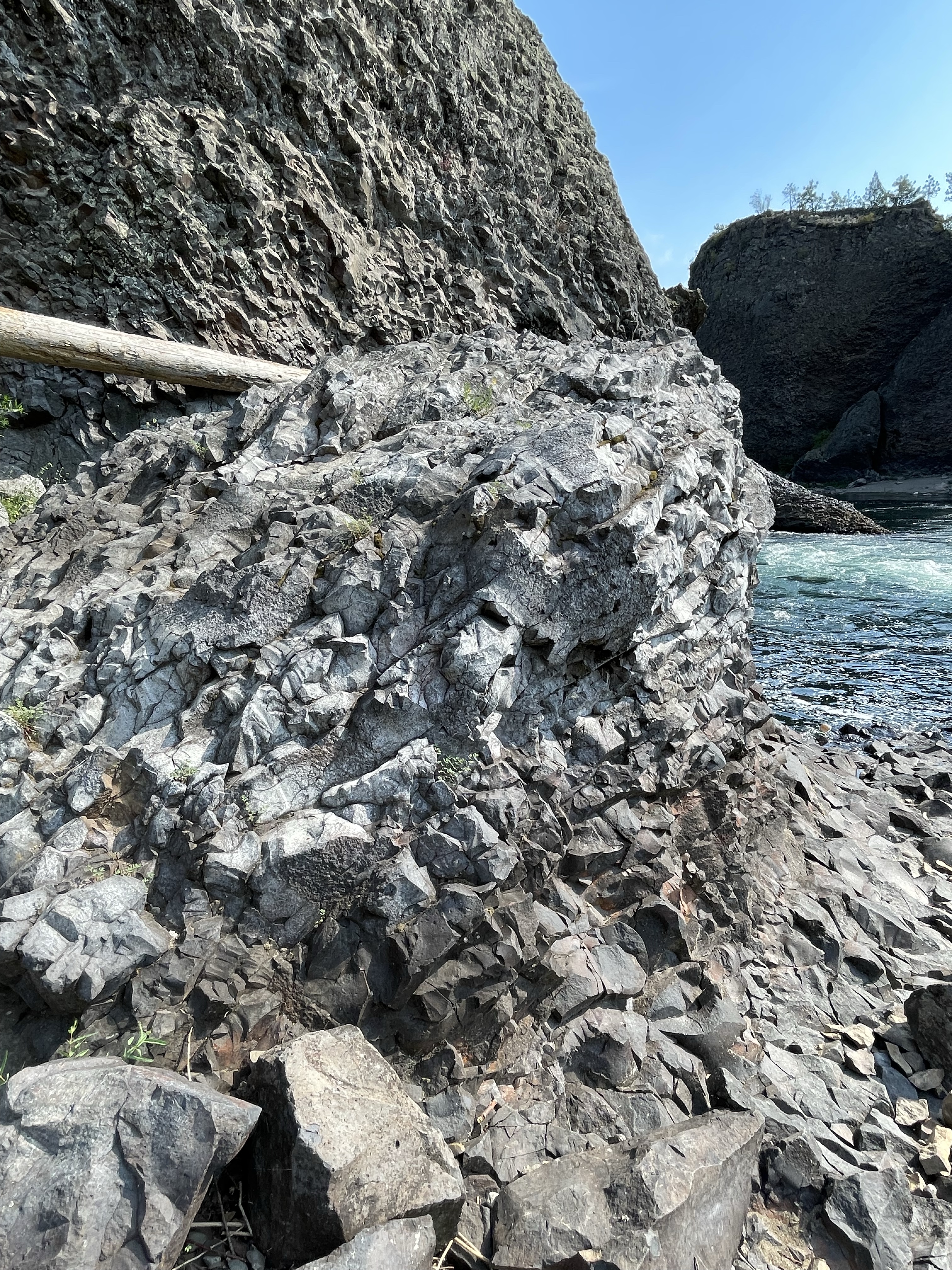
Figure 1. Photo of a large volcanic boulder that has been named the “Pitcher” by local inhabitants for centuries. The name comes from the columnar rock with a piece protruding from its left side. I don’t seen the resemblance but I don’t see angels and dragons in the stalactites found in caves either. Figure 2. Photo of the “Bowl” seen from a vantage point at the top of a cliff. The bowl is the dark opening to the left. These two exposures are huge boulders that fell off the surrounding cliffs when the Spokane River undercut the surrounding volcanic rocks.Figure 3. Geologic map from RockD, showing the Riverside area and the “Bowl and Pitcher” campground. The yellow areas to the left are basaltic flows dated to between 25 and 5 my. The tan area is glacial lake outwash deposits lining the river bed. Figure 4. Photo of the cliff where Fig. 2 was taken. Note the irregular surface of the entire cliff face; pieces of this rock are seen in the foreground, revealing strange, curved shapes.Figure 5. Photo of the “Bowl” rock, showing the curved structure seen in Fig. 4; I have seen this kind of form in limited areas in older basalt but never comprising a cliff. It is reminiscent of ropy lava (pahoehoe), which suggests that it was very viscous and flowed slowly. There was very little sign of weathering (forming soil profiles), so much of it was extruded very quickly. Note the indent on the right side of the image, where rocks carried by the river eroded the lava; a process like this probably led to collapse of these huge boulders into the Spokane River.Figure 6. Well-worn boulder (~2 feet long) showing lamination that could be volcanic or sedimentary in origin. If volcanic, it looks like a welded tuff (hot ash); either way, there is no rock like that contained within the basalts making up this area.Figure 7. A recently broken fragment (not by me) of a boulder shows a composition of alkali feldspar (white, high in sodium) with some quartz (pink and gray). I think it is syenite, an intrusive igneous rock dominated by Albite feldspar. Like the sample seen in Fig. 6, it isn’t associated with basalt.Figure 8. This badly beaten boulder remained intact and more than 2 feet long after millions of years in a river bed. It is similar to the sample in Fig. 6 but lamination isn’t apparent and, besides, I just wanted to share such an amazing specimen with you. Note that it is lying next to similarly colored rocks that haven’t been polished to such a high sheen.
Summary. Today’s excursion brings two questions to mind: 1) What is the meaning of such an immense thickness (hundreds of feet) of basalt with such an unusual form? (I’m going to call it “oyster” lava.); 2) How did rocks that are nowhere to be seen in the area (refer to Fig. 3) end up in Riverside Park?
Basalt flows are known to be highly irregular in outcrop because lava flows in tendrils, sheets, molten chunks blown out of a fissure; however, these flows (and there must be thousands of them exposed in the cliffs along Spokane River) are eerily uniform and individual flows can’t be identified. This is unusual for relatively young volcanic rocks. The problem is exacerbated by the scarcity of soil profiles; there wasn’t time for water to react with the highly reactive minerals in basalt before another layer was deposited. I don’t have an answer.
The second question is easier to answer. During the last two million years, this region was covered by thick ice sheets that periodically melted and then expanded. Dams of ice formed huge lakes like Lake Missoula, the size of some states. There is overwhelming evidence for the catastrophic collapse of such an ice dam between 20 and 10 thousand years ago. The region surrounding Spokane contains many igneous, sedimentary, and metamorphic rocks dating from Precambrian (older than 500 my) to the age of these basalts (about 10 my).
The resistant cliffs surrounding the “bowl and pitcher” channeled such massive floods many times, beating very hard rock (e.g. Fig. 8) to a pulp as the boulders bounced along and hit other equally hard rocks.
I don’t like unanswered questions but that’s how it goes because the rocks keep secrets …




 Timothy R. Keen
Trackbacks / Pingbacks