Inside Koko Crater
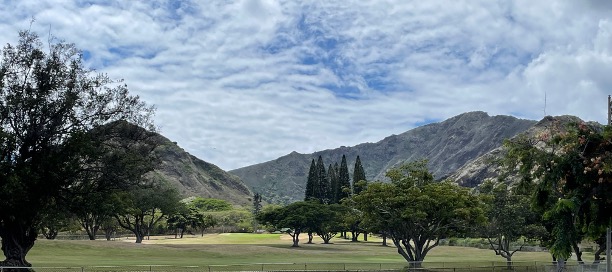
For this post, we went inside Koko Crater (Fig. 1) on the north side (Fig. 2), where the cone was breached, allowing easy access. A road had been constructed and the interior is now filled with a botanical garden and an equestrian center.

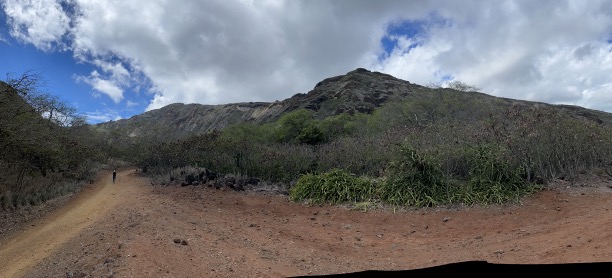
Parking is just outside the crater and a trail leads inside (Fig. 3), where a three-mile trail goes around the periphery. We didn’t have time to complete the circuit, so we settled for entering the main crater (see Fig. 2), where the walls were visible but not accessible for close examination (Fig. 4). However, the lower parts that were visible were covered with coarse debris less than 6 inches in diameter. There were some large boulders of vesicular basalt lying around, but they were loose and could have come from anywhere.

The extreme weathering seen on the inner slope in Fig. 4 suggests that the cap rock at least has a different composition, even if it is built from layers of ash. It is important to remember that tuff cones like Koko crater don’t continually erupt for centuries or millennia; they are local phenomena that vent part of the magma chamber that underlies a truly massive volcano like Ko’olau caldera (see Fig. 2). Thus, they are only active for a while, although dating is a problem for such short time scales.

It is important to note that Koko crater as we see it today has been eroded and the interior filled with breccia and ash during and between eruptions. We can’t say how much time passed between the layers seen in the middle of Fig. 5, but it could be hours to weeks. Most tuff cones are active for a couple of months, so the active period of Koko was on the order of a few years. Volcanic vents can produce a lot of ash very quickly.

This is my last post from Koko Crater. I didn’t have time to climb the 1048 steps to its summit, and I’m pretty sure my knees are glad.
In a nutshell, a vent formed along a fracture zone associated with the Ko’olau volcanic system and spewed ash and minimal lava flows onto the surface, where they interacted with the nearby shoreline, all of it lasting only a few decades at most.
Erosion has been minimal so we see Koko pretty much the way Pele left it….


 Timothy R. Keen
Recent Comments