Publications: A Change of Pace
As much as I enjoyed writing the Unveiled books, I was ready for a change and, besides, I had some more issues to work through. I’m not generally a conspiracy fan but 9/11 got everyone’s attention, especially with that whitewash report the federal government produced. However, in Night Shift, I got distracted from the conspiracy theory and really dug into a tragic relationship between two people who couldn’t have been more different.
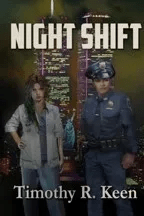
This book was a lot of fun to write, even though part of the story was tragic. I felt as if I knew Faheem and Sofia personally by the end. What a crazy couple, but they stuck it out despite their differences and what was happening to them, most of it their own fault. I’m still not certain if Faheem stumbled onto the truth…
I did a lot of reading about psychology and behavioral disorders while writing Night Shift; so, naturally, I was inspired to write about myself, not in an autobiographical style but more as a novel with a central character who could be me. Thus, A Change of Pace was created to write about myself anonymously. There’s a little biography in there but not much; nevertheless, Jim Walsh is as close to me as I can imagine a character. I also noted some eery similarities to my life that were not intentional. Perhaps writing a pseudo-autobiography was therapeutic after all.
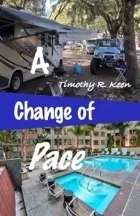
The cover sets the stage for this light romantic comedy about a fish out of water. Besides jumping from action/adventure to romantic comedy, I also did the cover artwork myself. I had used the same studio for the previous four books but this one seemed too simple for their expertise (they specialized in hand-painted fantasy art). Thus, the cover features the motorhome I was living in at the time and my old Land Cruiser, but I never lived in an upscale apartment in my life. That part is fantasy.
I love writing novels because it’s like binge watching several seasons of a favorite show and getting to know the characters intimately. There is so much that can’t be squeezed into the final text. Still, it can be fun to explore a stranger’s life for a few days, a span of time too brief to really get to know them, yet long enough to reveal something significant about their lives.
I took a break from writing novels to write a series of short stories that shared a common theme, which developed while working on them. I collected them together into Class of 1974. Imagine the different lives of people who graduated high school the same year, but had nothing else in common; until they all won the lottery.
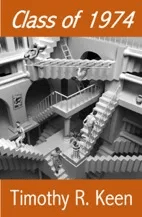
These stories share two common themes: the title implies that the stories are tied to a rather dismal year in recent American history; the second commonality is more dependent on luck. I created the cover from a stylized Escher staircase showing people going nowhere, which seems appropriate for my cohort.
I think every writer should write short stories between major works. It’s like writing practice. And short stories are a great break from the concentration necessary to complete a novel, not to mention the lengthy timeline. I think the idea for Mirror Images originated in a dream (I can’t remember for sure) with a lot of images flashing past, nothing recognizable; it may have been my waking memory of a series of static dreams. At any rate the eventual result was a collection of stories sharing as many mirror metaphors as I could think of.
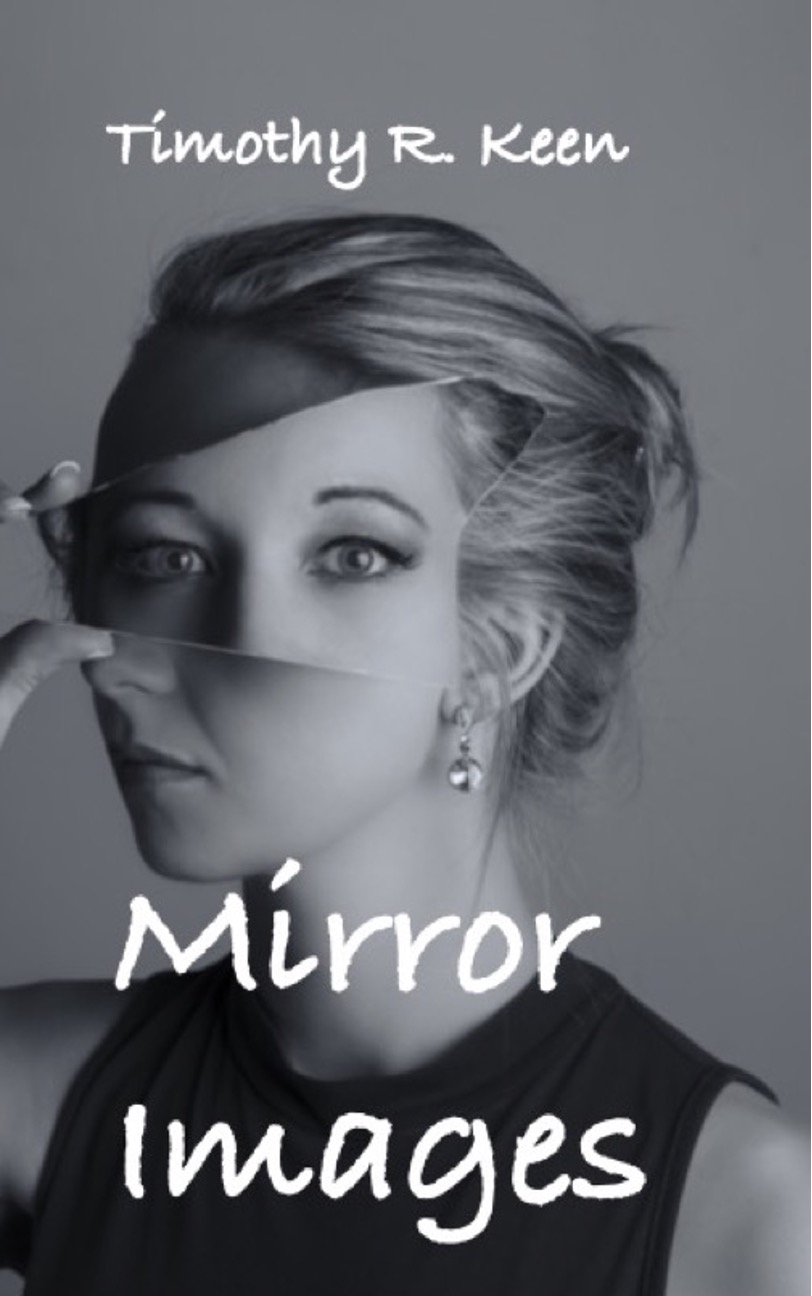
I fell in love with this photo I found on Shutterstock because it conveys so much in a simple black and white format, and it was a large image so it could be used for the entire paperback cover. Mirror Images contains a couple of stories I don’t care for (unhappy endings) and several I loved writing and enjoy reading over and over. I’d love to hear what you think.
That’s enough for this reboot post. Next time we dive deep into science fiction.
Review of “The Ministry for the Future” by Kim Stanley Robinson

I’m not certain where to start. This long book (563 pp) is actually two books, one fiction, the other nonfiction, interweaved so that the reader can’t follow either story. The central plot involves a lonely middle-aged woman who finds a friend in the most unlikely of places. It follows her career with the Ministry for the Future over about 25 years. The title comes from the second, nonfiction, story wedged into the real story. This is the author’s vision of the world over the next few decades; global warming is a central theme, but there are many other questions. In fact the backstory takes over the book. About half the chapters are explanations of various economic indices, technologies, and social theories that relate to the current plethora of problems confronting earth and humanity. However, this nonfiction narrative is presented as fiction, i.e., no footnotes, references, or bibliography. I’m sure they tried to get all these details correct but I don’t know. At any rate, I don’t care for “what if” nonfiction.
The choice of narration style is confusing. In fact, there may be three books contained in these pages: the main story is told in a normal manner by a third person narrator, with multiple points of view (actually I think only two), and literary attention paid to mundane details in Zurich, Switzerland. But this is from the perspective of the central character, who loves Zurich, even though she never bothered to learn Swiss German (what?). I felt like I was learning German from all the street names and other paraphernalia.
The nonfiction book is a series of essays of various aspects of society and technology, including excruciating details about glacial mechanics (boring!), finance, etc. This is also told by a third-person narrator, like reading a technical report.
The third book is a series of comments and reflections by people who live through the time period presented in the book, all in first-person, often with no identification. They often have no bearing on the plot. Redundant. These are interspersed with metaphysical comments from … the sun, other nonliving agents. Kind of like poetic interludes. And there are the Socratic interludes, in which unnamed persons debate various philosophical points.
I see what the author was trying to do, but it doesn’t work for me. It reads like they had three manuscripts (or piles of notes) on their desk, and jammed them together. Thus there is no flow and the reader is always having to shift reading mode while looking hopelessly for a plot.
And then there’s grammar and punctuation. I was looking for a pattern here: run-on sentences that lost their subject on their meandering path; sentence fragments; quotation marks for dialogue … or not. I thought perhaps the three threads used different writing styles to punctuate their mood, but I found nothing. The main story used quotation marks haphazardly. I had to reread at least one sentence on every page, often more. This is a clumsily written book.
The cover proclaims that this is one of Barrack Obama’s favorite books of the year. I doubt he finished it, just like the person who gave it to me, three-quarters completed – I finished it, not because it was entertaining or a pleasant diversion. I’m just a stubborn reader.
I could go on, but it isn’t worth the effort …
Review of “Sleeping Giants” by Sylvain Neuvel
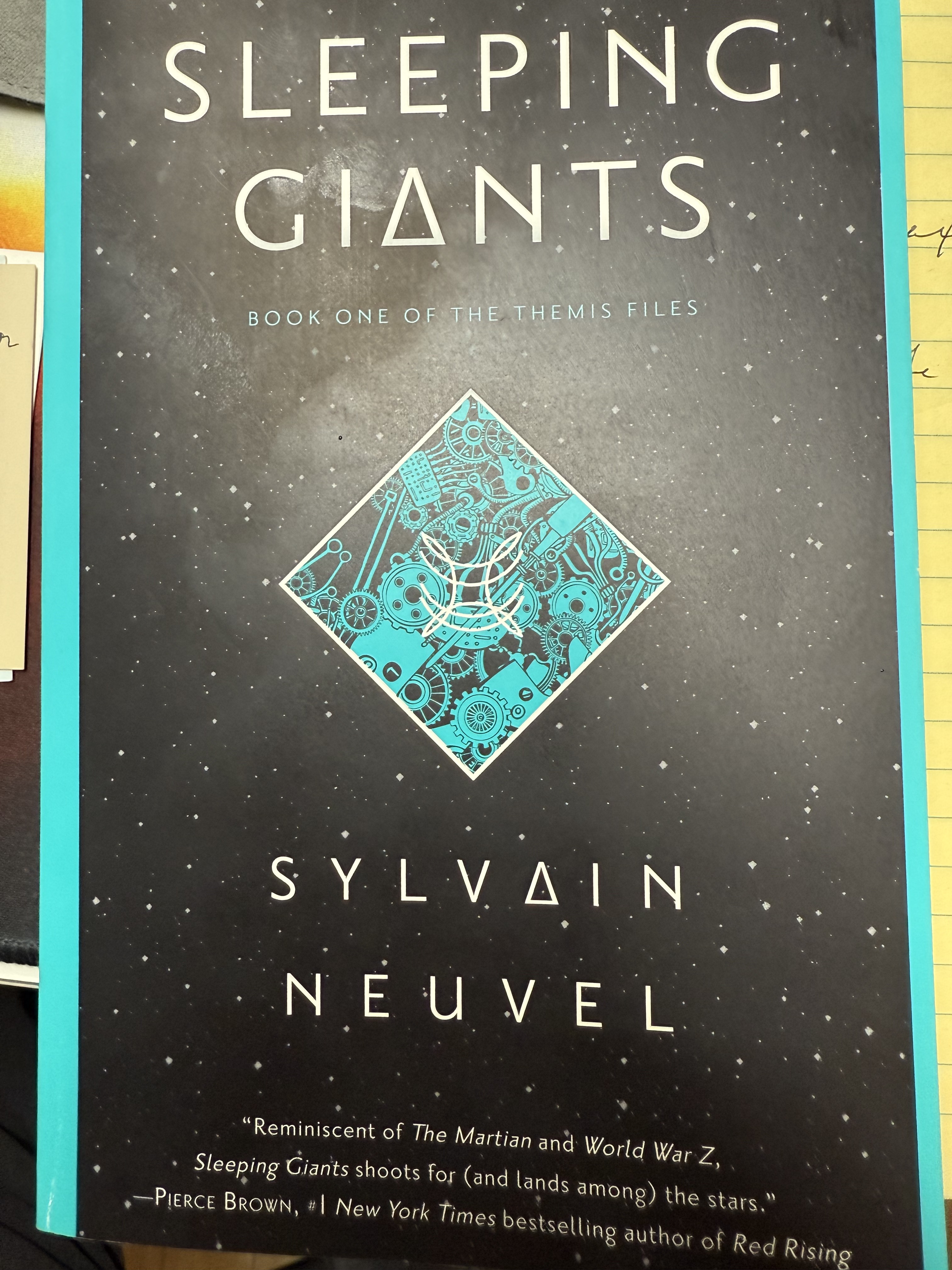
I’ve been reading science fiction in preparation for a writers workshop, focusing on the First Contact sub-genre. This commercially published book violates most of the rules that were introduced … we were also warned that publishing is a crap shoot. This isn’t actually as bad as you might think.
For one thing, this is a great title. It grabbed my attention on the lower shelf at Barnes and Noble, and that takes a lot of effort (kneeling down, trying not to be trampled). It was nestled between a lot of second and third books in trilogies. I guess not many people get past the first one. In fact, the fine print says this is book one of the Themis series. Fortunately, it is fine as a standalone story, ending on a hopeful note but giving the curious reader the chance to see how humanity screws up this galactic opportunity. I like the happy ending and skip the sequels.
The story begins with a little girl falling into an unexpected hole and landing in the palm of a twenty-foot hand. I thought the newspaper story style was convenient, but the entire book is written as interviews, reports, and diary entries. I eventually decided that the unnamed interviewer was the narrator and central character. As you might imagine, this killed the action scenes. They aren’t nearly as exciting when related after the fact. To reveal how the characters feel and their romantic lives, the narrator asks rather personal questions; they aren’t a therapist but only a program manager.
A lot of backstory is introduced by characters introduced simply to supply information. I felt I was missing need-to-know information because of this plot gimmick, until it was too late. Kind of like Perry Mason and his suddenly appearing witnesses.
There isn’t a lot of action, even accounting for the delayed reporting used, but there is a love triangle, jealousy, and even a suddenly psychotic evil scientist. The author’s choice of using an interviewer is interesting but it makes the entire story feel distant, like reading the newspaper, and that isn’t why I read novels.
I’m ambivalent about this story. It isn’t bad and, fortunately, not drawn out, so my recommendation is that it won’t put you to sleep … nor will it keep you on the edge of your seat. After what I said above (about the publishing business), I applaud a publisher willing to take a chance …

 Timothy R. Keen

Recent Comments