
Review of “Empire of Illusion” by Chris Hedges

As you can see from the book cover, the title is longer than my post title. I think the author could have omitted the subtitle, which almost acts as a table of contents. There weren’t very many chapters and the book isn’t long, but it seemed longer than it was because the author ranted on the subjects he covered. I was especially tired of hearing details from porn stars about what goes into a modern shock-porn movie. I don’t think the author had much to say on the other topics (e.g. higher education, politics, finance) either because they were repetitive and filled with vague references to a conspiracy by the “elite.”
Most of the examples of collusion he discusses are public knowledge and not conspiracies, but Hedges frames them for emotional impact; I suppose that is what investigative reporters do to make a living. I prefer facts to be presented in a logical order so that I can come to my own conclusions, rather than being told on every page that it’s a conspiracy.
If you remove about half the text, the part telling the reader what they already know, this book does present evidence for what the title claims. However, it is incomplete and only focuses on a few topics of interest to the author. Anyone could have written this by reading several newspapers and a few books, skimming social media, and taking the time to connect the dots. That introduces the problem of how the dots are connected and not everyone is going to see a conspiracy behind every social and economic trend.
That leads to my final point about this book: Hedges never connects the dots to complete the picture, not even speculatively. Each category he examines is presented in a standalone chapter and the only big picture he paints is ambiguous, more references to vague conspiracies. Who is conspiring and why is this something I don’t already know? How are the pornography and educational sectors connected? He doesn’t say.
Failing to justify the grandiose title, and possibly with a publisher’s deadline looming, Hedges throws in a couple of pages of optimistic encouragement for us idiots who are completely deceived by the web of conspiracies he’s woven. I do feel deceived — by Hedges, not the porn industry, educators, politicians, or any of the other groups he derides. I know they’re full of shit …
Review of “If/Then: How the Simulmatics Corporation Invented the Future,” by Jill Lepore

This book is another representative of what I see as a new genre of technology/sociology explorations of recent history. With so much data about the people behind events available to researchers, it is relatively straightforward to integrate events with their personal stories. I recently reviewed a similar book focused on Palo Alto, and this nonfiction work dovetails nicely with the West Coast narrative presented by Malcolm Harris. Their stories overlap somewhat and they are good bookends for understanding the origins of the digital/big data revolution; sometimes they come too close to the daily news for comfort.
Jill Lepore is a historian and so she presents the material more formally, but just as personal in terms of details, as Malcolm Harris.
This book is well written. I only had to reread a few sentences that got lost on the path from subject to action.
The story is fascinating, how a couple of visionaries imagined using what today is called “big data” to analyze trends and make predictions. There were quite a few revelations to me, especially with respect to what was going on behind the scenes during the Viet Nam war. The details of the lives of the people involved with Simulmatics were enlightening with respect to their objectives and the failure of their premature attempt to predict social behavior. The book is lacking a detailed description of the methods they used, so the connection to present deep-learning algorithms is speculative. I would have liked to see more depth in the technology itself. I guess that is a subject to be addressed by another author, one with a more technical background.
No one book can cover a subject as complex as recent social-technological-economic-political trends, with so much data available to the researcher, so this work shouldn’t be treated as definitive by any means. However, by coincidence I have read a couple of other books that give a more complete picture of important events that contributed significantly to the world we live in.
For anyone interested in recent U.S. history I recommend this book, as well as Palo Alto and The Rise and Fall of the Neoliberal Order.
I like the tone of these recent histories, which are replete with facts, but written to be read.
Review of “Palo Alto: A History of California, Capitalism, and the World” by Malcolm Harris
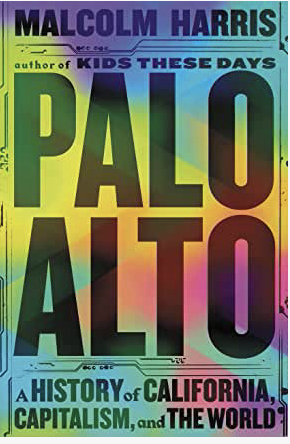
Before I write my review of this long book (629 pages), I have to rename it.
“Palo Alto: The Legacy of American Hypercapitalism in the Twentieth Century.”
This is a convoluted story about California, but it isn’t a history of the world or capitalism. However, as the author demonstrates through many quotes and facts, Palo Alto and the Bay Area in general, exemplify what went right and wrong when capitalism was allowed to run amok. As such it dovetails nicely with “The Rise and Fall of the Neoliberal Order” by Gary Gerstle.
The author tracks many social and economic trends through the prism of Palo Alto and Stanford University, telling the story in an entertaining and often amusing style. I learned a lot about the origins of what became the Neoliberal Order and how it crushed any who opposed it during the second half of the twentieth century. This book ties many social movements together in a unique manner that isn’t quite historical, nor is it simply investigative reporting. I enjoyed seeing the connections between what I’ve always thought of as unrelated events and movements.
At times the author makes it sound like there is a conspiracy at work in America, but that isn’t so because everything that was done occurred in the light of day and was reported in the press throughout. As Harris puts it (I’m paraphrasing), it was a historical trend and some people jumped to the head of the crowd. I tend to agree. Once the wheels of “progress” were unloosed on an unsuspecting world, they rolled over any who didn’t jump on the train. I got that metaphor from the origin story of Palo Alto.
I don’t want to forget grammar and punctuation. The author uses lengthy sentences and paragraphs, which gets him into trouble; sometimes the subject was forgotten by the end of a sentence. I know because I read these sentences (there were a lot of them) several times. Some sentences got so twisted that they made no sense. I don’t know why people do that in nonfiction; it’s fine in a novel to have a thought go on and on and morph into something else. It adds realism (stream of consciousness etc.) but it has no place when the purpose is to communicate ideas as clearly as possible. I guess it makes some writers feel smart.
Nevertheless, I recommend this book to anyone who is interested in the legacy of unconstrained progress on the fabric of society.
But it is a long book, full of tangential stories and occasional rants (okay, not so occasional).
Review of “The Rise and Fall of the Neoliberal Order” by Gary Gerstle

I didn’t know what neoliberalism was until I read this book. Now, I understand its origins and why it isn’t even a new idea. The author does a great job explaining the political oscillations of American society in the last century in 432 pages, although the last 50 or so are references.
The grammar and punctuation are good, although some of the sentences ran a little long — when I forget what the subject is, that’s a little long. However, it was a lot better than another book I recently reviewed. The material completely supports the title and there are few, if any, divergences. It is well written.
There are thorough reviews available, so I’ll finish my review by saying that it was an easy read and I didn’t want it to end.
Review of “Slouching Towards Utopia: An Economic History of the Twentieth Century” by J. Bradford DeLong

I looked forward to reading this book because the reviews I read said that the author had a unique perspective on the topic. That is certainly true, but the subject of this book is not Economic History; this rather long book (~550 pages) instead discusses societal and political factors influencing the economic history of (mostly) the United States. I believe the title is misleading.
A good part of the text discusses equal rights and pays lip service to their impact on the economics of the U.S. while failing to close the loop on the macroeconomic relationship between the Civil Rights movement and changes in national productivity. In that respect it added nothing to, and even said less, than a previous book I reviewed here. This pattern–focusing on social issues and not showing a cause-and-effect relationship to the economy–was a recurring theme.
The story picked up towards the end, when Neoliberalism was contrasted with the New Deal era. I had always called this socioeconomic program Reaganism. The origin of the Washington Consensus is discussed and I admit that this is a subject that fascinates me; the U.S. imposed the current world order on everyone else (outside the Communist sphere) because it was the only existing superpower in the 1950s. The causes of American isolationism in the interwar era (1920-1940) are discussed in a global context, but it had to be trimmed because of too much social history.
I found the book a teaser and bought a title on Neoliberalism that appears to be more economics and less sociology. I’ll write a review of it when I finish reading it.
This book was made difficult to read by the ridiculously long sentences; strings of phrases are connected with commas when they are better treated as separate ideas. I had to reread large portions of it because I forgot the topic of the sentence. I think the author did too a couple of times. I guess that for some people, the point is to impress the reader with your eruditeness rather than communicate clearly.
I can’t recommend this book even though it contains some good analyses and a different (I wouldn’t go so far as to say unique) perspective on the numerous fundamental changes that occurred. I didn’t feel that I’d learned anything new about the subject when I finished.
Review of “The End of the World is Just the Beginning” by Peter Zeihan

Many knowledgable reviews of this book have been written, and it started a firestorm of debate about the impacts of globalization, and its demise. That is the premise to all 475 pages. It is stated in the Introduction and repeated at least once on almost every subsequent page. The problem is: the author never explains why America would suddenly stop supporting an international convention it helped create. It is treated as an axiom, a given assumption from which all kinds of predictions can be made. There isn’t the slightest attempt to explain, much less justify, this fundamental premise. Because of this glaring deficiency, the scenario described in detail for many countries and industries is no more than an alternate history of a world that hasn’t appeared yet, like if the Axis powers had won World War II.
The details are culled from Zeihan’s experience as an international consultant, and he has plenty of them. They are reasonable, given the axiom of unilateral American withdrawal from the international scene. The strengths and weaknesses of various nations are interesting and will, of course, contribute to the future economic development of those economies. So, the book is worth reading, as a summary of the history and current state of various economic sectors (e.g. mining, petroleum, agriculture), and it is worth having around as a reference, a partial explanation of global trends. No doubt, many of his predictions will come true because they are based on facts, even if not supported with a bibliography.
I have another complaint, however; there are no references, and the footnotes consist of often witty comments rather than details not given in the text. There isn’t even a list of supporting sources. Nothing. I guess we’re supposed to trust the author, as an expert. Nevertheless, if taken in a humorous light (a perspective apparent in the author’s comments), like a conversation on the front porch with a beer in your hand (maybe a rum and coke), it is entertaining.
I enjoyed reading it, but I’m taking his predictions with a grain of salt.
Who is an Anarchist?

Anarchy: a state of disorder due to absence or nonrecognition of authority.
Wow!
Democracy is fragile whereas autocracy is a time-proven form of government. Anarchy is a theoretical political system, like Communism, that has never been applied. Look at the definition. Nature follows the Second Law of Thermodynamics, that everything seeks the least common denominator.
Given that we are struggling to get along, on our best day, denying outright the results of elections, which have been conducted in as open a manner as possible in what remains an analog world (despite fantasies about digitizing humanity), filled with human error, is paramount to Anarchy. (I hesitate to append that this even applies to Russia.)
“I don’t give a fuck. I want to run the world. I’ve got the guns to prove it.”
I admit that’s a little over the top, but my point is valid. If you don’t trust an elected government which has as much oversight as possible, and follow whatever antiauthoritarian conspiracy dogmas suit your fancy, you are…
Anarchist…
As much as it pains me to say, “If you aren’t willing to die for Democracy in your homeland, you are…”
“Anarchist…”
Review of “A Consumer’s Republic” by Lizabeth Cohen

This is an older nonfiction book that has recently been rediscovered by the media. I heard an interview with the author on NPR and immediately purchased the Kindle version. Overall, I found it very entertaining and informative, despite a few issues. By the way, the subtitle is incorrect; the book is definitely not limited to “Postwar America,” assuming that is a reference to the Second World War. It actually starts at the turn of the twentieth century. It was first published in 2003, so it covers a tempestuous century of changes in how and why we buy stuff.
The grammar and punctuation are good, but the sentences get a little long, sometimes losing their train of thought and morphing into a new sentence before they end. I did a lot of rereading. At its core, this book is the culmination of an in-depth study of economic growth in New Jersey, extrapolated to the entire nation using reasonable assumptions, usually demonstrated to be legitimate. The Garden State is a good prototype because apparently that’s where the suburbs and mass marketing began, a response to the cost of living and lack of space in the New York City metropolitan area.
The author does a good job presenting the lighter side of consumerism while describing the struggle of disenfranchised groups (e.g., women and African Americans) to gain access to the market, which was seen as just as important as political rights. The entanglement of economic and political development is complex but presented pretty well in this book.
The author proves the existence of the “Consumer Republic” using many quotes from social leaders from the era that demonstrate the intentional development of the modern segmented, mass-market political economy called America. I had never heard any of this before, even though I lived through it and was one of the consumers that made it tick.
Everyone should at least be aware of their part in the evolution of identity politics in the segmentation of the mass market, which occurred over the last third of the twentieth century. It is a humorous and frightening story.
Unfortunately, I don’t think very many Americans will read this book (it is 800 pages long); at least, try to find a summary or, better yet, an interview with Lizabeth Cohen.
Review of “Capital and Ideology” by Thomas Piketty.
I am not qualified to review this book but that has never stopped me before. I am not summarizing what the author and dozens, if not hundreds, of historical economists and historians have spent decades studying. This book is more than a thousand pages, which says a lot about the research and intellectual investment of the author and god-knows how many others in their endeavor. I don’t even feel competent to summarize this tome, so I’m going to focus on how the author communicated his message to me personally, just as if this were a piece of fiction, which it is to some extent.
This book was translated from French to English by a professional, even though the author is fluent in both languages. A wise choice because the English translation is very readable. Even the most pedantic segments (there were a lot) were comprehensible, and the figure captions recapitulated the text. This was a professionally written (in the old-school meaning) summary of mind-numbing bureaucratic and polling data being turned into actionable statistical data.
The message interpreted from these data wasn’t as convincing as the author wanted me to believe.
Piketty admits the uncertainty of his data constantly, so I’m not saying that there was any misrepresentation, only what he says himself many times in this iconic book: there are insufficient data to make any definitive recommendations, but we should nevertheless start a serious, multinational dialogue if we are to avoid the fate of…
This is where Piketty’s argument hits a snag. He doesn’t give any examples, not even from antiquity (like complex socioeconomic analyses of ancient societies from about 1100 BCE, a time not unlike our own), to support his conjecture, a term he doesn’t deny outright. He has no evidence of what anyone with the common sense of…
No one has any common sense about these issues, a point admitted by Piketty. He advises economic historians and political scientists to work together to address the issues alluded to above, but fails to demonstrate any understanding of the impact of his claim. Perhaps the author should have spent more time talking to political scientists and economists before unilaterally sharing his historical viewpoint, weighted heavily in favor of his agenda.
To be clear, I agree with the conclusions presented in this book. It’s worth the risk of the incremental changes he proposes to shift the trajectory of global civilization.
I’ve become pretty good at finding punctuation and grammatical errors, despite my lack of formal education, but I was impressed by the translator’s work. I didn’t keep count, but the error rate was a lot better than mine. I read the footnotes, where the error rate went up, but not to the point of even being annoying. This was a very well written and translated book.
I’m sorry to disappoint anyone who thought I was going to summarize the author’s work. However, I do recommend this book based on Piketty’s own suggestion: skip the evidentiary chapters and read his summary if you aren’t willing to read a lot of pedantic European economic history.
The conclusion of the book is made clear throughout: The global socioeconomic system needs a better model than capitalism.
I recommend this book for serious readers. For the rest of you, pick up whatever you can from the internet because Thomas Piketty is not a recluse.
Meanwhile, if a cliff-notes version appears…
Ungovernable
I propose that Homo sapiens are not by nature susceptible to sustainable governance. My purpose isn’t to convince the reader of my thesis but only to demonstrate its plausibility, even if only when considered from a limited perspective. This is going to be short and simple because I am not a historian or a political scientist. My interest in the topic arises from looking at the different forms of government currently forming the global community. None of them are doing a very good job, so I wondered if this was a problem with finding the perfect, or at least best suited, command and control administration or something more fundamental.
It turns out that governing systems are classified according to how they organize power or the source of their power. I presume this is a reference to political power or maybe legitimacy. For example, political power can be organized in several ways: Anarchy has no central state and trusts people to work out their differences amicably (laughable), more often than not serving as a bridge between other power structures (e.g. Afghanistan); Confederations are unions of sovereign states, like the European Union; Unitary States are what they sound like, a strong government controlling pretty much everything (85% of modern nations); and finally we have Federations with hierarchical government structures (think the U.S. and Germany).
I’m going to skip family, tribe, band, and clan organizations based on kinship.
Even the Mongols didn’t use Anarchy as a form of government. The others have been tried repeatedly and failed. The Sumerian Confederation is hard to pin down because it grew organically from people settling in Mesopotamia over thousands of years. Population density was low and they got along just fine, until one of their local rulers became the first recorded monarch in history.

Sargon didn’t do it alone. He obviously found plenty of young men willing to die for his cause, whatever that was. Maybe “Make Akkad great again!” His empire lasted a century after his death. The Athenian Confederation lasted less than fifty years. You do remember the Peloponnesian War? Moving on, Unitary States tend to be absorbed by empires, like the one King Sargon created from the Sumerian Confederation. The Roman Empire was adept at absorbing entire nations under the relentless onslaught of its legions. The Han Dynasty won a war of attrition to rule China for four centuries, constantly interrupted by civil wars. The British Empire lasted from the 16th to the 18th centuries.
I can’t help but wonder what will be the fate of so many Unitary States in the modern world?
The United States is the first recorded Federation in the history of the world. Thus, it’s a rather new invention but one requiring a lot of cooperation–dare I say trust?–to function effectively. None of the Federations have had enough time to fail yet although they have been tested, as in the American Civil War and Germany’s struggle in the twentieth century, i.e., two world wars.
The central theme to the organization of political power is that all forms of governance lead ultimately to war and the dissolution of the state/empire, to be replaced by something similar.
Enough of that. Now I’m going to blow through the Source of Political Power list because it is (laughably) long. This comes down to who has the brute force to impose their will on the people, and how this decision was made. It’s always male Homo sapiens with deadly weapons who decide, their determination expressed through one of the structures I just summarized.
Just for fun, I’ll list the different sources of power, before throwing the entire concept into the trash heap. Here it is: Autocracy; Democracy; Oligarchy; Demarchy (not a real thing but someone thought it was a good idea); Direct Democracy; Electocracy (like Putin being elected); Liberal Democracy; Liquid Democracy (you’ve got to check this out for yourself); Representative Democracy; Social Democracy; Soviet Democracy; and last but not least, Totalitarian Democracy (think Venezuela).
All of these ridiculous “forms” of government aside, the average duration of an empire (the most popular form of government in the historical record) is 250 years.
Why?
There was nothing fundamentally wrong with the Han Dynasty, the Roman Empire, or even the British Empire; ending these administrative organizations didn’t improve anyone’s life or advance the march of progress. I now come to the central point of this post…
The nearest relative to Modern Man (i.e. Homo sapiens) is the chimpanzee (aka Pan troglodytes), a social and gregarious species of great ape that forms bands as large as 150 members, not so different from Human hunter-gatherer groups. These “monkeys” actually form very complex societies. Nevertheless they have a substantially smaller prefrontal cortex than Homo sapiens. This is where it gets a little weird…
I grew up on Star Trek and really bought into the idea of one world that had survived several catastrophes, humanity having gotten its act together and joined the other sentient species populating the galaxy. Then I learned about time scales longer than a human lifespan–what an eye opener. Everything I’ve summarized in this post occurred within the last ten-thousand years. Homo sapiens branched from Pan troglodytes about 6 million years ago, a long time from a human perspective, on the order of 300K generations, which sounds really big; but here we are, isolated bands of humans behaving like chimpanzees in a few secluded areas of the world, or so we like to think…
There is no difference in the brain of the most “primitive” human’ alive today and mine. I’m going to jump ahead here but I encourage anyone who reads this to prove me wrong…
To summarize a lot of popular psychology books, the human brain is no better than a chimpanzee’s at remembering all the people it comes in contact with on a daily basis. Despite this limitation, our grossly enlarged prefrontal cortex allows us to process and analyze far more environmental data than a chimpanzee. Hmmm…let’s not get carried away; we can process a lot more social information but we don’t know what to do with it, and therein lies the problem.
I’m climbing way out on a sagging limb, maybe just a sprout, when I take a deep breath and finish this post.
Being smarter than chimpanzees doesn’t make us gods; we are no more capable than Pan troglodytes of forming social groups but, unlike our simian cousins, we can fool ourselves into a false sense of empowerment because of the narrative skills our enlarged prefrontal cortex supplies, which explains (to my mind) why…
Mankind is ungovernable and doomed to repeat a pattern of dominant and submissive behavior for the foreseeable future.
We cannot escape who we are…

 Timothy R. Keen
Recent Comments