Review of “The Gulag Archipelago: Volume 2” by Aleksandr Solzhenitsyn
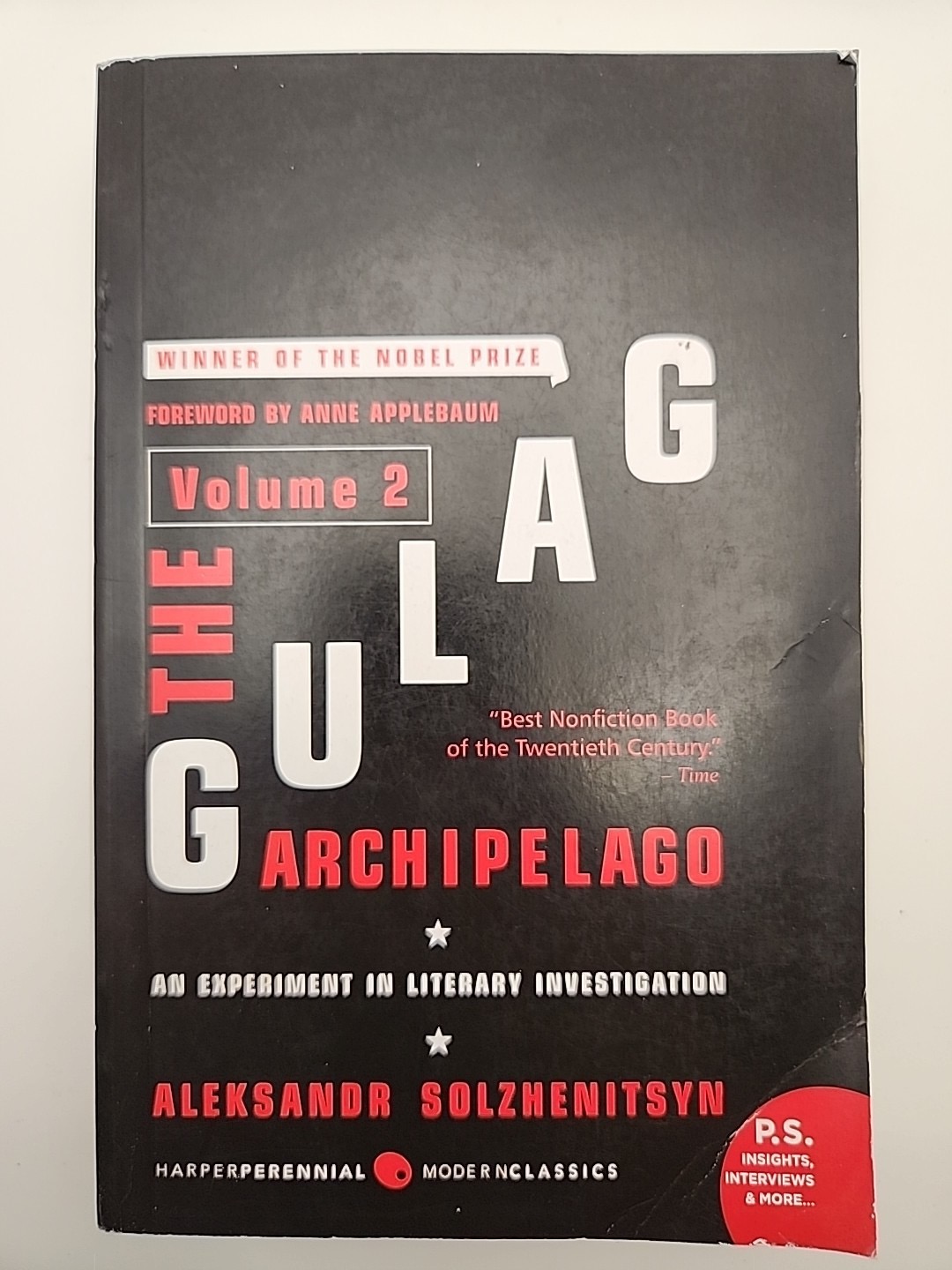
This three-volume book set won a Nobel Prize, so there isn’t much for me to add about its impact on the literary world. It describes the Soviet forced-labor, penal system in an entertaining style, blending personal experience with anecdotes and documented evidence from other camp survivors. It is nonfiction but neither is it autobiographical nor a documentary; it falls in a no-mans-land between personal opinion and an angry and disillusioned tirade. The first volume addressed the Soviet judicial system at a basic level, through the eyes of those ground up in its gears, which turned without purpose or guidance.
This volume explores life in the “Special Camps”, slave-labor facilities reserved for “58s”–political prisoners. The author describes what it’s like to become less than human through a relentless campaign of dehumanization and torture that lasts years, if not decades, for those consigned by the state to develop natural resources in regions where no one would voluntarily go. It is a brutal story of starvation, continuous mental and physical abuse, and death at the hands of the “natives'” own government. The vast majority of the “sons of the gulag” died in remote regions of Siberia, or at the gates of Moscow itself in camps, often comprising tents (in -30F weather!) over a period spanning decades. The inhumane conditions were often equally applied to women and children, as well as men.
The author convincingly portrays the Gulag as a microcosm of Soviet society, and, in my opinion, the human race as a whole. He exquisitely reveals the interaction of individuals as they form a new society, even in such harsh conditions. Cheks (Soviet masters) and Zeks (the 58s), joined by hardened criminals and exiled “free” people need each other to survive in the topsy-turvy world of Soviet Russia, but it is a marriage born in hell and consummated on the wind-ravaged, frozen steppe of Asia.
The English version was, of course, translated from Russian; the translator did an excellent job finding English and American phrases to match the original text–for example, the loyal Communists who found themselves labeled 58s and accepted their imminent demise in a death camp as due to something they did unawares, were, in the author’s opinion, pigheaded. So true.
This is another long volume in a saga that could go on for many more volumes, but there is only one more which I am currently reading. However, this is a review of this book; and my opinion is that it is too long, often awkwardly written, and doesn’t include enough autobiographical details. The author is trying to (I think) distance himself from what he refers to in Volume 3 as (paraphrasing) one of the most profound periods of his life.
Read it at your own risk.

 Timothy R. Keen
Recent Comments