
Review of “The Brothers Karamazov” by Fyodor Dostoyevsky
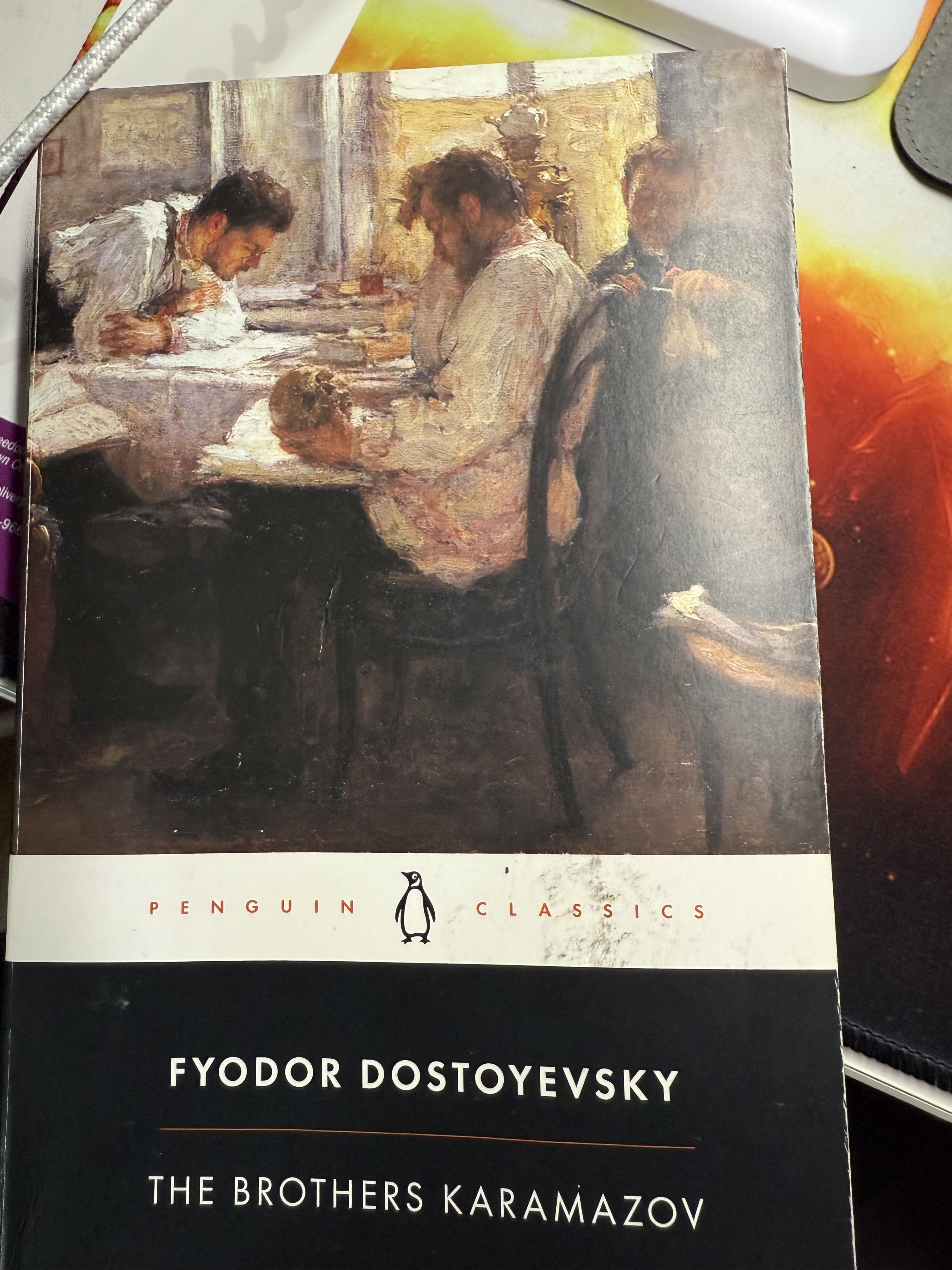
This review isn’t going to be as long as this literary classic (985 pp). I’ll skip all the usual analyses about the author’s commentary on contemporary Russian society (circa 1880), although it is set in a small village during the 1840s. The three brothers, Dmitry, Ivan and Aleksey, represent three types of character: rash and brutal; thoughtful and intelligent; emotional and sympathetic. The story centers on Dmitry, who has an ongoing conflict with their father Fyodor over his inheritance from his deceased mother. They are also in love with the same young woman. The tension is palpable and leads to violence. Eventually, Fyodor is murdered and Dmitry is tried for the crime and found guilty by a jury in a fair trial; the incriminating circumstantial evidence is simply too much to overcome. Enough of plot details.
No character is too minor to have their life described in detail, even if they have no relevance to the story. These ancillary stories make up about half the book, including entire chapters, filled with characters who serve no purpose other than showing something about life and death in nineteenth century Russia. The writing is extremely wordy. Some sentences are half a page long; some paragraphs several pages long; none of this makes sense from a literary perspective but appears to be whimsical. No thought by any character is left untouched by a narrator who claims to live in this village, but has the superpower of reading everyone’s mind. Nothing is left for the reader to figure out; every act, desire, emotion is fully explored through contrived scenes that make certain of this.
This book is considered a classic of existentialism for good reason: the characters make no attempt to change or even offer excuses; their innate personality is the reason for the most scandalous behavior — take me as I am or leave me alone! This is the appeal of this gritty story of bad decisions leading to foreseeable outcomes. The take-home message is that people cannot change who they are and should embrace their weaknesses as much as their strengths.
I cannot recommend this book. It is simply too long, filled with extraneous stories, and poorly written. However, if you want to have a taste of the Russian love of pain and suffering, I would suggest some short stories by Chekhov.

 Timothy R. Keen
This review proves that you have to have a certain level of intelligence and education to be able to critique the classics. I think you should stick to Harry Potter and leave classic literature to those who understand how to read it.
LikeLike
I agree, but I don’t think it’s a question of intelligence; however, a specialized education in a specific field is always an advantage in understanding the nuances of the work. Nevertheless, I treat every book/story/screenplay/play I read the same and my reviews reflect my non-specialist opinion. I don’t expect an expert, or even a professional, to give my reviews a first glance, but they might be useful to someone who is reading for entertainment or enlightenment (i.e. education). Your response implies that you disagree, which is great! I agree it is a classic (that’s why I read it) and an excellent example of nineteenth century Russian literature, but that doesn’t mean I have to enjoy every word in it. Dostoyevsky doesn’t get to go to the head of the line…
LikeLike